Chair in International Law, University of Edinburgh
ANTHONY PAGDEN
Distinguished Professor, University of California Los Angeles
BENJAMIN STRAUMANN
Alberico Gentili Senior Fellow, New York University School of Law
In the past few decades the understanding of the relationship between nations has undergone a radical transformation. The role of the traditional nation-state is diminishing, along with many of the traditional vocabularies which were once used to describe what has been called, ever since Jeremy Bentham coined the phrase in 1780, ‘international law’. The older boundaries between states are growing ever more fluid, new conceptions and new languages have emerged which are slowly coming to replace the image of a world of sovereign independent nation states which has dominated the study of international relations since the early nineteenth century. This redefinition of the international arena demands a new understanding of classical and contemporary questions in international and legal theory. It is the editors’ conviction that the best way to achieve this is by bridging the traditional divide between international legal theory, intellectual history, and legal and political history. The aim of the series, therefore, is to provide a forum for historical studies, from classical antiquity to the twenty-first century, that are theoreticallyinformed and for philosophical work that is historically conscious, in the hope that a new vision of the rapidly evolving international world, its past and its possible future, may emerge.
PREVIOUSLY PUBLISHED IN THIS SERIES
The New Histories of International Criminal Law Retrials
Edited by Immi Tallgren and Thomas Skouteris Sovereignty
A Contribution to the Theory of Public and International Law
Hermann Heller, edited and introduced by David Dyzenhaus
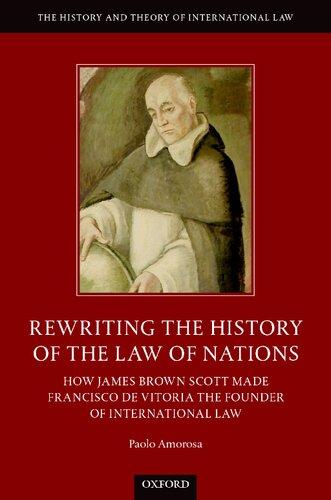
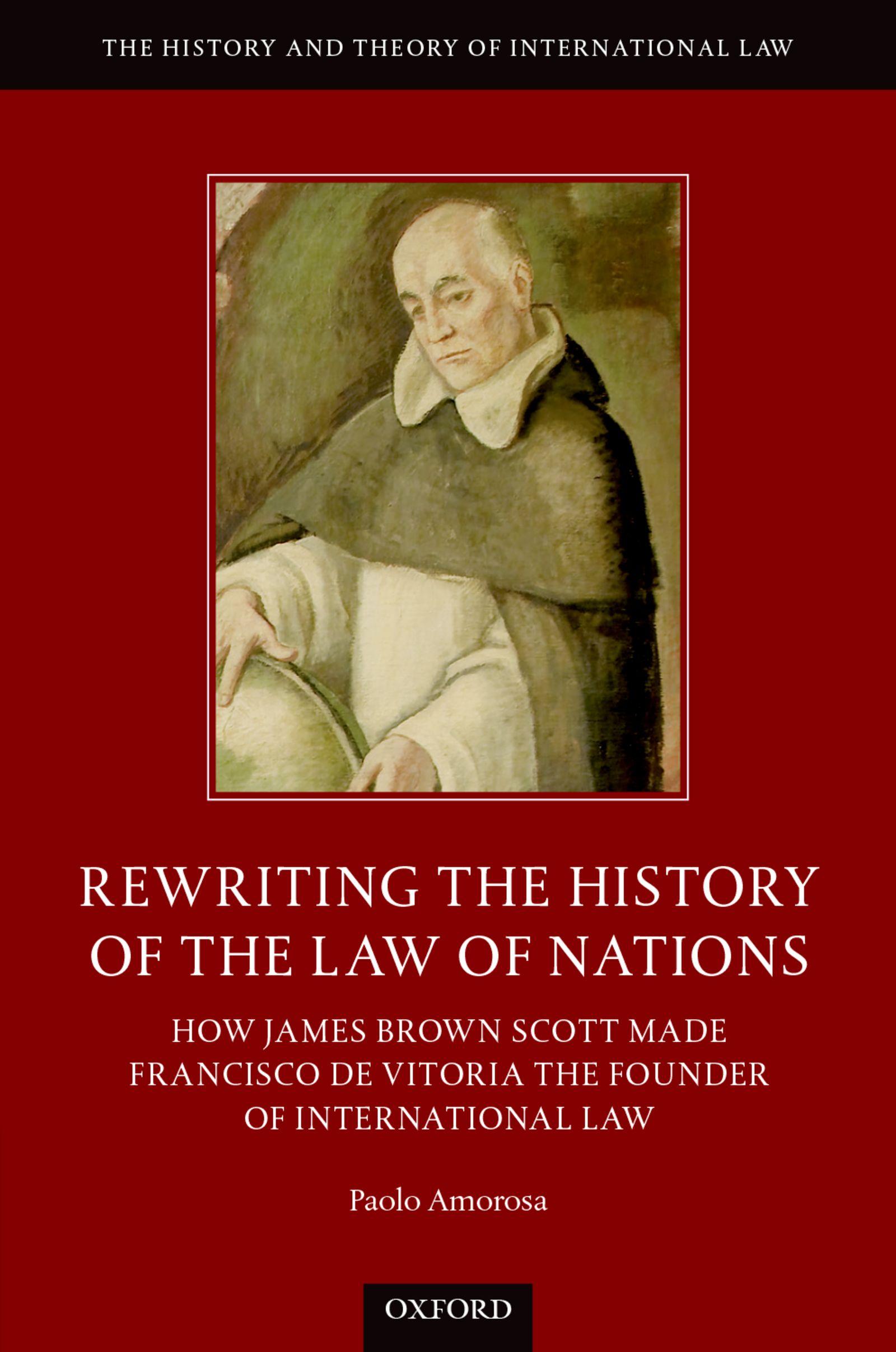
Rewriting the History of the Law of Nations
How James Brown Scott Made Francisco de Vitoria the Founder of International Law
PAOLO AMOROSA
3
Great Clarendon Street, Oxford, OX2 6DP, United Kingdom
Oxford University Press is a department of the University of Oxford. It furthers the University’s objective of excellence in research, scholarship, and education by publishing worldwide. Oxford is a registered trade mark of Oxford University Press in the UK and in certain other countries
All rights reserved. No part of this publication may be reproduced, stored in a retrieval system, or transmitted, in any form or by any means, without the prior permission in writing of Oxford University Press, or as expressly permitted by law, by licence or under terms agreed with the appropriate reprographics rights organization. Enquiries concerning reproduction outside the scope of the above should be sent to the Rights Department, Oxford University Press, at the address above
You must not circulate this work in any other form and you must impose this same condition on any acquirer
Crown copyright material is reproduced under Class Licence Number C01P0000148 with the permission of OPSI and the Queen’s Printer for Scotland
Published in the United States of America by Oxford University Press 198 Madison Avenue, New York, NY 10016, United States of America
British Library Cataloguing in Publication Data
Data available
Library of Congress Control Number: 2019941639
ISBN 978–0–19–884937–7
Printed and bound by CPI Group (UK) Ltd, Croydon, CR0 4YY
Links to third party websites are provided by Oxford in good faith and for information only. Oxford disclaims any responsibility for the materials contained in any third party website referenced in this work.
Series Editor’s Preface
The American jurist James Brown Scott, at one time, the main legal officer of the State Department, a founder of the American Society of International Law, and of the Carnegie Endowment for International Peace, was a central figure in the development and professionalization of international law in the United States in the early twentieth century. He was also very influential in the direction the historiography of the subject has subsequently taken, and in particular in its engagement with the so-called School of Salamanca of the sixteenth and seventeenth centuries, of which Francisco de Vitoria was the supposed “founder.” For Scott, Vitoria’s attempt to re-describe the earlier “law of nations” in such a way that while it remained firmly grounded in natural law, it became also a form of positive law was the foundational moment for modern international law. Vitoria had supposedly transformed what had earlier been only law between citizens and non-citizens of the Roman world into a truly global law which was both prior and superior to any form of civil law and thus equally applicable to both the Europeans and nonEuropeans. But Scott’s interest in Vitoria was not solely antiquarian. It was also crucial for his contribution to a series of debates over the future of international law, and international relations more widely, in the turbulent years after the end of First World War, a period which saw the rise of the United States as a global power and the creation of the first truly international legal and political institutions, the League of Nations and the Permanent Court of International Justice. For Scott himself, the two most pressing concerns, and the ones for which Vitoria’s conception of the “law of nations” was central, were his bid to demonstrate the enduring significance of the Catholic natural law tradition for modern international law, at a time when positivism had seemingly diminished it forever, and, paradoxically perhaps, to support the increasing demands for an international recognition of equal rights for women.
But that was not all. Vitoria is, of course, best known for his intervention into the debates over the justification of the Spanish conquest of the Americas. His claims that prior to the arrival of the Spanish the American Indians possessed what he called full “public and private dominium”—that is sovereignty and property rights—in the lands they occupied, and that the only grounds upon which a just war might be made against them could be found in a universally binding law seriously undermined all of the Spanish crown’s principal claims for the legitimacy of their conquest in the Americas. Ever since the early nineteenth century, this has led to him being looked upon, in Paolo Amorosa’s words, as “a brave humanitarian ahead of his time.” In the words of the English jurist Sir Travers Twiss, in 1856, he
and the other members of the “School of Salamanca” were “the early streaks of dawn, the earnest of the coming dawn.”
More recently a revisionist post-colonial literature has set out to demolish these comforting suppositions, arguing instead that Vitoria was merely pressing a revised version of the argument that Christians—and thus by implication all Europeans— always had the right to make war upon pagans as “barbarians” —and therefore all non-Europeans—and consequently to deprive them of both their sovereignty and their goods. This casts Vitoria not as the father of a truly international law, so much as the source of the claim, which was to be become central to the positivist international law of the nineteenth century, that the world is divided into “civilized” and “non-civilized” peoples, and that the former have not only a right but also a duty to rule over the latter. What is at stake in this dispute—and it is clearly of immense contemporary significance—is whether international law, and all forms of international justice, can ever be extricated from the history of European empirebuilding. Or as Paolo Amorosa phrases it here: “has international law been, since its birth, humanitarian or imperialist?”
Any attempt to answer this question, however, immediately lands us in the midst of a highly controversial methodological—and increasingly doctrinal— controversy. Is there really a continuous history of “international law” from the mid-sixteenth century until today? Can someone like Vitoria really be accused of contributing to the political agenda of imperial nations which lay far in the future? Can we, in other words, treat the questions which Vitoria attempted to answer as if they were substantially the same questions we might ask today? Or should we read all historical texts strictly in the terms, and the languages, provided by the contexts in which they were originally written? Does it make any sense to speak, as Scott did, of Vitoria as the “father” of anything so obviously remote from his conceptual grasp as modern “international law”?
This book addresses all three of these topics. It is a very substantial and original contribution to a central and still hotly contested moment in the evolution of both international law itself and of its historiography.
Anthony Pagden
Acknowledgments
While this long, difficult, and rewarding journey draws to a close, I want to offer my most sincere thanks to all the people who have shared it with me. In the first place, the dissertation this book is based on could not have come to light without the attentive guidance of my supervisor Martti Koskenniemi. It has been a privilege to discuss and review my work with him, constantly learning from his sharp insights and vast knowledge. The quality of the present text has benefited immensely from this process but, most importantly, I personally have: it is said that a doctorate represents a rite of initiation into the academic profession and Martti has succeeded in offering me a thorough perspective of what it means to be a scholar. His technical observations always incorporated a careful consideration of the ethical and political stakes involved. He checked certain lapses of condescension I have had toward my subjects, while nurturing my ambitiousness. All those many teachings I will always treasure.
There have been other scholars who, during different phases of the work, have engaged closely with my drafts, providing me with invaluable advice. Especially in the initial phase of the research, when its framework was still far from defined, Walter Rech has been a fundamental support. During many long discussions, he has helped me clarify my own ideas and pointed me to ways through which I could best express them. Pamela Slotte has been of tremendous help over the course of the writing process. Beyond reviewing the texts I produced, she patiently listened to every doubt I expressed on the most disparate issues, ranging from the theoretical foundations of the dissertation to the administrative details of its submission. She unfailingly responded with prompt assistance and solutions, making the path toward completion of my doctoral studies considerably smoother. Rotem Giladi has kicked off the final review process by carefully going through the initial parts of the text. The latest reviewers have been the pre-examiners Karen Knop and David Armitage. I am thankful for their encouraging reports and pointed observations. They have given me a better understanding both of the contributions this work offers and of the avenues for its further improvement toward this final book form. This work was conceived and researched in the context of the project “Intellectual History of International Law: Religion and Empire,” funded by the Academy of Finland. Besides Martti, the project leader and initiator, Walter, and myself, our research group included Mónica García-Salmones Rovira and Manuel Jiménez Fonseca. With Mónica I shared the coordination of the “International Law and Religion Working Group,” which resulted in the collective volume International Law and Religion: Historical and Contemporary Perspectives, published by Oxford
University Press in 2017. Mónica’s commitment to the long-term and large-scale endeavors we have worked on together has been exemplary, providing me with the motivation and enthusiasm necessary to overcome the many obstacles we faced. I am proud of the productive cooperation we built and of the achievements it led to. With Manuel I shared an office in the early years of my doctoral work. Together with our office mate Tuomas Tiittala, we spent long hours discussing our interests and views. At the time we considered those conversations as breaks from our solitary duties of reading and writing, but I now realize how much they contributed to the development of the basic ideas sustaining this text. Manuel has cared for my emotional health in a time of heavy personal loss, during which I doubted that I would ever be able to see the end of this project. The same goes for Tuomas. Our summer excursions into the nature of Middle Finland have been a source of inner peace and balance. I have similarly fond memories of a road trip from Salt Lake City to Las Vegas with Walter from that same period. The majestic views of the national parks we visited in Southern Utah gave me a new sense of perspective. Since September 2012 up to the completion of the dissertation in late 2017 I have been based at the Erik Castrén Institute of International Law and Human Rights (ECI) at the Law Faculty of the University of Helsinki. I cannot think of another place where I could have pursued my research surrounded by such a diverse and inspiring community of scholars. In the first place I am thankful to the people who, alongside my supervisor, have brought us together: Jarna Petman and Jan Klabbers have been wonderful mentors and colleagues throughout my time at ECI. It is an impossible task to list all who have shared with me a coffee, small talk, one or several conversations on the politics of the day, or some obscure scholarly theory on the sixth floor of Porthania or somewhere else in the Law Faculty, but I am going to try anyway: Elina Almila, Arnulf Becker Lorca, Martin Björklund, Luca Bonadiman, Katja Creutz, Mehrnoosh Farzamfar, Joakim Frände, Nora Fabritius, Massimo Fichera, Elisabetta Fiocchi, Lorenzo Gasbarri, Janis Grzybowski, Lauri Hannikainen, Ville Kari, Hiva Khedri, Margareta Klabbers, Tero Kivinen, Magdalena Kmak, Paavo Kotiaho, Vesa Kyyrönen, Tero Lundstedt, Marja Luukkonen, Marta Maroni, Ketino Minashvili, Panu Minkkinen, Ilona Nieminen, Erman Özgür, Silvia Park, Eliska Pírková, Outi Penttilä, Santtu Raitasuo, Alberto Rinaldi, Semir Sali, David Scott, Sahib Singh, Ukri Soirila, Milka Sormunen, Diliana Stoyanova, Anna Suni, Immi Tallgren, Nadia Tapia, Reetta Toivanen, Taina Tuori, Guilherme Vasconcelos Vilaça, Maria Varaki, Claire Vergerio, Kangle Zhang. I want them all to know, including those I have missed to mention, that I am thankful because they have all contributed to the brilliant experience that produced this work. Of course, one could not think of the ECI community without mentioning the Institute’s coordinator Sanna Villikka, a constant source of help and support for all of us. During her leave, I have seen Lauri UusiHakala and Mari Taskinen rise, through ability and dedication, to the impressive task of filling her shoes. I owe a special mention to Maria José Belmonte Sanchez,
research assistant for our project. Her constant moral support in the most difficult times of my doctoral studies is by itself a major contribution to this work. In addition, she has shared with me the tantalizing work of ordering and classifying the wealth of archival material that forms the backbone of this book. Also, the initial editing of the dissertation and the bibliography are the result of her skillful efforts.
Since my joining in April 2018, I have enjoyed the help and support of my current colleagues at the Centre of Excellence in Law, Identity and the European Narratives (funded by the Academy of Finland, funding decision number 312154) at the Faculty of Social Sciences of the University of Helsinki. The atmosphere at the Centre, collegial yet driven, relaxed yet creative, has proven ideal for the delicate process of turning the dissertation into a book manuscript. In particular, I would like to thank Kaius Tuori and Jacob Giltaij for reviewing the book proposal and for their advice on how to bring the best out of my work. I am also very grateful to Heta Björklund who has produced the final editing of the manuscript and the index.
Between September and November 2015 I visited archives in the United States, funded by the “Intellectual History of International Law” project. First, I spent a month at the Butler Library of Columbia University, examining the Carnegie Endowment for International Peace Records. I am thankful to the staff of the Rare Book & Manuscript Library for their professionalism and helpfulness, especially to Jennifer Comins, the curator of the collection. My access to the Butler Library was facilitated by the status of visiting scholar at Columbia’s History Department, which I have been awarded thanks to Mark Mazower. The following month I was in Washington, D.C., studying James Brown Scott’s personal papers at Georgetown University. I wish to thank the personnel of the Booth Family Center for Special Collections of the Lauinger Library. They kindly supported my work there beyond what duty required, answering my every question on the University and its history. In particular, Scott Taylor has been of tremendous help. Besides the project funding that made my archival research possible, for which I thank the Academy of Finland, I am grateful to the Ella ja Georg Ehrnrooth Foundation for the grant it awarded me for 2017.
I have presented parts of the work in several seminars and conferences. These included the Postgraduate Seminar in International Law at the Erik Castrén Institute, the Histories of International Law Conference (University of Utah, 2014), the Third World Approaches to International Law Conference (American University in Cairo, 2015), and the Conference Law in International Orders—Past and Present (Lauterpacht Centre for International Law, University of Cambridge, 2016). I am thankful to the organizers and to the participants of these events. The feedback I received on my papers and presentations in these contexts has been precious.
Last, but not least, I am grateful to my friends and family. Emanuele, Fabio, and Mario have been great company throughout my years in Helsinki. Laura, though not physically close, has always been present. I would like to thank my family for all their love and support. My relatives in Cerignola, my grandma Teresa, who has
recently left us, her sister Nuccia, my aunts and uncles, my cousins and the little Antonio, Francesco, and Luigi have filled my holidays with joy. Through simple things, like providing me with the local food I so sorely miss, they keep me in touch with my roots. They know that I might live far away, but I have not forgotten where I come from. The past few years have brought to my sister Annamaria, my mother Rita, and me reasons for grief. Nevertheless, they have reacted with admirable strength. I always knew I could count on them for anything. They have taken care of so many shared responsibilities and never complained that I was not there in Italy to contribute. I am truly grateful, even if I do not show it enough. My mom has also instilled in me the passion for books and knowledge. She read to me about history and mythology much before I could be able to do it myself. From this longue durée perspective, she has been the earliest contributor to this work. If she has been the person closest to me at the very beginning, Hanna-Mari was there at the conclusion. I feel blessed to have her in my life. During the final months of feverish writing, she has forgiven my absence into James Brown Scott’s world while gently holding me in the present. Her love has carried me through the finish line. Recently, in December 2018, she has also given me the best gift I have ever received by giving birth to our son Leone. While I type these last words with him sleeping close to me, I cannot but think at a long project that ends, this work, and a longer, even more challenging and rewarding that is just beginning, my life with him. Though the responsibility of fatherhood is great, he gives me strength and joy to face it with the same faith in the future I see in his trusting eyes and wide smiles. This book is dedicated to the memory of my father, Alfonso Amorosa (1944–2014), a scrupulous lawyer with a genuine sense of justice. His example of integrity is a most powerful inspiration and compass, in research as well as in life.
Florence, May 2019
Table of Contents
Science, International Law, and the Social Context: The Platt Amendment as Equality
2. The Narrative of 1898: The Religious Foundation of the Cuban Intervention 64
Before the War: Public Opinion, Humanitarianism, and Religious Discourse 64
International Law as Civilization and the Religious Discourse: The Platt Amendment as Selflessness
3. “The Best Friend of Cuba”: Scott’s Messianism between Hegemony
3 International Law as Science. Scott’s Historical Case for Adjudication and the Fight against Collective Security
1. The Armistice Books and the Science of International Adjudication
James Brown Scott and the Politics of the American Constitution
Case Method and the Ideology of Legal Evolution
Law as Law
2. The United States as Universal History: Scott’s Recurring Themes in Legal Progress
as Sanction: The Case for Adjudication against
3. The Losing Quest against Collective Security and the Decline of Scott’s Legalism
Emergence of Collective Security and the League to Enforce
Collective Security within the Administration: Scott and Lansing versus Wilson
PART II. REWRITING INTERNATIONAL
LEGAL HISTORY: VITORIA AND THE NEW WORLD, 1925– 1939
4 The Spanish Origin of International Law
1. The Spanish Origin’s Background
Setting the Canon: The Inception of the Classics of International Law Series
Turning to Salamanca: Scott’s Evolving Thought and the Early Classics
Scott and the Salamanca Scholars
2. Conceiving the Campaign: Scott’s Long Road to Salamanca
The Dutch Connection: From The Hague to Salamanca 140
The Making of Founders: From Grotius to Vitoria 146
Diverging Formulations of Postwar International Law: Scott’s Declining Position in the US Professional Community 151
Vitoria at Georgetown: Scott’s 1926 Course on the Founders of International Law 154
3. The Lessons of the Spanish Origin: Vitoria, Suárez, and the International Law of the Twentieth Century 161 “Spain, for me the Holy Land of International Law”: Scott’s 1927 First Visit to Salamanca 161
Putting the Argument on Paper: Scott’s First Book on the Spanish Origin 167
Vitoria and the Modern International Law 172
Suárez and the Philosophy of International Law 178
“The Ripened Fruit”: The Spanish Origin Campaign Looking Forward 183
5 The Catholic Conception of International Law 186
1. Early Approaches: Scott and the Catholic Church before the Great War 186
American Catholicism at the Turn of the Twentieth Century 186 CEIP and the Pontifical Letter of 1911 191
2. The Background of the Catholic Conception 199 Neo-Scholasticism and US Democracy
CEIP and the Reorganization of the Vatican Library 204
Building the Alliance: The American Committee for the Vitoria Celebrations 211
The Vatican’s Universal Sovereignty 215
The Inception of the Vitoria-Suárez Association between Academic Neo-Scholasticism and Catholic Activism 218
The Catholic Conception as a Collective Scholarly Enterprise 222
3. The Last Attempt: The Catholic Conception of International Law at the Vatican 225
Establishing the Catholic Conception: The Genealogy of Tyrannicide and the Salamancan Theories of International Organization 225
The Scott-Walsh Memorandum 231
The Catholic Conception and the Approaching War 237
The Conservative Legacy of the Catholic Conception 241
6 Apostles of Equality: James Brown Scott and the Feminist Cause 245
1. The Making of the US Feminist Movement and the National Woman’s Party 245
A Room of Their Own 245
Feminism and the Suffrage Movement in the United States 248
“A Party to Free their Own Sex”: The Anti-Democratic Campaigns and the Birth of the National Woman’s Party 252
“Jailed for Freedom”: Paul, Stevens, and the Nineteenth Amendment
2. From the National to the International, from Suffrage to Equal Rights 260 Internationalist Feminism and Early Approaches to Scott 260 Scott and the Principle of Independent Nationality 266 The National Woman’s Party in the 1920s: From Suffrage to Equal Rights
3. Scott and the International Equal Rights Campaign 283 The 1928 Pan-American Conference and the Beginning of the Scott–Stevens Collaboration
“Unprogressive Codification of Nationality at The Hague”
Victory at Montevideo: Scott and the Stevens Treaties
Vitoria and the Equal Rights Treaties: The Unbearable Lightness of Scott’s Equality
Concluding Remarks. The Legacy of James Brown Scott and the Responsibilities of International Legal History
List of Abbreviations
AIIL American Institute of International Law
AJIL American Journal of International Law
ASIL American Society of International Law
ASJSID American Society for the Judicial Settlement of International Disputes
CEIP Carnegie Endowment for International Peace
CU Congressional Union
ERA Equal Rights Amendment
IACW Inter-American Commission of Women
IWSA International Woman Suffrage Alliance
LEP League to Enforce Peace
NAWSA National American Woman Suffrage Association
NLWV National League of Women Voters
NWP National Woman’s Party
US United States
WILPF Women’s International League for Peace and Freedom
1. The Research Question and its Relevance to Current Debates on the History of International Law
In the mid-1920s, American international lawyer James Brown Scott (1866–1943) embarked on a campaign to prove that his discipline had been founded by the Spanish theologian Francisco de Vitoria in the sixteenth century and not by the Dutch Hugo Grotius in the seventeenth. International law was teeming with new ideas and experiments in the interwar years. Why would a leading scholar and political operator like Scott devote the last years of his career to a seemingly antiquarian endeavor?
This book provides an answer to that question. It describes how Scott’s historical work was not antiquarian at all, but crafted as an intervention in vital debates over the changing nature of international relations following the Great War. In turn, I do not see my research as mere historical revision either. Understanding Scott’s theory of the Spanish origin in context is useful to add depth to the conversations on international legal history of recent years, which have assumed the relevance of Vitoria for the discipline. Often, discussing the Dominican’s thought in the context of international law has carried a larger, not always ostensible, meaning. Assessing the attitude of Vitoria toward his country’s colonization of America has become a benchmark to evaluate the fundamental nature of international law itself. Was Vitoria using ius gentium to condemn colonial violence or was he ultimately justifying and enabling it? In other words, has international law been, since its birth, humanitarian or imperialist?
This debate has been sparked by Antony Anghie’s seminal postcolonial history of the discipline. Anghie’s Imperialism, Sovereignty and the Making of International Law makes the argument that Vitoria’s was “a particularly insidious justification of [the] conquest precisely because it is presented in the language of liberality and even equality.”1 His treatment of the natives spearheaded the legal distinctions that would embed colonialist thinking in international law. These unequal structures, according to Anghie, are still present and are reproduced every time that international law renews and reforms itself.2
1 Antony Anghie, Imperialism, Sovereignty and the Making of International Law, Cambridge: Cambridge University Press, 2004, p. 28.
2 See ibid., pp. 312–13 and Antony Anghie, “The Evolution of International Law: Colonial and Postcolonial Realities,” Third World Quarterly, 27, 2006, pp. 741–5.
Anghie’s assessment has been opposed by authors who still hold views substantially in line with Scott’s: Vitoria’s recognition of universal rights, applicable to both Spaniards and American natives, was a brave humanitarian stand, ahead of its time. Within this line of thinking, the Dominican’s “moral cosmopolitanism” is considered “still an impressive feat,”3 both in itself and because of the international legal tradition it originated. “Vitoria envisioned the ‘rules of the game’ for the world as a political community by reengineering the doctrine of the ius gentium. [He] gave birth to a big idea that many others, since then, have cultivated as a discipline and that has proved to be one of the most useful and now pervasive social artefacts of human progress.”4
The debate on Vitoria and his international legal legacy includes a third point of view criticizing both Anghie and his opponents on the basis of considerations of historical method. To evaluate Vitoria’s works in light of their later influence and use would be fallacious. To get a historically accurate account of the past, one should understand it in its own terms, without imposing our present concerns on it. In Martti Koskenniemi’s characterization, this “type of critique claims . . . that we have no way of assessing Vitoria without committing the sin of anachronism and that viewing him as the ‘origin’ of something—of ‘modern’ international law—is a purely ideological move that provides no understanding of Vitoria in the temporal context where he lived and thought.”5
The international legal scholar who has most vocally engaged in a rebuttal of this contextualist critique, in defense of Anghie’s work, has been Anne Orford. I want to direct the reader’s attention to a specific aspect of her rebuttal, which gives the measure of the importance of a full understanding of Scott’s work on Vitoria and the Salamanca School to underpin current discussions on international legal history and the development of international law in the last century. Orford notes that Anghie “open[s] his reading of Vitoria . . . with the reclamation” of the Dominican “by James Brown Scott.” While “Anghie does not deal with Scott in any detail in his history[,] the implications of [his] choice” to point at “Vitoria as received by Scott” are crucial. In so doing, “Anghie draws our attention to the special place that Vitoria played in the new American century.”6
Indeed, as I noted at the outset, Scott was a major player in the international law and foreign policy establishment in the United States in the early twentieth
3 Georg Cavallar, “Vitoria, Grotius, Pufendorf, Wolff and Vattel: Accomplices of European Colonialism and Exploitation or True Cosmopolitans?,” Journal of the History of International Law, 10, 2008, p. 209.
4 Pablo Zapatero, “Legal Imagination in Vitoria. The Power of Ideas,” Journal of the History of International Law, 11, 2009, pp. 228–9.
5 Martti Koskenniemi, “Vitoria and Us,” Rechtsgeschichte, 22, 2014, p. 122. The article also features a fuller account of the debate I just outlined (see ibid., especially pp. 120–3). For the most recent and best articulated contextualist intervention in the debate see Andrew Fitzmaurice, “Context in the History of International Law,” Journal of the History of International Law, 20, 2018, pp. 5–30.
6 Anne Orford, “The Past as Law or History? The Relevance of Imperialism for Modern International Law,” NYU Institute for International Law and Justice Working Paper Series, 2012/2, pp. 11 and 14.
century. A key founder of the American Society of International Law, Scott had been the main legal officer of the State Department before joining the leadership of the Carnegie Endowment for International Peace.7 The picture of Vitoria he depicted reflected the “practices of international law developed for the American century . . . Scott was a believer in”: in brief, “international administration” and “freedom of trade and commerce.” That picture also worked “for the rationalisation of those practices and the new forms of international legal authority they brought into being.”
Seen in this light, Orford argues, Anghie’s work does not take Vitoria out of his sixteenth-century context. Rather, it tracks a series of more recent contexts for his reception. Beginning with Scott’s historical work, “this series . . . suggests that the humanitarian critique of Spanish empire offered ideological innovators a means of rationalizing the form of empire that would triumph in the twentieth century. [E]arly modern ius gentium was systematically and carefully reconstructed in the United States of America . . . to make sense of practices that were already reshaping the world.”8
This book expands on Orford’s intuition and tells the story of Scott as an ideological innovator who adopted Vitoria as an historical subject and, at the same time, a proxy for his agenda. The nature of that agenda, after extensive investigation, turns out to be much more articulated and complex than a generic liberal internationalism and support for international institutions. Not only Scott’s vision of the postwar international order, which he later associated with the Salamanca School, focused on adjudication, in direct contrast with that of Woodrow Wilson and of the younger up-and-coming generation of US international lawyers;9 he also brought under Vitoria’s umbrella causes that were highly controversial in US foreign policy circles but were invested by Scott with deep personal meaning. The last two chapters of the book are dedicated to two such causes: Chapter 5 describes how Scott used Vitoria to champion the enduring significance of a Catholic conception of international law; Chapter 6 tracks Scott’s enlistment of Vitoria to support feminist activists seeking the international recognition of equal rights for women.
To serve his diverse goals, Scott deployed Vitoria in varied discursive functions that this book tracks and describes. In the first place, by successfully making the case for Vitoria as the founder of international law, Scott established the Dominican’s work as belonging to the canon of the discipline. The canonization of Vitoria’s arguments represented the logical basis of further moves. In Scott’s progressive mindset the thought of canonical figures came alive as the foundation of present global legal arrangements and the blueprint for their future configuration. Therefore, for him,
7 For a detailed account of Scott’s institutional and professional roles and initiatives, with an explanation of related political and ideological implications, see especially Chapter 1.
8 Orford, “The Past as Law or History?,” pp. 11 and 15–16.
9 See especially Chapters 3 and 4.
the transition from establishing Vitoria as founder to deploying him as pedigree of current proposals was natural and organic. Scott employed the Dominican to lend authority either to specific international legal projects or to foundational visions of the international legal order as a whole. In the former mode, for instance, Vitoria could be enlisted in support of treaties prescribing equal rights for women and efforts of international codification. In the latter case, he became the intellectual father of a modern international law based on individual rights, equality, and global legal institutions. Scott’s account was flexible and versatile not only when he cast Vitoria as pedigree but also when he sought to forge alliances. Indeed, Scott tailored the image of Vitoria he presented to the groups he sought to create common cause with. For instance, as a revered figure of the country’s siglo de oro, Vitoria was the symbol of the alliance between Scott and the Spanish legal establishment; as a celebrated Scholastic theologian he buttressed Scott’s approaches to the Roman Curia and the Catholic Church in the United States.
As the causes and the audiences he associated with Salamancan theology mirrored Scott’s individual preferences and inclinations, a comprehensive account of the campaign for the Spanish origin of international law should necessarily cover his formative years and early career, drawing connections with his personal life and the development of his legal thinking and professional endeavors. In turn, these aspects can be better understood only against the background of a larger historical context. As a result, the book adopts a composite literary register and a multilevel analysis. It is both a professional biography and the account of a paradigm shift in international legal history. While, at its core, it is a story of Scott as an historian of international law, it necessarily features the exploration of larger interconnected trends and events taking place during his lifetime: the rise of the United States as a global power and related ideological developments; the social and religious changes the country went through in the period under scrutiny; the activity of hemispheric and global legal networks; the profound changes international law underwent between the late nineteenth century and the outbreak of the Second World War, including the creation of the League of Nations and the Permanent Court of International Justice.
2. Earlier Scholarship on Scott
With the renewed interest in international legal history of recent decades and the rising number of publications on the subject, a series of aspects of Scott’s career has been researched and analyzed from varied and productive perspectives. There are valid texts that cover Scott’s professional career generally or his historical work on Vitoria and the Salamanca School of theology. None covers both in a comprehensive way as this book does.
Two older texts still represent fundamental reading for anybody wanting to approach the study of Scott as an historical subject: the biography by Scott’s righthand man, George Finch,10 and Ralph Nurnberger’s James Brown Scott: Peace Through Justice. 11 They are both highly informative, but lack depth of analysis.
An author that has recently produced a series of excellent studies on Scott has been Juan Pablo Scarfi.12 Scarfi’s work sheds light on the role of international legal networks in the ascendance of the United States as the informal hegemonic power in the Americas. He has also given some consideration to the function of Scott’s historical work on Vitoria within this hegemonic project.13 Yet, the perspective Scarfi adopts, focused on international relations in the American continent, is only one among those I incorporate in my analysis of Scott.
In my opinion, the most detailed study on Scott’s early career to date is Benjamin Coates’ unpublished PhD thesis Transatlantic Advocates. 14 It is an impressive work, insightful and supported by extensive archival research. It pays attention to Scott’s biography, education, and to the development of his legal thought. It draws a detailed picture of his institutional and professional relations, in the United States and globally. Coates’ achieved purpose is to describe the legalist turn of US foreign relations in the first two decades of the twentieth century and its relation to the expansive policies that followed the SpanishAmerican War.15 Yet, Coates does not focus on the religious and historical foundations Scott gave to his vision of international law. Moreover, he does not follow Scott’s career into the 1920s and 1930s. This is when Scott, by that time perceived
10 An abridged version of Finch’s unfinished biography, mostly drafted in the late 1940s and early 1950s, has been published recently (George A. Finch, edited by William E. Butler, Adventures in Internationalism. A Biography of James Brown Scott, Clark: Lawbook Exchange, 2012). The biography includes a series of yet unpublished draft chapters found, together with the ones eventually published, in the James Brown Scott Papers, Booth Family Center for Special Collections, Lauinger Library, Georgetown University, Washington, D.C. (JBS Papers). Finch had also published an initial short version of the biography as a memorial article, shortly following Scott’s death, on the AJIL (“James Brown Scott, 1866–1943,” American Journal of International Law, 38, 1944, pp. 183–217).
11 Ralph Dingman Nurnberger, James Brown Scott: Peace Through Justice, unpublished PhD dissertation, Georgetown University, 1975.
12 See especially Juan Pablo Scarfi, The Hidden History of International Law in the Americas: Empire and Legal Networks, Oxford: Oxford University Press, 2017 and Juan Pablo Scarfi, El imperio de la ley. James Brown Scott y la costrucción de un orden jurídico interamericano, Buenos Aires: Fondo de Cultura Económica de Argentina, 2014.
13 See especially Scarfi, El imperio de la ley, pp. 181–208 and Juan Pablo Scarfi, “Reconfiguraciones del saber jurídico. James Brown Scott reflota la obra de Vitoria desde Estados Unidos en años de entreguerras,” in Ricardo D. Salvatore (ed.), Los Lugares del Saber, Rosario: Beatriz Viterbo Editora, 2007, pp. 269–93.
14 Benjamin Coates, Transatlantic Advocates: American International Law and U.S. Foreign Relations, 1898–1919, unpublished PhD dissertation, Columbia University, 2010.
15 Coates later published a book on the topic, giving Scott a smaller role than in his dissertation (Benjamin Coates, Legalist Empire, Oxford: Oxford University Press, 2016). Carl Landauer treats the same theme by analyzing the first issue of the American Journal of International Law: “The Ambivalences of Power: Launching the American Journal of International Law in an Era of Empire and Globalization,” Leiden Journal of International Law, 20, 2007, pp. 325–58.
in the profession more as a noble father than a scholar at the cutting edge, turned more decidedly to history and developed his theory on the Spanish and Catholic origins of international law.
That later phase of Scott’s career is the object of Christopher Rossi’s Broken Chain of Being 16 Yet, Rossi’s book focuses on Scott’s (mis)understanding of medieval and early modern ideas of law. Rossi looks at Scott’s theory of the Spaniards as a political project to be situated within a specific timeframe merely to support the larger point of his book:17 Scott was on a crusade to bring international law back to its moral foundations. While I share this conclusion, I find Rossi’s narrative incomplete: his primarily philosophical outlook leads him to discount or misinterpret Scott’s more immediate political projects like the promotion of international adjudication.
As I noted above, international critical legal scholarship by now assumes18 that Scott’s modern recasting of the work of the Spanish theologians allowed him to justify in universalistic terms the turn to imperialism of the United States following the Spanish-American War. In this sense, his historical reading has been a powerful ideological pillar of the liberal understanding of international law that has characterized the American century. Still, to my knowledge, no attempt has yet been made to produce a study dedicated to Scott’s political uses of his international legal canon in context and in a deeper relation with the ideology of American exceptionalism. This book aims to be that study.
3. Scott’s Spanish Origin, Equality, and the Canon of International Legal History
There is one large question I ask the past: could it be all so simple that Scott’s redeployment of Vitoria was either a genuine humanitarian move or an imperialist, oppressive one? In other words, are there only two opposite ways to understand the humanitarian sensibility of liberal internationalism, selflessness on one side and rhetorical cloaking of power games on the other? In this book I strive to keep together both perspectives. On one hand, I argue extensively to prove the connection of Scott’s theory of the Spanish origin with the rise of the United States as a global power and the resulting imperialist policies and practices. This includes pointing out flaws and inconsistencies in Scott’s actions and thinking, evidence of a gap between his universalist, egalitarian aspirations and his nationalist and elitist prejudgments.
16 Christopher Rossi, Broken Chain of Being: James Brown Scott and the Origins of Modern International Law, The Hague: Kluwer Law International, 1998.
17 See ibid., pp. 21ff.
18 Once again, the best example is Orford, “The Past as Law or History?,” pp. 11–17.
On the other hand, I elaborate on my conviction that Scott could not be dismissed merely as a cynical apologist of power. His deep religious faith provided the foundations for his international legal scholarship. Putting aside for a moment any judgment on Scott’s project and the policies he supported, he deserves recognition for his authenticity. After years of studying his work and life, I am convinced that his belief in international law as a force for good, determining the moral and social progress of mankind, was sincere.
I consider this last aspect particularly relevant. Taking Scott’s moral stance in earnest allows a series of productive moves. At the outset, it aligns with a sociology of the international legal profession as a practice necessarily sustained by both cynicism and commitment, pragmatism and idealism.19 This intellectual attitude allows us to evaluate and understand the success among international lawyers of the narrative of the Spanish origin from a more comprehensive perspective, more apt to capture its ambivalent legacy. This book provides a comprehensive description of Scott’s project that serves the purpose of highlighting its shortcomings and contradictions without discarding its strengths and achievements. The relevance of this analysis for contemporary international law lies in the continuing significance of the liberal language of rights, free trade, and equality that Scott promoted through Vitoria.
Acknowledging Vitoria’s contemporary relevance as the accomplishment of Scott’s historical project also opens the avenue for a less direct but equally important critical perspective. Scott’s narrative offers reasons for opposition, but also provides lessons to learn. Accepting his good faith allows us to take him as a useful model for renewal in international law, even while disagreeing with his politics and recognizing the flaws of his history writing. Indeed, the proof that Scott was a successful innovator is that, even though he was almost forgotten until recently, we have been accepting his version of the historical canon of international law. Without Scott, Anghie and many other international lawyers would not have given such a pivotal role to Vitoria in their historical work. Scott’s narrative, though unpersuasive in historiographical terms, has endured. It still constrains the canon of authors associated with the development of international law and with it the self-understanding of the discipline. So, if the goal is to replace or, at least, demystify Scott’s history and its political implications, it is important to think of the Spanish origin not just as the paradigm we need to move beyond. It is also the narrative that has performed that same transformative operation before and replaced a previous dominant paradigm. Indeed, before Scott’s intervention, Hugo Grotius was given the title of founder of international law. His work
19 See Martti Koskenniemi, “Between Commitment and Cynicism: Outline for a Theory of International Law as Practice,” in Collection of Essays by Legal Advisers of States, Legal Advisers of International Organizations and Practitioners in the Field of International Law, New York: United Nations, 1999, pp. 495–523.
addressed the horror of the religious wars in Europe in the seventeenth century, ended by the peace of Westphalia and the rise of the nation-state. This perspective fit the Victorian understanding of international law as a tool regulating the external relations of European powers. By giving the title to Vitoria, Scott linked the inception of modern international law to the discovery of the American continent and the recognition of individual universal human rights. In the search of a newer transformative historical narrative of the discipline, moving away from Scott, learning what made him successful would allow to turn his skill against him. One key lesson that Scott’s story teaches is that for an historical narrative to have a political impact it needs to be spread outside academia and employed in the service of practical immediate goals. Current international law projects on the left and within the eclectic label of critical legal studies20 seem to have lost that kind of political ambition.21
What concrete political projects could be served by assessing critically Scott’s international legal history and move beyond his account? I can think primarily of two. The first revolves around the concept of equality. If we have returned to pay attention to equality in global politics in recent years it is because of the increasing lack of it, especially in economic terms.22 The recognition of this trend on a global scale runs against progressive narratives of modernity, predicting that globalization and the rise of international institutions could only lead to more equality, overall justice, and individual rights. Scott’s was one such account: as I explain in detail in the corpus of the book, equality was a key concept in his theory of international law already before he started working on Vitoria and turned the Dominican into equality’s prophet. Scott adopted equality as the distinctive principle of American political and legal culture, juxtaposing its progressiveness to the hierarchical societal arrangements of Europe. Yet, beneath the surface, Scott’s understanding of equality proved to be based on an elitist and exclusionary logic. If the concept of equality is to return to a prominent place in sustaining transformative political
20 According to Samuel Moyn, the problem with critical legal studies today is not only strategic but also theoretical. His diagnosis points to the lack of a common agenda shared by critical legal scholars, which, in turn, determined “the amorphous shape . . . of contemporary legal thought.” (Samuel Moyn, “Legal Theory Among the Ruins,” ssrn.com/abstract=2817067 (2016), p. 23, later published in Justin Desautels-Stein and Christopher Tomlins (eds.), Searching for Contemporary Legal Thought, Cambridge: Cambridge University Press, 2017.)
21 “[W]here a generation and a half ago, most of the practical momentum in the international law leftwing projects came in the fields of international diplomacy and political activism, a vast majority of all leftwing efforts in international law today are limited to the field of academia.” (Akbar Rasulov, “Bringing Class Back into International Law—A Response to Professor Chimni,” ssrn.com/ abstract=1675447 (2008), p. 6, later published in Finnish Yearbook of International Law, 19, 2008, pp. 243–94).
22 For a review of recent studies addressing global inequality from an international legal perspective see Jochen von Bernstorff, “International Law and Global Justice: On Recent Inquiries into the Dark Side of Economic Globalization,” European Journal of International Law, 26, 2015, pp. 279–93. For a historical account of the complex relation of equality and human rights see Samuel Moyn, Not Enough. Human Rights in an Unequal World, Cambridge: Belknap Press, 2018.
projects in international law, studying Scott can provide a series of warnings about its pitfalls and ambivalences.
The second project that can be helped by a better understanding of Scott’s historical work in context is a rethinking of the canon of international legal history. The idea of canon has not been explored within the discipline and represents a valuable future research direction. The beginning of a conversation on canon could contribute to confront the Eurocentric nature of international law and its history. Indeed, canons of intellectual contribution are not fixed.23 They derive from contingent decisions and projects, like Scott’s. They can be questioned and problematized. On one hand, having a canon of seminal texts is an invaluable resource for an academic discipline. It helps to create a common tradition of intellectual exchange. Without it, it would be difficult to develop the shared sensibility necessary to have meaningful discussions around common themes. On the other hand, a canon can be a limit to renewal and originality. Restricting the analysis of intellectual traditions to a few important books or authors, understood in dialogue with each other, is problematic.24 It may lead us to overlook the complexity of the intellectual and social milieu in which the canonical texts were produced. It also risks condemning texts and authors that are left outside as irrelevant on the basis of judgments made by early canon-setting authorities like James Brown Scott. By perpetuating established canons without sustained self-reflection, international legal history risks failing to unlock its full transformative potential. A cursory focus on canonical names, even if just aimed at disproving or qualifying their contribution, could limit the space for renewal of the discipline. In particular, sticking with the canon, made almost invariably of Western white men, helps only in a limited way to deal with the key issue of Eurocentrism. “European stories, myths and metaphors continue to set the conditions for understanding international law’s past as it does for outlining its futures.”25 Because of the attractive power of the canon, even historical projects with the explicit purpose of going beyond Eurocentrism often achieve their goal only in a limited fashion.26 Going beyond the canon or attempting to widen its scope are difficult choices for at least a couple of reasons. Non-canonical work risks being considered irrelevant simply because it deals with an unconventional topic, especially if authored by a junior scholar. Moreover, the very fact that a topic is unconventional makes it more
23 For a genealogical account of the idea of canon and a reconstruction of the debates it sparked in modern literature see Jan Gorak, The Making of the Modern Canon: Genesis and Crisis of a Literary Idea, London: Athlone, 1991.
24 For a seminal explanation of this point in historiography, see especially Quentin Skinner, “Meaning and Understanding,” History and Theory, 8, 1969, p. 3 and pp. 22–4.
25 Martti Koskenniemi, “Histories of International Law. Dealing with Eurocentrism,” Rechtsgeschichte, 19, 2011, p. 155.
26 For instance, Rose Parfitt (see “The Spectre of Sources,” European Journal of International Law, 25, 2014, pp. 297–306) has underlined this difficulty in relation to the Oxford Handbook of the History of International Law (edited by Anne Peters and Bardo Fassbender, Oxford: Oxford University Press, 2012).