Rethinking Bach
edited by Bettina Varwig
Oxford University Press is a department of the University of Oxford. It furthers the University’s objective of excellence in research, scholarship, and education by publishing worldwide. Oxford is a registered trade mark of Oxford University Press in the UK and certain other countries.
Published in the United States of America by Oxford University Press 198 Madison Avenue, New York, NY 10016, United States of America.
© Oxford University Press 2021
All rights reserved. No part of this publication may be reproduced, stored in a retrieval system, or transmitted, in any form or by any means, without the prior permission in writing of Oxford University Press, or as expressly permitted by law, by license, or under terms agreed with the appropriate reproduction rights organization. Inquiries concerning reproduction outside the scope of the above should be sent to the Rights Department, Oxford University Press, at the address above.
You must not circulate this work in any other form and you must impose this same condition on any acquirer.
CIP data is on file at the Library of Congress
ISBN 978– 0–19– 094389–9
DOI: 10.1093/oso/9780190943899.001.0001
9 8 7 6 5 4 3 2 1
Printed by Integrated Books International, United States of America
Acknowledgments
I would like to thank Suzanne Ryan for entrusting this project to me and for her unstinting support and enthusiasm in seeing it through to (almost) completion; also Norm Hirschy, her successor at Oxford University Press, for his expert guidance through the final stages. Daniel Melamed’s thoughtful and cool-headed advice in the initial planning stages and at later junctures proved invaluable in bringing the project to fruition. I would also like to thank Thomas Christensen for his constructive advice and input. Ariana Phillips-Hutton provided much-needed editorial support, Paul Newton-Jackson helped with setting some of the music examples, and Peter Elliott prepared the index. The publication process was supported by funds from a British Academy Mid-Career Fellowship I held in 2019–2020. Finally, I would like to express my immense gratitude to all my contributors: without their industry, wisdom, patience, and collaborative spirit, these pages would have remained regrettably blank.
Abbreviations
BDok Bach-Dokumente, ed. Bach-Archiv Leipzig
1: Schriftstücke von der Hand Johann Sebastian Bachs, ed. Werner Neumann und Hans-Joachim Schulze (Kassel: Bärenreiter, 1963)
2: Fremdschriftliche und gedruckte Dokumente zur Lebensgeschichte Johann Sebastian Bachs 1685–1750, ed. Werner Neumann und Hans-Joachim Schulze (Kassel: Bärenreiter, 1969)
3: Dokumente zum Nachwirken Johann Sebastian Bachs 1750–1800, ed. Hans-Joachim Schulze (Kassel: Bärenreiter, 1969)
5: Dokumente zu Leben, Werk und Nachwirken Johann Sebastian Bachs 1685–1800: Neue Dokumente, Nachträge und Berichtigungen zu Band I–III, ed. Hans-Joachim Schulze (Kassel: Bärenreiter, 2007)
BG [Bach Gesamtausgabe.] Johann Sebastian Bachs Werke: Herausgegeben von der Bach- Gesellschaft zu Leipzig, 46 vols (Leipzig: Breitkopf & Härtel, 1851–1899)
BWV [Bach Werke-Verzeichnis.] Thematisch-systematisches Verzeichnis der musikalischen Werke von Johann Sebastian Bach, ed. Wolfgang Schmieder (Leipzig: Breitkopf & Härtel, 1950; rev. edn. Wiesbaden: Breitkopf & Härtel, 1990)
NBA [Neue Bach-Ausgabe.] Johann Sebastian Bach: Neue Ausgabe sämtlicher Werke, ed. Johann-Sebastian-Bach-Institut, Göttingen and Bach-Archiv Leipzig (Kassel: Bärenreiter, 1954–2007)
NBR Hans T. David and Arthur Mendel, The New Bach Reader: A Life of Johann Sebastian Bach in Letters and Documents, revised and enlarged by Christoph Wolff (New York: Norton, 1998)
List of Contributors
Jeremy Begbie is the Thomas A. Langford Distinguished Professor of Theology at Duke Divinity School. He teaches systematic theology, and he specializes in the interface between theology and the arts. He is also Senior Member at Wolfson College, Cambridge, and an Affiliated Lecturer in the Faculty of Music at the University of Cambridge. Previously he was associate principal of Ridley Hall, Cambridge. His books include Theology, Music and Time (Cambridge University Press, 2000), and Music, Modernity, and God (Oxford University Press, 2013). He has taught widely in the United Kingdom and North America, and delivered multimedia performance-lectures in many parts of the world, including Israel, Australia, and Hong Kong.
John Butt is Gardiner Professor of Music at the University of Glasgow and musical director of Dunedin Consort. His career as both musician and scholar gravitates toward seventeenth- and eighteenth-century music, but he is also concerned with the implications of the past in our present. He is the author of five monographs, centering around Bach, the Baroque, and conceptions of historical performance; his recent work addresses issues of music and modernity, listening cultures, embodied musical experience, and music and film. His discography includes nearly thirty recordings as director of Dunedin Consort and as solo organist and harpsichordist. Highlights with Dunedin include the Gramophone Award–winning recordings of Handel’s Messiah and Mozart’s Requiem. Since receiving the William H. Scheide prize for his first book, he has received several subsequent awards, including Fellow of the British Academy (FBA) and Fellow of the Royal Society of Edinburgh (FRSE), the Dent Medal of the Royal Musical Association, and the Royal Academy of Music/Kohn Foundation’s Bach Prize. In 2013 he was awarded the medal of the Royal College of Organists, together with an Order of the British Empire.
Ellen Exner is a full-time faculty member at the New England Conservatory of Music in Boston, Massachusetts. She is Vice President of the American Bach Society and serves on the Council of the American Musicological Society. Her research focuses on musical life in eighteenth-century Berlin. She has published articles on music cultivation under the first Prussian queen, Sophie Charlotte, and in the lives of her grandchildren, Princess Anna Amalia and King Frederick II (“The Great”). Her work has been published in journals such as Eighteenth- Century Music, Early Music, and BACH: Journal of the Riemenschneider Bach Institute, and in essay collections issued by Oxford, Cambridge, and Illinois University Presses. She is currently writing a book
about Bach’s St. Matthew Passion for the American Bach Society’s new series, ABS Guides (Oxford University Press). She is also a freelance performer on historical oboes.
Wendy Heller, Professor of Music History and Chair of the Department of Music at Princeton University, specializes in the study of seventeenth- and eighteenth-century opera from interdisciplinary perspectives, with emphasis on gender and sexuality, art history, and the classical tradition. Author of the award-winning Emblems of Eloquence: Opera and Women’s Voices in Seventeenth- Century Venice (University of California Press, 2003) and Music in the Baroque (Norton, 2014), she is also the coeditor of Performing Homer: The Journey of Ulysses from Epic to Opera (Routledge, 2019). She is currently completing a book entitled Animating Ovid: Opera and the Metamorphoses of Antiquity in Early Modern Italy and critical editions of Handel’s Admeto and Francesco Cavalli’s Veremonda, L’Amazzone di Aragona.
Yvonne Liao is a music historian with primary interests in global historical thought and twentieth-century colonialism. She is a Research Associate at TORCH, The Oxford Research Centre in the Humanities, having recently completed a Leverhulme Early Career Fellowship at the University of Oxford. Her current book projects include Imperfect Global: Thinking European Music Cultures in Shanghai and Hong Kong, 1897–1997; a second planned monograph on Asian choral societies and regional decoloniality across the port cities of Singapore, Hong Kong, and Yokohama, 1950s–2010s; and The Oxford Handbook of Music Colonialism, a coedited volume exploring the global critical study of Western art musics.
Michael Marissen is Daniel Underhill Professor Emeritus of Music at Swarthmore College, where he taught from 1989 to 2014. He has also been a visiting professor on the graduate faculties at Princeton University and the University of Pennsylvania. His publications include The Social and Religious Designs of J. S. Bach’s Brandenburg Concertos (Princeton University Press, 1995); Creative Responses to Bach from Mozart to Hindemith (editor; University of Nebraska Press, 1998); Lutheranism, Anti-Judaism, and Bach’s “St. John Passion” (Oxford University Press, 1998); An Introduction to Bach Studies (coauthor Daniel R. Melamed; Oxford University Press, 1998); Bach’s Oratorios (Oxford University Press, 2008); Tainted Glory in Handel’s Messiah (Yale University Press, 2014), Bach and God (Oxford University Press, 2016); and essays in Harvard Theological Review, The Huffington Post, Lutheran Quarterly, and The New York Times
Michael Markham is a professor of Music History at the State University of New York at Fredonia. He received his PhD in Musicology from the University of California at Berkeley in 2006. Since then his writings on Baroque music and performance spaces, on solo song, and on J. S. Bach have appeared in
Gli spazi della musica, The Cambridge Opera Journal, The Opera Quarterly, and Repercussions. Further essays can be found in The Music Room in Early Modern France and Italy: Sound, Space, and Object (Oxford University Press, 2012) and The Music History Classroom (Ashgate, 2012). He is also a contributor at the Los Angeles Review of Books and other literary reviews, for which he writes on the contemporary reception of classical music.
Daniel R. Melamed is professor at the Indiana University Jacobs School of Music, and has taught at Yale University, the University of North Carolina at Chapel Hill, and Columbia University. He is the author of Hearing Bach’s Passions (Oxford University Press, 2005) and of Listening to Bach: The Mass in B Minor and the Christmas Oratorio (Oxford University Press, 2018), both for general readers; author of J.S. Bach and the German Motet (Cambridge University Press, 1995) and of An Introduction to Bach Studies (with Michael Marissen, Oxford University Press, 1998); and editor of the essay collections Bach Studies 2 (Cambridge University Press, 1995) and J. S. Bach and the Oratorio Tradition (University of Illinois Press, 2011). He is director of the Bloomington Bach Cantata Project and serves as president of the American Bach Society.
Derek Remeš is Dozent for Music Theory at the Hochschule Luzern—Musik (Switzerland). His dissertation, “Thoroughbass, Chorale, and Fugue: Teaching the Craft of Composition in J. S. Bach’s Circle” (Hochschule für Musik Freiburg, 2020) received highest honors and was awarded the Society for Music Theory’s Dissertation Fellowship Award. He is the author of Realizing Thoroughbass Chorales in the Circle of J. S. Bach (Wayne Leupold Editions, 2019). He has published articles in several journals, among them Eighteenth- Century Music, Music Theory Online, and the Zeitschrift der Gesellschaft für Musiktheorie Remeš is also coeditor of the journal Music Theory and Analysis. He holds master’s degrees (Organ and Music Theory Pedagogy) from the Eastman School of Music, where he received the Performer’s Certificate for “outstanding performing ability.” He also holds bachelor’s degrees (Composition and Film Scoring) from the Berklee College of Music (summa cum laude). Please visit derekremes.com.
Joshua Rifkin’s recordings of music by Bach include the Mass in B Minor (Gramophone Award for best choral recording, 1983), cantatas, and other works; principally with the Bach Ensemble, he has performed Bach’s works through the United States and Europe, as well as in Israel, Australia, and Japan. He has contributed many articles on Bach to scholarly publications, with particular concentration on matters of chronology, authorship, and performance.
Stephen Rose is Professor of Music and Director of Research in Music at Royal Holloway, University of London. His publications include The Musician in Literature in the Age of Bach (Cambridge University Press, 2011), Musical
Authorship from Schütz to Bach (Cambridge University Press, 2019), and the critical edition Leipzig Church Music from the Sherard Collection (AR Editions, 2014). His work on musical print culture has appeared in Early Music History, Journal of the Royal Musical Association, Music and Letters, and Notes; he has also contributed to The Ashgate Research Companion to Henry Purcell (Ashgate, 2012), The Cambridge History of Seventeenth- Century Music (Cambridge University Press, 2005) and The Cambridge History of EighteenthCentury Music (Cambridge University Press, 2009). He led two collaborative projects in digital musicology with the British Library: Early Music Online (2011) (www.earlymusiconline.org) and A Big Data History of Music (2014–2015) (www.rhul.ac.uk/ bigdatamusic). From 2004 to 2015 he was Reviews Editor of Early Music, and since 2016 he has been Coeditor of this journal.
Isabella van Elferen publishes on music philosophy, Baroque sacred music, popular music, film and TV music, and the Gothic. Her most recent book is Timbre: Paradox, Materialism, Vibrational Aesthetics (Bloomsbury, 2020). She is cochair of the Musical Materialisms network, editor for The Soundtrack and Gothic and Horror Media Cultures, and a member of the advisory board of Horror Studies, and was guest editor for Contemporary Music Review (2017 and 2020). Isabella is Professor of Music and School Director of Research at Kingston University London, where she cofounded the Visconti Studio in collaboration with music producer Tony Visconti.
Bettina Varwig is Lecturer in Early Modern Music at the University of Cambridge and Fellow of Emmanuel College. Previously she was Senior Lecturer in Music at King’s College London and Fellow by Examination at Magdalen College, Oxford. She has published widely on seventeenth- and eighteenth-century German musical cultures, including her monograph Histories of Heinrich Schütz (Cambridge University Press, 2011). Her forthcoming book, entitled An Early Modern Musical Physiology, has been supported by a British Academy Mid- Career Fellowship. Her work was awarded the Jerome Roche Prize of the Royal Musical Association in 2013 and the William H. Scheide Prize of the American Bach Society in 2016.
Organist and author David Yearsley’s most recent works of Bachian appreciation are his recording of the organ trio sonatas (on the Musica Omnia label) and the book Sex, Death, and Minuets: Anna Magdalena Bach and Her Musical Notebooks (University of Chicago Press, 2019). He teaches at Cornell University.
Introduction
(Still) Talking about Bach
As they step into the same rivers, other and still other waters flow upon them.
Heraclitus
Watery metaphors prove irresistible as I reflect on the central subject matter of this volume—Bach. The streams of prose about Johann Sebastian Bach that have emanated from the pens of myriad writers since the eighteenth century have to date coalesced in a sea of Bach scholarship that appears to be ever rising (over 73,000 titles are available in the online “Bach-Bibliographie” maintained by the Bach-Archiv Leipzig), but whose shorelines as yet remain quite firmly delineated. Or, to turn the metaphor around, Bach scholarship on the whole can still seem like a well-fortified island in an ocean of musicological and wider humanities/social sciences discourse that laps up against its shores without any serious risk of getting its inhabitants’ feet too wet. For this island territory, thankfully, existential threats in the form of floods or tsunamis remain a fairly distant prospect. A number of prestigious publication series with those iconic four letters in the title, from the Bach-Jahrbuch to Bach Perspectives and BACH: Journal of the Riemenschneider Bach Institute, continue to bolster the idea of a coherent, delimited field of Bach studies, whose purposes they value and serve. The current volume pays tribute to these long-standing efforts; and, in certain respects, it forms no exception to their collective endeavors, given the reproduction on its own title page of that same four-letter name, and the focus implied thereby on the illustrious individual who is usually designated by it. By its very existence, one might say, this book reaffirms the attraction of expending (further) time, thought, and ink on this single historical actor. And yet, this singular focus may of course be one of the first things that a proposed “rethinking” exercise may come to contest or modify. The paradoxical challenge of “rethinking Bach” thus consists in thinking about Bach by thinking beyond him: remapping the contours and borders of that island of Bach research, populating it with different people and unexpected objects, launching
Introduction In: Rethinking Bach. Edited by: Bettina Varwig, Oxford University Press. © Oxford University Press 2021. DOI: 10.1093/oso/9780190943899.003.0001
forays into that wider ocean of scholarship—all while keeping at least one eye on its principal site of attraction, the initial shared object of scholarly enquiry.
What or who, then, is this shared object of enquiry, the “Bach” of our title? On first impression, the individual born in Eisenach on March 21, 1685 may seem to present a clearly definable entity: a flesh-and-blood historical agent whose thoughts and actions scholars have worked to reconstruct and interpret for over two centuries now, captured most tangibly in that sturdy oversized statue erected in his honor next to the Thomaskirche in Leipzig in 1908. A quickfire account of those extensive scholarly labors might read something like this. After Johann Nikolaus Forkel’s initial appropriation of the composer for the German national cause in his 1802 biography, Bach emerged as one of the very first subjects of musicological study during the late-nineteenth-century formation of the discipline, and has endured his fair share of rethinking ever since.1 He became the celebrated “fifth evangelist” in the German Protestant renewal movement of the early twentieth century, an image fundamentally challenged by Friedrich Blume’s Marxist reinterpretation in the 1960s.2 In 1987, Bach even found himself at the forefront of the then new musicological thinking, in Susan McClary’s provocative reading of the fifth Brandenburg Concerto as staging a social revolution. 3 This significant moment of disciplinary upheaval held out the prospect of opening the field of Bach scholarship to a rapidly expanding set of concerns and methods, from gender to postcolonial, media, and sound studies; and a number of further pioneering efforts have indeed since been made in these directions, not least by some of the authors in this volume, or in a recent issue of BACH, dedicated to the composer’s digital and filmic afterlives.4 Nevertheless, ample scope undoubtedly remains for entering Bach more decisively into current intellectual trends and debates, both those within musicology and those shared with adjacent disciplines. This endeavor of dialogic expansion of the field forms one of the key motivations for the collective “rethinking” exercise undertaken in these pages.
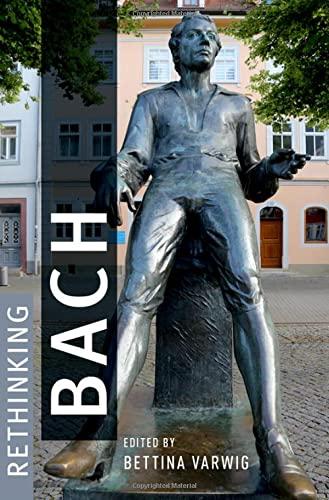
But does Bach continue to stand as a defined historical entity in the wake of such an exercise? In some ways, perhaps more so than before. Possibilities of envisaging a different kind of Bach from the one encountered in that imposing Leipzig statue, or in the famous bewigged portrait by his contemporary Elias Gottlob Haussmann, have certainly begun to multiply over the past decades: from the youthful insolence projected in Bernd Göbel’s Arnstadt sculpture of the composer from 1985 (reproduced on our title page) to the decidedly defamiliarizing result of a 2016 digital reconstruction of Bach’s facial features.5 Yet one of the striking aspects of the established tradition of Bach interpretation has been that the musicological Bach has by and large not been considered as an actual flesh-and-blood kind of historical agent, in the sense that his corporeal existence has tended not to figure in scholarly discourse to any significant extent.6 Notwithstanding his well-documented good appetite and healthy procreative drive, Bach’s body has customarily been treated as
transparent, so to speak, purportedly allowing scholars a direct view of the canon of disembodied musical works that his body once produced. The longstanding uncertainty surrounding the location of the composer’s burial site and actual physical remains has perhaps only contributed to this sense of the elusive immateriality of his legacy.7 Part II “Bodies,” in this volume intends to address this over- (or through-)sight, by delving into Bach’s imagination of the bodies/voices of his soprano singers, as explored in Wendy Heller’s essay; into contemporary theories of musical affect as a corporeal-material force, discussed in Isabella van Elferen’s contribution; and, in my own chapter, into the material fleshliness of Bach’s keyboard practice, discussed in dialogue with recent neurophysiological approaches to human creativity. Crucially, it is not only Bach’s body that thereby comes more decisively into view, but also those of his performers, listeners, congregants, surrounding family members and so on, thus situating Bach’s own physical existence within a larger assemblage of (gendered) bodies that productively widens the scholarly field of vision. In a manner akin to Andrew Talle’s recent groundbreaking study Beyond Bach, Bach as historical figure here becomes merely one node in an extensive network of cultural agents and activities;8 and while such a decentering exercise may well threaten Bach’s inherited hegemonic position in the Western canon, it contributes appreciably to a more textured, interconnected, and alive understanding of his actions in and engagement with the world around him.
Such possibilities of expansion and interconnection also arise in bringing Bach scholarship into closer dialogue with current methods and issues in adjacent fields, from theology to material culture studies. As Stephen Rose’s contribution shows, (Bach’s) musical practices hold the potential for offering particular—even unique—kinds of insight into broader patterns of cultural production and social interaction. In subjecting Bach to the “material turn” that has lately transformed research in disciplines from history to archaeology and literature, it is not only human bodies that emerge as newly significant points of focus. Rose’s chapter demonstrates that this material focus profitably encompasses the things surrounding those bodies and the practices associated with them—from postmortem inventories to the musical notes to which Bach applied his compositional craft. Here, again, we are at once encouraged to think beyond Bach in attending to the wider significance of material objects in early-eighteenth-century musical and social life; and to appreciate in novel terms Bach’s contributions to that wider sphere. A similarly productive two-way process can be envisaged with regard to Bach and certain strands of current theological thought. Notwithstanding the venerable tradition of theological Bach interpretation since the early twentieth century, Bach scholarship still has a lot to gain from paying more serious attention to the work of historical as well as systematic theologians; conversely, as Jeremy Begbie argues, certain musical qualities that are perhaps crystallized especially clearly in Bach’s output can enliven key debates within theological discourse: for instance,
about the “thinking together” of apparently non-congruent realities or beliefs. Once more, it becomes clear that Bach research can productively speak outward, as well as being itself reshaped substantively by that exchange with wellintentioned neighbors.
As will be amply evident by now, the name “Bach” stands for much more than Johann Sebastian as historical individual: it not only designates the collected, BWV-numbered corpus of musical works left behind by that individual, but also acts as a more capacious cipher, encompassing the multitude of intersecting and shifting meanings, feelings, beliefs, and values that became associated with the man and his music over the course of his long reception history in the West and beyond. These two broader connotations of “Bach”—the music at large and the “public mythic profile” (as Michael Markham calls it in his chapter)—cannot convincingly be regarded as operating in isolation, since our understanding of “Bach” as musical oeuvre necessarily evolved jointly with changing figurations of “Bach” as cultural icon. A further objective of at least some of the contributions in this collection, then, concerns unpicking a number of foundational assumptions that have shaped the coevolution of these two domains. One— or perhaps the abiding perception of Bach, consolidated in the wake of his requisitioning for German Protestant and nationalist causes, has been of pervasive profundity and seriousness of purpose, a perception that, as Markham shows here, has operated in conjunction with further clusters of associations such as purity, abstraction, universality, the arcane, and the divine. But should we accept it as a given that Bach’s music holds deep structural secrets expressed in notational symbols or numerical codes? Daniel R. Melamed suggests that some fundamental rethinking may be long overdue here, not least in order to counteract the removal of Bach’s works from everyday life and concerns into a self-contained sphere of the occult. And, in its supposed profundity, did the composer’s music indeed lack a sense of humor? Think again: as David Yearsley proposes in his chapter, such a deliberate tuning out of the sometimes subtle, sometimes raucous hilarity that infused both Bach’s social life and his musical vocabulary not only delimits our listening experiences and range of performance styles, but also ultimately dehumanizes his music by divorcing it from the lived realities of its creation and reception. Such challenges to certain long-standing tropes in Bach reception may well bring about gradual shifts in what “Bach” can and does stand for in the Western cultural imagination. Ideally, these shifts will work in tandem with hearing, performing, and appreciating his musical legacy afresh: not least by encouraging performers to interrogate critically the assumed authority of editors as purveyors of the true Bach, as Joshua Rifkin does here in his critical investigation of editorial practices of the Mass in B Minor. Derek Remeš, meanwhile, opens up another path toward such a re-evaluation of Bach’s place within current musical practices, by reconsidering the composer’s own chorale-based pedagogy as a way to revitalize the function of the “Bach chorale” in present-day music curricula.
One of the key developments that enabled Bach to become the celebrated “Bach” of the Western canon was the absorption of his compositional output into the nineteenth-century work concept and the classical concert culture it engendered. However, as John Butt explores in his contribution, this was perhaps less the result of an act of retrospective imposition than a realization of particular qualities latent within Bach’s compositional approach as well as concurrent philosophical debates about hermeneutics. In this light, it makes sense to take another look, too, at that fêted moment in 1829 in Berlin when Bach’s St. Matthew Passion was summarily claimed for the concert hall. Ellen Exner’s chapter proposes that the narrative of uniqueness attached to this moment, which has been so crucial to the modern perception of “Bach” the cipher, itself emerges as ripe for rethinking in light of preceding and surrounding cultural trends that made the event both much more likely and rather less singular than often assumed. Meanwhile, if Bach has loomed large in the imagination of Western concert audiences ever since, this celebrity has been grounded in the (tacit) understanding that his music encapsulates and speaks to some of the central concerns of Western modernity, of which classical concert culture can be regarded as one small but hugely revealing side effect. But here, too, we may need to be wary: Michael Marissen’s essay alerts us to the strong likelihood that Bach would have had very little positive to say if confronted with the beliefs of an average liberal-minded “modern” concertgoer. Such an argument, with its provocative echoes of Theodor Adorno’s scathing critique of the early music movement in 1951, asks us to take a critical look at some of the core convictions of modern-day Bach appreciation.9 It thereby not only demands some serious soul-searching from today’s community of Bach devotees, but also productively destabilizes the academic frameworks, cultural values, and even ways of writing within which past discussions about Bach have traditionally and comfortably unfolded.
We may not know this “Bach” as well as we think we do, then, notwithstanding the sometimes excessive sense of familiarity that can accompany repeated hearings of his most regularly performed works. And the potential for opening up new perspectives on a supposedly well-worn phenomenon is augmented yet further when we consider the pathways by which this product of the modern Western imagination traveled beyond its home turf as part of the European colonial enterprise. By mapping the subtle transformations of Bach’s meanings and uses in post/colonial Hong Kong over the course of the long twentieth century, often in the face of sonic realizations of his works that failed to correspond to the colonial imaginary of those artifacts, Yvonne Liao’s chapter not only shows us an (un)familiar Bach intricately enmeshed in the diverse histories of others—histories that could profitably be multiplied across other geographical domains, such as Thomas Cressy’s recent forays into Bach reception in Japan.10 We also, perhaps even more importantly, begin to appreciate Bach as a potential interlocutor in a broader cross-disciplinary conversation about developing
a historical-critical paradigm of “after Europe.” And not covered in these pages are many more such conversations that a Bach scholar might imagine joining. One would hope that future work might bring Bach into closer dialogue with disability studies, for instance, whether in relation to his own late-life visual impairment or the excessive demands that some of his writing for the voice placed on his performers; or we might (re-)view his early-eighteenth-century artistic, social, and economic life in Leipzig more determinedly through the lens of the transatlantic sugar and slave trade. There is still, I would suggest, a substantial amount to be learned from engaging with “Bach” on all these different levels, and in that sense this volume presents no more than a number of starting points for an exciting set of conversations to be continued or yet to be had.
Perhaps, then, the simple fact that “Bach,” in all these different formulations, has persisted into the 2020s—somewhat battered in places, newly brushed up in others— offers as good a reason as any for why he can and should still demand our attention. I suspect that many past and present Bach scholars, myself included, may ultimately trace their fascination with their subject matter to a hearty sense of love for and enjoyment of his music (even if, like in most branches of Western music studies, such infatuations tend to be buried fairly deeply these days). But such recourse to aesthetic valorization seems hardly necessary in light of the (super)saturation with “Bach” of many of the dominant strands of past and present music history. Bach’s legacy has been so richly entangled in so many domains of European and global cultural practices, and so crucial in shaping some of the fundamental assumptions about the nature and capacities of Western music (whether we like them or not), that talking about Bach still offers an exceptionally promising avenue toward a better understanding and more grounded critique of those practices and assumptions. Put more pointedly, we cannot profitably think through the development of Western (musical) cultures over the past three hundred and more years without grappling with Bach’s continual presence throughout that time. In this volume, therefore, we are indeed, for good reasons, still talking about Bach. And yet, in expanding the remit of what a nominally coherent field of “Bach studies” might encompass, the contributions offered here also intend to build bridges, between that island of splendid Bachian isolation and surrounding enclaves of knowledge—in the evocative phrase of Michel Serres, those other “islands sown in archipelagos on the noisy, poorly-understood disorder of the sea.”11 Among our ideal readership we encourage frequent crossings of those bridges in all directions.
Notes
1. Johann Nikolaus Forkel, Über Bachs Leben, Kunst und Kunstwerke (Leipzig: Hoffmeister und Kühnel, 1802).
2. Friedrich Blume, “Umrisse eines neuen Bach-Bildes,” Musica 16 (1962), pp. 169–176.
3. Susan McClary, “The Blasphemy of Talking Politics during Bach Year,” in Music and Society: The Politics of Composition, Performance and Reception, ed. Richard Leppert and Susan McClary (Cambridge: Cambridge University Press, 1987), pp. 13– 62. For a more expansive account of the history of Bach scholarship, see Robin Leaver’s informative introduction to The Routledge Research Companion to Johann Sebastian Bach, ed. Robin Leaver (New York: Routledge, 2017), pp. 1–22.
4. “Bach on Screen,” ed. Christina Fuhrmann and Rebecca Fülöp, BACH: Journal of the Riemenschneider Bach Institute, vol. 50/1 and 2, 2019.
5. See Caroline Wilkinson, “Facial Reconstruction—Anatomical Art or Artistic Anatomy?,” Journal of Anatomy 216 (2010), pp. 235–250, https://doi.org/ 10.1111/j.1469-7580.2009.01182.x.
6. Among some of the key exceptions to this trend, I would single out Suzanne Cusick, “Feminist Theory, Music Theory, and the Mind/Body Problem,” Perspectives of New Music 32 (1994), pp. 8–27, and David Yearsley, Bach’s Feet: The Organ Pedals in European Culture (Cambridge: Cambridge University Press, 2012).
7. On the history of Bach’s burial site and remains, see David Yearsley, Bach and the Meanings of Counterpoint (Cambridge: Cambridge University Press, 2012), pp. 211–224.
8. Andrew Talle, Beyond Bach: Music and Everyday Life in the Eighteenth Century (Urbana: University of Illinois Press, 2017).
9. Theodor W. Adorno, “Bach Defended against His Devotees,” in Theodor Adorno, Prisms (Cambridge, MA: MIT Press, 1995), pp. 135–146.
10. Thomas Cressy, “The Case of Bach and Japan: Some Concepts and Their Possible Significance,” Understanding Bach 11 (2016), pp. 140–146.
11. Cited in Georgina Born, “For a Relational Musicology: Music and Interdisciplinarity, Beyond the Practice Turn,” Journal of the Royal Musical Association 135 (2010), p. 209.
Chapter 2 Rethinking 1829
Ellen Exner
Felix Mendelssohn Bartholdy’s 1829 performance of Bach’s St. Matthew Passion in Berlin is one of the most fabled events in Western music history. The concert itself is frequently described in terms such as “miraculous” and “groundbreaking,” even though in the context of its time and place, it was actually neither. We are nevertheless accustomed to reading about it and the Bach revival that eventually followed in near-religious terms.1 In 1929, Friedrich Smend celebrated the centenary of the original Berlin performance by describing it as the beginning of a “new epoch,” brought forth “in a single stroke by the boy-genius Mendelssohn.”2 Similar rhetoric colors the account of Smend’s famously skeptical colleague, Friedrich Blume. Writing in the 1960s, Blume characterized the concert as follows:
Historically, it seems a miracle: a musician whose life and works had all but fallen into oblivion appears quite suddenly on the horizon of a new age, almost exactly a half century after his death, acquiring in the ensuing generations a resonance he had not even come close to attaining in his own lifetime. . . .
The Bach revival has influenced concert life, performance practice, musical instruction, aesthetics, the cultivation of taste; and the effect—“historically influential,” “epoch making” in the truest sense—cannot be fully evaluated even today. . . . Many revivals of other masters have occurred since, but none with such eruptive force, such a direct impact, and such far-reaching consequences. What is more, composers, too, willingly submitted to the resurrected “Father of Harmony.”3
More recently, Celia Applegate began her 2005 study Bach in Berlin with a similar flourish, declaring the 1829 concert a “momentous event” with an “almost accidental genesis.”4 She goes on to describe Mendelssohn’s decision to perform the St. Matthew Passion as though the choice were somehow inexplicable: “[Mendelssohn’s] great project was begun, but the historical record does not tell us why.”5 The historical record does, though, tell us why, depending on the questions we ask of it. If we put aside the miracle rhetoric and seek instead evidence of human agency behind the concert, it becomes clear that Berlin’s history was demonstrably full of Bach before 1829.
The portrayal of Mendelssohn’s St. Matthew Passion concert as a hallowed event had in fact been part of its consciously crafted legend from the beginning.
Ellen Exner, Rethinking 1829 In: Rethinking Bach. Edited by: Bettina Varwig, Oxford University Press. © Oxford University Press 2021. DOI: 10.1093/oso/9780190943899.003.0003
Adolf Bernhard Marx, editor of the Berliner Allgemeine Musikalische Zeitung, established the precedent of using evocative religious language to describe the upcoming concert, calling it “a most solemn religious celebration” that would “open the gates of a temple long shut down.”6 In context, Marx’s public exhortations certainly proved persuasive, but they were little more than the equivalent of modern-day buzz, helping to lure Berlin’s musical public to hear a concert of unstylish, extremely complex music. Words alone, though, could not make Bach’s Passion suddenly appealing: Marx was aided by the preexisting foundation of Bach cultivation among Berlin’s musical elite, who were already taken with his instrumental works and not entirely unfamiliar with the vocal ones. This complicated background is effectively made to disappear, though, by a rhetoric that promotes the 1829 concert as “sudden,” “inexplicable,” and “miraculous.”
There is ample evidence that by 1829, the quality of Bach’s music was not a new discovery among Berlin’s Kenner und Liebhaber. Manuscript copies of his music were sought after even before 1800,7 his vocal works were being studied and performed in the Prussian capital and elsewhere, 8 and a peculiar fascination with older repertories—including Carl Heinrich Graun’s Passion Der Tod Jesu (1755), performed in a concert setting—had long been a staple of public musical life. It was the combination of these local traditions, unique to Berlin, that most clearly paved the way for initial public excitement over Mendelssohn’s concert. Retelling the St. Matthew Passion concert’s story as though it were miraculous obscures these local origins in the service of a larger narrative that directs focus instead to Bach’s greatness and, through him, to Germany’s. Viewed in context of twentieth-century history, the cost of sensationalism in Bach scholarship, as exemplified by the traditional story of Mendelssohn’s 1829 St. Matthew Passion, turns out to be greater than it might first appear.
At root, the popular story of Mendelssohn’s St. Matthew Passion performance is the relatively simple way we have agreed to discuss the decidedly complex phenomenon of how Bach’s music later obtained its place at the center of German musical life. In this regard, the miracle narrative associated with the 1829 performance functions as a cultural myth. The writings of theologian John Dominic Crossan offer a framework for understanding the staying power of that narrative in spite of the (long-known) historical facts. According to Crossan, “the world is made up of stories. Some stories deny that they are stories, claiming a representation of reality ‘how it really is,’ not how we have ‘agreed to imagine it.’ ”9 Crossan follows Claude Lévi-Strauss in defining myth not in terms of tales of gods and goddesses or sophisticated lies, but rather as a story that functions to bridge irreconcilables: myths allow beliefs and facts that cannot simultaneously be true to somehow coexist.10 Such myths gain traction because they enable deeply held cultural beliefs that are expressed by larger master claims, or grand narratives.11 Among the “irreconcilables” that the St. Matthew Passion myth bridges is the distance between the fact that
Bach’s music was never truly forgotten in Berlin and the desirable tale of its miraculous rediscovery there. The grand narrative this little myth serves is that of German compositional supremacy proceeding from Bach, a subjective judgment that has long masqueraded as fact.
The St. Matthew Passion myth does its work by substituting an alluring saga full of uncanny, superhuman coincidence for a much less glamorous, more complicated, and ultimately very human story of appreciation for Bach’s music that is traceable from generation to generation in the decades leading up to the famous Passion concert. This chapter will argue that Berlin’s unusual, continuous engagement with older repertories, together with its active contemporary patronage of Bach’s music, offers an explanation for why Mendelssohn began his “great project”: in presenting the St. Matthew Passion in 1829, he was expressing publicly a number of elite musical priorities that had been part of Berlin’s musical culture for nearly a century. The concert therefore did not represent a rupture with the past, as the myth would have it, but rather a continuation of long-standing elite tradition made public.
My rethinking of 1829 begins with a new reading of Charles Burney’s famously scathing 1775 account of musical life in Berlin and extends to a 1929 press debate surrounding the concert’s centennial. Embedded within Burney’s observations is clear evidence of Berlin’s early history of Bach cultivation in the decades immediately following the composer’s death. Burney’s view in turn serves as context for evaluating the historical arguments presented in the 1929 debate over the extent of Mendelssohn’s role in bringing the St. Matthew Passion to life. Two centuries later, the way we discuss the Bach revival continues to echo the outcomes of that debate—particularly Smend’s “miracle” narrative.
Dr. Burney’s Complaint and the Case of Mendelssohn’s Great Passion
The belief that the 1829 concert’s genesis was sudden and inexplicable was enabled in part by a long history of selective reckoning with its eighteenthcentury precedents. Berlin’s musical reputation in the decades before the Passion performance was not estimable. The Prussian capital had been considered musically backward, especially for its peculiar engagement with unfashionable older repertories, at least since the time of Burney’s visit in the 1770s.12 His impression of Berlin’s musical culture was widely read in his time and continues to inform Anglo-American historical understanding of what went on there during the final decades of King Frederick II’s reign (1740 to 1786).13 According to Burney, precisely nothing of musical importance was happening in late-eighteenth-century Berlin: “Though the world is ever rolling on, most of the Berlin musicians, defeating its motion, have long contrived
to stand still.”14 Although it might have appeared to Burney (and therefore to his readers) that Berlin’s musical culture was far from contributing anything of value to the mainstream, looking back at his account with the 1829 Passion concert in mind transforms many of his complaints into harbingers of what we might now consider two critical music-historical developments: first, that Bach’s music was already uniquely esteemed in eighteenth-century Berlin and, second, that the city’s then-peculiar predilection for revering long-outdated compositions as masterworks was an early manifestation of canon formation in which Bach’s music would eventually assume a pivotal role.
It was no secret that King Frederick preferred music by his (now) obscure court composers from the 1740s and early 1750s: the Graun brothers, the Benda brothers, and Johann Joachim Quantz, all of whom composed in a signature style now recognized as the Berliner Klassik.15 Because they were the king’s favorites, it was their compositions that were heard repeatedly, for decades, in court circles and later held up as exemplary. Mendelssohn’s teacher, Carl Friedrich Zelter, was among the most outspoken and high-profile proselytizers for the music of the Berlin court, and thus this music forms such a large portion of the repertory found in the library collection he assembled while director of the Berlin Sing-Akademie.16 Significantly, music of the Bach family also plays a role in that collection. Frederick’s enlightened views produced a climate of relative freedom by eighteenth-century standards, but music was one area in which he would not be challenged: as Burney suggested, “for though a universal toleration prevails here, as to different sects of Christians, yet, in music, whoever dares to profess any other tenets than those of Graun and Quantz, is sure to be persecuted.”17 Burney’s perception from the middle of things did not allow him to comprehend the importance of the larger music-historical process of canon formation for what it was. Similarly, scholars working in the earliest decades of musicology took little interest in the musical culture around Frederick’s “Kleinmeister,” even though this culture was the very context in which Bach’s music was originally received in Berlin.
Burney observed that in the midst of Frederick’s imposed repertorial uniformity, there were still certain musical “schisms” in the city, and that only those of “the establishment” could speak out against prevailing royal taste. Among the dissenters were those who had the means to host private concerts and those who revered Bach’s music. There was significant overlap, including the court of the king’s youngest sister, Princess Anna Amalia (1723–1787). She famously elected to champion and collect music of the Bach circle long before the nineteenth century “discovered” its value.18 For example, she employed Johann Philipp Kirnberger from 1758 and named Carl Philipp Emanuel Bach her Honorary Kapellmeister upon his departure from Frederick’s service in 1768. With Kirnberger’s help, Amalia undertook a study of counterpoint and assembled one of the most important collections of Bach-family manuscripts in her famous Amalienbibliothek.19 Burney’s account of Kirnberger includes
mention of his position within Berlin’s musical culture as well as his time in Leipzig as a student of Johann Sebastian Bach.20 The same holds true for Burney’s portrait of Johann Friedrich Agricola, who later served as Frederick’s Kapellmeister following the death of Carl Heinrich Graun. When Burney finally met Emanuel Bach, whom he greatly admired, in Hamburg, the accomplishments of the Leipzig Thomaskantor were a topic of discussion.21 The two men spent time in Emanuel’s home, where Burney was treated to private performances at the keyboard and discussions about the compositions and collecting interests of Emanuel’s father. From the evidence in Burney’s account, one’s having studied with Sebastian Bach and possessing the wherewithal to comprehend his remarkable skills were points of pride in Berlin fifty years before the beginning of the “Bach revival.” Evidently the composer’s exquisite compositional craft was revered at the highest social levels already by the mideighteenth century—a fact witnessed by Marpurg’s Abhandlung von der Fuge (1753–1754) as well as Kirnberger’s Die Kunst des reinen Satzes in der Musik (dedicated to Princess Anna Amalia, 1771), for example.
It was no accident that Bach’s music was well regarded in Frederick’s Berlin. More of Bach’s students, including his sons, lived and worked there than anywhere else outside of Leipzig. The list of Bach’s students in Berlin included Carl Philipp Emanuel Bach, Wilhelm Friedemann Bach, Johann Christian Bach, Johann Friedrich Agricola, Johann Philipp Kirnberger, and Christoph Nichelmann. These students of Bach brought his legacy to Berlin with them, both generally in the form of knowledge and recollections, and literally in the form of original manuscripts and copies. Lest we forget, Johann Sebastian himself had a history with the city as well, having visited at least three times, with each visit resulting in a gift of music:
1721: The Brandenburg Concertos (BWV 1046–1051)
1741: Flute Sonata in E Major (BWV 1035) (for Fredersdorff, Frederick’s Chamberlain?)
1747: The Musical Offering (BWV 1079) (dedicated to Frederick)
These three pieces were not among those for which Bach was most well known in his time, but they do reflect his unique relationship with Berlin’s most elite patrons. For a time, this was also the circle within which he continued to be most highly regarded, as is evident from the repertory associated with Felix Mendelssohn’s great-aunt, Sara Levy (née Itzig), and her salon, which was intentionally modeled after Bach cultivation at Anna Amalia’s court.22 It should be recalled in this context that Princess Amalia’s library, curated by Kirnberger, preserved the dedication copies of Bach’s Brandenburg Concertos as well as the Musical Offering 23 They were not kept in the official royal libraries, presumably because the Princess had the most pronounced interest in Bach’s music.
For all of the reasons just described—the emergence of a canon of outdated “classics,” the central positions of Bach’s sons and students in Berlin’s musical
life, and musical patronage at the highest social levels—it hardly seems miraculous that the Prussian capital was the epicenter of Bach cultivation not only in the nineteenth century, but already in the eighteenth. Burney’s 1775 account provides clear evidence for why Mendelssohn might have chosen to explore the possibility of performing Bach’s St. Matthew Passion in Berlin. These details have seldom been incorporated into the retelling of the concert’s story, though. Perhaps their omission is due to the number of unfamiliar names and the (now) low-status repertories they involve, thus rendering the story less likely to capture interest than a tale of instant musical miracle.
The popular image of the Passion concert as the sudden beginning of a new era is not only a time-tested, crowd-pleasing tactic, but it is also a prime example of what Friedrich Blume once decried as the “traditional and beloved romantic illusions”24 we have inherited from Bach scholarship past. The “miracle” narrative of Mendelssohn’s St. Matthew Passion is so well known by now and so popular with audiences that perhaps we keep repeating it because we are reluctant to part with its effect. Ironically, Blume’s characterization of Bach’s musical return as “miraculous” and description of him as “the resurrected Father of Harmony” (quoted previously) actually perpetuate some of the very faults of Bach scholarship he sought to correct.
In a 1962 address before the International Bach Society, Blume chastised colleagues such as Friedrich Smend for continuing to produce what Robin Leaver calls “essentially romanticized and theologized images of the Thomaskantor.”25 According to Blume, writing in 1963, his generation of scholars had done precious little to alter the “picture which [Philipp] Spitta painted about 80 years ago,” that still “prevails today among a majority of Bach-lovers, players, and singers.”26 Blume might not be surprised to learn that some of those same Romantic views of Bach continue even now to dominate concert hall and conservatory culture. They also pervade musicological writing (mostly) outside of Bach Studies. The popular description of the St. Matthew Passion concert as a miracle is one example; the description of Bach as the “Fifth Evangelist” is another. 27 In Leaver’s words, this biblical characterization “gave rise to a flood of more popular literature in the first half of the twentieth century in which facts were confused by fictions, and subjective interpretations were preferred to objective investigations.”28 Blume’s proposed solution to the problem of distorting history involved charging his peers to seek out a “new picture of Bach” by using “new methods of evaluating and interpreting the sources,” and to see the “same facts in a different light,” all in search of a Bach who was “more down-to-earth, more human, more tied to his own period.”29 Blume’s call remains a point of departure for rethinking many of the beliefs that we have inherited about Bach and that continue to permeate non-specialist literature about him.
Part of the reason that the myth of 1829 has enjoyed such longevity is that scholars outside of Bach studies seldom have cause to engage critically enough
with its bibliographic domain to detect the historical incongruities under discussion here. It is standard scholarly practice to rely on what expert colleagues in adjacent fields have reported because of their greater fluency with the context and sources related to their subject areas. The myth of 1829 therefore informs the vast body of music-historical writing that includes reference to Mendelssohn, the St. Matthew Passion, and the nineteenth-century Bach revival. Because of the notoriously steep climb that is entry into Bach scholarship (“nearly impenetrable . . . for the uninitiated,”30 to quote Christoph Wolff), Bach myths seem to enjoy an especially long life. Public scholarship in the form of program notes, pre-concert talks, music journalism, liner notes for recordings, and so forth thrives on these sorts of stories because they are immediately gratifying to audiences, which of course carries commercial benefits. Thus, non–Bach scholars trustingly appropriate the irresistibly spectacular. Bach scholarship, meanwhile, has tended to spill most of its ink in exchanges with itself rather than in accessible communication with performers, its academic colleagues, or the general public. Blume’s dreaded Romantic-era illusions have thus proven tenacious, making their way even into the most responsible of twenty-first-century scholarship.
We can detect these illusions, for example, in Larry Todd’s excellent 2003 biography of Mendelssohn. In Todd’s account of the 1829 Passion performance, Mendelssohn’s lone heroism and the singular importance of the event are the focus of the retelling; the complexities of eighteenth-century Bach reception factor much less. The St. Matthew concert is the music-historical event for which Mendelssohn is arguably best known, so it would of course be in his biographer’s interest to highlight the legendary role of his subject. In Todd’s description, Felix was “the ‘prime mover’ . . . the stimulating agent behind the posthumous canonization of the Thomaskantor.”31 Todd also reads great personal significance for Felix into the 1829 performance, billing it as his rite of passage to manhood and the ticket to his social acceptance as a bona fide convert from the Jewish faith:
The revival of the St. Matthew Passion was the culminating event of Felix’s youth. Through the public success he symbolically achieved full assimilation into Prussian culture and thus confirmed his Christian faith through Bach’s ineluctable Passion, a work that had frustrated [his teacher] Zelter’s timid efforts at rediscovery. This epoch-making composition had indeed risen phoenix-like from the ashes [. . .]. 32
Todd’s language in describing the St. Matthew performance, like that of Applegate, Smend, and Blume, also invokes myth: Bach’s Passion is “ineluctable” and “epoch-making”; through Mendelssohn’s efforts, it rose “phoenixlike from the ashes.” In leveraging the phoenix analogy, Todd is implying that Bach’s return, like the mythic beast’s, was somehow divinely ordered and inevitable. Bach was not, however, a mythic beast. He was just as human
as Mendelssohn and Zelter—a point that Blume and, more recently, Robert Marshall have urged Bach’s devotees to recall.33
We tend to hear little about the earliest people to promote interest in Bach’s music after his death, probably because many of them were not in categories celebrated by past historians. For example, many of them were women, whose efforts history has not always valued enough to record. Bach scholarship is no exception. Among the many consequences of reporting history in terms of myths, heroes, and great men is that “normal” human agency is diminished to the point of invisibility and thus implicitly devalued. As Albrecht Riethmüller reminds us,
Language is as effective in shaping our conscious thoughts about music as the music itself. Passing observations or mere intimations often contain the coded messages; even if only occasionally repeated, they take root without further discussion. That they remain unanalyzed is also symptomatic. They simply exist, unreflected, fueled by the weight of consensus. 34
Omission of women’s roles in Bach reception is not harmless when it helps to perpetuate unenlightened social and political structures, even if unconsciously.
Mendelssohn, Bach, and Berlin in 1829
When we seek out the more complicated story of human involvement behind the 1829 myth, it quickly becomes evident that there were many people in Berlin who encouraged Mendelssohn’s early love for Bach and many more, even outside of Berlin, who kept the latter’s musical legacy alive. In Berlin itself there was of course Mendelssohn’s extended family, particularly the female members: his mother, Lea; her mother, Bella Salomon (née Itzig); and the other Itzig sisters, Sara Levy and Fanny von Arnstein. Adolf Weissmann’s famous quotation aptly sums up the situation: “at the Itzig’s, a veritable cult of Sebastian and Philipp Emanuel Bach is being observed.”35 Sara Levy’s engagement with Bach’s music has been so well documented elsewhere that it need not be rehearsed here. The influence of Mendelssohn’s family members was important particularly with regard to collecting Bach-family manuscripts and performing Bach’s keyboard music.
In terms of introducing young Felix to Bach’s vocal music and compositional approach, his teacher, Carl Friedrich Zelter, was also clearly indispensable. Zelter had been rehearsing selected movements from the St. Matthew Passion with a small group from his large, amateur choir, the Berlin Sing-Akademie, beginning at least a decade before the 1829 performance.36 Although Zelter knew of his student’s fascination with Bach and definitely helped to encourage it, Bella Salomon’s present of a manuscript copy of the Passion to her grandson Felix in 1824 was necessary, because it is reported that Zelter refused to allow
Felix access to his most precious Bach scores—including the St. Matthew Passion. In an echo of another famous Bach myth, that of the “moonlight manuscript,” Zelter supposedly did, at least, show Mendelssohn the locked door behind which this forbidden treasure was kept.37
Even though Zelter clearly recognized the compositional artistry of the Passion and had arduously rehearsed parts of it, as well as many of Bach’s motets, he saw little reason for the Passion to be publicly performed. Once Mendelssohn had his own score, though, he and his friend, the singer and actor Eduard Devrient, began envisioning a performance of the piece in Berlin that would use members of Zelter’s Sing-Akademie. Another detail that has frequently been obscured, however, is that Mendelssohn and Devrient’s idea was not sui generis: it was sparked by successful concerts outside of Berlin that they had seen or heard about that featured “ancient” repertory performed by civic ensembles very much like the Sing-Akademie. Similar concerts had been going on in London for decades (by the Academy of Ancient Music, for example) but they were also beginning to become a trend in the Germanspeaking lands. Mendelssohn himself had heard a performance of a Handel oratorio under Johann Nepomuk Schelble with the Frankfurt Cäcilienverein in late 1827—just over a year before Mendelssohn’s own performance of the St. Matthew Passion. Schelble’s Cäcilienverein also performed the “Credo” from Bach’s Mass in B Minor in 1828 and even had their own plans to perform the St. Matthew Passion. All of this was possible because one of Schelble’s singers, Franz Hauser, had brought many Bach scores with him from Berlin when he relocated to Frankfurt. He shared his scores with Schelble, whose interest in Bach reached back many years.38
Thus, contrary to the miracle myth, before Mendelssohn presented the Passion in 1829, sacred vocal works by Bach were already being performed publicly and the Sing-Akademie had been practicing his vocal music for decades. The historical record shows that Mendelssohn was aware of Schelble’s plans to perform the St. Matthew Passion, because he reported the news in his correspondence. 39 The “Credo” from Bach’s Mass in B Minor was actually performed not only in Frankfurt, but in Berlin, too, that same year (1828) under the baton of the Italian maestro Gaspare Spontini with the Prussian Royal Opera (!). Mendelssohn commented on the emerging taste for Bach’s music in a letter to his friend Adolf Fredrik Lindblad in Stockholm seven months before the Berlin Passion performance: “Bach is everywhere in fashion.”40 Bach was indeed so much in fashion ahead of Mendelssohn’s 1829 performance that the Berlin publisher Schlesinger announced, through A. B. Marx, plans to issue a score of the St. Matthew Passion a full year before the performance took place.41 Publishers produce only what they predict will be lucrative: Schlesinger, too, already sensed an audience for Bach’s sacred vocal music prior to 1829.
Traditionally, the Sing-Akademie’s Good Friday concert had been of C. H. Graun’s Der Tod Jesu (1755)—a lasting legacy of Frederick II’s policies and