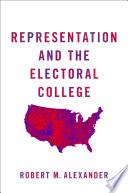
Acknowledgments
LIKE MANY GOOD ideas, this book can be traced to a conversation over a beer with a friend. I was attending the Republican National Convention in Cleveland, Ohio, as a Faculty Leader through the Washington Center program. The convention was off to an interesting start with Ohio Governor John Kasich refusing to attend the coronation of Donald Trump as the GOP’s nominee. Meanwhile, Hillary Clinton was getting a lukewarm reception from supporters of Bernie Sanders in the days before the Democratic National Convention. As it would turn out, Trump and Clinton were among the most disliked presidential candidates in polling history. In the following days, I wrote an op-ed suggesting that their poor favorability ratings could translate into faithless votes in the Electoral College. Having surveyed electors in each of the past four elections, I had found an appetite among a significant number of electors to defect in each of those contests. The 2016 meeting of the Electoral College did indeed yield an historic number of faithless votes (as detailed in Chapter 7).
Given the candidacies of Trump and Clinton, I was discussing the possibility of a potential Electoral College revolt with Steve Caliendo at Mike’s Bar and Grille in Berea, and he was amazed that my research on electors was not universally known. The Electoral College is often treated as a footnote among many political scientists. Although many are familiar with the importance of the institution, few scholars devote attention to it. Steve suggested that I needed to think more broadly about approaching my data on electors. After all, the Electoral College is an institution intersecting many areas of American politics—campaigns, voting behavior, federalism, and representation. In that “aha” moment, I decided to examine the Electoral College in the context of representation.
The purpose of the study is to help readers understand the ways in which the institution does or does not align with expectations relating to representative democracy. The Electoral College has a long history and has
been the subject of controversy from its inception. The Framers struggled mightily with the problem of selecting the nation’s chief executive. Many of the arguments made in 1789 persist to this day. Examining those arguments relative to norms of representation provides an opportunity to appropriately evaluate the Electoral College process.
This book represents a very long journey. As a graduate student, Lillard Richardson reminded me that presidential electors were real people and that scholars knew very little about them. Without his prompting, I never would have sought to examine them. I have benefited greatly from the tutelage of Tony Nownes. My “academic dad” has been an outstanding mentor and friend. He has provided considerable help with this research over the years. The political science honor society, Pi Sigma Alpha, awarded multiple chapter activity grants to help fund each of my surveys of presidential electors. I would like to thank Sean Twombly, Jim Lengle, Nancy McManus, and members of the Chapter Activity Grant Award Committee for their help and support over the years.
Such an effort would not have been possible without the assistance of many excellent students from Ohio Northern University. I have been fortunate to have remarkable students who are excited to learn and eager to please. I owe each of these students a deep debt of gratitude: Rebecca Boler, Lisa Bradley, Jessica Brasee, Troy Brinkman, David Brown, Zachary Bushatz, Kara Calomeni, Doug Chapel, Alexis Cobb, John Curiel, Christopher Difrancesco, Adam Downing, Elizabeth Drummond, Zac Esterline, Tiffany Ferry, Christine Frankart, Adam Gallagher, Dakotah Gray, Ross Grilliot, Anna Hoard, Jennifer Jameson, Jason Kaseman, Brittani Knisely, Maggie Koch, Steve Kochheiser, Jesse Longbrake, Tina Loughry, Melissa Mead, Robert Moorman, Kelly Morman, Matthew Oyster, Shaili Patel, Taylor Phillips, Derek Price, Robert Putnam, Dexter Ridgway, Stephen Saunier, Heather Stassen, Brad Stoll, Barbara Tate, Jamie Uppenkamp, Daniel Warren, and Benjamin Wollet.
I will forever be indebted to Jennifer Carpenter and David McBride, my editors at Oxford University Press. I am thankful for their collaboration and belief in this project. Holly Mitchell’s guidance throughout the process has been a delight. I am also thankful to Rajesh Kathamuthu, Wendy Walker, Sangeetha Vishwanthan, and Seth Cotterman for their attention to detail which improved the book. This project also benefited greatly from the five
anonymous reviewers during its early stages. As a first-generation college graduate whose grandparents had no more than an eighth-grade education, I am overwhelmed and overjoyed to publish with OUP.
My sincere appreciation is also due to the multitude of presidential electors who responded to the surveys over the years. Many went far beyond simply answering questions, providing additional information and insights and offering to answer any additional questions beyond those asked in their survey. I am also thankful to Derek Muller, James McCrone, and Kyle Cheney for their shared devotion to understanding the Electoral College—especially throughout the 2016 election cycle. Sometimes, it is nice to know that you are not alone. I must acknowledge that most all of this book was written with Radiohead, Weezer, Cake, or the Foo Fighters in the background. Thank God for music.
Lastly, I wish to thank my absolutely wonderful support network, from my colleagues at ONU to my friends from high school, college, and graduate school—I have been truly blessed. Obviously, one can neither obtain nor enjoy success alone. Nowhere can this be seen more than from my family. My parents, Bob and Phyllis Alexander, showed me what hard work really looks like. More important, they showed me love. I have always known that they would be there for me, regardless of the situation, and for that I am forever thankful. I have tried to serve as a similar inspiration to my children—Olivia, Anabel, and Amelia. I hope to have taught them the values of hard work, perseverance, and work/life balance. I am thankful that they have always had the ability to keep me grounded and to serve as constant reminders of what is truly important in life. Finally, my wife, Shelleigh, continues to be my biggest fan. From reminding me to eat to talking me through a thorny issue, her help and insights have been extraordinarily beneficial. I came to rely on our morning “coffee talks” to maintain my focus and my sanity. Without her selflessness, love, support, and encouragement this book would not have been possible. Thank you.
Introduction
THE 2016 PRESIDENTIAL election was among the most controversial and unpredictable contests in American history. Hillary Clinton (former First Lady, senator from New York, and Secretary of State) was heavily favored to win the presidency in the months, weeks, and days preceding the election. She appeared poised to become the first female president as polls across the country indicated she enjoyed comfortable margins over her foe, mogul Donald J. Trump (who had never held elected office). The day of the election Nate Silver’s 538.com forecast gave Clinton a 71 percent chance to win the presidency with 302 electoral votes to Trump’s 236.
Trump had run an unconventional campaign—refusing at one point to debate fellow Republicans during the primary season, spending very little campaign money throughout the election cycle, frequently claiming that the electoral process is rigged, and brazenly attacking Clinton as well as fellow Republicans. In a decidedly anti-Washington era, Trump capitalized on his lack of political experience and called on Americans to wreck the Washington establishment. On the day of the election few experts gave him a chance to win the presidency. However, as election returns started to come in, it became increasingly clear that he did indeed have a chance. Close races in Michigan, Wisconsin, and Pennsylvania indicated that it was Clinton and not Trump who was going to have a difficult path to the presidency. A few hours later, in a stunning turn of events, Trump was addressing the country as the president-elect, while Clinton was preparing a concession speech for the following day.
The surprises did not end that evening. Within days, it became clear that Clinton was likely to claim more votes across the country than Trump. When all the votes were counted, Clinton ended up with nearly 3 million more votes than Trump. The 2016 election marked the sixth time a
candidate ascended to the presidency while losing the popular vote to an opponent. Trump’s victory took many by surprise, and his path to the presidency was the subject of great criticism. Four years earlier, Trump famously tweeted that “the electoral college is a disaster for a democracy” and “This election is a total sham and a travesty. We are not a democracy!” (Donald J. Trump, November 7, 2012). Minutes later, he tweeted the following call for action: “Let’s fight like hell and stop this great and disgusting injustice! The world is laughing at us” (Donald J. Trump, 2012).
Four years later, he changed his tune. A week after his victory, he tweeted, “The Electoral College is actually genius in that it brings all states, including the smaller ones, into play. Campaigning is much different!” (Donald J. Trump, November 15, 2016).
After a brief respite, the Electoral College once again featured prominently in discussions across the United States and the world. The 2016 campaign highlighted a number of issues commonly debated regarding the Electoral College. The popular/electoral vote split was chief among the arguments in the wake of the election. Americans were quickly reminded that the presidential election consists of a state-by-state tally of votes, rather than a national popular election. Clinton received 48 percent of all votes cast to Trump’s 45.9 percent. This was in near perfect alignment with Silver’s final 538.com forecast—48.5 percent for Clinton and 45 percent for Trump (Silver, November 8, 2016). Yet, where those votes were cast was critical in determining the outcome of the election.
Trump won 30 states (and Maine’s 2nd congressional district) to Clinton’s 20 states and the District of Columbia. Victories in Wisconsin, Michigan, Pennsylvania, and Florida were key to Trump’s gaining an Electoral College majority. His margins of victory in these states were slim: he won Wisconsin, Michigan, and Pennsylvania by less than 1 percent of all votes cast in those states and Florida by just 1.2 percent of all votes cast in the state. These four states accounted for 75 electoral votes. For some perspective, it is worth noting that about 20 percent of voters make up their minds in the final two weeks of a presidential campaign (Box and Giammo, 2009–2010, 335). These “late deciders” typically are less partisan and less knowledgeable and care less about election outcomes than those who make their decisions earlier in the campaign (Box and Giammo, 2009–2010, 340). Late deciders are notoriously capricious. In a close race, they very well
could change an election from one candidate to another based on very little information, little partisan attachment, and little interest in the outcomes of the race. A change in just 1 percent in those key states would have swung the election to Clinton with 307 electoral votes to Trump’s 231 (and a 3 million vote margin in the popular vote as well). Combined with the popular vote total, such an Electoral College outcome would have been precisely in line with most predictions for the race. Recall that Silver’s final forecast had Clinton winning the Electoral College with 302 votes to Trump’s 236, along with a 2 to 3 percent nod in the popular vote (Silver, November 8, 2016).
Of course, this is not what happened. Instead, we witnessed the largest discrepancy between the popular vote winner and the electoral vote winner in American history. In spite of Clinton winning the popular vote 48 percent to 45.9 percent, Trump won 56.5 percent of all electoral votes cast to Clinton’s 42 percent. Trump was quick to note that if the election were based on the popular vote, he would have campaigned very differently. He maintained that because of the rules of the Electoral College, he ran a campaign to win electoral votes, not popular votes.
The fractious outcome led to a movement to unseat Trump in the days and weeks after the general election. Nearly 5 million people signed a Change.com petition asking presidential electors to vote for Hillary Clinton (Change.com, December 19, 2016). A related but separate campaign emerged within the Electoral College. Members of the Electoral College calling themselves “Hamilton Electors” engaged in a campaign to lobby fellow electors to abandon Trump in favor of a consensus Republican candidate. While the campaign was not successful, ten electors tried to exert their independence and strayed from their party’s nominees. Two electors were removed and one more changed his mind and voted for his party’s nominee. Ultimately, seven electors joined the ranks of so-called faithless electors. Apart from the death of a candidate during the interregnum period, this marked the largest number of rogue votes in American history. Lastly, while rare, we saw a state split its electoral votes between candidates for the second time in the last three elections. Trump was able to claim one electoral vote in Maine. Barack Obama was able to claim a single electoral vote in Nebraska in the 2008 election. While many states consider district or proportional representation schemes, these are the only two states that
currently allocate their electoral votes in this fashion. This fact has a profound effect on presidential campaigns.
To be sure, the 2016 election experienced just about everything when it comes to the Electoral College. As expected, calls for its abolition, modification, and maintenance accompanied the tumultuous campaign season. Although often treated as an afterthought, the 2016 election reminded observers that the institution is at the center of presidential elections. Most arguments supporting and opposing the Electoral College come down to notions of whom it ultimately represents. This book sets out to examine the Electoral College as it relates to representation.
The Mechanics of the Electoral College
The Electoral College consists of 538 electoral votes. This number corresponds to the representation each state is afforded in the House of Representatives (435 electoral votes), which is based on the population of each state, combined with two votes each state is afforded based on its representation in the US Senate (100 electoral votes). The 23rd Amendment to the US Constitution provides that the District of Columbia receives representation in the Electoral College (three electoral votes). It indicates that while the District may have electors, it may have no more electors than the state with the fewest electors. Regardless of the District’s population, it will never have more votes than the least populous state. For the foreseeable future, it would appear that the District will be relegated to three electoral votes, regardless of its population. Only a new amendment providing so would change this feature.
Electoral votes are awarded on a state-by-state basis. Essentially, 51 individual elections occur throughout the states (and the District of Columbia) to determine how electoral votes are awarded. For all states but two (Maine and Nebraska), if a ticket wins a plurality of votes in a state, it claims all of the state’s electoral votes. To win the presidency, a ticket must earn a majority of all electoral votes in the Electoral College (270). If no ticket earns a majority, the House of Representatives is tasked with selecting the president from among the top three candidates receiving electoral votes in the Electoral College. Each state votes as a unit, and a majority of state delegations is needed to win the presidency. Interestingly,
the Senate is tasked with selecting the vice president from among the top two candidates receiving Electoral College votes for vice president. This is due to the 12th Amendment.
Employing the House and Senate to determine the size and nature of the Electoral College is considered to be a means to achieve balance between more populated states and less populated states in the selection of the nation’s chief executive. This is because the House apportions representation based on population and all states have equal representation in the Senate with two senators. This is a prime example of how important the notion of representation is to the Electoral College. In practice, this feature can lead to great disparities in the relative voting power of citizens across the country. For instance, in 2016, California had 55 electoral votes compared to Wyoming’s 3. On first glance, this would seem to convey great voting power for the Golden State. Yet, when one translates electoral votes per person, we see that in the 2016 election, one electoral vote in California was equal to approximately 720,000 people and one electoral vote in Wyoming was equal to approximately 196,000 people. The constant two Senate votes provided to each state has the effect of increasing a less populated state’s per-person voting power relative to more populated states in the Electoral College. This is a feature that many opponents of the institution often criticize as being undemocratic. Others argue that without this feature, campaigns would mainly take part in more populated states, with little attention devoted to less populated states. Much more will be said about these arguments later.
The term “Electoral College” is actually a bit confusing. It is not one “college,” but 51 “colleges” where electors from each of the 50 states and the District of Columbia cast one vote for president and one vote for vice president. The term “college” simply means assemblage. Electors meet for one purpose and one purpose only—to select the president and vice president. Once they have done so, their duties are completed and each state’s college is disbanded.
The Constitution indicates that state legislatures control how electors are chosen. There is no mandate that electors are chosen by the citizenry, nor are they constitutionally required to vote in accordance with the popular vote in their respective states. In the earliest presidential elections, several state legislatures selected the electors, rather than having them selected by a
popular vote. With each succeeding election, more and more state legislatures devolved elector selection to the citizenry. By 1876 all states chose their electors by a popular ballot. This is important to note, as the Electoral College has been subject to many attempts to democratize it. This is one way in which the institution has indeed become more democratized over the years. Still, rather than directly voting for president and vice president, Americans vote for slates of electors who are committed to a specific party ticket. These electors are then entrusted with the duty of casting their votes for the party ticket when they meet about a month after the general election takes place. To this day, then, citizens continue to indirectly select the president and vice president when they cast their ballots in the general election.
All but two states apportion their electoral votes by means of the “winner-take-all” or unit rule. This means that whichever ticket receives the most votes in a state wins all of the state’s electoral votes. This is true whether the margin is large or razor thin. In 2000, Al Gore received 2,912,253 votes to George W. Bush’s 2,912,790 votes in Florida (a 537-vote difference out of nearly 6 million votes cast). Because of the winner-take-all feature, Gore received exactly zero votes in the Electoral College from the state. Critics charge that the winner-take-all method of awarding electoral votes often fails to accurately reflect statewide election results and has important negative implications regarding representation.
The unit rule is one of the reasons why popular vote margins can diverge from Electoral College vote margins. A candidate’s margin of victory simply does not change his or her electoral vote total in winner-take-all states. Winning the state is what matters. This was the case for George W. Bush in Florida. Regardless of whether he had won the state by 500 votes or by 5 million votes, he would have earned all of Florida’s 27 electoral votes. In most elections, this feature tends to magnify the winning ticket’s vote margins. For instance, Bill Clinton won 43 percent of the popular vote in 1992 but 69 percent of the Electoral College vote. As noted, while Trump earned 45.9 percent of the popular vote in 2016, he claimed 56 percent of the Electoral College vote. Differences between the popular and electoral vote are mostly due to the influence of the winner-take-all feature most states employ.
As noted, Maine and Nebraska have adopted the “district plan.” In this model, each congressional district is up for grabs. The ticket receiving the most votes in a congressional district wins that district. The ticket with the most votes across the state claims the two “bonus” electoral votes for that state. Many contend this is a fairer means to apportion electoral votes. It allows for interests within a state to gain some level of representation when they may otherwise have no chance to win an electoral vote if they were to use the unit rule. For instance, in 2008, John McCain overwhelmingly won Nebraska (56 percent to 41 percent). However, Obama was able to obtain one electoral vote in the state due to his strong showing in Omaha’s congressional district. In 2016, Trump bested Clinton in 7 of Illinois’s 18 congressional districts. However, because of Clinton’s overwhelming support from urban areas, the popular vote total in the state was not even close. Therefore, Clinton was able to claim all 20 of Illinois’s electoral votes, although significant pockets of support existed for Trump in the state. This is a chief reason why deviations occur between the popular and electoral vote in presidential elections.
Proponents of the district plan suggest it more accurately reflects the electorate’s wishes. It can lead to more competition and it democratizes the process. Over the years, several states have considered moving to the district plan. After the 2012 election, Florida, Michigan, Ohio, Virginia, Pennsylvania, and Wisconsin considered changing their allocation of electoral votes to proportional or district plans (Liebelson, 2013). While these efforts received considerable attention, none of these states changed how they apportioned their electoral votes for the 2016 election. In the wake of the 2016 election, state representatives in Pennsylvania once again introduced legislation to award their electoral votes based on the district plan. Many of these efforts lose momentum because they are seen to weaken the power of political parties by making conditions easier for third parties or local “sons” or “daughters” to win electoral votes and potentially become spoilers in the national election.
Once electors are selected, be it by the winner-take-all method or the district plan, they are then charged with translating their state’s vote into the electoral vote. That no constitutional requirement exists binding electors to the outcome of the popular vote vexes many observers of the presidential selection process. Still, almost all electors follow the will of voters in their
state. Less than 1 percent of all electors have cast so-called faithless votes over the course of presidential elections. Whether faithless electors are being faithful to the Constitution or not was a widely debated topic in the aftermath of the 2016 election.
Ten electors attempted to cast faithless votes when the Electoral College convened in December 2016. Two of those electors were immediately replaced and their votes were not counted. Another rogue elector was asked to reconsider his vote for Bernie Sanders and on a second ballot cast it for Clinton instead. Still, seven electors cast faithless votes (five Democrats and two Republicans). These seven faithless votes represented anywhere between 1 and 2 million votes cast in the general election. Writing about his faithless vote weeks after the election, an elector who cast his vote for Ron Paul contended he was being faithful to the Constitution (Greene, January 7, 2017). He argued that the general election was more like a “straw poll” so that electors could get a feeling about what the country was thinking (Greene, 2017). For him, it was an elector’s duty, not the citizenry’s, to determine who should be selected as the president and vice president of the United States. I examine this claim in much greater detail in Chapters 6 and 7. I argue that most Americans do not believe they are leaving the selection of the president up to virtually anonymous electors who do not appear on ballots throughout the country. Indeed, many Americans are dismayed when they learn that electors may cast faithless votes.
Common Arguments Concerning the Electoral College
There are many arguments supporting and opposing various features of the Electoral College.1 Writing about the institution in Federalist 68, Alexander Hamilton famously stated that the “the mode of appointment of the Chief Magistrate of the United States is almost the only part of the system, of any consequence, which has escaped without severe censure, or which has received the slightest mark of approbation from its opponents.” He went further, boldly claiming that when it came to selecting the president, “if the manner of it be not perfect, it is at least excellent” (Federalist 68). In spite of Hamilton’s enthusiasm for the Electoral College, it has been one of the most controversial institutions in all of American politics.
Advocates of the Electoral College argue that it promotes political stability by supporting the two-party system, requires candidates to generate broad voting coalitions, guards against the tyranny of more populated areas over less populated areas, maintains the federal system of representation, and curtails electoral fraud. Opponents charge that the institution violates political equality, fails to accurately translate the public’s will, produces “wrong winners,” discourages widespread political participation, and invites chicanery due to the potential for faithless electors. Each of these arguments is intimately related to how one operationalizes representation. It is worth discussing each of these claims in greater detail.
Arguments for the Electoral College
Support for the two-party system has a long tradition among political scientists. In 1950, the American Political Science Association released a report emphasizing the importance of a vibrant two-party system in the United States. The report concluded that an effective two-party system works to educate voters, simplify issues, effectively recruit candidates, run campaigns and helps organize legislatures to make public policy. It is argued that reliance on this system provides a relatively easy means for voters to hold the parties accountable at the ballot box. Multiparty systems and coalition governments are presumed to be more unstable and make it difficult to determine which party is to take credit or blame for public policies that are enacted.
In spite of the support of political scientists, many Americans express frustration with the two-party system. In 2015, 60 percent of Americans agreed that a third party was needed in the United States to ensure adequate representation (McCarthy, 2015). Support for third-party candidates has ebbed and flowed over time, with Ross Perot’s candidacy in 1992 serving as the last major bid to win the presidency. In that election, nearly one in five Americans voted for the Texas billionaire with no governing experience, yet he failed to receive a single Electoral College vote. Institutional barriers (such as the Electoral College) make it very difficult for third parties to be successful in the United States.
The winner-take-all process that most states employ to award their electoral votes is mostly responsible for producing two viable choices
among voters. In accordance with Maurice Duverger’s (1954) observations many years ago, single-member, winner-take-all systems result in two-party dominance. States are free to award their electoral votes as they see fit. Awarding them according to the unit rule most assuredly works toward the maintenance of the two-party system. As previously discussed, state legislatures sometimes consider alternative methods to award their electoral votes. Proportional representation and the district plan are the most common plans states mull. However, due to potential political fallout from a perceived power grab or the simple recognition that the unit rule helps maintain the two-party system, no state has changed its allocation of electoral votes since Maine did in 1992.
A related argument speaking to political stability is that the Electoral College forces candidates to create broad voting coalitions. This argument is closely tied to those supporting the institution as a bulwark to protect federalism. Proponents argue that without the Electoral College, campaigns would only take place in urban areas, with great attention devoted to states such as New York and California. To be sure, in my studies of presidential electors, one told me that “without the Electoral College, all we’d see is the underside of his plane on his way to New York or California—if you have a set of binoculars” (personal interview, April 16, 2004).
The constant two electoral votes afforded by the Constitution to all states regardless of their population gives greater voting power per capita to less populated states. Supporters argue that this feature requires candidates to visit more states and build broad-based coalitions. Thus, candidates need to appeal to both more populated and less populated states. The argument suggests that the Electoral College ensures that less populated states cannot be ignored in presidential campaigns.
In spite of such claims, candidates rarely visit sparsely populated states. Wyoming, Rhode Island, Idaho, Montana, and Alaska are routinely ignored by presidential campaigns. They do not receive campaign visits, nor are they the targets of campaign advertising. The most populated states are also eschewed by presidential campaigns. In 2016, four of the five most populated states (California, New York, Texas, and Illinois) received virtually no attention by the Trump and Clinton campaigns. Instead, the battleground states of Florida, Ohio, North Carolina, and Pennsylvania received the bulk of campaign advertising and campaign visits.
It is the Electoral College (and particularly the unit rule) that has created the occurrence of battleground or swing states. Candidates rightly focus their campaign resources in those states that are competitive. The more electoral votes nested within a closely contested state, the greater the attention among contenders for the presidency. The unit rule’s requirement that the candidate receiving the most votes in a state receives all of a state’s electoral votes makes these swing states especially important. If battleground states were to award their electoral votes via proportional representation, it is thought that this would most likely dampen their influence in presidential elections. Although some states have considered changing how they award their electoral votes, they recognize the benefit in maintaining the winner-take-all allocation of their electoral votes in order to be attractive to presidential campaigns.
In short, rather than campaigning across the country, typically candidates target no more than a dozen states. Yet a good argument could be made that if swing states are representative of the nation as a whole, then current electoral strategies caused by the Electoral College system create an efficient means of campaigning in a large republic. Chapter 4 takes up such arguments in greater detail.
The emphasis on the role of states in the Electoral College process is considered to be one of the bedrock principles among advocates of the institution. They contend that the Electoral College protects the principle of federalism. As we shall see in Chapter 3, the Framers were very much concerned with the relationship between the national government and the states. Proponents contend that the Electoral College represents one of many compromises to assuage those concerned with the power of a strong national sovereign. The push and pull between national and state power has been a common thread throughout American history, and the Electoral College is seen as an important fortification to protect states from the power of the national government. Any move to undo the Electoral College would be viewed as a move toward greater power at the federal level, and many Americans are uncomfortable with that proposition.
Yet many have criticized the emphasis on federalism proponents give to the Framers’ intentions when it comes to the Electoral College. Jack Rakove (2000, A35) notes that rather than an endorsement of federalism, the Electoral College simply “replicated other political compromises that
the Constitutional Convention had already made.” Others point out that citizens should look to the composition of the legislature rather than the one nationally elected figure (the president) if they are concerned about institutional protections of federalism. Neal Peirce bluntly argues that “the vitality of federalism rests chiefly on the constitutionally mandated system of congressional representation and the will and capacity of state and local governments to address compelling problems, not on the hocus-pocus of an eighteenth-century vote count system” (quoted in Edwards, 2004, 116).
Lastly, advocates of the Electoral College often contend that it works to curtail and contain voter fraud. The Florida recount in the 2000 election is commonly invoked in support of this argument. The thought of a national recount is disconcerting to many Americans. Because electoral rather than popular votes matter most, supporters assert that voter fraud can be contained at state and local levels. Closely contested states can be placed under a microscope if allegations of fraud emerge. It is argued that tracking voter fraud across the nation would be too difficult for election officials. However, others suggest that voter fraud would be less likely under a national popular vote. Jamin Raskin asserts that having 51 separate elections actually incentivizes attempts to manipulate the vote as actors can be more strategic in where they seek to manipulate the vote (2008, 189). Similarly, George Edwards (2004) argues that a national vote would take a herculean effort to either suppress or inflate vote totals. Echoing this point, Matthew Streb notes that while states can be and have been decided by infinitesimal margins, close national vote margins have been measured in hundreds of thousands, rather than thousands or hundreds. He states: “A recount was needed in Florida because 537 votes separated Bush and Gore. Recounts could have occurred in Iowa, New Mexico, and Wisconsin as well, because only a few hundred votes separated the candidates. Yet, there was no need for a recount nationwide, since Gore had more than a 537,000 vote lead over Bush” (2016, 167). Rather than seeking to alter outcomes in states with hundreds of thousands of voters, conspirators would need to alter outcomes in a pot of over 100 million voters from across the country.
Arguments Against the Electoral College
In many ways, the perceived benefits of the Electoral College are seen as the root of many of its perceived problems. For instance, the desire to protect the rights of states is seen to be at odds with political equality among citizens. Political equality is among the chief concerns critics of the Electoral College have about the institution. Toward this end, opponents contend that the Electoral College violates the principle of one person, one vote; discourages participation; has the potential to produce “wrong winners”; and invites mischief from potential faithless electors.
One of the institution’s greatest critics, George Edwards, observes that a “central theme of American history is in fact the democratization of the Constitution. What began as a document characterized by numerous restrictions on direct voter participation has slowly become much more democratic” (2004, 33). Examples of the movement toward greater democratization abound. Ensuring suffrage for African Americans and women is among the most obvious illustrations of this fact. The 17th Amendment’s provision that senators be elected directly by the citizenry rather than indirectly by state legislatures is another significant change toward greater democratization. While not tied to the Constitution, the rise of direct democracy within the states is another means where decision making has devolved toward greater direct citizen participation.
The Electoral College is not a democratic institution, nor was it intended to be. Yet, as Robert Dahl notes, political equality is a fundamental feature of American democracy. He asserts that “every member must have an equal and effective opportunity to vote, and all votes must be counted as equal” (2003, 37). The US Supreme Court decisions Baker v. Carr and Reynolds v. Sims emphasize political equality in congressional elections. In particular, these cases require state legislatures to take into account the principle of one person, one vote when drawing congressional districts. The effect of these cases was to provide greater representation to urban areas relative to rural areas. This is consistent with concerns over how changes to the Electoral College would affect representation geographically throughout the country.
As noted, the “bonus two” electoral votes awarded for each state based on its statehood has the effect of inflating the voting power of citizens in less populated states. Voters in Wyoming currently have nearly five times the voting power of voters in Texas. Many examples of this phenomenon
exist across the states. When considering the Electoral College, one person most assuredly does not equal one vote. It is argued that this feature violates the basic tenet of political equality. Yet the Senate itself also violates the practice of one person, one vote. Defenders of the institution point out that because the Electoral College incorporates the addition of two additional Senate votes, it is consistent with the same practice that provides for state equality in the Senate and therefore should not be changed.
A related criticism is that rather than working to protect the power of less populated states or preserving the power of more populated states, it is swing states that have gained undue attention from national tickets. Many recognize that candidates themselves do not treat the states equally. Daron Shaw (2006) has convincingly documented the inordinate focus candidates give to swing states in terms of campaign advertising and candidate visits. Voters in uncompetitive states seldom see the candidates and typically see few, if any, campaign advertisements. Conversely, residents in battleground states see candidates crisscrossing their states multiple times in the campaign’s final stretch. Lipsitz suggests that such behavior affects participation patterns across the states. Specifically, she found evidence that voters in swing states are more likely than voters in non-swing states to go to the polls in competitive campaign cycles (2009, 203). Thus, voter participation appears to be affected in part by the Electoral College process.
Schumaker and Loomis note that “electoral rules do matter, as different procedures can produce different winners of presidential elections” (2002b, 203). One consequence of the current Electoral College system as practiced in the states is the potential that a ticket can win the presidency while losing the popular vote across the country. This “wrong winner” scenario has come to be known as a “misfire” election. Nearly 1 in 10 presidential elections has ended in a misfire. The potential for misfires has actually been more of a norm than an exception. In almost half of all presidential contests, a shift in a relatively small number of votes scattered across one or a few states would have resulted in either a different winner or a contingent election due to no candidate receiving a majority of the electoral vote. While rare, popular/electoral vote splits do happen and have come close to occurring far more often than most recognize. Proponents of the Electoral College might take umbrage with the term “misfire” and suggest that the system has actually worked as intended—given the emphasis on federalism
over democracy as embodied by the Electoral College. Yet it is fair to say that issues of legitimacy arise when candidates who lose the popular vote across the country ascend to the nation’s only nationally elected office. Chapter 5 examines this issue in greater detail.
A final concern opponents note is the potential for mischief among presidential electors. Most Americans are quite surprised to learn they indirectly select the president and vice president of the United States. That surprise turns to disdain when they learn that no federal mandate exists requiring electors to vote according to the popular vote in their respective states. Over time, efforts to bind electors to the popular vote have occurred in a number of states. However, the constitutionality of laws to bind electors remains unclear.
For many Americans, concern over presidential electors is not particularly pressing. Almost all electors vote as anticipated. Nonetheless, faithless electors have occurred in 10 of the last 18 presidential elections. Often outside of the public’s eye, major campaigns have emerged to entice electors to change election outcomes in recent presidential contests. In the most recent misfire elections (2000 and 2016) electors faced a barrage of requests to honor the national popular vote over the Electoral College vote. Although they did not affect election outcomes, faithless electors occurred in both of those contests. Because each electoral vote represents hundreds of thousands of votes cast in the general election, large numbers of citizens are effectively disenfranchised by the actions of faithless electors. For many, the office of presidential elector is obsolete and should be abolished. This is in line with the push toward greater democratization of the Constitution discussed earlier. Remarking on the office of presidential elector in 1961, John F. Kennedy stated the following (Judson, 2016):
The area where I do think we perhaps could get some improvements would be in providing that the electors would be bound by the results of the State elections. I think that that would be a useful step forward. The electors, after all—the people vote, they assume the votes are going to be cast in the way which reflects the judgments of a majority of the people of the State. And therefore, I think it would be useful to have that automatic, and not set up this independent group who could vote for the candidate who carried the State or not, depending on their own personal views.
The potential for mischief among presidential electors is disconcerting to politicians and laypeople alike. Elector fidelity also figures prominently in any discussion of the notion of representation and the Electoral College.
A Controversial Institution
The many arguments enveloping the Electoral College confirm that it has been one of the most controversial institutions in all of American politics. Gary Bugh concludes that there have been at least 772 electoral amendments introduced to change or abolish the Electoral College since 1789 (2010b, 84). This does not include statutes at the state level meant to impact the Electoral College process. By most accounts, no other federal institution has witnessed more attempts to amend or abolish it.
Indeed, a major flaw in the Electoral College process was detected by just the third presidential election. The Framers did not foresee the emergence of party tickets and their subsequent effects on the presidential selection process. Originally, presidential electors cast two votes for president. The candidate with the highest number of electoral votes was chosen as the president and the runner-up was selected as the vice president. As Robert Bennett (quoted in Bugh, 2010b, 187) notes: “George Washington was the consensus choice to be the nation’s first president, but in the midst of his tenure it became clear that for the choice of later presidents the selection process set out in the Constitution was unlikely to proceed as anticipated.” The rise of the Federalists and the DemocraticRepublicans revealed a problem with the original process that came to a head in the election of 1800.
In that election, Thomas Jefferson and Aaron Burr both ran on the Democratic-Republican ticket while John Adams and Charles Pinckney ran on the Federalist ticket. Jefferson and Adams were considered to be the head of their respective party tickets. When the Electoral College met, Democratic-Republican electors cast one vote each for Jefferson and Burr. Federalist electors did the same for Adams and Pinckney. In total, Jefferson and Burr each received 73 electoral votes compared to 65 votes for Adams and 64 votes for Pinckney. The Constitution made no distinction in electoral votes between president and vice president. Instead, the top two candidates receiving votes were to become president and vice president. Because
electors cast the same number of ballots for both Jefferson and Burr, no candidate had a majority of Electoral College votes. Consequently, the election was thrown into the House of Representatives. Many Federalists in the House were intent on denying Jefferson the presidency and subsequently deadlocked 35 times. On the 36th ballot and with some encouragement by Alexander Hamilton, the House selected Jefferson as president. Hamilton, no fan of Jefferson, weighed in on the situation, arguing that while he did not like Jefferson’s principles, at least he had some. Conversely, he wrote that Burr was “bankrupt beyond redemption except by the plunder of his country” (Weller, Lubin, and Gould, 2016).
The legislature quickly took action and the 12th Amendment was adopted in 1804. Among other things, it required electors to cast one vote for president and one vote for vice president. The election of 1800 is also noteworthy because it dramatically changed the role of presidential electors. Instead of being chosen for their judgment, electors were to be selected for their loyalty. The emergence of party tickets transformed the office of elector from one of independence to one of servitude to the party.
In just over a decade of its existence, the Electoral College resulted in a constitutional crisis and underwent a major transformation. Continued efforts to amend or abolish the institution have occurred since. Two significant changes have occurred at the national level as a result of these efforts. The first, the Electoral Count Act of 1887, was born out of the 1876 election. That contest has come to be seen as one of the most controversial presidential elections in American history. In that race, Samuel Tilden won the popular vote over Rutherford B. Hayes but failed to secure a majority of Electoral College votes. Tilden was just one electoral vote short of an Electoral College victory. Complicating matters, political parties in three states claimed that their ticket was the winner in those states. Additionally, an elector in Oregon was disqualified and removed from office. Altogether, this left 20 electoral votes in dispute. In what came to be known as the Compromise of 1877, Hayes was awarded all 20 of the electoral votes and the presidency. In return, Hayes was to remove federal troops from Southern states. After a decade of debate, Congress passed the Electoral Count Act of 1887. The act codified a process to determine disputed electoral votes. In short, unless both houses of Congress dispute the