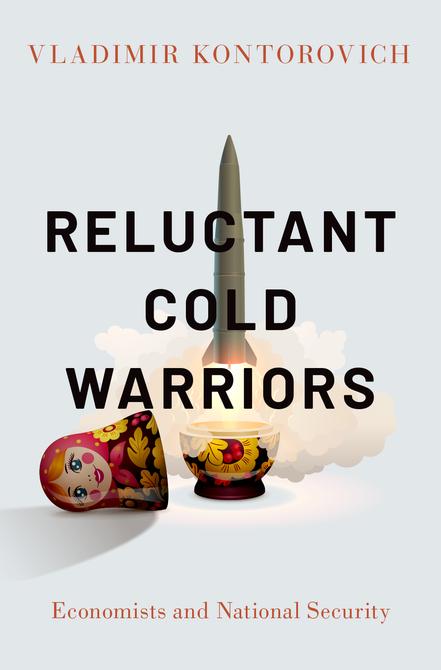
Reluctant Cold Warriors
Economists and National Security z
VLADIMIR KONTOROVICH
Oxford University Press is a department of the University of Oxford. It furthers the University’s objective of excellence in research, scholarship, and education by publishing worldwide. Oxford is a registered trade mark of Oxford University Press in the UK and certain other countries.
Published in the United States of America by Oxford University Press 198 Madison Avenue, New York, NY 10016, United States of America.
© Oxford University Press 2019
All rights reserved. No part of this publication may be reproduced, stored in a retrieval system, or transmitted, in any form or by any means, without the prior permission in writing of Oxford University Press, or as expressly permitted by law, by license, or under terms agreed with the appropriate reproduction rights organization. Inquiries concerning reproduction outside the scope of the above should be sent to the Rights Department, Oxford University Press, at the address above.
You must not circulate this work in any other form and you must impose this same condition on any acquirer.
CIP data is on file at the Library of Congress ISBN 978–0–19–086812–3
1 3 5 7 9 8 6 4 2
Printed by Integrated Books International, United States of America
To the memory of Isaac Kantorovich, Ada Temkina, and Vladimir Shlapentokh
Preface xi
Introduction: Why bother with the writings on a defunct economy by authors now at best retired? xiii
PART I: Sovietology and The Soviet Military Power
1. The Origin and Structure of Sovietology 3
1.1 The Cold War roots 3
1.2 Cradle-to-grave national security funding 5
1.3 The industrial organization of Sovietology 9
1.3.1 Structure and conduct 10
1.3.2 Reliability of results 11
1.3.3 Status within economics 15
1.4 Colleagues and competitors 18
1.4.1 The British, outsiders, political scientists, and others 18
1.4.2 Academics and government analysts 20
2. The Politburo’s Holy of Holies 25
2.1 A pillar of the system’s original design 25
2.2 A wartime-size peacetime military sector 26
2.2.1 Official Soviet data 27
2.2.2 Western estimates 29
2.2.3 Trying to make sense of it all 32
2.3 The defense industry 34
2.3.1 A sector apart 34
2.3.2 The most favored sector 38
2.3.3 The most successful sector 40
2.4 Mobilization preparations 43
2.5 Importance and impact 46
PART II: Soviet Military Power in The Sovietological Mirror
3. The Missing Sector 53
3.1 How to document an absence 53
3.2 Textbooks and readers 54
3.2.1 Which sectors merited a chapter 55
3.2.2 Applying a finer comb: index entries 59
3.3 Research volumes 61
3.4 Publications on the military sector proper 70
3.4.1 Journal articles 70
3.4.2 Books 72
3.5 The user side 74
3.5.1 Comparative economic systems textbooks and readers 74
3.5.2 Introductory economics textbooks 79
3.6 Summary 83
4. Civilianizing the Objectives of the Planners 87
4.1 Objectives and behavior in economics 87
4.2 Who exactly were the planners? 88
4.3 The Soviet account of the rulers’ objectives 89
4.3.1 The validity of self-proclaimed objectives 89
4.3.2 Constitutions and planning manuals 90
4.3.3 Can they be believed? 92
4.4 The Sovietological account of planners’ objectives 93
4.4.1 Sources: fragmentation in action 93
4.4.2 Sovietology’s standard view 94
4.5 Making sense of multiple objectives 98
4.6 Problems with the standard view of the rulers’ objectives 101
4.7 Patterns that seem to suggest production for its own sake 102
4.8 Bringing the Soviet rulers back into the fold of rational actors 104
5. Civilianizing Industrialization 107
5.1 The standard account of industrialization 107
5.2 Stalin’s account of industrialization 109
5.2.1 Objectives of industrialization 109
5.2.2 The role of heavy industry 110
5.3 How the standard account developed 111
5.4 Problems with the standard account 114
5.5 The banality of military industrialization 117
5.6 The real industrialization debate 119
5.7 Taking socialism too seriously 121
5.8 Summary 122
PART III: Why Government Money Could not Buy Economists’ Love
6. The Secrecy Hypothesis 129
6.1 The shape of the constraint 129
6.1.1 Secrecy in Soviet society 129
6.1.2 Economic information: civilian and military sectors 130
6.1.3 Breaches in the wall 133
6.2 The constraint was not binding 135
6.2.1 Concern about secrecy and the recognition of gaps in knowledge 135
6.2.2 The use of roundabout means to overcome secrecy 138
6.2.3 Response to the writings on the military sector 141
6.3 Direct test of the secrecy hypothesis 143
6.3.1 Sovietologists versus the New York Times 143
6.3.2 What an interested scholar found in Soviet publications 147
6.4 Conclusion 150
7. Beating Soviet Swords into Sovietological Ploughshares 153
7.1 The norms of the economics profession 153
7.1.1 How scholars choose research topics 154
7.1.2 How Sovietology fit in 155
7.1.3 Military topics out of favor with economists 157
7.1.4 Dressing military buildup in fashionable civvies 160
7.2 Looking for the essence of socialism 162
7.3 Politics 165
7.3.1 The politics and economics of science 166
7.3.2 Can Sovietologists inform us of each other’s bias? 167
7.3.3 Proliferation of digressions 168
7.3.4 Interpretation: exculpatory incantations 173
7.4 Persistence of civilianization and Soviet economic history 175
8. Civilianization Elsewhere 179
8.1 Writings on the German economy in the 1930s 179
8.1.1 Hitler’s military economy 181
8.1.2 Rearmament in the economics journals of the time 182
8.1.3 Why economists neglected rearmament 184
8.2 (No) violence in primitive societies 187
8.3 The marginalization of military history 189
Conclusion 192
Appendices 197
Appendix 1.1 Alternative estimates of the number of Sovietologists 197
Appendix 3.1 How the literature was surveyed for chapter 3 197
Appendix 3.2 Counting index entries in books 198
Appendix 3.3 Books on the Soviet military sector 199
Appendix 3.4 Books on particular sectors of the Soviet economy other than external and agriculture published before 1975 201
Appendix 3.5 Books on Soviet agriculture 201
Appendix 3.6 Books on Soviet foreign economic relations 204
Appendix 4.1 How the literature was surveyed for chapter 4 205
Appendix 8.1 How literature was surveyed for section 8.1 206
Bibliography 207 Index 251
Preface
In 1996, I wrote a chapter on Western misdiagnoses of the Soviet economy for a planned collective volume devoted to the collapse of Communism, which contained sections on economic growth, the military economy, and reform (Kontorovich 1996). The volume did not materialize, and a section on the treatment of the military aspects of the Soviet economy grew into three articles:
“What Did the Soviet Rulers Maximize?” 2009. Europe-Asia Studies 61 (9): 1579–1601 (coauthored by Alexander Wein);
“A Cold War Creature Which Sat Out the War.” 2014. Europe-Asia Studies 66 (5): 811–29;
“The Military Origins of Soviet Industrialization.” 2015. Comparative Economic Studies 57 (4): 669–92.
These articles have been rewritten to form parts of this book.
I am grateful to the Earhart Foundation and to Haverford College for financial support. Richard Ball, Gregory Brock, Robert Campbell, Janet Ceglowski, Julian Cooper, Robert Davies, Michael Ellman, Richard Ericson, Linda Gerstein, Philip Hanson, Mark Harrison, Gregory Khanin, Frederick Pryor, Peter Rutland, and Vladimir Shlapentokh made valuable suggestions and comments on the drafts of various parts of this book. Lyra Piscitelli edited the manuscript and suggested multiple revisions for consistency and clarity. I thank Amichai Berman, Kenneth Gudel, James Novak, Ioannis Rutledge, Diana Schoder, Alex Wein, and Isaac Wheeler for research assistance and for editing parts of the text.
Introduction: Why bother with the writings on a defunct economy by authors now at best retired?
Social science and the prevention of Armageddon
During World War II, social scientists in the United States were mobilized to help with a variety of tasks previously far beyond their professional expertise, from bombing-target selection to military personnel assignment. The newly found use of the social sciences for national security purposes outlasted the war and was one of the reasons for the field’s rapid expansion after 1945, fueled by government funding.1
One of the new functions of the social scientists working for the Office of Strategic Services (OSS), the wartime precursor of the Central Intelligence Agency (CIA), was advising the government about the nature, capabilities, and prospects of the enemy and allied powers. Previously reserved for generals, journalists, spies, and diplomats, this role was greatly enhanced in subsequent decades, and became a part of the permanent repertory of social science–government relations. But how well did social scientists do the job the government expected of them? I seek to answer this question based on a close look at one academic field, the study of the Soviet economy, called here “Sovietology” for the sake of brevity. The study of all aspects of Soviet society, including politics, society, history, and culture, which is usually denoted as “Sovietology,” is called here “Soviet studies.”
Two characteristics of Sovietology make it especially useful for studying the connection between national interests and the social sciences. First, it was a made-to-order, single-use field. Most other disciplines mobilized for national security needs, both during and after World War II, had a
previous “civilian” history, which shaped their scope and methods. They also had alternative “civilian” contemporary applications, which influenced their development. As will be shown in chapter 1, Sovietology was created from scratch specifically to help the US government fight the Cold War, and expired with the war’s end.
Second, the national security demands on Sovietology were especially urgent. It was summoned to life to assist in waging a conflict with the highest imaginable stakes. Armageddon, which the Soviet collapse helped avert, as the title of Kotkin (2001) proclaims, was the worst of several possible bad outcomes. If the Cold War was a war, it could be lost, difficult as this is to imagine now. Or the Soviet system could have endured until today, as Mikhail Gorbachev has gleefully reminded his critics from time to time, and with it the indignities it imposed on its subjects and the stress of conflict borne by the rest of the world. More people could have fallen under its sway, as Ethiopians and Afghans did in its final decades. It took a massive expenditure of resources, the loss of many lives, and great moral and political strain on the free societies to stand their ground during the half century of the Cold War.2 Given the Sovietologists’ knowledge of these stakes, one can assume that the limitations of their work were not for lack of trying.
The assessment of Sovietology’s response to national security needs is of far more than historical interest. While the urgency of national security demands has declined in the post–Cold War world, the use of social science has become a permanent feature of the national security system. Across American campuses, people with PhDs and knowledge of difficult languages, are analyzing the unfamiliar societies from which current and future threats to our security may spring, under contract with the federal government or in a federally sponsored center.
An assessment of their predecessors’ performance can tell us what may be expected from the national security applications of the social sciences. It is particularly important to identify systematic, predictable biases like those found in other human endeavors. Bureaucrats are known to over-manage and engage in logrolling, universities tend to serve professors rather than students, government regulators become advocates for the industries they are supposed to oversee, and the military often cling to familiar, although obsolete, weapons and strategies.3 Each of these deviations from an organization’s stated purposes can be explained by individual responses to the prevailing incentives. Social sciences, when they inform our security policy about the capabilities, prospects, and intentions
of rival countries, may be subject to similar professional deformations. If these are documented, and their origins traced to the incentives provided by the organization of social science, this knowledge can serve as a corrective lens for the users of social science expertise.
What we needed to know about the Soviet economy
The Soviet challenge to the West had many dimensions—diplomacy, propaganda, subversion—but it was military at the core.4 The imprint it left in American history consists mostly of military or military-related events: the Berlin blockade, the Korean War, the Rosenbergs and the theft of nuclear secrets, the Sputnik panic, the missile gap, the Cuban Missile Crisis, the Vietnam War, President Carter’s freedom from “inordinate fear of Communism,” President Reagan’s Strategic Defense Initiative (SDI), and Governor Michael Dukakis in the tank. The Sputnik, the MiGs of Korea and the SAMs of Vietnam, the missiles of 1962, and those to be parried by the SDI, all had to be designed, tested, and produced before becoming factors in the military and political game. There would have been no Cold War without the Soviet side’s unique capacity to produce large quantities of the most advanced weapons systems.
The part of the economy embodying this capacity is called here “the military sector.” It comprises a collection of military-related activities carried out both in specialized defense establishments and in civilian ones. It includes research, development, and production for military needs, the creation and maintenance of mobilization stocks and capacity, the acquisition of foreign technology for military production, and industrial dispersion, as well as the planning and financing of these activities. As will be shown in chapter 2, this sector constituted a separate economy within the Soviet economy and was not only unusually large and important, but also uniquely successful.
For Sovietology to serve its intended purpose, it had to fulfill two large tasks.5 One was the study of the overall economic potential of the USSR, which formed the foundation of its military might, including the size, growth rate, innovativeness, and adaptability of the economy and its main sectors. This task involved, to a greater or lesser degree, most of what economists do in the normal course of their professional lives, and the academic Sovietologists could not have failed to address it. This is admittedly
a very crude assessment. Gauging their success would require a topic-bytopic analysis, and no such effort is attempted here.
The second task expected of Sovietology was to inquire into the military sector, the part of the economy directly serving the Cold War. The Sovietologists themselves put this task at the top of their list of promises when lobbying for government funding for their field (see section 1.2).
Evaluation of Sovietology’s treatment of the military sector is the subject of this book. The widely known, yet previously unmentioned war economy
The economic decline during the last years of the USSR and the country’s eventual collapse gave rise to two new strands of research. One dealt with “transition,” or the introduction of market institutions into the formerly centrally planned economy. Writings in this genre often included brief descriptions of the Soviet economy as the departure point in the transition process. Another line of scholarship investigated the Soviet collapse in the context of the country’s economic history. In both of these literatures, one can read that “the communist economy was foremost a war economy” (Åslund 2002, 31, 38); “At the heart of the former Soviet economy was a defence industry of quite extraordinary scale. Its priority development over several decades distorted the development of the entire economy” (Cooper 1993, 3); and “The importance of the defence sector is hard to exaggerate” (Hanson 2003, 31). Further, rapid economic growth during and after industrialization had “a strictly military orientation.” 6 The economy was designed for military production rather than consumer welfare and was most successful at producing large quantities of military goods. 7
Serving the needs of the military is said not only to have dominated the life of the Soviet economy, but also to bear much responsibility for its death. The common argument in many explanations of the system’s demise is that excessive military spending and attendant economic irrationality depleted the civilian economy and promoted stagnation.8 Hanson (2003, 247–48) hypothesizes a different, though equally prominent role for arms production in the Soviet demise.
After 1991, disposing of the military industry’s inheritance, under the name of conversion, became one of the main issues of transition policy. By
my count, over a dozen books on the subject appeared in the West between 1993 and 2006, more than on any other single sector of the post-Soviet economies.
Most of the writers quoted here present the pre-eminence of the military sector as a self-evident fact, without citing any supporting sources, as if conveying common knowledge. Yet such statements would be surprising for a reader of the standard textbooks on the Soviet economy written only a few years earlier.
Consider the encyclopedic 600-page treatise by leading authority and Harvard professor János Kornai (1992). It was published by Princeton University Press and boasts 45 pages of bibliography. Far from speaking of a “militarized” or “war” economy, the book barely mentions military factors, listing the military industry as number seven among 11 priorities in allocation of investment.9 Another popular textbook, the almost 400-page Soviet Economic System by Alec Nove (1986), one of the masters in the field, went through three editions. It has three references to the military in the index, the same number of references as to “planning in ton-kilometers,” a technical matter of little systemic importance. None of the references concern “the overexpanded military-industrial complex,” which the same author would acknowledge eight years later (Nove 1994, 349).
If the transition writers in the 1990s were correct in their characterization of the Soviet economy, the military sector was a matter of tremendous importance for US national security and, indeed, the survival of the world. One would expect the academic experts on the Soviet economy to explore its every angle and to inform the public back when it mattered. If the Nove and Kornai books are typical of the studies of the Soviet economy during its lifetime, they did not, and it is important to know why.
Main findings and methods
A massive survey of the literature in chapter 3 confirms the suspicion raised by the Kornai and Nove books. Over its lifetime, Sovietology largely ignored the military sector, lavishing its attention instead on civilian sectors of lesser importance to the West and also of lower standing in the Soviet priority ranking. Also, when addressing a subject that, by the Soviets’ own account, had important military aspects, Sovietologists tended to ignore credible official military interpretations, and substitute their own contrived civilian ones. I call this phenomenon “civilianization” (chapters 4 and 5).
Introduction
I establish the neglect of the military sector using a straightforward and transparent method, comparing the number of references to the military and civilian sectors in Sovietological literature. The meaning of civilianization, however, requires some explanation. Sovietologists worked almost exclusively with sources of Soviet origin. Analyzing the economy meant, to a large degree, testing the Soviet-offered data, descriptions, and interpretations for reliability, and using the more reliable ones. Civilianization represents a systematic bias in this process, as the official statements on military significance of economic policies are downplayed irrespective of their reliability. Official statements emphasizing the civilian aspects of the same policies are played up and made to carry more explanatory weight than they are capable of. In asserting this bias, I do not rely on any generalized notions of whether one can or cannot “trust the Soviets,” but rather on the detailed economic and historical analysis of specific official pronouncements and the uses to which they were put by Sovietologists (chapters 4 and 5, sections 7.2 and 7.3.3).
The neglect of the military sector in Western literature, though not its civilianization, may be explained by extraordinary Soviet secrecy. However, there is no evidence that Sovietologists were much concerned with secrecy, or were interested in the work of the outsiders who managed to circumvent it. Secrecy made the study of the military sector more difficult, but far from blocked it, as the work of these outsiders demonstrated (section 6.3.2).
Sovietologists neglected the military sector and civilianized its important aspects as a matter of choice, not necessity. Self-interest impelled scholars in the small, low-prestige field to follow the agenda of the larger discipline of economics, which had little concern for military matters.
Investigating socialism’s claims of greater efficiency, stability, and equality was seen as the central mission of Sovietology, and such a retrograde part of the economy as the military sector was of no help in that task. Many authors were uneasy about as much as mentioning the military sector and rushed to vouch for the Soviets’ purely defensive intent, using unsourced and often inaccurate geopolitical and historical arguments (chapter 7).
The findings of the book suggest a revision of Soviet economic history, though not in the obvious way of introducing new evidence or interpretations. Chapters 4 and 5 draw a picture of the Soviet economy that is more militaristic than that provided by the standard account in Sovietological literature. This is hardly news, as research in Soviet archives after 1991
uncovered a wealth of information on the importance of the military sector in general, and in the First Five-Year Plan, the topic of chapter 5, in particular (Ellman 2008b, 104–5). Yet this avalanche of evidence had little effect on the acceptability of the civilianized account, which outlived both Sovietology and its subject and is well represented in the current literature. This persistence reflects a characteristic of Sovietological knowledge that I call “fragmentation.” Opposing views coexist in the literature, sometimes under the cover of the same textbook, without their adherents confronting each other or even acknowledging each other’s existence. Thus, the dominant civilianized accounts of Soviet planners’ objectives and of the First Five-Year Plan in Sovietology existed alongside minority positions stressing military factors, but the twain never met. In a fragmented field, evidence produced in favor of one position does not affect the standing of the opposing one, just as the appearance of Kornai’s Soft Budget Constraint theory did not lead anyone to question the Adjusted Factor Cost Standard (explained in section 1.3.2).
This book provides the first critical assessment of the standard accounts of two topics, the objectives of central planners and the intent of the First Five-Year Plan. These accounts advance the proposition that the Soviets pursued growth for its own sake, which would make the thrust of their economic policies irrational, and thus put them beyond the pale of economic analysis. The civilianized version of the First Five-Year Plan has additional elements, such as the important role of the 1920s ideological debate—and of a few individual economists involved therein—in originating the plan strategy, as well as the derivation of the plan’s stress on investment goods from Marx’s writings. I show the weaknesses of these interpretations, and propose a simpler, though less pacific, interpretation of the plan’s origins.
A disclaimer
At the center of this book is the failure of an academic field to perform an important task for which, in large measure, it was created. With some chapters documenting the dimensions of this failure, and others exploring its causes, the tone of the book is inevitably critical. This does not mean the author holds his subject in low regard. Americans studying the Soviet economy faced formidable obstacles—the small number of fellow practitioners, the lack of access to the object of study, and the unusual conceptual difficulties of understanding a new type of economy. Despite all this, the field of Sovietology performed many valuable services for society
and scholarship in its short life span. My criticism of some aspects of this enterprise is motivated by my belief in its seriousness and worthwhile nature.
The same is true at the level of individual scholars. In this book, I take issue with the writings of the people whose work I value highly and from whom I have learned much. My disagreement with their specific arguments does not necessarily signify a rejection of the articles or books, often excellent, where these arguments appear, or of the broader achievements of their authors.
Notes
1. Backhouse and Fontaine (2010, 8); Leonard (1991, 262–69) specifically on economics; Crowther-Heyck (2006, 425–26) on post-war years.
2. On resources, see Higgs (1994).
3. Williamson (1985, 148–59); Sykes (1990); Viscusi et al. (1995, 38–39); Keller (2002).
4. National Security Council ([1950] 1975, 64–67); Friedberg (2000, 36–40, 81).
5. There are other valid criteria for judging an academic field. For an evaluation of Sovietology’s contributions to the general understanding of society and the common arsenal of research tools, see Ellman (2009).
6. Gaidar (2003, 23); Earle and Komarov (1998, 6); Haynes and Husan (2003, 119); Pomer (2001, 140).
7. Skidelsky (1995, 103, 109, 111); subtitle of Gaddy (1996); Pomfret (2002, 18).
8. Cooper (1993, 1); Layard and Parker (1996, 47–48); Reddaway and Glinski (2001, 259–60). Easterly and Fischer (1995, 347–48, 361) test econometrically the impact of military spending on growth slowdown and find a small negative effect, a common result in such exercises.
9. On page 174, there are also passing references to military expenditures and to political control over armed forces.