Oxford University Press is a department of the University of Oxford. It furthers the University’s objective of excellence in research, scholarship, and education by publishing worldwide. Oxford is a registered trade mark of Oxford University Press in the UK and certain other countries.
Published in the United States of America by Oxford University Press 198 Madison Avenue, New York, NY 10016, United States of America.
All rights reserved. No part of this publication may be reproduced, stored in a retrieval system, or transmitted, in any form or by any means, without the prior permission in writing of Oxford University Press, or as expressly permitted by law, by license, or under terms agreed with the appropriate reproduction rights organization. Inquiries concerning reproduction outside the scope of the above should be sent to the Rights Department, Oxford University Press, at the address above.
You must not circulate this work in any other form and you must impose this same condition on any acquirer.
Library of Congress Cataloging-in-Publication Data
Names: Voparil, Christopher J., 1969– author.
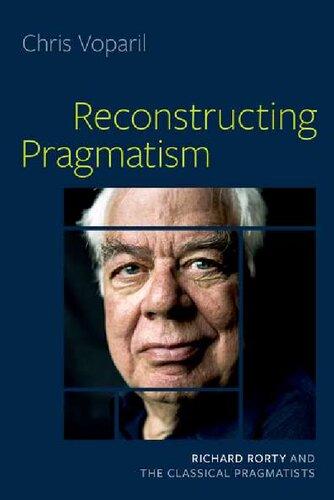
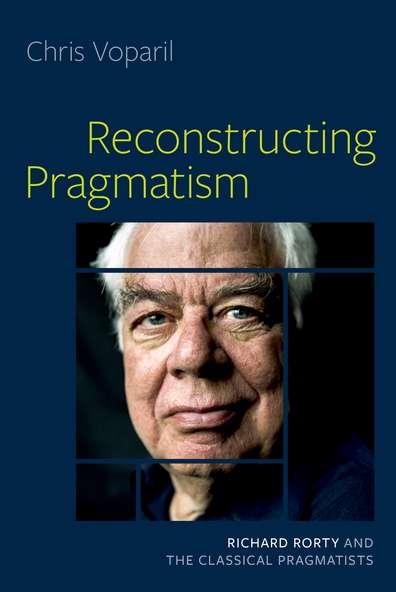
Title: Reconstructing pragmatism : Richard Rorty and the classical pragmatists / Chris Voparil.
Description: New York, NY, United States of America : Oxford University Press, [2022] | Includes bibliographical references and index.
Identifiers: LCCN 2021024181 (print) | LCCN 2021024182 (ebook) | ISBN 9780197605721 | ISBN 9780197605738 | ISBN 9780197605752 | ISBN 9780197605745 (epub)
Subjects: LCSH: Rorty, Richard. | Pragmatism.
Classification: LCC B 945 . R524 V67 2022 (print) | LCC B 945 . R524 (ebook) | DDC 144/.3—dc23
LC record available at https://lccn.loc.gov/2021024181 LC ebook record available at https://lccn.loc.gov/2021024182
DOI: 10.1093/oso/9780197605721.001.0001
1 3 5 7 9 8 6 4 2
Printed by Integrated Books International, United States of America
For Mariana—
Gracias por tu paciencia y amor
1. Rorty and Peirce: Pragmatism, Realism, and the Practice of Inquiry
2. Rorty and James: The Ethics and Epistemology of Belief
3. Rorty and Dewey: Pragmatist Philosophy as Cultural Criticism
4. Rorty and Royce: The Cultural Politics of Community, Loyalty, and
5. Rorty and Addams: Pragmatist
Acknowledgments
This project has been a long time in the making and has incurred incalculable debts with each passing year. My understanding of classical pragmatism, fallible and incomplete as it is, owes much to the fine work of many scholars of the pragmatist tradition, as evidenced throughout this book’s references. In a way, this book took as long as it did because to carry it out I had to grow into the thinker capable of completing it. This may suggest a journey of selfedification, but such growth is really about listening to and learning from others, whether in print or in person, and getting to the point where one can see what they see. I feel deep gratitude for the many learned interlocutors I have had the good fortune to know. Their generosity of wisdom and patience with my persistent queries exemplify the pragmatist philosophical spirit at its best.
There was a time when writing on Rorty wasn’t especially embraced in many philosophical, or even pragmatist venues. What is more, the body of scholarship on Rorty, until relatively recently, was not particularly helpful for thinking about his relation to classical pragmatism. Not only did nearly all of it pass negative, sometimes downright dismissive, judgment on what Rorty had to say about the classical figures, there was virtually no overlap between those who studied the classical pragmatists and those who had substantive interest in Rorty. The state of affairs has improved since I embarked upon this project. But it was quite an obstacle at the outset. The book in your hands (or on your screen) has its flaws and shortcomings, among them, no doubt, a tendency to overemphasize sites of positive connection between Rorty and the classical pragmatists considered here and to undersell some of the
disagreements. Future scholars of pragmatism, I trust, will chart course corrections in my interpretations. My hope is that there is value in their having some initial signposts.
I am grateful for the philosophical communities where much of this work was first presented. These contexts provided opportunities to receive feedback, but also to build relationships and, in some cases, deep friendships. These groups include the Society for the Advancement of American Philosophy, the Central European Pragmatist Forum, the European Pragmatism Association, the Southeast Roundtable on Philosophy of the Americas, and the Richard Rorty Society, as well as various other pragmatist research groups in South America and Europe that I have been fortunate to attend. I also thank, for their immense learning and insightful discussion, the participants in the “Peirce, James, and the Origins of Pragmatism” summer workshop at Emory University in 2012, led by John Stuhr and Vincent Colapietro.
I want to acknowledge, in particular, illuminating conversations and exchanges with Douglas Anderson, Richard Bernstein, Rosa Calcaterra, James Campbell, Vincent Colapietro, Harvey Cormier, William Curtis, Susana de Castro, Ramón Del Castillo, Susan Dieleman, Roberta Dreon, the late Michael Eldridge, Marilyn Fischer, Jim Garrison, Neil Gascoigne, the late William Gavin, Judith Green, Richard Hart, David Henderson, Larry Hickman, David Hildebrand, Brendan Hogan, Marianne Janack, Mark Johnson, Jacquelyn Kegley, Colin Koopman, Alexander Kremer, David Macarthur, Giovanni Maddalena, Stéphane Madelrieux, Wojciech Małecki, the late John McDermott, Eduardo Mendieta, Carlos Mougan, Gregory Pappas, Federico Penelas, Scott Pratt, Bjørn Ramberg, Michael Raposa, David Rondel, Henrik Rydenfelt, John Ryder, Mark Sanders, Charlene Haddock Seigfried, Richard Shusterman, Kenneth Stikkers, John Stuhr, Dwayne Tunstall, Emil Višňovský, and Judy Whipps. Three anonymous reviewers were enormously helpful in improving the manuscript. Lucy Randall’s insights and support were invaluable throughout the overlong
process of gestation. Special thanks are due to several who took time to read and comment on parts of the manuscript: William Curtis, Neil Gascoigne, Colin Koopman, and Scott Pratt. For his unending encouragement and exemplary mentorship, to Dick Bernstein, my former teacher and Rorty’s lifelong friend, I owe a debt of gratitude beyond words. It was in his year-long seminar on pragmatism circa 1995 that unbeknownst to me the seeds for this book were planted and that I first met Rorty, when we showed up to class one day and found him sitting in the front of the room. There no doubt were others whom I have failed to recall. The shortcomings of this work remain despite their best efforts, without which this book and my own grasp of the pragmatic tradition would be immeasurably inferior.
Finally, I thank my supportive parents, parents-in-law, family, and friends, especially my wife, Mariana, and sons, Aidan and Devin, for putting up with my reclusive ways and giving me the space and loving support to see the project to fruition.
Early, briefer versions of Chapters 2 and 3 appeared as:
“James and Rorty on Irony, Moral Commitment, and the Ethics of Belief.” William James Studies, 12, no. 2 (2016): 1–27.
“Pragmatist Philosophy and Enlarging Human Freedom: Rorty’s Deweyan Pragmatism.” In Richard Rorty: From Pragmatist Philosophy to Cultural Politics, ed. Alexander Gröschner, Colin Koopman, and Mike Sandbothe. New York: Bloomsbury, 2013, pp. 107–126.
I gratefully acknowledge their permission to reprint parts of these essays.
Abbreviations
Citations to Charles Sanders Peirce’s writings will be keyed to the 8-volume Collected Papers (Harvard University Press, 1958–1966).
Parenthetical citations will follow the standard formula, according to which (CP 1:123) denotes page 123 of volume 1 of Peirce’s Collected Papers.
Citations to John Dewey’s writings will be keyed to the 37volume The Collected Works of John Dewey (Southern Illinois University Press, 1969–1991). The Collected Works is organized into three chronological periods, The Early Works, The Middle Works, and The Later Works. Parenthetical citations will follow the standard formula, according to which (EW 4:30) denotes page 30 of volume 4 of The Early Works and (MW 6:100) designates page 100 of volume 6 of The Middle Works.
Citations to Richard Rorty’s major works will use the following abbreviations:
AOC Achieving Our Country: Leftist Thought in Twentieth-Century America (Cambridge, MA: Harvard University Press, 1998)
CIS Contingency, Irony, and Solidarity (New York: Cambridge University Press, 1989)
CP Consequences of Pragmatism: Essays 1972–1980 (Minneapolis: University of Minnesota Press, 1982)
EHO Essays on Heidegger and Others: Philosophical Papers, Vol. 2 (New York: Cambridge University Press, 1991)
LT The Linguistic Turn: Essays in Philosophical Method, ed. Richard Rorty (Chicago: University of Chicago Press, 1967)
OPP On Philosophy and Philosophers: Unpublished Papers, 1960–2000, ed. W.P. Małecki and Chris Voparil (New York: Cambridge University Press, 2020)
Abbreviations
ORT Objectivity, Relativism, and Truth: Philosophical Papers, Vol. 1 (New York: Cambridge University Press, 1991)
PCP Philosophy as Cultural Politics: Philosophical Papers, Vol. 4 (New York: Cambridge University Press, 2007)
PMN Philosophy and the Mirror of Nature (Princeton, NJ: Princeton University Press, 1979)
PSH Philosophy and Social Hope (New York: Penguin Books, 1999)
RR The Rorty Reader, ed. Christopher J. Voparil and Richard J. Bernstein (Malden, MA: Wiley-Blackwell, 2010)
RRP Richard Rorty Papers. MS-C017. Special Collections and Archives, The UC Irvine Libraries, Irvine, California. Citations to RRP include Box#, Folder#
TP Truth and Progress: Philosophical Papers, Vol. 3 (New York: Cambridge University Press, 1998)
Introduction
Learning from Rorty’s Reconstructed Pragmatism
The contemporary resurgence of philosophical pragmatism faces a critical impasse. On the one hand, creative energies abound. A new generation of scholars and practitioners of American philosophy who were drawn to the tradition’s classical figures by the leading voice of the pragmatist revival, Richard Rorty, is supplanting an older one that viewed him as an unhelpful interloper who did as much to distort as to revive. On the other hand, divisions and internecine quarrels continually thwart and fragment these new energies. Devotees of American philosophy often seem content to incite antipathy among and between “classico,” “paleo,” “neo,” and “new” pragmatisms, and to self-isolate through factions and exclusionary identifications with single thinkers.1
Paradoxically, Rorty’s work, and the massive body of secondary literature around it, are at the center of both dynamics: resurgence and fragmentation. His intellectual creativity, lively prose, bridgebuilding across traditions and disciplines, and immense international renown continue to be a font of creative and critical energy. The cross-disciplinary influence and global reach of Rorty’s thought have interjected pragmatism into conversations not only in philosophy but in fields as diverse as political theory, sociology, legal studies, international relations, feminist studies, literary theory, business ethics, and the philosophy of education. International interest in the pragmatic tradition is at an all-time high and actively ascendant.
The success of Rorty’s championing of pragmatism nevertheless remains double-edged. Back in 1982 Garry Brodsky predicted that Rorty’s writings “should initiate a new stage of creative and scholarly work on pragmatism and the several pragmatists” (1982, 333). Rorty indeed proved influential in initiating a period of renewed interest in pragmatism and widened its relevance, though much of his reception was outside philosophy, as the preceding list suggests. Among those already doing scholarly work on pragmatism, Brodsky’s prognostication missed the mark. Rorty’s overtures were not received constructively, to put it mildly. Quite the contrary; for years, if you came to pragmatism through the classical thinkers and the scholarship on them, you were taught to be reflexively critical of Rorty.2 Nearly four decades later, for all his international renown and role in pragmatism’s resurgence, when it comes to the classical pragmatists we might say that Rorty’s work has blocked the road of inquiry. His polemical claims and selective interpretations spurred the community to draw sharp lines of demarcation that distinguish “classical” or “paleo” pragmatism3 from its “neo” and “new” offspring to protect both classical and new pragmatisms alike from Rorty’s alleged distorted readings. Compounding matters, those who discovered pragmatism because of Rorty often lacked a strong motive to delve deeply into the classical figures. As a result, the landscape features separate camps, with little bridge-building and fruitful dialogue, and many missed opportunities for growth.
To put it another way, contemporary pragmatism as a whole has yet to learn from Rorty, in the sense of fully engaging his challenges and thinking through their implications for their own commitments and preoccupations. This is not to say that Rorty hasn’t been read and written about. If Rorty indeed was, for a time, “the most talked-about philosopher” (Gottlieb 1991), much of what was said was not particularly positive. Rorty’s iconoclastic, stinginggadfly assaults on long-cherished notions of traditional philosophy earned him enemies far and wide.4 Pragmatist philosophers in particular found his embrace of language over experience, his
apparent dismissal of pragmatist methodology (Seigfried 1996, 5),5 and his blatant disregard for truth and objectivity (Misak 2007), strikingly offensive.6 Deweyan pragmatists, above all, found Rorty’s freewheeling interpretations to transmit sufficient distortion and misunderstanding as to threaten the integrity of the pragmatic tradition as a whole.7
The specter of Rorty functions as a negative, fixed pole against which philosophers and intellectuals of all stripes position themselves. Virtually all pragmatists on the contemporary scene, whether classical or “new,” Deweyan, Jamesian, or Peircean, use Rorty as a foil to justify their positions, including Richard Bernstein, Robert Brandom, Susan Haack, Larry Hickman, Joseph Margolis, John McDermott, Cheryl Misak, Richard Posner, Huw Price, Hilary Putnam, Charlene Haddock Seigfried, Richard Shusterman, John Stuhr, Robert Talisse, and Cornel West, among many others. While these contrasts and divisions may have heuristic value within limited contexts, when reified into opposing camps, they become one-dimensional and obstruct further advancement. The need to defend the classical figures and discredit Rorty, while showing signs of abating as of late, has sidetracked contemporary pragmatists from the development of shared projects which realize Dewey’s aim of making philosophy “a resource in dealing with the problems that are urgent in contemporary life” rather than “ruminating on its own cud” (LW 17:85). This diagnosis is not new. Others, like Douglas Anderson, have lamented the “scholasticizing of the American tradition in which folks tend to associate with one thinker and then focus on what makes that thinker different from—and perhaps ‘better’ than—the others,” culminating in “schools of Peirceans, Jamesians, and Deweyans who overlook or downplay the very real and important agreements among the pragmatists” (2009, 495). Alas, little progress has been made in alleviating it.
Contributing to this state of affairs are two limitations in the existing secondary literature that result in having virtually nowhere to turn for constructive scholarly treatments of Rorty’s relation to
classical pragmatism. One is the overwhelmingly negative, critical tenor that characterizes most work on Rorty’s relation to classical pragmatism by scholars of American philosophy. Despite glimpses, in the time since Rorty’s death in 2007, of a less hostile, more ecumenical approach, the idea that there exists an unbridgeable divide separating classical from neopragmatism remains entrenched.8 One is hard-pressed to find accounts written in the last four decades on any of the classical pragmatists, or by any “new” pragmatists (see Misak 2007), that does not use a caricature of Rorty as a wedge.9 Reams of dismissive critical interpretation which obscure more than elucidate and seemingly obligatory passing swipes which reinforce shallow readings have made the figure and oeuvre of Rorty more caricatured than understood. This dismissive orientation toward Rorty, insofar as it has preempted learning from him, has become an obstacle to the future development of the pragmatic tradition.
The second limitation is the dearth of discussion of the classical pragmatists’ influence on Rorty’s intellectual positions in even the best Rorty-friendly treatments.10 Some treat in brief compass the “big three” of Charles Sanders Peirce, William James, and John Dewey, but nothing at all regarding other classical pragmatists, like Josiah Royce and Jane Addams.11 Among the very good accounts we find comparative examination of the relation of Rorty’s project to the classical pragmatists (again, only the big three), but independently of the question of their direct intellectual influence on Rorty.12 Robert Westbrook (2005), Richard Bernstein (2010), and Michael Bacon (2012b) offer enlightening expositions of the ideas and arguments of both classical and contemporary pragmatists, highlighting important continuities between them. Colin Koopman (2009) and David Rondel (2018) refreshingly draw from both classical pragmatist and Rortyan perspectives to capture their best and most timely collective insights. None of these fine works gives us an internal account of the relation between classical and Rortyan pragmatism. In sum, Rorty not only
still awaits a (full) definitive intellectual biography;13 there exists no in-depth scholarly treatment of his relation to the classical figures of pragmatism.
Reconstructing Pragmatism seeks finally to overcome prevailing caricatures of Rorty and dominant assumptions about his neglect or misunderstanding of the classical pragmatists. It might be thought of as a prolegomenon to the future development of pragmatism that does a lot of road-clearing work, sweeping away misconceptions and caricatures that block inquiry, but also intimating productive avenues for the tradition’s collective selfcriticism and renewal. The book’s basic claim is that the path forward runs through, rather than around or against, Rorty. The value of this direct approach is twofold: first, Rorty offers both critical challenges and affirmations, largely untapped, for articulating classical pragmatism’s ongoing relevance; and second, reading the classical pragmatists in nonpolemical dialogue with Rorty reveals limitations of received images of the classical pragmatists that predominate in current debates, opening up exciting potential for new, fresher modes of understanding. The chapters that follow endeavor to understand Rorty’s relation to the classical figures of American pragmatism, specifically Charles Sanders Peirce, William James, John Dewey, Josiah Royce, and Jane Addams. The best metaphor for characterizing this relation, I argue, is “reconstruction.” Viewing Rorty’s relation to pragmatism’s classical forebears through the lens of reconstruction directs us to confront the motivations and aims of the larger project guiding his critical engagement with their perspectives.14 Interpreting Rorty’s philosophical positions in isolation from these broader intentions has impoverished our understanding, making his stances appear shallow and ill-conceived, and deprived us of the creative impulse to growth that his work, at its best, sought to inspire. Rorty’s relevance for the ongoing vitality of pragmatism stems from his commitment to what Philip Kitcher has described in James and Dewey as the effort “to focus philosophy on issues that matter to people” (2012, xii).
Before proceeding, let me address the question begged here: Why not simply go around Rorty? Why is this such a problem? After all, among contemporary pragmatists we have the fine work of leading thinkers like Robert Brandom (e.g., 2011) and Huw Price (2011; 2013), who not only eschew Rorty-bashing but acknowledge their intellectual debts to him even as they judge his perspective critically and move past it. Others, like Susan Haack (1993a; 1998), Cheryl Misak (2000), and, to some extent, Kitcher (2012) and Scott Aikin and Robert Talisse (2017), define their positions against Rorty’s and say little more about him, seemingly no worse for the omission. This latter group falls into a slightly different category to the extent that they more explicitly seek to update or refresh the thought of classical pragmatist figures, especially Peirce and Dewey, in a way not on the agenda for Brandom or Price. Nevertheless, I want to suggest that our understanding of pragmatism as a whole, our grasp of Rorty’s thought, and even the stances of these contemporary pragmatists themselves, are enriched by taking Rorty more seriously. That is, each time Rorty’s work is caricatured rather than learned from, contemporary pragmatism remains not as strong or critically self-aware as it could be. Opportunities for further inquiry are closed and no one learns anything new.
To be clear, I am not advocating uncritical acceptance of Rorty’s pragmatism. Take the example of Price’s recent work (e.g., 2011; 2013). Fundamental differences abound between them on a number of substantive philosophical issues (see Rorty and Price 2010). Nonetheless, the development of Price’s own nuanced thinking around representationalism owes much to his sustained engagement with Rorty. Moreover, Price illuminates implicit tensions in Rorty’s own account that Rorty, arguably, could or should have accepted without violating his own commitments, potentially resulting in new insights. I seek to call attention to the missed opportunities and what is lost by dismissing him as confused, incoherent, or a pragmatist infidel. For another case, let us look at Kitcher, a more germane example given our interests here
in classical pragmatism.15 Kitcher aligns himself with Rorty over neopragmatists like Putnam and Brandom, who, in Kitcher’s view, domesticate the reconstructive impulses of the classical pragmatists to make them safe for the conventional practice of philosophy. By contrast, Kitcher acknowledges, “Rorty reads the pragmatists, as I do, in a more radical way” (2012, xiv). Indeed, Kitcher recognizes that “One of the great merits of Richard Rorty’s reading of the classical American pragmatists, particularly James and Dewey, lies in his recognition of their desire for a completely different approach to philosophy” (2012, 192–93). Kitcher even holds that Rorty’s “critique of philosophy-as-usual is as necessary today as it was in the 1970s or the 1920s.” However, he immediately adds: “I differ from him only in seeing the possibility of renewal where he envisaged a burial.” With this reductive characterization—Rorty’s thought isn’t engaged beyond broad brushstrokes and nothing after the 1980s is even cited—he unfortunately moves past Rorty rather quickly with a mere “So I side with Dewey” (2012, 21). It is taken as axiomatic that Rorty has nothing to offer Kitcher’s own reconstructive efforts and that contemporary reconstructions like Kitcher’s demand an either/or choice between Rorty’s and Dewey’s pragmatisms. And this dismissal is one of the more sympathetic instances. Kitcher is by no means hostile to Rorty and generously acknowledges his personal debt to him.
It should be said that Rorty often was his own worst enemy in inviting caricatured interpretations. He seemed to take mischievous pleasure in pushing the buttons of philosophers with offhanded dismissals of long-cherished commitments and maverick pronouncements of seemingly unwise and unnuanced nature. At times, Rorty did utter claims that seemed only to distort. In these cases, the visceral reactions they sparked often derailed productive inquiry. We easily could catalog a short list of insouciant assertions that were responsible for the lion’s share of anti-Rorty ire.16 As we shall see in the first chapter, there is no better example than his needless despoiling of Peirce’s contribution to pragmatism in his
1979 APA Presidential Address. Based on that remark, one would not guess that he had learned from leading Peirce scholars, devoted considerable study to his writings, and published his earliest articles on Peirce’s Categories. We must, then, distinguish the rhetoric of what Santiago Rey (2017) dubbed “Rorty the outrageous” from the substantive positions developed in his more thoughtful, reasoned mode. Perhaps, as Rey argues, the bold and outlandish statements served an intentional purpose in the performative dimension of Rorty’s breaking the crust of philosophical convention and shouldn’t be cast aside as unreasoned or discounted as carelessly excessive. At the same time, as Bernstein has observed, Rorty underestimated the “double-edged” nature of his rhetoric, how his attempts to break the crust of philosophical convention both gave ammunition to critics and, ironically, hardened the very commitments he sought to transform (2014, 13). One of our tasks in this book is to reconstruct the full scope of his sustained arguments and longstanding commitments to provide the scholarly elaboration that Rorty himself not only was disinclined to provide but often, wittingly or unwittingly, obscured. Learning from Rorty sometimes requires reconstructing his radical rhetoric to factor in what Bernstein calls “the more ‘reasonable’ ” Rorty (2014, 12). As a result, we will traffic not only in Rorty’s reconstructions but my own.
To be a little more specific, the book seeks to elucidate Rorty’s reconstructions of the thought of the classical pragmatists and to gather the insights and implications within these reconstructions that bear on the ongoing development of the pragmatic tradition. Broadly speaking, there are multiple aims at work throughout these pages. The first is straightforward scholarly recovery that seeks to introduce little-known historical and textual backgrounds to illuminate Rorty’s relation to the classical pragmatists as well as to clarify his own positions. The second aim is to highlight points where constructive dialogue is possible between Rorty’s commitments and objectives and those of the classical figures, as a corrective to
the many polemical readings that exist. The third is to offer insight into the precise nature of Rorty’s reconstructive efforts— that is, the why of his selective readings and partial endorsements of their views. Accomplishing this requires appreciating the least understood aspect of Rorty’s philosophy—namely, the intentionality and normative orientation driving his reconstructions: what I refer to as Rorty’s “pragmatic maxim,” a notion elaborated in the next section. The fourth aim looks to the future of pragmatism after Rorty and involves sweeping away the entrenched caricatures to alter the terms on which Rorty’s relation to classical pragmatism is evaluated, toward the goal of better marshalling the positive resources for internal collective self-criticism and development of the tradition.
Because Rorty’s relation to each of the five classical pragmatists who receive a chapter is different, the relative weights of the four aims—scholarly recovery, constructive dialogue, understanding Rorty’s reconstructions, and advancing pragmatism’s future— shift in each case. For example, in Chapter 1 on Peirce, the aim of scholarly recovery predominates, as Rorty’s early work on the founding pragmatist is likely the least familiar to most readers. In the case of James in the second chapter, there is less emphasis on the second aim of transcending polemics because there has been so much less ink devoted to contesting Rorty’s reading of James than his reading of Dewey. As the figure who shares the most with Rorty in basic orientation, Rorty’s critical reconstruction of James is less radical and controversial. As a result, constructive dialogue dominates in the chapter. In Chapter 3, less attention to the first aim is needed, given the amount of scholarly attention Rorty’s relation to Dewey already has received in the secondary literature, and the second and third aims take center stage. Chapters 4 and 5 diverge somewhat from the three that precede them based on the nature of Rorty’s relation to Royce and Addams, respectively. In the chapter on Rorty and Royce, the third aim fades, since Rorty wrote so little on Royce. Nevertheless, a bit of scholarly recovery
is necessary to make sense of the prominence of Rorty’s appeal to “loyalty” in his famous essay, “Justice as a Larger Loyalty,” which contains no allusions to the author of The Philosophy of Loyalty. The treatments of both Royce and Addams emphasize unexpected lines of constructive dialogue that generate critical resources for pragmatism’s contemporary relevance. The chapter on Addams contains little of the first and third aims, given the dearth of direct philosophical influence of Addams on Rorty. However, the second and fourth aims generate valuable insights toward the development of pragmatist social ethics that emerge from juxtaposing their surprisingly consonant commitments. An emphasis throughout the chapters is highlighting commonalities and shared projects where a deeper engagement with Rortyan resources should be of interest to pragmatists of all types, including Peircean and Deweyan.
Rorty’s Pragmatic Maxim: Putting Democracy First
In this book, I read Rorty as reconstructing the ideas of the classical pragmatists, integrating contemporary philosophical insights their work came too early to absorb and foregrounding emphases that align with his own aims. These basic aims are Deweyan in nature: deepening democracy and using philosophy as a vehicle for social change. On my reading, Rorty’s work falls within rather than outside existing broad-brush characterizations of the pragmatic tradition. For example, Bernstein (2010) emphasizes the deep rejection of Cartesianism and the spectator theory of knowledge. Scott Pratt identifies four commitments as “a common core of classical pragmatism”: interaction, pluralism, community, and growth (2002, 20). Talisse and Aikin point to the shared “aspiration of devising a philosophy that is at once naturalist and humanist” (2011, 4). Attention to the classical pragmatists’ anti-Kantianism— one of Rorty’s most persistent themes—including Peirce, in
particular, has emerged to suggest more commonality than previously recognized.17 I hope to give the currents of Rorty’s pragmatism that cohere with these common commitments the exposition they have long lacked.18
The metaphor of reconstruction resonates with an active pragmatic attitude alive to the transitional character of human life and oriented to improve rather than unconditionally accept existing forms. This is a key point. As Kitcher has explained,
Those who disparage pragmatism, as well as some admirers of the movement, are all too eager to suppose that James and Dewey wanted to offer general theories of Truth and Meaning, Mind and Reality, and thus to ignore explicit pronouncements about “the whole function of philosophy,” about the need for “reconstruction in philosophy,” and about the centrality to philosophy of “the general theory of education.” (2012, 193)
Indeed, perhaps no one is more associated with the notion of reconstruction than Dewey. In his Reconstruction in Philosophy, he envisioned, as an alternative to the “vain metaphysics and idle epistemology” that seeks refuge in the fixed and certain, an engaged practice of philosophy that works to ameliorate “the stresses and strains in the community life” from which it emerged (1982, 151, 256).19 Reconstruction also is apt for illuminating the classical pragmatists’ relations to each other.20
But does this emphasis on reconstruction overstate or misrepresent the driving force behind Rorty’s work? After all, one of the most entrenched views among pragmatists is the contrary one that “Rorty seeks to deconstruct philosophy; Dewey sought to reconstruct it” (Westbrook 1991, 540). No less astute reader of Rorty than Bernstein has postulated that Rorty often “protests too much.” Rorty’s personal and intellectual journey cannot be disassociated from a deep sense of disillusionment regarding philosophy’s promise—the “God that failed” syndrome, as