Oxford University Press is a department of the University of Oxford. It furthers the University’s objective of excellence in research, scholarship, and education by publishing worldwide. Oxford is a registered trade mark of Oxford University Press in the UK and certain other countries.
Published in the United States of America by Oxford University Press 198 Madison Avenue, New York, NY 10016, United States of America.
All rights reserved. No part of this publication may be reproduced, stored in a retrieval system, or transmitted, in any form or by any means, without the prior permission in writing of Oxford University Press, or as expressly permitted by law, by license, or under terms agreed with the appropriate reproduction rights organization. Inquiries concerning reproduction outside the scope of the above should be sent to the Rights Department, Oxford University Press, at the address above.
You must not circulate this work in any other form and you must impose this same condition on any acquirer.
Library of Congress Cataloging-in-Publication Data
Names: Rohling, Eelco J., author.
Title: Rebalancing our climate : the future starts today / Eelco J. Rohling.
Description: New York, NY, United States of America : Oxford University Press, [2022] | Includes bibliographical references and index.
Identifiers: LCCN 2021009734 | ISBN 9780197502556 (hb) | ISBN 9780197502570 (epub) | ISBN 9780197502587
Subjects: LCSH: Climate change mitigation.
Classification: LCC TD171.75 .R64 2022 | DDC 363.738/746—dc23 LC record available at https://lccn.loc.gov/2021009734
Printed by Sheridan Books, Inc., United States of America
To the next generations— that they may prosper sustainably
4.
4.2.2.
4.3.3.
4.4.
4.5.
5.1.
5.2.
5.3.
5.3.2.
5.3.3.
5.4.
5.5.
5.6.
7.
7.1.
7.2.
Acknowledgments
This book was written intermittently between August 2019 and October 2020. The entire period overlapped with convalescence following an anklerepair operation, followed by Australia’s terrifying bushfire season, and then the coronavirus pandemic. It was an eventful time, with one clear common denominator: lots of working from home. I thank my family for support and for tolerating my reduced participation in regular family life, and my parents and brother for supporting all the choices I have made, no matter how irrational they may have seemed at the time. I gratefully acknowledge support and advice from my fellow “climate-solutions enthusiasts,” Henry Adams, David Beerling, Justin Borevitz, Aurore Chow, Kerryn Brent, Phil Boyd, Wolfram Buss, Pep Canadell, Rebecca Colvin, Steve Eggins, Michael Ellwood, Jim Hansen, Will Howard, Andy Lenton, Adrienne Nicotra, Jan McDonald, Jeff McGee, Cameron O’Neill, and Kirsty Yeates. I am grateful to countless colleagues and friends for discussions and collaborations over the years that helped shape my views across a wide range of ocean and climate research, notably: Ayako Abe-Uchi, Sheldon Bacon, Edouard Bard, Andre Berger, Henk and Dan Brinkhuis, Wally Broecker, Harry Bryden, Ken Caldeira, Tom Chalk, Peter Clark, Rob DeConto, Michel Crucifix, Jerry Dickens, Harry Elderfield, Fabio Florindo, Gavin Foster, Simone Galeotti, Tom Gernon, Phil Goodwin, Katharine Grant, Ivan Haigh, Julia Hargreaves, Gabi Hegerl, Jorijntje Henderiks, Dave Heslop, Anna von der Heydt, Fiona Hibbert, Matt Huber, Peter Huybers, Peter Köhler, Gert de Lange, Juan Cruz Larrasoaña, Gordon Lister, Lucas Lourens, Dan Lunt, Gianluca Marino, Valerie Masson-Delmotte, Paul Mayewski, Taryn Noble, Joe Ortiz, Bette Otto-Bliesner, Heiko Pälike, Gert-Jan Reichart, Andrew Roberts, Laura Rodríguez-Sanz, Gavin Schmidt, Nick Shackleton, John Shepherd, Steven Sherwood, Mark Siddall, Appy Sluijs, Axel Timmermann, Paul Valdes, Bert Vermeersen, Roderik van de Wal, Felicity Williams, Jimin Yu, Jan-Willem Zachariasse, Jim Zachos, and Richard Zeebe. I thank Caroline Dycke for extensive help with conveying the message without drowning it in technical detail; Larisa V. Medenis for much-needed help with illustrations; Henry
Acknowledgments
Adams, Tom Goreau, and John Shepherd for providing super-constructive reviews of the first complete draft; David Orr and an anonymous reviewer for support and suggestions to the initial book proposal as well as the final manuscript; and Jeremy Lewis for managing the project at Oxford University Press.
Prologue
For much of the time I was writing this book in Canberra, Australia, during our summer of 2019–2020, bushfires raged throughout the country. Great swaths of forest were burned, including temperate rainforests. Smoke caused cities in Australia to rank as the most polluted in the world, by some margin. In the end, more than 12 million hectares had been burned, most of which was native forest and woodland that supported unique ecosystems, along with vast tracts of private land, including agricultural assets.
More than 1 billion or more mammals, birds, and reptiles were lost, along with innumerable bats, frogs, and insects and other invertebrates (Elsworthy, 2020; Lewis, 2020). The fires ravaged villages and towns, roads, power substations, communications infrastructure, bridges, cultural heritage sites, and so on. Some 2000 houses were destroyed, there were more than 30 casualties, and thousands of people were evacuated and displaced. Emergency services—most staffed by volunteers—had been worked to exhaustion. By early January 2020, the costs of recovery from this crisis were already estimated at $70 billion (Quiggin, 2020), and new fires were still appearing through the end of February.
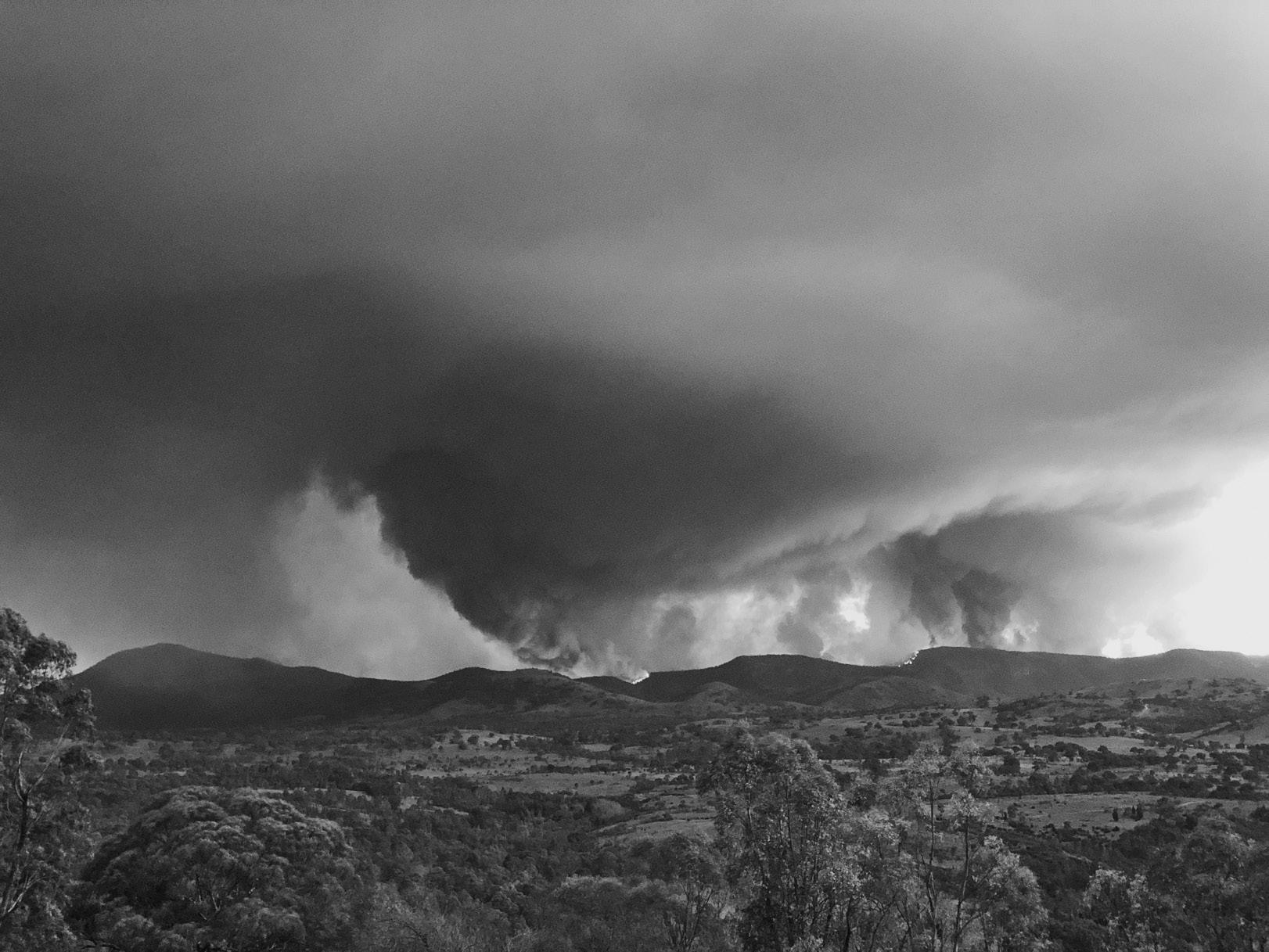
At the end of January 2020, a major new fire developed that rapidly closed in on Canberra, the nation’s capital and home to about 400,000 people (Figure P.1). The most immediate threat was to properties on the city’s outskirts, like mine, which backs onto a nature reserve with nothing other than woodland between us and the fire front. But the Canberra fires of 2003 demonstrated that fire can easily penetrate deep into the city’s heart. Conditions this time were perilously similar. Fortunately, history was not repeated because a change in the winds, and some heavy rains a week later, allowed the fire services to gain the upper hand.
Why did this unprecedented fire season happen? Fundamentally, the 2019–2020 bushfire crisis was a “weather-driven event, underpinned by years of warming and drying [because of climate change]” (Mullins, 2020). Ambient temperatures had been breaking record upon record, amid a succession of ever more numerous, intense, and persistent heatwaves
Figure P.1 The Orroral Fire in Namadgi National Park to the southwest of Canberra, which came within about 13 km of the author’s house (January 28, 2020). Eventually, a shift in the wind direction, followed a week later by heavy rains, allowed the fire services to slowly gain control and extinguish the blaze through February 2020.
Source: Photo by the author from just outside his back garden.
(King, 2017), and there had been severely reduced rainfall for two or three years. Everything was dry as a bone, and dry undergrowth and leaf litter had accumulated rather than decomposed; every single spark could ignite an uncontrollable blaze. Thinning out of forests and controlled hazardreduction burns in open forests proved to be of limited preventive value, given that the fires moved through the forest canopy and easily skipped through treated areas (Hayman, 2020). In fact, opening forests may promote the drying out of forests and soils, making them more susceptible to fire (Mottram, 2020).
While individual fires cannot be attributed to climate change because there is a range of underlying causes (Nguyen et al., 2020), the unprecedented intensity of the 2019–2020 bushfire season had been long predicted, based
on a clear relationship between climate change and the probability of long, intense fire seasons. In 1988 and 1995, the meteorologist Tom Beer had revealed a trend by which “temperature goes up, it gets drier, and then the fires go up” (Readfearn, 2019). And in reviewing the impacts of climate change on Australia and its economy, the 2008 Garnaut Climate Change Review highlighted “that fire seasons will start earlier, end slightly later, and generally be more intense,” and specifically predicted a more frequent and intense fire season by 2020 (Baker, 2020). Unfortunately, similar arguments made the media frequently another time in 2020, with the September bushfire catastrophe in the western United States.
The bushfire crisis made headline news around the world for several months and intensified the international public cry for action to curb climate change. Unfortunately, it may be impossible on short timescales to stop ongoing and looming fire crises in Australia and elsewhere, including the west coast of the United States, Siberia, Mediterranean countries, and countless other places. But on timescales of decades, something can certainly be done about the underlying drivers:
Global warming is related to the total amount of greenhouse gases accumulated in the atmosphere. Even without any new emissions, the legacy of already accumulated global emissions would maintain temperature where it is now. Worse, some additional year-on-year warming would continue because of slow responses in the climate system. To reverse the warming trend, a large net drawdown of carbon dioxide from the atmosphere is needed. Bringing this to the scale required is humanity’s grand challenge for the rest of this century. (Rohling, 2019)
In short, the timeliness of this book was well illustrated by Australia’s apocalyptic fire season, followed within less than a year by similar devastation in the western United States. And across the two was laid the 2019–2020 novel coronavirus crisis, with a global economic impact that was closely associated with a 5–10% reduction in greenhouse gas emissions. The coronavirus crisis acutely highlighted some of the major challenges we’ll face in reducing emissions to zero and even into the territory of net greenhouse gas removal.
This book is not about immediate measures to reduce fire risks, or health crises. Instead, it addresses the major underlying trend of climate change and
humanity’s grand challenge to reverse it. What can we do? And do we have options that won’t destroy the economy?
Prologue Sources
Baker, N. In 2008, the Garnaut Climate Change Review said Australia would face a more dangerous fire season by 2020. SBS News, January 7, 2020. https://www.sbs. com.au/news/how-a-climate-change-study-from-12-years-ago-warned-of-thishorror-bushfire-season
BBC News. Australia fires: a visual guide to the bushfire crisis. BBC News, Australia, January 31, 2020. https://www.bbc.com/news/world-australia-50951043
Bowler, J. We don’t want to alarm anyone, but a large amount of Siberia is on fire right now. Sciencealert, May 4, 2020. https://www.sciencealert.com/so-i-don-t-want-toalarm-anyone-but-a-huge-amount-of-siberia-is-on-fire
Chang, C. How the 2019 Australian bushfire season compares to other fire disasters. News.com.au, January 8, 2020. https://www.news.com.au/technology/environment/ how- the- 2019- australian- bushfire- season- compares- to- other- firedisasters/news-story/7924ce9c58b5d2f435d0ed73ffe34174
Elsworthy, E. NSW bushfires lead to deaths of over a billion animals and “hundreds of billions” of insects, experts say. ABC News, January 9, 2020. https://www.abc. net.au/news/2020-01-09/nsw-bushfires-kill-over-a-billion-animals-experts-say/ 11854836
Hayman, R. RFS Commissioner says hazard-reduction burns made his organisation “public enemy number one.” ABC News, January 8, 2020. https://www.abc.net.au/ news/2020-01-08/nsw-fires-rfs-commissioner-weights-in-on-hazard-reductiondebate/11850862
King, A. Are heatwaves “worsening” and have “hot days” doubled in Australia in the last 50 years? The Conversation, June 19, 2017. https://theconversation.com/areheatwaves- worsening- and- have- hot- days- doubled- in- australia- in- the- last- 50years-79337
Lewis, S. Over 1 billion animals feared dead in Australian wildfires. CBS News, January 7, 2020. https://www.cbsnews.com/news/australia-fires-over-1-billionanimals-feared-dead/
Mottram, L. Hazard reduction burning is not a panacea to bushfire risk: expert. ABC News, January 8, 2020. https://www.abc.net.au/radio/programs/pm/thinnedforests-can-be-more-prone-to-fire,-expert-says/11853280
Mullins, G. I tried to warn Scott Morrison about the bushfire disaster. Adapting to climate change isn’t enough. The Guardian, January 20, 2020. https://www. theguardian.com/commentisfree/2020/jan/20/i-tried-to-warn-scott-morrisonabout-the-bushfire-disaster-adapting-to-climate-change-isnt-enough Nguyen, K. et al. The truth about Australia’s fires—arsonists aren’t responsible for many this season. ABC News, January 11, 2020. https://www.abc.net.au/news/ 2020-01-11/australias-fires-reveal-arson-not-a-major-cause/11855022
Quiggin, J. Australia is promising $2 billion for the fires. I estimate recovery will cost $100 billion. CNN Business, January 10, 2020. https://edition.cnn.com/2020/01/ 10/perspectives/australia-fires-cost/index.html
Readfearn, G. “What could I have done?” The scientist who predicted the bushfire emergency four decades ago. The Guardian, November 17, 2019. https://www. theguardian.com/ australia- news/ 2019/ nov/ 17/ what- could- i- have- done- thescientist-who-predicted-the-bushfire-emergency-four-decades-ago
Rohling, E. Slow the flow and let the soil drink its fill. The Australian, December 31, 2019. https:// www.theaustralian.com.au/ commentary/ slow- the- flow- and- letthe-soil-drink-its-fill/news-story/45dbff7b201671051327bb329ff4f025
Thomas, T. Arctic wildfires emit 35% more CO2 so far in 2020 than for whole of 2019. The Guardian, August 31, 2020. https://www.theguardian.com/world/2020/aug/ 31/arctic-wildfires-emit-35-more-co2-so-far-in-2020-than-for-whole-of-2019
1 Introduction
Outline of the Challenge
Earth is poorly, we humans are the cause of it, and the situation is becoming critical. Humanity’s multi-faceted impacts on Earth and its ecosystems pose an imminent threat of extinction to 1 million animal and plant species. This is because of changes in land and sea use, direct (over-)exploitation, climate change, pollution, and invasive species (Intergovernmental Science-Policy Platform on Biodiversity and Ecosystem Services; IPBES, 2019). This echoes warnings from biologists that we’re racing into Earth’s sixth mass extinction, with modern species extinction rates more than 1000 times higher than natural rates. These rates exceed those of Earth’s most dramatic past mass extinction event. The IPBES report also emphasizes that the impacts of climate change range all the way from genetic levels to ecosystem levels and are expected to overtake other extinction drivers during the next few decades. Further key assessments of humanity’s impacts, including that of climate change, are given in the Intergovernmental Panel on Climate Change (IPCC) assessment reports, and other United Nations (UN) reports such as the Global Environmental Outlook.
Many of the facets of human impact are closely interrelated and are also coupled to the extraordinarily rapid increase in human population numbers. From less than 1 billion in 1800 and just over 1.6 billion in 1900, the human population has accelerated to just over 7.7 billion in 2019. By today, three-quarters of the land-based environment and two-thirds of the marine environment have been significantly altered by human actions, while crop and livestock production consume some 75% of freshwater resources. Plastic pollution has increased tenfold since 1980. An astonishing 300–400 million tons of heavy metals, solvents, toxic sludge, and other industrial waste are being dumped each year into the world’s waters. And fertilizers making their way into coastal ecosystems are responsible for 400 oxygen-depleted ocean dead zones.
We can’t claim to be surprised by these findings. Over the last two decades in particular, many scientific, media, and assessment reports have documented the increasingly detrimental human impacts on virtually all aspects of the planet’s life and environmental health. Most notably, we are now facing critical consequences from rapidly increasing heat stress and heat death occurrences; sea-level rise; extreme weather events; heat-related ecosystem collapses and critical species migrations; and dangerous feedbacks related to processes such as permafrost decomposition and associated CO2 and methane releases (e.g., McGrath, 2020; Casella, 2020). Finally, let’s not forget suggestions that many of the conflicts and refugee streams of recent decades arose at least partly from changing climate conditions and ecosystems, which can drive mass water and food shortages that help trigger unrest and revolts (e.g., Kelley et al., 2015; Vidal, 2019) although the relationship is not settled (Meyer, 2018).
It almost seems as if there is no way out. But here’s the critical bit: Don’t give up, because the doomsday scenario really isn’t the only way. Decisive action can still make a significant difference. We can draw inspiration from previous successes. Some came about because of regulation from the top down, as was the case with the Montreal Protocol that banned CFC gases because they eroded the stratospheric ozone layer, which protects life from harmful ultra-violet radiation. Top-down intervention also drove limitations on the use of coal in cities to fight rampant air pollution, which was impinging on public health, and banned lead additions to fuel and paint so as to limit environmental concentrations of that toxic element. In other cases, action gains momentum out of grass-roots public concern and resistance. The ban on whaling is an example of global public outcry driving decisive international action. In the push for action against climate change, a substantial grass-roots movement is currently developing to ensure that international agreements are followed by decisive action. Recent years have seen powerful school strikes and marches for climate action on a global scale, with exceptional speeches by next-generation citizens such as Greta Thunberg, as well as a concerted global call to declare a climate emergency. Thus, the public and especially the younger generation are pressuring the system. Many nations or states/regions within reluctant nations are heeding the call and have declared a climate emergency along with ambitious targets for reducing climate change. It’s a great start, but it is absolutely vital that the effort continues with similar energy.
In one book, I cannot tackle the entire gamut of human impacts. Instead, this book focuses specifically on human-caused, or anthropogenic, change in Earth’s climate system, including the oceans. I work on climate and ocean change every day, researching natural variability in pre-historic times, before humanity became an important factor. In technical terms, my scientific disciplines of past climate and past ocean research are known as paleoclimatology and paleoceanography, respectively. This background gives me a deep appreciation of the causes, scales, rapidity, and consequences of natural variations in Earth’s climate and ocean system, including the life contained therein, and also past mass extinctions. It informs me of how modern humanity’s impacts compare with the natural context. I outlined the deeptime natural-history perspective to climate change, from the formation of Earth to the present, in my first book, The oceans: a deep history. Humanity’s impacts were compared and contrasted with the natural cycles of climate change in my second book, The climate question: natural cycles, human impact, future outlook. I am left with no doubt that human actions are at the very heart of today’s profound and exceptionally rapid climate change and its impacts, and that the situation has become entirely unsustainable.
When arguing a case for change, however, we have to face the reality that fossil-fuel energy, petrochemical-based manufacturing, industrialized agriculture, and widespread use of cement and concrete have brought massive improvements in living standards, life expectancies, comfort of life, economic outlooks, and so on. This, along with deeply rooted capitalist incentives and strong emotional comfort-zone reasons, creates a major innate resistance to change. Yet, it is equally obvious that we cannot continue as today in the face of relentless human population growth and an associated increase in per capita energy and resource consumption as industrialeconomic development spreads. Thus, we find ourselves at a crossroads where we must take the route of sustainable behavior if we, and our children and grandchildren, wish to keep enjoying our time on this planet. After all, we have but one planet, and its ecosystem services are essential to our survival. The business-as-usual approach of stressing the planet’s life support systems—its climate and ecosystem services—to the point of collapse is pretty stupid, for lack of a better word.
Allowing the current extinction rates to continue unchecked will severely impoverish Earth’s ecosystems before the end of this century. That will decimate food production for human consumption, which we can ill afford
because this food production must instead be doubled by 2050. In sum, we desperately need to achieve a more sustainable approach if we are to improve the chances that Earth can continue to look after us. If we don’t, then we will deplete all Earth’s essential resources and ecosystem services and end up in a crisis during which the planet spits us out. Or, to be more precise, it spits out our children and grandchildren.
And there we have it: we have no choice. Business as usual means betraying our children’s and grandchildren’s trust that we will leave them a hospitable Earth. It is therefore time for a fundamental change in how we treat our planet, its climate and oceans, and its ecosystems, starting not tomorrow or in 20 years’ time, but right now. Every day we dither exacerbates the issues we have to repair.
But what’s to be done? What are the options? Many people don’t have this information to hand and don’t feel comfortable wading through the scientific and engineering literature to build up the understanding. This is why I decided to write this book, to document the surprising wealth of current thought about how we can make a difference.
Like most aspects of human impact, anthropogenic climate change has to date been clearly related to population growth. In the specific case of climate change, this effect has been multiplied by the growing population’s energydemanding industrial-economic development. It is important to emphasize, however, that these relationships are not obligate; going forward, we can break free of their confines. Along with most other climate scientists, I argue that we should do exactly that and do it urgently. In parallel, we should urgently address and remedy the influences that have accumulated already, over the past two centuries of industrialization and in particular over the six most recent decades.
Scientists and engineers have steadily developed a wide range of tools and concepts to address this challenge, and new ones crop up every day. Yet, the vast majority of these tools and concepts remains stuck in the computermodeling or laboratory-experiment stages, or occasionally in the small-scale demonstration stage. Progressing to demonstration sites and large-scale test sites is financially demanding, and attracting industrial partners is often problematic because economic profitability is not often evident for pioneering efforts. Regardless, there are significant success stories too, and these
often show that increasing implementation drives cost reductions in parts and manufacturing and in many cases also rapid increases in net profitability; for example, consider solar power, wind power, and increasingly also battery storage and transport electrification. Unfortunately, compared with the gargantuan scale of the challenge of reversing the anthropogenic climate impact, these success stories largely remain a drop in the ocean. Much more action is needed.
Reaching an unprecedented level of international consensus about the need for more action, the 2015 Paris Climate Agreement formulates a need to limit warming to within 2°C, and by preference within 1.5°C. It was followed by a wave of national climate pledges for action toward this goal. Despite the pledges, some politicians in small industrialized countries have muttered (especially around election time) that their nations’ emissions are tiny relative to those of the likes of China, the United States, and India, so that emissions reductions in their small nations are futile and too expensive. Of course, this overlooks that the large emitters also have larger populations, so that their per capita emissions may be closer to, or even lower than, those of the small nations. More critically, however, such political point-scoring efforts tend to deflect attention from the real elephant in the room, which is the fact that the challenge ahead is so enormous that only a robust joined-up global strategy can be successful.
So, let’s view the matter in a more solution-oriented way. As mentioned, the Paris Agreement sets a target maximum of 2°C warming, and a preferred limit of 1.5°C. Incidentally, many climate researchers, myself included, remain uncomfortable with anything higher than 1°C warming by 2100 because slow responses in the climate system will extend warming from that whatever we do.1 Regardless, the combined national pledges following the Paris Agreement suffice only for limiting warming to roughly 3°C. Even worse, most nations are falling considerably short of meeting their pledges, so that even greater warming might become locked in. Given that most pledges are greatly focused on emissions reduction, it’s evident that something more drastic and wide-ranging is needed.
The international research community is converging on what such a drastic and wide-ranging approach might look like. It is a multi-pronged strategy (Figure 1.1). One prong in the strategy for dealing with anthropogenic climate change involves rapid, massive reduction of greenhouse gas emissions (Chapter 3). The other prong concerns implementation of ways
Figure 1.1 Highly schematic representation of the multi-pronged strategy to deal with anthropogenic climate change.
Source: Modified from Long, J., and Shepherd, J.G. The strategic value of geoengineering research. In: Global Environmental Change, Handbook of Global Environmental Pollution, 1, Springer, Dordrecht, Netherlands, pp. 757–770, 2014.
to remove greenhouse gases from the atmosphere (Chapter 4). And a further potential prong may be increasing the reflectivity of Earth to incoming sunlight, to cool certain places down more rapidly (Chapter 5). Finally, we need to protect ourselves from climate-change impacts that are coming regardless: that is, the impacts that have become inevitable already (Chapter 6).
Make no mistake: this type of multi-pronged strategy for dealing with anthropogenic climate change is a truly major undertaking. It represents humanity’s biggest challenge yet, but it also creates a wealth of opportunities. It is therefore vital that a deep public awareness and acceptance is built of the tools and concepts available for each of the strategic prongs. Without such awareness and acceptance, it will be all but impossible to drive political action toward urgently commissioning the required research and development, including effective concept demonstration and then full-scale implementation. To help in creating this awareness, this book first outlines briefly what anthropogenic climate change is and why it is taking place, in straightforward terms. It then presents current thoughts about how we might minimize
anthropogenic climate change, partially remedy it, and address impacts that have become inevitable already.
My two previous books detailed how the Earth System operates, how natural climate cycles developed, how humans are moving the goalposts, and what future consequences may be expected. This book first summarizes key fundamentals about the climate system and causes for its change and then presents an overview of approaches, along with their critical opportunities, challenges, and limitations.
For clarity, I have kept call-outs to specific references within the text to the minimum needed to substantiate specific statements of the greatest relevance. When desired, further source information may be found in the books listed at the end of this chapter and the reading lists provided at the end of each chapter. The reading lists focus mostly (but not entirely) on open-access sources.
The story splits into a series of main components. Chapter 2 provides background on the greenhouse effect and anthropogenic climate crisis, as well as the changing public perception. Chapter 3 considers the urgent need for reducing greenhouse gas emissions. Chapter 4 deals with the additional need for greenhouse gas removal from the atmosphere. Chapter 5 assesses an option that many find controversial, solar radiation management, which does not alleviate high CO2 levels or ocean acidification but may offer rapid temperature relief in places. Chapter 6 covers aspects of adaptation to changes that have become inevitable already. Chapter 7 outlines aspects of societal reform—it addresses the question “how can we push the necessary changes?” Finally, Chapter 8 pulls it all together.
A point of clarification: wherever I mention dollar values in this book, this refers to US dollars. If the sources report different currencies, then I have translated them using 2019 exchange rates.
Note
1. I liken the delays in the slow processes of ocean warming and ice-sheet responses to what happens when a heavily laden freight train is called into action. A lot of energy is needed to get any movement into the train; at first, nothing seems to be happening while the engines are roaring. Then, the train begins to move and slowly, carriage by carriage, gathers pace. Eventually, the train reaches the desired speed. The engines can now be throttled down to the point where their output