Department of Psychology, School of Social Sciences, University of Westminster, London, United Kingdom
Table of Contents
Cover image
Title page
Copyright
Contributors
Preface
Chapter 1: Science of perception, decision making and fatigue in the maritime industry
Abstract
1: Introduction
2: Perception at sea
3: Decision making at sea
4: Conclusion: Using neuroscience to improve safety at sea
Acknowledgments
Chapter 2: Applications in sleep: How light affects sleep
Abstract
1: Sleep physiology
2: Non-visual effect of light and circadian timing
3: Circadian timing in the blind
4: Sleep in the blind
5: Light intervention to treat circadian disruption
6: Light intervention in the blind
Chapter 3: Understanding the effects of the menstrual cycle on training and performance in elite athletes: A preliminary study
Abstract
1: Introduction
2: Methodology
3: Results
4: Discussion
5: Conclusion
Chapter 4: Assessing decision-making in elite academy footballers using real-world video clips
Abstract
1: Introduction
2: Methods and materials
3: Results
4: Discussion
Chapter 5: Assessing decision making using 2D animations in elite academy footballers
Abstract
1: Introduction
2: Method and materials
3: Results
4: Discussion
Chapter 6: Expertise differences in a 2D animation simulation decision-making task: The influence of presentation speed on performance
Abstract
1: Introduction
2: Methods and materials
3: Results
4: Discussion
Chapter 7: Psychology and neuroscience applied to financial decision-making
Abstract
1: The irrational revolution
2: Inside the trader's brain
3: The amygdala
4: Ventromedial prefrontal cortex (VMPFc)
5: Applying neuroscience to financial markets
6: Gut-feelings in decision-making
7: Coming back to the amygdala
8: Heuristic decision-making in financial markets
9: Stress, testosterone and financial markets
10: Cortisol
11: Testosterone
12: Testosterone on the brain
Chapter 8: Impressions on the current state of cognitive neuroscience in occupational measurement
Abstract
1: Introduction
2: Occupational neuroscience: A new frontier
3: Measures of the workplace
4: Barriers to entry
5: Summary
Chapter 9: Predictive coding: Neuroscience and art
Abstract
1: Introduction
2: An explanation of the predictive coding framework
3: A re-examination of the strictly hierarchical view of the brain
4: The false distinction between processing and perceptual sites
5: Top-down influences in the processing of ambiguous stimuli
6: The perception of ambiguous art, a special case for predictive coding
7: Conclusions Acknowledgment
Chapter 10: Real-world applications in vision and aention: How to help patients find their (golf) balls again
Abstract
1: Introduction
2: The neuroscience of visual behavior
3: The neuroscience of visual search
4: Applications in neglect
5: Applications in hemianopia
6: Conclusion
Chapter 11: The effects of visual training on sports skill in volleyball players
Abstract
1: Introduction
2: Experiment 1
3: Experiment 2
4: Experiment 3
5: Experiment 4
6: General discussion Acknowledgments
Chapter 12: Electrophysiological investigation of the effects of Tai Chi on inhibitory control in older individuals
Abstract
1: Introduction
2: Methods
3: Results
4: Discussion Acknowledgments
Chapter 13: More time for science: Using Testable to create and share behavioral experiments faster, recruit beer participants, and engage students in hands-on research
Abstract
1: Introduction
2: Testable—The software
3: Testable Arena
4: Testable Library
5: Testable Minds
6: Testable Class
7: Conclusion
Chapter 14: Trust in artificial intelligence for medical diagnoses
Abstract
1: Introduction
2: Experiment 1
3: Experiment 2
4: Experiment 3
5: Conclusions
Chapter 15: The psychology of sustainable consumption
Abstract
1: Introduction
2: What is fast fashion?
3: Sustainable fashion
4: The psychological processes behind sustainable purchasing behavior
5: Implications for the psychology of marketing
6: Conclusion
Contributors
Preface
Beth Louise Parkin, Department of Psychology, School of Social Sciences, University of Westminster, London, United Kingdom
The challenge set in editing this volume was to give a picture of how psychology and cognitive neuroscience has reached the stage of intellectual maturity where we can ask how it serves our daily lives, commerce, and society. As we have seen with biological sciences and medicine over the past century, the discipline has moved from the gathering of knowledge and increased understanding of discrete processes of the body, to the application of improving almost every aspect of health. The volume is a reflection on this transition for psychology and cognitive neuroscience, examining how developments in our existing knowledge of the brain and mind can be used to achieve practical insights into applied human behaviors. The components of the human mind explored by psychology, for example aention, memory, perception, have remained remarkably constant over the past 50 years of psychological textbooks, yet the areas of life this discipline have ventured into is impressively broad. The work showcased in this Volume therefore spans a wide array of aspects of daily living which rely on our cognitive, physiological, and cyclical functions.
The opening chapter takes a direct approach to a consequential real-life problem; the impact of suboptimal conditions for mariners at sea. Djukanović and colleagues highlight how psychology can make a tangible contribution to safety practices, by presenting a guide to understand the importance of dark adaptation during shift work and exploring decision-making at sea. The chapter is an exemplary case study in the difficulties of translating laboratory
findings. Laboratory decision-making for example, is often studied by how much virtual money a subject is making on a computerbased task and rarely takes into account pressure. In reality, the mariners operate under the demands of commerce, in which virtual money is replaced by hundreds of lives or cargo worth millions of real dollars. The next chapter continues on the theme of light and dark rhythms by focusing on sleep. Sleep makes up 37% of our lives and is highly undervalued in today's society. As Santhi and Ball highlight it is often the things we take for granted that can have the greatest impact on our lives. This chapter outlines the two oscillatory mechanisms behind sleep and wakefulness, while explaining the importance of light as the zeitgeber that governs this vital process. It is important that, in this volume aimed principally at psychologists and cognitive neuroscientists, this work discusses photoreceptive retinal ganglion cells that make up 1% of cells in the eye. These have no function in vision but are entirely devoted to informing our brains of the time of day. The authors conclude by articulating the effect that the loss of these retinal ganglion cells have in the blind.
In Santhi and Ball we see the value of regulating a particular hormone, melatonin. The problem in studying hormones and cyclical functions is that they operate in circadian or ultradian rhythms. This means that data collection is slow and individual variability is high. Laboratory research on the impact of the menstrual cycle on behavior is no exception and may explain why it lags behind what we may expect. In the third chapter, Statham explores the impact of the menstrual cycle in decision-making and training of elite athletes. The work takes on this long-term problem area to provide insights into how physiology and psychology overlap to influence daily performance. Focusing on athletes allows Statham to bring the research area into a tractable sphere, controlling for fitness level, familiarity with pain, regularity of physical routine, and the physical and psychological goals of the experimental cohort.
Staying with sport the following three chapters remind us that specialist groups have been a bedrock of advance in the history of psychological science. The study of neuropsychological patients, for example, has been essential in the development of the discipline. In
p p p addition, we have seen the value of chess experts in helping to formulate theories of learning and memory. Sport is another area where we have access to people with extreme specialization, in which we can study skill acquisition and development. By using tasks adapted from the laboratory, Farahani investigates decisionmaking across the trajectory of elite footballers who make the journey through the academy system. Across these chapters, Farahani examines the influence of using different types and speeds of presentations of tactical scenarios, including real-time videos and 2D animations. The take home message here is that if we want to understand what an expert sees we may have to adapt our presentations to appear, to the novice, to be somewhat unrealistic (for example, professional footballers perceived real-time footage to be “too slow”). Of particular value in these chapters is that the author correlates data from a computer-based task with the assessments of professional football coaches. If psychology and cognitive neuroscience are to make the leap in affecting people's everyday lives, it's important to bring along the practitioners. The next chapter is particularly timely as this volume will appear as the COVID-19 crisis (hopefully) abides and the world is faced with new financial conditions and choices to make in this context. Kabir covers the psychological and neural basis of economic decision-making, in the specific context of the limits of human rationality and the stresses induced by market trading. The wider principles of decision-making covered in this chapter are applicable to many other domains of our decision-making, particularly under pressure. The review is a good starting point for someone requiring an introduction to the subject area. Williams and Lewis then go on to discuss occupational neuroscience and the issues faced in the extension of cognitive neuroscience to the workplace. The authors openly accept the problem that neuroscientific methods are not designed for people working in dynamic environments, and identify two methods, EEG and fNIRs, that may be of use in naturalistic seings. In their exploration they address a number of problems in bringing psychology into the real world. The first is the noise in the data, simply because of the kinds of environments in which data is
p y collected. The second is the type of tests that are suited for assessments. Most robust psychological tests are robust precisely because they tend to be insensitive to individual differences (visual search, n-back, etc.). However, in a seing where employers and employees are interested in individual differences, tasks must be selected based on different criteria. Third is the motivation and anxieties of the individuals who are being “tested.” We are not dealing here with data points for publishable experiments, but with descriptions of people which may incorrectly become self-fulfilling prophecies for career advancements or even self-belief. For example, it's very common for subjects to mistake state as trait results. It is an imperative that in translating findings to the work environment that employees and managers understand the meaning of the results. Williams and Lewis give serious consideration to these issues and are aware of the limitations of cognitive neuroscience in occupational seings.
Applying psychology is not only about industry or sport, it can also be an asset in other areas of life, perhaps those more associated with pleasure. Wolf for example, in his chapter, assesses the role of predictive coding in perception as an explanation of our experience of ambiguity in visual art. He takes ambiguity as a special case because it is accessible to experimentation via bistable images. In doing so he is able to make links between prediction, perception, and emotional experience.
Ellison and colleagues capture perfectly the journey from the fundamentals of physiology, psychology, and neuropsychology to its applications. In the development of the Durham Reading and Exploration (DREX) tool we can see how a knowledge of the vision and action system can be applied for the benefit of patients. The chapter begins with the anatomy and physiology of the vision and action systems, describing the classic work that has brought visual cognitive neuroscience to where it is today. The authors then build a bridge between fundamental visual cognition and the difficulties of implementing these in the real world. Just to give one example, many experiments are performed on a computer screen at a distance exactly 57.3 cm from the subject, and of course most objects out of
y j j the laboratory do not present themselves at this distance. As Ellison and colleagues discuss this falls into “near space,” whereas to make decisions about action patients also have to consider objects in “far space.” This chapter focuses on those with visual neglect or hemianopia, however the descriptions here can be used as a framework for others wanting to make their work meaningful to other patient populations. The authors are helpfully self-critical about the limits of their intervention and end with an honest and informative discussion of the interplay between theory of “what works” and the necessary trade-offs.
Zhou et al. then explores the issue of practice and transfer of skills to real world performance. In particular the chapter presents athletes with specific cognitive training regimes and asks whether this results in improvements in a volleyball spike (an equivalent to a tennis smash). We have seen many unsubstantiated claims of brain training and far transfer, however the question that remains is how similar can tasks be to usefully interact with each other. The authors observe that there are some improvements, dependent on the similarity in timing between presentation of the target during training and the presentation of the target during execution. The same group also examines the effects of practice and transfer in their chapter on the impact of Tai Chi on inhibitory control abilities. Much of psychology, including clinical work, focuses on young adults but in this chapter Chen and Muggleton pay aention to older participants. As people age and participation in sport, especially involving contact or fast reactions, becomes less achievable there is a need to replace these activities and socially prescribe those that will improve general health and wellbeing. Using behavioral, physiological and subjective outcome measures, Chen and Muggleton found that compared with groups who took regular exercise or were sedentary, the group performing Tai Chi showed improvements in inhibitory control and differences in electrophysiological responses. Given the cognitive effort, as well as financial and social constraints on many forms of exercise, this chapter provides reason to consider Tai Chi as a possible candidate for social prescribing in aging groups.
The volume has, thus far, focused on taking research out of the laboratory, however, there is no intention to undermine the value of laboratory research. For our research to be successfully applied the foundations have to be solid. In the recent discussions of the replication crisis in psychology, criticisms of current research practices include the use of small or homogenous subject groups, the nontransparency of data, and the variability of methodological tools. Rezlescu et al. present technological developments which allow us to move toward more reliable, accessible, and scalable research practices. The software tools described allow improvements in the speed in which experiments can be undertaken without sacrificing rigor. Testing materials can be shared, and subjects other than those from undergraduate populations can be easily accessed. These software advancements will also be of great use to anyone running field experiments.
The final two chapters take on some of the most pressing issues of our time. In the chapter “Trust in artificial intelligence (AI) for medical diagnosis,” Juravle et al. acknowledges that with advancements in AI there are now many areas of life in which we have to ask, what should we let machines do and how much trust do we put in them. In this chapter participants were presented with scenarios in which AI machines and doctors confirm a medical condition and recommend treatment. The experiments showed lower trust in the outputs of machines even when they are told that they are performed in conjunction with humans (for high risk medical conditions). Interestingly, some of this trust gap is narrowed when people are given the choice of whether to be diagnosed by AI or a human doctor. The important issue this chapter highlights is that humans do not respond to information in a vacuum. Our involvement in a decision is a prerequisite of accepting the sources of the decision-making. Juravle et al.’s chapter suggests, perhaps somewhat comfortingly, the medical negotiation between machine learning and medical practice will be a democratic one. The last chapter of the volume addresses the psychology of sustainable consumption. The scientific ground here is to explore how theories, such as the theory of planned behavior and temporal discounting,
y p p g can be applied to understand the antagonism of when intentions meet the limits of what one can psychologically or financially afford. Kotahwala discusses how these conflicts can be assessed and addressed both within the corporate sector (focusing on fast fashion markets) and within the individuals who constitute consumer populations.
Overall, the work presented in this volume has provided examples of how the firm foundations of cognitive science can be applied across many aspects of everyday life, and outlined some of the challenges faced in this translation. I hope this volume serves as a starting point for those wishing to make similar kinds of leaps.
Chapter 1: Science of perception, decision making and fatigue in the maritime industry
Nina Djukanović*; Rico Hodges-Smikle; Jina Lim Jia Xuan; Pietro
Sambuy Arts and Sciences Department, UCL, London, United Kingdom
* Corresponding author: Tel : + 44-42-06-0891-8349 email address: nina.djukanovicova.16@ucl.ac.uk
Abstract
In this paper, we investigate how perception, decision making and fatigue affect safety in the maritime industry. With maritime safety incidents often having disastrous effects on the lives of the seafarers, the natural environment, and the industry as a whole, a beer understanding of the science behind the human errors is necessary to increase safety at sea. We conducted interviews and real time observations of seafarers, and we combine our findings with a review of relevant academic literature with the aim of using scientific knowledge to address a real-world problem. We conclude that the seafarers consistently work at the limits of their cognitive abilities and that beer care for their wellbeing is crucial for safety at sea. It is hoped that this study will be beneficial to the practitioners in the field of the maritime industry as well as psychologists studying the effects of long term, high cognitive loads in the work environment.
In the maritime industry, from the bridge to the engine room, people continuously work under pressure and in adverse conditions. Challenging situations faced by the seafarers are often unique to the maritime industry and can be hidden in the way they see, scan, plan, decide, communicate and even sleep. In carrying out their jobs and responding to emergency situations, the way they perceive and make decisions plays a crucial role. With around 3200 marine incidents occurring each year (European Maritime Safety Agency, 2017), safety in the maritime industry is unacceptably low. During 2016 alone, there were 106 fatalities, 957 injuries, 26 ships lost and 123 investigations launched (European Maritime Safety Agency, 2017). Thus, research in the psychological and neurological factors affecting safety at sea can contribute to a beer understanding of human errors behind collisions.
In this chapter, we review the critical issues of perception, decision making and fatigue in the context of safety in the maritime industry through research in the form of interviews, participant observations and literature review. First, we explore the issue of perception with regards to aention, lighting conditions, what and where systems and visual size and distance. Second, we investigate the decisionmaking process on a vessel, focusing on communication and culture, trust, and group decisions. Finally, we explore the issue of fatigue at sea which is especially relevant to the crew members working shifts and those in a control rooms that are typically closed spaces.
2: Perception at sea
Vision and visual cognition play an essential role in the maritime industry as seafarers on a bridge primarily depend on their eyes to
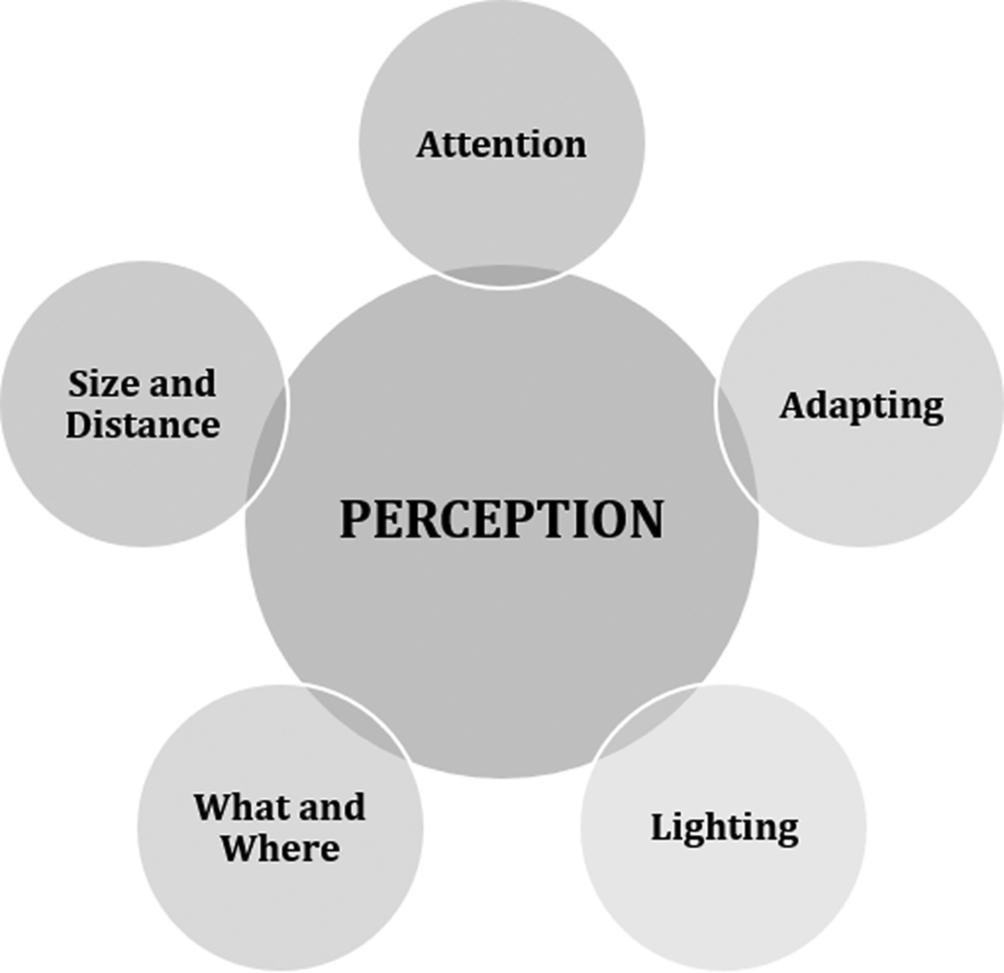
avoid collisions and spot objects at great distances. Aention, night conditions, light, “what and where” systems and visual size and distance are the key factors that determine safety at sea (Fig. 1).
FIG. 1 The key factors of “perception” that impact safety at sea.
2.1: Attention
Aention is a central process of perception which allows people to selectively process information and decide what is relevant. As Carrasco pointedly suggests, aention is “the mechanism that turns