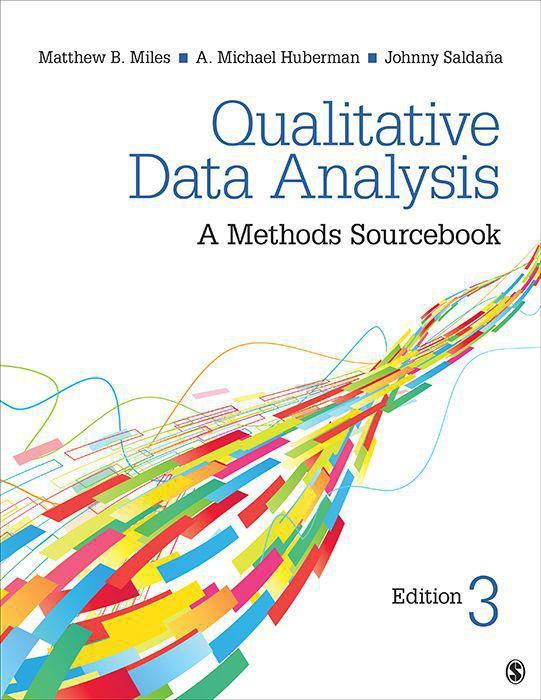
This new editionof Matthew B Miles andA Michael Huberman’s classic 1994 text, Qualitative Data Analysis: An Expanded Sourcebook, updates and streamlines the late authors’unique work for a new generation of qualitative researchers as well as for the dedicated followers of their methods over thepastthreedecades.Ihavebeenhonoredtojointhem,inspirit,as thethirdauthor of thisrevisedtext.
To this day, qualitative data analysis seems to remaina somewhatmysterious and elusive process for newcomers to the field. This is due in part to the wide variety of genres, methodologies, and methods available to researchers, making it sometimes difficult to choose the “best” ones for the particular studyinhand. Inaddition, qualitative researchhas a solid foundationofanalytic traditions but no current standardizationof practice there is no official qualitative executive board out there mandating exactly how analysis must be conducted Ours is “designer research,” customized to the particular goals andneeds ofthe enterprise andinterpretedthrougheachresearcher’s unique analytic lensandfilter Booksonresearchmethodscannolonger require;theycanonlyrecommend
This book offers its readers practical guidance in recommended methods for assembling and analyzingprimarilytext-based data. Qualitative Data Analysis: A Methods Sourcebook is designed for researchers invirtuallyall fields anddisciplines thathonor whattheir humanparticipants have to say, treasure the products and artifacts theycreate, and respect the complexityof social actionas it happens all around us Itis intended for students ingraduate degree programs who are learninghow to investigate the human condition through qualitative research coursework and for established scholars and practitioners continuing their professional development by reading the literature on currentmethods.
ANoteonThisRevision
For this thirdedition,SAGEPublications chargedmetomaintainthegeneral spiritandintegrityof the core contents of Miles and Huberman’s (1994) authoritative work, while makingtheir text more accessible and relevant to contemporary researchers. I have added information on the newer computing technology and software available today, and reorganized and streamlined the original authors’classic methods. Readers familiar withthe previous editionwill notice thatinthis editionI have re-envisioned the primarydisplaychapters, not organizingthembywithin-case and cross-case divisions but by Miles and Huberman’s five primary purposes of display: to explore, describe, order,explain,andpredict Ihave reducedthe number ofdisplays fromthe secondeditionand,when possible, reformatted themusingmainstreamsoftware. SAGEPublications’artproductionstaffhave redrawnmanyoftheoriginal figures
I have also added selected coverage of additional genres of qualitative inquiry, suchas narrative inquiry, autoethnography, mixed methods, and arts-based research, that have emerged prominently over the past 20 years I have smoothed down the second edition’s semiquantitative edges to align and harmonize the original authors’ approach with that of current qualitative inquirers. And I have brought my own analytic signature to the text, respecting some of the original authors’ traditions while adapting others into a newer, evolving research culture. Overall, I have scaled back the impressive, ifsometimes overwhelming, size ofMiles and Huberman’s original workto presentand re-presenttheir insightful analyticmethodsinamorefocusedanduseful manner.
Incertainproblematic sections of the second edition, I struggled withdecidingwhether to delete, maintain, or revise the text Since mycharge as third coauthor was to adapt Miles and Huberman’s work, not to write my own book on qualitative data analysis, I have respected the original authors’ contributions to the field bymaintainingthe conceptual approaches and mostofthe analytic methods
of their book. Nevertheless, I have, without guilt, mercilessly deleted most of its early references, second-source displays, duplicate and overextended discussions, and some more convoluted sections.
I have brought my own working knowledge of the book’s second edition into my revision efforts because, as a student, Iwas enrolled intwo courses where Miles and Huberman’s textwas required reading. This revision is based on what I wish the book had offered me as a novice to qualitative research and what I believe today’s graduate students need from a textbook on qualitative data analysis. My reorganizing decisions are based on pedagogical knowledge of how most university graduate students learn and on how I personally prefer to teach: progressing in a highly organized, systematicway,onebuildingblockatatime,towardaspiraled,cumulativesynthesis aprocessI’m almost certain Miles and Huberman would have appreciated and found compatible with their own approach.
I also brought my knowledge of Miles and Huberman’s book to my work as author of SAGE Publications’ The Coding Manual for Qualitative Researchers (Saldaña,2013),inwhichIincluded a few of their coding and analysis methods. And I incorporated some of The Coding Manual’s contentintothisbook,further integratingthethreecoauthors’work Inaddition,Isupplementedafew of the original authors’ display methods and discussions with examples from my own research projects and incorporated The Coding Manual’s method profile structure (Description, Applications,Example,Analysis,Notes) intothisrevision.
Finally, as the third coauthor of this edition, I have been in the position, both privileged and awkward, of “speaking” for the late Miles and Huberman When I am in agreement with their original premises and assertions, I deliberately use “we” in writing, as I do when making some informed assumptions that my own opinions would be similar to theirs Occasionally, when our opinionsseemtodiverge,subtlyor greatly,Ispecifywhosebeliefisbeingdiscussed.
Acknowledgments
I am honored that Helen Salmon, acquisitions editor of SAGE Publications’ College Division, commissioned me to adapt Miles and Huberman’s text for its third edition Her editorial assistant KaitlinPerrywas a tremendous resource for manuscript and displaypreparation. I also thankLaura Barrett, Kalie Koscielak, JudithNewlin, Nicole Elliott, and Janet Kiesel of SAGE Publications for their productionworkonthisbook.BettyMilesofferedmenotonlyher supportbutalsoher keeneye andeditorial prowess for this revision Myinitial contactwithSAGEbeganwiththeir Londonoffice editor, Patrick Brindle, who encouraged me to develop The Coding Manual for Qualitative Researchers,andfor hiswelcominginvitationIamtrulygrateful.
My own qualitative research methods professors at Arizona State University significantly influenced mygrowthas a scholar and writer. Iamindebted to TomBarone, MaryLee Smith,Amira De la Garza, and SarahJ. Tracyfor their life-changingimpact onmyacademic career. ColemanA. Jennings fromThe University of Texas atAustin served as my graduate school artistic mentor; Lin WrightfromArizona State Universitystarted me as anassistantprofessor onmyresearchtrajectory; and MitchAllen, Joe Norris, LauraA McCammon, Matt Omasta, andAngie Hines are myresearch colleagues and loyal supporters. Ialso extend thanks to mylong-distance mentors, HarryF. Wolcott, NormanK Denzin,andYvonnaS Lincoln,for their insightful writings,wisdom,andguidance
In the second edition of Qualitative Data Analysis, Miles and Hubermanthanked a large number of individuals and organizations. Their contributions continue to enrich this revised edition of the book, and theyhave mygratitude as well For this particular edition, I also thankOxford University Press for their permission to reprint selected excerpts from my text Fundamentals of Qualitative Research (Saldaña, 2011b); Teachers College Record and Taylor & Francis for article excerpt permissions; and Normand Péladeauof Provalis Research/QDAMiner and Katie Desmond of QSR International/NVivofor their permissiontousequalitativedataanalysissoftwarescreenshots
Myfinal thanks gotoMatthew B Miles andA Michael Hubermanthemselves Tomyknowledge, I never met them or heard them speak at professional conferences, but their data-analytic methods, whichIlearned intimatelyinmyqualitative researchcourses, have beenpartofmyworkever since I always strive to meet their rigorous standards, and I frequently quote their now classic advice to “think display.” I owe much of my career trajectory to the legacy of scholars before me whose methods books and articles helped shape my own ways of working as a qualitative researcher and data analyst. Miles and Huberman are two of those esteemed scholars, and I am honored to be connected withtheminthis new way I hope that this third editionof their bookpays proper tribute andhomagetotheir significantlevel ofscholarship.
Publisher’sAcknowledgments
SAGE Publications and Johnny Saldaña are grateful for feedback on the draft manuscript of the third edition from the following reviewers: James H. Banning of Colorado State University–Fort Collins,CarolynM.GarciaoftheUniversityofMinnesota,MadelynIrisofNorthwesternUniversity, Mary Madden of The University of Maine–Orono, Sharon M Ravitch of the University of Pennsylvania,PatriciaSomersofTheUniversityofTexas–Austin,andMildredE.Warner ofCornell University
AcknowledgmentsFromtheSecondEdition
Matthew B Miles and A Michael Huberman
The first edition of this book grew out of our (Miles and Huberman’s) experience in two linked research projects. One, beginning in 1978, was the field study component of the Study of Dissemination Efforts Supporting School Improvement (Department of Education Contract 30078-0527), led by David P. Crandall of The Network, Inc. We are indebted to him for his steady encouragement and support, and that ofAnn Bezdek Weinheimer, project officer fromthe Office of Planning,BudgetingandEvaluation.
In the field study itself, Beverly Loy Taylor and Jo Ann Goldberg were strong colleagues; their fieldwork and case study analysis, along with ours, led to Volume 4 of the DESSI final report, People, Policies, and Practices: Examining the Chain of School Improvement, later published as Innovation Up Close (Huberman&Miles,1984).
The second project, “The Realities of School Improvement Programs: Analysis of Qualitative Data” (NIE grant G-81-001-8), gave us the opportunityto develop our methodological ideas further and to write the first edition of this book. Rolf Lehming, of the Program on Dissemination and ImprovementofPractice,wasour projectofficer;wevaluedhissustainedinterestandadvice.
The ideas in the first edition and indeed in this one do not necessarily reflect the views or policiesoftheDepartmentofEducation.Butweremaingrateful for itssponsorshipofthesestudies.
In the past 10 years, many people have contributed to our understanding of qualitative data analysis and to the development of the second edition. We have experimented in the company of colleagues withstudies that expanded, tested, and refined the methods described inthe first edition We are indebted toAnnLieberman, EllenSaxl, Myrna Cooper, VernayMitchell, and SharonPietyJacobs, who joined Miles in a study (1983–1985) of school “change agents”; to the late Eleanor Farrar, KarenSeashore Louis, Sheila Rosenblum, and TonyCipollone, ina studywithMiles (1985–1989) of urban high school reform; to Per Dalin, Adriaan Verspoor, Ray Chesterfield, Hallvard Kuløy, Tekle Ayano, Mumtaz Jahan, and Carlos Rojas, whom we assisted in a World Bank study (1988–1992) of educational reform in Bangladesh, Ethiopia, and Colombia; to Marie-Madeleine Grounauer and Gianreto Pini, Huberman’s associates in a teachers’ life cycle study (1982–1986); and to Monica Gather-Thurler and Erwin Beck, associates in Huberman’s study of research use (1984–1988)
As always, the process of teaching from the book taught us a great deal There are too many participants to list, but we were fortunate to have led an extended series of seminars at the universities of Nijmegen and Utrecht (strong thanks to Rein van der Vegt) and at many other universities as well: Geneva, Zürich, Paris, Dijon, Leuven, Göteborg, Montreal, Toronto, Queen’s, Utah,Monash,Melbourne,andAdelaide
During 1990–1991, we sent an informal survey to a wide range of people engaged in qualitative research, asking for collegial advice and examples of their work. Our warm thanks to the 126 researchers who responded; they provided a wide range of ideas, papers, advice, and cautions that were immensely helpful. Many of these colleagues are quoted or cited in this book. Grants supportingtheextensiveretrieval andsynthesis workfor this editioncametous fromtheJohnD and Catherine T. MacArthur Foundation, where Peter Gerber provided thoughtful support, and from SAGE Publications Sara Miller McCune and David McCune of SAGE took a keen interest in the project. We are grateful for the active, intelligent guidance that our editor, Mitch Allen, provided throughoutthework
We owe a veryspecial debtto CarolynRiehl Her abilityto locate and extractinterestingideas both substantive and methodological from a wide range of qualitative studies is remarkable. She wasastrongthirdcolleagueduringour extendedperiodofretrieval andordering
Drafts of this editionwere reviewed bymanypeople: Our warmthanks for the thoughtful advice
Drafts of this editionwere reviewed bymanypeople: Our warmthanks for the thoughtful advice of Martha Ann Carey, Rick Ginsberg, David Marsh, Joseph Maxwell, Betty Miles, Renata Tesch, Harry Wolcott, and an anonymous Sage reviewer. As with the first edition, we are grateful to each other for theenergy,stimulation,andproductivityofour workinademandingenterprise
AbouttheAuthors
Matthew B. Miles, a social psychologist, had a career-long interest in strategies for educational reform His workfocused onplanned change ineducation, group and organizational studies, and the disseminationandimplementationofresearchfindings.His firstmajor researchprojectwas a 4-year studyofsixnew,innovativepublicschools
A. Michael Huberman’s long-terminterests were inscientific epistemology, and adult cognition and knowledge use His work focused on education policy, school reform, and the practical translationofresearchknowledge into effective school practice. His firstextensive projectwas a 4year studyofanexperimental elementaryschool’s implementationofPiagetiantheories inclassroom practice.
Johnny Saldaña, a theatre educator, has explored qualitative research methodologies ranging from coding to ethnodrama. His work focuses on young people’s and adults’ participation in, and transformationthrough,thearts Hisfirstqualitativeresearchprojectwasa2½-year ethnographyofa beginningteacher’sexperiencesataninner-cityfineartsmagnetschool.
Miles and Huberman collaborated for many years on studies of the dissemination of educational innovations and school improvement. In the course of a multisite study sponsored by the National Institute of Education, they began a study of the procedures they were using to analyze data, which provided the intellectual stimulus and the content of much of this book Miles and Huberman led seminarsbasedonthebookintheUnitedStates,Canada,WesternEurope,andAustralia.
Miles and Huberman’s work together and with other colleagues included the study of school change agents, innovation in urban high schools, the social architecture of schools, teachers’ life cycles, the use of scientific knowledge in vocational education, and educational reform in Bangladesh,Ethiopia,New Zealand,andColombia
Saldaña’s studies have included child audience responses to theatre, teachers’ perceptions of achievement standards, a survey of adults reflecting on their high school experiences, longitudinal qualitative research methodology, and arts-based research methodologies, including ethnodramatic and ethnotheatrical play production. Johnny Saldaña is the Evelyn Smith Professor of Theatre at Arizona State University and the author of Sage Publications’ The Coding Manual for Qualitative Researchers.
Part1
TheSubstantiveStart
Chapter1- Introduction
Chapter2- ResearchDesignandManagement
Chapter3- EthicalIssuesinAnalysis
Chapter4- Fundamentalsof Qualitative DataAnalysis
Introduction
ChapterSummary
This chapter introduces the reader to the coauthors’ perspectives about the nature, goals, and selected genres of qualitative research, and the interconnected components of qualitative data analysis. We offer recommended guidance for the various audiences of this book and establish the parametersofwhatwewill cover inthetext
Contents
ThePurposeofThisBook
TheNatureofThisBook
Audiences
Approach
Our Orientation
GenresofQualitativeResearch
AnApproachtoQualitativeDataAnalysis
AnalyticMethods: SomeCommonFeatures
TheNatureofQualitativeData
General Nature
StrengthsofQualitativeData
Our View ofQualitativeDataAnalysis
DataCondensation
DataDisplay
DrawingandVerifyingConclusions
Suggestionsfor Readers
StudentsandOther NoviceResearchers
ExperiencedResearchers
TeachersofQualitativeResearchMethodsCourses
ClosureandTransition
ThePurposeofThisBook
We wrote this booktoaddress a needfacedbyresearchers inall fields ofthe humansciences. Put simply, how canwe draw valid and trustworthymeaningfromqualitative data, and whatmethods of analysiscanweusethatarepractical andwill getusknowledgethatweandotherscanrelyon?
Qualitative data are a source of well-grounded, rich descriptions and explanations of human processes With qualitative data, one can preserve chronological flow, see which events led to which consequences, and derive fruitful explanations. Then, too, good qualitative data are more likely to lead to serendipitous findings and to new integrations; they help researchers get beyond initial conceptions and generate or revise conceptual frameworks. Finally, the findings from wellanalyzed qualitative studies have a quality of “undeniability” Words, especially organized into incidents or stories, have a concrete, vivid, and meaningful flavor that often proves far more convincing to a reader another researcher, a policymaker, or a practitioner than pages of summarizednumbers.
The expansionofqualitative inquiryfromthe 1970s onward has beenphenomenal. There are now
The expansionofqualitative inquiryfromthe 1970s onward has beenphenomenal There are now numerous handbooks (e.g., Denzin & Lincoln’s, 2012, The SAGE Handbook of Qualitative Research; Gubrium, Holstein, Marvasti, & McKinney’s, 2012, The SAGE Handbook of Interview Research), exemplary textbooks (Charmaz’s, 2006, Constructing Grounded Theory; Creswell’s, 2013, Qualitative Inquiry and Research Design), prestigious peer-reviewed journals (Qualitative Inquiry, Qualitative Health Research), online newsletters and forums (SAGE Publications’ Methodspace, The Qualitative Report), annual conferences (International Congress for Qualitative Inquiry, International Institute for Qualitative Methodology), and qualitative special-interest groups inseveral major professional associations(AmericanEducational ResearchAssociation).
Yet,intheflurryofthisactivity,weshouldbemindful ofsomepervasiveissuesthathavenotgone away. These issues include the labor intensiveness (and extensiveness over months or years) ofdata collection, frequent data overload, researcher integrity, the time demands of processing and coding data, the adequacy of sampling when only a few cases can be managed, the generalizability of findings,thecredibilityandqualityofconclusions,andtheir utilityintheworldofpolicyandaction.
Although many researchers, from graduate students writing their dissertations to experienced researchers, work alone on their projects and often focus on single cases, qualitative work is becoming more complex. Increasingly, we see mixed-methods studies that combine qualitative and quantitative inquiry, carried out by research teams working with comparable data collection and analysis methods. And exciting new approaches to qualitative inquiry draw their inspiration from poetry,dramaticliterature,visual art,andother creativegenres topresentandrepresentsocial lifein fresh,evocativeways.
Some qualitative researchers still consider analysis to be an art form and insist on intuitive approaches to it We are leftwiththe researcher tellingus ofcategories and patterns drawnfromthe welter of field data, in ways that are irreducible or even incommunicable. We do not really know how the researcher gotfrom1,000 pages offield notes and transcriptions to the final conclusions, as sprinkledwithvividillustrationsastheymaybe.
This book is written in the belief that, as qualitative researchers, we need to keep sharing our craft that is, the explicit, systematic methods we use to draw conclusions We need methods that arecredible,dependable,andreplicablein qualitative terms.Thatistheneedour bookaddresses.
TheNatureofThisBook
This is apractical methods sourcebookfor all researchers whomakeuseofqualitativedata.Butit is not intended as a comprehensive text; we do not address matters suchas how to gainentryinto a site, how to write field notes, or how to facilitate participant interviews. We want to share our experiences and those of other colleagues in the design and use of qualitative data analysis methods. Strong emphasis is placed on data displays matrices and networks that go beyond ordinary narrative text Each method of data display and analysis is described and illustrated in detail, with practical suggestions for the researcher’s use and adaptation with accessible software andbasicprograms
Audiences
This book is for practicing researchers in all fields whose work, whether basic or applied, involvesactual qualitativedataanalysisissues
An important subset of that audience is the beginning researcher a graduate student or earlycareer faculty member working with qualitative data. We have encountered many students who launch into qualitative dissertations or research projects who sometimes feel overwhelmed and undertrained. With them in mind, we keep the language accessible and supportive, and we offer suggestionsfor usingthebookinqualitativeresearchmethodscourses
Another audience is staff specialists and managers, who rely on qualitative information as a
Exploring the Variety of Random Documents with Different Content