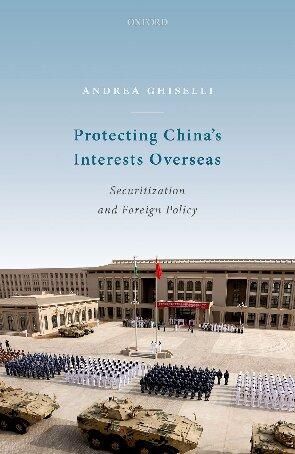
Protecting China’s Interests Overseas
Securitization and Foreign Policy
ANDREA GHISELLI
1
Great Clarendon Street, Oxford, OX2 6DP, United Kingdom
Oxford University Press is a department of the University of Oxford. It furthers the University’s objective of excellence in research, scholarship, and education by publishing worldwide. Oxford is a registered trade mark of Oxford University Press in the UK and in certain other countries
© Andrea Ghiselli 2021
The moral rights of the author have been asserted
First Edition published in 2021
Impression: 1
All rights reserved. No part of this publication may be reproduced, stored in a retrieval system, or transmitted, in any form or by any means, without the prior permission in writing of Oxford University Press, or as expressly permitted by law, by licence or under terms agreed with the appropriate reprographics rights organization. Enquiries concerning reproduction outside the scope of the above should be sent to the Rights Department, Oxford University Press, at the address above
You must not circulate this work in any other form and you must impose this same condition on any acquirer
Published in the United States of America by Oxford University Press 198 Madison Avenue, New York, NY 10016, United States of America
British Library Cataloguing in Publication Data
Data available
Library of Congress Control Number: 2020945985
ISBN 978–0–19–886739–5
Printed and bound in Great Britain by Clays Ltd, Elcograf S.p.A.
Links to third party websites are provided by Oxford in good faith and for information only. Oxford disclaims any responsibility for the materials contained in any third party website referenced in this work.
Preface
Among the many Chinese sayings, there is one that, translated literally, describes this book best: “It is coincidence that makes a book” (无巧不成书). This study is the product of the many events that first brought me to study Chinese and then made me interested in Chinese affairs.
Coming from a small, quiet city in Italy’s Emilia Romagna, between the Apennine Mountains and the Adriatic Sea, I did not have any special link with or interest in China or, in general, Asia. When I started studying the Chinese language in Venice in 2008, I had almost no clue about China. From then on, many things happened that made me spend a significant number of years in that country and write a book on its foreign policy.
Back then, relations between the West and China were far more relaxed than today. China, too, was different. Over the years, the situation has significantly changed and, today, we are told that we live in an era of great power competition.
One of the most significant products of this turn of events is that Chinese foreign policy is increasingly seen as an issue that can be only black or white. In my opinion, this is something that the world cannot afford, as confrontational narratives go hand in hand with similarly confrontational, but more dangerous policies.
Against this background, I believe that the mission of a so-called “China watcher,” even one who became so by accident, is to provide a balanced and accurate analysis of the situation, especially when it comes to a subject like the expansion of China’s interests overseas and its attempts to protect them.
There is no doubt that the analysis in the following pages has flaws. Yet I did my best and I hope the reader will appreciate my work.
Acknowledgments
This book could have not been written without the help and support of the many people whom I had the luck and privilege to meet over the years. The first person who ought to be thanked is my wife. My nocturnal writing habits and her much healthier need to sleep like normal people working outside academia were hard to reconcile with each other. This was especially true during the final and, to borrow from the Italian poet Giacomo Leopardi, “crazy and most desperate” days of writing. Despite this, she was always supportive and patient. My family has also provided me with great support and love which has kept me afloat in the most difficult moments. This book would not be here without them.
I think that research is not just about collecting data and writing during the many solitary hours that scholars spend in front of a laptop. Indeed, I would not have been able to write this book without the encouragement and the help of many other fellow scholars who helped me in different moments along the way.
This book originates from the doctoral dissertation that I wrote at the School of International Relations and Public Affairs of Fudan University. My then advisor, Professor Chen Zhimin, constantly exhorted me to be rigorous in the interpretation of the sources and cautious in my analysis, so as to truly shed light on a complex issue like that at the center of this study. Like a true mentor, he was supportive, patient, as well as very straightforward during the many hours that we spent talking about my work. Yet it goes without saying that any mistakes in this book can be attributed to me alone.
Heartfelt thanks also go to five other people whom I consider friends, first, and colleagues, second. The first two are Professor Enrico Fardella and Professor Giovanni B. Andornino. Their vision and inspirational leadership at the TOChina Hub and the ChinaMed Project had a tremendous influence on me and my research, pushing me to look at China’s presence in North Africa and the Middle East. The third is Doctor Jean Christopher Mittelstaedt, who has never pulled punches in his feedback on my work and has always pushed me to do better. His German sense of humor, critical mind, and straightforwardness never allowed me to settle for work that was only “good enough.” The fourth is Professor Ivan W. Rasmussen. Ivan offered me guidance and
advice countless times, kindly sharing with me precious suggestions and funny moments. Professor Courtney J. Fung is the fifth person, who, with her ambition and incredible talent, is a model for every emerging scholar. Courtney has always been a source of inspiration for me, and her words of advice were very important from when I started working on this book.
Professor Rosemary Foot, too, deserves a special acknowledgment. Although we met only a few times, she has always been incredibly kind and supportive. She is also one of the scholars who took time to read and comment on the early drafts of different chapters of this book. I look forward to paying back the favor to her and to Professor Shaun Breslin, Ms. Yunnan Chen, Doctor Pippa Morgan, as well as Doctor Andrew Chubb for the same reason. While they gave me important suggestions on how to improve the analysis presented here, any error is, again, mine alone.
Others who pushed me in the right direction before, during, and after the writing of the manuscript are Doctor Andrew Scobell, Doctor Sean M. LynnJones, Professor Geoffrey F. Gresh, and Professor Pascal Vennesson. This book is the proof that a few words of encouragement and a spot-on comment from a senior scholar can truly make a difference.
Finally, I am indebted to Mr. Dominic Byatt of Oxford University Press and the two anonymous reviewers who read the original draft of this book. Always clear and helpful, Dominic was a great guide throughout the process of publication, always ready to resolve any doubt that I had. The two reviewers provided important feedback, helping me to improve the structure of the book and clarity of my argument.
List of Illustrations
26.
27.
28. Military Operations Other Than War in Chinese military doctrine in
29. Articles on Military Operations Other Than War in Chinese military publications
30.
31.
32.
33.
34. The Sino-Sudanese
35.
36. PLA navy’s logistic stops between 2008 and 2015
37.
38.
7.
List of Abbreviations
AMS Academy of Military Science
ASEAN Association of Southeast Asian Nations
BRI Belt and Road Initiative
CASS Chinese Academy of Social Sciences
CCP Chinese Communist Party
CCP CMC Central Military Commission of the Chinese Communist Party
CCP CNSC Central National Security Commission of the Chinese Communist Party
CCP FALSG Foreign Affairs Leading Small Group of the Chinese Communist Party
CICIR China Institutes of Contemporary International Relations
CMC Central Military Commission
CNPC China National Petroleum Corporation
CNSC Central National Security Commission
GG Go Global
MFA Ministry of Foreign Affairs
MINUSMA United Nations Multidimensional Integrated Stabilization Mission in Mali
MOD Ministry of National Defense
MOFCOM Ministry of Commerce
MOOTW Military Operations Other Than War
MPS Ministry of Public Security
NDRC National Development and Reform Commission
NDU National Defense University
NOC national oil company
ODI overseas direct investments
PAP People’s Armed Police
PLA Chinese People’s Liberation Army
PLA AMS Academy of Military Science of the Chinese People’s Liberation Army
PLA Daily People’s Liberation Army Daily
PLA NDU People’s Liberation Army National Defense University
PSC Private Security Company
SASAC State-Owned Assets Supervision and Administration Commission
SOE state-owned enterprise
TEU twenty-foot equivalent unit
UN United Nations
UNAMID United Nations-African Union Hybrid Operation in Darfur
UNMIS United Nations Mission in Sudan
UNMISS United Nations Mission in South Sudan
UNSC United Nations Security Council
UNTAC United Nations Transitional Authority of Cambodia
UNTAET United Nations Transitional Administration in East Timor
WANA West Asia and North Africa
Introduction
On March 2, 2011, just as the civil war was raging in Libya and Western countries were about to launch air strikes against Muammar Gaddafi’s military, China completed the evacuation of some 36,000 of its nationals from the North African country. On March 15, the official newspaper of the Chinese People’s Liberation Army (PLA), the PLA Daily (People’s Liberation Army Daily), published an article arguing that the events in Libya marked a turning point for Chinese foreign policy: a crisis in a third country had never impacted Chinese interests abroad as much as this one. According to the military commentator, China’s “interest frontiers”—the geographical space that is defined (and constantly redefined) by the evolution of China’s interests and the threats to them—had never been so far from its geographical borders.1 Suddenly, the need to protect them had become a powerful factor in the equation of Chinese foreign policy. In particular, this need caused the transformation of the Chinese foreign and security policy machine, thereby allowing for the expansion of China’s security footprint overseas.
China’s military presence outside Asia, in the Middle East and North Africa in particular, has never been larger than it is today. Over 2,600 Chinese “blue helmets” are deployed abroad in United Nations peacekeeping operations in ten countries. Since 1990, when China sent its first military observers abroad, China has deployed more than 30,000 peacekeepers (Gu 2016). At the same time, the PLA Navy has been patrolling the Gulf of Aden for more than ten years. China’s first overseas military base was inaugurated in the East African country of Djibouti in August 2017. What was meant to be a simple logistics hub turned out to be a base capable of hosting armored vehicles and helicopters. Eight thousand Chinese troops have also started the necessary training to join the United Nations Peacekeeping Capability Readiness System, a newly formed rapiddeployment standby force. The number of employees of Chinese private security companies sent abroad has grown to the extent that, in 2016, they outnumbered the peacekeepers deployed by China (Bi 2017).
1 In Chinese: 利益边疆 (Lìyì biānjiāng).
Protecting China’s Interests Overseas: Securitization and Foreign Policy. Andrea Ghiselli, Oxford University Press (2021). © Andrea Ghiselli. DOI: 10.1093/oso/9780198867395.001.0001
That protecting the interests overseas comprises a military component seems today part of the foreign policy consensus in Beijing. Zhou Ping (2016, 2018), a professor who works as an advisor to the State Council, wrote that China must extend its “strategic frontiers” to make them overlap with its interest frontiers by establishing a military presence there.2 Hence, the expert in Middle Eastern affairs Liu Zhongmin (2018, 49), candidly wrote that “along with the continuous expansion of China’s overseas interests and the increase in international responsibilities . . . we need to discuss what is an appropriate presence of our military forces abroad.” China’s top policymakers have indeed discussed this issue and, during the first meeting of the Central National Security Commission (CNSC) of the Chinese Communist Party (CCP), held on April 17, 2018, Chinese President and CCP General Secretary Xi Jinping declared that protecting China’s overseas interests is an essential part of the efforts to defend the country’s economic development and national security (People’s Daily 2018).
That a country resorts to military means to protect its interest frontiers is not a new phenomenon in history. Balancing territorial defense and protecting interests in faraway regions, as Paul Kennedy’s seminal study (1987) on the rise and fall of great powers shows, have always been two of the main challenges that all aspiring great powers have had to face. John Semple Galbraith (1960) analyzed the same problem in the case of the British Empire by, interestingly, using the term “turbulent frontiers,” an expression very similar to that used by the Chinese commentator in the PLA Daily.
Yet this is not an obvious development for China. Besides cases like Taiwan and the protection of its own territorial integrity, the security and military dimension of China’s foreign policy has long been suppressed in favor of a businessonly approach to the world, especially outside Asia. Yitzhak Shichor (2005, 235) aptly described it as China’s “Japanized” foreign policy. Hence, what is happening can clearly be understood as the beginning of a major change in China’s international orientation (Hermann 1990). Therefore, how has the need to protect its interest frontiers influenced Chinese foreign and security policy? That is to say, how has the presence of Chinese nationals and assets abroad been framed as a security issue in the Chinese foreign and security policy debate? What parts of China’s foreign and security policy machine were involved in such a process and, at the same time, shaped by it?
This book argues that, so far, what happened in China does not seem to differ significantly from what other scholars have noticed when other great powers have had to deal with the same problem. On the one hand, crises abroad put pressure on Chinese civilian and military elites to acknowledge
2 In Chinese: 战略边疆 (Zhànlüè biānjiāng).
that protecting the life and assets of Chinese individuals and companies overseas had to be included in their understanding of national security and, therefore, new policies became necessary. On the other hand, uncertainty, lack of clear information and experience, and different interests within the bureaucracy have undermined the emergence of a wellthoughtout strategy until very recently. Indeed, despite the obvious differences between today’s China and the imperial powers of the past, such as the British Empire described by Galbraith, the vocabulary used by Chinese commentators to describe the problem is not the only similarity. Chinese policymakers share the same difficulties in devising a clear strategy and directing the vast and different agencies under their command to tackle the problem of defending the country’s interest frontiers in a coordinated way. After all, China’s policymaking process is rather fragmented, with a growing number of actors competing for influence and resources (Lampton 2001, Mertha 2009). At the same time, modern China has scant global experience and its elites have little understanding of what happens outside Asia and—until the arrival of Donald Trump at the White House—the United States. As a prominent Chinese scholar involved in the country’s international aid program commented:
When we go to a Southeast Asian country, we cannot understand their language, but we feel at home and find it easy to carry out projects with them. In Africa, everything is different, so it is hard to know how to proceed.
(Stallings and Kim 2017, 24)
China, Its Interest Frontiers, and the Gaps in Our Knowledge
The problem of protecting the lives and assets of Chinese citizens abroad is a new one, not just for Chinese policymakers but also for foreign obser vers, especially when it comes to studying the role of the Chinese armed forces. Indeed, in spite of the global significance of this issue, most scholars and analysts in the Englishspeaking academic community have preferred to focus on hard uses of the Chinese armed forces. The few studies that revolve around the problems that China is encountering in protecting its interests overseas provide good background on this topic (ParelloPlesner and Duchâtel 2015, Rolland 2019). Yet, being mostly based on anecdotes and case studies, they are not enough to understand this important aspect of Chinese foreign policy and policymaking.
Current scholarship is dominated by three general and interconnected themes that heavily influence what is considered important, what is not
important, what is asked, and what (or how it) is answered. The first theme is the inevitability of a future crisis or conflict with China. This is an old fear, both in the policy and academic world, especially in the United States. The perception of a future threat, caused by Chinese actions during the 1995‒6 Taiwan Strait crisis, prompted Congress in October 1999 to authorize the preparation of classified and unclassified reports on Chinese military developments to be issued every year, up to at least 2021. Today, other countries, such as North Korea and Russia, are identified as immediate threats to American security. However, the American armed forces see China as the most important threat in the long term (United States Senate Committee on Armed Services 2017). Similarly, John J. Mearsheimer’s classic argument (2001) about the inevitability of a clash between the current hegemonic power and the rising one is, almost twenty years since its first articulation, still used in many studies about the risks of war with China and how to avoid it (Coker 2014, Goldstein 2015, Allison 2017).
Second, China’s military is a traditional security threat to Asian stability and, especially, American interests in that region. This argument has been popular since the early 1990s (Yang and Liu 2012). On the one hand, government officials, scholars, and journalists have produced an enormous quantity of reports, papers, and articles on China’s quickly expanding military budget and the development of new weapons. On the other hand, events such as the 1995‒6 Taiwan Strait crisis, the surfacing of a Chinese submarine not far away from the Kitty Hawk carrier in 2006, the 2009 Impeccable incident, the reported aiming of its targeting radar by a Chinese warship at a Japanese one in 2013, and the growing number of “unsafe encounters” between the Chinese PLA Air Force and its Japanese and American counterparts, have shown that the PLA is quickly learning how to put its new hardware to use.
Third, the Chinese military is essentially an Asian actor and Chinese leaders are concerned about domestic stability and protecting China’s interests in the region. After all, they have to take care of disputes with neighboring countries, the emerging rivalry with the United States, the muchdesired reunification with Taiwan, and the instability caused by the North Korean regime. Hence, as Andrew J. Nathan and Andrew Scobell (2012) concluded, the PLA is very unlikely to expand its operations outside Asia in a significant way, even in the case of reunification with Taiwan. Christina Lin pointed out that the fact that American foreign policy institutions still consider China mostly as an Asian power only is surely one of the main reasons why the American foreign policy community continues to hold the same Asiancentered approach (Ghiselli 2017, 2).
Combined together, these three factors produce a paradoxical result: Chinese military operations outside Asia are either seen as an attempt to
establish spheres of influence, and thus a threat to American influence, or as operations of no significant value in terms of China’s national security. Because of this, the necessity for China to protect its interest overseas has mostly been treated as an issue of international relations, in other words, how it shapes its relations with other countries, without paying, first, enough attention to it in terms of foreign policy, that is, how it emerged in China’s foreign policy agenda and how it influences Chinese behavior. This is a serious problem. Indeed, this approach has had a rather negative influence on how we understand the dynamics behind operations overseas that the PLA has carried out so far, which, from peacekeeping to antipiracy patrols, all belong to the category of Military Operations Other Than War (MOOTW).
Since Chinese MOOTW overseas hardly fit with the dominant traditional securitycentered approach, there has been no real systematic and comprehensive attempt to look at their origin, and this remains a significantly understudied topic. There are a few very wellresearched works, like that of Erickson and Strange (2015) on Chinese antipiracy operations, or Fanie Herman (2016) on peacekeeping, but they focus solely on specific cases or operations. On the other hand, more general studies on the concept of MOOTW in China tend to be highly descriptive and have no ambition to explain its development and translation in operational terms (Kamphausen 2013, Clemens 2016). Other publications, instead, focus too much on the operational aspects of this issue (Scobell and BeauchampMustafaga 2019). The evolution of Chinese MOOTW overseas, therefore, remains a complex phenomenon despite this lack of attention. The antipiracy missions in the Gulf of Aden carried out by the PLA Navy since late 2008 are a case in point and show how the lack of scholarly attention produced inconsistent and problematic interpretations.
Between 2008 and 2010, the PLA Navy deployed one Type 52C destroyer, one Type 52B destroyer, one Type 51 destroyer, one Type 54 frigate, nine Type 54A frigates, and three supply ships. The Type 52B/C and the Type 54A warships are the most advanced in the group and today form the backbone of the Chinese Navy. While the first two missions lasted for four months, subsequent ones were extended to six months. Usually, the naval groups are composed of one frigate, one destroyer, and a supply ship, or two frigates with a supply ship. In those years, the PLA Navy had only four Type 52B/C destroyers and six Type 54A frigates in total (O’Rourke 2017, 30–4). Even allowing for a shortened period of training after commissioning, these numbers mean that, at any time during those years, up to half of its fleet of modern destroyers and a third of its modern frigates were not available. At the same time, Chinese sailors had to follow limited rules of engagement while patrolling an area smaller than that of other navies, and could not do
much to eliminate pirate threats (LinGreenberg 2010). Reportedly, the Chinese Navy arrested a pirate for the first time only in early 2017.
Because of the strict rules of engagement and its inexperience in sustaining these kinds of longrange deployments, many scholars pointed out that the PLA’s warwaging capabilities benefit only in a marginal way from engagement in antipiracy missions and other MOOTW overseas (Fravel 2011, Chase and Gunness 2010, Erickson and Strange 2015, 23–44). From this point of view, these deployments represent a significant and overly onerous investment in terms of fighting capabilities for operations outside Asia, while tensions with the United States and other claimants in the East and South China Seas maritime disputes continue to grow. Yet other PLA watchers emphasize how those operations influence traditional security trends in Asia by providing new training opportunities to the PLA (McDevitt 2012, 81, Gill and Huang 2009, Johnston 2016, 36–8, Lai 2012). Others, instead, downplay the security motivations of those operations in favor of their diplomatic side (Allen 2015, Mastro 2015, 209, Fravel 2011, Strange 2012, Blasko 2012, 3). It is evident that there is a problem when it comes to understanding and explaining Chinese military operations that are clearly more than an attempt to establish a symbolic presence and, at the same time, are far from being a real challenge to American predominance in the Middle East and Indian Ocean.
At the same time, many scholars treat China as a monolithic unitary actor, thereby paying little attention to how domestic politics account for the definition of Chinese national interests and the role of the PLA in their pursuit. Moreover, most of the analyses pay little attention to the other actors within the Chinese foreign policy machine that are involved in protecting China’s interest frontiers and, if necessary, supporting the PLA in doing so. The classic The Making of Chinese Foreign and Security Policy in the Era of Reform (1978‒2000) edited by David M. Lampton is an obvious exception. Yet it is a unique and outdated one. Today, even the most recent attempts to shed light on the making of Chinese security strategy focus only on the PLA (Saunders and Scobell 2015), and not on all the other actors that play a role before or in the aftermath of a possible military intervention. Besides, one should not forget that, as several scholars (Johnston 2013, Jerdén 2014, Hirono and Suzuki 2014, Hayes 2015) have already pointed out, an extreme, if not exaggerated focus on the traditional security side of Chinese foreign policy is symptomatic of the dangerous politicization of academic work, which is responsible for the creation of an overly confrontational narrative and, potentially, policy that can hardly benefit anyone.
To conclude, it is crucial to understand how China approaches the protection of its interests overseas and, in that context, the role of its armed forces. It
will be impossible to get the future of China’s international relations right if we do not fill the gap in our knowledge pertaining to this crucial aspect of its foreign policy. The repercussions of failing to do so would go beyond the academic debate, especially as the world enters (again) a grim era of great power competition.
Studying China’s Interest Frontiers and the Role of the PLA in Defending Them
Breaking with the narrow, traditional, securitycentered, and often structuralist approach commonly used to study Chinese security strategy, this book analyses China’s approach to its interest frontiers by looking at it from within the framework of securitization theory. Some, indeed, might have already noticed that the main research question and its two subquestions, with “how” at the beginning and their focus on the policymaking process, are formulated according to the work of the socalled secondgeneration securitization scholars, especially Thierry Balzacq (2011a) and Stefano Guzzini (2011). Those scholars paid great attention to how to operationalize the ideas and concepts that were initially put forward by the Copenhagen School of security studies with Buzan, Wæver, and de Wilde’s seminal book Security: A New Framework for Analysis (1998). In particular, they emphasize the necessity not only to connect speech acts with concrete actions, but also to understand and study securitization as a causal mechanism, thereby shedding light on the different dynamics that compose it. Ole Wæver (2011, 470–1) described securitization as an “idea theory . . . that clearly has one distinct concept at its center, and in which key concepts form a closely integrated constellation.” Hence, within this framework, other elements from the vast and diverse literature of foreign policy analysis, from bureaucratic politics to civilmilitary relations, can be employed to explain the peculiar relations between the actors involved in the securitization process.
Securitization theory is based on an ontology that includes the realist assumption that security is essentially about survival but allows for the introduction of the ontological importance of language that is posited by poststructuralism (Wæver 1989). Hence, answering the above questions requires starting from the simple fact that the legitimacy, and thus the survival, of a government derives from its ability to provide its citizens with a set of basic public goods related to the concepts of both traditional and nontraditional security (Klosko 2005, 27). Clearly, such a general principle is open to different interpretations depending on how the members of a government
understand the meaning of security (Security for whom? Security against what?). One must look at the world and the problems in it through the eyes of a certain actor if one wants to understand that actor’s actions.
There is no space for definitions of security and threat imposed by external observers. It is necessary, therefore, to track the process of securitization of issues that became existential threats to the sources of legitimacy of the Chinese civilian and military leadership. In other words, the key is to understand how the Chinese government became aware of the threats to its interests abroad and, against this background, to shed light on the motivations of the actors involved, and the context within which they operate. Only then will it be possible to unveil the causal connection between the threats to the lives and assets of Chinese nationals overseas and the Chinese leadership’s evolving definition of security, which together have fueled the rise in the Chinese policy agenda of the need to protect its interest frontiers, with the growth of Chinese overseas military deployments.
To do so in an effective and rational way, it is necessary to define the thematic and geographical scope of the study. The problems in the literature outlined above indicate how to do so; additionally, a quick overview of what Chinese officials and scholars say will point those interested in China’s interest frontiers in the right direction. To begin with, it is necessary to reassess the importance of events outside Asia and their impact on Chinese foreign policy. If one looks at where major incidents involving the security of Chinese nationals and where the main ongoing Chinese military operations are taking place, it is clear that the geographical focus of the analysis must be the Middle East and North Africa. Of course, the definition of those two regions must be flexible because, as economic interests expand and new threats appear on the horizon, geographical borders are replaced by interest frontiers. Hence, the reader of this book must be aware that countries like Mali and Ethiopia, not usually counted among those of the two abovementioned regions, are taken into consideration too (the complete list of the countries included is in Appendix 1). Of course, this does not mean that China does not have similar problems in other regions. However, the presence and evolution of the Chinese military in the Middle East and North Africa is outstanding in terms of quantity and quality. Therefore, its study offers the best opportunity to understand the dynamics behind China’s approach to the defense of its overseas interests in those regions and, potentially in the future, other places around the world. Second, nontraditional security must be put at the center of the analysis. As a leading Chinese scholar puts it, no country in the Middle East challenges China’s territorial unity and sovereignty. They all adhere to the One China Policy and support China’s position in maritime disputes in the
East and South China Seas. Yet this does not mean that Chinese security and foreign policy should not quickly adapt to threats in and from that region, such as the propagation of terrorism and attacks against Chinese nationals and companies there (Niu 2017). Indeed, even Chinese senior officials identify nontraditional security threats as a reason for China to deploy the PLA abroad (J. Yang 2018). PLA scholars, too, are very clear about the fact that the decision to carry out MOOTW abroad was born out of the necessity of dealing with nontraditional security issues (Guangming Daily 2010, Su 2017, Y. Wang 2015, 2).
It is within these theoretical, geographical, and thematic boundaries that this book begins its analytical assault on the black box of Chinese foreign policy. In every securitization process, there is an actor that leads the construction of a threat by describing an issue as detrimental to the security of a referent object. To have new measures taken against this new threat, the securitizing actor must convince a particular audience that can empower the actor to do so. Regardless of the political system, the securitizing actor and the empowering audience are different persons, usually belonging to different institutions of the state or groups within that society. In a democracy, the securitizing actors are the elected members of the government, while the empowering audience is the members of the parliament or congress. In modern China, we have the civilian members of the CCP and the soldiers of the PLA.
The Top Leadership and the Chinese People’s Liberation Army
The most important actors in the making of Chinese foreign and security policy are the CCP General Secretary, acting as Chairman (to date this post has always been held by a man) of the Central Military Commission of the CCP, and his fellow military members in the Commission. Despite the impressive work of scholars like James Mulvenon (Hoover Institution), the Commission remains impenetrable to external observers; it is impossible to know who convinced whom, who the securitizing actor is, and who belongs to the empowering audience. However, for the purposes of this book, there are good theoretical and practical reasons to take the civilian leaders as the securitizing actors and the PLA as the empowering audience. To begin with, the securitizing actor is usually recognized as having a higher level of institutional authority than its audience. By promoting the professionalization of the PLA through the reforms that began in the 1980s, the civilians essentially pushed the soldiers out of the decisionmaking process. Over time, the