Professor & Head, Department of Law, Co-Director of the Lieber Institute for Law and Land Warfare
Colonel Shane Reeves
Professor & Co-Director of the Lieber Institute for Law and Land Warfare
Professor Sean Watts
Francis Lieber Distinguished Scholar
Professor Michael Schmitt
Board of Advisors
Honorable John Bellinger
Lieutenant General (ret.) Dana Chipman
Sir Christopher Greenwood
Sir Adam Roberts
Professor Gary Solis
Dr. Wolf von Heinegg
Senior Fellows
Professor Laurie Blank
Major General (ret.) Blaise Cathcart
Professor Robert Chesney
Professor Geof Corn
Professor Ashley Deeks
Brigadier General (ret.) Richard Gross
Colonel (ret.) Richard Jackson
Professor Chris Jenks
Professor Eric Talbot Jensen
Colonel (ret.) Michael Lacey
Professor Naz Modirzadeh
Professor Beth Van Schaack
Professor Matthew Waxman
Tis is not an ofcial publication of the United States Military Academy, Department of the Army, or Department of Defense. Te views expressed in this volume represent the authors’ personal views and do not necessarily refect those of the Department of Defense, the United States Army, the United States Military Academy, or any other department or agency of the United States government. Te analysis presented stems from their academic research of publicly available sources, not from protected operational information.
Te Lieber Studies is one of the two fagship publications of the Lieber Institute for Law and Land Warfare. It is designed to provide scholars, practitioners, and students with in-depth and critical analysis of the most challenging legal issues related to warfare in the 21st Century. Established by the Department of Law of the United States Military Academy at West Point, the mission of the Lieber Institute is to foster a deeper understanding of the complex and evolving relationship between law and land warfare in order to educate and empower current and future combat leaders. It does so through global academic engagement and advanced interdisciplinary research. As such, it lies at the crossroads of scholarship and practice by bringing together scholars, military ofcers, government legal advisors, and members of civil society from around the world to collaboratively examine the role and application of the law of armed confict in current and future armed conficts, as well as that of other regimes of international law in situations threatening international peace and security.
Lieber Institute for Law and Land Warfare
The Lieber Studies
V olume 6
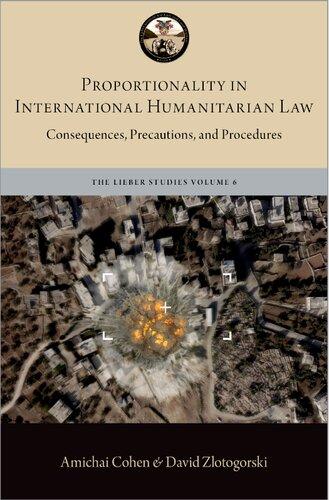
Proportionality in International Humanitarian Law
Consequences, Precautions, and Procedures
General Editor
P rofessor M ichael N. s ch M itt
Managing Editors
c olo N el s ha N e r . r eeves
c olo N el W i N sto N s . W illia M s
D r . s asha r a D i N
Authors
a M ichai c ohe N
D avi D Z lotogorski
Oxford University Press is a department of the University of Oxford. It furthers the University’s objective of excellence in research, scholarship, and education by publishing worldwide. Oxford is a registered trade mark of Oxford University Press in the UK and certain other countries.
Published in the United States of America by Oxford University Press 198 Madison Avenue, New York, NY 10016, United States of America.
All rights reserved. No part of this publication may be reproduced, stored in a retrieval system, or transmitted, in any form or by any means, without the prior permission in writing of Oxford University Press, or as expressly permitted by law, by license, or under terms agreed with the appropriate reproduction rights organization. Inquiries concerning reproduction outside the scope of the above should be sent to the Rights Department, Oxford University Press, at the address above.
You must not circulate this work in any other form and you must impose this same condition on any acquirer.
Library of Congress Cataloging-in-Publication Data
LC record available at https://lccn.loc.gov/2020044178
DOI: 10.1093/oso/9780197556726.001.0001
9 8 7 6 5 4 3 2 1
Printed by Integrated Books International, United States of America
Note to Readers
Tis publication is designed to provide accurate and authoritative information in regard to the subject matter covered. It is based upon sources believed to be accurate and reliable and is intended to be current as of the time it was written. It is sold with the understanding that the publisher is not engaged in rendering legal, accounting, or other professional services. If legal advice or other expert assistance is required, the services of a competent professional person should be sought. Also, to confrm that the information has not been afected or changed by recent developments, traditional legal research techniques should be used, including checking primary sources where appropriate.
(Based on the Declaration of Principles jointly adopted by a Committee of the American Bar Association and a Committee of Publishers and Associations.)
You may order this or any other Oxford University Press publication by visiting the Oxford University Press website at www.oup.com.
CONTENTS
Preface xi
Table of Treaties and Cases xiii
PART I: General Concepts
1. An Introduction to Proportionality 3
A. General Concepts 3
B. Legal Sources 8
C. Te Structure of the Book 9
2. Ethical and Constitutional Foundations 11
A. Te Possible Sources for Proportionality 11
B. A Philosophical and Religious Prism of Proportionality 12 Premodern Views of Proportionality 12
Te Philosophical Background 14
C. Te Rational Analysis of Proportionality 16 Rational Reciprocal Explanation 16
D. Proportionality as a Mode of Control 18
E. Te Constitutional and Administrative Background to Proportionality Analysis 21
3. A General Overview of Proportionality in IHL 23
A. Te History and Development of IHL Proportionality 23
B. Contemporary IHL and Proportionality 29
C. Te Changing Nature of Armed Confict and Proportionality 33 Applying Proportionality: Examples and Dilemmas 35 Fighting Non-State Actors and the Application of the Principle of Proportionality 39
Parallel Application of IHL and International Human Rights Law 44 Te Right to Life during Armed Conficts 48 Diferent Balances of IHL/HRL in Diferent Types of Armed Conficts? 50
D. Conclusion 55
PART II: Te Practical Application of Proportionality
4. Military Advantage 59
A. What Constitutes a Military Advantage? 60
B. Military Advantage of an Attack 65
5. Incidental Harm and the Analysis of Proportionality 73
A. Civilians or All Persons Protected from Attack 73
B. What Constitutes Harm? 78
Harm to the Person 78
Economic Damage 80
Civilian Objects 81
Damage to the Natural Environment 81
Beneftting from Proportional Harm 83
C. Indirect and Reverberating Efects 83
Foreseeable Harm 84
Causality 87
D. Level of Expectation/Anticipation 88
E. A Balancing Act: What Constitutes a Violation? 92 Diferent Standards in Diferent Conficts? 99
Excessive vs. Extensive: An Upper Limit to Civilian Harm? 100
F. From Whose Perspective Should Proportionality Be Examined? 101
6. Soldiers vs. Civilians 107
A. Te Basic Dilemma 107
B. Te Kasher vs. Walzer Debate 108
C. Te Lives of Soldiers and Proportionality 110
D. Te Context of Force Protection 114
E. Te Enemy’s Soldiers 117
7. Strategic and Cultural Considerations 119
A. Te Meaning of “Concrete and Direct Military Advantage” 120
B. Policy Arguments Regarding Strategic and Cultural Considerations 121
Te Divide between IHL and Laws on the Use of Force 121 An Inherent or Tangible Military Advantage? 122 Uncertainty and Manipulations 123
C. Who Bears the Burden of Accommodating a State’s Sensitivities? 125 A Matter of Context? 126 Permitting Less Collateral Damage? 127
D. Diferent Requirements for Diferent States? 128
E. Te Futility of Force, Deterrence, and Proportionality 131
8. Direct Participation in Hostilities and Its Efect on Proportionality 135
A. Te Concept of Direct Participation in Hostilities 135
B. Te Defnition of Direct Participation in Hostilities 139
9. Human Shields and Proportionality 145
A. Te Problem of Human Shields 145
B. Involuntary Human Shields 147
C. Voluntary Human Shields 149
D. Discerning Choice 150
10. Te Principle of Distinction and Its Relation to Proportionality 155
A. Te Defnition of Military Objectives and Its Relation to Proportionality 155
B. Indiscriminate Attacks 159 Protection of Cultural Property 165
PART III: Understanding Proportionality
11. Te Vagueness of Proportionality 169
A. Experimental Meanings of Proportionality 169
B. Te Formula of Proportionality 171
C. Rules of Tumb 174
D. Inherent Vagueness? 175
12. Procedural Aspects of Proportionality 177
A. Te Legal Background 178
B. Procedures 179
C. Te Suitable Decision-Maker 181 Doubts 187
D. How Much Intelligence Is Necessary? 189
E. Warnings 194 Roof Knocking 196
F. What Is the Role of Military Legal Advisors? 197
G. Conclusion 199 Creating a Zone of Reasonableness 199 Responsibility and Control 199 Organization and Culture 200
13. Judicial Review and Investigations 201
A. Introduction 201
B. Ex Ante Review 201
C. Ex Post Review: Te Problem with the Criminal Approach 203 Criminal Investigations 204 Te Problem with Criminal Investigations 205 Should Criminal Prosecutions Be Forsaken? 212
D. Ex Post Assessment: An Alternative to Criminal Trials 214 Te Non-Exclusive Nature of the Grave Breaches Regime under IHL 215
E. Te Saleh Shehadeh Targeted Killing 220
14. Te Future of Proportionality 223
A. On the Future of Proportionality 224
Image-Fare 224
Cyber Warfare and Proportionality 225
Autonomous Weapons and Proportionality 226
Conclusion—A Way Forward? 231
Bibliography 233
Index 247
PREFACE
Tis book aims to clarify the current debates regarding the concept of proportionality in international humanitarian law (IHL).
Almost all states involved in armed conficts recognize the principle of proportionality in IHL as a legal and ethical restraint on their military activities. Specifcally, it is broadly accepted that an attacking party cannot justify collateral damage to civilians if the harm caused is expected to be excessive with regard to the concrete military advantage gained. However, the precise meaning of this principle is frequently disputed. Tere are debates over many issues, including the degree to which force-protection measures can justify extensive collateral damage; the obligation to employ accurate but expensive weaponry; and the impact of using voluntary and non-voluntary human shields. Tere are also disagreements concerning the parameters that are supposed to be used in assessing such a case: What exactly is a “military advantage,” and what does it mean for the harm caused to “exceed” such an advantage?
Controversy is especially rife regarding asymmetrical conficts. Many states, among them many democracies, are engaged in armed conficts against non-state actors, some of them terrorist organizations. In these situations, questions relating to the correct interpretation and efective implementation of the principle of proportionality have arisen, for example, in connection with targeted killings and military operations in civilian areas.
Te goal of this book is to shine a light on these controversies; to clarify the areas in which there is disagreement; and in some cases, to ofer unorthodox points of view on these debates.
Te background for the book is an international conference entitled “Proportionality and Civilian Casualties in Asymmetrical Armed Conficts: An Interdisciplinary Approach.” Te conference was convened by the National Security and Democracy Center at the Israel Democracy Institute and by the Konrad-Adenauer-Stifung, and took place at the Israel Democracy Institute in Jerusalem in May 2016.
Te purpose of the conference was to evaluate the applicability and parameters of the principle of proportionality with regard to liberal states involved in asymmetrical conficts. Te premise was that a full understanding of the proportionality principle cannot be gained through exclusive use of a legal perspective. Te
principle of proportionality is at once a philosophical principle, a political necessity, and a restriction on military operations; thus, it is both a theoretical concept and a practical tool. As a result, a worthwhile discussion of the underlying reasoning, efects, and parameters of the proportionality principle must be multidisciplinary in character. Hence, the conference included scholars from diverse academic felds, such as law, philosophy, and political science, as well as varied practitioners: current and former military commanders, representatives of NGOs, and civilians.
Te discussions held at the conference gave us the initial impetus to embark on this book project, and the conference participants provided us with many interesting and novel points of view on the subject. Most of the material in the book is based on research undertaken by the authors following the conference. However, there are a few cases in which an original position was presented at the conference, without it being based on a publicly available source. On these rare occasions, we simply cite it as an “opinion presented at the Proportionality Conference.”
Te result is a book that aims to present many, perhaps most, of the current positions and debates regarding the application of the principle of proportionality. We believe that this work will be of use both to academics with an interest in these issues, and to practitioners, such as military legal advisers and judges. We believe that there are, in David Luban’s terms, at least two “cultures” of proportionality: that of the academics, and that of the practitioners.1 An important goal of this work is to bridge this gap, at least to some degree.
We would like to thank the Israel Democracy Institute’s National Security and Democracy Center and the Konrad-Adenauer-Stifung for their generous fnancial support, both for the conference and for further work on this book. Dr. Michael Borchard of the Konrad-Adenauer-Stifung and Professor Mordechai Kremnitzer, then vice president of the Israel Democracy Institute (IDI), were a constant source of support and wisdom. Professor Yuval Shany, current vice president of IDI, provided many important comments on earlier drafs. Mr. Yochanan Plesner, IDI president, supported the project from beginning to end. Special thanks to Dr. Dina Wyshogrod for tireless hours of help and support in her work on the various drafs of this book. We are especially grateful to all the participants in the conference, who invested much time and efort in clarifying concepts and in debating the issues covered in this book.
David Zlotogorski would particularly like to thank Mr. Tal Mimran for all his valuable guidance and advice throughout the journey and Mr. Ori Pomson for his expertise and unfagging assistance.
Amichai Cohen would also like to thank the Faculty of Law at the Ono Academic College, and especially Deans Yuval Elbashan and Elad Finkelstein for their support and encouragement during the work on this book.
Financial support for this book was provided by ERC Grant No. 324182.
1. David Luban, Military Necessity and the Cultures of Military Law, 26(2) Leiden J. Int’l L. 315 (2013).
TABLE OF TREATIES AND CASES
CONVENTIONS AND TREATIES
Adjutant Gen.’s Ofce, U.S. War Dep’t, Instructions for the Government of Armies of the United States in the Field, Gen. Ord. No. 100, Apr. 24, 1863 (Lieber Code) . .
9, 23–24, 23 n.4, 24 n.5
St. Petersburg Declaration Renouncing the Use in Time of War of Explosive Projectiles under 400 Grammes Weight, Dec. 11, 1868, 138 C.T.S. 297 24, 24 nn.8–9
Te Hague Convention (IV) Respecting the Laws and Customs of War on Land, Annexed Regulations, 1907, 205 C.T.S. 277 24 n.9, 25, 30 n.38, 135 n.1, 194 n.64
Protection of Civilian Populations against Bombing from the Air in Case of War, September 30, 1938, Resolution of the League of Nations Assembly, O.J. Spec. Supp. 182, at 16
Charter of the United Nations, Oct. 24, 1945, art. 2(4) 1 U.N.T.S. XVI
Geneva Convention for the Amelioration of the Condition of the Wounded and Sick in Armed Forces in the Field, Aug. 12, 1949, 75 U.N.T.S. 31 (GC-I) .
Geneva Convention for the Amelioration of the Condition of Wounded, Sick and Shipwrecked Members of Armed Forces at Sea, Aug. 12, 1949, 75 U.N.T.S. 85 (GC-II) 28, 33 n.54, 34 n.55, 45, 133 n.1, 137 n.8, 145, 204, 204 n.9, 204 n.13, 207, 207 n.24, 211, 215, 215 n.59
Geneva Convention Relative to the Treatment of Prisoners of War of August 12, 1949, 75 U.N.T.S. 135 (GC-III) . . . . . . . . . . . . 28, 33 n.54, 34 n.55, 45, 73–75, 73 n.1, 135 n.1, 136, 136 n.5, 137 n.8, 145, 146 n.5, 204, 204 n.9, 204 n.13, 207, 207 n.24, 211, 215, 215 n.59
Geneva Convention Relative to the Protection of Civilian Persons in Times of War of August 12, 1949, 75 U.N.T.S. 287 (GC- IV) . . . . . . . . 28, 33 n.54, 34 n.55, 41 n.78, 45, 77 nn.16–17, 137 n.8, 145, 145 n.3, 204, 204 n.9, 204 n.13, 207, 207 n.24, 211, 215, 215 n.59
European Convention for the Protection of Human Rights and Fundamental Freedoms, Nov. 4, 1950, 213 U.N.T.S. 221 21, 48 n.102, 207 Hague Convention for the Protection of Cultural Property in the Event of Armed Confict, May 14, 1954, 249 U.N.T.S 358 . . . . . . . . . . . . . 165, 165 n.38
Protocol Additional to the Geneva Conventions of 12 August 1949, and Relating to the Protection of Victims of Non–International Armed Conficts, June 8, 1977, 1125 U.N.T.S. 609 (AP-II) .
. 34, 137 n.8, 138, 150 n.21
Convention on Prohibitions or Restrictions on the Use of Certain Conventional Weapons Which May be Deemed to be Excessively Injurious or to have Indiscriminate Efects, Oct. 10, 1980, 1342 U.N.T.S. 137 .
8, 8 n.28, 34 n.57
Protocol on Prohibitions or Restrictions on the Use of Mines, Booby-Traps and Other Devices (Protocol II), Geneva, Oct. 10, 1980, 1342 U.N.T.S. 168
. . . 8 n.28, 34 n.57
Convention of the Right of the Child, Nov. 20, 1989, 1577 U.N.T.S. 3 . . . . 41 n.78
Statute of the International Criminal Tribunal for Former Yugoslavia, May 25, 1993, U.N. Doc. S/RES/827 (ICTY Statute) 205 n.16
Statute for the International Criminal Tribunal for Rwanda, Nov. 8, 1994, U.N. Doc. S/RES/955 (ICTR Statute) . . . .
Protocol on Prohibitions or Restrictions on the Use of Mines, Booby Traps and Other Devices (Protocol II), as amended, May 3, 1996, 35 I.L.M. 1206 .
Te International Covenant on Civil and Political Rights, Dec. 19, 1966, 999 U.N.T.S. 171 . . . . .
Second Optional Protocol to the 1954 Hague Convention for the Protection of Cultural Property in the Event of Armed Confict, Mar. 26, 1999, 2252 U.N.T.S. 172 . . . . . . . . . . . . . . . . . . . . . . . . . . 165, 165 n.40
Protocol on the Involvement of Children in Armed Confict, May 25, 2000, G.A. Res. 263, U.N. GAOR, 54th sess., annex I, U.N. Doc. A/54/263 41 n.78
Case Concerning Oil Platforms (Iran v. U.S.A), Merits, [2003] I.C.J. 161 . . . . 3 n.1
Legal Consequences of the Construction of a Wall in the Occupied Palestinian Territory, Advisory Opinion, [2004] I.C.J. 136 . . . . . . . . . . 47 n.99
Case Concerning Armed Activities on the Territory of the Congo (Dem. Rep. Congo v. Uganda), Judgment, [2005] I.C.J. 168 . . . . . . . . . . . . 3 n.1
INTERNATIONAL CRIMINAL TRIBUNAL FOR FORMER YUGOSLAVIA (ICTY)
Prosecutor v. Tadić, ICTY Appeals Chamber, IT-94-1-AR72, Decision on the Defence Motion for Interlocutory Appeal on Jurisdiction (Oct. 2, 1995)
A. v. U.K., E.Ct.H.R., App. No. 3455/05 (2009) 46 n.95
Abuyeva v. Russia, E.Ct.H.R., App. No. 27065/05 (2010) 207 n.29
Al Skeini v. U.K., E.Ct.H.R., App. No. 55721/07 ECHR (2011) 207, 207 n.30
Jaloud v. Te Netherlands, E.Ct.H.R., App. No. 47708/08 (2014) . . . . . . . 208 n.33
US MILITARY TRIBUNAL NUREMBERG
US Military Tribunal Nuremberg, Judgment of October 27, 1948, in Law Reports of Trials of War Criminals, Selected and Prepared by the United Nations War Crimes Commission, Vol. XII Te German High Command Trial, London: United Nations War Crimes Commission, 1949 146 n.6
INTER- AMERICAN COURT OF HUMAN RIGHTS
Rodriguez v. Honduras, Inter-Am.Ct.H.R. (Ser. C) No. 4 (1988) . . . . . . . 204 n.10, 207 n.25
SPECIAL COURT FOR SIERRA LEONE
Prosecutor v. Sesay, Trials Chamber I, SCSL-04-15-T (Mar. 2, 2009) . . . . 143 n.30
ETHIOPIA- ERITREA CLAIMS COMMISSION
Western Front, Aerial Bombardment and Related Claims—Eritrea’s Claims 1, 3, 5, 9-13, 14, 21, 25 & 26 (Eritrea v. Ethiopia), Partial Award (Dec. 19, 2005) 159 n.17
JUDGMENTS OF NATIONAL COURTS COLOMBIA
Constitutional Case No. C-291/07, Te Plenary Chamber of Colombia’s Constitutional Court (Apr. 25, 2007) .
GERMANY
1 BvR 357/07 Dr. H v. §14.3. of the Aviation Security Act (Feb. 15, 2006) . . .
Federal Court of Justice, Fuel Tankers case, Federal Prosecutor General Decision (April 16, 2010)
BGH, Urteil, III ZR 140/15 (Oct. 6, 2016)
ISRAEL
HCJ 2056/04, Beit Sourik Village Council v. Te Government of Israel, 58(5) PD 807 (2004) .
159 n.21
29 n.33, 32 n.50, 203, 203 n.6
HCJ 7957/04, Mara’abe v. Te Prime Minister of Israel, PD 60(2) 477 (2005) .
n.50
HCJ 3799/02, Adalah (Legal Center for Arab Minority Rights in Israel) v. IDF Commander of the Central Region, PD 60(3) 67 (2005) . . . . 152 n.32
HCJ 769/02, Public Committee against Torture v. Te State of Israel, PD 62(1) 507 (2006) . . . . . . . 6 n.13, 89 n.75, 140 n.16, 150 n.23, 203 n.8, 216
HCJ 8794/03, Hass v. Te Military Advocate General (Published in Nevo, Dec. 23, 2008) .
HCJ 3292/07, Adallah v. Attorney General (Published in Nevo, Dec. 8, 2011)
220 n.80
217 n.63
HCJ 3003/18, Yesh Din – Volunteers for Human Rights v. Te IDF Chief of Staf (Published in Nevo, May 24, 2018) . . . . . . . . 54 n.123, 141 n.16
JAPAN
Shimoda v. Te State, 8 Jap. Ann. I’ntl L. 212 (1964) . . . . . . . . 25 n.14, 100 n.121
UNITED KINGDOM
Ali Zaki Mousa v. Secretary of Defence [2010] EWHC 3304 . . . . . . . . . . 219 n.77
PART I
General Concepts
This part of the book presents the general concept of proportionality in IHL. We begin this section with two chapters in which the general principle of proportionality is explained, and the historical and legal development of this principle is reviewed.
1 An Introduction to Proportionality
A. GENERAL CONCEPTS
Tere are few concepts in international law that both captivate the mind and stir bitter debates as much as the application of the principle of proportionality in contemporary armed confict. As conficts are increasingly fought in urban settings, the concept of proportionality plays a crucial role in the protection of civilians from the horrors of war. Tis book is a study of proportionality as it is currently understood in the laws of armed confict—also known as international humanitarian law (IHL).1 Te principle of proportionality is one of the cornerstones of IHL together with the other basic principles of: distinction between civilians and combatants, the prohibition of inficting unnecessary sufering, the notion of military necessity, and the principle of humanity.2 Although proportionality is notoriously opaque and can seem a topic for theoreticians, the real-world impact of this principle and its interpretation is very concrete. States, and their armed forces, treat it as a serious limitation on their military activity.3 Tere are many reasons for the
1. Proportionality is an important principle not only in IHL, but also in the law that governs the conditions under which states may go to war—jus ad bellum. Although contemporary international law contains a broad prohibition on the use of force (United Nations (UN), Charter of the United Nations, Oct. 24, 1945, art. 2(4) 1 U.N.T.S. XVI), the primary, if not sole, exception to this prohibition is self-defense (Id., art. 51). In the simplest terms, in order for use of force in self-defense to be lawful, a state must have been the target of an armed attack, and its resort to force must be proportionate, immediate, and used only when necessary—as a last resort. A discussion of jus ad bellum proportionality, which in general terms determine whether the use of force is proportionate to the cause of war, is beyond the scope of this book. See generally Case Concerning Oil Platforms (Iran v. U.S.A), Merits, I.C.J. 161, paras. 51, 76–77 (2003); Case Concerning Military and Paramilitary Activities in and against Nicaragua (Nicar. v. U.S.A), Merits, I.C.J. 14, para. 194 (1986); Case Concerning Armed Activities on the Territory of the Congo (Dem. Rep. Congo v. Uganda), Judgment, I.C.J. 168, para. 147 (2005); Yoram Dinstein, War, Aggression and Self-Defence 230–33 (5th ed., 2011); David Kretzmer, Te Inherent Right to Self Defence and Proportionality in Jus Ad Bellum, 24 Eur. J. Int’l L. 235 (2013).
2. Tere is some disagreement as to what are the basic principles of IHL. We adopt here the list proposed by the ICRC in Marco Sassoli et al., How Does Law Protect in War? Vol. 1, 161–62 (I.C.R.C., 3rd ed., 2011).
3. Jack M. Beard, Law and War in the Virtual Era, 103 A.J.I.L. 409, 427 (2009).
prominence of the principle of proportionality, especially, its hold on the “imagination of the epistemic community in which it is used as the prism for viewing, arguing, and ultimately resolving disputes.”4
It is, perhaps, useful to present the principle of proportionality in the context of two other cardinal principles of IHL: the principles of necessity and of distinction.5 According to these, only combatants and military objectives may be targeted during armed conficts. Te attacking party must ascertain whether a given target is military or civilian, and refrain from attacking the latter. Te principle of proportionality adds a further constraint to the principle of distinction. Even if the target is a military objective, attacking it is prohibited if it is expected to cause incidental harm to civilians “which would be excessive in relation to the concrete and direct military advantage anticipated.”6
For example, while civilian buildings cannot be attacked during a military operation, a civilian building housing a group of soldiers can be attacked, because its use makes it a military objective. However, the principle of proportionality places limits on how and when this building may be attacked. It is prohibited to attack the building if it is known that a large number of civilians either in the building or in its vicinity would be harmed, even if unintentionally, to an extent that this harm (“collateral damage”) would be excessive relative to the military advantage gained by the attack. Tus, distinction and proportionality impose two cumulative conditions that must both be fulflled in order for an attack to be lawful. Both principles limit the freedom of operation and the discretion of the belligerent parties, and thereby play an important role in protecting civilians from the vicissitudes of armed confict.7
Te principle of proportionality is perhaps one of the clearest examples of the balance struck in IHL8 between the two conficting interests of military
4. Tomas M. Franck, On Proportionality of Countermeasures in International Law, 102 A.J.I.L. 715, 718 (2008).
5. Legality of the Treat or Use of Nuclear Weapons, Advisory Opinion, I.C.J. 8, 587, para. 78 (1996) [Nuclear Weapons Case]: “Te cardinal principles contained in the texts constituting the fabric of humanitarian law are the following. Te frst is aimed at the protection of the civilian population and civilian objects and establishes the distinction between combatants and non-combatants.”
6. Protocol Additional to the Geneva Conventions of August 12, 1949, and Relating to the Protection of Victims of International Armed Conficts (Protocol I), June 8, 1977, arts. 51(5)(b), 57(2)(a)(iii), 1125 U.N.T.S. 3 [AP-I].
7. Yoram Dinstein, The Conduct of Hostilities under the Law of International Armed Conflict 130 (2nd ed., 2010).
8. Michael N. Schmitt, Military Necessity and Humanity in International Humanitarian Law: Preserving the Delicate Balance, 50 Va. J. Int’l L. 795, 798 (2010). Another clear example is the obligation to avoid causing unnecessary sufering (AP-I, supra note 6, art. 35(2)).
necessity and humanity.9 Tis balance is meted out in the diferent treaties and their provisions as well as in the customary law of IHL. Proportionality—in general, and in IHL specifcally—represents a social convention that certain societal values must only be achieved at reasonable cost.10 Proportionality is diferent from other principles of IHL in that it balances military necessity against humanitarian interests “horizontally” rather than “vertically.” Tat is, rather than allowing for military necessity to justify any harm to civilians, or allowing the principle of distinction to completely prohibit any attacks involving collateral damage, proportionality instead requires the attackers to review their planned operation, weighing the foreseeable damage to the civilian population against the anticipated military advantage. If the harm resulting from the attack is expected to be excessive in relation to the military advantage that is anticipated, then proportionality requires that the attack be canceled or suspended.
Although it is one of the core principles of IHL, the term “proportionality” does not appear in any IHL treaty.11 As the principle of proportionality clearly limits the freedom of action that armed forces have during armed conficts, states have been reluctant to limit themselves by adopting an explicit prohibition on the use of disproportionate force.12
Tere seems to be no broad agreement on what constitutes a proportionate attack as opposed to a disproportionate one. It is generally accepted that an attack on a whole battalion, justifed from a military perspective, is proportionate when the expected collateral damage is the death of one civilian. It also seems uncontroversial that killing an entire village during an attack on one soldier, even if killing this soldier provides a military advantage, is disproportionate. However, there is
9. Commentary on the Additional Protocols of 8 June 1977 to the Geneva Conventions of 12 August 1949, para. 2206 (ICRC, Yves Sandoz, Christophe Swinarki, & Bruno Zimmerman eds., 1987) [AP-I Commentary].
10. Yuval Shany, The Principle of Proportionality under International Law 13 (2009) (Heb.).
11. Tis omission is not one of mere happenstance. Tere was an attempt to include the term proportionality in the First Additional Protocol to the Geneva Conventions (AP-I), though this attempt failed. See Amichai Cohen, Te Principle of Proportionality in the Context of Operation Cast Lead: Institutional Perspectives, 35 Rutgers L. Record 23, 27 n.37 (2009); W.J. Fenrick, Te Rule of Proportionality and Protocol I in Conventional Warfare, 98 Mil. L. Rev. 91, 102–07 (1982). Prior to AP-I, the principle itself was not even stipulated in any treaty; see William J. Fenrick, Applying IHL Targeting Rules to Practical Situations: Proportionality and Military Objectives, 27 Windsor Y.B. Access Just. 271, 277 (2009). Te use of the term “excessive,” rather than “disproportionate,” in AP-I stems from a concern raised by its framers that the use of the term “proportionality” could result in a standard that would excessively constrain states’ abilities to engage in combat. See Shany, Id., at 59.
12. Amichai Cohen, Proportionality in Modern Asymmetrical Wars, 8 (2010), available at: din-online.info/pdf/jc2.pdf.
a vast grey area between these two extremes that remains contentious.13 Almost three decades ago, W. Hays Parks, an expert in IHL who invested signifcant time studying the issue of proportionality, concluded that “there remains a substantial lack of agreement as to the meaning of the provisions in Protocol I relating to proportionality.”14 In the decades since, the principle still remains contested.15 At the outset, it might be useful to set out areas of agreement. Almost everyone agrees that proportionality in IHL is not a matter of the number of combatants or soldiers killed during a single attack or during the entire armed confict.16 From the standpoint of IHL proportionality, it is lawful for one state to sufer no military casualties whatsoever while killing thousands of enemy soldiers. Furthermore, according to most scholars, proportionality in IHL does not concern itself with equality or equity in the means or methods of warfare that states employ:17 it does not prohibit a state from using overwhelming force to subdue the military of the adverse party,18 and it is lawful for a modern state
13. Te latter part of this example is presented by Dinstein (Dinstein, supra note 7, at 134). Tis issue was also raised by the Israeli High Court of Justice. See HCJ 769/02, Public Committee against Torture v. Te State of Israel, PD 62(1) 507, para. 46 (2006) [Isr.] [Targeted Killings Case]. Recently, an empirical study examined how 331 lawyers and legal academics (LLM students) conducted proportionality analyses in diferent scenarios. Te study found that ideology (being a hawk or a dove) is strongly associated with proportionality analysis, as are changes to the facts and circumstances in the scenarios that were presented to the respondents in the survey. In the scenarios presented before the respondents, 90.9% of the “hawks” approved a given attack, as opposed to only 52.1% of “doves.” See Raanan Sulitzeanu-Kenan, Mordechai Kremnitzer, & Sharon Alon, Facts, Preferences, and Doctrine: An Empirical Analysis of Proportionality Judgment, 50 L. & Soc’y Rev. 348, 366–72 (2016).
14. W. Hays Parks, Air War and the Law of War, 32 Air Force L. Rev. 1, 175 (1990).
15. Cohen, supra note 12, at 13.
16. Gabriella Blum claims that the lives of soldiers should be protected in specifc cases, but focuses on the principle of distinction and the principle of necessity. Gabriella Blum, Te Dispensable Lives of Soldiers, 2 J. Legal Analysis 115, 158 (2010). Ido Rozenzweig does suggest that lives of soldiers should be protected under the principle of proportionality, though his opinion seems to be somewhat singular in that respect. See: “Rethinking the Basic Principles of IHL and their Application to Combatants’ Lives” (draf article, on fle with the authors).
17. Adam Roberts, Te Equal Application of the Law of War: A Principle Under Pressure, 872 Int’l Rev. Red Cross 931, 932 (2008): “Under this principle, the laws of war . . . apply equally to all those who are entitled to participate directly in hostilities . . . it is not relevant whether a belligerent force represents an autocracy or a democracy, nor is it relevant whether it represents the government of a single country or the will of the international community.” However, see also Gabriella Blum, On a Diferential Law of War, 52 Harv. J. Int’l L. 164, 194 (2011), who suggests that “a common-but-diferentiated principle of proportionality and the duty to take precautions in attack might impose substantially higher degrees of responsibility on richer or more technologically advanced countries than on poorer ones.”
18. Parks, supra note 14, at 170; Fenrick, supra note 11, at 277. While proportionality in IHL does not concern itself with the relation between the harm caused to each one of the parties, determining proportionality in jus ad bellum does involve a discussion of whether the use of force
to use tanks and airplanes against an adversary that only has poorly equipped infantry soldiers.19 Proportionality concerns only expected harm to civilians and civilian objects.20
Yet even with regard to civilians, proportionality does not require parity between the number of casualties— those killed or injured— on both sides of the conflict. We might imagine a specific scenario in which there will be a direct causal connection between saving the lives of a number of civilians at a cost of the lives of other civilians—for example, in an operation aimed at preventing a specific terrorist attack. But this is not the usual case, or even a very realistic one. In most cases, determining whether an attack is proportionate or not is not simply a matter of crunching numbers. 21 Rather, proportionality is an intricate evaluation of completely different sets of values—on the one hand, the harm to civilians and civilian objects, and on the other, the anticipated military advantage. Most commentators agree that these two values cannot be compared through the simple use of a formula, because they have no common denominator. 22 Proportionality analysis has therefore been called a “value judgment.” 23
and harm committed to the opposing party was proportionate to the justifcation of the use of force. For more on this matter, see Chapter 7.
19. Such an action might be questionable under proportionality in jus ad bellum, which is not the subject of this work. See: Kretzmer, Te Inherent Right to Self Defense and Proportionality in Jus Ad Bellum, supra note 1.
20. Dinstein, supra note 7, at 129.
21. Id., at 130. One example of this misconstrued application of proportionality analysis can be found in the United Nations Human Rights Council, Report of the United Nations Fact-Finding Mission on the Gaza Confict, U.N. Doc. A/HRC/12/48 (Sept. 25, 2009) [Te Goldstone Report]. Robert Sloane writes that: “Many critics of the IDF’s conduct in the 2008–09 campaign Operation Cast Lead, including prominent international lawyers on the Goldstone Commission, seized upon the numerical disparity between people (civilians and combatants) killed by Hamas’s forces (13) and people killed by the IDF (estimates vary, but likely more than 1,100), as decisive evidence of disproportionate force—without considering the anticipated military objective or ex ante context. Te IDF might well be culpable for using disproportionate force. But the foregoing would be an indefensible application of AP-I’s defnition” (Robert D. Sloane, Puzzles of Proportion and the ‘Reasonable Military Commander’: Refections on the Law, Ethics, and Geopolitics of Proportionality, 6 Harv. Nat’l Sec. J. 299, 317 (2015)).
22. For a view that proportionality can be assessed by using a specifc equation tailored to include the diferent considerations that must be examined in the analysis, see Boaz Ganor, Global Alert: The Rationality of Modern Islamist Terrorism and the Challenge to the Liberal Democratic World (2015). Tis suggestion will be discussed in some detail in Chapter 11.
23. Dinstein, supra note 7, at 132; International Criminal Court, Elements of Crimes, 19 n.37 (2011), available at: www.icc-cpi.int/NR/rdonlyres/336923D8-A6AD-40EC-AD7B45BF9DE73D56/0/ElementsOfCrimesEng.pdf.