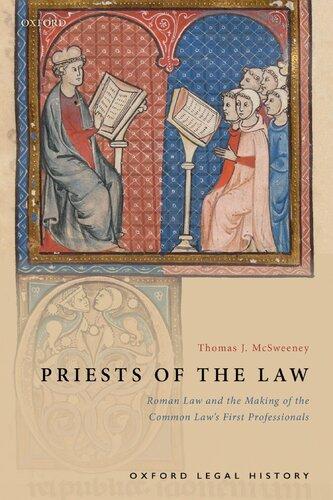
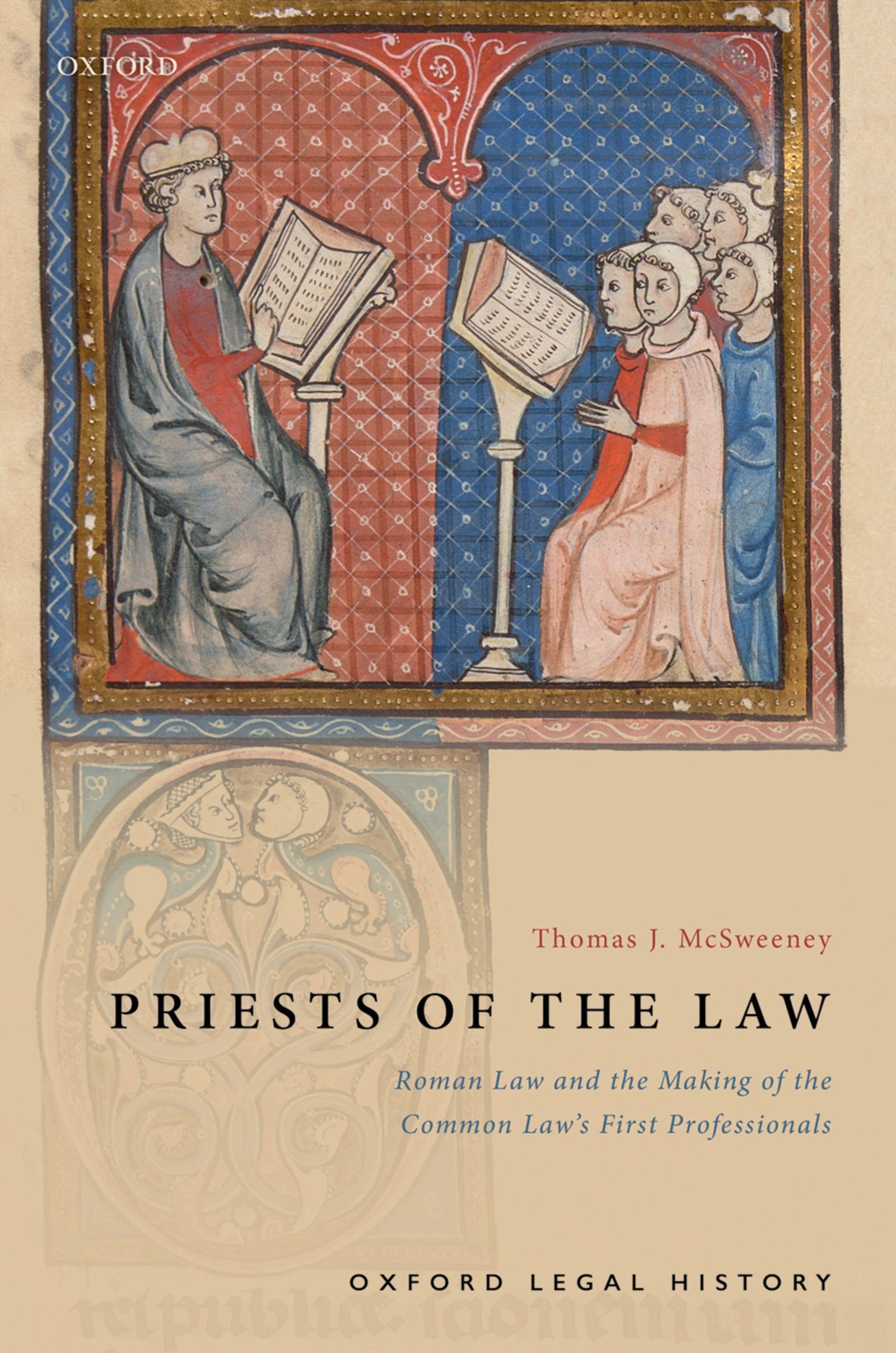
Priests of the Law
Roman Law and the Making of the Common Law’s First Professionals
THOMAS J. MCSWEENEY
3
Great Clarendon Street, Oxford, OX2 6DP, United Kingdom
Oxford University Press is a department of the University of Oxford. It furthers the University’s objective of excellence in research, scholarship, and education by publishing worldwide. Oxford is a registered trade mark of Oxford University Press in the UK and in certain other countries
© Thomas J. McSweeney 2019
The moral rights of the author have been asserted
First Edition published in 2019
Impression: 1
All rights reserved. No part of this publication may be reproduced, stored in a retrieval system, or transmitted, in any form or by any means, without the prior permission in writing of Oxford University Press, or as expressly permitted by law, by licence or under terms agreed with the appropriate reprographics rights organization. Enquiries concerning reproduction outside the scope of the above should be sent to the Rights Department, Oxford University Press, at the address above
You must not circulate this work in any other form and you must impose this same condition on any acquirer
Crown copyright material is reproduced under Class Licence Number C01P0000148 with the permission of OPSI and the Queen’s Printer for Scotland
Published in the United States of America by Oxford University Press 198 Madison Avenue, New York, NY 10016, United States of America
British Library Cataloguing in Publication Data
Data available
Library of Congress Control Number: 2019946449
ISBN 978–0–19–884545–4
Printed and bound by CPI Group (UK) Ltd, Croydon, CR0 4YY
Links to third party websites are provided by Oxford in good faith and for information only. Oxford disclaims any responsibility for the materials contained in any third party website referenced in this work.
To Abby, Sean, and Charlotte
Preface
I first became interested in the history of lawyers as a law student. Our profession is a strange one. My Doktorvater is fond of saying that law school is designed to replace your brain with an entirely new one. The degree to which law school fundamentally transforms people is debatable, but I think law school is, at the very least, designed to make people think that they have been changed; a friend once observed that the only organization that does a better job than a law school of convincing you that you have been transformed into something different is the Marine Corps. We separate the world, by way of a curious analogy to the clergy, into lawyers and laymen. In law school I began to wonder how we got this way. When I got to graduate school, I became interested in the processes by which people who work with law have constructed the image of the lawyer as someone separate and different from people who perform other types of work.
These kinds of questions kept coming back to me when I read the thirteenthcentury treatise On the Laws and Customs of England, more commonly known as Bracton. I am the kind of person who is interested in the kinds of things that interested the authors of Bracton. I like to tell my property students that my class will teach them to see the world as it truly is. When they walk down Duke of Gloucester Street in Colonial Williamsburg, they will no longer see boxwood hedges and blooming crape myrtles. Rather, they will see a combination of beautiful, abstract property interests: possessory estates, future interests, easements, and covenants. And yet, when I read Bracton, I found that I was less interested in what its authors wrote about the law than in why they wrote it at all. What compelled this group of justices in England’s central courts to spend what must have been a large amount of their spare time, working long into the night watches, writing a massive treatise? I hope to show that Bracton is at least as much about the justices who wrote it, and how they wanted to perceive themselves and their work, as it is about teaching anyone how servitudes worked in thirteenth-century England.
This book would not have been possible without the support of the many people who devoted their time and energy to helping me develop as a scholar. Many different institutions have been generous in their support for this project. I have had a number of academic homes while I have worked on this project,
starting with the history department at Cornell University, where Priests of the Law began life as my doctoral dissertation. That was followed by two years as a visiting assistant professor on the faculty at Cornell Law School. From there I moved to William & Mary Law School, where I feel particularly fortunate to have a dean and faculty who have supported me as a historian of medieval law. A number of individuals and organizations have provided financial support for this project, as well. I would especially like to thank fellow William & Mary alumnus Joseph J. Plumeri for his support for the Plumieri Award for Faculty Excellence, which helped me complete this book manuscript. The Huntington Library in San Marino, California, provided me with a grant to spend a month working with their legal manuscripts. The Graduate School at Cornell University, the Mario Einaudi Center for International Studies, and the Bibliographical Society of America sent me to England for a fruitful summer in the archives. The staff at Cambridge University Library, the British Library, the National Archives in Kew, the Wren Library at Trinity College, Cambridge, the library at Trinity Hall, Cambridge, and Lincoln’s Inn Library in London all gave me valuable access to their collections, and for that I am extremely grateful. The Anglo-American Legal Tradition project at the University of Houston has also been a wonderful resource and I would like to thank all who have worked on that project for the work they have done to make the treasures of the British National Archives more accessible.
There are a number of people who influenced my thinking about this project as I was developing it. I have presented portions of this book project at various conferences, colloquia, and workshops, including the 2015 Hurst Summer Institute in Legal History, the annual meetings of the American Society for Legal History in 2010 and 2016, the 2013 British Legal History Conference in Glasgow, the 2015 Law and Governance in Pre-Modern Britain Conference at the University of Western Ontario, the London Legal History Seminar, the 2018 Medieval Studies conference at the University of Wisconsin, the International Medieval Congress at Leeds, the International Congress on Medieval Studies at Western Michigan University, the annual meeting of the Charles Homer Haskins Society, the William & Mary Legal History Seminar, the William & Mary Medieval and Renaissance Studies Colloquium, the European History Colloquium and the Medieval Studies Student Colloquium at Cornell University, and the faculty speaker series at Cornell, Emory, and St. Louis University law schools. I appreciate the feedback I have received from the participants in all of these events. I would additionally like to thank the student editors at the Temple Law Review and the Buffalo Law Review. My first two law
review articles, both on Bracton, appeared in those publications. I have adapted parts of each of those pieces and incorporated them into this book.
I have been a part of two wonderful writing groups, one of which was generously funded by the Society for the Humanities at Cornell, and my friends in both of those groups—Eliza Buhrer, Abigail Fisher, Sarah Harlan-Haughey, Ada-Maria Kuskowski, Guillaume Ratel, and Melissa Winders—have given me wonderful feedback. I have learned much about writing good scholarship while reading their work on late medieval theories of cognition, the criminal networks of English coiners, nature in English outlaw literature, the world of the French coutumiers, the construction of truth in early modern French courts, and aristocratic courtesy in the Welsh marches. I also need to thank the “half-bakers” group of junior faculty at William & Mary Law School, including Jeff Bellin, Jay Butler, Chris Griffin, Tara Grove, Alli Larsen, Sarah Rajec, and James Stern. This wonderful group of people gave me some good advice on the introduction to this book when I was stuck.
I have had some outstanding students, both at William & Mary and Cornell, and several have made direct contributions to this book. In particular, I would like to thank my research assistants, Kristi Breyfogle, Gwen Brown, Ryan Schuster, and Evan Steiner. Sarah Spencer, who was the founding president of the William & Mary Legal History Society and a tireless promoter of legal history at William & Mary Law School during her three years here, also deserves thanks for bringing certain things to my attention that helped my argument in Chapter 7.
Several scholars have generously volunteered their time to give me comments and advice on the manuscript at various stages. The members of my dissertation committee gave me important guidance as I worked on this project. I hope each them will recognize something of their own scholarship in this work. Bernadette Meyler’s guidance in thinking about legal texts as literary productions has been a major influence on my scholarship. Duane Corpis pushed me to think about the social side of intellectual history. David Powers first got me thinking about the relationship between judges and jurists, and the interactions between the different kinds of texts they produce. I would also like to mention Charlie Donahue, David Seipp, Tom Green, Dick Helmholz, and Karl Shoemaker, who gave me excellent comments in the later stages.
There are two people in particular who deserve special thanks: the two Pauls who have helped me to shape this project. Without their patient mentoring and meticulous work in reading and commenting on the text, it would not be where it is today. Paul Brand, my editor at the Oxford Legal History series, has
been a wonderful mentor and has used his encyclopedic knowledge of law in the thirteenth century to prevent me from falling into a number of errors. I owe an unrequitable debt to Paul Hyams, my Doktorvater, for taking me on as a graduate student, for shaping me as a scholar, for challenging me, for encouraging me, and for writing more letters of recommendation than I can count. I hope I prove to be worthy of the faith they have both placed in me.
On a more personal note, my mom and dad were very supportive, as well. It was nice to be close to them, as well as my grandparents and my sister’s family, while I was working my way through graduate school.
I have saved the most important person for last: my wife, Abby, who has patiently stood by me and given me her love and support through law school, graduate school, my VAP, the job market, and the quest for tenure. It has worked out well for us. We are now back in Williamsburg with two future William & Mary alumni of our own, Sean and Charlotte, who were both born while I was working on this book. They turned me into a coffee drinker, but they have also kept me grounded while I have worked, long into the night watches, towards tenure and to finish this project.
My study of history has given me a certain degree of humility about my own role in the grand sweep of history. In order to really be remembered by later generations, one has to be both exceptional and lucky. Even being the Roman emperor or president of the United States does not, by itself, guarantee one a place in our society’s historical imagination. For a historian of the middle ages, the kind of mark one can make is quite a bit more modest. Historical knowledge proceeds incrementally. We each build upon what others have written. My hope is that this book will contain something in it that is useful to a historian of another generation, and that she will unlock more of the mysteries of Bracton.
List of Abbreviations
AALT The Anglo-American Legal Tradition <http://aalt.law.uh.edu/> Azo, Summae Azo, Summa Codicis . . .(Institutionum et Digestorum) & Brocardica (Vico Verlag 2008), reprint of Summa Azonis Sive Locuples Iuris Civilis Thesaurus (Venice 1581)
Bracton Woodbine, GE (ed) and Thorne, SE (tr), Bracton on the Laws and Customs of England, 4 vols (Belknap Press 1968–77)
BNB Maitland, FW (ed), Bracton’s Note Book, 3 vols (CJ Clay & sons 1887)
CM Matthew Paris, Chronica Majora, 7 vols (Henry Richard Luard ed, Rolls Series, Longmans & Co, 1872-83)
Corpus Iuris Canonici Friedberg, E (ed), Corpus Iuris Canonici, 2 vols (Bernhard Tauchnitz, 1879–81)
CPR Calendar of the Patent Rolls of the Reign of Henry III Preserved in the Public Record Office, 1232–1272, 4 vols (His Majesty’s Stationery Office 1906–13)
CR Close Rolls of the Reign of Henry III Preserved in the Public Record Office, 13 Vols (His Majesty’s Stationery Office 1902–38)
CRR Curia Regis Rolls Preserved in the Public Record Office, 20 vols (Her Majesty’s Stationery Office 1922–2006)
CUP Cambridge University Press
Digest of Justinian Watson, A (tr), The Digest of Justinian, 4 vols (Revised edn, University of Pennsylvania Press 1998)
EHR English Historical Review
Glanvill Hall, GDG (ed and tr), The Treatise on the Laws and Customs of the Realm of England Commonly Called Glanvill (Reprint edn, Clarendon Press 2002)
Justinian’s Institutes Birks, P, and Mcleod, G (trs), Justinian’s Institutes (Cornell University Press 1987)
LQR Law Quarterly Review
MCL Brand, P, The Making of the Common Law (Hambledon Press 1992)
ODNB Oxford Dictionary of National Biography (Online edn, OUP 2008)
OUP Oxford University Press
RLC Hardy, TD (ed), Rotuli Litterarum Clausarum in Turri Londinensi Asservati, 2 vols (Record Commission 1833–44)
RLP Hardy, TD (ed), Rotuli Litterarum Patentium in Turri Londinensi Asservati, 2 vols (Record Commission 1835)
xiv List of Abbreviations
SR Luders, A, Tomlins, TE, France, J, Tauton, WE, and Raithby, J (eds), The Statutes of the Realm: From Original Records, etc. (1101–1713), 11 vols (London, 1810–28)
SS Selden Society
TNA The National Archives (United Kingdom)
Introduction
Sometime in the middle decades of the thirteenth century, a justice working in the courts of the English king wrote, “law is called the art of what is fair and just, of which we are deservedly called the priests, for we worship justice and administer sacred rights.”1 The words appear in a treatise that bears the title De Legibus et Consuetudinibus Angliae (On the Laws and Customs of England) or De Legibus et Consuetudinibus Anglicanis (On English Laws and Customs).
De Legibus which is known today as Bracton, after the man who was presumed for seven centuries to have been its author—has achieved a reputation for being one of the foundational texts of the common law. Lawyers, judges, and academics occasionally dust off this ancient tome when they want to make the case that a particular rule or principle has been a part of our common-law tradition from its beginning, or close to it.2 This book will be less concerned with what Bracton can tell us about the law of the thirteenth century, however, than in what it can tell us about the people who wrote it, those people who the author of the sentence above describes as the law’s priests. The author of this sentence supposes himself to be part of some community and, through the use of the word “we,” hints that he imagines that his reader is a member of that same community. He never explicitly defines the “we,” however. Who were these priests of the law?
Bracton was written over several decades, between the 1220s and the 1260s, and its authors were justices working in the courts of the king. Martin of
1 “Ius ergo derivatur a iustitia, et habet varias significationes. Ponitur enim quandoque pro ipsa arte, vel pro eo quod scriptum habemus de iure, quod ius dicitur ars boni et aequi, cuius merito quis nos sacerdotes appellat. Iustitiam namque colimus et sacra iura ministramus.” Bracton, vol 2, 24. I have provided a bit more of the Latin for context. As we shall see, the author did not so much write this sentence as adapt it from an earlier source.
2 It was cited in a supreme court opinion as recently as 2018, when Justice Gorsuch, in his dissent in Sveen v. Melin, cited Bracton for the principle that “Because legislation often disrupts existing social arrangements, it usually applies only prospectively.” Sveen v. Melin, 138 S Ct 1815, 1826 (2018). It is interesting for the purposes of this book to note that Justice Gorsuch was actually citing to a provision of Roman law that had been worked, without attribution, into the text of Bracton. The statement that “every new constitution ought to impose a rule on future things and not on things past” is probably a paraphrase of a provision from Justinian’s Codex. Bracton, vol 3, 181. It was probably worked into an already-complete passage at some later point in the editing process; it appears to have been inserted mid-sentence and is not directly relevant to the material around it.
Priests of the Law. Thomas J. McSweeney, Oxford University Press (2019). © Thomas J. McSweeney. DOI: 10.1093/oso/9780198845454.003.0001
Pattishall (d. 1229), who was an important justice in the 1210s and 1220s, may have started the project. His clerk, William of Raleigh (d. 1250), who would become the chief justice of the court coram rege, the court that would later be known as the King’s Bench, was probably the primary author. Raleigh’s clerk, Henry of Bratton (d. 1268), who became a justice of the court coram rege himself, appears to have edited the treatise and added his own material to it. The central argument of this book will be that the justices who wrote Bracton were the first people in the history of the common law to think of themselves as legal professionals. It will build upon the work of several scholars who have examined the beginnings of the legal profession in England. Ralph Turner’s magisterial work, The English Judiciary in the Age of Glanvill and Bracton, c. 1176-1239, gives us a very detailed account of the early judiciary, and the stages by which full-time justices came to dominate the work of the king’s courts.3 C.A.F. Meekings and David Crook pick up where Turner left off in their detailed narrative history of the court coram rege from 1234 up to 1272.4 Paul Brand has written on the judiciary in the reign of Edward I (1272–1307) and, in particular, the “emergence during the course of the reign of a much more recognizably ‘professional’ judiciary.”5 Although his focus is on the last decades of the thirteenth century, Brand examines changes that took place in the courts and the judiciary, some of which reach back into the first half of the century. Brand’s Origins of the English Legal Profession deals primarily with the origins of two other groups of legal professionals, the serjeants and attorneys, people who worked for clients in the royal courts. These groups were coalescing around the same time the Bracton authors were writing, in the middle decades of the thirteenth century.6 I am indebted to all of these scholars for the detailed work they have done in reconstructing judicial careers in the thirteenth century. This book will build upon their work to illuminate the process by which justices of the early thirteenth century came to think of themselves as legal professionals. When these scholars discuss the professionalization of the judicial bench, they tend to focus either on the development of expertise
3 Ralph V. Turner, The English Judiciary in the Age of Glanvill and Bracton, c. 1176-1239 (CUP 1985) (hereafter Turner, English Judiciary).
4 CAF Meekings and David Crook, King’s Bench and Common Bench in the Reign of Henry III (Selden Society 2010) (hereafter, Meekings and Crook, King’s Bench and Common Bench).
5 Paul Brand, “Edward I and the Transformation of the English Judiciary” in MCL, 135 (hereafter Brand, “Transformation”).
6 Paul Brand, The Origins of the English Legal Profession (Blackwell 1992) 54–55 (hereafter Brand, Legal Profession). Brand notes that a reference in Matthew Paris’ Chronica Majora under the year 1239 to the king obtaining the services of all of the serjeants of the Common Bench seems to indicate that the serjeants were an identifiable group of professionals by that time. Ibid, 55. There is evidence that some people were practicing in the courts regularly enough to be considered professionals as early as the 1220s. Ibid.
or on structural changes within the courts that placed them on a more regular footing.7 Turner and Brand show us, for instance, that by the early decades of the thirteenth century more of the central royal courts’ work was being done by justices who served continuously for long periods of time and that many justices began their careers as judicial clerks, gaining experience in the courts before they ascended to the bench.8 Expertise is not the only mark of a professional, however. This book will focus on another aspect of professionalization, the justices’ self-perception. The justices who wrote Bracton are interesting figures not just because they had developed expertise in the law, but because they actually thought of themselves, first and foremost, as people who worked with law.
This book will examine Bracton and the other writings produced by the Bracton authors for evidence of the ways the justices thought about themselves. Bracton is a massive tome; it fills more than 1,200 pages in its modern edition and generally fills a very large single volume in its medieval manuscripts.9 It draws on many sources. Those sources included numerous forms of writs— the small pieces of parchment that kept the royal administration running in the thirteenth century—as well as legislative acts, such as Magna Carta and the Provisions of Merton, and cases decided in the royal courts. The authors borrowed from earlier English sources, such as the Glanvill treatise, written in the late 1180s, just a few decades after the reforms of Henry II’s reign. Its authors also probably had access to even earlier works, such as the Leges Edwardi Confessoris, an early twelfth-century composition that claims to recount the laws of a late Anglo-Saxon king. They may have known Latin translations of genuine Anglo-Saxon law codes.10
7 Brand notes, for instance, that there was a growing tendency throughout the thirteenth century towards fewer justices who served longer periods of time on the bench and who did so to the exclusion of other types of work. These tendencies became much more pronounced in Edward I’s reign, but the trend towards specialization appears to have begun as early as John’s reign, if not before. Brand, “Transformation” (n 5) 141–44. This tends to show that justices were specializing and developing expertise in the work of the royal courts. Brand also notes that there is some evidence that there were attempts to place justices on regular salaries as early as 1218. Salaries became more common in the ensuing decades until, in the 1250s, most justices were receiving them. Ibid, 144–47.
8 Brand, Legal Profession (n 6) 27–29. Brand argues that the development of a professional judiciary helped create the conditions necessary for a professional bar to develop. Ibid, 32.
9 The treatise known as Glanvill is much smaller. Glanvill fits easily in a single volume of 177 pages in its modern edition, with fewer words per page. It is slightly more than one-tenth the size of Bracton
10 HG Richardson, “Studies in Bracton” (1948) 6 Traditio 61, 75–78 (hereafter Richardson, “Studies in Bracton”); TFT Plucknett, Early English Legal Literature (CUP 1958) 53 (hereafter Plucknett, Legal Literature); Wiebke Fesefeldt, Englische Staatstheorie Des 13. Jahrhunderts: Henry De Bracton Und Sein Werk (Musterschmidt Verlag 1962) 82; Paul Brand, “The Date and Authorship of Bracton: A Response” (2010) 31 Journal of Legal History 217, 220–22, 225 (hereafter Brand, “Date and Authorship”).
The Bracton authors did not rely exclusively on English sources for their treatment of the “laws and customs of England,” however. They also relied on another textual tradition: the tradition of Roman and canon law. In the twelfth and thirteenth centuries, the study of Roman law experienced a revival in those parts of Europe that, centuries before, had comprised the Western Roman Empire. The revival had begun in Italy. Bologna became the premier center for the study of Roman law and its close cousin, canon law. People from every corner of Latin Christendom—those parts of Europe and the Mediterranean world that recognized the pope as the head of the Church—traveled to learn at the feet of the doctors of Bologna. From Northern Italy, the study of Roman and canon law quickly spread. The first teacher of Roman law in England, Master Vacarius, arrived in the 1140s.11 Vacarius’ students, along with English scholars returning from continental schools, established their own schools in England. Oxford arose as one such center of learning in the last decades of the twelfth century.
Roman and canon law were taught together in the universities—indeed, they are often referred to as the “two laws,” a loose translation of the medieval Latin phrase “utrumque ius”—and helped to knit together a shared educated culture throughout Europe. To the people who traveled, often at great danger and expense, to learn them, they were the universal laws of Christendom. Canon law was the law of the one, holy, catholic, and apostolic Church. It was binding law wherever the pope had authority and, by the turn of the twelfth century, popes were taking a very broad view of their authority. Roman law could also be understood as a universal law. Roman law was the law of the Christian empire. Just as canon law was regarded as the universal law of the sacerdotium, the priestly power exercised by the pope, Roman law was regarded by many as the universal law of the regnum, the secular power exercised by kings and emperors.12 The ordinary gloss to Gratian’s Decretum tells us that, although the main text of the Decretum says that the law of the Quirites—an archaic term for “Romans”—binds only the Romans, it actually binds all people, because “all subject to the Roman Empire are called Romans” and “The emperor is prince of the entire world.”13 This gloss implies that Roman law applies to the entire world as a positive law, but students of Roman law were more likely to think
11 Jason Taliadoros, Law and Theology in Twelfth-Century England: The Works of Master Vacarius (c. 1115/20-c. 1200) (Brepols 2006) 3–4 (hereafter Taliadoros, Law and Theology).
12 For a discussion of sacerdotium and regnum or imperium, see Jacques Le Goff, Medieval Civilization, 400-1500 (Julia Barrow tr, Barnes & Noble Books 2000) 264–68.
13 Ordinary Gloss to D.1 c.12, nulli; Gratian, The Treatise on Laws with the Ordinary Gloss, (Augustine Thompson and Katherine Christensen trs, Catholic University of America Press, 1993) 12. Not all jurists of the twelfth and thirteenth centuries would have agreed. The thirteenth-century canonists Laurentius Hispanus and Hostiensis both argued that the law of the Romans did not apply in the kingdoms of their own time. Laurent Mayali, “Ius Civile et Ius Commune dans la Tradition Juridique Médiévale” in
of it as a universal law in a somewhat different sense. Roman law was a sort of Platonic form of law. Medieval scholars referred to it, at times, as ratio scripta (written reason).14 As the most rational form of law humans had produced, it approached the natural law. To many of its students, it had normative value. The laws of their own realms should, ideally, reflect its universal glory.
The authors of Bracton had, at their disposal, a broad range of texts of Roman and canon law. Bracton borrows much of its organization from the Summa Institutionum (Summa on the Institutes), of Azo, one of the leading doctors of Bologna. In addition to the work of Azo, the authors of Bracton used, quoted from, and cited to the primary sources of Roman law, those sixth-century compilations made at the command of the Emperor Justinian: the Institutes, Digest, and Codex.15 They used the works of canonists, as well. They surely knew Gratian’s Decretum, the textbook that essentially established canon law as an academic discipline at Bologna in the middle decades of the twelfth century. They knew more recent texts, such as an ordo judiciarius, a procedural manual, written by the Bolognese jurist Tancred, completed around 1216.16 They knew and used Raymond of Peñafort’s Summa de Casibus (Summa of Cases) and his Summa de Matrimonio (Summa on Marriage), both written in the 1220s or 1230s.17 They likely knew the Decretals of Gregory IX, a major collection of papal decretals completed by Raymond in 1234.18 They were also familiar with the work of English canonists. The Summa Aurea (Golden Summa) of William of Drogheda, a contemporary of the Bracton authors who taught Roman and canon law at Oxford until his untimely death at the hand of one of his servants in 1245, figures prominently in the treatise.19 Despite the prevalence of texts
Jacques Krynen (ed), Droit Romain, Jus Civile, Et Droit Français (Presses de l’Université des Sciences Sociales de Toulouse 1999) 205.
14 Laurent Mayali, “Romanitas and Medieval Jurisprudence” in Michael Hoeflich (ed), Lex Et Romanitas: Essays for Alan Watson (Robbins Collection 2000) 134.
15 Close to 500 individual texts from the Digest and Codex are quoted in the treatise. They are only occasionally marked as quotations, however. Bracton, vol 1, xxxvi. Usually they are worked into the text without attribution to the source. I have counted thirty-four citations to texts of Roman- or Canon-law sources in the treatise, although the exact number depends on what one counts as a citation. See Bracton, vol 2, 45, 46, 53, 98, 101, 185, 295, 303, 305, 320, 323, 324, 362, 363, 367, 429; vol 3, 68; vol 4, 276. Most of those citations are in the format a civilian would have used to cite the text. See Bracton, vol 2, 53, 98, 303, 323–24. Some, however, simply cite “a lex” or “the Institutes.” See, e.g., Bracton, vol 2, 46, 367.
16 Nicholas Vincent, “Henry of Bratton (alias Bracton)” in Mark Hill and RH Helmholz (eds), Great Christian Jurists in English History (CUP 2017) 32 (hereafter Vincent, “Henry of Bratton”).
17 HG Richardson, “Tancred, Raymond, and Bracton” (1944) 59 EHR 376–84; Naomi D Hurnard, The King’s Pardon for Homicide before A.D. 1307 (Clarendon Press 1969) 70.
18 Fritz Schulz, “Bracton on Kingship” (1945) 60 EHR 136, 167.
19 HG Richardson, “Azo, Drogheda, and Bracton” (1944) 59 EHR 22 (hereafter Richardson, “Azo, Drogheda, and Bracton”). For a good summary of the literature on the sources of Bracton, see Vincent, “Henry of Bratton” (n 16) 32–33.
of the Bolognese masters in the treatise, its authors probably never travelled to Bologna. They interacted with the luminaries of Bologna through their texts and their students, some of whom had returned to England to teach. Through the circulation of texts and students, the greatest of the doctors of Bologna developed rock-star-like reputations that spanned Latin Christendom. In the writings of the English scholar Thomas of Marlborough, who studied at Bologna in the first decade of the thirteenth century, we find Azo described as “lord of the lords of the laws of Bologna.”20
It was in these texts that the authors of Bracton found a template for the legal professional. Bracton was written primarily for the justices and clerks of the royal courts, and it is designed, in part, to convince those justices and clerks that they are part of the broader legal culture of Latin Christendom, the culture defined by the two universal laws. The phrase with which this chapter began, “law is called the art of what is fair and just, of which we are deservedly called the priests, for we worship justice and administer sacred rights,” is presented in the treatise as if these are the words of the author. The author of Bracton is speaking these words to his reader and he draws himself and his reader into a single community defined by that “we.” We know that the authors of the treatise were justices of the central royal courts and, just a few paragraphs before the quotation appears in Bracton, the text defines its audience as apprentices who are preparing to sit as royal justices in England.21 Bracton’s audience, the “we” who are “deservedly called priests” of the law, are the justices and clerks of the English king’s central royal courts.
These words draw the author and the reader together into a community and define that community as a group of people who are both masters and servants of the law. I think it does something else, however. The phrase “law is called the art of what is fair and just, of which we are deservedly called the priests, for we worship justice and administer sacred rights,” is actually derived from Roman law, and the author of this passage likely expected that his reader would know that. It originated with the Roman jurist Ulpian (d. 223 C.E.). For Ulpian, the “we” in the sentence was comprised of people like himself, the jurists who were teaching and consulting on the law of Rome during its classical period. Ulpian’s words were transmitted to scholars in medieval Europe through Justinian’s Digest, a sixth-century compilation of the works of the most important jurists of the classical era.22 They were later included, in a slightly modified version,
20 “Legum dominorum dominus Bononiae.” Richardson, “Azo, Drogheda, and Bracton” (n 19) 22.
21 Bracton, vol 2, 20.
22 D.1.1.1.
in Azo’s Summa on the Institutes, the Bracton authors’ probable source for the quotation.23
As we shall see in later chapters, the authors of Bracton imagined their reader as someone who was well-versed in Roman law. Anyone who had studied Roman law in the thirteenth century would likely have encountered Ulpian’s words, either in Azo or in the Digest 24 In the context of Bracton, the “we” referred to the justices and clerks of the royal courts, but it also would have evoked, in the mind of the reader, the jurists of civil law working in the universities of Western Christendom. The “we” thus draws the justices and clerks of the royal courts together into a single community, but also draws them into community with the jurists of the civil law who were expounding this sacred and universal law throughout Christendom.
This book will argue that the authors of Bracton were the first people in the history of the common law, at least that we know of, to grapple with the idea of what it means to be a legal professional, and that they found their model for the legal professional in the civilians’ and canonists’ ideal of the jurist, the iuris peritus or iuris prudens. Roman law gave the authors of Bracton a way of imagining themselves, in a particular time and place, as part of a universal endeavor. In Bracton, they found a way of attaching universal significance to the mundane work of the English royal courts. Through their writing, they transformed themselves into jurists of the universal law. In making this argument, this book will explore three themes. First, it will explore the relationship between the two laws and the early common law. The degree to which the common law was, in its first century, influenced by Roman and canon law is one of the central questions with which historians have wrestled over the last century. The debates in this field have largely stalled, however, in disagreements over whether particular rules, doctrines, and procedures of the early common law were inspired by the two laws. I hope to offer a new way forward in these debates by arguing for a different kind of civilian and canonist influence on the early common law, which I hope will open new avenues of inquiry for this central question of common-law scholarship.
That new way forward implicates the second and third themes of the book. The second deals with the ways in which the common law was developing in the early thirteenth century. At the time these justices started writing Bracton, the common law had already developed its own technical terminology, quite different from the terminology used in Roman and canon law, and had already
23 Azo, Summae, 1043, 47–48 (commentary on Inst.1.1.pr.).
24 D.1.1.1.
diverged quite a bit in substance and procedure from the two laws. It had not developed much when it came to higher-level questions, however. The 1220s to 1260s were a period of experimentation and contestation when it came to thinking about just what the common law was, where it resided, and who should control it. This meant that there was more space for civilian and canonist influence on the common law in the realm of higher-level thinking about law than in the realm of rules, doctrines, and procedures. I hope to demonstrate that the kind of civilian and canonist influence we find in Bracton and related texts is influence of this higher-order sort.
That brings us to the third theme, which is methodological. The historians who have debated the level of connection between the early common law and Roman and canon law have tended to focus on demonstrating that rules, doctrines, and procedures that became central features of the common law were originally borrowed from Roman or canon law. In this book, I will offer a different way of thinking about influence from one legal system to another. When we look at the common law as an amalgam of practices rather than a set of rules, doctrines, and norms, influence from the two laws becomes more apparent. When I say that the common law is an amalgam of practices, however, I do not refer to the practices of litigants in using the law or of justices in applying it. The practices I examine in this book are the practices of using, reading, and producing texts in the royal courts of the thirteenth century. The authors of Bracton had extensive knowledge of Roman and canon law, probably acquired in the schools. Instead of transplanting rules and doctrines to the royal courts, however, they brought particular ways of doing law with them from their study of Roman law. In the schools they had learned to think of law as a textual practice; they then adapted the textual practices of the schools to their work in the courts. They re-imagined the records of the legal proceedings that took place in their courts, the plea rolls, as the consilia of jurists, for instance. These very tangible textual practices gave them space to imagine the work of the English royal courts as one constituent part of the universal culture of the two laws and to imagine themselves as members of an order of jurists that spanned the Christian West.
Roman Law, Canon Law, and Common Law
The degree to which the early English common law interacted with and was influenced by Roman and canon law has occupied historians for more than a century. Traditional narratives of English exceptionalism—and its subset, common-law exceptionalism—have set the terms of the debate and made the
issue of Roman- and canon-law influence one of the central questions of the literature on the early common law. Some scholars have argued that England was precocious in its legal development and, as a result, largely avoided the kind of Roman- and canon-law influence that continental legal systems experienced. According to these scholars, by the time Roman and canon law were developed enough to influence English law, they found in England an established system of royal courts that were impervious to penetration by foreign ideas.25 Alternatively, some scholars argue that the two laws were central to the early development of the common law. Frederic William Maitland’s theory that Roman and canon law partly inspired Henry II’s new writs in the 1160s is still being debated.26 Recently scholars have argued for Roman- and canon-law influence on some of the pillars of the common law, such as Magna Carta and trial by jury.27
25 Raoul van Caenegem is a proponent of this view. RC Van Caenegem, The Birth of the English Common Law (2nd edn, CUP 1988) 106. Over a century ago, Heinrich Brunner offered an influential version of this thesis. Brunner thought that England was precocious in its development, and had incorporated a bit of Roman law in the early stages. According to Brunner, this small reception of Roman law had “operated as a sort of prophylactic inoculation, and had rendered the national law immune against destructive infection.” Heinrich Brunner, “The Sources of English Law” in Select Essays in Anglo-American Legal History, vol 2 (Little, Brown, and Company 1908) 42. Brunner’s metaphor still has some currency among legal historians. See John Hamilton Baker, An Introduction to English Legal History (4th edn, Butterworths 2002) 28.
26 Richard Helmholz has stated that “It is now generally agreed that [the assize of novel disseisin] was suggested by Roman law notions mediated through the canon law.” RH Helmholz, “The Early History of the Grand Jury and Canon Law” (1983) 50 University of Chicago Law Review 613, 626 (hereafter Helmholz, “Grand Jury”). Charles Donahue, on the other hand, states that “Recent work with the origins of [the writ of right, the assize of novel disseisin, and the assize of mort d’ancestor] would suggest that they have little to do, in their origins, with the [Roman] concepts of ownership and possession.” Charles Donahue, “Ius Commune, Canon Law, and Common Law in England” (1991-92) 66 Tulane Law Review 1745, 1759. I tend to think that it is still an open question. Donahue largely follows S.F.C. Milsom, who argued that the early writs were primarily about relations between lord and vassal, and therefore came out of a very different tradition of thought than the Roman concepts of ownership and possession. This tradition of thought was, indeed, incompatible in many ways with the Roman categories of ownership and possession. SFC Milsom, The Legal Framework of English Feudalism (CUP 1976). There is a bit of room between these two positions. It is possible, for instance, that Henry II’s writs were not influenced by the two laws’ distinction between ownership and possession, but that the counsellors who were developing them and the justices who were applying them did turn to Roman law to fill in some of the specifics, such as whether the winning plaintiff could also recover his chattels by the assize of novel disseisin. Donald Sutherland, The Assize of Novel Disseisin (Clarendon Press 1973) 23–24 (hereafter Sutherland, Novel Disseisin). John Hudson has recently referred to the assize as an exercise of “judicial bricolage,” which incorporated some ideas from Roman and canon law. John Hudson, The Oxford History of the Laws of England, Volume II: 871-1216 (OUP 2012) 612.
For two recent summaries of the literature on the possibility of civil- and canon-law influence on the early assizes, see Anne J Duggan, “Roman, Canon and Common Law in Twelfth-Century England: The Council of Northampton (1164) Re-Examined” (2010) 83 Historical Research 379, 397–99; Joshua C Tate, “Ownership and Possession in the Early Common Law” (2006) 48 American Journal of Legal History 281.
27 Helmholz, “Grand Jury”; RH Helmholz, “Magna Carta and the Ius Commune” (1999) 66 University of Chicago Law Review 297 (hereafter Helmholz, “Magna Carta and the Ius Commune”); Mike Macnair, “Vicinage and the Antecedents of the Jury” (1999) 17 Law and History Review 537 (hereafter Macnair, “Vicinage”); Kenneth Pennington, “The ‘Ius Commune’, Suretyship and Magna Carta” (2000) 11 Rivista