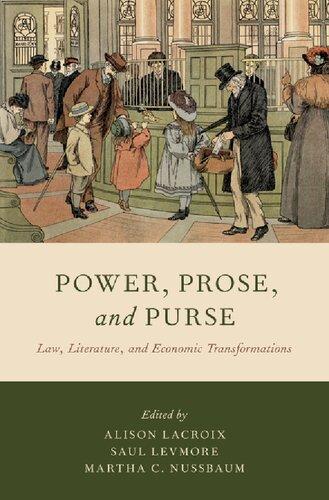
Power, Prose, and Purse
LAW, LITERATURE, AND ECONOMIC TRANSFORMATIONS
Edited by Alison L. LaCroix
Saul Levmore and Martha C. Nussbaum
Oxford University Press is a department of the University of Oxford. It furthers the University’s objective of excellence in research, scholarship, and education by publishing worldwide. Oxford is a registered trade mark of Oxford University Press in the UK and certain other countries.
Published in the United States of America by Oxford University Press 198 Madison Avenue, New York, NY 10016, United States of America.
© Oxford University Press 2019
All rights reserved. No part of this publication may be reproduced, stored in a retrieval system, or transmitted, in any form or by any means, without the prior permission in writing of Oxford University Press, or as expressly permitted by law, by license, or under terms agreed with the appropriate reproduction rights organization. Inquiries concerning reproduction outside the scope of the above should be sent to the Rights Department, Oxford University Press, at the address above.
You must not circulate this work in any other form and you must impose this same condition on any acquirer.
CIP data is on file at the Library of Congress
ISBN 978–0–19–087345–5 9
Printed by Sheridan Books, Inc., United States of America
CONTENTS
List of Contributors vii
Introduction: Cooperation and Competition between Plots and Principles 1
MOLLY BROWN, SAUL LEVMORE, AND MARTHA C. NUSSBAUM
PART I Swindlers or Entrepreneurs?
1. Counterfeiting Confidence: The Problem of Trust in the Age of Contract 15
SUSANNA L. BLUMENTHAL
2. Gamblers and Gentlefolk: Money, Law, and Status in Trollope’s England 51 NICOLA LACEY
3. Regulating Greed: Biographical Markers in Dos Passos’ The Big Money 79 SAUL LEVMORE
4. The Morning and the Evening Star: Religion, Money, and Love in Sinclair Lewis’s Babbitt and Elmer Gantry 95 MARTHA C. NUSSBAUM
5. Jay Gatsby, Justice Douglas, and the Significance of Class in American Society 125 JUSTIN DRIVER
PART II Preferences and Capitalists
6. Wealth and Warfare in the Novels of Jane Austen 151 SEEBANY DATTA- BARUA AND JONATHAN S. MASUR
7. Commerce, Law, and Revolution in the Novels of Elizabeth Gaskell and Charlotte Brontë 169 ALISON L. LACROIX
8. Bartleby’s Consensual Dysphoria 191 ROBIN WEST
9. Love from the Point of View of the Universe: Walt Whitman and the Utilitarian Imagination 221 MARTHA C. NUSSBAUM
10. Money and Art in Edward Bellamy’s Looking Backward 249
DOUGLAS G. BAIRD
11. The Second New Deal and the Fourth Courtroom Wall: Law, Labor, and Liberty in The Cradle Will Rock 267
LAURA WEINRIB
12. Raisin, Race, and the Real Estate Revolution of the Early Twentieth Century 287
CAROL M. ROSE
PART III Optimism and Pessimism
13. The Grapes of Wrath, Economics, and Luck 315
RICHARD H. MCADAMS
14. Irish [and English and American] Poets, Learn Your Trade: Law and Economics in Poetry 345
DEIRDRE NANSEN MCCLOSKEY
Index 365
CONTRIBUTORS
Douglas G. Baird is the Harry A. Bigelow Distinguished Service Professor of Law at the University of Chicago Law School. He served as Dean of the Law School from 1994 to 1999. He received his BA in English summa cum laude from Yale College. His research and teaching interests focus on corporate restructurings and contracts.
Susanna L. Blumenthal is the William Prosser Professor of Law and Professor of History at the University of Minnesota. She is the author of Law and the Modern Mind: Consciousness and Responsibility in American Legal Culture.
Molly Brown is in the PhD program in philosophy at the University of Chicago. She is the winner of the first Ernst Freund Prize in Law and Philosophy and will use the prize to write an essay on transgender feminism.
Seebany Datta-Barua is Assistant Professor of Mechanical and Aerospace Engineering at the Illinois Institute of Technology, where she has taught since 2012. She received a BS in physics in 2000 and an MS and PhD in aeronautics and astronautics in 2008, all from Stanford University. Datta-Barua’s research is focused on space weather, navigation, data assimilation, remote sensing, and atmospheric dynamics. Datta-Barua received the National Science Foundation CAREER award in 2014. She is an Early Career Representative for Commission G of the International Union of Radio Scientists (URSI). She is also an Associate Editor of Radio Science and has been recognized as an Outstanding Reviewer for Space Weather and Navigation.
Justin Driver is the Harry N. Wyatt Professor of Law at the University of Chicago Law School. His teaching and research interests focus on constitutional law, constitutional theory, education law, and the intersection of race with legal institutions. His major scholarly writings include “The Constitutional Conservatism of the Warren Court” in the California Law Review; “The Consensus Constitution” in the Texas Law Review; “Supremacies and the Southern Manifesto” in the Texas Law Review; “Constitutional Outliers” in the University of Chicago Law Review; and “Reactionary Rhetoric and Liberal Legal Academia” in the Yale Law Journal. He recently published his first book, The Schoolhouse Gate: Public Education, the Supreme Court, and the Shaping of America’s Constitutional Rights (Pantheon Books, 2018).
Nicola Lacey is School Professor of Law, Gender and Social Policy at the London School of Economics. She is an Honorary Fellow of New College Oxford and of University College Oxford; a Fellow of the British Academy; and a member of the Board of Trustees of the British Museum. In 2011 she was awarded the Hans Sigrist Prize by the University of Bern for outstanding scholarship on the function of the rule of law in late modern societies, and in 2017 she was awarded a CBE for services to Law, Justice, and Gender Politics. Her publications include Women, Crime and Character: From Moll Flanders to Tess of the d’Urbervilles (Oxford University Press, 2008) and In Search of Criminal Responsibility (Oxford University Press, 2016).
Alison L. LaCroix is Robert Newton Reid Professor of Law and an Associate Member of the Department of History at the University of Chicago. She is the author of The Ideological Origins of American Federalism (Harvard University Press, 2010) and a coeditor of two volumes on law and literature topics: Subversion and Sympathy: Gender, Law, and the British Novel (with Martha C. Nussbaum; Oxford University Press, 2012) and Fatal Fictions: Crime and Investigation in Law and Literature (with Richard H. McAdams and Martha C. Nussbaum; Oxford University Press, 2017). Her teaching and research interests include legal history, constitutional law, civil procedure, federal jurisdiction, law and linguistics, and law and literature.
Saul Levmore is the William B. Graham Distinguished Service Professor of Law at the University of Chicago. He writes on a wide variety of legal and economic topics, and occasionally on law and literature. He has taught and written about torts, corporations, copyright, nonprofit organizations, comparative law, public choice, corporate tax, commercial law, insurance, and contracts. He is a member of the American Academy of Arts and Sciences and a past president of the American Law Deans Association. His recent academic work is on the timing of lawmaking, confidential agreements, and informants, and a recent popular work is Aging Thoughtfully: Conversations about Retirement, Romance, Wrinkles, and Regret (with Martha Nussbaum; Oxford University Press, 2017).
Jonathan S. Masur is the John P. Wilson Professor of Law at the University of Chicago Law School. He received a BS in physics and an AB in political science from Stanford University and his JD from Harvard Law School. After graduating law school, he clerked for Chief Judge Marilyn Hall Patel and for Judge Richard Posner. Masur is co-author of Happiness and the Law (University of Chicago Press, 2015). He is a two-time winner of the Graduating Students Award for Teaching Excellence and has served as director of the Wachtell, Lipton, Rosen & Katz Program in Behavioral Law, Finance and Economics since its founding.
Richard H. McAdams is Deputy Dean and Bernard D. Meltzer Professor of Law at the University of Chicago Law School. He is the author of The Expressive
Powers of Law (Harvard University Press, 2015; paperback, 2017) and coeditor of Fatal Fictions: Crime and Investigation in Law and Literature (with Alison L. LaCroix and Martha C. Nussbaum; Oxford University Press, 2017) and Fairness in Law and Economics (with Lee Fennell; Edward Elgar, 2013). He has served on the National Science Foundation Advisory Panel for Law and Social Sciences, the editorial board of the Annual Review of Law and Social Science, and the board of directors of the American Law and Economics Association. He has written essays on Shakespeare’s Othello, Harper Lee’s, To Kill a Mockingbird and Go Set a Watchman, and Herman Melville’s Billy Budd
Deirdre Nansen McCloskey has been since 2000 UIC Distinguished Professor of Economics, History, English, and Communication at the University of Illinois at Chicago. Trained at Harvard as an economist, she has written sixteen books and edited seven more, and has published some three hundred and sixty articles on economic theory, economic history, philosophy, rhetoric, feminism, ethics, and law. She taught for twelve years in economics at the University of Chicago and describes herself now as a “postmodern free-market quantitative Episcopalian feminist Aristotelian.” Her latest books are How to be Human* *Though an Economist (University of Michigan Press, 2001), Measurement and Meaning in Economics (S. Ziliak, ed.; Edward Elgar 2001), The Secret Sins of Economics (Prickly Paradigm Pamphlets, University of Chicago Press, 2002), The Cult of Statistical Significance: How the Standard Error Costs Us Jobs, Justice, and Lives (with Stephen Ziliak; University of Michigan Press, 2008), The Bourgeois Virtues: Ethics for an Age of Capitalism (University of Chicago Press, 2006), Bourgeois Dignity: Why Economics Can't Explain the Modern World (University of Chicago Press, 2010), and Bourgeois Equality: How Ideas, Not Capital or Institutions, Enriched the World (University of Chicago Press, 2016). Before The Bourgeois Virtues her best-known books were The Rhetoric of Economics (University of Wisconsin Press, 1985, 2nd ed. 1998) and Crossing: A Memoir (University of Chicago Press, 1999), which was a New York Times Notable Book.
Her scientific work has been on economic history, especially British. Her recent book Bourgeois Equality is a study of Dutch and British economic and social history. She has written on British economic “failure” in the nineteenth century, trade and growth in the nineteenth century, open-field agriculture in the Middle Ages, the gold standard, and the Industrial Revolution.
Her philosophical books include The Rhetoric of Economics (University of Wisconsin Press, 1985; 2nd ed. 1998), If You're So Smart: The Narrative of Economic Expertise (University of Chicago Press, 1990), and Knowledge and Persuasion in Economics (Cambridge University Press, 1994). They concern the maladies of social scientific positivism, the epistemological limits of a future social science, and the promise of a rhetorically sophisticated philosophy of
science. In her later work she has turned to ethics and to a philosophicalhistorical apology for modern economies.
Martha C. Nussbaum is Ernst Freund Distinguished Service Professor of Law and Ethics at the University of Chicago, appointed in the Law School and the Philosophy Department. Her most recent books are Aging Thoughtfully: Conversations about Retirement, Romance, Wrinkles, and Regret (with Saul Levmore; Oxford University Press, 2017) and The Monarchy of Fear: A Philosopher Looks at Our Political Crisis (Simon & Schuster, 2018).
Carol M. Rose is the G. B. Tweedy Professor of Law Emerita at Yale Law School and the Lohse Professor of Law Emerita at the University of Arizona. Her research concentrates on the history and theory of property, environmental law, natural resources, and intellectual property. Her four books are Saving the Neighborhood: Racially Restrictive Covenants, Law, and Social Norms (with R. W. Brooks; Harvard University Press, 2013); El Derecho de Propiedad en Clave Interdisciplinaria (The right to property in an interdisciplinary key) (University of Palermo, 2010); Property and Persuasion (Westview, 1994), and Perspectives on Property Law (with R. C. Ellickson and H. E. Smith; Aspen, 4th ed. 2014).
Professor Rose has lectured and taught by invitation in many parts of the world. Her work has appeared in numerous journals and anthologies, including translations in Italian, Spanish, and Chinese. She has degrees in philosophy (AB, Antioch College), political science and law (the University of Chicago, MA and JD), and history (Cornell University, PhD). She is a member of the American Academy of Arts and Sciences.
Laura Weinrib is Professor of Law at the University of Chicago Law School and an Associate Member of the University of Chicago Department of History. A legal historian, her scholarship explores the intersection of constitutional law and labor law. She is the author of The Taming of Free Speech: America’s Civil Liberties Compromise (Harvard University Press, 2016), which traces the emergence during the first half of the twentieth century of a constitutional and court-centered concept of civil liberties as a defining feature of American democracy.
Robin West is the Haas Professor of Law and Philosophy at Georgetown University Law Center, where she teaches Law and Humanities, Law and Philosophy, Topics in Jurisprudence, Contracts, and Torts. She writes broadly on issues pertaining to jurisprudence, law, and humanities, feminism and law, and constitutional theory. She has recently published Teaching Law (Cambridge Press, 2013) and Normative Jurisprudence (Cambridge Press, 2011). She lives in Baltimore with her husband and enjoys her three grown children, who have now scattered to various coasts but often return to Charm City for their vacations.
Introduction
COOPERATION AND COMPETITION BETWEEN PLOTS AND PRINCIPLES
Molly Brown, Saul Levmore, and Martha C. Nussbaum
Most novels involve money and, one way or the other, they are also about law. Fictional characters, like real ones, are at the mercy of the financial resources and legal rights assigned to them. Power, Prose, and Purse explores the connections among literature, money, and law. The focus is on literary works that explore money and law in the period framed by the Industrial Revolution and the Great Depression. Predictably, the chosen works draw attention to the upheavals brought on by these great events. These upheavals are usually described as economic events, but they also had an impact on law and literature. Most of our chapters address the question of how literature altered, or was affected by, money and law, but the larger subject is how the human experience was or continues to be affected by all three—literature, law, and money (or economics)—inasmuch as not one of these operates alone and none alone could possibly explain as much as the combination of them all. A serious economic depression, for example, is likely to bring on political changes that have an impact on law, but it is also likely to motivate writers who contemplate the distribution of power and wealth, and who might be inclined to pay special attention to the dislocations brought on by an economic depression. Our guiding premise is that it is more useful to think of literature and law (not to mention money) as affecting one another than it is to take for granted that only one is the engine of change, while the other is pushed along by circumstance. The contributions to this volume endeavor to avoid the inclination to think of law, literature, and economics as engaged in a competition, where one approach or style of analysis must win and be declared the authority regarding human behavior, and therefore the proper thing to study when one is
attempting to understand or influence the world. In this introductory essay we suggest that literature and economics offer different tools for understanding and evaluating law. Literature often succeeds by drawing attention to a particular person or concrete situation in what can be called a focused or micro approach. Economics has come to stress data and macro effects. While it is easy to think of these approaches as competitors, the essays in this book encourage the idea that they ought to work as partners, as readers attempt to gain insight into the world and the role or sources of its legal rules. The tendency to interpret the world with the tools one knows best is a natural and powerful one. Information, perhaps especially when fictional, is more plausible the more it matches one’s existing conception of the world. Even when contemplating a work of fiction, lawyers like to begin by ascribing an individual’s behavior, fortune, and life story to things like well-drawn contracts, legal rules, and the influence of attorneys. Similarly, an economist is likely to see the world as shaped by market forces, individual effort, and ingenuity rather than luck or insufficient initial endowments. Most of us read novels and analyze legal materials and corporate histories in order to learn or discover something about the world or ourselves. If we are lucky, we are jolted into a new discovery or understanding. Still, it is hard to escape the fact that we are more inclined to believe stories when they are consistent with our preconceptions and training. This tendency does not vanish when we are writing or reading a set of essays about literature. Collaboration is an acquired taste, and the trick is to avoid a hardening of our tendencies when there is much to be gained by allowing in the insights of less familiar specialties.
Money itself offers an example of this choice between a competitive and a cooperative approach. Financial matters, without reference to law, have a predictable and familiar relationship with literature. On the one hand, economists can be dismissive, or simply ignorant, of literature and quick to complain that a story is just a one-off tale that tells us little about the impact of social policies in the real world. On the other hand, novelists are inclined to regard literature, if not art more broadly, as a worthy endeavor, deserving public support and serious political attention. They are in danger of thinking of economics as a competitor, at least when it comes to understanding behavior and evaluating (or attracting) government policies, not to mention public and private support. There is the likelihood that the affection for one method brings on a devaluation of others. A literary person is more likely to think that a focus on the accumulation of capital is unattractive, if not the root of much evil. The reaction is stronger when it is observed alongside wealth inequality and the struggle of those with limited resources. Faced with evidence of an economic depression, an economist might search for evidence of a failure to maintain important assets or to invest in new technologies. In the world of literature meanwhile, a writer is more likely to pay attention to a perceived unfairness of the economic system or to a failure to respect human values in the pursuit of profit
and the glorification of self-interest. Again, our emphasis is more likely to be on how literature and economics interact or offer a combined understanding of successes and failures. The benefit of collaboration rather than competition is yet greater when law is added to the mix.
Collaboration between law and literature is familiar to readers of earlier volumes arising out of a series of Law and Literature conferences at the University of Chicago Law School,1 and of course these books can be read out of order, so it is not too late to take in the old excitement and insights. A recurring observation in these earlier volumes is that novelists open our eyes to injustices and in this way point to law’s defects and, in many cases, its potential. Literature is thus an engine of both social and legal reform. The present volume adds complexity and insight by putting money on the stage together with law and, of course, literature. Finance thickens the plot. It is common for novels to draw attention to misdeeds associated with a taste for money. A character might marry or murder for money, and a swindler might succeed at the expense of a vulnerable target. The reader is meant to see that law ought to play a stronger role in punishing the wrongdoing and preventing unfairness, although often the larger message is that the task is too great for law and that custom or shared sensibilities must play some role. At times, the larger and more direct message is that money, and especially dramatic financial inequality, is objectionable. None of the works discussed in this volume is quite so simple. Many novelists aim to serve as social and legal reformers, but a serious novel is bound to be more subtle, ironic, or ambiguous than a tale in which money corrupts a good heart and then destroys the innocent. The literary works examined in these chapters may deliver some simple sermons about money, but typically they offer complex messages about law, greed, social class, and human interactions. But before turning to these essays and literary works, we should say something about the focus of the literary enterprise.
Novelists often explore the world they know or imagine with mirrors and magnifying glasses. Heroes, villains, and innocent bystanders are meant to be captured by a well-designed microscope. The more deftly a work of fiction explores the nuances of an event or an individual’s behavior, the greater its authenticity. For example, many readers of Shakespeare’s King Lear learn something about excessive pride and attempts to judge one’s children. The tale affects listeners even though they are not themselves kings or inclined to turn over their power to a daughter or two. The work feels both grand and authentic, even if most readers have no idea of the historical facts that inspired Shakespeare. Over many centuries most readers were moved by what they thought of as fiction. It is not, however, merely the impression of historicity that lends authenticity. Lear suffers because of his error in favoring the one daughter who was honest and without guile, and readers learn from this experience even though it happens in a way they might not have understood or believed before encountering the work. Perhaps such a historically significant
and widely lauded work proves little, since a single example or story can always be the exception rather than the rule. Consider, then, a novel chosen almost at random from contemporary fiction, The Heart’s Invisible Furies, by John Boyne. This highly acclaimed 2017 novel touches close enough to historical events to help the reader think that the acquired empathy and insight are at least as relevant to policymaking as any careful empirical study. The book can be described as a history of the Irish Republic, as the story of the decline of the Catholic Church’s power in that country, or as the tale of a young gay man who copes with his own inclinations and those of the nasty world around him. There might be better ways to learn Irish history, and some collection of data might make a stronger argument about the cause of the Church’s decline. But it is hard to see how a law or economics approach could match this novel’s power when it comes to its third subject, the personal and social costs of discrimination, intolerance, and sex stereotypes. The novel is both heartbreaking and hilarious, and this combination helps to make it believable. The prose generates insight and wisdom. Even a reader who is generally skeptical about stories cannot help but feel educated as well as emotionally moved.
Literary works are a superior means of encouraging empathy, but we hesitate to give any simple sense of empathy too much credit. For one thing, the magic of King Lear works differently; few readers identify with Lear, and even fewer share his circumstances or initial weakness. For another, the power found in novels like Boyne’s is partly related to the shame one feels about the repulsive behavior of most of the characters and about the complicitous role of the legal system. A story about a cruel employer can be effective both in bringing a reader to empathize with the victimized employee and in highlighting how much he or she may have in common with the employer, provoking discomfort and embarrassment. It can be the complexity of the response, particularly the negative emotion, that forces one to think about ill-gotten gains more generally or other matters that turn a story into an influence on lawmaking or political inclinations. Even when something like shame is at work, literature can be more effective than impersonal, though accurate, economic analysis.
This effectiveness is provocatively described by cultural theorists and the burgeoning field of critical finance studies.2 One strategy these scholars deploy may seem upside down to economists, as it uses fiction to make sense of reality and to understand law. It goes without saying that law, because it focuses on individual cases but then issues decisions that apply to many other cases and individuals, is a battleground between the approaches offered by literature and economics, and between empathy and efficiency (measured by money). This is a topic that goes far beyond our volume, but the point is to draw attention to the styles of literature and economics and then, in keeping with our theme, to suggest that they can be partners rather than competitors.
A novelist’s capacity to develop empathy in readers can bring about a reinterpretation of the role of law. For example, Elizabeth Anker has studied
novels about human rights, and she uses them to interpret the legal issues posed by the South African Truth and Reconciliation Commission. The work is not about money, to be sure, but the connection it develops between literature and law is instructive. A novel is used as a starting point, much as an economist would categorize a financial loss in order to understand a court’s or legislature’s decision to award damages. Anker’s approach is distinctive; a conventional legal analyst would start with law and then see how literature used it, or how the legal experience motivated the literary creation. But rather than asking how a lived experience brings about real law, Anker has us understand reality as influenced by law and as something that cannot be well understood without it.
The critical theorist Anna Kornbluh is more inclined to begin by pointing to a weak spot in the universe of finance theory, before turning to the truth that the literary approach is said to provide. Consider the idea (found everywhere in law) that resources should flow to those who pay more for them. This comes naturally to someone with a finance education. Finance teaches that money can serve as a means of measuring preferences and, further, that there is a social benefit to allocating goods to the users who value them most highly. A reader who is influenced by Kornbluh would likely be suspicious of this starting point, though it should be emphasized that Kornbluh herself is primarily invested in discursive issues. There are other ways to allocate goods and even to detect degrees of attraction. If one begins with stories in which the ability and willingness to pay lead to absurd or dangerous results, one is more impressed by these other methods of allocation. If we had a society in which most academics and political advisers taught that goods should flow to citizens in proportion to their physical strength and ability to beat up their competitors, we would quickly develop support for a competing idea, such as allocating goods to those who speak most eloquently about them or to those who suffered the most in some prior period. Eloquent speech and earlier setbacks may not be the best basis for producing a happy or wealthy society, but either would look pretty good in comparison with the alternative of inflicting pain. This is in the spirit (though hardly the precise content) of Kornbluh’s work, which emphasizes the inherently unstable enterprise that is finance and regards literature as often missing this reality by drawing attention to the human psyche of characters. Still, there is the constant suggestion that the lessons learned about money from literature are more powerful once one sees the defects of finance and of lawmaking that exhibits a fetish for finance. The approach is compatible with one that begins by developing empathy for a party that seeks to change the law or enlist its support, though critical theorists are asking us also to be aware of the errors of those who think they have learned from literature alone.
Most of the chapters in our volume are also compatible with critical finance studies, and certainly with Anker’s strategy of thinking about a novel’s
readers as attracted to a view that then finds root in law. But it might be more honest to say that for the most part our authors do not see literature and economics as competitors in the quest to understand or evaluate law at all. Instead, they advance the idea that two approaches are better than one. A reader who is armed with empathy (or other literary products) and some economics will find law more sensible or more coherent than one who goes at it with literature or economics alone. Similarly, literature and law together can enrich one’s understanding of the use and distribution of money. Finally, perhaps more tentatively, it is plausible that training in both economics and law can make one a better reader of literature. Literature and economics may seem to be on a collision course, but there is subtle collusion between them, and this collusion or joint enterprise is at the heart of our project.
Before turning to the details of our chapters, we wish to emphasize that though our argument is that literature, law, and money taken together can in various ways increase understanding and push forward change, we do not mean to ignore the deep tensions between them. Recall the aforementioned idea that literature has a tendency to home in on a specific event or personality (real or imagined) rather than look to evidence of overall costs and benefits. We can of course learn from individual stories, but once the question is framed in terms of legal rules or policy, we risk being overly influenced by one story or our own empathic reaction, when what is usually most salient for legal purposes is evidence of large-scale effects.
Novelists and those who study them appreciate the risk of painting with a broad brush. Indeed, a common criticism of a weak film or novel is that its characters are insufficiently developed. When a novel reaches for something universal and sweeps across time, it still does so with the use of a magnifying glass rather than a broad brush. In contrast, both law and economics work to characterize aggregate effects, albeit with occasional attention to particular cases. They generalize out of both necessity and conviction. They may use particular and real cases as inspiration, but they commonly express contempt for theorizing on the basis of occasional observation. Economics especially prefers data over a single, memorable, and chosen case, and a law is generally well regarded if it benefits many people, even at the expense of a few unfortunate losers. For example, law might set a minimum age for operating a motor vehicle or for obtaining Social Security benefits. As long as such laws do not discriminate against powerless groups or generate costly countermaneuvers, they are regarded as sensible even though they leave no room for the gifted underage driver to profit or to help others. Blind justice generates pride even when it causes or ignores small losses. As the stakes increase, law is willing to do some digging rather than data collecting. Thus, convicted criminals face a range of penalties, but even with mandatory sentencing guidelines there is some room for a judge to think about the circumstances and character of an individual defendant and to lighten his or her sentence. Law has its rules and
standards, themselves a matter of large-scale and micro lawmaking, but many allow for exceptions on their own terms, through selective enforcement or clever interpretation. These exceptions, which often represent an injection of humanity into law, should not obscure the larger canvas on which law paints with a broad brush.
The difference in design or method between law and literature contributes to the sentiment that when they are combined or compared, there is a collision in progress. It is a collision that favors literature; the broad brush emerges as heartless when compared with a judgment made under the magnifying glass. On the other hand, and more optimistically, it can be this very tension that produces some of the best work combining literature and law, when under the artist’s glass we gain legal insight, even if it is not based on statistical evidence. Money—or at least the rules that give money value, and the conventions that apply to financial matters—is like law rather than literature when it comes to the choice between narrow and wide analysis. For example, when the Federal Reserve raises interest rates, it considers macroeconomic effects, such as overall levels of employment and inflation; it may consider the impact on disparate regions, farmers, or importers, but not in a way that takes into account the fact that some of the winners and losers arrived at their predicaments because of avarice, disloyalty, or kindness. Similarly, a jurisdiction might control the rents a landlord can charge—something that literary scholars are far more likely than economists to favor in the first place—but the legal machinery of rent control is unlikely to inquire into the hardship experienced by particular owners or potential tenants. Legal arguments for and against rent control may focus on the costs of relocation, wealth inequality, and the value of free markets, but these are not arguments that drill down to individual character or inspiration. A lawyer might be inclined to say that a party who is fearful about changes in rent control, actions of the Federal Reserve, or various calamities could purchase insurance; law should improve the economy or country as a whole and not worry about individual losses. This would be a surprising and perhaps poorly framed reaction given the influence of literature on students and elected officials, and it is not one found in any of the books discussed in this volume.
The important tension between literature, on the one hand, and law and money, on the other, is pervasive in the chapters that follow. Our chapters never stray too far from the question of when generalizations are useful. It is a question that is familiar to all lawyers and that connects law to literature at every turn. Even the most heartless lawyer can benefit from, or imitate, literature’s strength in sympathizing with and drawing attention to those who suffer misfortune or are disadvantaged by law or finance. Non-lawyers and other readers who start out with the benefit of a big heart or a love of literature will surely have no trouble seeing and enjoying the insights that law, money, and literature offer when mixed together. Such readers will be accustomed to
separating reality from wishful thinking or metaphor. All readers, we hope, will emerge with a greater appreciation of the interaction between storytelling and social science.
The heart of our book begins with “Swindlers or Entrepreneurs?”—a contrast that pushes law to consider the cost of generalization. Markets work best where law deters fraud. The broader the tools used to combat fraud, however, the more law threatens to discourage socially useful market transactions. Examples of this tension are easy to identify. Insider trading may seem unfair and fraudulent, but an important reward for innovators is the ability to buy and sell shares of a corporation on the basis of special effort and knowledge. At the margin, every capitalist seems like a scammer; every advertising genius a fraudster; and every politician a liar or sleight-of-hand artist. Law’s task is to separate the bad from the good but to do so with generalizations. Of course, it would be nice to do this without losing sight of other values. Additionally, it is unworkable to legislate penalties for all who appear to prey on the weak in a manner that does more social harm than good. This sort of formula makes it impossible to stay out of law’s way, and it gives excessive discretion to government officials. In contrast, novels develop characters in ways that encourage us to think that we can identify criminals and victims, and to think that law is weak or itself corrupt when it cannot do the same.
“Swindlers or Entrepreneurs?” begins with Susanna L. Blumenthal’s chapter, “Counterfeiting Confidence: The Problem of Trust in the Age of Contract.” Blumenthal explores Herman Melville’s 1857 novel, The ConfidenceMan: His Masquerade. Confidence men benefited from the Industrial Revolution, which ushered in a new era of mobility, advancing technologies, population density, and relocations that brought strangers into contact with one another. All of these developments contributed to the incubation of crime in metropolitan centers. Blumenthal shows Melville wrestling with the question of whether capitalists really differ from scammers. The essay builds to the novel’s clever story within a story, or “contract of trust.” Finance is built on trust, but the more we must trust one another in markets, the easier it is to be duped. Economists might say that we need, on average, to have trustworthy markets, or means of purchasing insurance if we are risk averse, but novelists are more inclined to think about trustworthy individuals rather than invisible hands.
Nicola Lacey’s “Money, Law, and Status in Trollope’s England” works with the coevolution of the novel and capitalism. In preindustrial England, social status brought about money and wealth, but following the Industrial Revolution, the newly rich were eventually able to purchase status. Lacey draws from Orley Farm and The Way We Live Now to show money as a test of character. The latter novel appeared in 1875, plainly inspired by financial scandals and large-scale frauds of the early 1870s. Lacey points to law’s fitful responses, a consequence of the fact that lawmakers (then and now) are unsure whether
more law provides a solution or creates a deeper morass. Trollope did not ridicule law, and the more he showed the disasters of the time or the hardships that swindlers visited upon innocents, the more his readers might have expected law to provide solutions. Still, Lacey distinguishes Trollope from Dickens, who openly called for law to engineer social reforms. To take one example, Trollope’s leading swindler, Augustus Melmotte, was apparently unbowed by England’s regulatory efforts in its 1890 legislation aimed at financial markets.
But perhaps all capitalists really are swindlers of one sort or another. Saul Levmore interprets John Dos Passos’ famous trilogy, U.S.A, and especially its final novel, The Big Money, as making this case. Levmore explores the novelist’s use of biographical sketches to illustrate the difficulty of distinguishing greed from ambition. Dos Passos appears to presuppose an economy in which one person’s gain comes at the expense of another. Greed looms so large that it is blamed for the stock market crash and the Great Depression. The chapter exposes Dos Passos’ determined opposition to acquisitive impulses and takes it as an opportunity to imagine how law might indeed choose to control greed. Dos Passos exempts artists from his criticism, but the chapter dares us to think of museums as among the greediest of hoarders.
Martha C. Nussbaum’s chapter on two Sinclair Lewis novels makes lovers out of hucksters. Babbitt is conventionally described as a novel about middleclass conformity. The eponymous protagonist succeeds in “selling houses for more than people could afford to pay,” and perhaps that describes what we all try to do in a capitalist economy. Elmer Gantry, too, is easily understood as the tale of an opportunistic evangelist who preys on the faithful while engaging in sexual indiscretions himself. Nussbaum refuses this reading. She anchors her discussion in Dante, for whom love is sublime and avarice is the lowest of lows. Nussbaum carefully reveals how the conventional abstracts of these novels, distorted over time by the film version of Elmer Gantry, miss the role that love, and especially joyful love, plays. George Babbitt is rather gallant away from his day job and, over the two years we know him, he comes to celebrate love. We admire his rebellious son’s defection from conformity, and then his marriage for true love. Nussbaum defends Gantry’s sexuality, even giving him a decent grade for fidelity. His sermons are joyful and far superior to those of the narcissistic, rationalist clergyman whom Lewis offers for comparison. The essay provokes yet further with the hint that joyfulness ought to inform law’s strategy in recognizing some religions and not others. And as Nussbaum reanimates Elmer Gantry, we are left to identify the true hucksters in the novel.
The section concludes with Justin Driver’s comparison of two upwardly mobile Americans, F. Scott Fitzgerald’s Gatsby and Justice William O. Douglas, as encountered in Go East, Young Man. Both stories look like the American Dream attained, as ambition and hard work bring rewards, and both books finish with an unrivaled sense of hope. Fitzgerald wrote about his bootlegger during the 1920s, as if to say that ordinary people could not
make it without resorting to crime, in the same period that Douglas made his ascent in the law. Gatsby was a huckster, pretending to be Oxford-educated and affecting an accent. He gives himself away to astute observers when he discusses money. Meanwhile, Douglas insists that his own success does not prove that the American Dream is alive and well; he immodestly attributes his success to his superhuman talents. The contrast highlights one of our buried themes: Fitzgerald’s single example, fictional at that, hardly proves a general point about class barriers; Douglas, the jurist, insists that the magnifying glass obscures the larger picture.
Part II, “Preferences and Capitalists,” is launched with “Wealth and Warfare in the Novels of Jane Austen,” in which Seebany Datta-Barua and Jonathan S. Masur deploy preferences as a sorting mechanism. They describe the incentive structure found in the Royal Navy in Austen’s time and, with references to her characters, suggest that exciting and enterprising young men chose to serve in the Royal Navy rather than the army or militia, because of its unique and more entrepreneurial prize system.
With Alison L. LaCroix’s “Commerce, Law, and Revolution in the Novels of Elizabeth Gaskell and Charlotte Brontë,” we remain in Britain but enter the Industrial Revolution, with its transforming influence on society. LaCroix argues that three significant novels—Brontë’s Shirley and Gaskell’s Mary Barton and North and South, all of which focus on the world of commerce and manufacturing—are critical in their appraisals of the effects of the Revolution on both individuals and society. Issues of control, regulation, and authority permeate these novels, and the spin of LaCroix’s delivery is influenced by the attention paid to gender. These novels were written by women at a time when women’s writing was strongly discouraged, and they portray strong female characters who strive for autonomy and the right to pursue their own ideas of morality. Their self-determination foreshadows, even helps to bring about, far-reaching political and legal change.
Robin West’s “Bartleby’s Consensual Dysphoria,” a title and term meant to convey induced political passivity, addresses preferences rather directly. West seeks to explain the Occupy Wall Street movement’s identification with the title character of Melville’s novella Bartleby, the Scrivener, though she refocuses our attention on Bartleby’s employer, a lawyer. He is a victim of classical legal thought and the transition from community to individuality; he is puzzled, as the system of which he is a part reorients itself to satisfying individual preferences, perhaps as an outgrowth of thinking about the rational economic actor, homo economicus. Dysphoria arises out of the disjuncture between preference satisfaction and our hedonic selves.
Individual preferences form the centerpiece of economic theory and its cousin, utilitarianism, but Martha C. Nussbaum, in “Love from the Point of View of the Universe: Walt Whitman and the Utilitarian Imagination,” suggests that we have it all wrong when we take these preferences as given.
Utilitarianism, properly understood, is about aggregate utility, and literature can help people change their preferences. Nussbaum sees Walt Whitman’s poems as trying to do just that, inviting in marginalized people, whose preferences may have been hidden. Whitman, like Nussbaum, elevates that which contributes to equality.
Douglas G. Baird’s “Money and Art in Edward Bellamy’s Looking Backward” interprets Bellamy’s futuristic novel as the ultimate criticism of income inequality. Bellamy’s imagined world comes with central planning, credit cards, and individual budgets, but no currency, competition, or savings. Bellamy describes the world as having little law, but Baird shows that such central planners would necessarily produce volumes of regulations, which is to say laws by another name, and in so doing a sad sameness of human experience.
Laura Weinrib’s contribution, “The Second New Deal and the Fourth Courtroom Wall: Law, Labor, and Liberty in The Cradle Will Rock,” seconds a claim advanced by Robin West, that law might do more good for people by abandoning the call to define and protect their individual liberties and considering instead the larger picture—in this case the relative power of employers, unions, and other entities. Mark Blitzstein’s 1937 musical encourages the audience to think about its own participation in the legal and economic system. The middle class, it posits, can be crushed just as unions are crushed by big business.
Finally, Carol Rose’s legal-historical look at Raisin in the Sun takes on the darkest of preferences, racial discrimination against blacks. “Raisin, Race, and the Real Estate Revolution of the Early Twentieth Century” argues that here literature seems to do its conventional job as it focuses on one family’s misery in order to encourage legal reformers and improved markets. Rose challenges even this optimistic view by suggesting that in the right circumstances markets on their own can tolerate and perpetuate housing (and other) discrimination. And yet the chapter reveals the limited power of law because many of the practices used to block integration were already illegal by the time Lorraine Hansberry’s play debuted in 1959. Moreover, law—in the form of big government—was part of the problem rather than the solution inasmuch as the Federal Housing Authority joined the drumbeat for “maintaining property values.”
The essay by Richard H. McAdams, “The Grapes of Wrath, Economics, and Luck,” is not so much about optimism and pessimism (unless it is optimism for the New Deal) as about the determinants of good and bad outcomes. The chapter shows John Steinbeck’s relentless focus on luck rather than merit or just deserts in his description of the Joads, tenant farmers from Oklahoma during the Great Depression. The suggestion is that our feelings for this unfortunate family will lead to an understanding that capitalism is hardly a system in which everyone gets what he or she deserves. Homo economicus should
find room for entitlements and redistributive policies through legal and financial institutions.
The volume concludes with Deirdre Nansen McCloskey, “Irish [and English and American] Poets, Learn Your Trade: Law and Economics in Poetry,” and a plea for—not to mention a celebration of—poetry, work, and money. McCloskey reveals her economist (rather than literary) roots by emphasizing the broad-brush approach. She argues for trusting markets as opposed to individuals. Her plea also offers a connection to Nussbaum’s take on Walt Whitman. Poetry can observe in a mirror and magnify, but it can also inspire and change. Whether focused inward or outward, it can appreciate rather than demonize commerce. Appropriately, the chapter also finds common ground with the volume’s opening essay on hucksters, by Susanna L. Blumenthal. Literature has its eye on the individual, while most of law and economics operates on the larger scale of the market. Literature is well positioned to influence its readers, as it brings humanity to law and economics. Readers seem to appreciate the attention paid to individual human experience. Like it or not, a good story can move an inveterate data collector.
Notes
1. These include Shakespeare and the Law: A Conversation among Disciplines and Professions (Chicago: University of Chicago Press, 2013); Subversion and Sympathy: Gender, Law, and the British Novel (Oxford: Oxford University Press, 2013); American Guy: Masculinity in American Law and Literature (Oxford: Oxford University Press, 2014); and Fatal Fictions: Crime and Investigation in Law and Literature (Oxford: Oxford University Press, 2016).
2. See, for example, Anna Kornbluh, Realizing Capital: Financial and Psychic Economies in Victorian Form (New York: Fordham University Press 2014); Leigh Claire La Berge, Scandals and Abstraction: Financial Fiction of the Long 1980s (Oxford: Oxford University Press, 2015); and Annie McClanahan, Dead Pledges: Debt, Crisis, and Twenty-First Century Culture (Stanford, CA: Stanford University Press, 2017). Interested readers can find other references in these sources.
PART I Swindlers or Entrepreneurs?