

https://ebookmass.com/product/power-and-liberty-
Instant digital products (PDF, ePub, MOBI) ready for you
Download now and discover formats that fit your needs...
(eTextbook PDF) for Liberty, Equality, Power: A History of the American People 7th Edition
https://ebookmass.com/product/etextbook-pdf-for-liberty-equalitypower-a-history-of-the-american-people-7th-edition/
ebookmass.com
Revolution and Witchcraft. The Code of Ideology in Unsettled Times Gordon C. Chang
https://ebookmass.com/product/revolution-and-witchcraft-the-code-ofideology-in-unsettled-times-gordon-c-chang/
ebookmass.com
Power and Possession in the Russian Revolution Anne O'Donnell
https://ebookmass.com/product/power-and-possession-in-the-russianrevolution-anne-odonnell/
ebookmass.com
Transformational Piano Teaching: Mentoring Students from All Walks of Life
Derek Kealii Polischuk
https://ebookmass.com/product/transformational-piano-teachingmentoring-students-from-all-walks-of-life-derek-kealii-polischuk/
ebookmass.com

Blood Kisses: An m/m romance (Dark Blood Book 1) Scarlet Blackwell
https://ebookmass.com/product/blood-kisses-an-m-m-romance-dark-bloodbook-1-scarlet-blackwell/
ebookmass.com
Intolerable : mm enemies to lovers romance (Shooting Star Book 4) Sienna Sway
https://ebookmass.com/product/intolerable-mm-enemies-to-loversromance-shooting-star-book-4-sienna-sway/
ebookmass.com
The Logic of Information: A Theory of Philosophy as Conceptual Design 1st Edition Luciano Floridi
https://ebookmass.com/product/the-logic-of-information-a-theory-ofphilosophy-as-conceptual-design-1st-edition-luciano-floridi/
ebookmass.com
Netter Atlas of Human Anatomy: A Systems Approach: paperback + eBook 8th edition Frank H. Netter Md
https://ebookmass.com/product/netter-atlas-of-human-anatomy-a-systemsapproach-paperback-ebook-8th-edition-frank-h-netter-md/
ebookmass.com
3 Hours a Day Knolly Williams
https://ebookmass.com/product/3-hours-a-day-knolly-williams/



ebookmass.com
https://ebookmass.com/product/olympic-crown-bellerive-royalsbook-1-w-million/
ebookmass.com

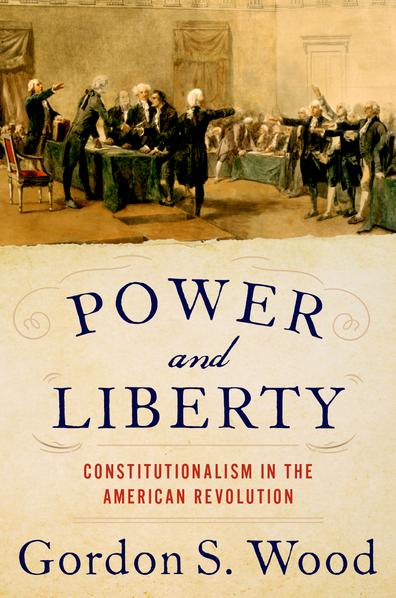
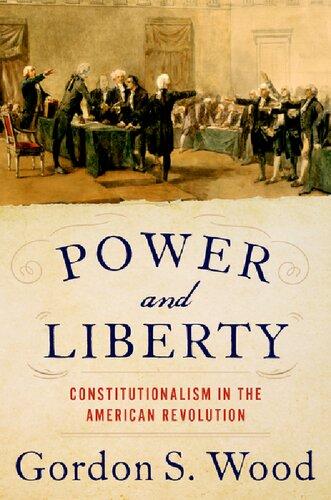
POWER AND LIBERTY
POWER AND LIBERTY
Constitutionalism in the American Revolution
Gordon S. Wood
Oxford University Press is a department of the University of Oxford. It furthers the University’s objective of excellence in research, scholarship, and education by publishing worldwide. Oxford is a registered trade mark of Oxford University Press in the UK and certain other countries.
Published in the United States of America by Oxford University Press 198 Madison Avenue, New York, NY 10016, United States of America.
© Oxford University Press 2021
All rights reserved. No part of this publication may be reproduced, stored in a retrieval system, or transmitted, in any form or by any means, without the prior permission in writing of Oxford University Press, or as expressly permitted by law, by license, or under terms agreed with the appropriate reproduction rights organization. Inquiries concerning reproduction outside the scope of the above should be sent to the Rights Department, Oxford University Press, at the address above.
You must not circulate this work in any other form and you must impose this same condition on any acquirer.
CIP data is on file at Library of Congress ISBN 978–0–19–754691–8
DOI: 10.1093/oso/9780197546918.001.0001
Printed
by Sheridan Books, Inc., United States of America
To Jack, Jim, Norman, and Tony
All of us practicing the art of growing older
ACKNOWLEDGMENTS
This book began as a series of lectures that I presented at the Northwestern University Pritzker School of Law in the fall of 2019. I want to thank Dean Kimberly A. Yuracko and her colleagues for the invitation and for the splendid hospitality they showed my wife and me during our stay in Chicago. I especially want to extend my thanks to Professors Robert Bennett, Steven G. Calabresi, Andrew M. Koppleman, James T. Lindgrin, John O. McGinnis, and James E. Pfander for their many kindnesses. In addition to their hospitality, Professor Pfander ran the mini-course that I taught, and Professor Koppleman offered some astute advice on several lectures that he read. I have a special thanks to Glenn Weinstein and Lindsey Arenberg for the warm friendship they extended to my wife and me during our visit to Chicago; it was extraordinary, and we will never forget it.
My thanks too to Richard D. Brown, Patrick Conley, and Stanley Lemons for supplying some essential information. I also extend my thanks to the two anonymous reviewers who helped improve the manuscript, to copy editor Mary Anne Shahidi, and to Joellyn
Acknowledgments
x Ausanka and Amy Whitmer, senior production editors at Oxford, who shepherded the manuscript through the production process. I am especially grateful for the editorial expertise of the indefatigable Susan Ferber. She is a special jewel in the crown of Oxford University Press. Finally, my thanks to Louise for everything.
POWER AND LIBERTY
Introduction
In his pamphlet Common Sense, published six months before the Declaration of Independence, Thomas Paine called for a “continental conference,” which, “being impowered by the people,” would have the legal authority to draw up a “charter ,” a written document for America “answering to what is called the Magna Charter of England.” This charter would outline the form of government and secure “freedom and property to all men,” especially the rights of conscience, and “such other matter as is necessary for a charter to contain.” Then, said Paine, the Conference, which was not the government but an “intermediate body between the governed and the governors,” would dissolve, its work of framing the charter done. The framers of such an enlightened government, a government, said Paine, that fixed “the true points of happiness and freedom,” would “deserve the gratitude of ages.” To those unenlightened conservatives who dare to ask, where is the king? tell them, “in America the law is king.”1
In this extraordinary passage from his extraordinary pamphlet, Paine anticipated much of the constitutional work carried out by the Revolutionary generation of Americans over the next three or four decades. Although Paine had arrived in America only in November 1774, he was emotionally and intellectually prepared
to be an American. A former corset maker, schoolmaster, and twice-dismissed excise officer, the thirty-seven-year-old Paine had left England full of rage at the decadent monarchical society that had kept him down and by 1776 was ready to articulate America’s destiny.
Because of his uncanny ability to extract from the culture the most progressive elements of enlightened thinking, Paine, a middling “mongrel,” as John Adams called him, “begotten by a wild Boar on a bitch Wolf,” was often able to be more American than those born and raised in the New World. Certainly, his emphasis on charters written at a moment in time and embodying, like Magna Carta, a fundamental law that protected individual liberties and rights was thoroughly American. Perhaps Adams was not entirely wrong when he sarcastically suggested that the Revolutionary era ought to be called “the Age of Paine.”2
The Revolutionary era was the most creative period of constitutionalism in American history and one of the most creative in modern Western history. During the five or six decades between the early 1760s and the early nineteenth century, Americans debated and explored all aspects of politics and constitution-making—the nature of power and liberty, the differing ideas of representation, the importance of rights, the division of authority between different spheres of government or federalism, the doctrine of sovereignty, the limits of judicial authority, and the significance of written constitutions. There was scarcely an issue of politics and constitutionalism that eighteenth-century Americans didn’t touch upon.
Rarely has any nation in such a short period of time discussed and analyzed so many different issues of constitutionalism and created and secured so many political institutions, institutions that have lasted for more than two hundred years. Perhaps fifth-century Athens had similar debates, but we don’t know much of what the
Athenians said. Seventeenth-century England had important constitutional discussions, but we have only a fragment of what the English participants discussed.
The case of America’s constitutional origins is different. We Americans have an enormous amount of material covering the halfcentury of discussions and debates concerning power, liberty, and constitution-making, much of it now available both online and in letterpress editions.
These debates and documents--and those who engaged in the debates and created the documents--have an immediacy, a presentday relevance for Americans, that is extraordinary. The principles embodied in these documents seem to have a quality that transcends time and space. Americans look back to the eighteenthcentury revolutionaries and the constitutions and documents they wrote with a special awe and respect. The Federalist papers, for example, have assumed a quasi-sacred character. Although the papers were polemical pieces dashed off in defense of the new Constitution during the heated debate over its ratification in the state of New York, they are now regarded as authoritative sources for interpreting the Constitution, and as such are even cited by the justices of the Supreme Court. So important has The Federalist become that in 1980 a concordance of the papers was put together, so that, like the Bible, every word and every phrase in the eighty-five papers can be parsed and analyzed. No other major nation invokes its twohundred-year-old founding documents and their authors and in quite the way America does.3
It is not simply our continual concern with constitutional jurisprudence and original intent that explains our fascination with the eighteenth-century founding and its debates and documents. More important for Americans, these founding documents and the principles expressed in them have become our source of identity.
The identities of other nations, say, being French or German, have become lost in the mists of time, and their nationhood, their sense of having a common ancestry, has usually been taken for granted (which is why such nations are having greater problems with immigrants than we are). But Americans have never been a nation in any traditional or ethnic meaning of the term. By the early nineteenth century John Adams wondered whether America could ever be a real nation. In the United States, he said, there was nothing like “the Patria of the Romans, the Fatherland of the Dutch, or the Patrie of the French.” All he saw in America was an appalling diversity of religious denominations and ethnicities. In 1813 he counted nineteen different religious sects in the country. “We are such an Hotch potch of people,” he lamented, “—such an omnium gatherum of English, Irish, German, Dutch, Sweedes, French, &c. that it is difficult to give a name to the Country, characteristic of the people.”4
Lacking any semblance of a common ancestry, Americans have had to create their sense of nationhood out of the documents—the declarations and constitutions and bills of rights—and the principles embodied in them that accompanied their eighteenth-century Revolution. Because the United States had no ethnic basis for its nationhood, it was ideally suited to become a nation of immigrants, something Abraham Lincoln clearly recognized and celebrated. Half the population of the United States, he said on the eve of the Civil War, had no direct blood connection to the Revolutionary generation. Nevertheless, all these German, French, Irish, and Scandinavian immigrants who had come to America since the Revolution had, said Lincoln, found themselves “our equals in all things.” The moral principles embodied in the Revolutionary documents, especially in the Declaration of Independence with its claim that all men are created equal, made, he said, all these different peoples one with the founders, “as though they were blood of the blood and flesh of the
flesh of the men who wrote the Declaration,” and by implication all the other great documents of the Revolutionary era. No wonder Americans make so much of their founders.5
The constitutional debates and discussions that produced all these documents went through several phases during the Revolutionary period. It began in the early 1760s with a debate between the British colonists and the politicians in the mother country of Great Britain over the nature of the empire. During this imperial debate, which is the subject of chapter 1, both the colonists and the English government were surprised to discover that their experience in the empire over a century and a half had drastically diverged. The colonists’ idea of representation had developed very differently from that of the British. At the same time, the British had constructed a notion of parliamentary sovereignty that was at odds with the Americans’ understanding of divided political power. The colonists desperately tried to convince the English of the need for recognizing separate spheres of authority in the empire, but to no avail. The British clung to Parliament as the bulwark of their liberties, forcing the colonists to escape from Parliament’s authority entirely and to make their allegiance to the king the sole tie keeping them in the empire. The debate climaxed with the Declaration of Independence in 1776, probably the greatest document in American history.
With independence, the thirteen new republics drew up constitutions (the focus of chapter 2) in which the framers sought to implement what they had learned from the imperial debate and from their previous experience in the empire. In order to prevent the rise of tyranny in their societies, they severely limited gubernatorial or magisterial power in a variety of ways and at the same time expanded the liberty of their popular houses of representatives. Although most of the new republican governments retained
a semblance of the mixed model of the English constitution—with executives, upper houses, and houses of representatives—they were seriously unbalanced, with an extraordinary amount of power granted to the greatly enlarged lower houses. These Revolutionary state constitutions set the basic pattern for America’s governments over the next two and a half centuries, including the federal government. The national Constitution, created a decade after the Declaration of Independence, was derived largely from the state constitutions.
The thirteen independent states came together in a league of union based on a treaty, the Articles of Confederation, that was finally ratified in 1781, only two years before the end of the eight-year war with Great Britain. Although this confederation, resembling the present-day European Union, was as strong as any confederation in history, its Congress lacked the powers to tax and regulate trade. But the problems Americans faced in the 1780s, described in chapter 3, seemed to some to go well beyond the obvious inadequacies of the Articles. These problems had to do with the excesses of democracy in the states, supported by an emerging middle class. The state legislatures were running amuck, creating evils involving the mutability, multiplicity, and injustice of laws—all of which brought the Americans’ experiment in republican government into question. Reformers concerned with the rampaging state legislatures were able to use the nearly unanimous desire to amend the Articles of Confederation as a cover for scrapping the Articles and creating an entirely new national government embodied in the Constitution of 1787.
James Madison, who more than anyone was responsible for the Convention that drew up the new federal Constitution, was frustrated by the fragmentary and inadequate record of previous constitution makers. He wanted to ensure that subsequent framers
of constitutions would know how Americans in 1787 went about creating a new government. His determination to keep as many notes as possible on what was said in the Convention accounts for the extraordinary record we have of the debates, analyzed in chapter 4. In one modern printed edition Madison’s notes cover more than 550 pages.6 The Convention had been closed to the public, and Madison’s notes were not published until 1840, several years after his death, criticism of the Convention’s secrecy, including that by Thomas Jefferson, led to an agreement that the popular ratifying conventions in 1787–88 would be open to the public.
These debates within the conventions were accompanied by multitudes of writings and discussions out of doors, all creating an extraordinary record of opinions about politics and the proposed Constitution. Over the past half-century, editors at the Historical Society of Wisconsin have collected every scrap of evidence pertaining to these discussions surrounding the ratification of the Constitution and have published their collections in more than two dozen modern letterpress volumes, with more to come. The participants in these debates included not just the elite leaders, such as James Madison and Alexander Hamilton, but also dozens of middling men, such as William Findley of Pennsylvania and Melancton Smith of New York, together with numerous backbenchers whom no one today has heard of. There is nothing quite like this collection of debates over politics and constitutionalism in the early modern period anywhere in the world.
The breadth and depth of popular interest in the Constitution in 1787–88 was remarkable. The towns of Massachusetts, for example, elected 370 delegates to the state’s ratifying convention, of whom 364 attended. Most were eager to meet and discuss the Constitution. It took six days for the delegates from Bath, Maine (then part of Massachusetts), to make their way south across rivers
and through snow to Boston. The people of Massachusetts believed they were involved, as the little town of Oakham told its delegates, in deciding an issue of “the greatest importance that ever came before any Class of Men on this Earth.” The town of Richmond in the far west of Massachusetts held four meetings in December 1787 at four different times and places to discuss the Constitution, and on Christmas Eve the town finally voted that it was “not proper to adopt the Constitution as it now stands.” Interest in the Constitution was the same everywhere. Richmond, Virginia, the new capital of the state, had trouble accommodating not only the 170 delegates to the ratifying convention but also what one observer called the “prodigious number of People from all parts of the Country” who wanted to witness the debates.7
One of the major issues both in the Convention and in the ratification debates involved slavery—the subject of chapter 5. In 1787 the northern states were already moving against the institution, and even Virginians were taking steps that seemed to point toward the abolition of slavery. There was a widespread feeling in the North and even in the Upper South that slavery was dying a natural death, which helps account for the willingness of the delegate to the Convention to make some compromises with the slaveholding states.
Crucial for understanding the constitutionalism of the Revolutionary era is the emerging role of the judiciary, which is the topic of the sixth chapter. Although Alexander Hamilton in The Federalist called the judiciary the “weakest” branch of the new federal government, developments over the following two decades or so revealed its latent authority.8 Some Americans came to believe that the courts at times were more capable than the elective branches in setting social policy. Perhaps nowhere else in the world do courts wield as much power in shaping the conditions of life as
they do in the United States—and that judicial power first emerged in the Revolutionary era.
The Revolution became much more than a break from Great Britain and a war for independence. It released pent-up social forces in the North that turned northern society into a middle-class world. These Revolutionary social developments moved much of the country into modernity, as revealed by the emerging demarcation between public and private realms, the theme of chapter 7. No doubt the American Revolution has little in common with the violence and terror of the French Revolution, but the two revolutions do share this momentous separation of public and private spheres.
This book, which is largely a distillation of my fifty years of work on the subject, is in no way a complete history of constitutionalism in the Revolutionary era. There are so many more subjects to be explored and written about—the constitutional issues relating to the native peoples, for one obvious example. Although it may not cover all issues, in those it covers, it is not meant to be partial to any political view, and it is not seeking to retrieve a usable past.9
Assuming that every nation needs its history to be as accurate as possible, this book aims to recover those aspects of America’s constitutional history it deals with as impartially and as truthfully as possible. These are difficult times, and any claim of objectivity is immediately suspect. But without a commitment to objective truth and the pastness of the past, the history of a nation becomes distorted, turns into politics by other means, and ends up becoming out-and-out partisan propaganda. But as impartial as it seeks to be, this book makes no claim to possessing any final truth. Because the sources are so rich and the stakes are so high, interpreting and reinterpreting the constitutional history of the era of the founding will continue just as long as the republic endures.