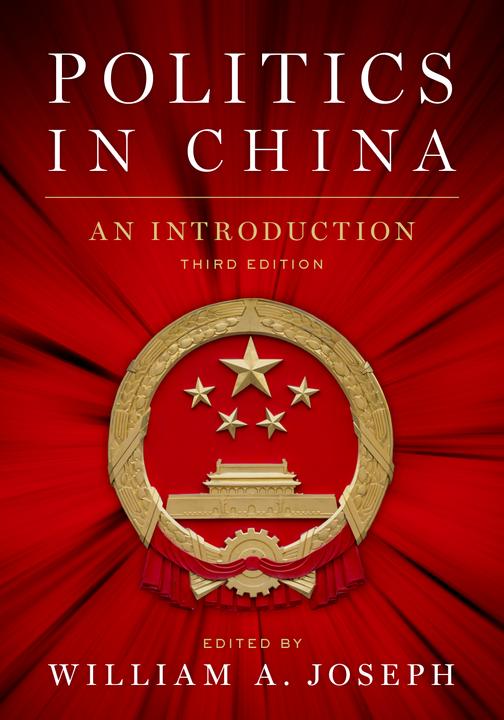
Politics in China
An Introduction
THIRD EDITION
Edited By William A. Joseph
Oxford University Press is a department of the University of Oxford. It furthers the University’s objective of excellence in research, scholarship, and education by publishing worldwide. Oxford is a registered trade mark of Oxford University Press in the UK and certain other countries.
Published in the United States of America by Oxford University Press 198 Madison Avenue, New York, NY 10016, United States of America.
© Oxford University Press 2019
All rights reserved. No part of this publication may be reproduced, stored in a retrieval system, or transmitted, in any form or by any means, without the prior permission in writing of Oxford University Press, or as expressly permitted by law, by license, or under terms agreed with the appropriate reproduction rights organization. Inquiries concerning reproduction outside the scope of the above should be sent to the Rights Department, Oxford University Press, at the address above.
You must not circulate this work in any other form and you must impose this same condition on any acquirer.
CIP data is on file at the Library of Congress
ISBN 978–0–19–087071–3 (pbk.)
ISBN 978–0–19–087070–6 (hbk.)
9 8 7 6 5 4 3 2 1
Paperback printed by Sheridan Books, Inc., United States of America Hardback printed by Bridgeport National Bindery, Inc., United States of America
To my Sino-Mentors, John Wilson Lewis (1930–2017) and Harry Harding 子曰、 學而時習之、不亦說乎
The Master said, “To learn something, and then to put it into practice at the right time: is this not a joy?”
Confucius, The Analects, Chapter 1, Verse 1
Translated by Simon Leys, Norton, 1997
Illustrations
MAPS
Map
Map 1.1 China’s Major Regions
Map 16.1 Tibet Autonomous Region and Tibetan Plateau
Map 17.1 Xinjiang Uyghur Autonomous Region
FIGURES AND TABLES
Figure 1.1
Figure 1.2 Administrative Divisions of the People’s Republic of China
Figure 1.3 Major Periods in Chinese History from Imperial Times to the Present
Table 1.1 China’s Economic Development in Comparative Perspective
Table 3.1 Top Leaders of China from 1949 to 1976
Table 4.1 Top Leaders of China since 1976
Figure 6.1 Organization of the Chinese Communist Party
Table 6.1 CCP Politburo Standing Committee (elected October 2017)
Figure 6.2 Organization of the People’s Republic of China
Figure 6.3 CCP Membership (1949–2017)
Figure 6.4 Occupations of CCP Members (2016)
Figure 6.5 Politburo Members with Provincial Experience
Figure 6.6 Membership Turnover of Top CCP Organizations 19th Party Congress (October 2017)
Figure 8.1 China’s GDP by Sector of the Economy (1976–2017)
Figure 8.2 China’s Annual Growth Rates of Agriculture and Industry (1978–2017) 286
Figure 8.3 China’s Foreign Trade (1980–2017) 294
Figure 8.4 China’s Imports and Exports as a Percent of GDP (1976–2017) 294
Figure 8.5 China’s “Going Out” Strategy (2002–2017) 298
Figure 8.6 China’s Rural-Urban Income Gap (1978–2017) 303
Table 8.1 Appendix: Selected Indicators of China’s Global Integration (1978–2016) 306
Figure 9.1 Party/Government Officials and Administrative Divisions Below the Provincial Level
Figure 9.2 Selection of Village Cadres and Town Officials
Figure 10.1 Urban Disposable Income per capita and Employment in State-Owned Enterprises (1990–2016) 353
Figure 12.1 Carbon Dioxide Emissions (1980–2050)
Figure 12.2 Carbon Dioxide Emissions per capita (1980–2016)
Table 13.1 China’s Health (ca. 1950–2016)
Figure 13.1 Sources of HIV/AIDS Transmission in China (1985–2014)
Figure 13.2 New Cases of HIV/AIDS in China (2005–2015)
Figure 14.1 China’s Population (1960–2017)
Figure 14.2 China Total Fertility Rate in Comparative Perspective 423
Figure 14.3 Age Composition of China’s Population (1982-2100) 434
Figure 15.1 The Growth of the Internet in China (2002–2017) 441
Figure 19.1 Taiwan’s Economic Growth by Decade 544
Table 19.1 Survey on “Taiwan Public’s Views on Current Cross-Strait Relations” (2017) 547
Acknowledgments
In the most immediate sense, this project began when Oxford University Press invited me to submit a proposal for an introductory textbook on Chinese politics about ten years ago. But its true origins go back to the summer of 1966, when I took my first college course on China in summer school at the University of California, Berkeley. My academic interest in China had been piqued during my freshman year at Cornell by events unfolding in Beijing (we called it “Peking” then) as the Red Guards—university students like myself—were challenging professors about their political views and methods of education during the very early stages of China’s Great Proletarian Cultural Revolution. It was a tumultuous time on American campuses (Cornell and Berkeley were epicenters) and also on European college campuses, and the youthful rebellion against authority in China seemed to many young people to be part of a global generational movement.
The news from the People’s Republic of China (we called it “Communist China” or “Red China” then) reaching Western audiences in the mid-1960s was, at best, piecemeal and sketchy because of Cold War hostilities and the PRC’s self-imposed isolation from much of the world. It would be quite a few years before the terrible destructiveness of the Cultural Revolution and the atrocities committed by the Red Guards would become widely known and well-documented. By then, I was immersed in Chinese Studies. I had been intellectually captivated by that summer-school course, taken at Berkeley, with the incomparable Benjamin I. Schwartz of Harvard. When I returned to Cornell for my sophomore year in the fall semester of 1966, I took the plunge into learning Chinese. I also began my study of Chinese politics with Professor John Wilson Lewis. What an extraordinary time that was to be learning—and teaching—about Chinese politics! I still vividly recall Professor Lewis’s lecture on why the philosophical debate that had raged a few years before in China over whether “one divides into two” or “two unites into one” was crucial to understanding Chairman Mao Zedong’s ideological motives for launching the Cultural Revolution. John became my undergraduate advisor, and I was very fortunate to be able to continue my study of Chinese politics with him at Stanford, where I completed an MA in East Asian Studies and a PhD in political science. I also
benefited enormously in my training at Stanford as a China Watcher, political scientist, and teacher from the guidance and inspiration provided by Harry Harding. I dedicate this book with deepest gratitude to my academic mentors, John Wilson Lewis (1930-2017) and Harry Harding.
At Oxford University Press, I am much indebted to David McBride, editor-in-chief for the Social Sciences, and Emily Mackenzie, associate editor, for their support and encouragement during the many stages of this book from conception to publication. Jeremy Toynbee, project manager at Newgen, did a terrific job of sheparding this edition through the production process.
The contributors are what make this book unique. Each is a broadly trained China scholar and practitioner of her or his discipline (mostly political science); but each is also a specialist in the study of the particular subject of the chapter of which he or she is the author or co-author. It has been a pleasure and an honor to work closely with them, and I want to thank them for being part of this project. I learned a great deal from them, as I have from so many other colleagues in the China field.
The contributors and I are very grateful to the following China scholars for their valuable comments on the chapters in this and earlier editions of this book: Marc Belcher, Edward Friedman, Thomas B. Gold, Merle Goldman, J. Megan Greene, David M. Lampton, Kenneth Lieberthal, Barrett McCormick, Kevin J. O’Brien, Margaret Pearson, Benjamin Read, Michael Sheng, Wenfang Tang, and several anonymous reviewers.
Wellesley College, my home institution for four decades, sits on the shores of Lake Waban—which the beloved Chinese writer and Wellesley alumna (MA, 1923), Bingxin, affectionately called “Weibing Hu” 慰冰湖 —“The lake that comforts Bing.” For me, the college has been a beautiful and supportive academic setting in which to ponder and teach about the ever fascinating subject of Chinese politics.
As editor, I assume full responsibility for any and all errors. I invite readers to send comments and corrections directly to me at wjoseph@wellesley.edu.
William A. Joseph Wellesley, MA May 2019
Contributors
Robert Barnett is based at Pembroke College, Cambridge, and is an Affiliate Researcher at King’s College, London. He founded the Modern Tibetan Studies Program at Columbia University in New York, directed the program from 1999 to 2018, and has taught at Columbia, Princeton, INALCO (Paris), and IACER (Kathmandu). He ran an independent research project on contemporary Tibet in London from 1987 to 1998. His books and edited volumes include Conflicting Memories, with Benno Weiner and Françoise Robin (2019); Tibetan Modernities: Notes from the Field, with Ronald Schwartz (2008); Lhasa: Streets with Memories (2006). His writing includes studies of Tibetan politics, cinema, television, religious regulations, social management, women politicians, and contemporary exorcism rituals. He runs a number of training programs in Tibet on ecotourism, small business skills, and is a frequent commentator on Tibet and nationality issues in China for the media.
Gardner Bovingdon is associate professor in the Departments of Central Eurasian Studies and International Studies, and adjunct associate professor of Political Science at Indiana University. A specialist on nationalism, identity politics, and historiography with a geographical focus on Central Asia, he has published a number of journal articles and book chapters on these topics. His book, The Uyghurs: Strangers in Their Own Land, was published in 2010.
Jacques deLisle is the Stephen A. Cozen Professor of Law and professor of political science at the University of Pennsylvania, where he also serves as the director of the Center for East Asian Studies and deputy director of the Center for the Study of Contemporary China. He is the director of the Asia Program at the Foreign Policy Research Institute. His scholarship, which has appeared in many international affairs journals and law reviews, focuses on domestic legal and legal-institutional reform, the relationship of legal development to economic and political change, and the roles of law in addressing crises in China; the PRC’s engagement with the international legal order; and Taiwan’s international status and cross-Strait relations. He is the coeditor of China's Global Engagement: Cooperation, Competition, and Influence in the 21st
Century (2017), The Internet, Social Media, and a Changing China (2017), and China’s Challenges: The Road Ahead (2014).
Bruce Gilley is professor of political science in the Mark O. Hatfield School of Government at Portland State University. His research centers on the comparative and international politics of China and Asia as well as the comparative politics of democracy and political legitimacy. He is the author of China’s Democratic Future (2004) and The Right to Rule: How States Win and Lose Legitimacy (2009).
William Hurst is associate professor of political science at Northwestern University. He is the author of The Chinese Worker after Socialism (2009) and Ruling Before the Law: The Politics of Legal Regimes in China and Indonesia (2018), as well as coeditor of Laid-off Workers in a Workers’ State: Unemployment with Chinese Characteristics (2009) and Local Governance Innovation in China: Experimentation, Diffusion, and Defiance (2015). His ongoing research focuses on the political economy of land and development in Mainland China, Indonesia, Malaysia, and Taiwan.
William A. Joseph is professor of political science at Wellesley College and an associate in research of the John King Fairbank Center for Chinese Studies at Harvard University. He is the author of The Critique of Ultra-Leftism in China (1984) and editor or coeditor of New Perspectives on the Cultural Revolution (1991), China Briefing (1991, 1992, 1994, 1997), The Oxford Companion to Politics of the World (2nd ed., 2001), Introduction to Comparative Politics: Political Challenges and Changing Agendas (8th ed., 2018).
Joan Kaufman is the senior director for academic programs at the Schwarzman Scholars Program, Lecturer on Global Health and Social Medicine at Harvard Medical School, and a member of the Council on Foreign Relations. She was previously the director of Columbia University’s Global Center for East Asia, based in Beijing, and associate professor at Columbia University’s Mailman School of Public Health, distinguished scientist at the Heller School for Social Policy and Management, Brandeis University, founder and director of the AIDS Public Policy Program at Harvard’s Kennedy School of Government, and China team leader for the International AIDS Vaccine Initiative. She has lived and worked in China for more than fifteen years for the Ford Foundation and the UN, was a Radcliffe Fellow at Harvard, and a Soros Reproductive Health and Rights fellow. Dr. Kaufman teaches, works, and writes on AIDS, gender, international health, infectious diseases, reproductive health, health sector reform, and health governance issues with a focus on China
John James Kennedy is professor of political science and director of the Center for East Asian Studies at the University of Kansas. His research focuses on rural, social, and political development including village elections, tax reform, family planning, and rural education. He frequently returns to China to conduct fieldwork and collaborate with Chinese colleagues in Northwest China. Prof. Kennedy is the co-author (with Yaojiang Shi) of Lost and Found: the 'Missing Girls" in Rural China (2019). He has also published a number of book chapters as well as articles in journals such as Asian Survey, China Quarterly, Journal of Peasant Studies, Journal of Chinese
Political Science, Journal of Contemporary China, Asian Politics and Policy, and Political Studies.
Richard Curt Kraus is professor emeritus of political science, University of Oregon. He is the author of Class Conflict in Chinese Socialism (1981), Pianos and Politics in China (1989), Brushes with Power: Modern Politics and the Chinese Art of Calligraphy (1991), The Party and the Arty (2004), The Cultural Revolution: A Very Short Introduction (2012), and coeditor of Urban Spaces: Autonomy and Community in Contemporary China (1995).
Cheng Li is director and senior fellow at the Brookings Institution’s John L. Thornton China Center. Dr. Li is the author/editor of numerous books, including Rediscovering China: Dynamics and Dilemmas of Reform (1997), China’s Leaders: The New Generation (2001), Bridging Minds Across the Pacific: The Sino-US Educational Exchange (2005), China’s Changing Political Landscape: Prospects for Democracy (2008), China’s Emerging Middle Class: Beyond Economic Transformation (2010), China’s Political Development: Chinese and American Perspectives (2014), Chinese Politics in the Xi Jinping Era: Reassessing Collective Leadership (2016), and The Power of Ideas: The Rising Influence of Thinkers and Think Tanks in China (2017). He is the principal editor of the Thornton Center Chinese Thinkers Series published by the Brookings Institution Press.
Sonny Shiu-Hing Lo is professor and deputy director (Arts and Sciences) in the School of Professional and Continuing Education at the University of Hong Kong. His new books include China’s New United Front Work in Hong Kong (forthcoming, with Steven Hung and Jeff Loo), Interest Groups and the New Democracy Movement in Hong Kong (2018), and The Politics of Controlling Organized Crime in Greater China (2016).
Katherine Morton is the chair and professor of China’s International Relations at the University of Sheffield. Her research addresses the domestic and international motivations behind China’s changing role in the world and the implications for foreign policy and the study of International Relations. Prior to her appointment at the University of Sheffield she was the associate dean for research at the College of Asia and the Pacific, Australian National University, and a Senior Fellow in the Department of International Relations. She has published widely on the environment and climate change, global governance, transnational security, food security, maritime security, and the South China Sea. Her current book project examines the likely impacts of China’s rising international status upon the evolving system of global governance.
Shelley Rigger is Brown Professor of East Asian Politics at Davidson College. She has been a visiting researcher at National Chengchi University in Taiwan and a visiting professor at Fudan University in Shanghai. She is the author of three books on Taiwan: Politics in Taiwan: Voting for Democracy (1999),From Opposition to Power: Taiwan’s Democratic Progressive Party (2001); and Why Taiwan Matters: Small Island, Global Powerhouse (2011) as well as articles on Taiwan’s domestic politics, the national identity issue in Taiwan-China relations and related topics.
R. Keith Schoppa is Doehler Chair in Asian History emeritus at Loyola University, Maryland. He has authored many books and articles, including, most recently, In a Sea of Bitterness: Refugees during the Sino-Japanese War (2011). His book Blood Road: The Mystery of Shen Dingyi in Revolutionary China (1996) won the 1997 Association for Asian Studies’ Levenson Prize for the best book on twentieth-century China, and he is also the author of textbooks on modern China and East Asia. He has received fellowships from the National Endowment for the Humanities, the American Council of Learned Societies, and the John Simon Guggenheim Memorial Foundation.
Christian Sorace is assistant professor of political science at Colorado College. He is the author of Shaken Authority: China’s Communist Party and the 2008 Sichuan Earthquake (2018) and coeditor of Afterlives of Chinese Communism: Political Concepts from Mao to Xi (forthcoming). His new research focuses on comparative urbanization, crisis, and temporality in Ulaanbaatar, Mongolia, and Inner Mongolia, China.
Frederick C. Teiwes is emeritus professor of Chinese Politics at the University of Sydney. He is the author of numerous works on Chinese Communist elite politics during the Maoist era, including Politics and Purges in China (1979), 2nd ed., 1993), Politics at Mao’s Court (1990), The Tragedy of Lin Biao (1996), China’s Road to Disaster (1999), and The End of the Maoist Era (2007) (the latter three studies coauthored with Warren Sun). During the past decade he and Dr. Sun have published revisionist studies of the early post-Mao period, notably Paradoxes of Post-Mao Rural Reform (2016). He thanks the Australian Research Council for generous research support over many years.
Tyrene White is professor of political science at Swarthmore College. She is the author of China’s Longest Campaign: Birth Planning in the People’s Republic, 1949–2005 (Cornell University Press, 2006), and many articles on rural politics and population policy in China. She is the editor of China Briefing: The Continuing Transformation (2000) and coeditor of Engendering China: Women, Culture, and the State (1994). Her current research examines China’s regulatory politics in comparative perspective and the causes of China’s fertility decline in the 1970s.
Fengshi Wu is senior lecturer in the Asia Institute, the University of Melbourne. She specializes in environmental politics, state-society relations, and global governance with the empirical focus on China and Asia. She was a visiting fellow at the Harvard-Yenching Institute (2008-2009) and a graduate fellow of the American Academy of Political and Social Sciences (2004). Her recent academic works have appeared in China Journal, VOLUNTAS, China Quarterly, Journal of Environmental Policy and Planning, and Journal of Contemporary China. She recently edited the book China’s Global Conquest for Resources (2017) on China’s overseas investment in and acquisition of natural resources.
Guobin Yang is the Grace Lee Boggs Professor of Communication and Sociology at the Annenberg School for Communication and Department of Sociology at the University of Pennsylvania. He is the author of The Red Guard Generation and Political Activism in China (2016) and The Power of the Internet in China: Citizen Activism
Online (2009). His Dragon-Carving and the Literary Mind (2003) is an annotated English translation of Wenxin Diaolong, the Chinese classic of rhetoric and literary theory. He has edited or coedited four books, including China’s Contested Internet (2015), The Internet, Social Media, and a Changing China (with Jacques deLisle and Avery Goldstein, 2016), and Re-Envisioning the Chinese Revolution: The Politics and Poetics of Collective Memories in Reform China (with Ching-Kwan Lee, 2007).
David Zweig is professor emeritus, Division of Social Science, at The Hong Kong University of Science and Technology HKUST, and director, Transnational China Consulting Limited (HK). He is vice president of the Center on China and Globalization (Beijing). He is the author of four books, including Freeing China’s Farmers (1997), Internationalizing China: Domestic Interests and Global Linkages (2002), and China’s Brain Drain to the United States (1995), and coeditor of SinoChina Energy Triangles: Resource Diplomacy under Hegemony (2015). His current book project focuses on the reverse migration of Chinese talent.
Abbreviations
ACWF All-China Women’s Federation
BRI Belt and Road Initiative
CAC Cyberspace Administration of China
CC Central Committee
CCP Chinese Communist Party
CCRG Central Cultural Revolution Group
CCTV China Central Television
CCYL Chinese Communist Youth League
CMC Central Military Commission
CMS Cooperative Medical Scheme
CNNIC China Internet Network Information Center
CPSU Communist Party of the Soviet Union
DPP Democratic Progressive Party
ELG Export-Led Growth
GAPP General Administration of Press and Publication
HIV/AIDS Human Immunodeficiency Virus/Acquired Immune Deficiency Syndrome
HKSAR Hong Kong Special Administrative Region
HLLAPCs Higher-Level Agricultural Producer Cooperatives (Collectives)
IMF International Monetary Fund
KMT Kuomintang
LegCo Legislative Council
LLPAPCs Lower-Level Agricultural Producer Cooperatives (Cooperatives)
LSG Leading Small Group
NCNA New China News Agency (Xinhua)
NPC National People’s Congress
PAP People’s Armed Police
PBSC Politburo Standing Committee
PLA People’s Liberation Army
PRC People’s Republic of China
ROC Republic of China
SAR Special Administrative Region
SARS Severe Acute Respiratory Syndrome
SASAC State-owned Assets Supervision and Administration Commission
SCNPC Standing Committee of the National People’s Congress
SEZ Special Economic Zone
SMEs Small- and-Medium Enterprises
SOE State-Owned Enterprise
SAPPRFT State Administration of Press, Publication, Radio, Film, and Television
TAR Tibet Autonomous Region
TVE Township and Village Enterprise
USSR Union of Soviet Socialist Republics
VRA Villager Representative Assembly
WTO World Trade Organization
XPCC Xinjiang Production and Construction Corps (bingtuan)
XUAR Xinjiang Uyghur Autonomous Region