Tis series consists of carefully selected volumes of signifcant original papers on predefned themes, normally growing out of a conference supported by a Mind Association Major Conference Grant. Te Association nominates an editor or editors for each collection, and may cooperate with other bodies in promoting conferences or other scholarly activities in connection with the preparation of particular volumes.
Director, Mind Association: Daniel Whiting
Publications Ofcer: Eliot Michaelson
Recently published in the series
Te Language of Ontology
Edited by J. T. M. Miller
Quine, Structure and Ontology
Edited by Frederique Janssen-Lauret
In the Light of Experience
Edited by Johan Gersel, Rasmus Tybo Jensen, Morten S. Taning, and Søren Overgaard
Evaluative Perception
Edited by Anna Bergqvist and Robert Cowan
Perceptual Ephemera
Edited by Tomas Crowther and Clare Mac Cumhaill
Common Sense in the Scottish Enlightenment
Edited by C. B. Bow
Art and Belief
Edited by Ema Sullivan-Bissett, Helen Bradley, and Paul Noordhof
Te Actual and the Possible
Edited by Mark Sinclair
Tinking about the Emotions
Edited by Alix Cohen and Robert Stern
Te Social and Political Philosophy of Mary Wollstonecraf
Edited by Sandrine Bergès and Alan Cofee
Te Epistemic Life of Groups
Edited by Michael S. Brady and Miranda Fricker
Reality Making
Edited by Mark Jago
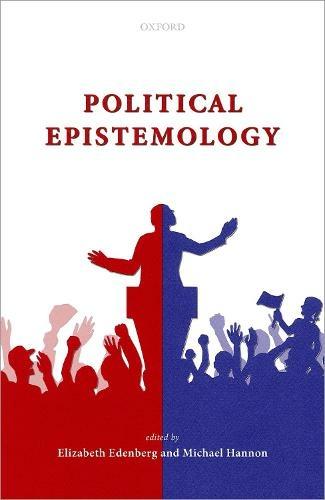
Political Epistemology
Edited by ELIZABETH EDENBERG and MICHAEL HANNON
1
Great Clarendon Street, Oxford, OX2 6DP, United Kingdom
All rights reserved. No part of this publication may be reproduced, stored in a retrieval system, or transmitted, in any form or by any means, without the prior permission in writing of Oxford University Press, or as expressly permitted by law, by licence or under terms agreed with the appropriate reprographics rights organization. Enquiries concerning reproduction outside the scope of the above should be sent to the Rights Department, Oxford University Press, at the address above
You must not circulate this work in any other form and you must impose this same condition on any acquirer
Published in the United States of America by Oxford University Press 198 Madison Avenue, New York, NY 10016, United States of America
British Library Cataloguing in Publication Data Data available
Library of Congress Control Number: 2021931432
ISBN 978–0–19–289333–8
DOI: 10.1093/oso/9780192893338.001.0001
Printed and bound in the UK by TJ Books Limited
Links to third party websites are provided by Oxford in good faith and for information only. Oxford disclaims any responsibility for the materials contained in any third party website referenced in this work.
Acknowledgments
Tis volume would not have been possible without generous support from several funders and people. Firstly, we’d like to thank the Aristotelian Society, the Society for Applied Philosophy, and the Mind Association for providing the funds to organize the inaugural Political Epistemology Network event in London 2018, where the idea for this volume frst took shape. We would also like to thank the British Academy, the Society for Applied Philosophy, and especially Georgetown University and Ethics Lab for supporting a workshop on Epistemology, Democracy, and Disagreement in October 2018. Tis allowed us to invite many contributors of this volume to Washington D.C. for two days of spirited discussion about the contents of this book. Tanks to everyone who participated in these events.
We’d also like to thank the Institute of Philosophy at the University of London, and especially Barry Smith and Richard Somerville, for providing the venue, funding, and support to run a series of events on political epistemology that shaped this volume, as well as for providing Elizabeth Edenberg with a visiting fellowship to make the collaborative work on this project possible. Michael Hannon would also like to thank Jeroen de Ridder and the Dutch Research Council for supporting his research as part of the NWO Vidi grant on “Knowledgeable Democracy: A SocialEpistemological Inquiry” (Project 276-20-024).
A number of other people deserve thanks for helping us to develop this project over the past two years. In particular, we’d like to thank Maggie Little, Robin McKenna, Scott Sturgeon, Étienne Brown, Boudewijn de Bruin, Kate Elgin, Jonathan Healey, Syndey Luken, August Gorman, Lukas Chandler, Michael Tschiderer, Patricia Martin, Roxie France-Nuriddin, Daniel Sulmasy, and two anonymous reviewers. Tanks also to Marie Traore for her fantastic help preparing the index for this volume and to Baruch College, for providing support for her research assistance. We’d also like to thank our editor, Peter Momtchilof, as well as Sarah Sawyer from the Mind Association, who initially suggested that we include this edited volume as part of the Mind Association Occasional Series to be published with Oxford University Press. We are incredibly grateful to both of them for their encouragement. Also, we want to apologize to anyone we forgot to mention by name and say thank you for your help. Tis book is the result of many years of thinking about political epistemology, and we are sure that we have learned things from more people than we can now remember.
Finally, we’d like to thank every contributor to this volume: Kristofer AhlstromVij, Elizabeth Anderson, Jason Brennan, Quassim Cassam, Tomas Christiano, David Estlund, Alexander Guerrero, Jennifer Lackey, Michael Lynch, Fabienne Peter, Jeroen de Ridder, Regina Rini, Jennifer R. Steele, Robert Talisse, and Briana Toole. When we frst envisioned our dream team of contributors, we never expected all of you to fnd the time to contribute to this project. Tank you so much for being part of this. It was a pleasure to work on this project with you all.
List of Contributors
Kristofer Ahlstrom-Vij is Reader in Philosophy at Birkbeck College, University of London, and Research Fellow at the National Institute of Economic and Social Research, London. He works in social epistemology, both theoretical and applied, with a particular interest in the value of truth and the ways in which society can be set up to promote it. At present, he is exploring the role of factual information in political attitude formation, and how to re-think democratic processes and institutions in light of the problems posed by public ignorance. His publications include Epistemic Consequentialism (Oxford University Press, 2018), Epistemic Paternalism: A Defense (Palgrave Macmillan, 2013), and articles in Noûs, Philosophy and Phenomenological Research, Philosophical Studies, and other journals.
Elizabeth Anderson is Arthur F. Turnau Professor and John Dewey Distinguished University Professor of Philosophy and Women’s Studies at the University of Michigan. Her research covers topics in moral and political philosophy and epistemology, including: democratic theory, equality in political philosophy and American law, racial integration, the ethical limits of markets, the history of egalitarianism, theories of value and rational choice, pragmatism, and feminist epistemology and philosophy of science. Anderson’s book Te Imperative of Integration (Princeton University Press, 2013), was winner of the American Philosophical Association’s 2011 Joseph B. Gittler Award for an outstanding scholarly contribution in the feld of the philosophy of the social sciences. Her most recent book, Private Government: How Employers Rule Our Lives (and Why We Don’t Talk About It) (Princeton University Press, 2017) is based on her Tanner Lectures, delivered at Princeton’s Center for Human Values.
Jason Brennan is Robert J. and Elizabeth Flanagan Family Professor of Strategy, Economics, Ethics, and Public Policy at the McDonough School of Business at Georgetown University. He is the author of thirteen books, including Injustice for All (Routledge Press, 2019), with Chris Surprenant and When All Else Fails (Princeton University Press, 2018).
Quassim Cassam is Professor of Philosophy at the University of Warwick. He was previously Knightbridge Professor of Philosophy at Cambridge University, Professor of Philosophy at UCL, and Reader in Philosophy at Oxford University. He is the author of seven books, including Vices of the Mind: From the Intellectual to the Political (Oxford University Press, 2019), Conspiracy Teories (Polity, 2019), and Extremism: A Philosophical Analysis (Routledge, 2021).
Tomas Christiano is Professor of Philosophy and Law at the University of Arizona. His current research is in moral and political philosophy with emphases on democratic theory, distributive justice, and global justice. He is co-editor of Politics, Philosophy and Economics (Sage). His books include Te Constitution of Equality:
Democratic Authority and Its Limits (Oxford University Press, 2008), Te Rule of Te Many: Fundamental Issues in Democratic Teory (Westview Press, 1996), and the edited volume Philosophy and Democracy: An Anthology (Oxford University Press, 2003). He is currently working on books on economic justice, citizen participation, and the foundations of equality.
Elizabeth Edenberg is Assistant Professor of Philosophy at Baruch College, Te City University of New York. Prior to joining Baruch College, she was Senior Ethicist and Assistant Research Professor at Georgetown University’s Ethics Lab where she led translational ethics projects, collaborating with teams of computer scientists, lawyers, and social scientists investigating emerging ethical and political challenges posed by technology. She specializes in political philosophy, political epistemology, and the ethics of emerging technologies. Her articles have appeared in journals such as Te Journal of Political Philosophy, Law and Philosophy, New Media & Society, and IEEE: Security and Privacy.
David Estlund is Lombardo Family Professor of the Humanities and Philosophy at Brown University. His research interests include liberalism, justice and injustice, democracy, dissent, and ideal theory. He previously taught at University of California, Irvine, and has spent fellowship years at Harvard’s Program in Ethics and the Professions and at Australian National University. He is editor most recently of Te Oxford Handbook of Political Philosophy (Oxford University Press, 2013) and author of Democratic Authority: A Philosophical Framework (Princeton University Press, 2008), and Utopophobia: On the Limits (If Any) of Political Philosophy (Princeton University Press, 2020).
Alexander Guerrero is Henry Rutgers Term Chair and Associate Professor of Philosophy at Rutgers University. His work in epistemology, political and moral philosophy, and legal philosophy has appeared in journals such as Ethics, Philosophy and Public Afairs, Public Afairs Quarterly, and Philosophical Studies. One of his main areas of research is on “lottocracies,” which is the idea that lotteries, not elections, should be used to select political ofcials. He received his PhD from the NYU Philosophy Department in 2012, and he has a JD from NYU School of Law.
Michael Hannon is Assistant Professor of Philosophy at the University of Nottingham and founder of the Political Epistemology Network. He is author of What’s the Point of Knowledge? (Oxford University Press, 2019) and co-editor of Te Routledge Handbook of Political Epistemology. He writes about skepticism, fallibilism, the value of knowledge, expressive political discourse, and the role of empathy in politics. He is currently writing a book for Routledge titled Political Epistemology: An Introduction.
Jennifer Lackey is Wayne and Elizabeth Jones Professor of Philosophy at Northwestern University, Director of the Northwestern Prison Education Program, and Editor-inChief of Philosophical Studies and Episteme. Most of her research is in the area of social epistemology, with recent work on the rationality of punishment, credibility and false confessions, eyewitness testimony and epistemic agency, epistemic reparations, the duty to object, and the epistemology of groups. She is the author of Te Epistemology of Groups (Oxford University Press, forthcoming) and Learning from
Words: Testimony as a Source of Knowledge (Oxford University Press, 2008), editor of Academic Freedom (Oxford University Press, 2018) and Essays in Collective Epistemology (Oxford University Press, 2014), and co-editor of Te Epistemology of Disagreement (Oxford University Press, 2013) and Te Epistemology of Testimony (Oxford University Press, 2006). She is the winner of the Dr. Martin R. Lebowitz and Eve Lewellis Lebowitz Prize for Philosophical Achievement and Contribution as well as the Young Epistemologist Prize, and she has received grants and fellowships from the Andrew W. Mellon Foundation, the American Council of Learned Societies, the National Endowment for the Humanities, and the Alice Kaplan Institute for the Humanities.
Michael P. Lynch is Board of Trustees Distinguished Professor of Philosophy at the University of Connecticut, where he directs the Humanities Institute. His books include Te Internet of Us: Knowing More and Understanding Less in the Age of Big Data (Liveright, 2017), In Praise of Reason: Why Rationality Matters for Democracy (MIT Press, 2012), Truth as One and Many (Oxford University Press, 2009), and the New York Times Sunday Book Review Editor’s pick, True to Life (MIT Press, 2004). His most recent book, Know-it-All Society: Truth and Arrogance in Political Culture (Liveright, 2019) was the recipient of the George Orwell Award for Distinguished Contribution to Honesty and Clarity in Public Language.
Fabienne Peter is Professor of Philosophy at the University of Warwick, specializing in political philosophy, moral philosophy, and social epistemology. She has published extensively on political legitimacy and on political epistemology. She is the author of Democratic Legitimacy (Routledge, 2009) and is currently writing a book on Te Grounds of Political Legitimacy, which explores the meta-normative foundations of conceptions of legitimacy. She has co-edited Public Health Ethics and Equity (with Sudhir Anand and Amartya Sen) and Rationality and Commitment (with Hans Bernhard Schmid). She is a past editor of Economics and Philosophy.
Jeroen de Ridder is Associate Professor of Philosophy at Vrije Universiteit Amsterdam, and Professor (by special appointment) of Christian Philosophy at the University of Groningen. He is currently president of Te Young Academy, the junior section of the Royal Netherlands Academy of Arts and Sciences. His research focuses on issues in social epistemology, philosophy of science, and philosophy of religion. He is principal investigator for a fve-year research project on “Knowledgeable Democracy: A SocialEpistemological Inquiry,” funded by a Vidi grant from the Dutch Research Council (NWO). With Michael Hannon, he has co-edited Te Routledge Handbook of Political Epistemology (Routledge, 2021).
Regina Rini is Canada Research Chair in Philosophy of Moral and Social Cognition at York University in Toronto. She writes about moral agency, moral disagreement, normative change, social epistemology, and the philosophy of digital technology. Her work has appeared in numerous philosophy journals, as well as in public venues such as the Times Literary Supplement, New York Times, and Los Angeles Times. Her most recent book is Te Ethics of Microaggression (Routledge, 2020). She is currently writing a book about the efects of social media on democratic political culture.
Jennifer R. Steele is an Associate Professor of Psychology in the Faculty of Health at York University in Toronto, Canada, and the Director of the Interpersonal Perception and Social Cognition Laboratory. In her main line of research, Dr. Steele takes a social cognitive approach to understanding racial biases across the lifespan. She has used a variety of tools, including implicit measures, to assess the attitudes and beliefs of children and adults. Dr. Steele publishes regularly in high-impact peer-reviewed journals and her research has been funded by federal granting agencies including the Social Sciences and Humanities Research Council of Canada and the Canada Foundation for Innovation.
Robert B. Talisse is W. Alton Jones Professor of Philosophy at Vanderbilt University. He specializes in contemporary political philosophy, with particular interest in democratic theory and liberalism. His most recent work engages issues at the intersection of political philosophy and epistemology; in addition, he pursues topics in pragmatism, analytic philosophy, and ancient philosophy. His books include Overdoing Democracy (Oxford University Press, 2019), Engaging Political Philosophy (Routledge, 2016), and Democracy and Moral Confict (Cambridge University Press, 2009).
Briana Toole is an Assistant Professor in the Department of Philosophy at Claremont McKenna College. Toole is an epistemologist with interests in the philosophy of race and gender and feminism. Her work examines the relationship between social and political systems and the epistemic frameworks that support them. Toole is also the founder of the philosophy outreach program Corrupt the Youth.
Introduction
Elizabeth Edenberg and Michael Hannon
As current events around the world have illustrated, epistemological issues are at the center of our political lives. It has become increasingly difcult to discern legitimate sources of evidence, misinformation spreads faster than ever, and the role of truth in politics has allegedly decayed in recent years. It is therefore no coincidence that political discourse is currently saturated with epistemic notions like “post-truth,” “fake news,” “truth decay,” “echo chambers,” and “alternative facts.” Furthermore, disagreement between citizens is not only about moral and political values but also about what information is true and which experts we should trust. Te irreconcilable clash of political outlooks and the deep polarization characteristic of many contemporary societies endanger the common ground upon which the collective pursuit of truth depends. As a result, a worrying form of skepticism threatens our liberal democratic institutions.
Tese issues are part of a rapidly growing area of research called “political epistemology.” While scholars have been interested in topics at the intersection of political philosophy and epistemology at least since Plato’s Republic, the term “political epistemology” only recently entered the academic lexicon and it does not yet point to a clear set of research questions or core topics. Still, we believe this term captures an important area of work at the intersection of political philosophy and epistemology that has become especially important in the current political climate. Tis includes work on propaganda and misinformation, political disagreement, polarization, conspiracy theories, the epistemology of democracy, voter ignorance and irrationality, skepticism wielded for political purposes, and the epistemic virtues (and vices) of citizens, politicians, and political institutions.
If political epistemology has old roots, why has it only recently been recognized as a distinctive subfeld of philosophy? We hypothesize that two recent developments largely explain the emergence of political epistemology as a feld in its own right.
First, new research in social epistemology (itself a relatively young feld) has centered on topics that bear on political life. Tis led to the development of conceptual tools that are readily applicable to political issues; for example, contemporary social epistemologists have studied the social dimensions of knowledge, the role of trust in testimony and reliance on experts, the epistemology of disagreement, judgment aggregation, and the design of social systems to realize our epistemic goals.
Second, recent political developments seem to cry out for epistemological analysis. Te spread of fake news, the rise of conspiracy theories, the intensifcation of political polarization, the decline of trust in experts and the media, and the alleged era of “post-truth” politics all indicate that we are in the midst of a politically charged epistemic crisis. As the April 2017 issue of the New Scientist declared: “Philosophers
of knowledge, your time has come.” Philosophers have answered the call by seeking to play a crucial role in understanding and shaping our response to these political developments.
Tis volume is part of that response. It brings together leading philosophers working at the intersection of epistemology and political philosophy to explore ways in which the analytic and conceptual tools of epistemology bear on political philosophy, and vice versa. By bringing these scholars together, this volume aims to generate new ideas that may help us better understand and make progress in the current crisis over the relevance of truth and knowledge in contemporary politics.
Te volume is organized around three broad themes: the role of truth and knowledge in politics; epistemic problems for democracy; and disagreement and polarization. We selected these themes to refect some of the dominant areas of interest in contemporary political discourse. Tey capture broad questions about the role of epistemic considerations in justifying political authority, as well as more specifc applications to questions of skepticism and disagreement between citizens.
Part I is broadly concerned with the role of truth and knowledge in politics. As Hannah Arendt wrote in her famous New York Times article, “no one ever doubted that truth and politics are on rather bad terms with each other.” Lies, bullshit, spin, and propaganda are not only tools of demagogues, but are seemingly permanent features of the political world. And yet we have allegedly entered the era of posttruth politics, where political life is characterized by intensifed epistemic anarchy. Is there a new war on truth and, if so, how do we fght back?
Elizabeth Anderson examines how political discourse is increasingly distorted by “epistemic bubbles,” which threaten democracy because their members are vulnerable to charlatans, propagandists, and demagogues. She proposes two models of how populism creates epistemic bubbles: frst, by promulgating biased group norms of information processing; and second, by replacing empirically oriented policy discourse with identity-expressive discourse. Anderson then considers diferent strategies for popping epistemic bubbles. Her analysis suggests that social epistemology must get more social by modeling cognitive biases as operating collectively and outside people’s heads, via group epistemic and discursive norms.
Relatedly, Regina Rini focuses on the ways in which Russian propagandists have hijacked social media to wreak epistemic and political damage. An increasingly common worry is that social media enables authoritarians to meddle in democratic politics; for instance, trolls and bots amplify deceptive content. But Rini argues that these tactics have a more insidious anti-democratic purpose. Authoritarians who implant lies in democratic discourse ofen intend for these lies to be caught. Teir primary goal is not to deceive citizens but rather to undermine the democratic value of testimony. Rini illustrates how this makes democratic societies less resilient to authoritarian pressure by examining recent Russian social media interference operations. Rini and Anderson both draw general lessons about the new epistemic vulnerabilities that society faces, but they have diferent focal points: Anderson worries about the closed-mindedness of epistemic bubbles, whereas Rini is concerned about increasing levels of skepticism toward democratic institutions. While Anderson and Rini both look at problematic consequences of manipulations of our fragmented epistemic landscape, Quassim Cassam analyzes whether the
concepts of post-truth and bullshit are useful tools for political-epistemological analysis. He compares diferent accounts of bullshit and post-truth before ultimately arguing that neither concept provides an adequate conceptualization of the political tactics that have come to the fore in recent years. Indeed, he argues that an emphasis on bullshit and post-truth trivializes and misdescribes these tactics, which are more adequately conceptualized in terms of propaganda and hate speech.
Te chapters by Anderson, Rini, and Cassam collectively illustrate a concern about citizens’ ability to access political facts. In the next chapter, Fabienne Peter investigates the possibility of political justifcation under conditions of substantial uncertainty. As Peter observes, political deliberation and decision-making routinely occur in circumstances of substantial uncertainty about what should be done, where this uncertainty concerns both empirical facts and normative facts. But is uncertainty about empirical and normative facts symmetrical? While many argue that uncertainty about empirical facts should be taken into account for political justifcation, some have argued that normative uncertainty does not demand the same caution. Against this asymmetrical view, Peter argues that political justifcation must also take normative uncertainty into account.
In the fnal chapter of this section, Briana Toole tackles a persistent threat to the egalitarian promise of democracy: white supremacy. She argues that white supremacy has remained a challenge to democratic institutions because it is epistemologically resilient. According to Toole, white supremacy is more than a tool of social and political oppression: it is an epistemological system that serves as the foundation for how we understand and interact with the world. Tis makes it especially resilient to dismantling because epistemological systems have the capacity to resist change to their underlying structure while also ofering the appearance of large-scale reform. Her analysis of white supremacy as an epistemological framework allows us to better understand, and eventually overthrow, this oppressive system.
Part II centers on epistemic challenges to democratic institutions. Democratic institutions are frequently defended on the grounds that they treat individuals fairly—whether this is because of democracy’s instrumental value in achieving justice or its intrinsic respect for citizens’ equality. Yet critics have asked whether democracy can withstand criticisms about the epistemic quality of the decisions made by democratic rule. Te chapters in this section focus on diferent aspects of the epistemic challenge to democracy—at times to defend democracy from its critics, at times to show just how worrisome the epistemic challenges should be for those who extoll democratic institutions.
Tis section begins with David Estlund’s chapter questioning how weighty the requirement for democratic rule can be when challenged by alternatives that would make better political decisions. He draws an analogy between paternalism and epistocracy (political rule by the wise) to consider the limits to one’s right to selfgovernance. As Estlund points out, epistocracy and paternalism are analogous in at least two respects: merely knowing better is not enough to justify taking charge, but the prohibition on each is unlikely to be absolute. If one person’s competence is very low and the other person would do far better by taking over, then paternalism is plausibly justifed. Estlund asks whether our right against asymmetrical subjection is beholden to epistemic constraints based on a sufcient competence gap. While our
right against paternalism is limited by certain cases of incompetence, Estlund asks whether (and to what extent) such gaps in competence also impact our right to democracy.
While Estlund seeks to clarify the epistemic challenge to democracy, Tomas Christiano defends the value of democracy against epistemic objections based on voter ignorance. He grants that voters are typically not very knowledge about politics, but he claims this provides no good grounds to endorse rule by experts. Christiano argues that democracy can retain its value in advancing citizens’ interests in an egalitarian way, even within contexts of low information decision-making. However, he acknowledges that critics of democracy do identify an underdeveloped part of the foundations of political equality, which is the theory of citizen participation. He proposes a collaborative conception of how citizens participate in a democracy that can help show how citizens can act on good information and how democracy can be made more efective and egalitarian.
Jason Brennan’s chapter draws on empirical political science literature about voter psychology and voter ignorance to critique the public reason project. According to the public reason view, moral or political rules must be justifable or acceptable to all those persons over whom the rules have authority. However, Brennan endorses the politically “realist” view that most citizens lack the kinds of beliefs and attitudes which public reason liberals believe are normatively signifcant. As a result, the public reason theorists’ understanding of reasonable disagreement between citizens is unsubstantiated by the empirical literature and, thus, their proposed solutions are of little value.
Alexander Guerrero agrees with critics of democracy that elections introduce a host of problems for democracy, including epistemic problems. But rather than give up on the value of egalitarian rule by the people, he argues for a reconceptualization of democracy in favor of a lottocratic alternative to our usual electoral representative models. Afer identifying the epistemic pathologies of electoral representative institutions, Guerrero argues that lottocratic systems of government perform much better on epistemic terms. In particular, he argues that lottocracy is better able to embody the institutional epistemic virtue of “sensibility,” viz,. appreciating and responding to the world as it is. We should therefore prefer lottocracy over electoral representative models for epistemic reasons.
In the fnal chapter of this section, Kristofer Ahlstrom-Vij and Jennifer Steele empirically study public ignorance and what to do in light of the fact that most citizens have only a superfcial understanding of politically relevant matters. In particular, they look at attitudes towards immigration in the UK and whether or not policies can truly refect the “will of the people” when people lack sufcient knowledge about the relevant issues. Tis case study on immigration serves to highlight the ofen-overlooked problem that policies implemented with reference to popular sentiments might not capture the will of the people.
Part III of this book is about two deeply interrelated issues: political polarization and intractable disagreement in politics. Political debates are becoming increasingly polarized in Western-style democracies. Citizens have highly unfavorable views of each other, ofen regarding their political opponents as immoral, stupid, lazy, and even threatening to each other’s way of life. Te chapters in this section outline
various types of polarization, identify the mechanisms that cause citizens to polarize, and suggest ways to mitigate partisan discord.
Robert Talisse’s chapter identifes several distinct kinds of polarization and ofers a view of how their interaction gives rise to various political problems, ranging from legislative deadlock and partisan animosity to escalating extremism. Tis conceptual work is important: political commentary is currently saturated with narratives about the harms of polarization, but these commentaries fail to acknowledge the diferent types of polarization; as a result, they obscure from view the diferent causes of—and solutions to—these problems.
Jeroen de Ridder also distinguishes multiple senses of “polarization” in order to provide a more precise account of what polarization is. By identifying the diferent ways in which citizens can polarize, both de Ridder and Talisse enable us to better understand the mechanisms of polarization and address the problems they pose for democracy. While de Ridder agrees with Talisse that polarization undermines democracy, de Ridder’s analysis centers on how deep disagreements erode the common ground needed to harness the epistemic power of democratic deliberation. In deep disagreements, parties disagree about relatively fundamental underlying moral or epistemic principles and therefore see each other as less than fully rational or morally subpar. de Ridder argues that deep disagreements lead to both cognitive and practical polarization, especially when they concern matters that are central to people’s social identities. Tis, in turn, entrenches their disagreement even further, resulting in a vicious feedback loop.
Michael Lynch’s chapter explores two contributing factors to polarization. Te frst is epistemic disagreement—or disagreement over what is known, who knows it, or how we know. Te second is intellectual arrogance—or arrogance about what we know or think we know. Lynch argues that even the perception of widespread epistemic disagreement is dangerous. Moreover, he argues that epistemic disagreement and intellectual arrogance are mutually reinforcing. Tis makes them doubly dangerous. By increasing cognitive polarization, they undermine the democratic value of the pursuit of truth.
In keeping with the chapters above, Elizabeth Edenberg argues that intractable disagreements threaten our ability to build a cohesive political community. Tis is exacerbated by social media, which allows us to sort ourselves into increasingly likeminded groups that consume information from diferent sources and end up in polarized and insular echo chambers. But in contrast with the previous chapters, Edenberg argues for the need to shif away from epistemic evaluations of our fellow citizens in order to build a political community based on mutual respect. Te breakdown of discourse online provides reasons to draw out not an epistemic but a moral basis for political cooperation among diverse citizens—one inspired by Rawlsian political liberalism.
Jennifer Lackey explores when we should, from an epistemic point of view, disagree about politics by asking the general question: when do we have the epistemic duty to object to assertions that we take to be false or unwarranted? She characterizes this as an imperfect duty rather than a perfect duty, and she examines in detail one specifc account of imperfect moral duties before sketching her own view of the duty to object. She then applies her view to the political domain and highlights the ways
in which pressing issues arise when we disagree about political matters. An interesting feature of Lackey’s view is its implication that we should ofen increase the level of disagreement with our political opponents. Tis starkly contrasts with the chapters by Talisse, de Ridder, Edenberg, and Lynch, all of whom worry about increasing levels of political division. Lackey suggests that objecting to political opponents may actually diminish the extent of political disagreement in the long run.
In the fnal chapter, Michael Hannon argues that the extent and depth of political disagreement is largely overstated. While Hannon agrees with Talisse, de Ridder, Lynch, and Edenberg that voters are increasingly polarized in terms of their attitudes towards each other, he maintains there is comparatively little polarization on the issues. Te extent and depth of political disagreement is exaggerated by the fact that many people will deliberately misreport their beliefs as a way to express their attitudes. Hannon then draws out a number of signifcant implications from this idea. For example, he argues that insincere disagreement explains why debates ofen go so poorly, why people seem to hold blatantly contradictory views, and why it is ofen so difcult to correct false beliefs.
Although this book is divided into three parts, the chapters in this volume speak to each other across a variety of other issues. For example, Talisse’s chapter focuses on polarization as a dominant explanation for epistemic bubbles, whereas Anderson questions this hypothesis and provides an alternative account that focuses on the epistemic norms of specifc groups. Like Anderson, both Toole and Lynch examine the epistemic norms of groups. Lynch looks at our epistemic attitudes we take towards each other, while Toole analyses the resilient epistemic system of white supremacy, which frames the conditions under which knowledge is possible. Lackey argues that we have an epistemic duty to object to our political opponents, while Brennan suggests that such objections are ofen the expression of tribal cheerleading. Rini and Edenberg both look at how social media have fragmented our epistemic landscape, with Rini diagnosing the core issue as an intentional weaponization of skepticism and Edenberg arguing (against both Rini and Lynch) that the epistemic lens is important but incomplete. Anderson and Hannon agree with Brennan that political disagreements are ofen insincere and merely refect identity-expressive discourse. By contrast, de Ridder and Lynch worry that political disagreements have grown especially deep in polarized societies. However, these authors all agree that we cannot understand the nature, extent, and depth of political disagreement without better understanding how it is bound up with socio-political identities. Christiano investigates whether political ignorance undermines democracy’s promise to advance the interests of citizens in an egalitarian way, whereas Ahlstrom-Vij and Steele argue that political choices based on ignorance fail to refect what individuals really want. Peter picks up on the idea that uncertainty is signifcant for political legitimacy, arguing that political justifcation should take both normative and empirical uncertainty into account. Estlund, Christiano, Peter, and Guerrero all ofer diferent arguments for what political legitimacy requires to best accommodate democracy’s epistemic and egalitarian goals.
Tis is just a small sampling of the ways in which the chapters in this volume have rich connections across diverse issues. Te volume also investigates the extent and implications of political ignorance (Ahlstrom-Vij and Steele, Anderson, Cassam,
Christiano, Guerrero, Lynch, and Rini), democratic deliberation (Anderson, Brennan, de Ridder, Hannon, Lynch, Rini, and Talisse), the signifcance of epistemic considerations for political legitimacy (Brennan, Christian, Estlund, Guerrero, and Peter), the epistemology of political disagreement (Anderson, de Ridder, Edenberg, Hannon, Lackey, Lynch, and Talisse), and identity politics (Anderson, de Ridder, Hannon, Lynch, Toole, and Talisse), among other topics at the intersection of political philosophy and epistemology.
Tis volume does not aspire to provide a comprehensive guide to the burgeoning feld of political epistemology, nor does it bring together rival answers to a single question or small cluster of questions. Te frst approach is more suitable for an introductory handbook of political epistemology, while the second is more appropriate for subfelds of philosophy that are already well defned and where there is an established set of research questions that focus the discussion. We view this volume as serving a somewhat diferent aim: to highlight some of the key topics, questions, and problems at the heart of political epistemology. A premise underlying the selection of themes and essays for this volume is that, beyond a certain point, progress on certain foundational issues in both political philosophy and epistemology cannot be achieved without attending to both the epistemic and political dimensions of these problems. By bringing political philosophers into conversation with epistemologists, this volume promotes more cross-pollination of ideas while also highlighting the richness and diversity of this area of philosophy. Our hope is that through careful analysis of the philosophical issues underlying contemporary political challenges, we can identify constructive paths forward.
PART I TRUTH AND KNOWLEDGE IN POLITICS
1
Epistemic Bubbles and Authoritarian Politics
Elizabeth Anderson
1. Epistemic Bubbles and their Treats to Democracy
Contemporary American political discourse is distorted by “epistemic bubbles.” An epistemic bubble may be defned as a relatively self-segregated social network of like-minded people, which lacks internal dispositions to discredit false or unsupported factual claims in particular domains. Due to factors internal to the network, members are liable to converge on and resist correction of false, misleading, or unsupported claims circulated within it.
In the U.S., the rise of politically consequential epistemic bubbles appears to be tied to increasing partisan polarization. As Talisse documents in this volume, Americans are divided by partisan identity not only with respect to political issues, but with respect to numerous otherwise politically irrelevant lifestyle choices. Partisan polarization is higher now than at any time since the end of the Civil War (Hare and Poole, 2014). Moreover, members of diferent parties disagree not only about values, but about facts. Partisan disagreement about certain politically salient factual claims—such as whether human activity is causing climate change, and whether carrying concealed weapons makes people safer—exceeds disagreement about values, such as the justice of progressive taxation (Kahan, 2016, p. 1).
Factual disagreement need not indicate that partisans occupy distinct epistemic bubbles. It could be that members of rival parties began with diferent priors, and that evidence is insufcient to justify convergence on a consensus position. However, as the scientifc consensus that humans are changing the climate became more certain, and evidence of this was more widely publicized, partisan disagreement over this claim grew from a 17 percent diference between Democrats and Republicans in 2001 to a 41 percent diference in 2016 (Dunlap et al., 2016, p. 9). Democrats converged on the scientifc consensus, while Republicans departed from it. Tus, whether an epistemic bubble exists is indicated not by within-group consensus and between-group disagreement, nor by a group’s initial convergence on certain false, misleading, or unsupported beliefs, but by the failure of a group to update its beliefs in an accuracy-directed response to new information.
Politically consequential bubbles have formed around two types of claims. One concerns scientifc claims about risk. Millions of Americans deny that human activity is causing global warming. Many others believe that vaccines cause autism. Te second type concerns delegitimizing claims about government, public policy, politicians, and infuential people. Many hold that “the deep state” plotted against President Trump, that Bush was complicit in the 9/11 attacks, that some U.S. cities
are run under Sharia law. Sometimes the two types merge—for example, in the belief that claims about the dangers of the novel coronavirus are a hoax to discredit President Trump.
Epistemic bubbles threaten both sound policymaking and democracy itself. Groups inside bubbles are vulnerable to manipulation by charlatans, propagandists, and demagogues. Tis disables them from contributing productively to the epistemic functions of democracy, which involve collective learning from accurate information about problems and policies that is asymmetrically distributed across citizens (Anderson, 2006). Bubbles threaten the whole society when intransigent false beliefs concern serious problems we all face. Refusal to acknowledge genuine risks can be worse than disagreement about values. If partisans agree about the facts of anthropogenic climate change, but disagree about values, they can still reach compromises— for example, over whether market-friendly, revenue-neutral solutions would be preferable to state regulation. But if one side insists that the science of global warming is a communist hoax, it is likely to see obstruction of all action to mitigate climate change to be the only acceptable course—and to view those who disagree as subversives and traitors. Similarly, intransigent false beliefs that the state is involved in conspiracies against the people sow mistrust of democracy and of rival political parties. Such beliefs do not merely impair the intergroup discussion that lies at the core of possibilities for democratic cooperation. Tey underwrite a hostile exclusionary politics of “enemies within” that undermines democracy itself, by writing fellow citizens out of the social contract, and by licensing destructive attitudes toward democratic institutions.
If epistemic bubbles are a problem, we need to fgure out how to burst them. Tis requires analysis of how they form and operate. I begin by considering two prominent models of how bubbles work: Cass Sunstein’s group polarization theory, and Dan Kahan’s cultural cognition theory. Both theorists are inclined to deny that partisan groups difer in their tendencies to form epistemic bubbles. Indeed, laboratory evidence indicates that individuals with diferent partisan and ideological identities do not difer on average with respect to relevant cognitive characteristics. However, evidence from the feld suggests that there is a partisan asymmetry. Republicans today are more vulnerable to epistemic bubbles than Democrats. Group asymmetries are possible even if individual cognitive characteristics do not difer between groups, due to features of the group itself. I argue that an important cause of partisan asymmetry in epistemic bubbles is due to the rise of populist politics within the Republican Party. I then ofer two models of how populist politics generates epistemic bubbles. Te collective cognition model claims that populist groups promulgate group norms for assimilating evidence that generate epistemic bubbles. Te discursive model claims that populist groups adopt rhetorical styles that function similarly to epistemic bubbles, in suspending accuracy-guided empirical inquiry with them. Both models suggest that social epistemology needs to get more political, by considering the impact of populist political styles on what people assert and believe. Tey suggest that social epistemology needs to get more social, by locating critical features of epistemic bubbles outside people’s heads, in the norms by which certain groups operate. I conclude with a discussion of how each model points to potential strategies for bursting epistemic bubbles.
2. Two Models of Epistemic Bubbles
Cass Sunstein’s (Sunstein, 2009; Sunstein and Vermeule, 2009) group polarization theory ofers one prominent model of epistemic bubbles. Begin with a relatively enclosed social network of relatively like-minded individuals—people who have similar or skewed values and prior credences on particular types of claims in some domain. Tree sets of universal cognitive biases make that group vulnerable to the spread of false and extreme beliefs within the network, and make it resistant to correction, if the falsehoods ft the group’s priors.
Te frst set of biases propels information and reputation cascades. Individuals ofen rely on a popularity heuristic: pay attention to those to whom many others in the network are listening. Claims within a network can thus go viral. A conformity heuristic propels the propagation of belief: if some people in the network express belief in a claim, others are liable to defer, until it is so popular that most agree. Even private dissenters may express agreement to preserve their reputation within the group.
A second set of biases leads to group polarization—tendencies to accept extreme beliefs within the group. Expressions of agreement with the belief increase members’ confdence in it, and may also exaggerate its content. For example, among Republicans, evidence that Hillary Clinton was negligent in managing some classifed State Department emails turned into certainty that her behavior was criminal. Claims that pander to the group’s fears and wishes intensify those emotions. Tis motivates group members to commit themselves to more extreme actions related to the claims (“Lock her up!”) (Sunstein, 2009, p. 35).
A third set of assimilation biases leads members to resist correction of popular beliefs. Confrmation bias leads people to seek and believe new evidence that confrms their belief. Disconfrmation bias leads people to discredit or rebut evidence that disconfrms their belief. Attempts to refute false beliefs may be self-defeating: repetition of a claim for the purpose of negating it increases people’s familiarity with it, and people give greater credence to familiar thoughts. People also tend to distrust outgroup sources that attempt to correct beliefs held within the group (Berinsky, 2015, pp. 246, 245).
Sunstein’s theory ofers a plausible account of several mechanisms that likely underlie epistemic bubbles. Yet his account lacks specifcity. Because it is contentneutral, it over-predicts the tendency of groups to converge on false beliefs, if they begin with a signifcant prior bias in favor of them. Yet epistemic bubbles appear to form primarily around false or unsupported claims that appeal to specifc values or motives peculiar to the group.
Dan Kahan’s cultural cognition theory explains why epistemic bubbles form around claims about risk. Cultural cognition refers to a set of cognitive biases tied to the ways the perception of risk is afected by individuals’ worldviews and cultural identities. Building on Mary Douglas and Aaron Wildavsky’s (1982) “cultural theory of risk,” Kahan (2012) postulates that individuals form perceptions of the risk of activities depending on their perceived threat to or congruence with their ideals of social order, which defne group identities. Individuals view those who challenge the cultural dominance of their worldview as threats not only to their preferred social
order, but to their cultural identities and to their social status within their cultural group and relative to those holding rival worldviews.
Cultural cognition theory classifes individuals’ worldviews along two axes. Te hierarchical–egalitarian axis sorts individuals on a continuum from those who prefer society to be hierarchically organized to those who prefer social equality. Te individualism–communitarianism axis sorts individuals on a continuum from those who prefer that society be based on market competition and self-reliance to those who prefer collective action to regulate conduct and provide for individual needs. Te widest gaps in risk perception typically lie between hierarchical individualists and egalitarian communitarians. For example, on a four point scale, hierarchical individualists rate the risk of gun ownership to public safety at 2.26, while egalitarian communitarians rate it at 2.95, with the other two groups in-between (Kahan et al., 2007, p. 481). Hierarchical individualists view gun ownership as enabling them to practice the virtue of self-reliance in defending themselves against criminals. It upholds their authoritative status as protectors of their families. (Hierarchical individualists are disproportionately white men.) Egalitarian communitarians are more likely to fear that gun owners threaten them, and prefer public safety to be collectively secured by police.
Cultural cognition theory ofers empirically well-supported and compelling explanations for group diferences in risk perception. It is hard for people to think that an activity they view as virtuous and honorable is dangerous. Hence, hierarchical individualists discount the dangers of gun ownership, infate the dangers of gun regulation, and exhibit biased assimilation of information about gun risks—favoring information that highlights successful uses of guns in self-defense, and discounting information about gun accidents and misuse. Tey give credence to experts who claim that gun ownership reduces crime, and distrust those who claim that the risk of being killed by a gun rises if one lives in a household with guns. Egalitarian communitarians exhibit biases in the other direction.
Cultural cognition theory highlights two identity-protective biases. One inclines people to conform to the beliefs dominant within their group, to express their commitment to and maintain their standing within the group. To concede the danger of what the group regards as virtuous risks that standing by marking oneself as a threat to the group’s status. By contrast, individuals have no motive to assimilate information about the risk in an accuracy-enhancing way, because an individual’s personal opinion of objective risk has no impact on its incidence or on policies to address it. Hence cultural cognition is “perfectly rational” for the individual, because it enhances the individual’s welfare (Kahan, 2016, p. 13). However, it is collectively irrational in preventing society from arriving at an accurate consensus on risks and from adopting efective policies to address them.
Te second identity-protective bias concerns how members of identity groups relate to advocates of rival worldviews. Each group is disposed to see the others as threatening to their social standing. Tis disposition is activated by culturally antagonistic memes: ways of framing the stakes or the weight of the evidence in discussions of risk that stigmatize rival identity groups as vicious or stupid (Kahan et al., 2017, p. 5). Public discussion of risks degenerates into expressions of mutual contempt, in a competition over the relative standing of the groups. Tis explains why disagreements