Classical and Quantum Parametric Phenomena Oded
Zilberberg
https://ebookmass.com/product/classical-and-quantum-parametricphenomena-oded-zilberberg/
ebookmass.com
Political Alternation in the Azores, Madeira and the Canary Islands 1st ed. Edition Teresa Ruel
https://ebookmass.com/product/political-alternation-in-the-azoresmadeira-and-the-canary-islands-1st-ed-edition-teresa-ruel/
ebookmass.com
Business ethics Ninth Edition William H. Shaw
https://ebookmass.com/product/business-ethics-ninth-edition-william-hshaw/
ebookmass.com
Diagnosketch: A Visual Guide to Medical Diagnosis for the Non-Medical Audience Sapana Adhikari
https://ebookmass.com/product/diagnosketch-a-visual-guide-to-medicaldiagnosis-for-the-non-medical-audience-sapana-adhikari/
ebookmass.com
The Eternal Decline and Fall of Rome: The History of a Dangerous Idea Edward J. Watts
https://ebookmass.com/product/the-eternal-decline-and-fall-of-romethe-history-of-a-dangerous-idea-edward-j-watts/
ebookmass.com
Hacking Electronics: Learning Electronics with Arduino and Raspberry Pi, 2nd Edition Simon Monk
https://ebookmass.com/product/hacking-electronics-learningelectronics-with-arduino-and-raspberry-pi-2nd-edition-simon-monk/
ebookmass.com
Preface
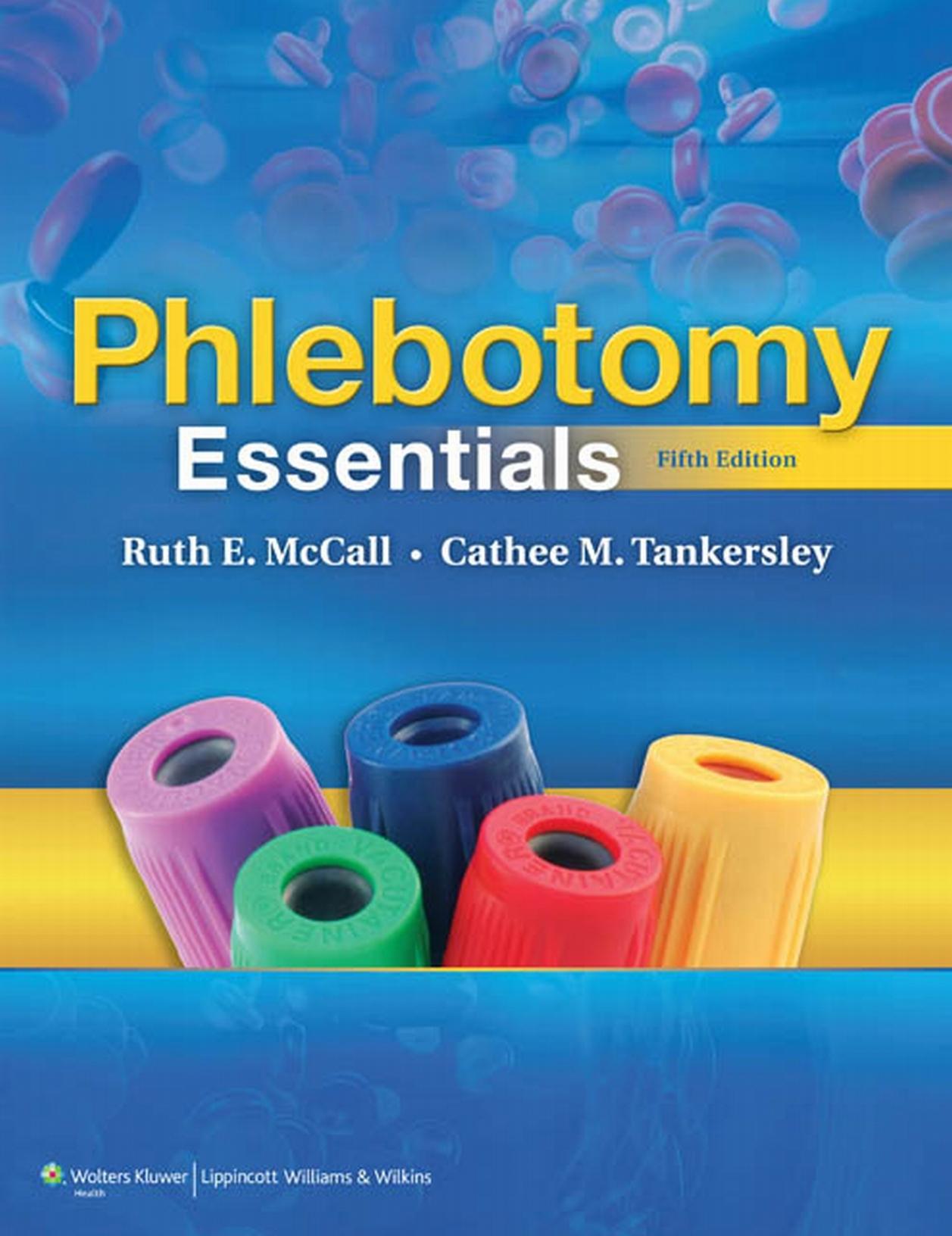
Phlebotomy Essentials, fifth edition, was written for all who want to correctly and safely practice phlebotomy. The authors have over 70 years of combined experience in laboratory sciences, phlebotomy program direction, and teaching many different levels and diverse populations of phlebotomy students. As with previous editions, the goal of Phlebotomy Essentials, fifth edition, is to provide accurate, up-to-date, and practical information and instruction in phlebotomy procedures and techniques along with a comprehensive background in phlebotomy theory and principles. It is appropriate for use as an instructional text or as a reference for those who wish to update their skills or study for national certification.
Organization
Much care has been taken to present the material in a clear and concise manner that encourages learning and promotes comprehension. A good deal of time was spent organizing and formatting the information into a logical and student-friendly reading style in an order that allows the reader to build on information from previous chapters.
The book is divided into four units. Unit I, The Healthcare Setting, presents a basic description of the healthcare system and the role of the phlebotomist within it. Major topics include communication skills, healthcare financing and delivery with an emphasis on clinical laboratory services, quality assurance and legal issues and their relationship to the standard of care, and comprehensive instruction in infection control and safety.
Unit II, Overview of the Human Body, provides a foundation in medical terminology and a basic understanding of each of the body systems, including associated disorders and diagnostic tests. An entire chapter is devoted to the circulatory system, with special emphasis on the vascular system, including blood vessel structure, vascular anatomy of the arm, and blood composition.
Unit III, Blood Collection Procedures, describes phlebotomy equipment (including the latest safety equipment and order of draw) and proper procedures and techniques for collecting venipuncture and capillary specimens based upon the latest CLSI standards. Also included is an extensive explanation of preanalytical variables, complications, and procedural errors associated with blood collection.
Unit IV, Special Procedures, offers information and instruction on how to handle special blood and nonblood specimen collections and the latest in point-of care instruments and testing. Routine and special handling and processing of specimens, with an emphasis on the latest rules of safety, are included in this section. Covered in this unit is an overview of the Laboratory Information System (LIS)—how it supports the laboratory process and is used by the phlebotomist in specimen collection. Also included is a discussion of nonblood specimens and testing information, which can be an important part of the phlebotomist’s responsibilities, as well as arterial puncture for those phlebotomists who do ABGs or who anticipate advancing beyond venous collection.
The appendices give readers ready access to helpful supplementary information as they progress through the text.
• Appendix A is an alphabetical list of laboratory tests including specimen type, handling considerations, and the department that does the testing. Not only does this help readers categorize the many different tests performed by a laboratory, but it also provides practice in using a reference manual.
• Appendix B, Laboratory Math, provides a quick review and reference for certain calculations that may be needed but are not always used enough to have been committed to memory.
• English to Spanish translation of conversational phrases, including phonetic Spanish pronunciation guidelines, found in Appendix C can help non–Spanish-speaking phlebotomists provide safe and appropriate directions to patients who speak only Spanish.
• Appendix D identifies conditions that require work restrictions for healthcare workers, a quick reference that can help phlebotomists learn when and how to protect themselves and others from infection.
• Appendix E, Answers to Study and Review Questions and Case Studies, allows readers to check their answers, reinforcing the material and assuring that they have learned it correctly.
• Appendix F gives the reader immediate access to tube guides from two leading manufacturers for a quick reference and colorful way to learn by association.
There are many technical and specialized terms associated with healthcare in general and phlebotomy in particular. The extensive updated and alphabetically arranged glossary makes the meanings of unfamiliar terms within easy reach.
Features
The fifth edition includes various features meant to help the reader learn and retain the information in Phlebotomy Essentials.
• Key Terms and Objectives open each chapter and help students recognize the important terms and concepts that they will come across in reading the chapter.
• Consistently organized step-by-step Procedures, with an explanation or rationale for each step, assist the student in learning and understanding phlebotomy techniques.
• Key Points emphasize important concepts to enhance student learning.
• Cautions highlight critical information to help students identify and avoid dangerous practices.
• FYIs are interesting notes and fun facts that will enhance practical application of the information.
• Memory Joggers offer a proven way to help students remember important information.
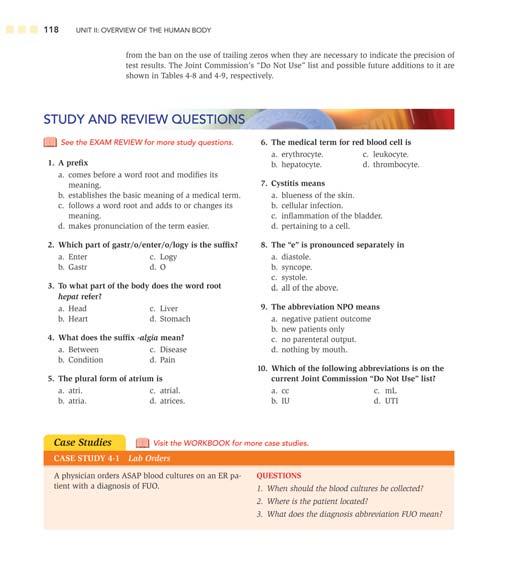
• Study and Review Questions at the end of each chapter provide a review of each chapter’s content.
• Case studies at the end of each chapter bring concepts to life and enhance critical thinking skills.
• A Media Menu at the end of each chapter points out online student resources available for that chapter.
• Book Icons throughout the text refer readers to the Student Workbook for Phlebotomy Essentials and the Phlebotomy Exam Review, for further opportunities to enrich their learning (available for separate purchase).
• Online Icons throughout the text refer readers to corresponding videos and animations on the book’s companion Web site, which bring the content to life (see “Additional Resources,” below, for more information).
The content of this new edition of Phlebotomy Essentials was designed in accordance with applicable National Accrediting Agency for Clinical Laboratory Science (NAACLS) competencies.
Procedures have been written to conform to the latest OSHA safety regulations and, wherever applicable, standards developed by the CLSI.
Additional Resources
Phlebotomy Essentials, fifth edition, includes additional resources for both instructors and students that are available on the book’s companion Web site at http://thepoint.lww.com/McCall5e.
INSTRUCTORS
Approved adopting instructors will be given access to the following additional resources:
• Lesson Plans
• Critical Thinking Questions
• Brownstone Test Generator
• Image Collection
• All the appendixes from the book
• PowerPoint Slides with Images and Tables
• WebCT-/Blackboard-Ready Cartridges
• Signature Papers (i.e., HIPAA/confidentiality forms, blood-borne pathogen statements, assumption-of-risk form, health declaration form)
• Log Examples
• Lab Skills Evaluation Checklists (i.e., venipuncture, skin puncture, special test procedures)
• Phlebotomy Program Pre-test and Post-test and their answer keys
STUDENTS
Students who have purchased Phlebotomy Essentials, fifth edition, have access to the following additional resources:
• New to the fifth edition, interactive games and exercises offer a fun way to study and review. Exercise types include Look and Label, Zooming In, Word Building, Body Building, Roboterms, Interactive Crossword Puzzles, Quiz Show, and Concentration.
• 23 videos, including 10 that are new to the fifth edition
• 17 animations, including 12 that are new to the fifth edition
• Audio flash cards and, new to the fifth edition, a flash card generator
• An audio glossary, new to the fifth edition
In addition, purchasers of the text can access the searchable Full Text On-line by going to the Phlebotomy Essentials, fifth edition Web site at http://thepoint.lww.com/McCall5e. See the inside front cover of this text for more details, including the passcode you will need to gain access to the Web site.
Related Titles
The authors of this textbook have created the following two titles, available for separate purchase, that correspond to Phlebotomy Essentials, fifth edition, to create an ideal study package for phlebotomy training programs. Each corresponds to this main textbook in chapter sequence.
• The companion workbook (McCall R, Tankersley C. Student Workbook for Phlebotomy Essentials, 5th ed., available for separate purchase) provides students with chapter-bychapter exercises to reinforce text material, assessment tools to evaluate their skills, realistic scenarios to gauge their grasp of key concepts, and skills logs to chart their progress. The workbook includes key terms matching exercises, chapter review questions,
crossword puzzles, skill and knowledge drills, requisition activities, case studies, and procedure evaluation forms.
• The companion exam review book (McCall R, Tankersley C. Phlebotomy Exam Review, 4th ed., available for separate purchase) prepares students for all the national certification exams in phlebotomy.
Acknowledgments
The authors wish to express their gratitude to the many individuals who gave of their time, talent, and expertise to make this edition of Phlebotomy Essentials current and accurate. In particular, we would like to thank Jane Adrian, David Berg, Theresa McGillvray-Dodd, Joyce Hall, Maureane Hoffman, Glenda Hiddessen, Bob Kaplanis, Scott Leece, Jeri Litteral, Charez Norris, Mary Robitaille, Phil Tate, and Janet Vittori.
In addition we would like to thank animator Mark Flanders, illustrator Christine Vernon, photographer Bruce Knapus, videographer Michael Norde, and all who played a role in the latest videos, including Jim Gregory, Lynette Hales, Nancy Jefferys, Bruce Knaphus, Patty Lewis, April Meyers, Flavia Pradolin, Donald Pryor, and Maura Smith.
Finally, we would like to thank Acquisitions Editor Pete Sabatini and the production and editorial staff at Lippincott Williams & Wilkins, especially those with whom we worked most closely, with an extra special thank you to Senior Product Manager Meredith Brittain for her patience, support, and dedication to this endeavor.
RUTH E. McCALL
CATHEE M. TANKERSLEY
Chapter Closing Elements
Each chapter closes with the following elements to help you study and test your knowledge of what you’ve learned:
STUDY AND REVIEW QUESTIONS provoke thought and help test your comprehension of each chapter’s major concepts.
CASE STUDIES Enhance critical thinking skills and show how to apply concepts in the real world.
MEDIA MENUS point out online student resources available for that chapter.
Additional Learning Resources
In addition to the helpful tools outlined here, you also have access to a variety of free resources at http://thepoint.lww.com/McCall5e designed to help make learning exciting and effective. These include:
• Interactive games and exercises that offer a fun way to study and review. Exercise types include Look and Label, Word Building, Body Building, Roboterms, Interactive Crossword Puzzles, Quiz Show, and Concentration.
• 23 videos and 17 animations that illustrate important procedures and concepts
• Audio flash cards, flash card generator, and audio glossary
• Fully searchable Full Text Online
Reviewers
Carol Abshire, MLT, BGS
Laboratory Manager/Coordinator
Arts & Science
Lamar State College—Orange Orange, Texas
Diana Alagna, RN, RMA
Program Director
Medical Assisting Branford Hall Career Institute Southington, Connecticut
David E. Berg, MS, FAHA Director, Arizona Research Foundation Phoenix, Arizona
Judith Blaney, AMT, MCLS
Phlebotomy Internship Coordinator
Allied Health Department
Manchester Community College Manchester, New Hampshire
Gerry Brasin, AS, CMA (AAMA), CPC Coordinator Education/Compliance
Premier Education Group Springfield, Massachusetts
Marilyn Braswell, BA, MT (ASCP), SBB
Phlebotomy Instructor
Healthcare Continuing Education
Central Piedmont Community College Charlotte, North Carolina
Lou Brown, BS, MT (ASCP), CMA (AAMA)
Program Director
Medical Assisting and Phlebotomy
Wayne Community College Goldsboro, North Carolina
Mary Ellen Brown, CMA (AAMA), PBT (ASCP) Instructor
Medical Assisting Department Lincoln Technical Institute
Hamden, Connecticut
Susen Edwards, MA Program Coordinator
Allied Health
Middlesex County College Edison, New Jersey
Nancy Feulner, MS Ed Program Coordinator
Health Science College of DuPage Glen Ellyn, Illinois
Tammy Gallagher, BS, MT
Medical Technologist
Butler County Community College Butler, Pennsylvania
Kathi Gilmore, AS Master Instructor
Medical Assisting Remington College, Nashville Campus Nashville, Tennessee
Joyce Hall, C (ASCP) Laboratory Administrative Manager
John C. Lincoln—North Mountain Phoenix, Arizona
Andrea T. Harper, MS, MLS (ASCP)
Adjunct Faculty Phlebotomy Instructor
Manchester Community College Manchester, New Hampshire
Nancy Heldt, MS, MT (ASCP)
Professor of Medical Laboratory Technology
Division of Science and Health Careers
Oakton Community College Des Plaines, Illinois
Claudia N. Hewlett, AS
Senior MA Lead Instructor
Allied Health Remington College Memphis, Tennessee
Maureane Hoffman, MD, PhD Professor Pathology
Duke University Medical Center Durham, North Carolina
Carol Itatani, PhD, MS, MT (ASCP)
Professor
Department of Biological Sciences
California State University, Long Beach Long Beach, California
Cherika de Jesus, CMA/AAMA
Lead Medical Assistant Chair
Medical Assistant
Globe University Minnesota School of Business
Brooklyn Center, Minnesota
Paula Furlan Kimball, MS, MLT, AHI
Assistant Master Technical Instructor
Department of Allied Health—MLT Program
University of Texas at Brownsville and Texas Southmost College Brownsville, Texas
Robin Gaynor Krefetz, M.Ed
MLS (ASCP) PBT
CLT and Phlebotomy Program
Director
Community College of Philadelphia Philadelphia, Pennsylvania
Tanya O. Mace, MSN, RN, PBT (ASCP)
Program Director Nursing and Phlebotomy
Brunswick Community College Supply, North Carolina
James R. McGee, MA, MT (ASCP)
Instructor, Phlebotomy Training and Exploring Medical Language
Retired, Part Time Instructor
Healthcare Continuing Education Central Piedmont Community College
Charlotte, North Carolina
D. Gayle Melberg, MS, MT (ASCP)
Adjunct Faculty
Medical Laboratory Technician
J. Sargeant Reynolds Community College Richmond, Virginia
Cheryl Milish, AAS Instructor
Allied Health
Southwestern College Florence, Kentucky
Judith Miller, BS, MT (ASCP)
Clinical Coordinator
Medical Laboratory Technician Program
Barton County Community College Great Bend, Kansas
Lane Miller, MBA/HCM
Director
Continuing Education Medical Careers Institute
Virginia Beach, Virginia
Michael Murphy, CMA (AAMA) Program Coordinator
Berdan Institute at The Summit Medical Group Union, New Jersey
Sonja Nehr-Kanet, MS, MLS (ASCP)
CLS Program Director/Clinical Associate Professor Clinical/Medical Laboratory Science Program
Idaho State University Meridian, Idaho
Charez Norris, RRT
Clinical Educator, Respiratory Services
John C. Lincoln—North Mountain Phoenix, Arizona
Robert Plick, RMA, RPT, CET, BS
American Heart Association CPR Instructor
9 Health Fair Phlebotomy Task Force
Externship and Community Affairs Coordinator, Medical Instructor
Medical Instructor, Medical Lab Assistant/Phlebotomist and Associate Minister Church of Christ Education Department
Alta/Westwood College Denver, Colorado
Pamela B. Primrose, PhD, MT (ASCP)
Professor and Program Chair Medical Laboratory Technology/ Phlebotomy
School of Health Sciences
Ivy Tech Community College South Bend, Indiana
Debbie Reasoner, (NHA)-CPT-CHI
Director and Instructor
Phlebotomy/Lab Assistant West Coast Phlebotomy, Inc. Oregon City, Oregon
Mary Robitaille, BS, MT (ASCP)
Phlebotomy Instructor
CNM Community College
Albuquerque, New Mexico
Mary E. Stassi, RN-BC
Health Occupations Coordinator
St. Charles Community College
Cottleville, Missouri
Philip Tate, DA
Author, Seeley’s Principles of Anatomy and Physiology, 2010 Lubbock, Texas
Scott Tharpe, CLS (CA), MT
Program Director, Clinical Laboratory Sciences
Health Science
Saddleback College
Mission Viejo, California
Marie Thomas, CLT, CMA
Clinical Instructor/Lead
Medical Assisting Berdan Institute
Wayne, New Jersey
Barbara Vaiden, BS, MT (ASCP)
Supervisor
Phlebotomy
OSF Saint Anthony Medical Center Rockford, Illinois
Janet Vittori, BS, MT (ASCP)
Point-of-Care Testing Coordinator
Laboratory Supervisor
John C Lincoln Hospital—North Mountain Phoenix, Arizona
APPENDIX A
Laboratory Tests 477
APPENDIX B
Laboratory Mathematics 487
APPENDIX C
Conversational Phrases in English and Spanish 493
APPENDIX D
Work Restrictions for Healthcare Employees 495
APPENDIX E
Answers to Study & Review Questions and Case Studies 497
APPENDIX F
Tube Guides 503
GLOSSARY 507
Index 523
Detailed Contents
About the Authors iv
Preface vi
User’s Guide x Reviewers xiv
Brief Contents xvi
List of Procedures xxviii
UNIT I THE HEALTHCARE SETTING 1
1 Past and Present and The Healthcare Setting 3
KEY TERMS 3
OBJECTIVES 3
PHLEBOTOMY: A HISTORICAL PERSPECTIVE 4
PHLEBOTOMY TODAY 6
The Changing Role of the Phlebotomist in the Emerging Healthcare Environment 6 Official Recognition 7
Patient–Client Interaction 8
Communication Skills 12
THE HEALTHCARE SETTING 16
Healthcare Delivery 16
Healthcare Financing 18
The Changing Healthcare System 20
Organization of Hospital Services 21
Clinical Laboratory Services 23
Clinical Laboratory Personnel 33
Clinical Laboratory Improvement Act 34
STUDY AND REVIEW QUESTIONS 35
CASE STUDIES 36
BIBLIOGRAPHY AND SUGGESTED READINGS 36
MEDIA MENU 37
2 Quality Assurance and Legal Issues 39
KEY TERMS 39
OBJECTIVES 39
QUALITY ASSURANCE IN HEALTHCARE 40
National Standard and Regulatory Agencies 40
Quality Assurance in Phlebotomy 43
Areas of Phlebotomy Subject to Quality Assessment 46
Documentation 49
Risk Management 52
LEGAL ISSUES 54
Tort 55
Malpractice Insurance 57
Avoiding Lawsuits 57
Patient Consent 57
The Litigation Process 59
Legal Cases Involving Phlebotomy Procedures 59
STUDY AND REVIEW QUESTIONS 60
CASE STUDIES 61
BIBLIOGRAPHY AND SUGGESTED READINGS 62
MEDIA MENU 62
3 Infection Control, Safety, First Aid, and Personal Wellness 63
KEY TERMS 63
OBJECTIVES 63
INFECTION CONTROL 64
Infection 64
The Chain of Infection 65
Breaking the Chain of Infection 69
Infection-Control Programs 69
Infection Control Methods 70
Isolation Procedures 75
SAFETY 80
Biosafety 81
Electrical Safety 88
Radiation Safety 92
Chemical Safety 93
FIRST AID 98
External Hemorrhage 98
Shock 98
Cardiopulmonary Resuscitation and Emergency Cardiovascular Care 99
PERSONAL WELLNESS 99
Personal Hygiene 100
Proper Nutrition 100
Rest and Exercise 100
Back Protection 101
Stress Management 102
STUDY AND REVIEW QUESTIONS 102
CASE STUDIES 103
BIBLIOGRAPHY AND SUGGESTED READINGS 103
MEDIA MENU 104
UNIT II OVERVIEW OF THE HUMAN BODY 105
4 Medical Terminology 107
KEY TERMS 107
OBJECTIVES 107
WORD ROOTS 108
PREFIXES 108
SUFFIXES 109
COMBINING VOWELS/FORMS 110
DISCREPANCIES IN THE CLASSIFICATION OF WORD ELEMENTS 111
UNIQUE PLURAL ENDINGS 112
PRONUNCIATION 112
ABBREVIATIONS AND SYMBOLS 112
THE JOINT COMMISSION‘S “DO NOT USE” LIST 112
STUDY AND REVIEW QUESTIONS 118
CASE STUDIES 118
BIBLIOGRAPHY AND SUGGESTED READINGS 119
MEDIA MENU 119
5 Human Anatomy and Physiology Review 121
KEY TERMS 121
OBJECTIVES 121
BODY POSITIONS 122
Anatomic Position 122
Other Positions 122
BODY PLANES 122
BODY DIRECTIONAL TERMS 123
BODY CAVITIES 123
BODY FUNCTIONS 125
Homeostasis 125
Metabolism 125
BODY ORGANIZATION 126
Cells 126
Tissues 127
Organs 128
BODY SYSTEMS 128
Skeletal System 128
Muscular System 129
Integumentary System 131
Nervous System 135
Endocrine System 137
Digestive System 141
Reproductive System 143
Urinary System 144
Respiratory System 146
STUDY AND REVIEW QUESTIONS 151
CASE STUDIES 151
BIBLIOGRAPHY AND SUGGESTED READINGS 152
MEDIA MENU 152
6 The Circulatory System 153
KEY TERMS 153
OBJECTIVES 153
THE HEART 154
Heart Structure 154
Heart Function 157
Heart Disorders and Diagnostic Tests 160
THE VASCULAR SYSTEM 161
Functions 161
Structures 161
Blood Vessel Structure 163
The Flow of Blood 166
Phlebotomy-Related Vascular Anatomy 166
Vascular System Disorders and Diagnostic Tests 170
THE BLOOD 170
Blood Composition 170
Blood Type 174
Blood Specimens 175
Blood Disorders and Diagnostic Tests 177
HEMOSTASIS AND COAGULATION 177
Coagulation Factors and Pathways 177
The Role of Thrombin 180
The Hemostatic Process In Vivo 181
The Role of the Liver in Hemostasis 184
Hemostatic Disorders and Diagnostic Tests 184
THE LYMPHATIC SYSTEM 184
Functions 184
Structures 185
Lymph Flow 185
Lymphatic System Disorders and Diagnostic Tests 186
STUDY AND REVIEW QUESTIONS 187
CASE STUDIES 188
BIBLIOGRAPHY AND SUGGESTED READINGS 188
MEDIA MENU 188
UNIT III BLOOD COLLECTION PROCEDURES 189
7 Blood Collection Equipment, Additives, and Order of Draw 191
KEY TERMS 191
OBJECTIVES 191
GENERAL BLOOD COLLECTION EQUIPMENT AND SUPPLIES 192
Blood-Drawing Station 192
Phlebotomy Chairs 192
Equipment Carriers 193
Gloves and Glove Liners 194
Antiseptics 194
Disinfectants 195
Hand Sanitizers 195
Gauze Pads/Cotton Balls 196
Bandages 196
Needle and Sharps Disposal Containers 197
Biohazard Bags 197
Slides 197
Pen 197
Watch 197
VENIPUNCTURE EQUIPMENT 198
Vein-Locating Devices 198
Tourniquet 198
Needles 200
Evacuated Tube System 202
NEEDLE AND HOLDER UNITS 205
Syringe System 210
Winged Infusion Set 212
Combination Systems 213
BLOOD COLLECTION ADDITIVES 213
Anticoagulants 215
Special-Use Anticoagulants 218
Antiglycolytic Agents 218
Clot Activators 219
Thixotropic Gel Separator 219
Trace Element–Free Tubes 220
ORDER OF DRAW 220
Carryover/Cross-Contamination 220
Tissue Thromboplastin Contamination 222
Microbial Contamination 222
STUDY AND REVIEW QUESTIONS 223
CASE STUDIES 223
BIBLIOGRAPHY AND SUGGESTED READINGS 224
MEDIA MENU 224
8 Venipuncture Procedures 225
KEY TERMS 225
OBJECTIVES 225
VENIPUNCTURE STEPS 226
Step 1: Review and Accession Test Request 226
Receipt of the Test Request 228
Reviewing the Requisition 229
Step 2: Approach, Identify, and Prepare Patient 229
Step 3: Verify Diet Restrictions and Latex Sensitivity 237
Step 4: Sanitize Hands 238
Step 5: Position Patient, Apply Tourniquet, and Ask Patient to Make a Fist 239
Step 6: Select Vein, Release Tourniquet, and Ask Patient to Open Fist 240
Step 7: Clean and Air-Dry the Site 244
Step 8: Prepare Equipment and Put on Gloves 246
Step 9: Reapply Tourniquet, Uncap and Inspect Needle 247
Step 10: Ask Patient to Remake a Fist, Anchor Vein, and Insert Needle 247
Step 11: Establish Blood Flow, Release Tourniquet, and Ask Patient to Open Fist 249
Step 12: Fill, Remove, and Mix Tubes in Order of Draw or Fill Syringe 250
Step 13: Place Gauze, Remove Needle, Activate Safety Feature, and Apply Pressure 251
Step 14: Discard Collection Unit, Syringe Needle, or Transfer Device 252
Step 15: Label Tubes 252
Step 16: Observe Special Handling Instructions 253
Step 17: Check Patient’s Arm and Apply Bandage 253
Step 18: Dispose of Contaminated Materials 253
Step 19: Thank Patient, Remove Gloves, and Sanitize Hands 253
Step 20: Transport Specimen to the Lab 254
ROUTINE ETS VENIPUNCTURE 254
BUTTERFLY PROCEDURE 262
SYRINGE VENIPUNCTURE PROCEDURE 265
PROCEDURE FOR INABILITY TO COLLECT SPECIMEN 265
PEDIATRIC VENIPUNCTURE 270
Challenges 270
Dealing With Parents or Guardians 271
Dealing With the Child 271
Pain Interventions 272
Selecting a Method of Restraint 272
Equipment Selection 273
Procedures 273
GERIATRIC VENIPUNCTURE 273
Challenges 273 Safety Issues 276
Patients in Wheelchairs 276
Blood-Collection Procedures 277
DIALYSIS PATIENTS 278
LONG-TERM CARE PATIENTS 278
HOME CARE PATIENTS 279
HOSPICE PATIENTS 279
STUDY AND REVIEW QUESTIONS 279
CASE STUDIES 281
BIBLIOGRAPHY AND SUGGESTED READINGS 282
MEDIA MENU 282
9 Preanalytical Considerations 283
KEY TERMS 283
OBJECTIVES 283
REFERENCE RANGES/INTERVALS 284
BASAL STATE 284
PHYSIOLOGICAL VARIABLES 284
Altitude 285
Dehydration 285
Diet 285
Diurnal/Circadian Variations 287
Drug Therapy 287
Exercise 288
Fever 288
Gender 288
Intramuscular Injection 288
Jaundice 289
Position 289
Pregnancy 290
Smoking 290
Stress 290
Temperature and Humidity 290
PROBLEM SITES 291
Burns, Scars, and Tattoos 291
Damaged Veins 291
Edema 291
Hematoma 291
Mastectomy 291
Obesity 292
VASCULAR ACCESS DEVICES (VADS) AND SITES 293
Arterial Line 293
Arteriovenous Shunt, Fistula, or Graft 293
Blood Sampling Device 293
Heparin or Saline Lock 296
Intravenous Sites 296
Previously Active IV Sites 297
Central Vascular Access Devices 297
PATIENT COMPLICATIONS AND CONDITIONS 300
Allergies to Equipment and Supplies 300
Excessive Bleeding 301
Fainting 301
Nausea and Vomiting 303
Pain 303
Petechiae 303
Seizures/Convulsion 304
PROCEDURAL ERROR RISKS 304
Hematoma Formation 304
Iatrogenic Anemia 305
Inadvertent Arterial Puncture 305
Infection 306
Nerve Injury 306
Reflux of Additive 306
Vein Damage 307
SPECIMEN QUALITY CONCERNS 307
Hemoconcentration 307
Hemolysis 308
Partially Filled Tubes 309
Specimen Contamination 311
Wrong or Expired Collection Tube 311
TROUBLESHOOTING FAILED VENIPUNCTURE 311
Tube Position 311
Needle Position 311
Collapsed Vein 314
Tube Vacuum 315
STUDY AND REVIEW QUESTIONS 315
CASE STUDIES 316
BIBLIOGRAPHY AND SUGGESTED READINGS 317
MEDIA MENU 317
10 Capillary Puncture Equipment and Procedures 319
KEY TERMS 319
OBJECTIVES 319
CAPILLARY PUNCTURE EQUIPMENT 320
Lancets/Incision Devices 320
Laser Lancets 320
Microcollection Containers 320
Microhematocrit Tubes and Sealants 322
Capillary Blood Gas Equipment 323
Microscope Slides 324
Warming Devices 324
CAPILLARY PUNCTURE PRINCIPLES 324
Composition of Capillary Specimens 324
Reference Values 325
Indications for Capillary Puncture 325
Tests That Cannot Be Collected by Capillary Puncture 325
Order of Draw 326
CAPILLARY PUNCTURE STEPS 326
Step 1: Review and Accession Test Request 326
Step 2: Approach, Identify, and Prepare Patient 326
Step 3: Verify Diet Restrictions and Latex Sensitivity 326
Step 4: Sanitize Hands and Put on Gloves 326
Step 5: Position Patient 326
Step 6: Select the Puncture/Incision Site 326
Step 7: Warm the Site if Applicable 329
Step 8: Clean and Air-Dry Site 330
Step 9: Prepare Equipment 330
Step 10: Puncture the Site and Discard Lancet 330
Step 11: Wipe Away the First Blood Drop 331
Step 12: Fill and Mix Tubes/Containers in Order of Draw 331
Step 13: Place Gauze and Apply Pressure 332
Step 14: Label Specimen and Observe Special Handling Instructions 332
Step 15: Check the Site and Apply Bandage 332
Step 16: Dispose of Used and Contaminated Materials 333
Step 17: Thank Patient, Remove Gloves, and Sanitize Hands 333
Step 18: Transport Specimen to the Lab 333
CAPILLARY PUNCTURE PROCEDURES 333
SPECIAL CAPILLARY PUNCTURE PROCEDURES 340
Capillary Blood Gases 340
Neonatal Bilirubin Collection 341
Newborn/Neonatal Screening 343
Routine Blood Film/Smear Preparation 348
Thick Blood Smear Preparation 351
STUDY AND REVIEW QUESTIONS 352
CASE STUDIES 353
BIBLIOGRAPHY AND SUGGESTED READINGS 353
MEDIA MENU 354
UNIT IV SPECIAL PROCEDURES 355
11 Special Collections and Point-of-Care Testing 357
KEY TERMS 357
OBJECTIVES 357
SPECIAL PROCEDURES 358
Blood Bank Specimens 358
Type, Screen, and Cross-Match 360
Blood Donor Collection 360
Blood Cultures 362
Antimicrobial Neutralization Products 371
Coagulation Specimens 372
2-Hour Postprandial Glucose 372
Glucose Tolerance Test 372
Lactose Tolerance Test 375
Paternity/Parentage Testing 375
Therapeutic Drug Monitoring 376
Therapeutic Phlebotomy 377
Toxicology Specimens 378
Trace Elements 380
POINT-OF-CARE TESTING 381
Quality and Safety in Point-of-Care Testing 381
Coagulation Monitoring by POCT 383
Arterial Blood Gases and Electrolytes 389
Multiple-Test-Panel Monitoring by POCT 390
Other Tests Performed by POCT 392
STUDY AND REVIEW QUESTIONS 407
CASE STUDIES 407
BIBLIOGRAPHY AND SUGGESTED READINGS 408
MEDIA MENU 409
12 Computers and Specimen Handling and Processing
KEY TERMS 411
OBJECTIVES 411
COMPUTERIZATION IN HEALTHCARE 412
Computer Networks 413
Computer Components 413
Elements of the Computer 414
Laboratory Information System (LIS) 415
General Laboratory Computer Skills 420
Computerized Analyzers 420
Interfacing 420
Connectivity Industry Consortium (CIC) 421
Computerization Trends 421
SPECIMEN HANDLING 421
Routine Handling 422
Special Handling 425
SPECIMEN PROCESSING 426
Specimen Suitability 427
Centrifugation 428
Aliquot Preparation 431
STUDY AND REVIEW QUESTIONS 432
CASE STUDY 433
BIBLIOGRAPHY AND SUGGESTED READINGS 434
MEDIA MENU 434
13 Nonblood Specimens and Tests 435
KEY TERMS 435
OBJECTIVES 435
NONBLOOD SPECIMEN LABELING AND HANDLING 436
NONBLOOD BODY-FLUID SPECIMENS 436
Urine 436
Amniotic Fluid 444
Cerebrospinal Fluid 444
Gastric Fluid/Gastric Analysis 445
Nasopharyngeal Secretions 445
Saliva 445
Semen 445
Serous Fluid 445
Sputum 446
Sweat 446
Synovial Fluid 447
411
OTHER NONBLOOD SPECIMENS 447
Buccal Swabs 447
Bone Marrow 447
Breath Samples 448
Feces (Stool) 449
Hair 449
Throat Swabs 450
Tissue Specimens 450
STUDY AND REVIEW QUESTIONS 451
CASE STUDY 452
BIBLIOGRAPHY AND SUGGESTED READINGS 452
MEDIA MENU 453
14 Arterial Puncture Procedures 455
KEY TERMS 455
OBJECTIVES 455
ABGS 456
PERSONNEL WHO PERFORM ARTERIAL PUNCTURE 457
SITE-SELECTION CRITERIA 457
ARTERIAL PUNCTURE SITES 458
The Radial Artery 458
The Brachial Artery 460
The Femoral Artery 460
Other Sites 461
ABG SPECIMEN COLLECTION 461
Test Requisition 461
Equipment and Supplies 462
Patient Preparation 464
Radial ABG Procedure 467
ABG Collection from Other Sites 472
HAZARDS AND COMPLICATIONS OF ARTERIAL PUNCTURE 472
Arteriospasm 472
Artery Damage 473
Discomfort 473
Infection 473
Hematoma 473
Numbness 473
Thrombus Formation 473
Vasovagal Response 473
SAMPLING ERRORS 474
Air Bubbles 474
Delay in Analysis 474
Improper Mixing 474
Improper Syringe 474
Obtaining Venous Blood by Mistake 474
Use of Improper Anticoagulant 474
Use of Too Much or Too Little Heparin 475
CRITERIA FOR ABG SPECIMEN REJECTION 475
STUDY AND REVIEW QUESTIONS 475
CASE STUDIES 476
BIBLIOGRAPHY AND SUGGESTED READINGS 476
MEDIA MENU 476
APPENDIX A
Laboratory Tests 477
APPENDIX B
Laboratory Mathematics 487
APPENDIX C
Conversational Phrases in English and Spanish 493
APPENDIX D
Work Restrictions for Healthcare Employees 495
APPENDIX E
Answers to Study & Review Questions and Case Studies 497
APPENDIX F
Tube Guides 503
GLOSSARY 507
Index 523
List of Procedures
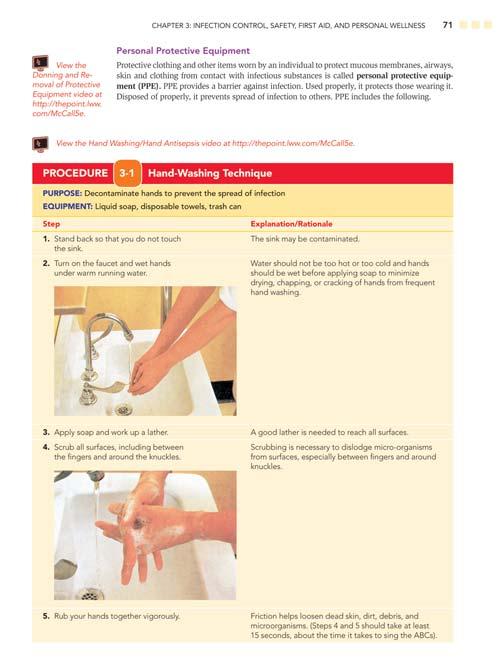
PROCEDURE 3-1 Hand-Washing Technique 71
PROCEDURE 3-2 Cleanup Procedures for Blood and Other Body Fluid Spills 88
PROCEDURE 8-1 Tourniquet Application 241
PROCEDURE 8-2 Routine ETS Venipuncture 254
PROCEDURE 8-3 Venipuncture of a Hand Vein Using a Butterfly and ETS Holder 262
PROCEDURE 8-4 Needle-and-Syringe Venipuncture 265
PROCEDURE 8-5 Using a Syringe Transfer Device 268
PROCEDURE 9-1 Performing Venipuncture Below an IV 297
PROCEDURE 9-2 Steps to Follow if a Patient Starts to Faint During Venipuncture 302
PROCEDURE 10-1 Fingerstick Procedure 333
PROCEDURE 10-2 Heelstick Procedure 336
PROCEDURE 10-3 Collection of a Capillary Blood Gas (CBG) Specimen by Heel Puncture 340
PROCEDURE 10-4 Newborn Screening Blood Spot Collection 346
PROCEDURE 10-5 Preparing a Blood Smear from a Capillary Puncture 348
PROCEDURE 11-1 Blood Culture Specimen Collection 365
PROCEDURE 11-2 GTT Procedure 374
PROCEDURE 11-3 Bleeding-Time Test 387
PROCEDURE 11-4 Pregnancy Testing 400
PROCEDURE 11-5 TB Test Administration 404
PROCEDURE 13-1 24-Hour Urine Collection Procedure 441
PROCEDURE 13-2 Clean-Catch Urine Collection Procedure for Women 442
PROCEDURE 13-3 Clean-Catch Urine Collection Procedure for Men 443
PROCEDURE 13-4 Throat Culture Specimen Collection 450
PROCEDURE 14-1 Modified Allen Test 465
PROCEDURE 14-2 Preparing and Administering Local Anesthetic 466
PROCEDURE 14-3 Radial ABG Procedure 470