Philosophy in Ovid, Ovid as Philosopher
Edited by KATHARINA VOLK AND GARETH D. WILLIAMS
3
Oxford University Press is a department of the University of Oxford. It furthers the University’s objective of excellence in research, scholarship, and education by publishing worldwide. Oxford is a registered trade mark of Oxford University Press in the UK and certain other countries.
Published in the United States of America by Oxford University Press 198 Madison Avenue, New York, NY 10016, United States of America.
© Oxford University Press 2022
All rights reserved. No part of this publication may be reproduced, stored in a retrieval system, or transmitted, in any form or by any means, without the prior permission in writing of Oxford University Press, or as expressly permitted by law, by license, or under terms agreed with the appropriate reproduction rights organization. Inquiries concerning reproduction outside the scope of the above should be sent to the Rights Department, Oxford University Press, at the address above.
You must not circulate this work in any other form and you must impose this same condition on any acquirer.
Library of Congress Cataloging-in-Publication Data
Names: Volk, Katharina, 1969- editor. | Williams, Gareth D., editor. Title: Philosophy in Ovid, Ovid as philosopher / [editiors] Katharina Volk and Gareth D. Williams.
Description: New York, NY : Oxford University Press, [2022] | Includes bibliographical references and index.
Identifiers: LCCN 2021033980 (print) | LCCN 2021033981 (ebook) | ISBN 9780197610336 | ISBN 9780197610350 (epub)
Subjects: LCSH: Ovid, 43 B.C.-17 A.D. or 18 A.D.—Criticism and interpretation. | Philosophy in literature. | LCGFT: Literary criticism. | Essays.
Classification: LCC PA6537 .P45 2022 (print) | LCC PA6537 (ebook) | DDC 871/.01—dc23
LC record available at https://lccn.loc.gov/2021033980
LC ebook record available at https://lccn.loc.gov/2021033981
DOI: 10.1093/oso/9780197610336.001.0001 1 3 5 7 9 8 6 4 2
Printed by Integrated Books International, United States of America
Preface vii
Contributors ix
Introduction 1
Katharina Volk and Gareth D. Williams
PART I: OVID’S SAPIENTIA
1. Ouidius sapiens: The Wise Man in Ovid’s Work 23
Francesca Romana Berno
PART II: THE EROTIC CORPUS
2. Elegy, Tragedy, and the Choice of Ovid (Amores 3.1) 49 Laurel Fulkerson
3. Ovid’s Ars amatoria and the Epicurean Hedonic Calculus 63 Roy Gibson
4. Criticizing Love’s Critic: Epicurean parrhesia as an Instructional Mode in Ovidian Love Elegy 84
Erin M. Hanses
5. Ovid’s imago mundi muliebris and the Makeup of the World in Ars amatoria 3.101–290 104 Del A. Maticic
6. Ovid’s Art of Life 124
Katharina Volk
PART III: METAMORPHOSES
7. Keep Up the Good Work: (Don’t) Do It like Ovid (Sen. QNat. 3.27–30) 145
Myrto Garani
8. Venus discors: The Empedocleo-Lucretian Background of Venus and Calliope’s Song in Metamorphoses 5 164
Charles Ham
9. Labor and pestis in Ovid’s Metamorphoses 184
Alison Keith
10. Cosmic Artistry in Ovid and Plato 207
Peter Kelly
11. Some Say the World Will End in Fire: Philosophizing the Memnonides in Ovid’s Metamorphoses 226
Darcy A. Krasne
PART IV: THE EXILIC CORPUS
12. Ovid against the Elements: Natural Philosophy, Paradoxography, and Ethnography in the Exile Poetry 251
K. Sara Myers
13. Akrasia and Agency in Ovid’s Tristia 267
Donncha O’Rourke
14. Intimations of Mortality: Ovid and the End(s) of the World 287 Alessandro Schiesaro
15. The End(s) of Reason in Tomis: Philosophical Traces, Erasures, and Error in Ovid’s Exilic Poetry 308
Gareth D. Williams
PART V: AFTER OVID
16. Philosophizing and Theologizing Reincarnations of Ovid: Lucan to Alexander Pope
Philip Hardie
Preface
This volume grew out of the editors’ longstanding interest in two apparently unrelated topics: Ovidian poetry and Roman philosophy. While many classical Latin poets were increasingly studied for their philosophical allusions and affiliations, Ovid was until relatively recently still often considered an irreverent virtuoso averse to serious thought. But could an Augustan poeta doctus really be so out of touch with one of the most significant intellectual developments of his time? Was there no philosophy in Ovid—and no way of seeing Ovid as a philosopher?
With these questions in mind, we contacted an international group of scholars—both seasoned Ovidians and younger colleagues—and asked whether they might be interested in participating in a conference on Ovidius Philosophus. The response was overwhelmingly enthusiastic; one person even told us that he had been waiting his “whole life for this conference to come along”! The event took place at Columbia University on March 29–30, 2019, and the chapters in this volume are (sometimes significantly) revised versions of the papers delivered then. We are most grateful to the authors for making the conference a success and contributing their work to the volume.
In organizing the conference and seeing the publication to completion, we have relied on the support of many individuals and institutions, which it is a pleasure to acknowledge in these pages. The Stanwood Cockey Lodge Foundation generously subsidized both the original event and the volume’s preparation for publication. Additional funding for the conference came from the Columbia Department of Classics, the Columbia University Seminars, Columbia’s Center for the Ancient Mediterranean, and Columbia’s Society of Fellows and Heyman Center for the Humanities. We are most grateful for their support and also wish to convey our heartfelt thanks to Lien van Geel for her skill and good cheer in taking care of the conference logistics.
We are delighted that our exploration into Ovidian philosophy has found a home with Oxford University Press and thank Stefan Vranka for his belief in the project and for his help and support throughout. We are grateful to Ponneelan Moorthy for steering the book through production and to
Donald Watt for his impeccable copy-editing, as well as to the Press’s anonymous readers, whose detailed comments and suggestions have, we believe, enabled us to improve the volume significantly. For his invaluable help in preparing the manuscript for submission, we wish to thank our editorial assistant John Izzo, whose eagle eye has saved us from many an error.
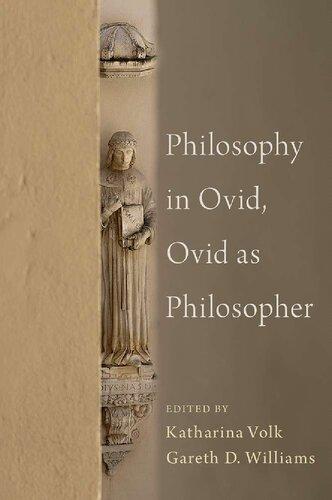
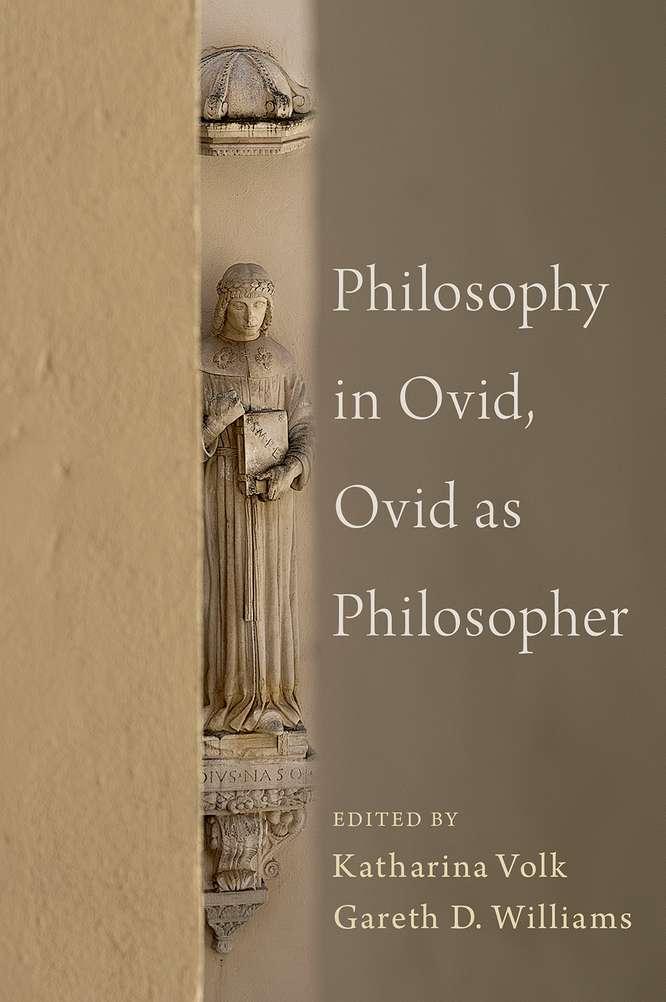
The volume’s cover image is by the Spanish photographer Joaquín B érchez from the book Photographica Ovidiana (edited by him and his son Esteban B érchez Castaño), a serendipitous discovery made by one of the editors during a stay in Madrid. We are most grateful to Joaquín for permitting us to use his beautiful photograph, which we believe provides a most fitting entry to our volume.
New York, June 2021
Contributors
Francesca Romana Berno is Associate Professor of Latin language and literature at Sapienza University of Rome. She has published mostly on Seneca the Younger’s prose works, but also on Cicero and Ovid, always paying attention to philosophical issues, and in particular to rhetorical strategies aimed at moral exhortation.
Laurel Fulkerson is Associate Vice President for Research and Professor of Classics at the Florida State University. Her research focuses on Latin poetry and the emotions. She has just published a book with T. E. Franklinos, Constructing Authors and Readers in the Appendices Vergiliana, Tibulliana, and Ouidiana (Oxford University Press 2020).
Myrto Garani is Assistant Professor in Latin Literature at the National and Kapodistrian University of Athens, Greece. She has published widely on Empedocles’ reception in Latin literature, especially in Lucretius and Ovid. She is currently working on a monograph on Seneca’s Natural Questions Book 3 to be published in the Pierides series (Cambridge Scholars Publishing) and a commentary on Lucretius’ De rerum natura 6 (for the Fondazione Lorenzo Valla).
Roy Gibson is Professor of Classics at Durham University and has published widely on Ovid and Roman love elegy. His most recent book, Man of High Empire: The Life of Pliny the Younger, was published by Oxford University Press in 2020.
Charles Ham is Assistant Professor of Classics at Grand Valley State University, and his research focuses on philosophical discourse in Augustan poetry. Current projects include a book on Ovid’s reception of Empedocles in his elegiac poetry and an article on Pythagoreanism in Fasti 6.
Erin M. Hanses is Lecturer in Classics and Ancient Mediterranean Studies at Penn State University. Her primary research interests lie in the intersection of Latin love elegy and Roman Epicureanism, and she has several articles forthcoming on literary manifestations of Epicurean thought in the Roman world.
Philip Hardie is Fellow of Trinity College, Cambridge, and Emeritus Honorary Professor of Latin Literature in the University of Cambridge. His Sather Lectures were published in 2019 as Classicism and Christianity in Late Antique Latin Poetry
Alison Keith is Professor of Classics and Director of the Jackman Humanities Institute at the University of Toronto. She has published widely on gender and genre in Latin literature and Roman society, and is the author most recently of a volume on Virgil in the Understanding Classics series published by Bloomsbury Academic.
Peter Kelly is Lecturer in the Classics department of the National University of Ireland, Galway. He has published a number of major articles on Ovid and Greek Philosophy. He is currently finalizing his monograph, The Cosmic Text from Ovid to Plato, which is under review with Cambridge University Press.
Darcy A. Krasne is Lecturer in Classics at Columbia University. She has published articles and book chapters on Valerius Flaccus, on Ovid’s Ibis, Metamorphoses, and Fasti, and on Vergil’s Aeneid; she is also the co-editor of After 69 ce: Writing Civil War in Flavian Rome (De Gruyter, 2018). Her current project, a monograph entitled Cosmos and Civil War in Valerius Flaccus’ Argonautica, is under contract with Oxford University Press.
Del A. Maticic is a doctoral candidate in Classics at New York University, completing a dissertation on raw materiality in Augustan literature.
Donncha O’Rourke is Senior Lecturer in Classics at the University of Edinburgh. He has published widely on Latin elegiac and didactic poetry, including as editor of Approaches to Lucretius: Traditions and Innovations in Reading the De Rerum Natura (Cambridge University Press, 2020) and as co-editor of Didactic Poetry of Greece, Rome and Beyond: Knowledge, Power, Tradition (Classical Press of Wales, 2019). His forthcoming monograph Propertius and the Virgilian Sensibility will be published by Cambridge University Press.
K. Sara Myers is Professor of Classics at the University of Virginia. She is the author of Ovid’s Causes: Cosmogony and Aetiology in the Metamorphoses (Michigan University Press, 1994), a commentary on Ovid’s Metamorphoses 14 (Cambridge University Press, 2009), and numerous articles on Roman poetry. Her current research project is on ancient Roman literary gardens.
Alessandro Schiesaro is Professor of Classics at the University of Manchester. He has held chairs at Princeton, King’s College London, and Sapienza University of Rome. His main fields of interest include Latin literature, literary theory, and psychoanalysis, and he has published work on several Roman authors, including Lucretius, Virgil, Horace, Ovid, and Seneca.
Katharina Volk is Professor of Classics at Columbia University and has published widely on both Ovid and Roman philosophy, among other topics. Her most recent monograph, The Roman Republic of Letters: Scholarship, Philosophy, and Politics in the Age of Cicero and Caesar, is about to be published by Princeton University Press.
Gareth D. Williams is Professor of Classics at Columbia University and has published books on Ovid and Seneca and, most recently, Pietro Bembo on Etna: The Ascent of a Venetian Humanist (Oxford University Press, 2017).
Introduction
Katharina Volk and Gareth D. Williams
The Project
The sixteen essays collected in this volume began life as papers delivered at a conference held at Columbia University in March 2019. This event, organized by the present editors under the title of Ovidius Philosophus: Philosophy in Ovid and Ovid as a Philosopher, brought together a distinguished group of scholars from both sides of the Atlantic in an attempt to explore from different but mutually informing viewpoints Ovid’s profound engagement with philosophical sources and influences across his poetic corpus.
Ovid’s close familiarity with philosophical ideas and with specific philosophical texts has long been recognized, perhaps most prominently in the Pythagorean, Platonic, Empedoclean, and Lucretian shades that have been seen to color his Metamorphoses. This philosophical component has often been perceived as a feature implicated in, and subordinate to, Ovid’s larger literary agenda, both pre- and post-exilic; and because of the controlling influence conceded to that literary impulse, readings of the philosophical dimension have often focused on the perceived distortion, ironizing, or parodying of the philosophical sources and ideas on which Ovid draws, as if his literary orientation inevitably compromises or qualifies a “serious” philosophical commitment.
The Columbia conference sought to counter this tendency by (i) considering Ovid’s seriousness of engagement with, and his possible critique of, the philosophical writings that allusively inform his works; (ii) questioning the feasibility of separating out the categories of the “philosophical” and the “literary” in the first place; (iii) exploring the ways in which Ovid may offer unusual, controversial, or provocative reactions to received philosophical ideas; and (iv) investigating the case to be made for viewing the Ovidian corpus not just as a body of writings that are often philosophically inflected, but also as texts that may themselves be read as philosophically adventurous and
Katharina Volk and Gareth D. Williams, Introduction In: Philosophy in Ovid, Ovid as Philosopher. Edited by: Katharina Volk and Gareth D. Williams, Oxford University Press. © Oxford University Press 2022. DOI: 10.1093/oso/9780197610336.003.0001
experimental. Few scholars would now hesitate to call Ovid philosophically informed; but what further light might be shed on his poetics if he should be perceived as philosophically confident, adept, and resourceful? To what extent can or should Ovidius philosophus be seen as an abiding or evolving presence in our reading of his oeuvre? In what ways did the post-Ovidian literary tradition at Rome recognize philosophical import in, and/or perhaps the philosophical idiosyncrasy of, his writings?
Certain of these questions have been well treated in important contributions on specific Ovidian texts in recent times,1 but we hope in this volume to broach the topic of Ovid’s philosophical engagement frontally, so to speak: to prioritize the philosophical component, that is, and to show how Ovid uses his literary apparatus to deploy, test, and experiment with ideas received from a range of schools and thought systems. Even though this area of Ovidian studies continues to show encouraging signs of growth,2 much work remains to be done: it is telling that in both the Brill and the Cambridge Companions to Ovid, each of which was published in 2002,3 there is no index entry on philosophy, let alone any dedicated chapter on Ovid’s treatment of philosophical ideas; and the same holds true of the Blackwell Companion of 2009.4 Against this background, the essays collected in this volume are intended at the individual level to address in new ways many particular aspects of Ovid’s recourse to philosophy across his corpus. Collectively, however, they are also designed at least partially to redress what, in general terms, remains a significant lacuna in Ovidian studies.
Problems of Definition
But what precisely do we mean by the term Ovidius philosophus? Did Ovid’s philosophical affinities and preferences as glimpsed or revealed in his writings shift or evolve over time, and can any pattern of philosophical consistency or development be discerned across his oeuvre? To what extent might any such
1 To focus for now only on Anglophone contributions, see on Ovid’s erotic corpus Kleve 1983; Dillon 1994; and esp. R. K. Gibson 2007 (building in important ways on Labate 1984). On an exilic front, see already DeLacy 1947, but esp. Claassen 1999 and 2008 with Kelly 2018. On the Fast. and Met. (esp. the cosmogony in Met. 1 and Pythagoras’ speech in Met. 15), McKim 1984–5; P. Hardie 1991 and 1995; Myers 1994; Nelis 2009; van Schoor 2011.
2 See esp. Beasley 2012; Ham 2013; Kelly 2016, 2019, and 2020.
3 Boyd, ed. 2002; P. Hardie, ed. 2002.
4 Knox, ed. 2009.
pattern be influenced by generic or thematic considerations—ethical philosophy predominating in his erotic elegiac corpus, say, before Ovid expands in a more natural-philosophical direction in the Fasti and Metamorphoses, only to reassert the ethical emphasis with a different valence in the therapeutic eclecticism of his exilic phase? If the outlines of an overall (if adaptable and loosely coordinated) philosophical program are posited across Ovid’s oeuvre, does he strive for any effect or vision of “progress” that connects his disparate works and career stages?
Then there are different grades of philosophical reference to consider, at the levels both of literary evocation and technical specialty: if direct reference to a given source (such as Empedocles, say, or Epicurus, as discussed in a number of the chapters that follow) constitutes “hard” allusion, to what extent and effect does Ovid use “soft” evocation of a less source-specific kind? In what ways might the difference between “hard” and “soft” here resemble the difference that has been long (and hotly) debated on a literary-critical front between allusion on the one hand and intertextuality on the other?5 That is, to what extent could the presence of well-known philosophical ideas in Ovid be viewed as part of a repository of intertextual contact points that inflect his discourse without necessarily carrying a specially charged or targeted meaning from a specific source of allusion?
As for the matter of technical specialty, can Ovid be seen to purvey a “philosophy” even when there are few, if any signs of his recourse to any particular philosophical school or technical language? In the Ars amatoria and Remedia amoris, for example, Ovid arguably projects an idiosyncratic outlook on love that promotes its own vision of anthropology, psychology, and ethics: can this be counted as one example of Ovidian “philosophy” on a spectrum that embraces at another extreme his harder-core, directly allusive experimentation with (say) Empedoclean ideas in the Metamorphoses? In the Metamorphoses alone, Deucalion and Pyrrha in Book 1 and Philemon and Baucis in Book 8 are rewarded by the gods for the simple piety of their ways: can this promotion of humility count as an ethical “philosophy” of sorts, and one that in turn causes us (philosophically?) to question the behavior of the Ovidian gods when they resort to more extreme forms of persecution and libidinous excess toward mortals elsewhere in the poem? More broadly, to what extent might Ovid’s portrayal of ethical or ethically questionable behavior in many episodes of the Metamorphoses as well as other
5 For overview, see Hinds 1998, esp. 17–51.
parts of his corpus (e.g., the erotic ethic inculcated in the male lover in Ars 1 and 2, say, or the suspect loyalty of various friends in his exilic corpus) be viewed as philosophically meaningful even if such ideas cannot be straightforwardly aligned with any one doctrine or school? In contrast to the fate-driven teleology of the Aeneid, moreover, fate in the Metamorphoses resembles a “historical prop”6 that struggles to assert itself amidst the narratological, chronological, and scene-shifting twists and turns of Ovid’s metamorphic cascade of stories: does this conspicuous rejection of Virgilian teleology constitute a form of counter-“philosophy” by which Ovid resists the implication that the Augustan “Golden Age” is the culmination of Roman historical development?
For present purposes, the flexible potentialities of “philosophy” that are opened up by such questions help to delimit the definitional parameters for the Ovidius philosophus featured in this book. In terming him philosophus, we broadly mean Ovid’s appeal to, and manipulation of, well-known philosophical ideas (Pythagorean, Platonic, Epicurean, Stoic, etc.) that were already in wide currency in Roman literature; what sets him apart is not the ideas themselves, but his idiosyncratic application of them. In general terms, we stress that the Roman adaptation of Greek philosophy from Lucretius and Cicero onward down to the younger Seneca and beyond is deeply complex in its shifting modes of reception, trends of interpretation, and styles of articulation.7 Furthermore, given that Ovid’s uses of philosophy are manifold, as well as subject to change from one context to another, we have no wish to assert a monochromatic (and, in our opinion, unprovable) view of his philosophical allegiances and development over time. In contrast to a schematic approach of this kind, we prefer to stress an organic approach that assesses each text on its own terms and according to Ovid’s philosophical needs or aspirations in the moment.
But how then does Ovidius philosophus differ from other late Republican and Augustan poets who were no less philosophically engaged? Lucretius must in many ways constitute a special case as a philosophical pioneer in Latin, a fundamentalist who renders Epicureanism through poetic techniques of a deep Empedoclean stamp;8 by comparison, Ovid’s recourse to philosophy is less obsessive in doctrinal focus, more eclectic in its range of influences, and more varied at least in the diversity of the applications
6 Tissol 2002: 309.
7 See on these tendencies Volk forthcoming.
8 See esp. Sedley 1998.
to which he puts those many influences in different contexts.9 More pertinent for now are Horace and Virgil, partly because of the scale and variety of their respective oeuvres, and partly also because of the many different shades that characterize—as in Ovid’s case—their philosophical palettes. For a holistic overview of these palettes, we turn to the elegant summations of two scholars: John Moles on Horace, and Susanna Braund on Virgil.
In his 2007 essay entitled “Philosophy and Ethics,” Moles tellingly uses inverted commas to capture in Horace’s case the slipperiness that we have just imputed to Ovidian philosophy: “ ‘Philosophy,’ both in its broadest sense and in the narrow sense of specific philosophies, informs Horace’s own poetry” (165). In surveying this informing process across Horace’s oeuvre, Moles nicely captures in his own mixture of firm statement and equivocation (as if always taking aim at a moving target) the difficulty of “fixing” the Horatian philosophical position. Yes, the Satires show Bionian, Cynic, and diatribic traces, but Epicurean shades can also be discerned in a shimmering texture where recognition is sure in one sense but ever qualified in another (168):
Philosophical programmes, then, can be presented piecemeal and unsequentially, implemented, Romanised, incompletely descriptive, ironised, redefined, subverted, etc.: but they must be recognized.
“In the Epodes, as elsewhere, ‘soft’ philosophical colouring denotes Epicureanism, ‘hard’ Stoicism, Cynicism, or both” (170): that “elsewhere,” of course, includes the Odes, where Stoicism is “the dominant philosophical presence in few odes,” Epicureanism dominant in “more than twice as many odes,” the two juxtaposed in “[a]nother important group . . . , in varying relationships of tension” (172). About a third of the Odes are thus ruled “varyingly philosophical,” and though the pull to Epicureanism is strong, Horace nevertheless avoids “the exclusive commitment alien to his temperament (or its representations), to his role as Augustan vates, and to the collection’s literary, political, social and philosophical fecundity” (173). Once totally absorbed in philosophy in Epistles 1 (cf. 1.1.11), Horace lies low in Epicurean fashion (cf. latet, 5), but in thrall to no single philosophical master (13–15), oscillating as he does between the Stoics (16–17) and Aristippus
9 See Schiesaro 2014 (focusing on the story of Phaethon in Met. 1 and 2) for a powerful case study—with important ramifications for other parts of the Met.—of Ovid’s engagement in “a strategy of active confrontation and pointed contrast” (74) with Lucretius.
(18–19). Moles discerns two main strands in Epistles 1: first, “Socratic noncommitment and Academic, Panaetian and Aristippean relativism legitimatise not just flexibility within philosophies but choice between philosophies” (177); second, Epicureanism comes to the fore, and there it remains into Horace’s last decade, “the main thread, not just of his poetry, or even of his philosophy, but of his life” (179).
Many aspects of Moles’s coverage of Horace usefully contextualize Ovid’s own philosophical maneuverings: to reapply Moles’s words, “Philosophy,” both in its broadest sense and in the narrow sense of specific philosophies, informs Ovid’s own poetry, and the Horatian medley of influences is matched by a similar Ovidian versatility of philosophical appeal, even if the two may invoke different strands of doctrinal influence to different extents and effects. In these respects there is nothing remarkable about Ovid’s turning to philosophy per se; what matters is the idiosyncratic imprint that he imposes on that larger tendency—an imprint that Moles’s Horace expresses through “the main thread” of his Epicureanism. But Virgil now provides another important but different philosophical perspective before we focus more closely on the distinctive Ovidian imprint.
In her 2019 essay entitled “Virgil and the Cosmos: Religious and Philosophical Ideas,” Braund shows how the poet has been “claimed” for various philosophical schools, the Stoic and Epicurean chief among them; but—like Moles on Horace—she eschews this reductive approach for a more flexible view of the poet’s philosophical range and ambitions. She focuses not on “the narrow questions of Virgil’s sources and consistency” (282–3), but on his elaboration of three main ideas—issues of physics and cosmology; ethical issues; eschatology—in contexts where the philosophical component is conditioned by localized concerns. Take the cosmological aspect (289–90):
It is clear that in matters of cosmology, Virgil absorbs ideas from a variety of sources and is much less concerned to produce a coherent synthesis than to integrate his material into its immediate context, which is often highly politicized.
Virgil was not “a doctrinaire member of any particular school of thought” but “uses different ideas for different purposes in different contexts” (296)— words that could equally be applied to Ovid. What distinguishes the philosophical approach of Braund’s Virgil, however, is its coordination with mainstay techniques of Roman cultural formation, especially exemplarity
and appeal to the weight of tradition (mos maiorum). Hence in summation (297, our emphasis):
Virgil’s poems are illuminated when viewed not in terms of systems of philosophical thought but as reflecting and participating in the exemplarity central to the formation of the Roman man (vir) and Roman manhood (virtus). This in turn corresponds to the function of Roman education, which was not to develop freethinkers but to focus the individual’s thoughts upon his role as an individual in the state. Virgil’s prime allegiance is to Italy and to Rome
As in Horace’s case (and that of Ovid), Virgil’s recourse to philosophy is unsurprising, but the conceptual trajectory it enables or supports is allimportant. If the distinctive philosophical signature of Moles’s Horace lay in “the main thread” of his Epicureanism, Braund’s Virgil applies his philosophical apparatus in the wider service of Roman self-definition—in an intellectual context, that is, where the strands of Hellenistic thought “were adapted to serve specifically Roman needs, both for the individual and for the collective Roman state with its ideal of Romanitas” (282).
What, then, of any signature tendencies in Ovidius philosophus? If the fact of his appeal to diverse philosophical ideas is unremarkable in itself, what in general terms might distinguish his approach to those ideas? We offer three proposals here, the first of them predicated on the view taken of Virgil earlier. Born in 43 bce, Ovid belonged to a generation that came of age after the battle of Actium in 31 and the dawn of the Augustan era. True, the arrival of the pax Augusta could hardly dispel overnight the factional hatred that had riven Rome for decades; but Ovid was too young to know at first hand the bloody horrors of previous generations, and in this respect the pax Augusta encouraged, even if it did not cause, the indifference to the cursus honorum that he himself articulates.10 The consolidation of Augustus’ power and myth also created a discursive landscape in which Augustanism was an inescapable fact of life at Rome, an all-penetrating phenomenon that manifested itself in the emperor’s rebuilding program, his moral reforms, his intervention in Rome’s religious and ritual calendar, and in so many other facets of Roman life. From this perspective, the Augustan presence in Ovid’s writings inevitably poses a problem of signification: the phenomenon of Augustus is no
10 Cf. Am. 1.15.1–6, Tr. 4.10.33–40; McKeown 1987: 31.
fixed commodity but a fluid object of representation and controversy, and one that defies a reductive view of Ovid’s attitude to the princeps; at issue is not whether Ovid can be seen to be solidly or consistently pro- or antiAugustan, but the extent to which he captures Augustus’ elusiveness as a floating signifier, or as an idea that is always in development.11
Against this background, the ironic flippancy that has long been detected in Ovid’s earliest work, his Amores, represents a youthful spirit of nonconformity—a voice that is not anti-Augustan per se, but sets itself in tension, however playfully, with the new values and conventions of Augustan discourse. This tendency may undergo adjustment as Ovid expands the scale of his literary ambition in the Heroides, Ars amatoria, and Remedia amoris and then, in the early years ce, in the Fasti and Metamorphoses down to his exile in 8 ce. But if in these works Ovid serially tests the underpinnings of Augustan meaning and authority, his independence of outlook suggests the freethinker’s detached viewpoint, not the more disciplined form of Roman mindset (focusing “the individual’s thoughts upon his role as an individual in the state”) that Braund associates with Virgil.12 So in the matter of Ovid’s experimentation on a philosophical front: in an age when the fissures between the Augustan legend and reality were becoming increasingly open to interrogation, when fanciful hypothetical scenarios were all the rage in the declamatory schools, and when the compass of Roman self-identity was being sorely tested in the transition from Republic to Empire, in many contexts Ovid can be seen to probe and play with philosophical ideas rather than ideologically building with and on them in the Virgilian sense; to posit ideologies of the self rather than of the state (witness the erotic “philosophy” of the Ars), and even, in his erotodidaxis, to explore certain “techniques of the self” that touch on and redirect the ethical-therapeutic strain in philosophy from the Hellenistic age onward;13 and, in his restless appetite for experimentation, to be more interested in the intellectual process of inquiry than in its end result. In effect, the advancing Augustan times set for Ovidius philosophus an agenda very different from that of Virgil in particular: Ovid is no less seriously engaged
11 On these points, Feeney 1992, esp. 2–6, 9; Barchiesi 1997b, esp. 7–11, 43–4, 254–6; Myers 1999: 196–8. For the aggression of Ovid’s competitive tendency, cf. Oliensis 2004: 316 (in connection with the Ibis) for his wish “not just to destroy Augustus but to take over his place and his power.” In this and other ways Ovid advances a broader movement within Augustan poetry—a vision now well articulated by Pandey 2018b in exploring “the poets’ public responses to imperial iconography as a tool for dissecting, debating, even disrupting imperial power” (5).
12 S. Braund 2019: 297
13 On these techniques, Rabbow 1954; Foucault 1986: 37–68; Hadot 1995; Sellars 2009.
with philosophical ideas than Virgil, but the sociopolitical context gives a different ideological meaning to and motivation for his probings. True, after his banishment to Tomis in 8 ce, a more somber philosophical demeanor prevails, with notable shades of a Horatian turning-within; but there, too, the exploratory impulse still remains visible, as several chapters in this volume seek to show.
Second, and to modify the sociopolitical thrust of this first point: experience of Ovid’s habit of reapplying received literary tropes with a startling panache and an eye for extreme effect (hyperbole, bathos, parody, etc.) should put us on our guard on a philosophical front. In the Metamorphoses, for example, epic burlesque competes against itself when, after battle has already been spectacularly waged at the wedding banquet of Perseus and Andromeda in Book 5, a still greater battle rages between the Lapiths and Centaurs at the wedding feast of Pirithous and Hippodamia in Book 12: there, ever more bizarre weaponry of an impromptu kind—goblets, a table leg, even a far-flung altar—vastly diversify what now looks like the much more banal, relatively conventional weaponry (a mere brand from an altar, say, or the odd mixing bowl) deployed in the Perseus-Andromeda scene.14 Here is only one, albeit extreme instance of how Ovid characteristically challenges the received tradition: might we not anticipate a similar appetite for inflationary elaboration or arch provocation in his deployment of philosophical ideas? Take, for example, Pythagoras’ discourse on the universality of change in Metamorphoses 15: one of the many conundrums posed by this speech arises from Pythagoras’ stress on the wonder-inducing effects of inquiry into nature’s secrets. Lucretius’ Epicurus is a major source of inspiration for Ovid’s cosmic adventurer; but Pythagoras’ eye for wonder is directly at odds with the Lucretian rhetoric of reason that seeks systematically to demystify natural marvels.15 A paradoxical mismatch results between the Lucretian literary aspiration of his discourse and its philosophical thrust—just one of the eccentricities that contribute to the episode’s capstone value in Book 15 as a bravura philosophical parody, not paradigm. Again, the Lucretian component in Pythagoras’ Empedoclean epos16 underscores the depth and scale of pre-Ovidian experimentation in philosophical poetics. But Ovid’s flamboyance in treating inherited literary topoi might yet lead us to anticipate a
14 On the parodic element in Book 12, Mader 2013 with Musgrove 1998.
15 For this approach, Beagon 2009 with Myers 1994: 133–66.
16 P. Hardie 1995.
similar idiosyncrasy in his philosophical excursions and appropriations: his treatment of Pythagoras in Metamorphoses 15 offers but one example of how the literary and philosophical impulses are inextricably conjoined in him, and how the same capacities of bold initiative are to be expected and looked for on both fronts simultaneously.
Third, a major aim of the chapters in this volume is to show that philosophical appropriation is not just an ornamental feature of Ovid’s poetics, but in many ways instrumental to them: the philosophical component drives contextual meaning rather than offering mere window dressing. The same is evidently true of Lucretius, say, or Virgil; but the point bears stressing in Ovid’s case partly to counter any lingering suspicion of philosophical superficiality or dilettantism in him, and partly to highlight what is perhaps the most distinctive characteristic of Ovidius philosophus: the singularity of effect that he achieves in any given context where philosophical ideas are invoked, adapted, or exploited to carefully calculated ends. Hence the chapters that follow are surveyed from two perspectives in the rest of this Introduction. First, the individuated focus: our overview of each contribution is meant to stress not just the restless diversity of Ovid’s philosophical probings across his corpus, but also how a fresh or renewed sensitivity to philosophical considerations can enrich, deepen, and even transform our understanding of particular works or contexts. Second, the collective focus: in tracing certain patterns of thematic commonality and continuity among the chapters, we aim to capture something of the tension between part and whole that we find to be central to the functioning of Ovidius philosophus across his oeuvre. The localized context may crucially condition the point of his philosophical maneuvering in the moment, but allowance has equally to be made for the possible accumulations and networks of philosophical meaning that transcend the localized viewpoint. In effect, our goal is to examine Ovidius philosophus both in toto and per partes, and to explore the possible interdependence of those categories.
The Chapters in Overview
A single chapter occupies the first of the five sections into which this volume is divided. In Part I (“Ovid’s sapientia”), Francesca Romana Berno’s “Ouidius sapiens: The Wise Man in Ovid’s Work” anchors the collection with a wideranging exploration of the term sapiens and its cognates throughout Ovid’s
oeuvre: in exploring the evolution of his use of such terms, Berno argues that a progressive thread of meaning in the concept of sapientia can be traced from his erotic and erotodidactic writings into the “middle” phase of the Fasti and Metamorphoses and finally into his exilic corpus.
The global span of Berno’s chapter sets the stage for the schematic division of the Ovidian corpus in Parts II–IV. The five chapters in Part II (“The Erotic Corpus”) focus on Ovid’s erotic corpus from a variety of perspectives. In Chapter 2, “Elegy, Tragedy, and the Choice of Ovid (Amores 3.1),” Laurel Fulkerson takes her starting point from the epiphany first of personified Tragedy and then of Elegy in Amores 3.1, where both vie for the poet’s attention: which poetic path will he take? Elegy wins the day; but in relating Ovid’s dilemma to Prodicus’ famous “Choice of Hercules” between vice and virtue, Fulkerson argues that Ovid’s undoing of the traditional generic opposition between elegy and epic through the insertion of tragedy in Amores 3.1 allows him to explore a more sophisticated and complex view of “choice” than the Prodican model allows for: philosophy and virtue, she argues, rarely center on a single life decision, and by adding tragedy to the generic mix in Amores 3.1, Ovid folds the Prodican dimension into a wider reflection on the nature of philosophical, poetic, and life choice.
The focus turns to Epicureanism in Chapters 3 and 4. In Chapter 3, “Ovid’s Ars amatoria and the Epicurean Hedonic Calculus,” Roy Gibson explores Ovid’s engagement in his amatory corpus with the Epicurean calculus of pleasure. That calculus is spread unevenly over the three books of the Ars. It appears largely absent from Book 3, except in those instances where Ovid recommends gradually decreasing pain and increasing pleasure for men. Conversely, the concept of Panaetian-Ciceronian decorum is strongly in evidence in Book 3, but less prevalent in the books addressed to men. In exploring this relative imbalance of philosophical emphases for the sexes, Gibson argues that Ovid turns the spotlight on the Epicurean calculus at certain significant junctures of the Remedia as well as the Ars to negative effect: in the midst of his erotodidaxis he expresses serious doubts about fundamental aspects of the Epicurean project.
In Chapter 4, “Criticizing Love’s Critic: Epicurean parrhesia as an Instructional Mode in Ovidian Love Elegy,” Erin M. Hanses argues that throughout his erotic corpus Ovid engages with a key element of Lucretian didactic, Epicurean parrhesia. The relationships nurtured or displayed between student and teacher in Lucretius’ De rerum natura are manipulated by Ovid as he shifts his own persona from that of student
of love in the Amores, to teacher of love in the Ars, and finally to doctor of love in the Remedia. Each of these shifts mimics a different aspect of Epicurean parrhesia: talking across (student to student), a mode evinced in the Amores; talking down (teacher to student), as in the Ars; and talking up (student to teacher), a mode actualized when the Remedia is read as a response to Lucretius. In progressing through the ranks of these didactic relationships, Hanses’s Ovid directly challenges Lucretius qua philosophical authority on love.
The Ars features centrally in the two remaining chapters in Part II. In Chapter 5, “Ovid’s imago mundi muliebris and the Makeup of the World in Ars amatoria 3.101–290,” Del A. Maticic argues that Ovid, in the instructions he delivers on female cultus in that section of Ars 3, subverts the technique of ekphrastic world depiction in the well-known imago mundi shield tradition. For Maticic, Ovid redirects that tradition by constructing not an imago mundi but a mundus muliebris (“woman’s world”)—a description not of a work of art but of an aesthetic system encompassing the body of the female practitioner of cultus. The protective connotations of the heroic shield are also carried over to this mundus muliebris: Ovid delineates a cultus shield that is forged in the worldly experience of his female reader, and the alternative “cosmology” so portrayed is that of her relations with the sociocultural systems surrounding her. On this approach, Ovidian cultus engenders not so much a quality of worldliness as an aesthetic of what Maticic terms “worldedness,” where the materials of the female body are enmeshed as phenomena with the apparent beings surrounding her.
Then, after our tour of the localized world of 3.101–290, Katharina Volk takes a broader view of the Ars, and also of the Remedia, in Chapter 6, “Ovid’s Art of Life.” Volk contends that Ovid’s erotodidactic poems, the Ars and Remedia, constitute philosophical texts, in the senses (i) that both are very much like philosophy, in that they are influenced by philosophical doctrines and discourses popular in Ovid’s time; and (ii) that these poems are philosophical in their own right, deploying their own theories of anthropology, psychology, and ethics to promulgate a method of “loving wisely.”
For all its humor, all its reveling in artifice, and its willing suspension of disbelief, Volk finds a positive vision at the heart of Ovid’s ars; and this “philosophy” shows numerous similarities to the Foucaultian “techniques of the self” that we touched on earlier: methods of cognitive and behavioral conditioning designed to achieve the desired inner state of mind and outer practice of virtue.
In what ways does Ovid’s range of philosophical vision and experimentation expand outward when he progresses from erotic elegy to the “higher” generic callings of the (still elegiac) Fasti and the (qualifiedly) epic Metamorphoses? The five chapters in Part III all focus on the Metamorphoses in particular, and a concerted effort has been made to explore parts and aspects of the poem that have thus far received relatively little attention from a philosophical perspective. In Chapter 7, “Keep Up the Good Work: (Don’t) Do It like Ovid (Sen. QNat. 3.27–30),” Myrto Garani begins from Seneca’s grandiloquent visualization of the universal cataclysm at the climax of Natural Questions 3 to argue that Seneca draws on Ovid’s account of the mythical flood in Metamorphoses 1 as a proto-scientific text. According to Garani, Seneca suggests that he himself is about to build on those earlier “scientific” discoveries so as to elucidate more effectively, from a philosophical viewpoint, the recurring phenomenon of the cataclysm that heralds the end of each world cycle. Through selective quotation from the Metamorphoses, Garani’s Seneca systematically demythologizes Ovidian storytelling and then turns both mythical and historical events into integral parts of his own cosmic narrative, thereby formulating an effective Stoic praemeditatio futurorum malorum, that is, the best means of reconciling his addressee, Lucilius, to the inevitability of cosmic catastrophe. In effect, Seneca invests Ovid’s mythical flood with a heuristic value so as to create a “diachronic analogy” with his own flood narrative, and so to invoke his Ovidian source as reinforcement for the cosmic projection delivered at the end of Natural Questions 3.
In Chapter 8, “Venus discors: The Empedocleo-Lucretian Background of Venus and Calliope’s Song in Metamorphoses 5,” Charles Ham considers a particular aspect of the song contest between the Heliconian Muses and their mortal challengers, the daughters of Pierus—an aspect that has major ramifications for the broader Empedoclean presence in the Metamorphoses. Focusing on the Muse Calliope’s performance, Ham argues that her song, and specifically its representation of Venus, are to be read against an Empedocleo-Lucretian background. Ham’s Calliope represents Venus not simply as a version of Empedoclean Philia/Aphrodite or the Lucretian Venus of the proem to De rerum natura 1, but rather as a chiefly discordant figure akin to Empedoclean Neikos or Strife. Further, in exploring Venus’ representation in the song, this chapter also considers some of the ways in which Calliope’s Empedocleo-Lucretian background bears on her status as an important ideological symbol in the Augustan period.
The Lucretian/Epicurean accent then recurs in Chapter 9, “Labor and pestis in Ovid’s Metamorphoses,” where Alison Keith examines Ovid’s engagement in three episodes with two famous “problems” of Epicurean philosophy, labor (“toil”) and pestis (“plague”). For Keith, Ovid’s reference to human toils in the Deucalion and Pyrrha episode—genus experiens laborum (Met. 1.414)—implies the impossibility of mankind’s attaining the chief goal of Epicurean philosophy, pleasure. Ovid uses the same phrase late in his account of the plague at Aegina when describing the Myrmidons (7.656), a hardy new people created by Jupiter from ants. The unexpectedly happy outcome of Ovid’s Aeginetan plague narrative, in which Aeacus’ piety is rewarded with the renewal of his people, comprehensively undoes the devastation of Lucretius’ plague narrative in De rerum natura 6 and systematically opposes the Epicurean logic that underpins it. In his account of Hercules’ demise on Mt. Oeta, Ovid again conjoins the motifs of labor and pestis in the hero’s mental review of his labors as he lies dying. In his final words on the pyre, Hercules questions the very existence of the gods in a phrase (9.203–4: “Can anyone still accept that the gods exist?”) that recalls Epicurean skepticism of traditional religion. But Ovid’s subsequent narrative of the hero’s apotheosis methodically refutes this Epicurean position in an episode that heals the cosmic and physical desolation symbolically embodied in Hercules’ death on the pyre.
Plato enters in Chapter 10, Peter Kelly’s “Cosmic Artistry in Ovid and Plato.” This chapter explores the particular appeal that Platonic philosophy held for Ovid, especially when Plato operates at the border with myth and fuses cosmic and human artistry. Kelly argues that a main attraction for Ovid lay in the fact that the first major rendition of creationist cosmogony in the Greco-Roman tradition is found in Plato. Plato continually utilizes the imagery of artistic production and mimesis to interrogate the relationship between how the world is formed and how we can come to knowledge of it, which leads to a pervasive parallelism between the structures of the world and the text—a dynamic that is evident throughout Ovid’s work, not least in the suggestive identification of cosmogony and textual creation in Metamorphoses 1. Further, Plato repeatedly blurs the interface between myth and philosophy when attempting to represent the fluid and bodily nature of the material world in a way that, Kelly proposes, was foundational for Ovid.
After this Platonic interlude, Lucretius again looms large in Chapter 11, Darcy A. Krasne’s “Some Say the World Will End in Fire: Philosophizing the Memnonides in Ovid’s Metamorphoses.” The cremation of Memnon
and the subsequent generation and destruction of the Memnonides in Metamorphoses 13 have primarily drawn attention as one modulation of the Homero-Virgilian Trojan cycle of Books 12–14. In launching her different trajectory of argument, Krasne proceeds from the concluding lines of the episode (13.600–22). There, Ovid appears to be engaging with scientific terminology, especially the language and imagery of Lucretius’ cosmogony in De rerum natura 5. Taking this observation as her starting point, Krasne presses its ramifications further, both within and beyond the Metamorphoses, tracing Ovid’s intertexts back to Virgil, Lucretius, and Empedocles. Through this complex of intertexts, Krasne argues, the Memnonides become a metaphor for Rome’s birth in fratricide and its resulting cyclical trend of ekpyrotic civil war and rebirth.
We move in Part IV (“The Exilic Corpus”) to Ovid’s place of exile on the grim Pontic shore in Tomis (modern Constanța in Romania). K. Sara Myers sets the scene in Chapter 12, “Ovid against the Elements: Natural Philosophy, Paradoxography, and Ethnography in the Exile Poetry.” The four Empedoclean elements that underlie the metamorphic physics of the Metamorphoses reappear in Ovid’s descriptions of the environment of Tomis. But Myers shows how, in Pontus, these elements are largely reduced to three: air, water, and earth, all of which behave in unnatural or disordered ways. Ovid’s frequent use of adynata further underscores the cosmic disarray of the natural world of his exile, and the regression to disorder and Chaos. Missing in Tomis, Myers observes, is the element of heat that could thaw the icy water, make the land fertile, and set in motion a harmony of the elements; instead, a continual state of elemental strife persists. Ovid’s exilic cosmos can thus be seen as the opposite of the universal flux and change posited by Pythagoras in Metamorphoses 15; in Myers’s Tomis nothing flows and all stays the same. Yet she demonstrates how Ovid’s employment of the traditional explanatory discourses of natural philosophy, ethnography, geography, medical theory, and aetiology signals his continued mastery of these modes of knowledge, even as he finds himself in an environment where the impossible becomes real, and in a world that seems beyond the reach of human understanding.
A different but complementary challenge to human (self-)understanding is then explored by Donncha O’Rourke in Chapter 13, “Akrasia and Agency in Ovid’s Tristia.” Elegy often illustrates a particular condition of personal agency known in ancient ethical discussion as akrasia, whereby individuals find that they are powerless to stop themselves from engaging in actions