Philosophical Foundations of Precedent
Edited by
TIMOTHY ENDICOTT, HAFSTEINN
DAN KRISTJÁNSSON, AND SEBASTIAN LEWIS
Great Clarendon Street, Oxford, OX2 6DP, United Kingdom
Oxford University Press is a department of the University of Oxford. It furthers the University’s objective of excellence in research, scholarship, and education by publishing worldwide. Oxford is a registered trade mark of Oxford University Press in the UK and in certain other countries © Te several contributors 2023
Te moral rights of the authors have been asserted First Edition published in 2023
All rights reserved. No part of this publication may be reproduced, stored in a retrieval system, or transmitted, in any form or by any means, without the prior permission in writing of Oxford University Press, or as expressly permitted by law, by licence or under terms agreed with the appropriate reprographics rights organization. Enquiries concerning reproduction outside the scope of the above should be sent to the Rights Department, Oxford University Press, at the address above
You must not circulate this work in any other form and you must impose this same condition on any acquirer
Public sector information reproduced under Open Government Licence v3.0 (http://www.nationalarchives.gov.uk/doc/open-government-licence/open-government-licence.htm)
Published in the United States of America by Oxford University Press 198 Madison Avenue, New York, NY 10016, United States of America
British Library Cataloguing in Publication Data Data available
Library of Congress Control Number: 2022947941
ISBN 978–0–19–285724–8
DOI: 10.1093/oso/9780192857248.001.0001
Printed and bound in the UK by TJ Books Limited
Links to third party websites are provided by Oxford in good faith and for information only. Oxford disclaims any responsibility for the materials contained in any third party website referenced in this work.
In memory of Joseph Raz
Homage to Bruno Celano
List of Contributors
Introduction: Te Central Question and Its Ramifcations 1 Timothy Endicott, Hafsteinn Dan Kristjánsson, and Sebastian Lewis
I. THE NATURE OF PRECEDENT
1. Precedent: Te What, the Why, and the How 11 Larry Alexander
2. Te Doctrine of Precedent and the Rule of Recognition 21 Grant Lamond
3. On the Nature of Stare Decisis
Sebastian Lewis
4. Why Precedent Works
Nicholas W Barber
5. Precedent and Legal Creep: A Cause for Concern?
Adam Rigoni
6. Elements of Precedent
Hafsteinn Dan Kristjánsson
7. Precedent and Paradigm: Tomas Kuhn on Science and the Common Law 89 Leah Trueblood and Peter Hatfeld
8. Supplanting Defeasible Rules
Barbara Baum Levenbook
II. P RECEDENT AND LEGAL ARGUMENT
9. Te Uses of Precedent and Legal Argument
Claudio Michelon
10. Te ‘Expiscation’ of Legal Principles
Luís Duarte d’Almeida
11. Te Hermeneutics of Legal Precedent
Ralf Poscher
12. Do Precedents Constrain Reasoning?
Emily Sherwin
13. Precedent, Exemplarity, and Imitation
Amalia Amaya
14.
III. P RECEDENT AND LEGAL THEORY
31. Statutory Interpretation and Binding Precedents in the Civil Law Tradition 418
Lorena Ramírez-Ludeña
32. Te Oracles of Codifcation: Informal Authority in Statutory Interpretation 431
Nils Jansen
33. Predictability and Precedent 443
Hillary Nye
V. EFFECT S OF PRECEDENT IN MORALITY AND LAW
34. Precedent Slippery Slopes 459
Katharina Stevens
35. ‘A Previous Instance’: Yamamoto and the Uses of Precedent 475
Jeremy Waldron
36. Consistency in Administrative Law 488
Adam Perry
37. Escaping Precedent: Inter-Legality and Change in Rules of Recognition 498
Nicole Roughan
38. Hoary Precedents 511
Matthew H Kramer
39. Partnering with the Dead to Govern the Unborn: Te Value of Precedent in Judicial Reasoning 523
Heidi M Hurd
40. Emotions and Precedent 537 Emily Kidd White
List of Contributors
Larry Alexander is the Warren Distinguished Professor of Law at the University of San Diego School of Law.
Amalia Amaya is the British Academy Global Professor in the School of Law at the University of Edinburgh and Research Professor of Philosophy at the National Autonomous University of Mexico.
Nicholas W Barber is Professor of Constitutional Law and Teory at Trinity College, University of Oxford.
Mikołaj Barczentewicz is Senior Lecturer in Law at the University of Surrey.
Scott Brewer is Professor of Law at Harvard Law School.
Bruno Celano was Professor of Philosophy of Law at the University of Palermo.
Luís Duarte d’Almeida is Honorary Professorial Fellow at the University of Edinburgh, and Aggregate Associate Professor and Director of CEDIS—R&D Centre in Law and Society at NOVA University’s School of Law, Lisbon.
Kenneth M Ehrenberg is Professor of Jurisprudence and Philosophy, and Co-Director of the Surrey Centre for Law and Philosophy at the University of Surrey School of Law.
Timothy Endicott is the Vinerian Professor of English Law at the University of Oxford.
Richard H Fallon, Jr is the Story Professor of Law at Harvard Law School.
John CP Goldberg is the Carter Professor of General Jurisprudence at Harvard Law School.
Peter Hatfeld is Hintze Research Fellow in the Department of Physics at the University of Oxford.
John Horty is Professor of Philosophy at the University of Maryland.
Heidi M Hurd holds the Ross and Helen Workman Chair in Law and is Professor of Philosophy at the University of Illinois.
Nils Jansen holds the Chair for Roman Law, Legal History, German and European Private Law at the Westfälische Wilhelms-Universität, Münster.
Emily Kidd White is Assistant Professor in Osgoode Hall Law School at York University.
Maris Köpcke is Lecturer at the Faculty of Law of the University of Barcelona.
Matthew H Kramer is Professor of Legal and Political Philosophy at the University of Cambridge and Fellow of Churchill College, Cambridge.
Hafsteinn Dan Kristjánsson is Assistant Professor of Law at the University of Iceland and Stipendiary Lecturer at Balliol College as well as St Anne’s College, University of Oxford.
Grant Lamond is University Lecturer in Legal Philosophy at the University of Oxford and Fellow in Law at Balliol College, University of Oxford.
Brian Leiter is Karl N Llewellyn Professor of Jurisprudence and Director of the Center for Law, Philosophy, and Human Values at the University of Chicago.
Barbara Baum Levenbook is Professor Emerita at North Carolina State University.
Sebastian Lewis is Lecturer in Law at Oriel College, University of Oxford, and Global Associate Professor of Law at the University of Notre Dame in England.
Andrei Marmor is the Jacob Gould Shurman Professor of Philosophy and Law at Cornell Law School.
Claudio Michelon is Professor of Philosophy and Law and Director of the Edinburgh Centre for Legal Teory at the University of Edinburgh.
Hillary Nye is Assistant Professor at the Faculty of Law of the University of Alberta.
Adam Perry is Associate Professor at the Faculty of Law of the University of Oxford and Fellow and Tutor at Brasenose College, University of Oxford.
Stephen Perry is John J O’Brien Professor of Law and Professor of Philosophy Emeritus at the University of Pennsylvania Law School.
Ralf Poscher is Director of the Department of Public Law, Max Planck Institute for the Study of Crime, Security and Law and Honorary Professor at the Faculty of Law, University of Freiburg.
Lorena Ramírez-Ludeña is University Lecturer in Legal Philosophy at the Department of Law, Universitat Pompeu Fabra, Barcelona.
Adam Rigoni is Associate Teaching Professor at Barrett, Te Honors College at Arizona State University.
Nicole Roughan is Associate Professor at the Faculty of Law at the University of Auckland.
Frederick Schauer is David and Mary Harrison Distinguished Professor of Law at the University of Virginia.
Fábio Perin Shecaira is Professor at the Faculty of Law at the Federal University of Rio de Janeiro.
Emily Sherwin is Frank B Ingersoll Professor of Law at Cornell Law School.
Dale Smith is Professor at Melbourne Law School at the University of Melbourne.
Torben Spaak is Professor of Jurisprudence in the Department of Law at Stockholm University.
Barbara A Spellman is Professor of Law and Professor of Psychology at the University of Virginia.
Katharina Stevens is Assistant Professor in the Department of Philosophy at the University of Lethbridge.
Cass R Sunstein is the Robert Walmsley University Professor at Harvard Law School.
Leah Trueblood is Career Development Fellow in Public Law at Worcester College and British Academy Postdoctoral Fellow at the Bonavero Institute of Human Rights.
Nina Varsava is Assistant Professor of Law at the University of Wisconsin-Madison.
Jeremy Waldron is Professor in the School of Law at New York University.
Benjamin C Zipursky is Professor of Law at Fordham Law School, where he holds the James H Quinn ’49 Chair in Legal Ethics.
Te Central Question and Its Ramifcations
Timothy Endicott, Hafsteinn Dan Kristjánsson, and Sebastian Lewis
You have no general reason to do the same thing today that you did yesterday. Let alone the same thing that someone else did yesterday. So why should a judicial decision today depend on what a court decided in the past? Tat is the central question concerning precedent in law.
Tis book ofers a broad array of philosophical investigations into the central question, and into the multiple, ramifed issues that arise from eforts to answer it. By ‘philosophical’ we mean, in this context, having to do with basic aspects of the nature and authority of precedent and of the forms of reasoning that it involves, and with fundamental normative principles as to how and when to act in accordance with precedent.
We will not summarize the forty original contributions to the subject that this book presents. We aim to set the scene by pointing out reasons for the range and the depth of the investigations ofered here. And we will explain the way in which the project has developed.
Te chapters discuss and criticize a variety of practices of adhering to past decisions or precedents (we think of a precedent as a previous decision, considered under the aspect of its potential use as a guide to action). Te chapters address precedent in the common law, the civil law, and allied felds of practical reasoning. Tose varied practices all presuppose an answer to the central question. Without an answer, we would seem to end up with a sort of pragmatic paradox: a putative argument for the conclusion that courts cannot rationally act on the basis of precedent. On this view, you should do the same thing today that you did yesterday, if there were reasons that required it yesterday, and the same reasons require it today. If a court did its duty in yesterday’s case, today’s court ought to do something similar in a relevantly similar case (unless its duty has changed). But then, it is enough for today’s court to act on the grounds that also required that same decision in yesterday’s case. Today’s court need not treat the mere fact of yesterday’s decision as a ground of decision. Conversely, if yesterday’s court made the wrong decision, then it seems that today’s court should do something diferent (that is, it should act on the grounds that yesterday’s court ought to have acted on in a relevantly similar case). Precedent, it would seem, makes no rational diference, whether yesterday’s decision was right or wrong. It appears that courts should never act on the basis of precedent. A precedent, you might say, can only have independent force when it was decided incorrectly, and then today’s court should depart from it!
Tat argument needs to be met if the practice of precedent is to be justifed. In this book you will see resolutions to this apparent paradox ofered from diverse perspectives, and you will see arguments that it is irresolvable.
Timothy Endicott, Hafsteinn Dan Kristjánsson, and Sebastian Lewis, Introduction In: Philosophical Foundations of Precedent
Edited by: Timothy Endicott, Hafsteinn Dan Kristjánsson, and Sebastian Lewis, Oxford University Press.
© Timothy Endicott, Hafsteinn Dan Kristjánsson, and Sebastian Lewis 2023. DOI: 10.1093/oso/9780192857248.003.0001
1. Surely Like Cases Should Be Treated Alike?
Te answer to the central question may seem to be obvious because judicial decision is a matter of right, and in matters of right, like cases should be decided alike.
But put that way—in the passive voice—there cannot possibly be such a general principle: if there were any genuine principle, it would have to be a principle that a particular agent or agency ought to decide like cases alike. Te unity that legal systems tend to impose on themselves ofers a crucial initial step in a justifcation of following precedent in law. Te legal unifcation of judicial agency may involve a hierarchy, and may allow dissenting judgments, but it secures fnality and a non-contradictory form of ordering. In that unifcation of agency, judges tend not to be free to disregard what other judges have done. Te judges who serve on a court tend to act as representatives of a single, institutional agency. Tat tendency generates expectations that the court will act consistently, and a sense of responsibility on the part of judges to do so. Te decision of the court is seen as an action of the same agency that reached a decision yesterday, or years ago. Adherence to precedent not only makes the system look unifed; it tends to make the system look timeless, conferring the stability, reliability, and consistency that are crucial elements in the rule of law. Tis institutional unifcation is crucial to making sense of precedent in law.
2. Answers to the Central Question Generate a Central Tension
And then, if an agent ought to treat like cases alike, that seems to answer the central question. And yet, even if an agency has reason to take the same action in the same circumstances, it does not actually follow that it should do the same as it did in the past. What if the agency acted improperly in the past, ignoring the reasons for action that apply in the case it decided and in all relevantly similar cases? Systems that give legal force to precedent seem to act on a presumption that what has been done has been rightly done, and because no such presumption is perfectly reliable, a tension arises between reasons for acting consistently, and reasons for reform. A court may have to choose whether to perpetuate a mistake, or to act diferently today. Judges very ofen feel an impulse to buttress the credibility and the prestige of their institutions by adhering to what has been done before (we will call this the ‘prestige impulse’). Te presumption that the court has acted rightly in past decisions becomes an element in the good repute of the court. But of course, like any responsible agent, a court should not only aim for consistency; it ought to be prepared to improve, and to learn from past mistakes.
Te value of readiness to reform is endangered by a practice of strict adherence to precedent. A rule requiring decisions that accord with precedent creates a potential tension with justice: both with general justice (because a bad precedent may generate an unjust general rule) and with equity (because there may be some special reason of justice in a new case for departure from a general rule). All the reasons for precedent have a poignant frailty, insofar as the court that decided the earlier case was fallible. Conversely, the fallibility of the later court counts in favour of precedent. Te result is a tension within the law’s efort to regulate its own content and development in a way that manages imperfections in its institutions and in its rules. Adhering to precedent promotes the rule of law, insofar as its rule-like constraint distinguishes judicial decision in a new case from the arbitrary say-so of today’s court. But a strict doctrine of precedent can also pose a threat to the rule of law, insofar as it gives legal
efect to wayward and wilful decisions, generating the arbitrariness of governance by the mere say-so of a court in an earlier case. Acting by precedent, Jeremy Bentham wrote, ‘is acting without reason, to the declared exclusion of reason, and thereby in declared opposition to reason’.1
Te reasons for treating the mere fact that a court decided this in the past as a norm for today are very diferent from the reasons for treating the mere fact that a legislature (or the framers of the constitution, or the maker of a will, or the parties to a contract) decided this in the past as a norm for today. Yet the central question about precedent is an instance of the general question of why the community today should pay attention to what was decided on behalf of the community in the past. So it is an instance of the question of why there should be law. And therefore, the central tension is an instance of the general tension between the value of the rule of law and the demands of justice. Te central tension is the very epitome of that broader tension. And because justice can require that ofcials and institutions adhere to the rule of law instead of presuming to act on their own conception of justice, the central tension is a tension within the principle that a state must act justly.
Te central tension can be managed to some extent by a variety of judicial techniques. Tese techniques have the potential to make various practices of precedent more just:
• overruling (typically by higher courts);
• an obiter dicta rule (giving the efect of precedent only to the earlier court’s rationale for its decision in the case—the ratio decidendi and not to other statements of law made by the judges along the way);
• distinguishing a precedent (confning its efect to some new, restrictive specifcation of the basis on which it was decided, so as to justify a diferent decision in a new case);
• a per incuriam rule (a doctrine that a decision does not have the legal efect of a precedent insofar as it was decided on a basis that was legally mistaken, if it is incontrovertible that the court in that case would have decided diferently, if the mistake had been pointed out);
• innovative techniques of interpreting precedents: the efect of a precedent can evolve (or even change radically) because of the legal efect of later decisions that interpret it or reinterpret it or misinterpret it; and
• treating precedents as sources of persuasive authority only, as is done in many civilian jurisdictions.
Because of these management techniques, the central tension is a dynamic tension with refexive aspects. Te system’s management of its practice can itself generate problems. A doctrine of precedent can create a danger of hidebound, merely conformist adherence to stupid decisions, but a doctrine of precedent can also create a danger of lawless judging: the judges in a later case sometimes honour the judges in a precedent by treating the earlier judgment as if it had established whatever rule the judges in the later case would prefer. Moreover, a legal system may use legislation as a technique to respond to perceived injustices resulting from precedent, through the legislature’s capacity to reform the law made by precedent (at least, if the precedent does not change constitutional rules that are beyond the competence of the legislature!). But lawmakers may be accused of disrespect for the rule of law if a legislature reverses the particular efect of a judicial decision. Te law may prevent
1 J Bentham, Constitutional Code for the Use of All Nations and All Governments Professing Liberal Opinions (Robert Heward 1830) 566.
them from doing so. And lawmakers are sometimes accused of disrespect for the rule of law even when the legislature enacts a prospective departure from a rule that was made by precedent—a fascinating result of the prestige impulse, which for many generations supported a rule that statutes would be presumed not to change the common law.
3. Against a Negative Model of Precedent
If the rival risks of hidebound decisions and lawless decisions make you sceptical about precedent, let us ofer you an experiment. We recommend it, at the outset of this book, as a reminder of the possibility that a doctrine of precedent might promote justice and the rule of law. Imagine an anti-precedent doctrine: when a court decides a new case in which the facts are the same as those of an earlier case, this doctrine requires the court to give an outcome that is diferent from the outcome that it gave in the earlier case. Please do not spend too much time imagining it—a moment is enough to see that an anti-precedent doctrine would be deranged (Lewis Carroll might have made it into a doctrine of the Queen of Hearts’ legal system). A rule that a court should decide like cases alike has advantages and drawbacks; a rule that courts should decide like cases diferently would be irrational. Te community would be subjected to governance that is organized against reason. It really would involve what Bentham said a doctrine of precedent involves: acting in declared opposition to reason.
In adjudication, as in other areas of human action, there is a radical asymmetry between doing the same thing this time as you did before, and doing something diferent this time. Te former, adopted as a general policy, involves the tensions that you will encounter in the chapters of this book. You can see that it may be worth trying to resolve those tensions, because deciding a new case diferently from an earlier case cannot possibly be your general policy.
4. Te Book
Tere are new things to be said about the role of precedent in law. Old questions can be addressed in new and diferent ways, and new issues are waiting to be brought into the daylight. We embarked on this project because we thought that there was an opportunity for established writers and for new voices to make original contributions to the feld in a collegial and interactive project.
We had to make a strategic decision: whether to try to cover the area by commissioning people to write on particular topics, or whether to invite them to decide for themselves. We wholeheartedly took the latter approach. Our priority was for the authors to decide what would be worthwhile, in a landmark collection that would involve an inclusive and balanced group of authors coming from both the civil and the common law tradition. Although the challenge remains, we hope to continue working towards a more inclusive and interconnected community of legal philosophers.
We invited the authors to address problems of doctrine, of history, and of comparative law, using any of the methodologies appropriate to dealing with such problems. But the central purpose of each contribution was to be philosophical (in the broad sense explained earlier, which includes much of what is sometimes called ‘jurisprudence’ or ‘legal theory’). Te focus of the book is on the role of precedent in law, but we have also taken a broad approach to the
connection to law. We simply asked the authors to say something new and worthwhile in the philosophy of precedent in law.
Tat approach explains why the book is arranged in fve rather fuid parts: (I) the Nature of Precedent, (II) Precedent and Legal Argument, (III) Precedent and Legal Teory, (IV) Precedent and Judicial Power, and (V) Efects of Precedent in Morality and Law. We could well have arranged the essays diferently within those parts, and several of the essays deal with all fve of those matters. Our allocations of essays to those parts of the book are impressionistic, refecting our sense of each author’s focus of attention. And all of the essays address the central question and the central tension, to some extent, and from very diferent directions.
We set out to arrange for each author to receive critical feedback from at least one of their fellow authors. To kick of that process in a convivial fashion, we organized a two-day online workshop in October 2021, in which we discussed twenty-one of the chapters ofered here. We are very grateful to the authors for the responses they gave each other in the workshop, and also by correspondence.
A signifcant part of the value of the resulting volume lies in the diversity of problems that the authors chose to address, and in the diversity of perspectives and methods that they have brought to their work, and in their diverse opinions. As you can see, this diversity in the work did not arise from central planning, but from the variety of the authors’ own ideas and approaches. It has been a pleasure to see the results of the authors’ lateral thinking. Again and again we have found them working out what they might bring to the project that is original and diferent from what anyone else would do. It actually came as a relief to us that the essays in this unregulated array do not all simply address the central question and the central tension in the same way. You might say that we were lucky, but it isn’t exactly luck: it is the result of forty-three authors asking themselves what they have to say that will shed new light on issues resulting from the central question, and from the tensions generated by ways of approaching it.
In lieu of a summary, consider the following forty questions—each of which we have drawn from one of the forty essays—as a glimpse of those ideas and approaches:
Can precedents really be distinguished, or can they only be followed or overruled? (Larry Alexander)
Can the law-creating aspect of precedent be explained in terms of criteria provided by a social rule? (Grant Lamond)
What is the relation between moral and legal grounds for following precedent? (Sebastian Lewis)
What is the relation between legal duties to follow precedent and non-legal social rules of the legal community? (Nicholas Barber)
Should fndings of fact ever be treated as having precedential efect in later cases? (Adam Rigoni)
Is stare decisis a norm for the recognition of law, or a norm governing institutional decision-making? (Hafsteinn Dan Kristjánsson)
Does setting a precedent amount to establishing a paradigm? (Peter Hatfeld and Leah Trueblood)
What forms of argument do courts use when they rely on precedent? (Claudio Michelon)
Does distinguishing a precedent amount to replacing one original rule with two new rules? (Barbara Baum Levenbook)
Can courts extract an underlying principle from a string of previously decided cases? (Luís Duarte d’Almeida)
Do the intentions of the court determine the content of the law that is made by its decisions? (Ralf Poscher)
Can precedent constrain judicial decision-making in any way other than by laying down determinate, authoritative rules? (Emily Sherwin)
Are precedents exemplars, so that reasoning by reference to precedent is a form of imitative behaviour? (Amalia Amaya)
Is it possible for a doctrine of precedent to constrain courts when they can distinguish earlier cases? (John Horty)
What is the relation between power and reason in precedential decision-making? (Scott Brewer)
Does the norm applied in a precedent remain essentially the same (changing only by specifcation) in a later case? (Bruno Celano)
What is the role of analogy in precedent-based decision-making? (Cass R Sunstein)
Can perceptions of similarity lead a later court to reason from particular to particular, without the mediation of any rule or principle? (Frederick Schauer and Barbara A Spellman)
Does a doctrine of precedent impose a duty either to follow a horizontal precedent, or to explain a departure? (Andrei Marmor)
Is the use of precedent compatible with the idea that law is an artefact? (Kenneth M Ehrenberg)
Do judges have a duty to decide in a way that will accord with future decisions? (Nina Varsava)
Does a doctrine that precedents may be distinguished empower courts to amend the law? (John CP Goldberg and Benjamin C Zipursky)
Is law capable of constraining the judgment of a court as to whether an earlier case was relevantly similar to a new case? (Brian Leiter)
Is it true that precedents are binding (and are sources of law) in the common law but not in the civil law? (Fábio Perin Shecaira)
Should precedents be understood as giving second-order reasons to treat frst-order reasons as having a greater weight than they would otherwise have? (Stephen Perry)
Are the reasons for following precedent genuine, or merely conventional? (Torben Spaak)
Should courts follow a mistaken interpretation of a statute in an earlier case, or should they adopt the true interpretation that the statute ought to have been given? (Dale Smith)
Can a court in a jurisdiction with a doctrine of precedent choose not to set a precedent when it decides a case? (Mikołaj Barczentewicz)
What kind of power do we exercise when we set a precedent? (Maris Köpcke)
Does a doctrine of precedent in constitutional cases mean that a court’s erroneous interpretation of the Constitution can displace the supreme law of the land? (Richard H Fallon, Jr)
Can precedents have binding force in countries where the courts and the jurists claim that judges must not make law but only apply it? (Lorena Ramírez-Ludeña)
If a civil law jurisdiction imposes no obligation on judges to decide in accordance with earlier decisions, but it is the judges’ regular and accepted practice to do so, how should we describe the law of their jurisdiction? (Nils Jansen)
To what extent is predictability a value that calls for adherence to precedent? (Hillary Nye)
When judges know that their decision will set a precedent, should they be concerned that their decision may start future courts down a slippery slope? (Katharina Stevens)
How, if at all, can non-judicial precedents justify state action? (Jeremy Waldron)
Should the law require administrative agencies to treat their previous decisions as precedents? (Adam Perry)
How do judges escape from precedent (and utilize precedent) in deciding claims that they should give efect to the norms of indigenous legal orders such as tikanga Māori in Aotearoa New Zealand? (Nicole Roughan)
Can it be the case that judicial decisions made long ago (and never overturned) are not legally binding as precedents? (Matthew H Kramer)
Does the justifcation of a doctrine of precedent depend on arguments—aesthetic, psychological, or moral—for living in the past? (Heidi M Hurd)
What roles can precedent play in the judge’s emotional engagement with legal concepts and doctrines? (Emily Kidd White)
Given the many connections among the questions the authors address, you will frequently fnd one benefting from the views of another. You will also fnd one author disagreeing deeply with another. Te book could not give a clear portrayal of the state of the discipline if it were not full of controversy. But we encouraged the authors to prioritize the articulation and defence of original claims, over taking further incremental steps in established debates.
Like law in general, the practice of following precedent can fourish without consensus on crucial questions concerning its nature and value. As ever in legal philosophy, it turns out that the controversial issues tend to be basic issues. We hope that readers will gain from discovering the various forms of convergence and divergence among authors in this volume, and we would only add this caveat: not every claim by one author is challenged by another. Perfect dissensus is not attainable in a collaborative project of this kind! It is just where you fnd the authors agreeing with each other that we hope you will be especially prepared to disagree, and to bring to the issues your own contrary-minded thinking.
5. A Note About Joseph Raz
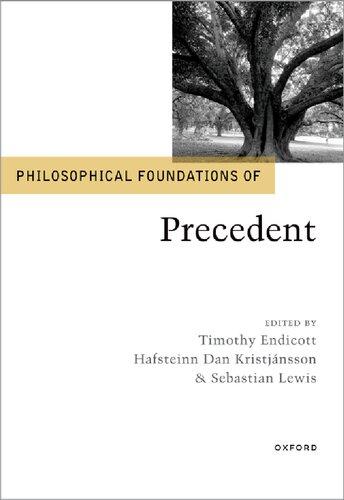
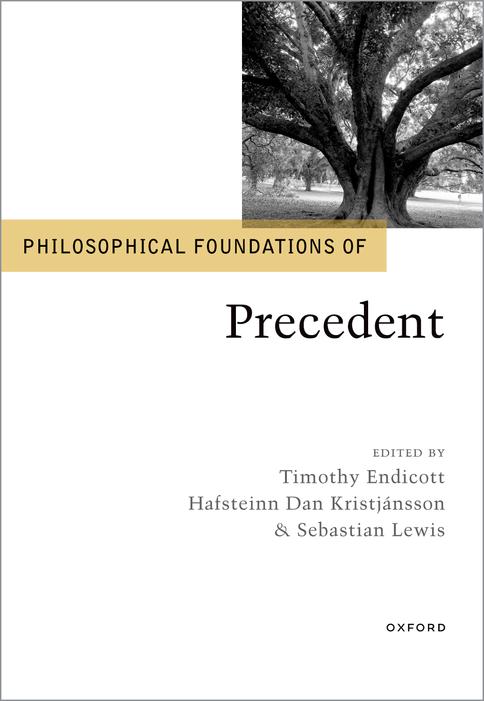
Just weeks before his untimely death at the age of eighty-three in May 2022, Joseph Raz agreed that we could use one of his photographs on the jacket for this book. Tat makes this book part of a proud tradition of books with cover photographs by Professor Raz, published by the university presses of Cambridge, Harvard, Oxford, and Yale.
Te photograph that Joseph gave us portrays the connection between the roots and the ramifcations of a dynamic organism. We knew that the beautiful and evocative image, and the simple fact that it was Joseph who created it, would mean something to many readers whose understanding, like ours, has been infuenced and shaped through our responses to Joseph’s pioneering work on precedent, on the nature of law, and on practical reasoning in general. We have all gained from his patient and brilliant and unyielding determination to situate philosophy of law in the philosophy of practical reason. Tat is why we dedicate this book to Joseph’s memory.
Sebastian Lewis
6. And Finally
We thank the authors. We did not know, when we started, what a pleasure it would be to watch this unprecedented collection of original philosophical investigations come together.
Timothy Endicott Hafsteinn Dan Kristjánsson Sebastian Lewis