Oxford University Press is a department of the University of Oxford. It furthers the University’s objective of excellence in research, scholarship, and education by publishing worldwide. Oxford is a registered trade mark of Oxford University Press in the UK and certain other countries.
Published in the United States of America by Oxford University Press 198 Madison Avenue, New York, NY 10016, United States of America.
All rights reserved. No part of this publication may be reproduced, stored in a retrieval system, or transmitted, in any form or by any means, without the prior permission in writing of Oxford University Press, or as expressly permitted by law, by license, or under terms agreed with the appropriate reproduction rights organization. Inquiries concerning reproduction outside the scope of the above should be sent to the Rights Department, Oxford University Press, at the address above.
You must not circulate this work in any other form and you must impose this same condition on any acquirer.
CIP data is on file at the Library of Congress ISBN 978–0–19–066289–9
Printed by LSC Communications, United States of America
For Paul Liam, perceptual learner extraordinaire
5. “Chunking”
5.2
5.3
5.4
5.5
5.6
5.7
PREFACE
One day, in the middle of writing this book, I found myself waiting in a medical specialist’s examination room, typing up a section of the manuscript on my laptop. A couple of months earlier, my doctor had suggested I visit a specialist about a small area on my right forearm. My doctor did not seem to think it was a big deal, but he suggested I visit a specialist just to be safe. So I found myself sitting, waiting for the specialist, and typing up this manuscript. The specialist, who looked to be well into his seventies, finally opened the door. I put away my laptop, and he began to look at my arm slowly and meticulously. As he proceeded, it became clear that he was alarmed, much more so than the primary-care doctor had been. He called for a lab test. What the specialist was worried about turned out to be early melanoma, a serious form of skin cancer, caught soon enough that it had not yet spread.
Many times during the course of writing this book I have thought back to that specialist. Sometimes I find myself wondering what sorts of prior events had led to his perception at that moment when I was sitting in that room. I imagine the long lines of patients he
has seen and the textbooks and journal articles he has read. I think about and I wonder what exactly enabled him to see in an expert way that day, and so many others.
This book aims to make progress in our theoretical understanding of perceptual learning, both in terms of its nature and its scope. Discussions of perceptual learning can be found throughout the history of philosophy and psychology. William James (1890), for instance, writes about how a person can become able to differentiate by taste between the upper half and the lower half of a bottle for a particular kind of wine (p. 509). This can be understood as a case of perceptual learning—a long-term change in perception that results from practice or experience.
Psychologists have been studying perceptual learning under that name since Eleanor Gibson wrote the first review article on the topic more than a half-century ago. Philosophers do not typically use the term. Yet cases of perceptual learning can be found in the literature from Diogenes Laertius’s third-century discussion of Stoic philosophy, to the work of the fourteenth-century Hindu philosopher Vedānta Deśika, and the work of the eighteenth-century Scottish philosopher Thomas Reid. Much more recently, cases of perceptual learning can be found in the work of Susanna Siegel, Christopher Peacocke, Charles Siewert, Galen Strawson, Berit Brogaard, Casey O’Callaghan, Tim Bayne, and many others. This book catalogs cases of perceptual learning in the philosophical literature for the first time.
Why is perceptual learning philosophically significant? One reason is that it says something about the very nature of perception— that perception is more complex than it may seem from the firstperson point of view. Specifically, the fact that perceptual learning occurs means that the causes of perceptual states are not just the objects in our immediate environment, as it might seem at first
glance. Rather, there is a long causal history to our perceptions that involves prior perception. When the expert wine taster tastes the Cabernet Sauvignon, for example, that glass of wine alone is not the sole cause of her perceptual state. Rather, the cause of her perceptual state includes prior wines and prior perceptions of those wines. Although there are some recent exceptions (see, for instance, O’Callaghan, 2011; Bayne, 2009; Brogaard, 2018; Brogaard & Gatzia, 2018; Chudnoff, 2018),1 philosophers have relied largely on their intuitions and on introspection to understand cases of perceptual learning. Arguably, however, psychology and neuroscience are now in a position to weigh in on philosophical claims about perceptual learning. This book offers an empirically informed account of perceptual learning for philosophers.
The book also offers a way for philosophers to distinguish between different kinds of perceptual learning. In some cases, perceptual learning involves changes in how one attends; in other cases, it involves a learned ability to differentiate two properties, or to perceive two properties as unified (see Goldstone, 1998; Goldstone & Byrge, 2015). This taxonomy can help to classify cases of perceptual learning in the philosophical literature and to evaluate the philosophical claims drawn from these cases.
1. O’Callaghan (2011) explores the case of hearing speech before and after one learns the relevant language, and understands it as an instance of perceptual learning. He uses empirical evidence to argue that the phenomenal difference in a person’s perception when one learns a language is not because they now hear meanings, but because they now hear the linguistic sounds differently. (For more on this, see chapter 6.) Bayne (2009) uses the case of associative agnosia, in which patients perceive the form of objects but not their categories. By contrasting this case with the perception of a typical perceiver, he argues that perception comes to represent high-level categories, such as when we come to perceive a tomato as a tomato. In much the same way that I do in this book, Brogaard (2018), Brogaard and Gatzia (2018), and Chudnoff (2018), all draw on the perceptual learning tradition of Eleanor Gibson, as well as more recent perceptual learning experiments in cognitive psychology, in order to support a wide array of conclusions in philosophy of mind and epistemology.
While there is a diverse array of cases of perceptual learning in the philosophical literature, this book also offers a unifying theory. The theory, very roughly, is that perceptual learning serves a function. It embeds into our quick perceptual systems what would be a slower task were it done in a controlled, cognitive manner. This frees up our cognitive resources for other tasks. For instance, a novice wine taster drinking a standard Cabernet Sauvignon might have to think about its features first and then infer that it is a Cabernet Sauvignon. An expert, by contrast, would be able to identify the type of wine immediately. This learned ability frees up cognitive resources for the expert, which enables her to think about other things, such as the vineyard or the vintage of the wine. My account gives us a new way to understand perceptual learning cases in terms of cognitive resources and cognitive economy.
Part I of the book focuses on the nature of perceptual learning; Part II focuses on its scope, rethinking several domains in the philosophy of perception, given perceptual learning. To give just one example (which I take to involve attentional learning), some philosophers (most notably, Siegel, 2010) have held that because natural kinds, such as pine trees or wrens, can come to look different to us through perceptual learning, it is evidence that perception can represent such natural kinds (in addition to low-level properties such as colors, shapes, and textures). I argue that what actually happens in such cases is that we come to attend to different low-level properties (such as the prototypical pine-green color of the pine tree or the round shape of the wren). Such cases involve the training of attention.
The book begins, however, with an introductory chapter on perceptual learning that answers the following questions: What is perceptual learning? What are the different kinds of perceptual learning? And what function does it serve for us? These are the issues we now turn to in chapter 1.
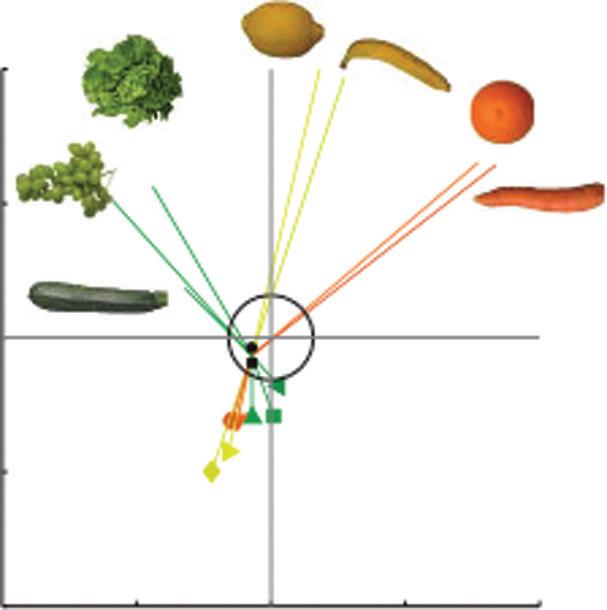
Figure 7.2. Hansen and colleagues (2006) asked participants to make fruit stimuli neutral gray, using a dial. Participants should have dialed the colors to point (0, 0) on the axes. Instead, they overshot, making the fruits closer to their opponent colors. Hansen and colleagues interpreted this result to mean that participants saw the grayed fruits as having more of their prototypical color than the fruits actually had. Source: Hansen et al. (2006).
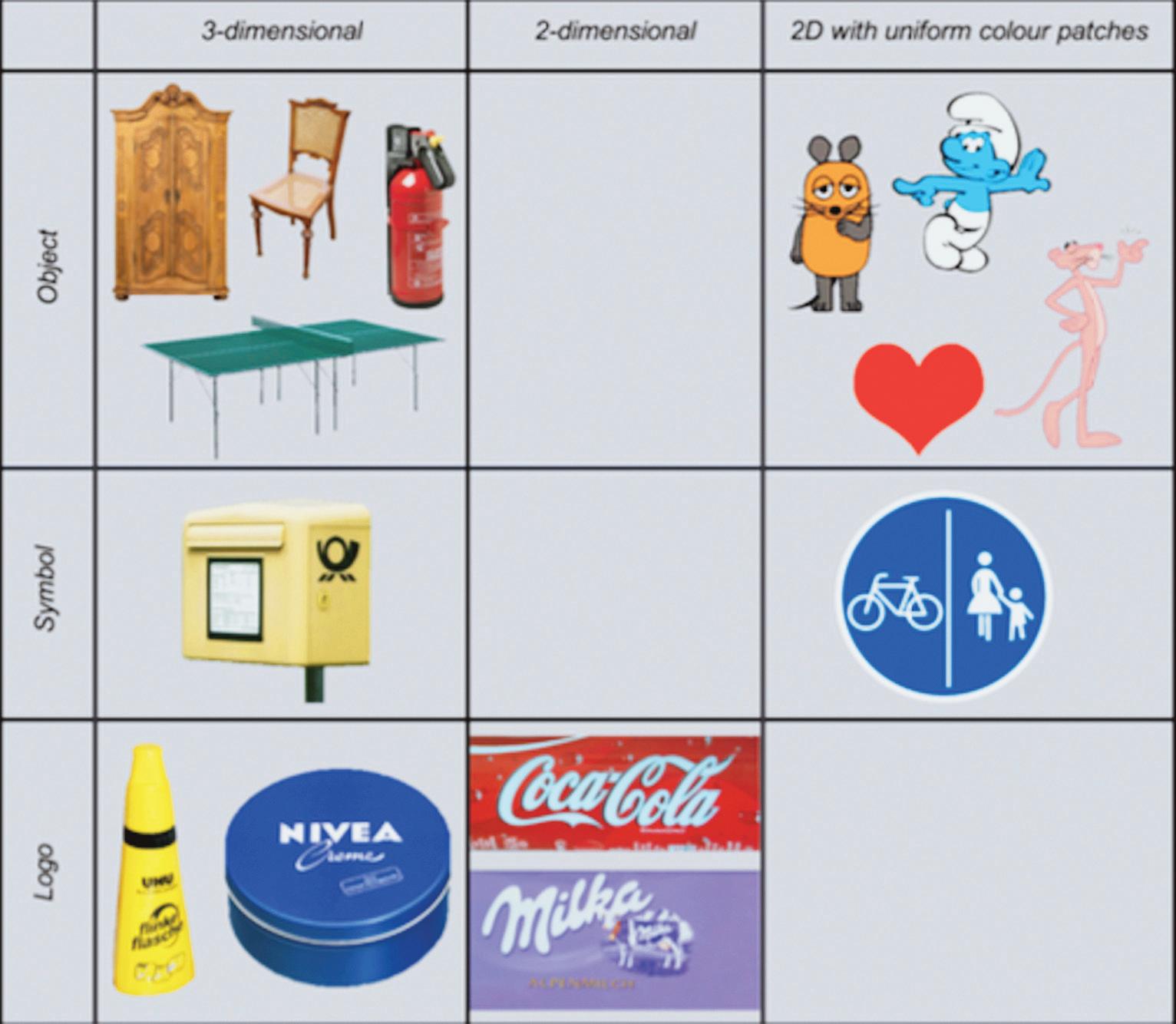
Figure 7.3. Witzel and colleagues (2011) found the memory color effect for ten out of fourteen of these artificial objects (that is, for everything except the fire extinguisher, heart, Coca-Cola logo, and mouse cartoon figure). Source: Witzel et al. (2011).
(b)
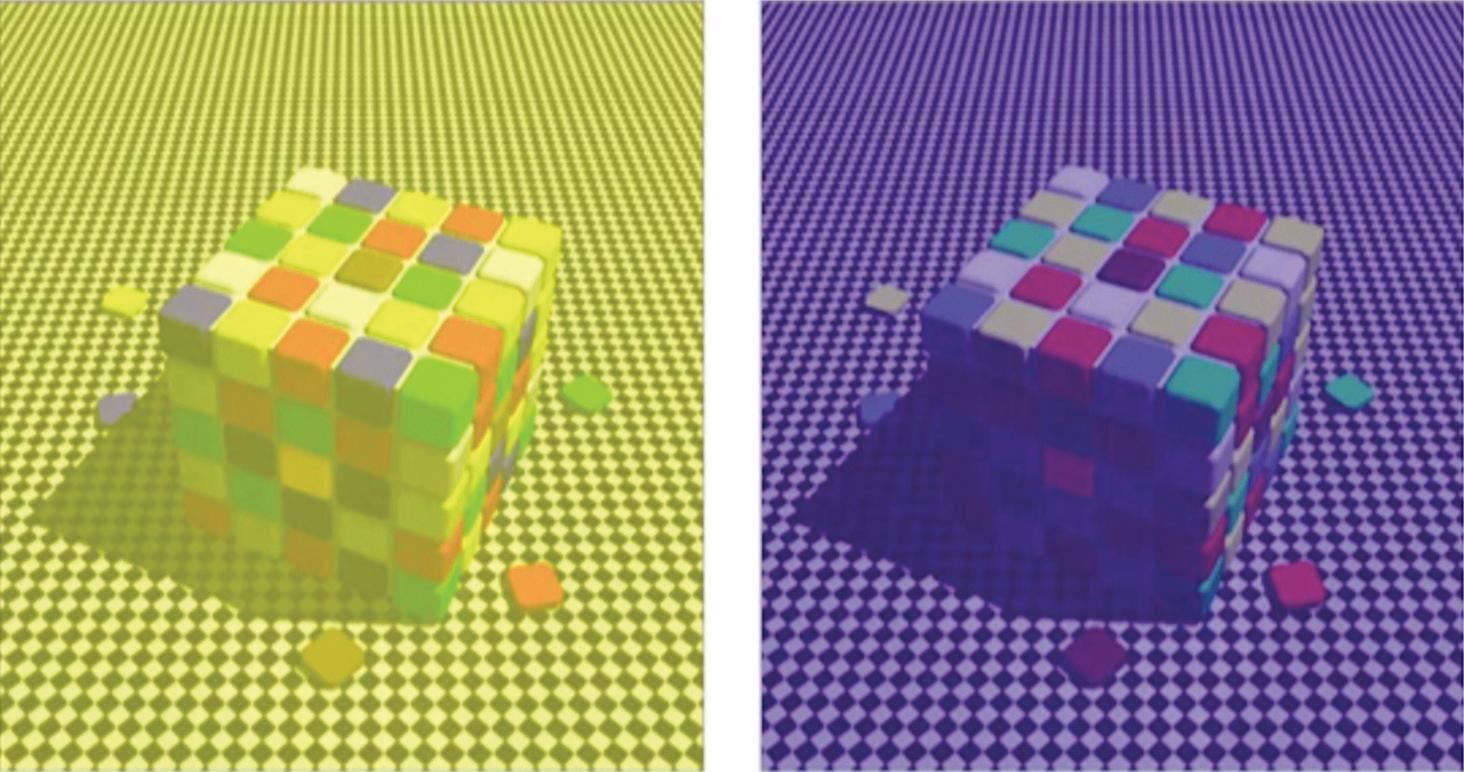
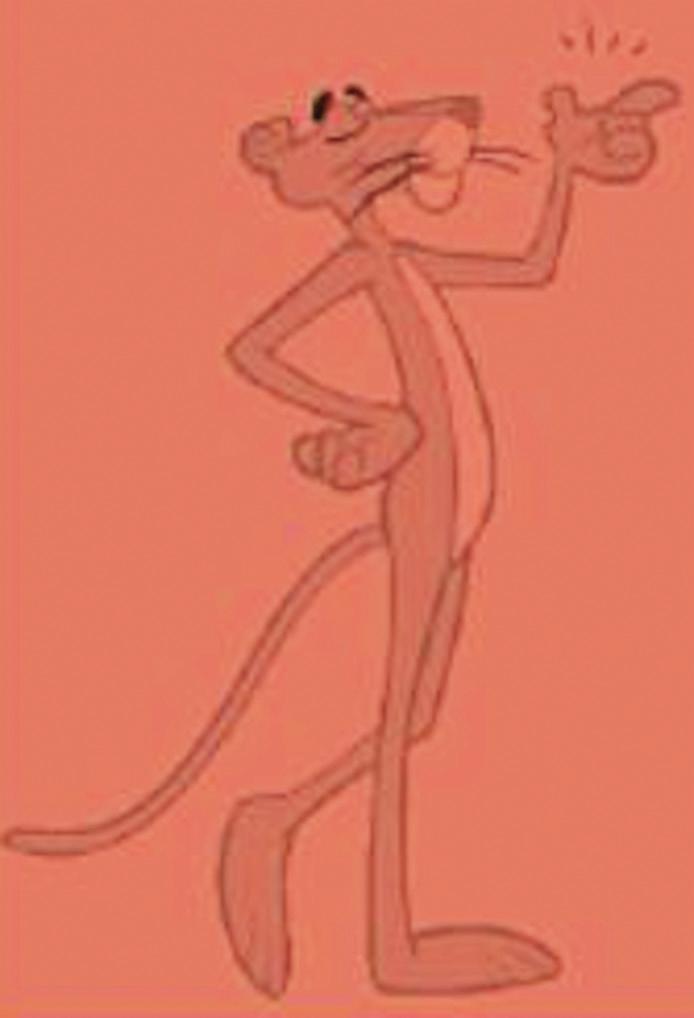
Figure 7.5. This figure illustrates one major challenge for explaining memory color as a case of color constancy. Starting with the two cube images (a), the blue tiles on the cube on the far left are actually the same shade as the yellow tiles on the cube to the right of it. Yet they are perceived as different shades because of color constancy. Importantly, nearly all humans will experience this effect. By contrast, the discolored Pink Panther (b) on the right will be experienced as pinker than it actually is only if someone has seen the Pink Panther before. Source: (a) Lotto and Purves (2002); (b) The original undiscolored image is from Witzel et al. (2011).
Figure 7.6. This picture shows clusters of bananas in front of a banana plant background. Several psychology studies have provided evidence that under some conditions (such as dim lighting), we see objects that have prototypical colors (such as yellow bananas) as more like their prototypical color. My claim is that this effect enables us to more easily differentiate objects from their backgrounds, such as bananas from the banana plant background in this figure. This is especially relevant in dim lighting situations. Image from http://www. banana-plants.com/index.html.
P art I
THE NATURE OF PERCEPTUAL LEARNING
How to Understand
Perceptual Learning
1.1 I ntro DUC t I on
People sometimes say things like the following: Cabernet Sauvignon tastes different to an expert wine taster than to a novice; or, Beethoven’s Ninth Symphony sounds different to a seasoned conductor than it does to someone just hearing it for the first time. Both these examples are cases of perceptual learning, very roughly (to be elaborated on in this chapter), cases of long-term changes in perception that result from practice or experience (see Gibson, 1963, p. 29). Opening examples aside, one need not be an expert to have undergone perceptual learning. Practice or experience with Cabernet Sauvignon or Beethoven’s Ninth Symphony might result in long-term perceptual changes, even if those changes fall short of full-blown expertise. As I mentioned in the preface, philosophers do not typically use the term “perceptual learning.” Yet, in the philosophical literature, there are a great many examples that would seem to count as cases of it. 1 Christopher Peacocke (1992), for instance, writes
1. Note that unless otherwise specified, the philosophers that propose the following examples suggest them as cases of perceptual changes, not just extra-perceptual changes. I return to this distinction in section 1.2.
about what happens perceptually when someone learns to read a language written in Cyrillic script. He claims there is a difference “between the experience of a perceiver completely unfamiliar with Cyrillic script seeing a sentence in that script and the experience of one who understands a language written in that script” (p. 89). Susanna Siegel (2010) describes how pine trees might look visually salient to someone who has learned to recognize them. She motivates this by suggesting that if you were tasked to cut down all and only the pine trees in a particular grove of trees, and you had never seen pine trees before, pine trees might begin to look visually salient to you after a while (p. 100). Similarly, Charles Siewert (1998) writes that after we learn to recognize a sunflower, certain features “ ‘stand out for us as significant’ and ‘go together’ ” (p. 256). He says there is “a difference between the way things look to us when they merely look somehow shaped, colored, and situated, and how they look to us when they look recognizable to us as belonging to certain general types” (p. 256).
In the philosophical literature, cases of perceptual learning are not just limited to the last few decades. For instance, in his discussion of Stoic philosophy, the 3rd-century historian of philosophy Diogenes Laertius (1925) writes that “a statue is viewed in a totally different way by the trained eye of a sculptor and by an ordinary man” (p. 161). One way of understanding this claim is that there is a difference in the perception of an expert versus a layperson, when they see a statue. In discussing the perceptual expertise of jewelers, the 14th-century Hindu philosopher Vedānta Deśika writes, “[T]he difference among colours [of a precious stone], which was first concealed by their similarity, is eventually made apparent as something sensual” (translated, Freschi, 2011, pp. 12–13). On Vedānta Deśika’s view, perceptual learning enables the expert to see two colors of a
gem as distinct, where as a novice he saw them as the same colors. Later on, in the 18th-century, Thomas Reid ([1764]1997) famously wrote of how people “acquire by habit many perceptions which they had not originally” (p. 171). In just one of the many examples he gives, Reid writes about how a farmer acquires the ability to see the rough amount of hay in a haystack or corn in a heap (p. 172).2 One way of understanding Reid’s claim is that the farmer has undergone long-term changes in his perception, following experience with things he has encountered in his farm life.
Cases of perceptual learning also occur in senses besides vision. Ned Block (1995), for instance, claims, “[T]here is a difference in what it is like to hear sounds in French before and after you have learned the language” (p. 234). As Casey O’Callaghan (2011, pp. 786–787) points out, Galen Strawson (2010, pp. 5–6), Michael Tye (2000, p. 61), Susanna Siegel (2006, p. 490), Jesse Prinz (2006, p. 452), and Tim Bayne (2009, p. 390) each make essentially the same claim as Block about what happens perceptually when we learn to hear a language. This auditory case and the visual cases given by Peacocke, Siegel, Siewert, Reid, Vedānta Deśika, and Diogenes Laertius, can all be understood as cases of perceptual learning: cases of long-term perceptual changes that result from practice or experience.
This book develops an account of perceptual learning and its philosophical significance. In the next section, I give a more precise statement about what perceptual learning is, in order to differentiate cases of perceptual learning from cases that are not perceptual learning. In section 1.3, I distinguish three different kinds of
2. There is a recent debate about whether acquired perception for Reid is genuine perception. Copenhaver (2010, 2016) argues that it is; Van Cleve (2004, 2015, 2016) argues that it is not.
perceptual learning, and I use these distinctions to offer the first taxonomy of cases in the philosophical literature. This taxonomy is important both in this chapter and throughout the book, as it helps to clarify the roles that perceptual learning can legitimately play in the arguments that philosophers have made. In section 1.4, I offer a theory of the function of perceptual learning, which I call the “Offloading View,” a view that I continue to argue for throughout the book. The view is that perceptual learning serves to offload onto our quick perceptual systems what would be a slower and more cognitively taxing task were it to be done in a controlled, deliberate manner. The upshot is that this frees up cognitive resources for other tasks.
At the outset, one might wonder why we should think perceptual learning really occurs (and is genuinely perceptual). In chapter 2, I give an abductive argument that perceptual learning does occur and is perceptual. I draw on three converging bodies of evidence for this, evidence from three different levels of analysis. First, there are the introspective reports just mentioned of long-term changes in perceptual phenomenology due to learning, which philosophers and others have been raising independently from one another for many centuries now. Secondly, there is evidence from neuroscience. In particular, a battery of studies provide evidence that perceptual learning creates neural changes specifically in the primary sensory areas (both visual and non-visual; see Furmanski, Schluppeck, & Engel, 2004; De Weerd et al., 2012; Braun et al., 2000). Thirdly, in line with both the phenomenological and neuroscientific evidence, there is a body of behavioral evidence from psychology, much of which I will introduce in this chapter.
The book also offers a further argument that perceptual learning occurs (in the perceptual sense in which I am understanding it). In chapters 3 through 7 I offer independent arguments that perceptual
learning occurs in each of five different perceptual domains: in natural kind recognition, sensory substitution, multisensory perception, speech perception, and color perception. If I am right about those cases, then this is a further argument that perceptual learning really occurs (and is genuinely perceptual).
1.2 what I s P er C e P t U al learn I ng ?
What are the common characteristics of Peacocke’s Cyrillic case, Siegel’s pine tree case, Siewert’s sunflower case, Diogenes Laertius’s statue case, Vedānta Deśika’s gemstone case, Reid’s haystack case, and Block’s case of hearing French? Loosely following E. J. Gibson (1963, p. 29), I understand these and other cases of perceptual learning to be cases of long-term changes in perception that are the result of practice or experience. Let me say something about each part of this description, and by doing so, demarcate cases of perceptual learning from cases in the philosophical literature that are similar but do not count as perceptual learning.
Perceptual Learning as Long-Term Perceptual Changes
Perceptual learning involves long-term changes in perception. This rules out short-term adaptive effects such as the waterfall illusion (see Gibson, 1963, p. 29; Gold & Watanabe, 2010, p. R46). For instance, if one looks at the trees on a riverbank, and then at an adjacent waterfall for a long time, and then back at the trees, one’s perception of the trees may have changed. In particular, they may appear as if they are moving upward (in the opposite direction of the waterfall’s downward motion). This is a perceptual change, and it is also the result of experience (in particular, the experience of