Morphology effect of MnO2 promoter to the catalytic performance of Pt toward methanol electrooxidation reaction Yuan-Yuan Feng & Gui-Hua Song & Qiang Zhang & Jian-Ning Lv & Xi-Yu Hu & Yu-Long He & Xin Shen
Oxford University Press is a department of the University of Oxford. It furthers the University’s objective of excellence in research, scholarship, and education by publishing worldwide. Oxford is a registered trade mark of Oxford University Press in the UK and certain other countries.
Published in the United States of America by Oxford University Press 198 Madison Avenue, New York, NY 10016, United States of America.
All rights reserved. No part of this publication may be reproduced, stored in a retrieval system, or transmitted, in any form or by any means, without the prior permission in writing of Oxford University Press, or as expressly permitted by law, by license, or under terms agreed with the appropriate reproduction rights organization. Inquiries concerning reproduction outside the scope of the above should be sent to the Rights Department, Oxford University Press, at the address above.
You must not circulate this work in any other form and you must impose this same condition on any acquirer.
Library of Congress Cataloging-in-Publication Data
Names: Bricca, Jacob, author.
Title: How documentaries work / by Jacob Bricca.
Description: New York, NY : Oxford University Press, [2023] | Includes bibliographical references.
Identifiers: LCCN 2022029907 (print) | LCCN 2022029908 (ebook) | ISBN 9780197554104 (hardback) | ISBN 9780197554111 (paperback) | ISBN 9780197554135 (epub)
Subjects: LCSH: Documentary films—Production and direction.
LC record available at https://lccn.loc.gov/2022029907
LC ebook record available at https://lccn.loc.gov/2022029908
DOI: 10.1093/oso/9780197554104.001.0001
1 3 5 7 9 8 6 4 2
Paperback printed by Sheridan Books, Inc., United States of America
Hardback printed by Bridgeport National Bindery, Inc., United States of America
Introduction
Deconstructing the Documentary
In conducting research for my book Documentary Editing: Principles and Practice, I interviewed fellow documentary editors to gather their insights into the process of cutting a documentary. As I sat down to turn their stories into words on the page, I was struck by an exciting but uncomfortable feeling: I was revealing secrets. There are numerous skills one utilizes in crafting a documentary, and many of them are unknown to the audiences that ultimately consume them. Some of these are tiny little elisions, but others are more substantial—and possibly more questionable. As I chatted with a director I had worked for and asked permission to share the details of a scene that I had cut for him, he chuckled mirthfully. “Oh, Jacob, you’re going to give away all our secrets!” He was joking, of course. But the very fact that I felt the need to ask permission was testament to the fact that there is something tricky going on in the production of nonfiction material.
When Norman Hirschy at Oxford University Press approached me about writing this book, I knew that a similar truth-telling would be necessary. There exists today a large gulf between the conversations that documentary filmmakers have among themselves about what they produce and the understanding that most viewers have about what they see onscreen. This is not to say that viewers are incapable of discernment or that they accept what is given to them at face value; to the contrary, most are highly sophisticated and do the work of reading documentary codes with extraordinary skill. But the codes themselves—the patterned execution of documentary
tropes and conventions—need examination if audiences are to fully understand what they are consuming. Few are the filmmakers that have time, budget, or inclination to follow Penny Lane’s example of building an exhaustive online appendix to her documentary Nuts!, which dissects the film passage by passage and characterizes each one with labels like “Tricky Edit,” “Chronological Distortion,” and “Probable Invention.” Without such documentation, viewers are left to their own devices.
Meanwhile, documentarians have been boldly pushing the medium forward with highly stylized reenactments, staged events, and provocative intermingling of traditional documentary elements with those previously reserved for fiction. As documentary has recently come into its own as an auteur’s medium, it has also lost some of its distance from scripted fiction, which begs the question: How should we read documentaries? If, according to the late author and documentary editor Dai Vaughan, “To read a film as fiction . . . implies that everything . . . is subject to authorial control,”1 then how, exactly, do we read a documentary, which is supposedly about the untamed, uncontrollable real world and therefore beyond such control? How should we interpret was we see?
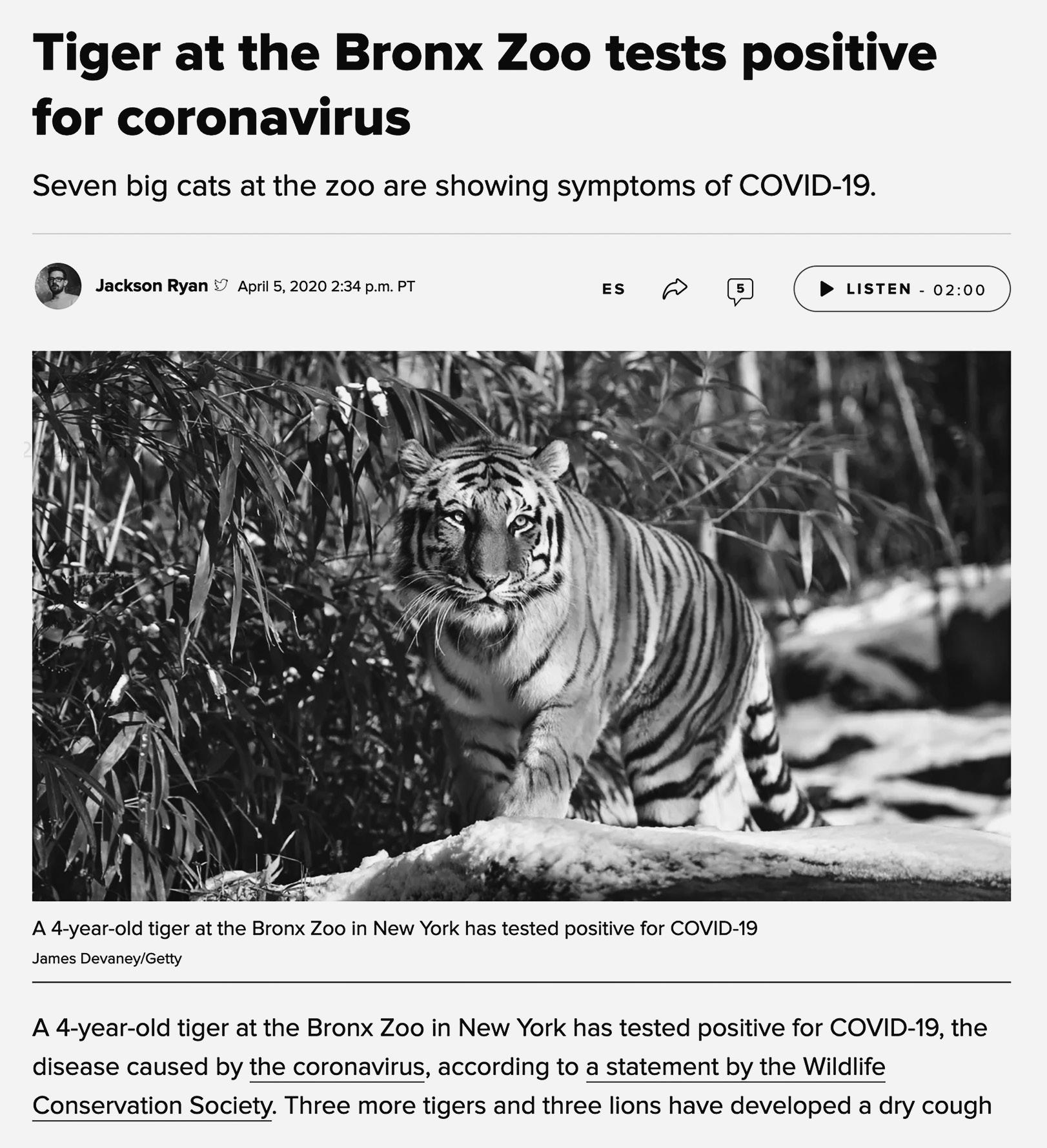
“Tiger at the Bronx Zoo Tests Positive for Coronavirus,” states the headline on a story dated April 5, 2020, on the CNET website (Figure I.1). Looking at the story, one’s eye is immediately drawn to the picture of the tiger as it roams the grounds of the Bronx Zoo, and one may also note that it is one of “seven big cats at the zoo that are showing symptoms.” The picture caption identifies it as “a 4-year-old tiger at the Bronx Zoo.” This all seems rather unremarkable.
Yet a look at the photo credit reveals a piece of interesting information: the source of the picture is listed as “James Deverney / Getty.” A quick web search reveals that the photo is for sale from Getty Images, one of the largest stock image archives in the world (Figure I.2).
Looking at the details on the Getty site, we can now confirm that while this picture was indeed taken at the Bronx Zoo, it was done so
in December 2017, not April 2020 when the story was written. This means that a four-year-old tiger in the Bronx Zoo has indeed tested positive for the virus, but it’s unlikely that this is the tiger in question or that the one in the picture is four years old.
Let’s note that none of the individual elements carry any false claims. But it’s precisely in the implied relationship between all of these true things that we find ambiguity and slippage. Seeing the words “a 4-year-old tiger” directly under the picture created an impression—here’s the tiger that the article talks about that is not fully accurate. We are instead looking at an impression of the real thing, a serviceable facsimile.
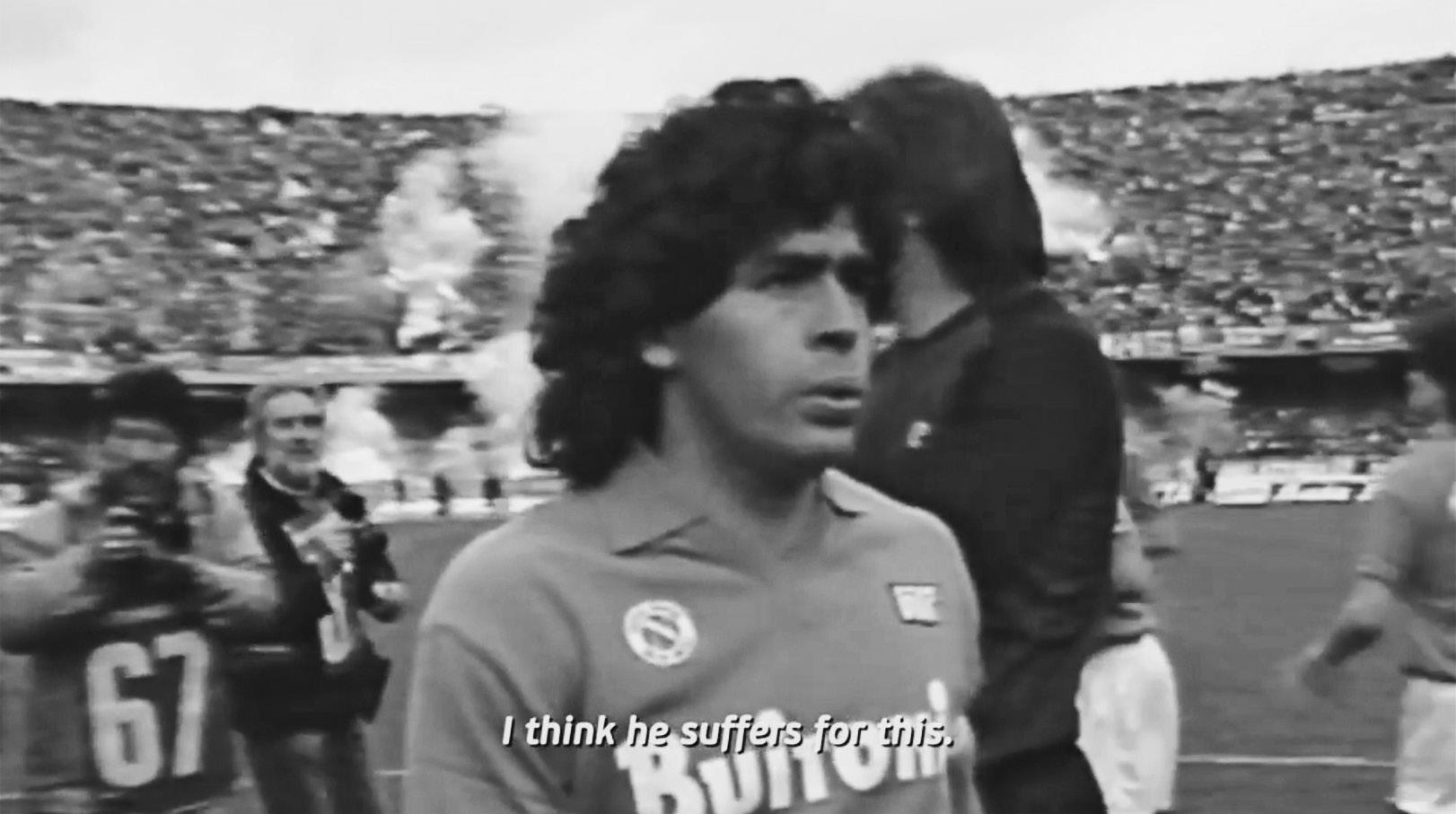
This loose relationship between what images seem to represent and what they actually depict is fundamental to documentary filmmaking. In fact, it is the very indeterminacy of an image’s origin that makes many common techniques of documentary storytelling possible. At one crucial moment in Asif Kapadia’s 2019 film Diego Maradona, a documentary about the world-famous Venezuelan footballer, Maradona’s ex-girlfriend Cristiana Sinagra speculates in an old television interview about why he refuses to acknowledge paternity of their son. Painting a complex psychological portrait of the emotional toll his lies are taking on him, she says with pity, “I think he suffers for this.” Precisely at this moment, the audience sees Maradona in slow motion, taking the field for a match in front of tens of thousands of cheering fans, with a stark look on his face (Figure I.3). Upon the utterance of the word “suffers,” Maradona grimaces, as if thinking about something particularly painful. Precisely what was on Maradona’s mind at that particular moment in a crowded stadium over thirty years ago is unknowable, but it could have been anything from a tight hamstring to pregame jitters. In the logic of the film, however, he is feeling the crushing weight of his own moral shortcomings. Perhaps no one summed up this concept more succinctly than the aforementioned Dai Vaughan.
The documentary response is one in which the image is perceived as signifying what it appears to record; a documentary film is one which
seeks, by whatever means, to elicit this response; and the documentary movement is the history of the strategies which have been adopted to this end.
Documentary will be consequent upon what it appears to show, rather than upon what it necessarily does show; and the relationship between the two is a matter for the filmmakers’ ethics, inaccessible to the viewer. Yet the assumptions which the viewer makes about this relationship, on the basis of signals intended or unintended, will inform his perception of the film. To make a documentary is therefore to persuade the viewer that what appears to be is.2 * * *
Moving pictures are fictions. When we sit in a movie theater or in front of a laptop screen, we are not actually watching anything move. A series of still frames are being shown in rapid succession, fooling our brain into seeing movement and working in tandem with a set of perceptual cues that allow us to decode two-dimensional images as three-dimensional space. If the film is compelling, we react just as though something were actually happening—we laugh, we cry, we are scared, we are moved. Just as our brain experiences dreams as if
Figure I.3 Diego Maradona suffers in Diego Maradona
they are real while they are occurring, a powerful movie produces convincing sensory stimulation that simulates lived experience. This comes as a surprise to no one, yet its implications are profound. It means that when we watch a movie or a television show we are entering a dream space that doesn’t actually exist anywhere but inside our own minds. When the content is a scripted, fictional film, we give implicit acknowledgment to this fact—we know it isn’t real. But when we watch a documentary, a much more complex and problematic dynamic is in play because we relate these experiences back to the historical reality that we all share. It seems all too real. As filmmaker and sociologist Edgar Morin said prophetically in 1960,
We ought to know that fiction film is by definition much less illusory and much less deceitful than so-called documentary cinema, because both director and spectator know that it’s fiction, which is to say that its truth is conveyed through the imagination. On the other hand, documentary cinema hides its fiction and its imaginings behind the facade of reality.3
While documentaries may seem to be fundamentally distinct from fiction films, in fact they carry far more similarities than differences. “All films are documentaries,” stated Bill Nichols provocatively in 2001 in the first edition of his seminal book Introduction to Documentary.4 As he pointed out, both types of films are created by placing cameras in front of human persons at various moments in time and constitute a record of those moments. While the moments in a fiction film were staged, the moments did exist, or, as Vaughan helpfully puts it, “Any fiction film can be perceived as a documentary on its own making.”5 Whether they involve actors delivering lines from a script or real people performing as themselves, all films are christened with moments of human performance captured by a camera.6
Nichols goes on to point out the similarities between professional actors and documentary participants. Film actors are trained to ignore the highly unnatural environment of a film set, on which film
lights, props, and scenery are piled high around them and a dozen crew members watch their every move. Directors of documentaries often look for a similar lack of self-consciousness when they are researching their projects and may drop subjects from the production whose response is to freeze up in front of the camera. But which is the more authentic response: to acknowledge the artificiality of the situation and wonder about the consequences of the shoot, or to pretend the camera and the consequences aren’t there?
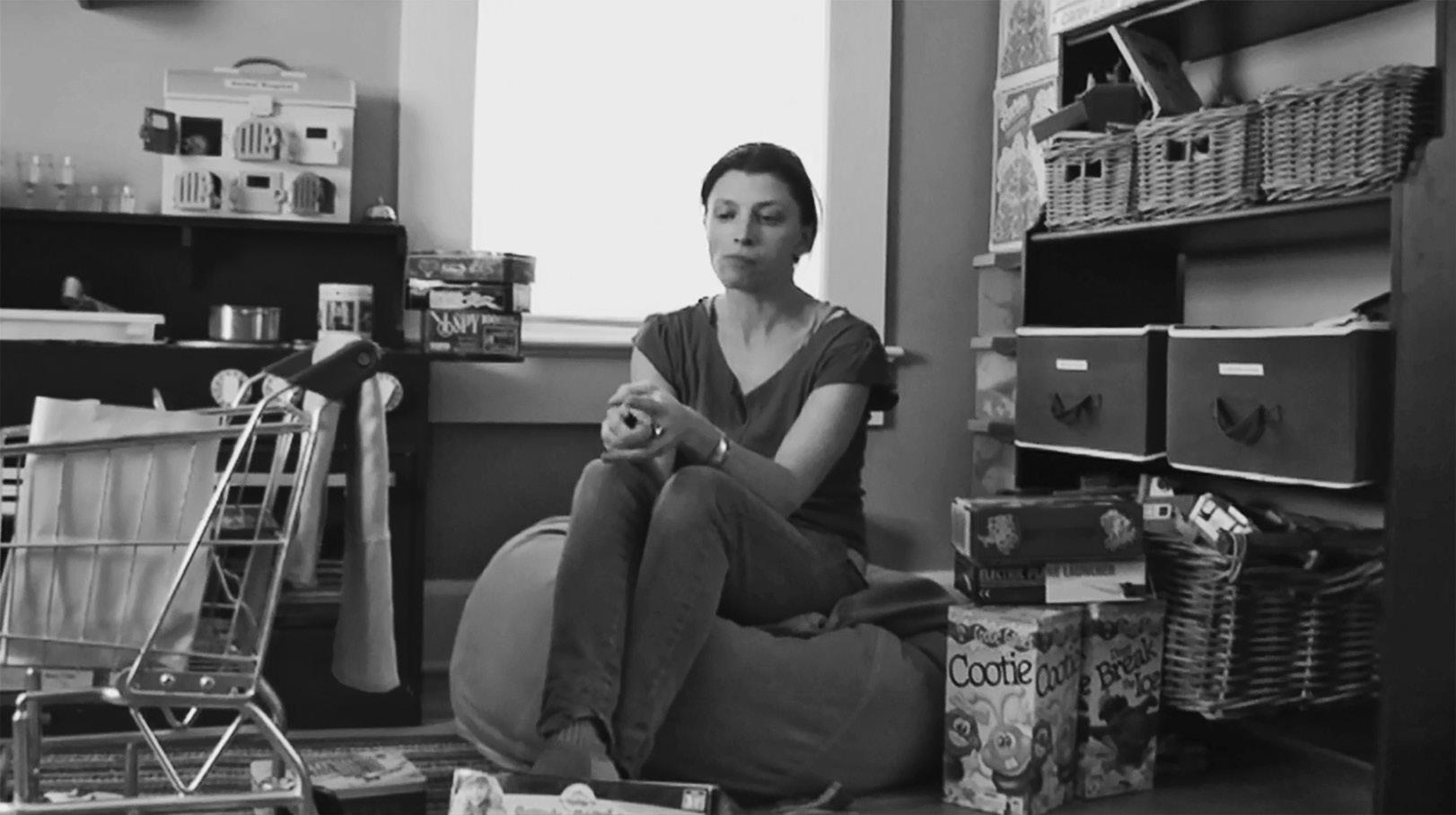
Perhaps that’s a false dichotomy. Documentarian Jean Rouch claimed that “when people are being recorded, the reactions that they have are always infinitely more sincere than those they have when they are not being recorded.”7 Frederick Wiseman agreed, claiming that “most people aren’t capable of changing their behavior on camera. It takes a great actor to be able to do that, but most of us don’t have the skills.” Or maybe the most authentic documentary is one that highlights its own duality, like the Robert Greene film Actress, which simultaneously plays out as a documentary about actress Brandy Burre’s midlife career crisis and one about Burre playing a role in a documentary about the same thing (Figure I.4). (Slumped over a beanbag in her kids’ playroom, she says, “I’m not
Figure I.4 Brandy Burre plays herself in Actress
acting, so this is my creative outlet, I guess,” before stopping and repeating the exact same lines, as if trying to get the halfhearted sentiment just right for the camera.) And what are we to think of the highly refined storytelling conventions that are operative in so many documentaries that require the arrangement of reality into formulaic models of exposition, development, and payoff?
It again begs the question: what is a documentary? Scottish filmmaker John Grierson’s 1926 definition as a film that practices “the creative treatment of actuality” is pithy, but policing its boundaries has always been a fraught endeavor.8 Author Michael Rabiger tries to separate documentaries from propaganda by asking whether the filmmaker begins the process with the point already firmly established (propaganda) or from a position of honest inquiry (documentary).9 Yet the proliferation of sponsored documentaries leaves some films in limbo, like the 2018 documentary Breaking2, sponsored by Nike. The production is really an extended, multipart Nike commercial, since its products are in nearly every frame and many of the protagonists are the company’s employees, but it would be unhelpful to ignore the fact that it strongly follows standard documentary conventions.10 What about hybrid films like Alfonso Ruizpalacios’s Una Película de Policias (A Cop Movie), which has a segment showing two actors going through reallife police academy training in order to more faithfully perform their parts in the reenactments that take up most of the running time of the film, or American Animals, which features documentary interviews with the perpetrators of a bungled art heist in 2004 but consists mostly of reenacted scenes? The nonscripted portions of each of these films are tiny, but don’t the films differ only in quantitative terms (rather than qualitative ones) from any other documentary that utilizes reenactments?11 What about reality shows like The Bachelor? They break the very first rule that most documentarians hold sacred—the idea that the documented event is separate from (and exists without prior connection to) the film. Yet numerous are the films in which documentarians conspire to create events expressly for the purpose of filming them (Icarus, Forks over Knives, Jackass Forever). And it’s important to
note that the storytelling strategies practiced in traditional feature documentaries and docuseries are not fundamentally different from those at play on television shows like Love Island or The Great British Baking Show.
In my research for this book I talked to directors, producers, and craft persons of all kinds; I also scoured my own career as a documentary producer, director, and editor for useful anecdotes. I made the choice to define documentary broadly. While this volume concentrates on feature-length films and docuseries, to exclude discussion of reality television and other unscripted shows would do a disservice to our goal of elucidating the structural conventions and commonplace practices of the form, so these genres are included as well. Indeed, anything that illuminates what is usually taken for granted is fair game, for it is often what is taken for granted that is the most in need of dissection.
I see this book as an opportunity to build a bridge between practitioners and viewers and to open a discussion about how meaning in documentaries is made. That discussion is already in progress, but while robust debates occur at conferences like “Getting Real” (sponsored by the International Documentary Association), the Flaherty Seminar (sponsored by International Film Seminars, Inc.), and “Visible Evidence” (put on by the academics who make up the Visible Evidence Governing Council), they attract mainly practitioners and academics, and much of the discourse in documentary studies is understandably focused on highly specific theoretical issues rather than holistic analysis. A big-picture view on documentary is needed now more than ever, for as we head into the heart of the 2020s, documentary is increasingly popular, increasingly alive with creativity, and also increasingly beset with ethical conundrums. While this book is not written primarily as a forum for addressing those conundrums (readers would be well advised to pick up a copy of Bill Nichols’s Introduction to Documentary), it does attempt to lay bare some of the practices that bring them to the fore. By reading this book I hope to give the reader the tools to decipher, decode, and deconstruct the complex flows of information in a documentary.
Notes
1. Dai Vaughan, For Documentary (Berkeley: University of California Press, 1999), 130.
2. Vaughan, For Documentary, 59.
3. Edgar Morin, “Chronicle of a Film,” in Cine-Ethnography, ed. Steven Feld (Minneapolis: University of Minnesota Press, 2003), 229–65.
4. Bill Nichols, Introduction to Documentary, 1st ed. (Bloomington: Indiana University Press, 2001), 36.
5. Vaughan, For Documentary, 58.
6. Animated films and those with heavy use of computer graphics complicate this statement with respect to fiction films.
7. James Blue, “The Films of Jean Rouch,” Film Comment 4, nos. 2–3 (Fall–Winter 1967): 84–86.
8. Laura Marcus, “‘The Creative Treatment of Actuality’: John Grierson, Documentary Cinema and ‘Fact’ in the 1930s,” in Intermodernism: Literary Culture in Mid-Twentieth-Century Britain, ed. Kristin Bluemel (Edinburgh: Edinburgh University Press, 2009), 190.
9. Michael Rabiger, Directing the Documentary, 6th ed. (New York: Focal Press, 2015), 22.
10. “The State of Journalism on the Documentary Filmmaking Scene,” published by the Center for Media & Social Impact in September 2021, lists some recent examples of undisclosed conflicts of interest in recent documentaries. https:// cmsimpact.org/report/the-state-of-journalism-on-the-documentary-filmmak ing-scene/p/documentary-film-growing-faster-than-its-standards/.
11. To be precise, interviews take up 11.4 minutes out of the total running time of 117 minutes of the film.
1 Raw Materials
Documentary films are collages. Any single passage of a documentary is apt to contain material from a huge variety of sources, so it’s useful for us to begin by breaking them down into their constituent parts. Documentaries vary greatly in style and content, but they all consist of some combination of verité footage, interviews, archival materials, reenactments and animations, title cards, music, and voice-over narration. Each element represents a different kind of intervention in the real world, and each speaks to the audience in its own way.
Verité
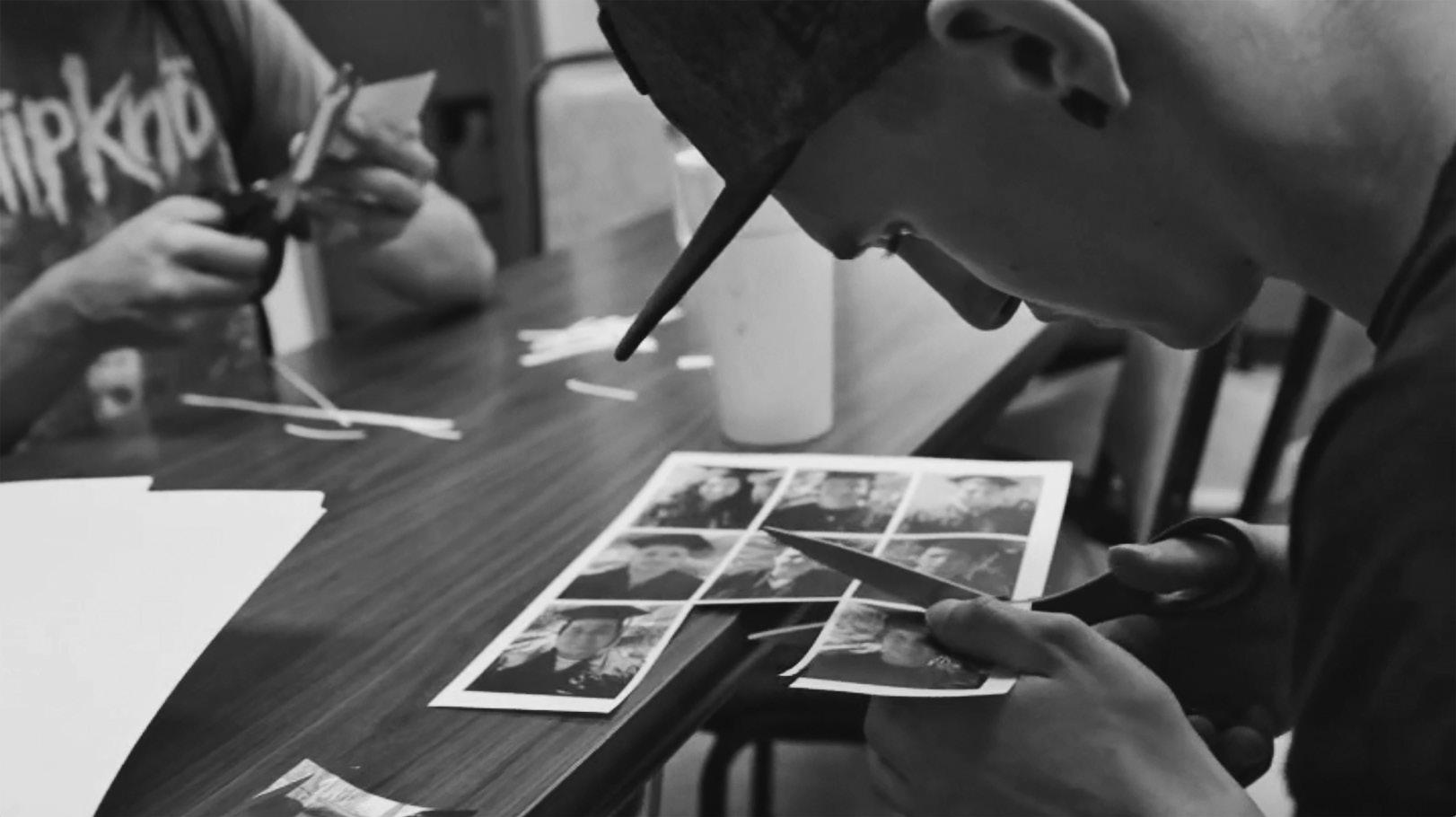
In a scene from The Bad Kids, the 2016 Sundance Special Jury Prize Winner that I edited with Mary Lampson, Joey, a smart but troubled teen, arrives back at Black Rock High School in Joshua Tree, California, after several weeks of truancy.1 “I miss my coffee pot; I miss my coffee grind; I miss everything about my house,” says Joey as he takes a seat at a table next to a friend, where they have been assigned the duty of cutting out photos for a display case featuring the school’s next graduating class (Figure 1.1). “Why’d you leave?” his friend asks, mirroring the audience’s own curiosity about his situation. “My mom, she accused me of stealing somebody’s drugs. I woke up to her screaming and yelling at me,” Joey says ruefully. “It’s nothing new . . . she was on another bad trip. I walked out the door.” The poignancy and sadness of the scene is palpable: here Joey sits,
cutting out pictures of other students who will be graduating while he, because of his poor attendance, has hardly moved the needle on the requirements for graduation.
For a filmmaker seeking to reproduce many of the storytelling conventions of traditional Hollywood films, verité is the ticket.2 Here a documentarian brings the camera directly into the lives of the protagonists. The similarity to scripted fiction is unmistakable: the audience witnesses things through the interactions of the characters with each other and the world around them. Instead of telling the audience about his situation in an interview, Joey relates everything to another character, providing pitch-perfect exposition. A documentary shooter will often “cover” a scene in a way that facilitates the editing, getting an establishing shot to identify the location, shooting wide shots to communicate the geography of the participants, and catching moments of compelling drama in medium shots and close-ups. Crucially, exposition and subtext can be expressed directly through character action, something that every screenwriting manual labors to endorse.
It is crucial to point out that verité scenes are an imaginary experience created for the viewer. In the scene from The Bad Kids, for instance, the dialogue has been extensively rearranged to feature
Figure 1.1 Joey cuts out graduation pictures in The Bad Kids
this one succinct exchange and makes it seem as though Joey started talking about his departure from home as soon as he sat down. Indeed, while the camera rolled for well over thirty minutes, the final scene clocks in at a mere thirty-three seconds. As we will see in Chapter 6, with every cut something has been excised.
Interviews
When many people think of documentaries, one of the signature elements that comes to mind is the interview. Instead of putting the audience directly into a situation with verité, interviews allow the filmmaker to tell the audience a story or relate an observation through the account of a participant, observer, or expert. Here the audience is one step removed from the action, for instead of witnessing things play out, they are hearing someone explain in words how they played out, or how the person feels about them. A picture is painted for the audience, but as description and summary rather than as seemingly direct experience.
The words spoken in an interview are important, but an interviewee’s body language and tone of voice carry another rich layer of information. A subtle vocal inflection can turn the meaning of a statement into its opposite with just a hint of sarcasm. What’s more, every interview is an opportunity to invite subjects to ponder the event in question as they speak. As editor Jason Rosenfield, ACE notes, “[The subject] may be giving a description of a past event, but it becomes something in the present because they are reliving an experience in their mind and having an emotional reaction all over again. In a sense you’re able to watch what it was like to be there, even though you’re only listening to somebody talk.”
The interview is a strongly interventionist move. Whereas in verité the filmmaker only learns what participants are thinking if they happen to speak about it to others, here the filmmaker can pry it right out of them. Steve James, director of Hoop Dreams, The Interrupters, and America to Me, is well aware of the difference and chooses to include interviews in his films.
It’s rare for me to see a pure verité film that really gets into all the dimensions of what’s going on in a way that’s satisfying to me as a viewer. I want to know more about the people, I want to know more about what they’re thinking, I want to know more about what’s led to this moment. A pure verité filmmaker is captive to some degree to what they’re able to capture, and I don’t like being captive to that because it can just reinforce stereotypes. If you do a pure verité film about poor people in the inner city, so much of their lives, purely observed, can seem to reinforce certain stereotypes about those communities. But if you talk to them and you start to really get inside them with interviews, then those scenes that could reinforce stereotypes suddenly don’t do that anymore. I also find that people have tremendous abilities to analyze and reflect on their own lives. I want people who watch my films to think of the people in the films as not just subjects for scrutiny and empathy, but also as sources of true insight.
Archival
Put simply, archival material is material that predates the making of the film. Archival documents include home movie recordings, digital and print photos, segments of old films, television news programs and commercials, written documents (old letters as well as digital files), and audio recordings.
The use of archival material in documentaries is as varied as documentaries themselves. It can be the subject of the film itself, as in essay documentaries like Thom Anderson’s Los Angeles Plays Itself, Irene Lusztig’s The Motherhood Archives, or Jayne Loader, Kevin Rafferty, and Pierce Rafferty’s The Atomic Cafe, in which the clever arrangement of clips from 1950s government propaganda films reveals the alarming misinformation about nuclear fallout that they contained. The clips may come with lower-third title cards providing full attribution of the source (as in the first example) or with none at all (as in the other two), depending on the whims of the director. They may be selectively employed to illustrate an idea put forth in interviews, serving as the visual confirmation for an assertion made
with words. Or they can simply be used to “set the scene” of an event that takes place in the past, as when driving shots of Hollywood Boulevard and Sunset Boulevard are used to bring the audience into the world of the 1970s Los Angeles for many scenes in Be Water, the ESPN documentary on the kung fu movie star and filmmaking pioneer Bruce Lee. Here the archival footage is useful for its essential banality and lack of connection to another narrative; whether it was taken from a stock footage library or an establishing shot from a fiction film, its meaning here is simply: Los Angeles, mid-1970s.
Because its only defining characteristic is that it predates the making of the film, “archival” is a large, malleable category with seemingly endless functions. It also tends to carry a powerful and seductive aura of authenticity, which we will discuss in detail in Chapter 10.
Reenactments and Animation
Reenactments are often employed by filmmakers to solve a fundamental problem: some portion of the story took place before they arrived to document it, or access to the locations where it took place was impossible (prisons, hospitals, etc.). There is no chance of capturing these moments in verité, and while interviews can tell the audience about what happened (past tense) they cannot put the audience directly “in the moment” to experience it for themselves. If there are no suitable archival materials, filmmakers are left with two primary options: reenactments or animations.3
The use of reenactments is as old as motion pictures themselves, and it is fitting that Nanook of the North, commonly thought of as the first feature documentary, used them liberally. Robert Flaherty’s intimate depiction of life among a small group of Inuit in northern Quebec showed “Nanook” (not his real name) acting out fishing and hunting practices that were already a relic of an earlier age.4 As Bill Nichols remarked, “[Flaherty’s] entire salvage anthropology model of coaxing Allakariallak to do what ‘Nanook’ would have done some thirty years earlier, without motorized vehicles, rifles, canned food,
wood-frame homes, or filmmakers along for the ride, amounted to one colossal, unacknowledged reenactment and, therefore, fraud.”5
The operative word here is unacknowledged. If the audience is unaware of what they’re watching, the justification for the proposition starts to unravel. This is the key distinction made in the codes of ethics put forward by major journalist organizations, such as this one from a consortium of journalist organizations that includes the Society of Professional Journalists and the Association of Black Journalists:
Avoid misleading reenactments or staged news events. If reenactment is necessary to tell a story, label it.6
Back in the 1980s when newsmagazines like A Current Affair and Hard Copy covered true crime stories in a tabloid style, they would do just that, putting a large “Reenactment” title card over the first shot of a reenactment segment, or sometimes over the entire scene. As this journalism-based true crime trend crossed over into prime time in the late 1980s, these explicitly labeled reenactment segments had a short life on shows like Saturday Night with Connie Chung (later renamed Face to Face with Connie Chung) and NBC’s Yesterday, Today, and Tomorrow. The latter featured anchor Mary Alice Williams explaining the rules of engagement on the first show of the series: “In some cases we will faithfully recreate events, carefully documenting every important detail and always clearly identifying every re-creation; scenes and stories not identified as recreations are real.”7 Yet these shows received cool receptions from critics who saw them as demeaning to the hard-news focus of the storied news departments of the networks that they played on, and with scant interest from audiences they quickly died out.8
Meanwhile, documentaries made outside of the major news organizations and their strict labeling guidelines took a different approach, signaling the presence of a reenactment through purely formal means. Reenactments today will often gesture selfconsciously to their own artificiality, with actors representing key characters shown from disadvantaged, oblique angles. Their faces
are not shown and, as a rule, they do not speak.9 Whereas scenes in a fiction film are staged toward the audience so that the spectator has an easy view of the action, in reenactments the action is usually staged away. The shots often feel furtive, just a bit voyeuristic, giving the audience an intentionally partial view. The images are gestural in nature, hinting at a larger world that is never shown, but which can be imagined by the audience. Sometimes it’s the color grading or lighting setup that will set a reenactment apart, or there will be some other way of distinguishing them from the other material. In The Jinx, for instance, nearly all archival elements appear with a soft-edged border around them, while reenactments are shown full screen.
These coded formal gestures allow documentary filmmakers to feel that they are being transparent with the audience about the source of the footage while avoiding an ugly “Reenactment” title card. This, of course, assumes that the audience can read the code. As we will discuss in the concluding chapter of this book, the gestures used these days by some nonfiction filmmakers are becoming so subtle as to be almost impossible to detect.
Solving issues of access is not the only reason that documentarians utilize reenactments. Ever since Errol Morris boldly used the aesthetics of film noir to inform the deliberately stylized and spare reenactments he created for his 1988 documentary The Thin Blue Line, fellow documentarians have seen the potential of using reenactments to bring a unique visual style to their films. Even more recently, Joshua Oppenheimer utilized the staging of reenactments as a central way of exploring the point of view of his subjects in The Act of Killing, allowing the perpetrators of genocidal crimes to reenact their own brutal torture and killings as a way of exploring the psychology of evil. Other filmmakers such as Trinh T. Minh-ha and Sarah Polley have played with the ability of deliberately staged scenes to explore issues of truth and selfhood.
Reenactment has been memorably accomplished via animation in recent years, sometimes in concert with the need to obscure the identities of those involved, as in Jonas Poher Rasmussen’s Flee, which tells the story of an Afghani refugee known as Amin. Here the level