A Politics of Melancholia
from plato to arendt
George Edmondson and Klaus Mladek
prince ton university press
prince ton & oxford
Copyright © 2024 by Princeton University Press
Princeton University Press is committed to the protection of copyright and the intellectual property our authors entrust to us. Copyright promotes the progress and integrity of knowledge. Thank you for supporting free speech and the global exchange of ideas by purchasing an authorized edition of this book. If you wish to reproduce or distribute any part of it in any form, please obtain permission.
Requests for permission to reproduce material from this work should be sent to permissions@press.princeton.edu
Published by Princeton University Press 41 William Street, Princeton, New Jersey 08540 99 Banbury Road, Oxford OX2 6JX
press.princeton.edu
All Rights Reserved
Library of Congress Cataloging-in-Publication Data
Names: Edmondson, George, 1964– author. | Mladek, Klaus, author.
Title: A politics of melancholia : from Plato to Arendt / George Edmondson and Klaus Mladek.
Description: Princeton : Princeton University Press, [2024] | Includes bibliographical references and index.
Identifiers: LCCN 2023018166 (print) | LCCN 2023018167 (ebook) | ISBN 9780691251295 (hardback) | ISBN 9780691251301 (paperback) | ISBN 9780691251448 (ebook)
Subjects: LCSH: Melancholy (Philosophy) | Melancholy in literature. | Political science—Philosophy. | BISAC: LITERARY CRITICISM / General | PSYCHOLOGY / Emotions
Classification: LCC BF575.M44 E34 2024 (print) | LCC BF575.M44 (ebook) | DDC 152.4—dc23/eng/20230911
LC record available at https://lccn.loc.gov/2023018166
LC ebook record available at https://lccn.loc.gov/2023018167
British Library Cataloging-in-Publication Data is available
Editorial: Anne Savarese and James Collier
Production Editorial: Natalie Baan
Cover Design: Chris Ferrante
Production: Lauren Reese
Publicity: William Pagdatoon
Copyeditor: Leah Caldwell
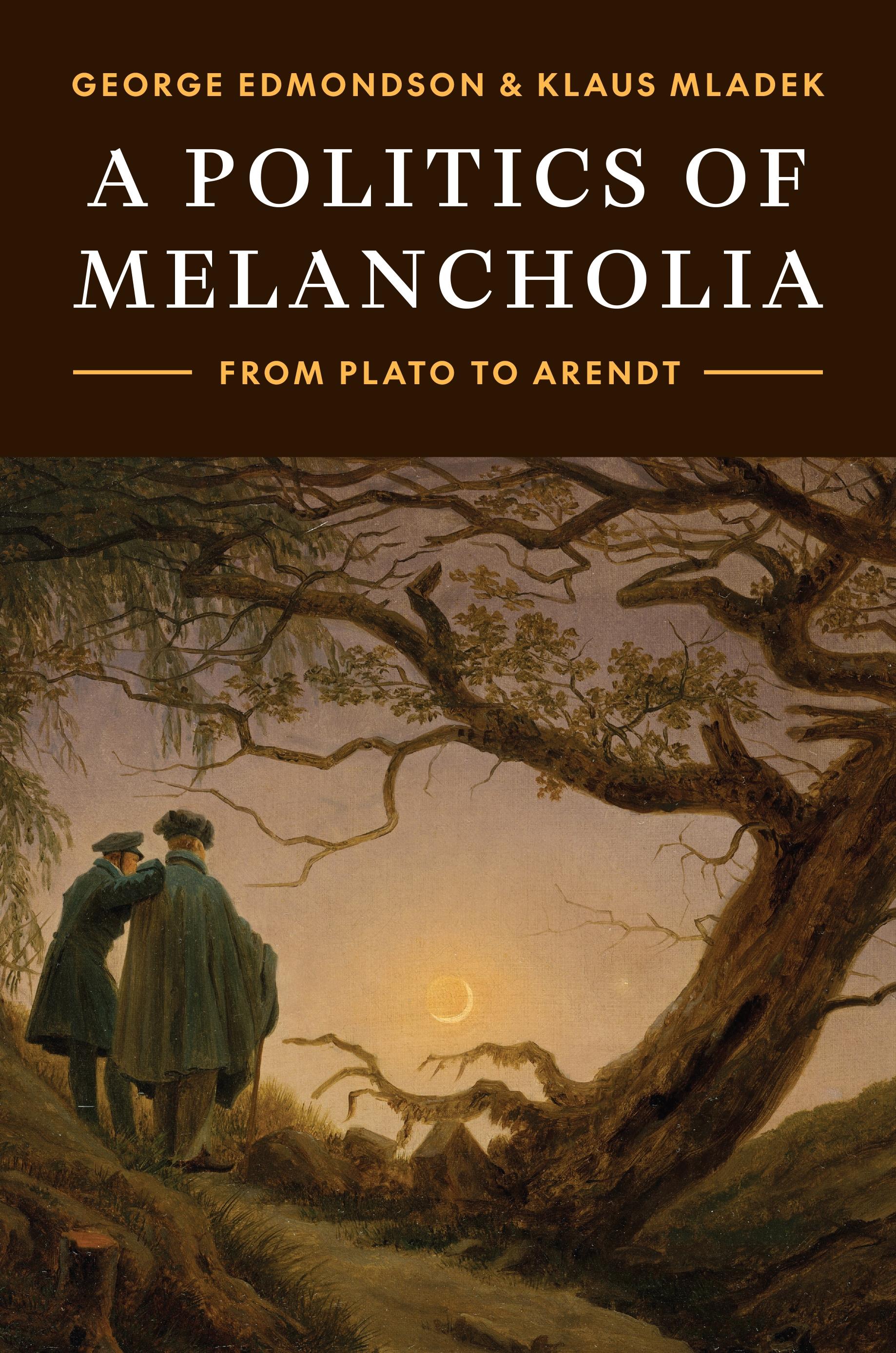
Jacket image: Caspar D. Friedrich, Two Men Contemplating the Moon. ca. 1825–30. Oil on canvas. Wrightsman Fund / Metropolitan Museum of Art
This book has been composed in Miller
Printed on acid-free paper. ∞
Printed in the United States of America
10 9 8 7 6 5 4 3 2 1
Acknowledgments · vii
Prologue 1
chapter 1 The Eros of Stasis: Plato’s Melancholic Republic 30
chapter 2 Hamlet, the Melancholic Prince 65
chapter 3 Woyzeck Is the Worst 107
chapter 4 The Melancholic Transformation of Dr. Freud 141
chapter 5 Melancholia under Capitalism: Marx, Schumpeter, Adorno 192
chapter 6 Arendt’s Melancholic Revolution 220
Notes · 245 Bibliography · 265 Index · 277
acknowl edgments
a book so long in the making as this one teaches protracted lessons in gratitude and humility. We are particularly grateful to Dartmouth’s John Sloan Dickey Center for International Understanding for hosting a seminar devoted to our manuscript and to Timothy Campbell and Dominiek Hoens for generously agreeing to read our work in pro gress. Alongside our Dartmouth colleagues who took part in the same seminar—Andrew McCann, Margaret Williamson, Azeen Khan, and Donald Pease—they helped us transform a folie à deux into a book- to-be. An added note of thanks is due to Azeen Khan, whose timely intervention put the whole project back on track. For their support and friendship over the years, we thank our Dartmouth colleagues Aden Evens, Patricia Stuelke, Colleen Boggs, Michael Chaney, Nirvana Tanoukhi, Alexandra Halasz, Veronika Füchtner, Rebecca Biron, Michelle Clarke, Klaus Milich, Yi Wu, James Godley, Marc Dixon, and Jason Houle. Eric Santner, Gerhard Richter, Adam Sitze, Carsten Strathausen, Kristina Mendicino, Martin Puchner, Amanda Claybaugh, Heather Lukes, Molly McGarry, Jack and Shelley Dumpert, and Reagan Arthur have each done something to sustain the project and its authors, and we thank them. A fellowship from the American Council of Learned Socie ties funded a year of uninterrupted writing and research near the beginning of the project, while the efforts of our indefatigable research assistant, Leah E. Casey, helped ease our workload toward the end. We are forever grateful to our anonymous reviewers at Princeton University Press for returning two deeply engaged, detailed, and generous readings of a long manuscript, and to our editor, Anne Savarese, for showing us that good things do indeed come to those who wait. Finally, we thank Hazel-Dawn Dumpert and Kristin O’Rourke, without whom we wouldn’t be melancholic, just miserable.
Some paragraphs from the prologue made their way into “Chaucerian Humor,” Studies in the Age of Chaucer 41 (2019): 73–105. Material from chapter 4 appears in “The Noise of Neighbors: An Essay on ‘The Blacksmiths’ and Unrelated Matters,” Modern Philology 117, no. 1 (2019): 1–23. Language from chapters 1 and 6 shows up in the entry on “Gerechtigkeit,” in Enzyklopädie der Genauigkeit, eds. Markus Krajewski, Antonia von Schöning, and Mario Wimmer (Konstanz University Press, 2021),
[ vii ]
161–174. A section of the prologue was first published as part of “A Politics of Melancholia,” in A Leftist Ontology, ed. Carsten Strathausen (University of Minnesota Press, 2009). Parts of chapter 5 were first published in the chapter “Natural History” in our edited volume, Sovereignty in Ruins: A Politics of Crisis (Duke University Press, 2017).
a politics of melancholia
Like his father too, whom he also partly resembles, he is always plotting against the fair and good; he is bold, enterprising, belligerent, a mighty hunter, always weaving some intrigue or other, keen in the pursuit of wisdom, sorrowful, but not bereft of resources; a philosopher at all times, terrible as an enchanter, sorcerer, sophist. He is by nature neither mortal nor immortal. But now he springs to life when he gets his way, now he dies—all in the very same day. Because he is his father’s son, however, he keeps coming back to life, but then anything he finds his way to always slips away, and for this reason, Melancholia is never completely without resources, nor is he ever rich.
The curious reader may be wondering where they should look for this fragment of dialogue. Let us spare them the effort: it is nowhere to be found. If it sounds familiar, that is because we have constructed it out of some language from Plato’s Symposium, where it masquerades as Socrates’s myth of the birth of Eros, which he credits not to the historical Aspasia but to the fictional Diotima. We make this construction, drawing on the Freudian technique of fabricating a narrative audacious enough to force a confrontation with a forgotten part of the analysand’s history, not to try the reader’s patience, but to unsettle the history of philosophy just enough to help recover the place of melancholia within it: a place unjustly usurped by love. Having forgotten Freud’s insight that the melancholic temperament is an expression of love, that indeed love can take the ambivalent form of perpetual conflict, undying fury, and discontent in the face of injustice, we have instead grown accustomed to thinking of melancholia as, at best, an ethical disposition or, at worst, a merely personal affliction. What has been lost is the understanding, possessed by both Freud and Aspasia, that the true lover is always melancholic, the authentic melancholic always a lover. That will come as no great revelation to anyone familiar with the Galenic tradition, or the history of medieval and early-modern medicine, or heartache. Our point, however, is not simply the obvious one that there exists an intimate, affective connection between love and melancholy. Our point is that melancholia, being one of the proper names for love, is an interpersonal condition rather than a personal one; and being an interpersonal condition, it exists within the realm of politics. According to Hannah Arendt, one of the “reasons why philosophy has never found a place where politics can take shape” is “the assumption that there is something political in man that belongs to his essence.” Such an assumption, rooted in philosophy’s myopic fixation on man, is fatefully misguided. “Man ,” insists Arendt, “is apolitical.” Politics, by contrast, “arises between men, and so
quite outside of man. There is therefore no real political substance. Politics arises in what lies between men and is established as relationships.”1 Politics is immaterial, a spirit—a daimon, to borrow some language from Aspasia. Or perhaps we should say: politics is a ghost, an intermediary spirit shuttling between human actants (“for God mingles not with man,” as the wise Aspasia tells us). But for that very reason, Arendt is wrong to conclude that philosophy has never found a place where politics can take shape. It did once find a place; but then it just as quickly repressed its knowledge of that place. It silenced the historical Aspasia’s tale of Melancholia, progeny of Poverty and Abandon, in favor of the fictional Diotima’s myth of Eros. It replaced the deinos daimon of melancholia, the daimon of conflict, contestation, and righteous fury, with the doctrine of ideas. Politics was sealed up within a fable of philosophical love.
With that in mind, let us return to our construction. Like all constructions, ours is staged in order to release the spirit of encrypted loss; it thus already takes part in a politics of melancholia. Philosophy became melancholic the moment it turned its back on politics following the death of Socrates—the one death it could neither forget nor forgive.2 But in melancholically turning its back on the daemonic realm of politics, philosophy also, in the paradoxical way of these things, ended up banishing Melancholia. Socrates was made to speak, long after his own death, of the transcendent love that would drive philosophy to seek the truth that would reform the polis. Meanwhile, the deinos daimon Melancholia continued to haunt the outskirts of the city, the lone inhabitant of the lost place of politics, incapable of forgetting the death encrypted in the name of Eros. This was the great injustice, the unforgettable outrage: every thing that Socrates was made to say about love in the Symposium that it was bold, enterprising, belligerent; terrible as an enchanter, sorcerer, sophist; prone to plotting and intrigue; keen in the pursuit of wisdom, sorrowful but not bereft of resources; dying and springing to life again, continually; a philosopher at all times—could also be said, should also be said, about Melancholia. Melancholia’s place had been usurped; Aspasia had been supplanted; their words and characters had been attributed to others. The thing about a spirit, though, is that it can never die; it will always haunt. And so it is with the daimon Melancholia, who, despite being displaced by Eros, has nonetheless managed to maintain a furtive, immaterial existence in certain literary and philosophical texts. Returning to those (mostly canonical) texts, this book seeks to redress the injustice done to the demigod Melancholia by restoring his acolytes to their rightful position as the poets, by turns inventive and destructive, outraged and inspired, of political thought.
We realize, of course, that a critical work on melancholia must seem, at this point, like an exercise in melancholia itself. After all, wasn’t the great age of academic melancholia over and done with by the early aughts? Isn’t melancholia a bit passé? Isn’t W. G. Sebald dead and gone? The ancient disposition of melancholia did indeed enjoy, after long years of confinement, a burst of scholarly interest in the last decade of the twentieth century and the early years of the twenty-first. But as if aware of melancholia’s infernal origins, the representative works from this period— Postcolonial Melancholia , The Melancholy of Race , The Psychic Life of Power—all tend to politicize melancholia only insofar as they cast it in a negative light: an obstacle to authentic political engagement, an affliction in need of a remedy.3 Adding a Foucauldian twist to an uncritical (if also widespread) reading of Freud’s essay “Mourning and Melancholia,” these works bequeath to us a vision of melancholia as doubly sinister: not just morbid and pathological, a species of failed mourning that hinders us from working through the traumatic legacies of the past, but a mechanism of governmentality to boot.
Paul Gilroy’s Postcolonial Melancholia offers a simple case in point. Gilroy’s central claim is that white Britons suffer from—and, more to the point, inflict—a melancholia that amounts to an unethical form of collective forgetting, an almost willful refusal to reckon with the shameful burden of the past. At the most basic level, carriers of postcolonial melancholia find themselves unable to work through, and, in working through, accept, the painful reality of the loss of empire. Exhibiting only the most morbid and pathological characteristics of melancholia, they test the reality of multiculturalism—test it in the way that Freud says the melancholic tests the painful reality of the loss of the loved object—and reject it, managing thereby to forget the shame of the past while at the same time refusing to acknowledge the loss of empire or confront its lasting costs. Not only, then, do white Britons refuse to accept what they view as an impoverished present; their refusal prevents everyone from advancing into a more egalitarian future, one freed from the burden of empire’s supposedly glorious past.
The drawback of this thesis, as we see it, is that it is too quick to cede the power of melancholia, which comes across as little more than an insidious instrument of reactionary oppression, to the wrong parties. Misconstrued as ressentiment, melancholia is left drained of its capacity to challenge, even arrest, existing power formations. Like Anne Cheng, for whom the raced American subject assumes an identity formation indistinguishable from the denigrated object of melancholia—an object disciplined and rejected by turns, an object not fully incorporated into the very
body (politic) that paradoxically cannot do without it for its own identity formation—and Judith Butler, who argues that the lacerating and immobilizing grief of the melancholic interiorizes the violent tactics of social regulation, Gilroy takes what was the conflictual disposition of melancholia and turns it into a form of affective panopticism. No longer recognizable as the spirit of politics, melancholia is hereby transformed into the opposite of itself: a disciplinary instrument through which the subject of power, forced to adopt the thwarted position of the abjected lost object, is denied political participation and full citizenship.
A corrective to this disciplinary version of melancholia was offered by a second tradition—let’s call it the sorrowful-recollective—inspired by Derrida’s revision of melancholia as the ethically retentive counterpart to forgetful mourning.4 The wellspring of this tradition, David Eng’s and David Kazanjian’s preface to their edited collection, Loss, deserves special comment, which we will reserve for later. A more recent example, and one that shows just how fluid and heterogeneous these traditions can be, is Joseph R. Winters’s Hope Draped in Black. There is much we admire in Winters’s approach, in par tic ular his fruitful campaign to make “strange bedfellows” of the Black literary tradition and the critical theory of the Frankfurt School.5 We likewise share Winters’s desire to liberate melancholia from the orthodox Freudianism that arguably ends up constraining the work of Butler and Cheng. And we are fully on board with his critique of the American model of amnestic pro gress. Where we part com pany is over the potenza the power and potential—of melancholia itself. In keeping with what we regard as the self-imposed limitations of a merely ethical, as opposed to fully political, melancholia, Winters is too quick to reduce melancholia to a program of remembrance and the recollection of loss, as if Walter Benjamin’s angel of history, whom Winters invokes, were not being irresistibly propelled (albeit backward) into the future. Such an approach, we feel, downplays the poietic dimension of melancholia, its capacity for making as well as for remembering, “registering,” and “unsettling.” If there is hope, it is not only because “expressions of ‘death and disappointment’ ” can “simultaneously voice longings for a better, more just existence”; it is because our situation is utterly hopeless, and hopelessness is the mother of political poesis.6 That is why, though we have no wish to deny anyone their historical claim to incomparable sorrow or question the “heightened receptivity to loss” acquired through the intergenerational trauma of “race-inflected violence and suffering,” we resist the idea that the cause of melancholia is temporal rather than lost, or that the melancholic’s contemplative gaze must be directed backward rather
than downward—that its perspective must be historical and not, as we will go on to argue in these pages, drawing on the language of Marxian critique, natural historical.7 As we understand it, the power of melancholia, like that of thought and judgment, belongs to everyone (the pallor of our canonical representatives notwithstanding). The political melancholic affirms, sorrowfully but also jubilantly, our common condition of living in the midst of the worst.
That common condition has been brilliantly diagnosed, and at times brilliantly countered, by the works of what we will call the affective tradition, works such as Jonathan Flatley’s Affective Mapping, Rebecca Comay’s Mourning Sickness, and Jonathan Lear’s Radical Hope. 8 Indebted as much to Heidegger and Benjamin as to psychoanalysis or poststructuralist ethics, these works make a powerful case for understanding melancholy as both persistent and ubiquitous: nothing less than the Stimmung of a modernity ushered in by the French Revolution. But melancholy, however ubiquitous as a mood, is not in and of itself political; or, rather, its affirmative political dimension remains latent if it is treated only as an affective atmosphere or as the basis for a “counter-mood.”9 Where the governmental and recollective traditions leave us with a mostly negatively politicized melancholia recuperable only as the work of mourning, these later works bequeath us a melancholia that manifests as a mood to be managed rather than as a form of thought capable of transforming the outside world. Correspondingly, they figure a melancholic who has attunement but lacks praxis.
Our melancholic is different. A figure standing both for what needs to be done and for what remains unrealizable in the world’s political aspirations, our politicized melancholic, far from being indifferent, marginalized, or affectively disciplined, embodies the universal condition of communal life: a discontent that so vexes and irritates a community’s members that it becomes the common symptom binding them together. In that respect, the affective dimension of the melancholic disposition remains most faithful to the common cause of a polity. Faithfully, then, this book returns, in true melancholic fashion, to some of the unforgettable offenses on which communities, whether imagined or historical, have been founded: the death of Socrates; the fratricide in Hamlet; Woyzeck’s killing of Marie in Georg Büchner’s Woyzeck; the murder of Moses in Freud’s last text; the violent appropriation of nature by the invisible hand of the market; the intergenerational betrayal of the revolutionary idea that Hannah Arendt detects in the aftermath of the revolutions of the eighteenth century. Such returns are neither nostalgic nor recuperative. Rather, they repeat the melancholic gesture of holding on to the worst—of affirming the common sense that
there is indeed something rotten, not only in the state of Denmark, but universally. Yet even as our melancholic practice remains attuned to histories of wreckage and grief, it follows Hamlet in turning the tactical ruses and surprises of the nocturnal temperament to a different end than selflaceration or, just as impor tant, self-recovery. Political melancholia, as we have come to understand it through our readings of literary and philosophical texts, is mournful but also jubilant, catastrophic but also poietic. It is the name we give to the restive dimension of an ageless affect, an immemorial mood of unbending disconsolation. And while its presence can be detected in the recorded histories of successive political orders, it cannot be said to belong to or arise from any of them. More closely aligned with what Roberto Esposito, reflecting on the commencement of a continuously emergent revolutionary beginning, terms “the origin of the political” than with any conventional concept of politics, melancholia is political in that it organizes the other volatile sentiments, particularly shame, anxiety, and wrath, that human culture carries over from its prehistory.10 Following in the footsteps of a tradition of melancholic thinkers descended from Aristotle, we argue that those affective registers of melancholia, in affirming the worst, are what enable us to open a space for “the existence of the unreal” that not only makes us courageous and just but that also enjoins us to think something new.11
Among modernist proponents of that tradition, Benjamin is surely the most well-known, and with good reason, as we will see in a moment. Yet Benjamin was not alone in recognizing what he called the “motorial” force of melancholia; he had precursors.12 When Kierkegaard, for example, raised the restlessness of anxiety to the dignity of a philosophical object, he declared melancholia to be the “ailment of our age”—but an “ailment” so dear to him, of such “utmost importance,” that he could never do without it. “The strange ideas of my melancholy,” he wrote, “I do not give up.”13 It is not the destruction of traditional beliefs that causes this epochal ailment. Rather, what occasions this crisis is the melancholic way of thinking itself: the revelation of another history and another politics brought about by what Theodor Adorno, in his study on Kierkegaard, calls the melancholic’s “specific engagement with historical realien.” 14 In making a ruin appear out of the flotsam washed ashore from the tradition of the forgotten, melancholia makes a crisis. The melancholic, as Kierkegaard emphasizes, has “uncommon powers” in dealing with reality, even when he is inwardly shattered by it and his immense capacities are concealed from him under the guise of providence.15 The melancholic recalls something essential from history—remnants of long forgotten figures and past
struggles—and discovers in them the necessity of another path, a deeper passion. That passion is attuned to an affirmative mode of mourning, of “standing face to face with nothingness,” of wishing that the echo of your mourning and your emptiness would reverberate back to you.16 As Adorno demonstrates, Kierkegaard’s philosophy originates in melancholia, which becomes something akin to a transcendental affect. From out of a specific struggle with historical realities, melancholia makes possible not just the emergence of new truths, but the different aesthetic and attitude toward life those truths require.17
Benjamin’s Origin of German Tragic Drama takes this philosophy a step further. For Kierkegaard, melancholy was the “ailment of our age” precisely because it named an interior state, albeit one pensively engaged with historical realities. Benjamin transforms the melancholic disposition into something impersonal, a generalized mood of the world that surpasses any compensatory schemes pursued by the interiorizing “work of mourning” (Trauerarbeit). Mourning plays, observes Benjamin, “are not so much plays that cause mourning, as plays through which mournfulness finds satisfaction”; they are “plays for the mournful” (119). This is a historical claim about the experience of the profaned world after the death of tragedy. But it is also a way of acknowledging that mournfulness, now freed from the cell of subjective dejection, has become persistent and pervasive, detectable in all objects and spheres of life. When Benjamin ties “the theory of mourning” to a feeling “which is released from any empirical subject and is intimately bound to the fullness of an object,” when he celebrates the “astounding tenacity of intention” “at the heart of mourning,” “capable of a special intensification” “matched perhaps only by love,” he thus does more than diagnose melancholia as a reaction to a world suddenly emptied of meaning. He describes a world “which is revealed under the gaze of the melancholy man”: a world in which the subject is apprehended by the “solemn” intention “within the object itself.” “Mourning is the state of mind” that is “bound to an a priori object.” Persevering like love, “and that not playfully,” as Benjamin is quick to clarify, the melancholic state of mind is more persistent, more pervasive, and more generalized than it first appears. “Only called a feeling because it does not occupy the highest place,” melancholia is shown by Benjamin to be categorical, an ontology, the a priori condition of life in modernity (139).
What finally makes that melancholic ontology affirmative, and not merely a new version of acedia, is the place of repetition within it. “The never-ending repetition” characteristic of the Trauerspiel its reliance on grave processions and ostentatious displays, on empty ceremony and
pomp—“secures the bleak rule of a melancholic distaste for life,” according to Benjamin (140). That way of describing the staginess of Trauerspiel may make it sound as though the genre trafficked in a clichéd version of the melancholic temperament, which is often accused of being fixated, ruminative, spiraling, tedious: repetitive in the worst sense. But what Benjamin in fact describes is how the melancholic passion for stilted ostentation and halting procession reveals an enigmatic dynamism stored up in historical phenomena, precisely by bringing those phenomena to a standstill, objectifying them, and draining them of their vitality. In the deadening “depersonalization” performed by Trauerspiel, Benjamin locates the mechanism of a peculiarly melancholic poesis. Offstage, “the deadening of the emotions, and the ebbing away of the waves of life which are the source of these emotions in the body, can increase the distance between the self and the surrounding world to the point of alienation from the body.” When staged as Trauerspiel, “the concept of the pathological state, in which the most simple object appears to be a symbol of some enigmatic wisdom because it lacks any natural, creative relationship to us, was set in an incomparably productive context” (140). Yet productive how, one might ask, and of what? One answer to that question comes by way of Howard Caygill’s gloss on Benjamin’s claim that there will eventually come a point “where the universe has been taken over by that despair which is actually its secret hope.” “When there is only repetition,” explains Caygill, “then the affirmation of it creates a novelty and thus breaks the immanence of repetition.”18 Analogously, the melancholic affirmation of repetition, dramatized in “the never-ending repetition” of Trauerspiel’s paradoxically frozen processions, breaks the immanence of mere repetition by performing a transmutation of mourning that is truly novel. 19 Repeatedly replaying the alienation of the self in relation “to the surrounding world,” increasing the “symptom of depersonalization . . . to an intense degree of mournfulness,” Trauerspiel gives rise to a new, and newly redeemed, form of mourning. The “contemplative paralysis” formalized in the genre’s incessant repetition reveals that mourning is double: that the self-absorbed object of mourning does not coincide with itself; that it is outside of itself, different from itself, a surprise to itself (140).
As Benjamin demonstrates, nowhere is this turn of melancholia toward affirmation clearer than in Shakespeare’s Hamlet : “[Hamlet’s] life, the exemplary object of his mourning, points, before its extinction, to the Christian providence in whose bosom his mournful images are transformed into a blessed existence. Only in a princely life such as this is melancholy redeemed, by being confronted with itself” (158). Melancholia
grasped in this fashion, at the point where it encounters and interrupts itself, where it is repeated and affirmed and where it is no longer contained in a form but effects a transformation, “inspires itself to new life” and awakens “within itself the clear light of self-awareness” (158). Even the most despairing and destitute melancholia, once fully affirmed, would become something other than mere despair and destitution. In fact, it may pass over from being affirmative to being, like divine violence or the proletarian general strike, “afformative”: the insertion into history of a caesura, a pause or paralysis that is also a fundamental interruption.20 This paralysis, wherein “no work is done, nothing is produced, and nothing is planned,” not even the work of mourning, is the political event of affirmative melancholia.21 It manifests a new sociality, a melancholic collective attuned to the bleak rule of an empty world, like the mourners in the frozen processions of Trauerspiel.
The reader can be forgiven for thinking that this affirmative version of melancholia bears only a passing resemblance to melancholia as it is commonly understood. How did it come to that? How did it happen, to pose the question a different way, that the figure who inspired an awestruck Aristotle to wonder, “Why is it that all men who have become outstanding in philosophy, statesmanship, poetry or the arts are melancholic?” got driven underground, forced to endure a furtive and disreputable existence on the outskirts of the polis? Should we blame Cassian, who warned his fellow cenobites that “our sixth combat is with what the Greeks call ἀκηδία [acedia], which we may term weariness or distress of heart”? Or should we blame Pinel, who, after describing melancholia in the usual fashion (“The symptoms generally comprehended by the term melancholia are taciturnity, a thoughtful pensive air, gloomy suspicions, and a love of solitude”), declared that “nothing . . . can be more hideous than the figure of a melancholic, brooding over his imaginary misfortunes”?22 Many commentators would be inclined to point the finger at Freud and at his 1917 essay “Mourning and Melancholia,” in particular. We, however, wish to point a different finger in a slightly different direction, toward an overly deferential reading of Freud’s essay and of its revision, six years later, as part of The Ego and the Id. Freud begins “Mourning and Melancholia” by drawing a contrast—too sharp, in the opinion of later commentators—between the work carried out by “normal” mourning, on the one hand, and “pathological” melancholia, on the other. The former process, avers Freud, holds little mystery. Having first “shown that the loved object no longer exists,” “reality-testing” then “proceeds to demand that all libido shall be withdrawn from its attachments to that object.”23 Understandably, this process, which gets “carried
out bit by bit, at great expense of time and cathetic energy,” can drag on, and it often arouses an opposition on the part of the ego “so intense that a turning away from reality takes place and a clinging to the object through the medium of a hallucinatory wishful psychosis” (14:244). In the end, though, concludes Freud, experience shows “that when the work of mourning is completed the ego becomes free and uninhibited again,” ready to transfer its libido to another object (14:245). In melancholia, by contrast, no transference of libidinal energy to a new object occurs; instead, that free libido is withdrawn into the ego, where, Freud tells us, “it [is] not employed in any unspecified way, but [serves] to establish an identification of the ego with the abandoned object” (14:249). The result, according to Freud, is an entrenched ambivalence, on the part of the ego, toward the object—that is to say, toward that portion of itself that identifies with the object. On the one hand, the ego’s “narcissistic identification with the object . . . becomes a substitute for the erotic cathexis, the result of which is that in spite of the conflict with the loved person the love-relation need not be given up” (14:249). Or, as Freud puts it a few pages later, “by taking flight into the ego, love escapes extinction” (14:257). At the same time, however, the melancholic continues to harbor feelings of aggression and hostility toward the object that abandoned, injured, or other wise disappointed the ego. “If the love for the object—a love which cannot be given up though the object itself is given up—takes refuge in narcissistic identification,” writes Freud, “then the hate comes into operation on this substitutive object, abusing it, debasing it, making it suffer and deriving sadistic satisfaction from its suffering” (14:251). Inwardly directed, played out again and again (“In melancholia . . . countless separate struggles are carried on over the object, in which hate and love contend with one another” [14:256]), ambivalence ensures that it is not only love for the object that the melancholic preserves but conflict, too. As Freud puts it in a famous passage:
[T]he shadow of the object fell upon the ego, and the latter could henceforth be judged by a special agency, as though it were an object, the forsaken object. In this way an object-loss was transformed into an ego-loss and the conflict between the ego and the loved person into a cleavage between the critical activity of the ego and the ego as altered by identification (14:249).
Having declined the reality principle’s injunction to transfer their libidinal energies to another object, the melancholic gets ambivalence and internalized aggression instead.
That, at least, is one way of reading the situation. We believe, however, that there is more implied by, even embedded in, Freud’s diagram of the psyche than ambivalence or a conflict turned inward. What the diagram gives us instead is a model for neutralizing sovereign power, which in turn frees us to pursue a politics bereft of the consolations of mastery. Consider the intersection of identification and the ego ideal. The superego, Freud tells us in The Ego and the Id, arises out of the nascent ego’s identification with the ego ideal.24 The gestures of melancholia, meanwhile, repeatedly stage a history in which the feelings associated with what Freud calls “the loss of an ideal kind”—outrage, disappointment, disillusionment, “dissatisfaction with the ego on moral grounds”—get transferred onto the object, which is then criticized, in turn, by the “institution” or “agency” that Freud will eventually label the superego (14:246). In “Mourning and Melancholia,” Freud presents this as a quasi-political parable in which a “mental constellation of revolt” has “passed over into the crushed state of melancholia” (14:248). But here Freud misapprehends as capitulation what is in fact a peculiar tactic of the melancholic. The superego, we know, needs the ego in the same way a sovereign needs cowering subjects. Like the sovereign, the superego thrives on the cultivation of par ticular affects: dread, certainly, but also the pleasures associated with failure and resignation. Yet Freud says something else about the melancholic ego. He says that “the complex of melancholia behaves like an open wound, drawing to itself cathectic energies . . . from all directions, and emptying the ego until it is totally impoverished” (14:253). This is one key to understanding melancholia as a political disposition: the fact that it drains the psychical complex of the affects, the dread and suffering and perverse pleasure, on which the superego ordinarily feeds. With the ego thus depleted— a situation too easily mischaracterized as impotence or a lack of agency—the superego becomes bonded to the object, becomes, as it were, completely absorbed in the object, like a monarch who, deprived of cowering subjects, spends all day staring at his moldering coronation robes and dented crown. Far, then, from laying out a straightforward political parable— cruel and oppressive superego on one side of the barricade, crushed ego on the other—Freud’s diagram in fact schematizes a self-enclosed system collapsing in upon itself, with the superego berating and denigrating an object that is really only a part of the self-same complex: the derivative of an ego ideal lacerating itself for its own loss.
Freud himself provides us with a compelling image of this dynamic. Describing the unconscious nature of melancholia— oftentimes, the melancholic “knows whom he has lost but not what he has lost in him,”
suggesting “that melancholia is in some way related to an object-loss which is withdrawn from consciousness”—Freud notes the following:
In mourning we found that the inhibition and loss of interest [in the outside world] are fully accounted for by the work of mourning in which the ego is absorbed. In melancholia the unknown loss will result in a similar internal work and will therefore be responsible for the melancholic inhibition. The difference is that the inhibition of the melancholic seems puzzling to us because we cannot see what it is that is absorbing him so entirely (14:245–246).
That Freud himself should fail to see what it is that absorbs the melancholic so entirely is instructive, if not altogether surprising. For it never seems to occur to Freud, as it never seems to occur to certain critics of melancholia, that there could be a form of melancholia that has nothing to do with, and cannot be understood by, any would-be sovereign figure: a melancholia that, far from being beholden to the superego, circumvents it altogether. For such a melancholia, the superego represents, at best, an obstacle to be overcome—a pretender seeking to claim credit for a disposition that precedes it—on the way to accomplishing a larger goal. The melancholic has no choice, then, but to develop tactics; and here we encounter one of them. Freud confesses that he cannot see what absorbs the melancholic so completely. And yet Freud himself remains completely absorbed in the melancholic’s absorption in the unconscious object. Absorbed by absorption, with no ego to distract him, Freud becomes lost to the realm of the lost object.
Meanwhile, the melancholic is free to direct her pent-up energies elsewhere. “The most remarkable characteristic of melancholia, and the one in most need of explanation,” observes Freud, “is its tendency to change round”—the language already evokes revolution—“into mania” (14:253). “What has happened here,” Freud goes on to conjecture, “is that, as a result of some influence, a large expenditure of psychical energy, long maintained or habitually occurring, has at last become unnecessary, so that it is available for numerous applications and possibilities of discharge”— among which we would like to include, not just political action alone, but that paradoxical combination of discontent and sublime fury which allows us to contemplate the unreal (14:254). Freud then arrives at the following conclusion:
In mania, the ego must have got over the loss of the object (or its mourning over the loss, or perhaps the object itself), and thereupon the whole quota of anticathexis which the painful suffering of melancholia
had drawn to itself from the ego and “bound” will have become available. Moreover, the manic subject plainly demonstrates his liberation from the object which was the cause of his suffering, by seeking like a ravenously hungry man for new object-cathexes (14:255).
As Freud interprets it, mania amounts to something like an extreme resolution of mourning: evidence that the subject has at last “got over” the object. But if mania seems triumphant, it is not because the melancholic has abandoned the object (although he may have transcended loss, which is something else entirely); it is because he has devised a strategy to neutralize the superego. What mania signals is not the final convergence of melancholia with mourning. That would be to misunderstand how melancholia perpetuates and even intensifies the conflict that mourning seeks to resolve. What mania signals is the next, furious phase in the melancholic’s project, made possible by abandoning the superego to the object. But not, let us reiterate, by abandoning the object. Freud contends that the manic subject, newly liberated from the crushed state of melancholia that inevitably follows the psyche’s failed revolt against reality, seeks like a ravenously hungry man for a new object in which to invest their libidinal energies. That, however, is to assume that melancholia and mania are mutually exclusive states. It is also to ignore the possibility that they exist on a continuum, with mania functioning as a more heightened, and indeed more radicalized, version of melancholia: a melancholia that has overcome being crushed and, newly emboldened, returned to a “mental constellation of revolt.” Recall that Freud characterizes melancholia as a state of sustained ambivalence, an admixture of love and hate for the incorporated (and unrelinquished) object, a confusion of fidelity and conflict. Eager to identify any evidence that “healthy” mourning always wins the day, Freud imagines an uplifting scenario in which the emancipated maniac, having freed himself from the object whose incorporation has caused him so much suffering, seeks after new object-cathexes. But what if the melancholic turns manic not because they have relinquished the object but because they have figured out the true power of cathexis? What if melancholics were demonstrating their liberation not by seeking new object-cathexes in the outside world but by cathecting to the object in just the way that Freud says they do: by investing their free libidinal energies not in the object as such but in the “vehement passions,” the conflict of love and love of conflict, associated with it?25 When Freud observes that the most remarkable thing about melancholia is its tendency to turn round—to make a revolution—into mania, he bears witness to the
liberated melancholic’s recovery of the mental constellation of revolt, now under the furious, inspired guise of mania.
So: the political melancholic has the power to arrest the would-be, superegoic master by absorbing the latter’s attentions in the realm of the object. They also have the capacity to liberate themselves from the suffering caused by their incorporation of the object, not by ravenously seeking after new, compensatory object-cathexes (the melancholic is nothing if not faithful), but by cathecting their libidinal energies to the mental constellation of revolt, the undying love and endless conflict, associated with the object. With that reframing of the melancholic temperament in mind, we would now like to raise a more fundamental question: What exactly is the “lost” object of melancholia? Freud himself is somewhat vague on the topic, associating it both with the loved object and with an unspecified “what”—an ideal, say, or an aspiration, or some grand plan—that is lost when the object as such is lost. In the specific case of political melancholia, however, the “what” that is lost is politics itself. Here we diverge from Giorgio Agamben, who in his own reading of the lost object of melancholia argues that melancholy “would be not so much the regressive reaction to the loss of the love object as the imaginative capacity to make an unobtainable object appear as if lost.”26 Melancholia is reassuringly deceptive, according to Agamben. If the object in question has never in fact been possessed, melancholia will delude us into believing that it is merely lost; if the object in question could never be possessed only because it never existed, melancholia will delude us into believing that it may be appropriated, imaginatively, as something lost. This, we wish to argue, both is and is not the case with politics, and has been from its origin. We have never known, nor ever had, politics. But neither is politics “lost” in the way that Foucault implies when he argues that the death of Socrates ushered in “a form of veridiction peculiar precisely to philosophical discourse, and the courage of which must be exercised until death as a test of the soul that cannot take place on the political platform.”27 Politics is lost, like the object in melancholia is lost, only insofar as it has never been possessed. And therein lies the true cause of melancholic grief, as well as its power of affirmation. We have had any number of spurious, compensatory objects in the place of politics—governmentality, war, the sovereign exception, postpolitical competition, and political economy all come to mind—but we have only ever known politics as something lost. The political melancholic has been dissatisfied with every one of those substitutes, every one of those compensatory objects soliciting their, and our, libidinal cathexis. The political melancholic is not so naïve, however, as to believe