Edited by Christopher Bulstrode, James Wilson-MacDonald, Deborah M. Eastwood, John McMaster, Jeremy Fairbank, Parminder J. Singh, Sandeep Bawa, Panagoitis D. Gikas, Tim Bunker, Grey Giddins, Mark Blyth, and David Stanley
Oxford Textbook of Fundamentals of Surgery
Edited by William E. G. Thomas, Malcolm W. R. Reed, and Michael G. Wyatt
Oxford Textbook of Vascular Surgery
Edited by Matthew M. Thompson, Robert Fitridge, Jon Boyle, Matt Thompson, Karim Brohi, Robert J. Hinchliffe, Nick Cheshire, A. Ross Naylor, Ian Loftus, and Alun H. Davies
Oxford Textbook of Urological Surgery
Edited by Freddie C. Hamdy and Ian Eardley
Oxford Textbook of Neurological Surgery
Edited by Ramez W. Kirollos, Adel Helmy, Simon Thomson, and Peter J. Hutchinson
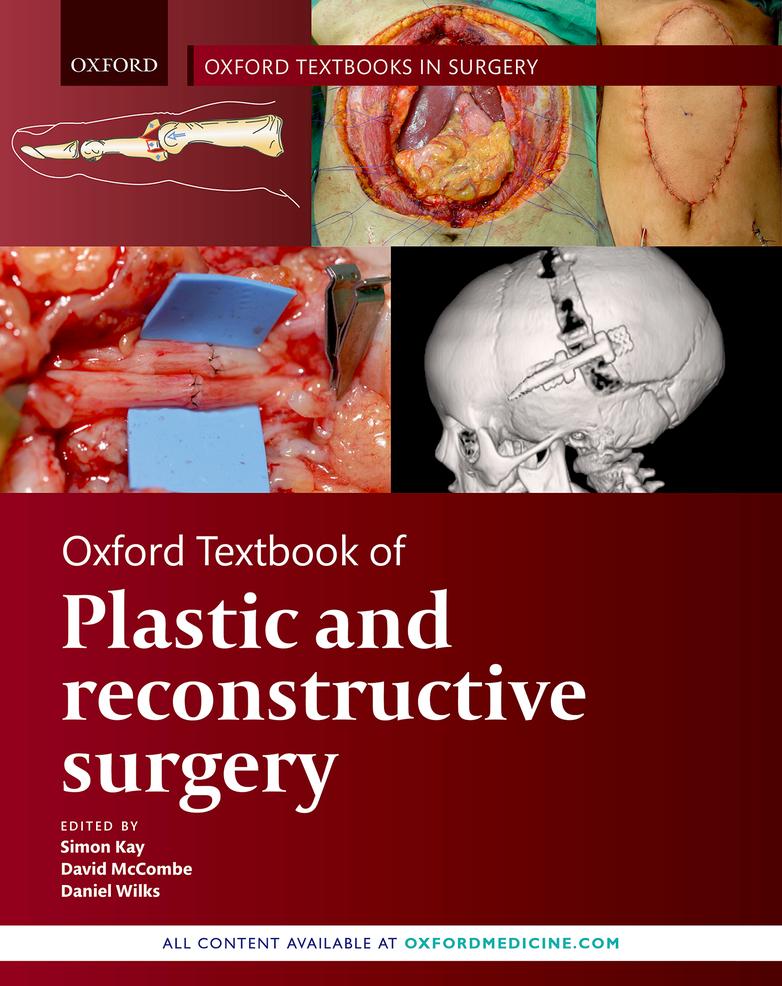
Oxford Textbook of Plastic and Reconstructive Surgery
Edited by Simon Kay, Daniel Wilks, and David McCombe
Oxford Textbook of
Plastic and Reconstructive Surgery
EDITED BY Simon Kay
Consultant Plastic Surgeon, Plastic and Reconstructive Surgery Department, Leeds Teaching Hospitals NHS Trust, Leeds, UK
Daniel Wilks
Consultant Plastic Surgeon, Plastic and Maxillofacial Surgery Department, The Royal Children’s Hospital, Melbourne, Australia
David McCombe
Clinical Associate Professor, Plastic and Maxillofacial Surgery Department, The Royal Children’s Hospital, Melbourne, Australia
3
Great Clarendon Street, Oxford, OX2 6DP, United Kingdom
The moral rights of the authors have been asserted
First Edition published in 2021
Impression: 1
All rights reserved. No part of this publication may be reproduced, stored in a retrieval system, or transmitted, in any form or by any means, without the prior permission in writing of Oxford University Press, or as expressly permitted by law, by licence or under terms agreed with the appropriate reprographics rights organization. Enquiries concerning reproduction outside the scope of the above should be sent to the Rights Department, Oxford University Press, at the address above
You must not circulate this work in any other form and you must impose this same condition on any acquirer
Published in the United States of America by Oxford University Press 198 Madison Avenue, New York, NY 10016, United States of America
British Library Cataloguing in Publication Data
Data available
Library of Congress Control Number: 2020945296
ISBN 978–0–19–968287–4
DOI: 10.1093/med/9780199682874.001.0001
Printed in Great Britain by Bell & Bain Ltd., Glasgow
Oxford University Press makes no representation, express or implied, that the drug dosages in this book are correct. Readers must therefore always check the product information and clinical procedures with the most up-to-date published product information and data sheets provided by the manufacturers and the most recent codes of conduct and safety regulations. The authors and the publishers do not accept responsibility or legal liability for any errors in the text or for the misuse or misapplication of material in this work. Except where otherwise stated, drug dosages and recommendations are for the non-pregnant adult who is not breast-feeding
Links to third party websites are provided by Oxford in good faith and for information only. Oxford disclaims any responsibility for the materials contained in any third party website referenced in this work.
To Rowan, Cyrus, and Jacob, and to my teachers, especially my patients.
To Anna and Emmeline for joining me on the journey and my family, friends, and colleagues for helping me find the way.
To Georgie, Lachie, Finn, and Stella, to my mentors and to those willing to learn.
Series preface
This is a new development in surgical publishing; the first two editions of the Oxford Textbook of Surgery are to be replaced by a series of specialty-specific textbooks in surgery. This change was precipitated by the ever-increasing size of a single textbook of surgery which embraced all specialties (the second edition of the Oxford Textbook of Surgery was three volumes), and a decision to adapt the textbooks to meet the needs of the audience; firstly, to suit the requirements of Higher Surgical trainees and, secondly, to make it available online.
Thus, we have produced a key book to deal with the fundamentals of surgery, such as Anatomy, Physiology, Biochemistry, Evaluation of Evidence, and so forth. Then there are to be separate volumes covering individual specialties, each appearing as an independent textbook and available online via the Oxford University Press Academic Platform.
It is planned that each textbook in each specialty will be independent although there obviously will be an overlap between different specialties and, of course, the core book on fundamentals of surgery will underpin the required scientific knowledge and practice in each of the other specialties.
This ambitious programme will be spread over several years, and the use of the online platform will allow for regular updates of the different textbooks.
Each textbook will include the proposed requirements for training and learning as defined by the specialist committees (SACs) of surgery recognized by the four Colleges of Surgery in Great Britain and Ireland, and will continue to be applicable to a global audience.
This ambitious programme will be spread over several years, and the use of the online platform will allow for regular updates of the different textbooks.
When completed, the Oxford Textbooks in Surgery series will set standards for a long time to come.
Professor Sir Peter J. Morris Nuffield Professor of Surgery Emeritus, and former Chairman of the Department of Surgery and Director of the Oxford Transplant Centre, University of Oxford and Oxford Radcliffe Hospitals, UK
Introduction
The word ‘text’ is derived from the Latin texere meaning to weave, to join, fit together, or braid. This is particularly apt in this case as the editors have attempted with a broad loom to assemble a comprehensive description of Plastic Surgery. As will be described in the following chapters, Plastic Surgery is a specialty that encourages the practitioner to apply its principles and techniques to resolve, repair, and reconstruct across all the domains of the body. Consequently, the breadth of the specialty can be simultaneously inspiring and intimidating to the surgeon, as they may be presented with a diversity of challenges that can be addressed with principle-based decision making but require nuanced knowledge of the issues that relate to the individual problem.
The genesis of this text owes much to its ancestor, the Oxford Textbook of Surgery, edited in 2000 by Sir Peter Morris and William Wood. This comprehensive and authoritative reference was designed to meet the demands of specialists and trainees addressing general surgery and several other specialties. Its evolution into what is now a series of 11 multivolume texts, overseen by Sir Peter, detailing the entirety of surgery is testament to the innovation and dedication that typifies his remarkable career.
Our purpose is to offer the aspiring surgeon a comprehensive guide to Plastic Surgery as well as provide a reference for those who are established in their practice. We have attempted to encompass the curriculum of the Royal College of Surgeons fellowship in Plastic Surgery and have added further chapters where necessary to arm the surgeon with knowledge. We have enlisted a range of authors from around the globe and are grateful for the incisive knowledge and enthusiasm that they have brought to this project.
A multiauthor text such as this relies upon the generosity of experts in their individual fields in being prepared to educate all of us with their hard-won knowledge to the benefit of all of
our patients and their families and we are grateful for this. The editors are also grateful to the section editors who have assembled their individual teams of authors and shepherded them all through the process of chapter development to submission and have been invaluable in their efforts to produce the inaugural edition of this text.
The organisation and production of this textbook relies upon the specialist knowledge and the strength of a publisher and the editors thank Oxford University Press for their support and expertise in helping to bring this project to fruition. The editors would like to thank Caroline Smith, Jamie Oates, and Helen Liepman of Oxford University Press in particular for their support, coaching and coaxing throughout the gestation and birth of this work.
The continuing development of an innovative discipline such as Plastic Surgery means that what is written in these pages today inevitably will have evolved by tomorrow. That does not make this text obsolete or redundant. Such progress is only possible on a solid foundation of knowledge, summarised and consolidated from time to time, which this text provides. We are grateful that you as a reader are using this work as your foundation in your own areas of development.
Simon Kay
Daniel Wilks
David McCombe
Preface
Healing after injury is a remarkable biological phenomenon found in all vertebrates, given the opportunity. To hasten or improve healing by surgical repair may have been practiced throughout the history of our species, but to go one step further and to reconstruct damaged anatomy has been only a dream until the last few hundred years. It was a miracle that Jesus could reattach the ear of one of his captors, and the legend of Saints Cosmos and Damien transplanting a lower limb was of course fantastical also. Things began to change when flap surgery for nasal reconstruction, passed down by artisan surgeons in the east, emerged in the west, first in Sicily, before being reported from British colonial India. Free grafting was slower to be investigated and understood, even though the corresponding horticultural practices were well established. Paul Bert’s experiments on skin grafting in sheep were early examples of science in reconstructive surgery, possibly influencing Reverdin in clinical practice a short time later.
The advents of asepsis and anaesthesia allowed more and more empirical experience, rather than laboratory experiment, on the repair and reconstruction of the integument. This moved from simply closing the difficult wound to consideration of aesthetics. The First World War, the first industrialised conflict employing high- explosive and trench warfare, produced the pabulum of facial and head injuries on which the innovations of surgeons like Morestin, Esser, Valadier and Gillies were nourished.
The Second World War saw another great step forward for surgical practice with the development of antimicrobial drugs. That conflict left us the legacy of extensive skin grafting and burns reconstruction, as well as the prompt evacuation of field casualties. The Korean and Vietnamese conflicts especially capitalized on these protocols and saw step advances in vascular surgery, cavity surgery and neurosurgery. The Second World War heralded an era of proliferating surgical spin-offs, and plastic surgery took its place amongst the major acute disciplines. Many of the facial trauma bone fixation techniques of the first conflict were now applied to hand and limb surgery. Scientific enquiry took a firm hold of our burgeoning specialty, wonderfully exemplified by the collaboration between Gibson and Medawar whose investigation into the “second set” skin grafting phenomenon started the modern understanding of immunology and transplantation.
Since then the efflorescence of scientific and empirical reconstructive surgical developments has been remarkable, from the cornfields of Kentucky to the highways of Slovenia, the People’s
Hospitals of China, the clinics of Europe and throughout the world. Every surgical discipline has contributed to the growth of plastic surgery, and every surgical specialty has learned and benefited from it. Our boundaries are wonderfully indistinct and porous and yet we preserve a distinct identity at the focal point of the reconstructive web.
But something else has happened. We moved from asking only “how?” to asking “why?”, and to examining our outcomes more rigorously and within wider frames of reference. Surgeons moved gradually to consider not just the form, or appearance of restored anatomy, but also the activity or function of the reconstructed part. Many metrics were designed and recorded to reflect this urge to restore activity and function. But physiological function was not the final goal. Forty years ago or more, craniofacial units, for example, started to realise that the best judges of surgical aesthetic outcomes might be a child’s peers, not the surgeon or even the parents. At about the same time surgeons began to include the concept of participation as an outcome. How closely did the patient integrate back into the normal activities of life and partake in their society? How did a patient feel about themselves? How did they behave? Finally we saw the “why?” of surgery emerge into stark scrutiny. What worth has a sophisticated and successful suite of surgery to restore form or function if the patient is no better psychologically or socially?
The human body transports and nourishes the acme of evolution that is the human brain, which in turn holds the mystical entities that are the mind and spirit. It is remarkable, through the intercession of social mechanisms, how a defect in the body can adversely influence the expression of these latter two. More and more we realise that our success in treating the physical, the appearance and function of the body, can only be interpreted through the prism of behavior. Each of us must be empathetic to our patients’ minds and collaboration in psychology should be the norm. Perhaps Harvey Cushing knew this when he said “I would like to see the day when somebody would be appointed surgeon somewhere who had no hands, for the operative part is the least part of the work”.
This wide-ranging text reflects the breadth and the depth of our craft, and throughout it we see the traces of our past and the directions of our future as we strive to restore ever more effectively and more comprehensively the human beings in front of us. Its existence is a tribute to Sir Peter Morris who first proposed it to me, and to the considerable roll call of fellow editors and authors whose patience and hard work are only now rewarded by the final text. I was
delighted when David McCombe agreed to join me to bring the energy and perspective of the Southern Hemisphere to the task. We then reasoned that textbooks are aimed in great part at young surgeons who are too often unrepresented in the editorship, and so and we were both grateful when Dan Wilks accepted my invitation to be a co-editor whilst still a surgical trainee. But of course it is the enthusiasm, experience and continuing quest for refinement of all our contributors that powers our specialty. That and the patients
that place their trust in us and whom we keep as the focus of all our endeavours.
Simon Kay
REFERENCE
Endpiece. No hands. BMJ. 2004; 329(7462): 374. https://www.ncbi. nlm.nih.gov/pmc/articles/PMC509378/pdf/bmj3290374a.pdf
Brief contents
Contents xv
Section editors xxiii
Contributors xxv
Symbols and abbreviations xxix
SECTION 1
General principles and techniques 1
Section editors: Simon Kay, David McCombe, and Daniel Wilks
SECTION 2
Burns surgery 127
Section editor: Jeremy Rawlins
SECTION 3
Nerve surgery 227
Section editors: Simon Kay, Mikael Wiberg, and Andrew Hart
SECTION 4
Upper limb 321
Section editors: Vivien Lees and James Haeney
SECTION 5
Lower limb 575
Section editor: Umraz Khan
SECTION 6
Craniofacial and cleft 669
Section editors: Hiroshi Nishikawa, Felicity V. Mehendale, and David C.G. Sainsbury
SECTION 7
Maxillofacial trauma 787
Section editor: Lachlan M. Carter
SECTION 8
Head and neck surgery 851
Section editor: Maniram Ragbir
SECTION 9
The chest and breast 983
Section editors: Rodney Cooter, Nicola R. Dean, and Kieran Horgan
SECTION 10
Abdomen 1173
Section editor: Andrew Fleming
SECTION 11
Urogenital surgery and gender dysphoria 1273
Section editor: Oliver Fenton
SECTION 12
Cosmetic surgery 1333
Section editors: Nigel Mercer and Mark Soldin
SECTION 13
The legal, ethical, and behavioural components of plastic surgery 1571
Section editor: Simon Kay
Index 1609
Section editors xxiii
Contributors xxv
Symbols and abbreviations xxix
SECTION 1
General principles and techniques
Section editors: Simon Kay, David McCombe, and Daniel Wilks
1.1 General principles and techniques 3
Simon Kay and David McCombe
1.2 Tissue healing 7
Gus McGrouther
1.3 Infections 13
Donald Dewar
1.4 Structure and function of the skin 21
Mark Goodfield
1.5 Vascular anatomy 25
Amanda Murphy, Steven F. Morris, and G. Ian Taylor
1.6 Anaesthesia 31
Chetan Srinath and Alan Yates
1.7 Skin grafts 35
Siobhan O’Ceallaigh and Mamta Shah
1.8 Skin flaps 39
Donald Dewar
1.9 Microsurgery 51
David McCombe and Wayne Morrison
1.10 Benign skin conditions and tumours 61
Rajib Rahim and Graeme Stables
1.11 Non-melanoma skin cancer and premalignant conditions 69
Barbara Jemec and Gregor B.E. Jemec
1.12 Pigmented lesions and melanoma including premalignant conditions 79
Michael Henderson, John Spillane, David Gyorki, and Christopher McCormack
5.12 Orthopaedic management of congenital pseudarthrosis of the tibia 655
Fergal Monsell
5.13 How the foot and ankle works (mechanics of the foot) 661
Ian Winson
5.14 The skeletal consequences of meningococcal septicaemia 665
Fergal Monsell
SECTION 6
Craniofacial and cleft
Section editors: Hiroshi Nishikawa, Felicity V. Mehendale, and David C.G. Sainsbury
6.1 Classification of craniofacial anomalies 671
Jagajeevan Jagadeesan and Hiroshi Nishikawa
6.2 Embryology of craniofacial skeleton 685
Mark S. Lloyd
6.3 Genetics of craniofacial anomalies 691
Andrew O.M. Wilkie
6.4 Assessment of patients with craniosynostosis 697
Nicholas White
6.5 Non-syndromic craniosynostosis 705
Christian Duncan and Hiroshi Nishikawa
6.6 Syndromic craniosynostosis 713
Stephen Dover and Martin Evans
6.7 Hypertelorism and orbital dystopia 721
Aina V.H. Greig and David J. Dunaway
6.8 Orofacial clefts: embryology, epidemiology, and genetics 729
David R. FitzPatrick
6.9 Classification, evaluation, and management of the neonate with a cleft 737
David C.G. Sainsbury
6.10 Primary management of cleft lip and palate 745
Jason Neil-Dwyer
6.11 Outcome assessment in cleft lip and palate surgery 761
Marc C. Swan, Conrad J. Harrison, and Tim E.E. Goodacre
6.12 Secondary surgery in cleft lip and palate 767
Peter D. Hodgkinson
6.13 Velopharyngeal dysfunction 777
David C.G. Sainsbury, Caroline C. Williams, and Felicity V. Mehendale
SECTION 7
Maxillofacial trauma
Section editor: Lachlan M. Carter
7.1 Assessment of the maxillofacial patient: maxillofacial trauma and ATLS® 789
Christopher J. Mannion
7.2 Fractures of the mandible 793
Lachlan M. Carter
7.3 Zygomatic complex fractures 801
A. Nicholas Brown
7.4 Orbital fractures 807
Trevor Teemul
7.5 Fractured nasal bones 815
A. Nicholas Brown
7.6 Management of midface fractures: maxilla 817
Jiten D. Parmar and Lachlan M. Carter
7.7 Frontal sinus and nasoethmoidal injuries 821
Nabeela Ahmed, Lachlan M. Carter, and Rabindra P. Singh
7.8 Sequencing of panfacial fracture repair 827
Jiten D. Parmar and Lachlan M. Carter
7.9 Introduction to orthognathic surgery, the assessment of facial disproportion, and orthognathic treatment planning 831
Claire Bates, Trevor Hodge, Christopher J. Mannion, and Lachlan M. Carter
7.10 First and second branchial arch anomalies 841
Claire Bates, Trevor Hodge, and Lachlan M. Carter
7.11 Common orthognathic procedures 845
Claire Bates, Christopher J. Mannion, and Lachlan M. Carter
SECTION 8
Head and neck surgery
Section editor: Maniram Ragbir
8.1 The head and neck multidisciplinary team 853
Kristian Sørensen
8.2 Anatomy and embryology of the head and neck 855
Charles Y.Y. Loh and Christopher G. Wallace
8.3 Tumours of the oral cavity 859
Jonathan A. Dunne and Paolo L. Matteucci
8.4 Tumours of the nasopharynx, oropharynx, and hypopharynx 867
Isma Z. Iqbal, Anusha Balasubramanian, and Vinidh Paleri
8.5 Tumours of the larynx 875
Mark Puvanendran and Vinidh Paleri
8.6 Tumours of the thyroid gland 879
Ramesh Gurunathan and Vinidh Paleri
8.7 Tumours of the salivary glands 885
James Wokes and Neil McLean
8.8 Tracheostomy 893
Peter Kalu and Maniram Ragbir
8.9 Assessment and management of metastatic neck disease 897
Vinidh Paleri and Maniram Ragbir
8.10 Scalp, forehead, and calvarial reconstruction 903
Kaz M.A. Rahman
8.11 Eyelid reconstruction 907
Mogdad Alrawi
8.12 Lip reconstruction 919
David C.G. Sainsbury
8.13 Cheek reconstruction 931
Matthew Potter
8.14 Nasal reconstruction 937
Michael D. Kernohan and Kelly Thornbury
8.15 Reconstruction of the pharynx 945
Jonathan Pollock and Maniram Ragbir
8.16 Reconstruction of the mandible and maxilla 951
Colonel Douglas G Bryant, Alex P. Jones, and Maniram Ragbir
8.17 Anatomy and physiology of the facial nerve and aetiology of facial nerve palsy 963
Onur Gilleard and Kallirroi Tzafetta
8.18 Management of facial palsy 969
Omar A. Ahmed and Richard Chalmers
8.19 Radiology of the head and neck 973
Ivan Zammit-Maempel
8.20 Adjuvant therapy for head and neck cancers 977
Charles Kelly
SECTION 9
The chest and breast
Section editors: Rodney Cooter, Nicola R. Dean, and Kieran Horgan
9.1 Embryology and development of the chest wall and breast 985
Quoc Lam
9.2 Deformities of the chest 991
Harvey Stern
9.3 Surgical anatomy of the breast 1001
Amy E. Jeeves
9.4 Congenital deformities of the breast 1007
Michelle L. Lodge
9.5 Preoperative imaging for autologous breast reconstruction 1017
Mark Ashton and Iain Whitaker
9.6 Breast malignancy: diagnosis and management 1025
Kieran Horgan, Barbara Dall, Rebecca Millican-Slater, Russell Bramhall, Fiona MacNeill, David Dodwell, Indu Chaudhuri, and Sebastian Trainor
9.7 Breast reconstruction: patient assessment 1053
Nicola R. Dean
9.8 Tissue expander and implant breast reconstruction 1063
Melissa A. Mueller, Emily G. Clark, and Gregory R.D. Evans
9.9 Latissimus dorsi breast reconstruction 1069
Mark A. Lee
9.10 TRAM flap breast reconstruction 1081
Janek S. Januszkiewicz
9.11 DIEP flap breast reconstruction 1093
Mark Ashton
9.12 Alternative flaps for microsurgical breast reconstruction 1107
Hinne A. Rakhorst
9.13 The tissue-engineered breast 1115
Wayne Morrison
9.14 Management of complications of microvascular abdominal flap breast reconstruction 1121
Marc A.M. Mureau
9.15 The nipple–areolar complex 1133
Garry Buckland
9.16 Ancillary considerations in breast surgery 1145
Emily G. Clark, Melissa A. Mueller, and Gregory R.D. Evans
9.17 Anaesthesia and analgesia considerations in breast surgery 1151
Glenda Rudkin and Sarah Gardiner
9.18 Measuring outcomes in plastic surgery of the breast 1159
Nicola R. Dean, Rod Cooter, and Andrea L. Pusic
SECTION 10
Abdomen
Section editor: Andrew Fleming
10.1 Functional anatomy of the abdominal wall 1175
Kezia Echlin
10.2 The open abdomen 1179
Omar A. Khan, Emma Rose McGlone, and Marcus Reddy
10.3 The principles of complex abdominal hernia repair 1185
Kezia Echlin and Andrew Fleming
10.4 Local and free flap abdominal wall repair 1195
Jonathan W.G. Lohn and Martin J.J. Vesely
10.5 Necrotizing fasciitis of the abdomen 1203
Anthony Barabás and Andrew Fleming
10.6 Functional anatomy of the pelvis and gluteal region 1209
Donald Hudson and Sean Moodley
10.7 Pilonidal disease 1213
Kezia Echlin and Andrew Fleming
10.8 Pressure ulcers 1223
Donald Hudson and Sean Moodley
10.9 Perineal reconstruction following anorectal excision 1247
Alexandra Crick
10.10 Vulval and vaginal reconstruction 1259
Lucy Cogswell
SECTION 11
Urogenital surgery and gender dysphoria
Section editor: Oliver Fenton
11.1 Hypospadias 1275
Simon Wharton, Khurram Khan, and David Coleman
11.2 Bladder exstrophy and epispadias: functional and surgical challenges 1295
Dan Wilby and Dan Wood
11.3 Penile reconstruction 1303
Giulio Garaffa and David J. Ralph
11.4 Differences in sex development: surgical challenges 1313
Dan Wood
11.5 Gender reassignment 1321
Oliver Fenton
SECTION 12
Cosmetic surgery
Section editors: Nigel Mercer and Mark Soldin
12.1 Psychological assessment 1335
Nichola Rumsey and Nicole Paraskeva
12.2 Avoiding patient dissatisfaction: the consultation, preoperative preparation, and postoperative care 1341
Nigel Mercer and Mark Soldin
12.3 Lasers and flashlamps in the treatment of skin disorders 1347
Richard J. Barlow
12.4 Botulinum toxins 1355
Sherina Balaratnam, Sami Stagnell, and Tamara W. Griffiths
12.5 Lipomodelling 1359
John Dickson and Nigel Mercer
12.6 Fillers and dermabrasive therapies 1363
Brett Archer
12.7 Treatment of large and ptotic breasts 1367
Adam Searle, Albert de Mey†, and Christophe Zirak
12.8 Hair restoration 1373
Nagham Darhouse and Greg Williams
12.9 Periorbital, lower face, and neck 1379
Norman Waterhouse, Naresh Noshi, Niall Kirkpatrick, and Lisa Brendling
12.10 Primary aesthetic rhinoplasty 1399
Lucian Ion
12.11 Modification of the facial skeleton in aesthetic facial surgery 1425
Paul Johnson and David Tighe
12.12 Gynaecomastia 1429
John Dickson and Nigel Mercer
12.13 Treatment of small breasts and inverted nipples 1435
Marion Grob and Elliott Smock
12.14 Asymmetry of the breast 1449
Farida Ali
12.15 Abdominal wall anatomy 1461
Nicholas Wilson Jones
12.16 Anatomy, physiology, and pathology of body fat 1465
Isabel Teo and Mark Soldin
12.17 Abdominoplasty 1473
Christopher Abela and Mark Soldin
12.18 Liposculpture 1481
Marco Gasparotti, Isabel Teo, Andrea Maria Florio, Davide Lazzeri, and Mark Soldin
12.19 Buttock augmentation 1491
Lina Triana and Mildred Martínez Millán
12.20 Aesthetic surgery of the genitalia 1499
Maleeha Mughal and Mark Soldin
12.21 Bariatric surgery 1505
Alberic Fiennes
12.22 Upper trunk and breast surgery after massive weight loss 1513
Mohammed Akhavani and Mark Soldin
12.23 Lower body lift and abdominal surgery after massive weight loss 1523
Dirk F. Richter and Nina Schwaiger
12.24 Thigh lift 1543
Anthony Barabás and Mark Soldin
12.25 Brachioplasty 1551
Charles J. Bain and Mark Soldin
12.26 Aesthetic surgery of the leg 1557
Athanasios Papas and Mark Soldin
12.27 The ageing breast 1567
Donald Hudson
SECTION 13
The legal, ethical, and behavioural components of plastic surgery
Section editor: Simon Kay
13.1 The ethics of gender reassignment surgery 1573
Oliver Fenton
13.2 Psychological consequences of the birth of a child with a congenital hand anomaly 1577
Maggie Bellew
13.3 Psychological assessment of cosmetic surgery patients 1583
Maggie Bellew
13.4 Factitious injury and related conditions 1591
Simon Kay and Maggie Bellew
13.5 Legal aspects of consent to treatment and the nature of malpractice claims in the United Kingdom 1597
Mark Ashley
13.6 Consulting with children 1605
Simon Kay and Maggie Bellew
Index 1609
Section editors
Lachlan M. Carter Department of Oral and Maxillofacial Surgery, Leeds Teaching Hospitals, Leeds, UK
Section 7: Maxillofacial trauma
Rodney Cooter Waverley House Plastic Surgery Centre, Adelaide, Australia
Section 9: The chest and breast
Nicola R. Dean Department of Plastic and Reconstructive Surgery, Flinders Medical Centre; and College of Medicine and Public Health, Flinders University, South Australia, Australia
Section 9: The chest and breast
Oliver Fenton Department of Plastic Surgery, Pinderfields Hospital, Wakefield, UK
Section 11: Urogenital surgery and gender dysphoria
Andrew Fleming Department of Plastic Surgery, St Georges NHS Trust, London, UK
Section 10: Abdomen
Andrew Hart Canniesburn Plastic Surgery Unit, Glasgow Royal Infirmary; and College of Medical Veterinary and Life Sciences, The University of Glasgow, Glasgow, UK
Section 3: Nerve surgery
James Haeney Department of Plastic Surgery, Castle Hill Hospital, Cottingham, Hull, UK
Section 4: Upper limb
Kieran Horgan Department of Breast Surgery, Leeds Teaching Hospitals NHS Trust, Leeds, UK
Section 9: The chest and breast
Simon Kay Plastic and Reconstructive Surgery Department, Leeds Teaching Hospitals NHS Trust, Leeds, UK
Section 1: General principles and techniques
Section 3: Nerve surgery
Section 13: The legal, ethical, and behavioural components of plastic surgery
Umraz Khan Department of Reconstructive Plastic Surgery, North Bristol NHS Trust, Bristol, UK
Section 5: Lower limb
Vivien Lees Department of Plastic Surgery, Wythenshawe Hospital, Manchester, UK
Section 4: Upper limb
David McCombe Plastic and Maxillofacial Surgery Department, The Royal Children’s Hospital, Melbourne, Australia
Section 1: General principles and techniques
Felicity V. Mehendale Cleft Lip and Palate Service, East of Scotland, Royal Hospital for Sick Children, Edinburgh, UK
Section 6: Craniofacial and cleft
Nigel Mercer The Cleft Unit of the South West of England, Frenchay Hospital, Bristol, UK
Section 12: Cosmetic surgery
Hiroshi Nishikawa Department of Plastic and Reconstructive Surgery, Birmingham Children’s Hospital, Birmingham, UK
Section 6: Craniofacial and cleft
Maniram Ragbir Department of Plastic Surgery, University of Newcastle, Freeman, Hospital, Newcastle upon Tyne, UK
Section 8: Head and neck surgery
Jeremy Rawlins Plastic, Reconstructive, and Burns Surgery, Royal Perth Hospital, Perth, Australia
Section 2: Burns surgery
David Sainsbury Cleft Lip and Palate Service, Birmingham Children’s Hospital, Birmingham, UK
Section 6: Craniofacial and cleft
Mark Soldin Department of Plastic Surgery, St Georges Hospital, London, UK
Section 12: Cosmetic surgery
Mikael Wiberg Departments of Integrative Medical Biology and Surgical and Perioperative Science, Faculty of Medicine, Umeå University; Umeå University Hospital Regional NHS Trust; and University Hospital, Sweden
Section 3: Nerve surgery
Daniel Wilks Plastic and Maxillofacial Surgery Department, The Royal Children’s Hospital, Melbourne, Australia
Section 1: General principles and techniques
Contributors
Nabeela Ahmed Oral and Maxillofacial Surgery Department, Queens Medical Centre, Nottingham, UK
Omar A. Ahmed Department of Plastic and Reconstructive Surgery, Royal Victoria Infirmary, Newcastle upon Tyne, UK
Mohammed Akhavani Department of Plastic Surgery, Royal Free Hospital, London, UK
Sohail Akhtar Department of Upper Limb Surgery, Wrightington Hospital, Wigan, UK
Farida Ali Department of Plastic Surgery, St George’s University Hospital, London, UK
Mogdad Alrawi Department of Plastic Surgery, Royal Victoria Infirmary, Newcastle upon Tyne, UK
Brett Archer Southbank Plastic Surgery Centre, Southbank, Victoria, Australia
Zoran M. Arnež Plastic, Reconstructive and Aesthetic Surgery, Department of Medicine, Surgery and Health Sciences, University of Trieste, Italy
Mark Ashley DAC Beachcroft LLP, Bristol, UK
Mark Ashton Department of Plastic and Reconstructive Surgery, Royal Melbourne Hospital, Melbourne, Australia
Charles J. Bain Department of Plastic Surgery, Guys and St Thomas’ NHS Foundation Trust, London, UK
Robert Bains Department of Plastic and Reconstructive Surgery, Leeds Teaching Hospital NHS Trust, Leeds, UK
Sherina Balaratnam S-Thetics Clinic, Beaconsfield, Buckinghamshire, UK
Anusha Balasubramanian Surrey and Sussex Healthcare NHS Trust, Redhill, Surrey, UK
Anthony Barabás Department of Plastic Surgery, Hinchingbrooke Hospital, Cambridgeshire, UK
Richard J. Barlow Department of Surgery and Laser Unit, Guy’s and St Thomas’ NHS Foundation Trust, London, UK
Anna Barnard Department of Plastic and Reconstructive Surgery / Discovery Hand Unit, James Cook University Hospital, Middlesbrough, UK
Claire Bates Leeds Teaching Hospitals, Leeds, UK
Maggie Bellew Department of Plastic Surgery, Leeds General Infirmary, Leeds, UK
Grainne Bourke Great North Air Ambulance Service; and Department of Plastic Surgery, Leeds General Infirmary, Leeds, UK
Sebastian Bourn Great North Air Ambulance Service; and Royal Infirmary of Edinburgh, NHS Lothian, Edinburgh, UK
Russell Bramhall Department of Plastic Surgery, Glasgow Royal Infirmary, Glasgow, UK
Lisa Brendling Department of Dermatology, Brighton and Sussex University Hospitals NHS Trust, Brighton, UK
A. Nicholas Brown Maxillofacial Surgery Department, York Tweaching Hospital NHS Foundation Trust, York, UK
Colonel Douglas G Bryant Department of Oral and Maxillofacial Surgery, James Cook University Hospital, Middlesbrough, UK
Garry Buckland Plastic and Reconstructive Surgery Department, Prince of Wales Private Hospital, Randwick, Sydney, Australia
Peter Burge Nuffield Orthopaedic Centre, Oxford, UK
Lachlan M. Carter Department of Oral and Maxillofacial fSurgery, Leeds Teaching Hospitals, Leeds, UK
Richard Chalmers Department of Plastic Surgery, University Hospital of North Durham, Durham, UK
Indu Chaudhuri Department of Breast Oncology, Leeds Teaching Hospitals NHS Trust, Leeds, UK
Christopher Abela Department of Plastic Surgery, Chelsea and Westminster Hospital, Bariatric Multidisciplinary Team, London, UK
Emily G. Clark Department of Aesthetic and Plastic Surgery, University of California, Irvine, CA, USA
Lucy Cogswell Department of Plastic Surgery, Oxford University Hospital NHS Trust, Oxford, UK
David Coleman Department of Plastic Surgery, Oxford University Hospitals, John Radcliffe Hospital, Oxford, UK
Sophie Collier Department of Microbiology, Royal Free London NHS Foundation Trust, London, UK
Lesley A. Colvin University Department of Anaesthesia, Glasgow Royal Infirmary, Glasgow, UK
Rod Cooter Department of Epidemiology and Preventive Medicine, Monash University, Victoria, Australia
Alexandra Crick Plastic Surgery Department, Salisbury NHS Trust, Salisbury, UK
Tania Cubison Department of Burns and Plastic Surgery, Queen Victoria Hospital, East Grinstead, UK
Lars B. Dahlin Department of Hand Surgery, Lund University, Skåne University Hospital, Malmö, Sweden
Barbara Dall Department of Breast Imaging, Leeds Teaching Hospitals NHS Trust, Leeds, UK
Nagham Darhouse Department of Plastic Surgery, Chelsea and Westminster Hospital, London, UK
Megan G. Davey The Roslin Institute, University of Edinburgh, Edinburgh, UK
Albert de Mey† Department of Plastic Surgery, Brugmann University Hospital, Brussels, Belgium
Nicola R. Dean Department of Plastic and Reconstructive Surgery, Flinders Medical Centre; and College of Medicine and Public Health, Flinders University, South Australia, Australia
Vikram Devaraj Department of Plastic Surgery, Royal Devon and Exeter Hospital, Exeter, UK
Donald Dewar Plastic Surgery Department, James Cook University Hospital, Middlesbrough, UK
John Dickson Plastic Surgery Department, Derriford Hospital, Plymouth, UK
David Dodwell Nuffield Department of Population Health, University of Oxford, Oxford, UK
Julie Doughty Department of Surgery, Gartnavel General Hospital, Glasgow, UK
Stephen Dover West Midlands Craniofacial Unit, Birmingham Children’s Hospital, Birmingham, UK
David J. Dunaway Department of Craniofacial Surgery, Great Ormond Street Hospital, London, UK
Christian Duncan Plastic and Craniofacial Surgery, Alder Hey Hospital, Liverpool, UK
Jonathan A. Dunne Department of Plastic Surgery, Imperial College Healthcare NHS Trust, London, UK
Kezia Echlin Department of Plastic Surgery, St Georges NHS Trust, London, UK
David Elliot St Andrew’s Centre for Plastic Surgery and Burns, Broomfield Hospital, Chelmsford, UK
Martin Evans Oral, Maxillofacial, and Craniofacial Surgery, Birmingham Children’s and Queen Elizabeth Hospitals, Birmingham, UK
Gregory R.D. Evans Department of Plastic Surgery, University of California, Irvine, CA, USA
Sian Falder Plastic Surgery Department, Alder Hey Children’s NHS Foundation Trust, Liverpool, Merseyside, UK
Oliver Fenton Department of Plastic Surgery, Pinderfields Hospital, Wakefield, UK
Alberic Fiennes International Federation for the Surgery of Obesity and Metabolic DiseaseEuropean Chapter, Surrey, UK