Introduction
D. Justin Coates and Neal A. Tognazzini
Ethical theorizing, at its heart, is a humanistic enterprise. No matter how impressive or intricate a moral theory, if it does not speak to our humanity, it is of no help in answering the questions that led us to moral philosophy in the first place: Who am I? What do I owe to others? How should I live? To answer these questions in a humane and fruitful way, we must begin by exploring one of the most important issues in all of moral philosophy: “the controversy about a proper and defensible self-image” for human agents (Watson 2004: 196). In other words, we must explore both the promise and the limits of human agency.
The promise of human agency is found in two key capacities. The first is our ability to critically reflect on our motives and shape our lives according to the evaluative standards that we accept. As a result, our actions can express our evaluative point of view, our take on the world—i.e., they can express us. And it’s because my actions can reflect who I am and what I value in this way that those same actions are attributable to me as an agent. The second of these capacities, normative competence, is one that enables us to recognize and respond to norms. Without this capacity, we could not really relate to others in meaningful ways, since most human relationships are structured in part by normative standards that apply to the parties who are in the relationship. Nor could we be answerable and accountable to others for our actions.
Of course, the promise of human agency is not always met. So it’s equally important that the humanistic moral philosopher not dismiss a sober description of us as we are for the sake of pursuing some unattainable ideal. A “defensible self-image,” then, must be able to help us understand the full range of maladies that we as active beings are subject to: our proneness not only to banal impairments such as alienation, weakness, and imprudence, but also to more serious limitations as well: compulsion, addiction, and a variety of affective disorders that can (to varying degrees) undermine our capacity for interpersonal relationships.
Coates and Neal A. Tognazzini
Over the past four decades, few philosophers have probed the nature of human agency and the fabric of our moral communities as insightfully as Gary Watson. Among the numerous topics Watson has explored, at least two have had agenda-setting significance amongst moral philosophers: the variety of ways in which our values give shape to and direct our lives, and the significance and form of our answerability to one another as fellow participants in a shared way of life. In the wake of Watson’s groundbreaking research, new avenues for moral theorizing have materialized.
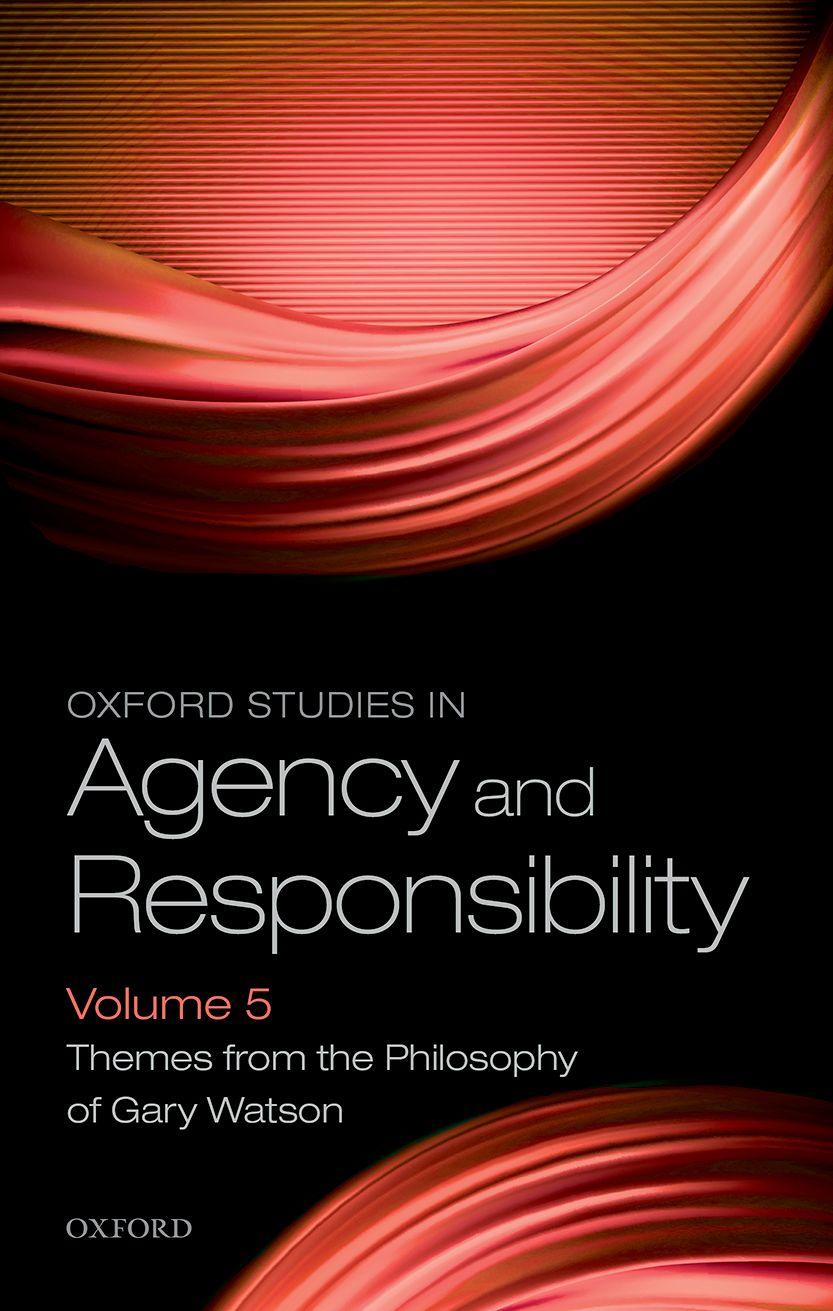
The purpose of this volume is to collect together some recent reflections on Watsonian themes, most of which were presented in November 2016 at a workshop in New Orleans organized by David Shoemaker, Justin Coates, and Neal Tognazzini.1 On this occasion Gary Watson himself was also invited to offer some further reflections on the issues that have gripped him over the course of his career, and those further reflections appear toward the end of this volume under the title, “Second Thoughts.” The workshop began, though, with an interview of Watson conducted by Sarah Buss, which allowed the audience members a glimpse into Watson’s personal history and the intellectual context surrounding his groundbreaking work. That interview, edited for readability, is also included.
Although the workshop itself did not have any externally imposed structure other than that provided by the description “themes from the work of Gary Watson,” the resulting essays (including two that are included here but weren’t presented at the conference) are unified in various predictable ways, given the issues that have occupied Gary over the course of his career. Before we close this introduction, then, it might help to orient the reader if we say a bit about what to expect.
Michael McKenna’s chapter, “Watsonian Compatibilism,” builds on and systematizes several key elements of Watson’s views on agency and responsibility. And while McKenna hews more closely to the spirit of Watson’s earlier work on these topics than to the letter of it, the result is a unique and attractive theory of freedom and responsibility, one that deserves a place alongside other compatibilist contenders.
Susan Wolf’s chapter, “Attributability and the Self,” similarly explores and extends important elements of Watson’s oeuvre. Starting with Watson’s famous distinction between responsibility-as-attributability and responsibility-as-accountability, Wolf develops a more systematic story about the relationship between the way in which agents are responsible for their actions and the kind of response that is licensed by those actions. When we
1 In addition to hosting and serving as primary organizer of the workshop in New Orleans, Dave has also been instrumental in helping this collection come together. We extend our deep gratitude to him.
criticize another, we’re responding to the features of her agency that make her action attributable to her. On the other hand, when we blame or sanction her, we’re responding to those aspects of her agential involvement that make her accountable for what she’s done.
Pamela Hieronymi’s chapter, “I’ll Bet You Think This Blame is About You,” also takes Watson’s “Two Faces of Responsibility” as its launching point. But from there, Hieronymi goes on to offer her own account of what blame’s about. It’s not, contrary to the most common view, about the wrongdoer, though of course it is a response to their action. Instead, it’s about the person who was wronged. But this apparently small shift in our thinking about blame has significant implications for how we conceptualize our responsibility practices more generally.
R. Jay Wallace’s chapter, “Moral Address: What It Is, Why It Matters,” is also concerned with Watson’s overall conception of moral responsibility. However, unlike Hieronymi, Wallace understands blame to be (at least) an incipient form of moral address. On this view, the communicative or directed nature of blame, and of other so-called reactive emotions, is key to understanding not only the nature and significance of our responsibility practices but also moral obligation itself. In so doing, Wallace helpfully explores the influence of P. F. Strawson’s “Freedom and Resentment” on Watson’s thinking about agency and morality.
Michael Smith’s chapter, “Gary Watson: Strawsonian,” continues in this vein. But whereas Wallace is hopeful that something can be salvaged in Watson’s debt to Strawson, Smith is less sanguine. Smith’s chapter then attempts to offer, if not a Strawsonian theory of moral responsibility, one that’s similarly grounded in the reactive emotions. Rather than focusing on retributive emotions like resentment or indignation, Smith instead focuses on the role trust could play in justifying something analogous to our blaming practices.
T. M. Scanlon’s chapter, “Learning from Psychopaths,” continues a debate between Scanlon and Watson over the moral status of psychopaths. On Watson’s theory of moral responsibility, an agent cannot be morally responsible if she lacks normative competence. Psychopaths (apparently) lack this kind of competence, so Watson concludes that they are not morally responsible for their actions. On the other hand, Scanlon argues that because psychopaths are minimally rational—they are agents for whom reasons have some purchase—their failure to respond to distinctively moral reasons is attributable to them. Thus on Scanlon’s view, psychopaths can be morally responsible for their actions.
Jeanette Kennett’s chapter, “Competence, Attributability, and Blame: Resolving the Responsibility of the Psychopath,” takes up this same question. Kennett’s resolution to these issues is subtle. She argues first that
psychopaths are not accountable for their actions in the sense required for moral blameworthiness. Second, she argues that psychopaths’ actions are not attributable to them in the way that would make them fitting targets of the criminal law.
R. A. Duff’s chapter, “Moral and Criminal Responsibility: Answering and Refusing to Answer,” extends Watson’s work on moral responsibility to the domain of criminal responsibility. Duff argues first that the sense of responsibility at stake operates analogously in both the moral and criminal contexts. He then explores the constraints that answerability places on those who are holding the agent responsible for their action. Not only must the agent possess normative competence at the time at which they act, but they must also be in possession of the same capacity at the time at which others are holding them responsible. So too, Duff argues, those who hold others answerable for their actions must have the moral standing to do so.
Gideon Yaffe’s chapter, “Compromised Addicts,” seeks to better understand the prospects of Watson’s account of addiction. In particular, Yaffe is concerned with the question of how addiction can weaken the demand that the addict comply with otherwise legitimate demands. Watson answers this question by pointing to the way addictive desires distract attention in a way that makes it unreasonable to expect addicts to comply with legitimate demands with the same alacrity we expect non-addicts to comply with such demands. Yaffe demurs. Instead, he argues that the expectation that addicts comply with otherwise legitimate demands is weakened because for the addict, wholehearted effort to comply is simply not possible.
Gary Watson’s chapter, “Second Thoughts,” offers his current account of the distinction between the two faces of responsibility. So too, it offers further thoughts on weakness of will and negligence. Watson worries that quality-of-will theories of moral responsibility (like that of P. F. Strawson) are ill-equipped to make sense of these phenomena.
Finally, we include an interview of Gary Watson conducted by Sarah Buss on November 3, 2016. This is a wide-ranging and significant discussion of Gary’s personal history and philosophical development. In it, one finds the same depth of humanity, care, and patience that characterizes Gary’s philosophical writings. We hope that you find it as illuminating as we did.
D. Justin Coates and Neal A. Tognazzini
1 Watsonian Compatibilism
Michael McKenna
In what follows, I will construct a compatibilist theory of freedom and responsibility built from key elements of Gary Watson’s important essays on these topics. Watson himself reports in the opening paragraph of his Agency and Answerability that his collected essays on free will, agency, and responsibility “do not provide a sustained argument for a systematic resolution” to the problems animating his work (2004: 1). Indeed, he notes that the central claims in his essays are after all not mutually consistent and that he no longer stands by some of them. Even setting aside worries about consistency between his essays, there is a spirit to Watson’s work that I have always found attractive and admirable, albeit at times downright maddening: his exquisite ability to explore a problem in great detail, combined with the intellectual courage to walk away from it without a solution. Watson will often unearth in forceful detail the sources of a philosophical worry, one that appears to threaten a position he endorses, and rather than show us the way out of the predicament, he just leaves us in it, perhaps with a cagey suggestion about how to escape, but no more. I love this about Gary’s work, and I hate it too. It drives me bananas, but in a good way. What is his compatibilist view of free will? Is it actually a compatibilist view? (There’s some suggestion that it is not.1) How are we to understand free agency? Does it require acting from our own evaluative resources? Is there an understanding of identification that captures something crucial about our agency, and can we account for freedom and the loss of it by reference to this notion? In what does moral responsibility consist? And what of the reactive attitudes, especially the retributive ones? Are they required for
1 Distinguishing between a compatibilist account of the ability to act otherwise, and the basis for libertarian worries about free will, Watson suggests that compatibilists don’t have the resources to account for the latter. For example, see Watson (1987a appearing in 2004: esp. at 184 and 187–9).
moral responsibility? If so, are they after all benighted? Do they presuppose conditions for freedom that conflict with determinism or (more permissively) naturalism?
I will not presume to answer these questions for Gary Watson nor construct a unified theory meant to represent his own view. Instead, I will construct what might on a generous interpretation be called a Watsonian theory of freedom and responsibility, one that draws upon important elements of Watson’s views but also departs from them at critical points. It is thus meant to be inspired by Watson’s work but not simply to be an account of it. At various junctures I will adopt a more adversarial posture, but only for the purpose of crafting something approximating an overall Watsonian theory of freedom and responsibility.
To proceed, I will attend to three features of Watson’s work. First, on Watson’s view (1975, 1987a) acting freely is explained in terms of acting in accord with one’s evaluative commitments. This is intended to help account for identification with pertinent elements of one’s own psychic nature. When a person acts in accord with these elements, she is free insofar as she is self-determining. When she acts contrary to them, it seems she is not free just because she is not self-determining. Can we account for free agency in these terms? Second, Watson has characterized his own view as a version of a reasons-responsive theory (2004: 8–9). How should we understand his notion of responsiveness or sensitivity to reasons? In what ways does it differ from others such as John Martin Fischer and Mark Ravizza (1998) who have developed a reasons-responsive view? Third, Watson has certainly done as much as anyone since P. F. Strawson (1962) to deepen our understanding of moral responsibility, both by way of his critical assessment of Strawson’s views (Watson, 1987b and 2014), and in terms of his own work on the topic (1996). How should we understand morally responsible agency in light of his contributions?
1.1 FREE AGENCY: MESH THEORIES, IDENTIFICATION, AND THE REAL SELF
In developing an account of free agency, Watson (1975), like Harry Frankfurt (1971), proposed a way to salvage the traditional compatibilist strategy dating back to Hobbes and Hume.2 On this traditional approach, exercising free agency was understood in terms of exercises of unencumbered intentional action. A pithy characterization of free action, so understood,
2 This is also essentially the same account defended in more recent times by Ayer (1954), Hobart (1934), Moore (1912), and Schlick (1939).
is that an agent acts freely just in case she is unimpeded in doing what she wants to do.3 Freedom on this lean model is explained with simple resources involving nothing more metaphysically sophisticated than what is required for exercises of intentional agency. The free part in free agency, then, just amounts to a negative condition: the absence of anything that would interfere with purposeful action.
A familiar problem for the traditional compatibilist way of theorizing about freedom is that some impediments to an agent’s freedom can arise from conditions internal to her own psychic life, as in cases of compulsions, addictions, severe phobias, and the like. In such cases, an agent is doing what she wants in some obvious sense, and yet she is manifestly unfree. By different means, both Watson and Frankfurt attempted to solve this problem by replicating the traditional compatibilist model, but with resources involving an agent’s own psychology. Their solution was to treat the elements of an agent’s own mental life that are sources of unfreedom as similar to external impediments. Just as one is not free to act as one wants if there is an external impediment to acting as one wishes—like a locked door or chains that bind—so too can one’s own will be like an external impediment to what one truly wants to do. In such cases, a person does not have the will she wants, and when she acts on it, she acts unfreely.
Watson and Frankfurt each developed this solution in his own unique way by looking to the internal psychic architecture of a person wherein some aspects of an agent’s own mental life could be sources of her freedom while other aspects could be impediments to it. A natural picture on such a view represents some elements of the agent’s inner life as genuine parts of the agent. Other elements are then treated as external or alien to the person so that these elements too, like actual chains or doors, could be regarded as distinct from the agent who acts. They could thus be treated either as impediments to freedom or instead vehicles for it (as when the door is unlocked rather than locked, or the chains are unshackled rather than shackled). Susan Wolf has aptly characterized such views as Real Self views (1990). In doing so, she cast a clear light on the burden Frankfurt, Watson, and other likeminded theorists such as Bratman (2003) and Velleman (1992) take on in explaining free agency in this manner—sense needs to be made of the boundaries of the Real Self (sometimes the expression used is the Deep Self ).
Free action in relation to the Real Self is then explained in terms of a mesh theory. When an agent’s psychic elements mesh in a harmonious manner, so
3 A further condition, found in both Hobbes and Hume, is an ability to do otherwise condition wherein an agent is also able to do otherwise conditional on her wanting to do otherwise. For a more comprehensive discussion of this topic, see McKenna and Pereboom (2016: 50–6). For the moment, we can set this further condition aside here.
that the machinery generating her intentional actions is aligned with her Real Self, then she acts freely. But when it does not, then some of those psychic elements are instead external impediments to the agent, alien to the agent’s Real Self, and so sources of unfreedom.
As is well known, Frankfurt (1971) attempted to develop a mesh theory in terms of a hierarchical relation between desires. A further element involved an agent’s identification with some desires as part of herself, as in contrast with others with which she does not identify and so are alien. When an agent acts freely, the first-order effective desires leading her to act are the ones that, at a higher level, she wishes to be her will. By identifying with them as such, she makes them part of her Real Self rather than alien to her.
As is equally well known, Watson (1975) issued a devastating criticism of Frankfurt’s (1971) proposal. Two elements of Watson’s critique together provided the basis for his own positive account. One is that Frankfurt offered no way to make sense of identification as the basis for what would circumscribe the elements of the agent’s Real Self, as distinct from external desires construed as unwelcome causal influences on the production of intentional action.4 Another was that Frankfurt simply misidentified the ingredient unique to the make-up of a person that would make sense of how the sources of an agent’s action might or might not be misaligned with her Real Self. It is not the mere higher ordering of a motivational influence that matters, Watson contended, but the source of one’s motivations. Desire alone will not do the trick, with or without higher and lower orders. When motivation arises from one’s evaluations, and when these work in harmony with the other sources of an agent’s desire, then we can make sense of a person acting freely. When there is a misalignment, so that one acts on desires in opposition to one’s evaluations, one acts unfreely. Hence, on Watson’s proposal, the salient psychic architecture of a person rendering her a free agent involves not hierarchies of one sort of thing—desire—but distinct sources of motivation, one from a person’s motivational system and another from her evaluational system. The latter but not the former gives rise to motivation for acting as an upshot of valuing something as worth pursuing.
1.2 TWO CRITICISMS AND A DIAGNOSIS
I turn to two well-rehearsed criticisms of Watson’s account of free agency. I hope to show how they are intertwined. In doing so, I will set the stage for arguing against Real Self views and, more importantly, against a
4 Watson did not use the terminology of ‘Real Self’ in his 1975 essay, but this is, in essence, what the point of his criticism amounted to.
conception of free agency understood on analogy with the absence of external impediments.
To begin, as Watson himself later acknowledged (1987a), his original (1975) proposed account of free agency faces the same problem accounting for identification that Frankfurt’s does. According to Watson (1975), Frankfurt was not dialectically entitled just to name certain desires as the agent’s own, and so part of her Real Self, in contrast with others by contending that she identified with the former but not with the latter. The aspiration was rather that hierarchical relating to one’s desires would account for what identification came to. So Frankfurt’s proposed solution, adding identification as a further condition, was not explanatory. Instead it just gave a name to what needed explaining. So too, Watson conceded in “Free Action and Free Will” (1987a), contrary to what he had intended in “Free Agency” (1975), he could not account for identification by way of certain evaluative commitments over others.5 To quote Watson:
[W]hat one values in a particular case may not be sanctioned by a more general evaluational standpoint that one would be prepared to accept. When it comes right down to it, I might fully ‘embrace’ a course of action I do not judge best; it may not be thought best, but is fun, or thrilling . . . Perhaps in such a case one must see this thrilling thing as good, must value it; but, again, one needn’t see it as expressing or even conforming to a general standpoint one would be prepared to defend.
Call such cases, if you like, perverse cases. The point is that perverse cases are plainly neither cases of compulsion nor weakness of will. There is no estrangement here. One’s will is fully behind what one does. Of course, a person’s evaluational system might just be defined in terms of what one does, without regret, when it comes right down to it, but that would be to give up on the explanation of identification by evaluation. Just as the hierarchical account ends up presupposing rather than explaining the notion of identification, evaluation would do no explanatory work.
We are left with a rather elusive notion of identification and thereby an elusive notion of self-determination. The picture of identification as some kind of brute self-assertion seems totally unsatisfactory, but I have no idea what an illuminating account might be. (Watson, 1987a as appearing in Watson, 2004: 168–9; my italics)
Of course, even if elusive, with the notion in place, one could draw on the machinery of the Real Self view to explain that when actions are free—they come from the Real Self—and when they are not—they come from outside of the Real Self. But naturally, the question is, how can Watson or any other mesh theorist carry this project off? It seems that appeals to an evaluative system will not do—or at any rate, this is what Watson himself suggested.
5 See also Velleman’s (1992: 472) discussion of this problem for Watson’s view.
Now consider another equally familiar problem for mesh theories.6 Set aside worries about identification. Suppose for the moment that identification is well understood. Consider this formulation of Watson’s proposed account of acting freely, which perhaps is overly simplified:
FA: We act freely just in case we act in accord with what we value, as issuing from our evaluative system; we act unfreely just in case we act in opposition to what we value.
The problem with this proposal, at least in the (overly?) simplified form FA, is that it cannot explain cases in which an agent freely acts contrary to her own evaluative commitments. Note that such cases differ from those Watson identified as perverse cases (in the preceding quotation). In the perverse cases, the agent does identify with her springs of action, and there is, as Watson put it, no estrangement. Instead, in these other sorts of cases, an agent freely acts contrary to what she values. So in some sense, by Watson’s own lights, there is a kind of estrangement. The most familiar examples are cases of weakness of will, but there is also recklessness.7 Presumably, when an agent acts contrary to what she judges best from a powerful compulsion or coercion she does not act freely. Indeed, she is paradigmatically unfree. Mesh theories are custom-designed to capture these cases. But how can a mesh theory, when linked to a Real Self view, account for cases in which an agent freely acts contrary to what she judges best to do? Since on the formulation of Watson’s proposal FA, freedom is explained just in terms of acting on the basis of what one values, and since this demarcates the boundaries of the Real Self, the theory alone does not have the resources to account for these cases.
There is an obvious way to remedy the preceding difficulty. Add an ability into the mix. So consider this amendment to FA:
FA-ability: We act freely just in case we are able to act in accord with what we value, as issuing from our evaluative system; we act unfreely just in case we are unable to act in accord with what we value.
In the case of the agent acting from compulsion, she is unable to act in accord with what she values. In the case of the agent who acts from weakness of will, she is able to do so, but freely elects not to. Her ability thus remains unexercised albeit retained. The easiest pair of contrast cases to
6 Several philosophers have pursued this line of objection to mesh theories. See, for example, Haji (1998: 74), Fischer (2012: 129-30), McKenna (2011: 181), and McKenna and van Schoelandt (2015: 48).
7 Cases of recklessness might be harder to understand in these terms. So I’ll just attend to weak-willed action.
illustrate the point is that consisting of Frankfurt’s unwilling addict who takes the drug against her will, and (a case Frankfurt does not consider) a willing non-addict who freely takes the drug fully judging that it is best not to, but nevertheless giving in to her desire for the pleasure it offers. Watson’s own words suggest that he would be open to a formulation of his view along the lines of FA-ability:
[I]n the case of actions that are unfree, the agent is unable to get what he most wants, or values, and this inability is due to his own “motivational system.”
(Watson, 1975, as appearing in 2004: 14–15)
Given this passage, it appears that FA is too simplistic, and it is FA-ability that better captures Watson’s own intentions. If so, he has a ready answer to the current challenge.
But I am skeptical that FA-ability can provide the support needed for Watson’s version of a Real Self view, and for three reasons:
First, FA and FA-ability are incongruous, at least as Watson understands them, only if he is willing to commit to the existence of unexercised specific (rather than merely general) abilities. It is not clear that he is. At least in the case of weakness of will, as is well-known, Watson (1977) is skeptical of the phenomena. More particularly, what Watson is skeptical of is the thesis that the weak-willed agent has but fails to exercise an ability to control herself at the moment when she acts weakly (1977 as appearing in 2004: 42). If, as it happens, we likewise should be skeptical of all pertinent unexercised agential abilities, then we should treat all such abilities as ones that are exercised. If so, then FA and FA-ability, while having different meanings, are extensionally equivalent.
Second, set aside skepticism about weakness of will and relevant unexercised abilities. Relying upon the notion of ability does not fit well with the strict aims of a Real Self view and the attempt to treat compromises to free agency as external impediments to acting freely. If the weakwilled non-addict’s desire to take the drug is after all external to her, then it appears not to be the case that externality rather than internality is what explains self-determination or lack of it. Something else is doing the work—an ability. But now, if it is merely an ability to resist a desire, what’s it matter if it is internal or external to the agent? What matters is whether her ability affords her sufficient control over it to be free with respect to whether she acts on it.
Third, and related to the second, a familiar burden for compatibilists is all about whether the ability at issue regarding free will is something that is after all compatible with determinism. And the present proposal is silent on that point. So it doesn’t get the compatibilist that far after all, whereas the original appeal of the traditional compatibilists was (at least in part) that
the external/internal divide alone could be used to show that compatibilism is a no-brainer.8
I shall now offer a single diagnosis of the preceding difficulties: They are rooted in a commitment to a Real Self view, and more to the point, to the internal versus external model as a basis for explaining free and unfree agency. What apparently drives the need to account for identification is that without it we cannot make sense of the boundaries of the Real Self. As an upshot, we cannot in turn show when certain psychic forces are external to the agent and so threats to freedom—understood, as Watson puts it, in terms of self-determination—rather than as sources of freedom. Similarly for the problem of acting freely contrary to one’s own evaluative commitments. What drives the problem is that such action, understood as free, seemingly involves sources of agency external to the agent’s Real Self. Hence, it becomes challenging to account for unfreedom in terms of causes external to the agent. (Those sources are apparently consistent with either free or unfree action.) Fixing the problem by reference to unexercised abilities just indicates that what needs explaining are the abilities themselves.
1.3 AGAINST IDENTIFICATION AND REAL SELF VIEWS
Here is my proposal for the Watsonian compatibilist: She should preserve the mesh theory and so persist in theorizing in terms of the relation between a person’s evaluational system and other elements of her psychic constitution. But she should reject a commitment to a Real Self view. The strategy of relying upon the Real Self cannot bear the weight it was designed to carry. I’ll now offer three further reasons for rejecting it.
First, as a simple metaphor, the idea that a person has a real or a deep self is appealing. It is a worthy enterprise to understand what this amounts to and how it fits with our experience of our own agency. That much should be granted. But in the context of helping us to draw a metaphysical, or at least an action-theoretic, distinction between free and unfree actions, if taken literally it suggests something that is misleading: Certain desires that play a role in an agent’s actions are literally not an agent’s own. As Alfred Mele has noted, “no desires float free of desiring beings” (1995: 117). When
8 So as to avoid any misunderstanding, nothing about Watson’s writings indicates that he has such a dim view of incompatibilists’ concerns. Clearly, his view is that, whether or not compatibilism is true, the issue’s a brainer, not a no-brainer. See his “Introduction” (2003: 24–5) to his edited volume, Free Will, as well as his fair and balanced assessment of the free will debate in his “Free Agency and Free Will” (1987a).
we then say that such and such desire is not the agent’s own, if taken as a substantive proposal meant to explain different cases of free and unfree action, it is only natural to ask, as Mele does (117), whose desire is it? Of course, as Mele suggests, one could appeal to the model of a deeper core of a person and then hold that external desires are part of the person that are not within this deeper core. But this is hard to make sense of as something having boundaries—something that could help us identify free actions and mark others as unfree. Note, for instance, that in the quotation given in the previous section Watson describes the source of an agent’s (putatively) external, freedom-undermining desires as issuing from his own motivational system. Presumably the word ‘his’ refers to the agent’s Real Self. If so, the agent, qua Real Self, owns his motivational system. It’s his. Yet some of the desires emanating from it—the thing he does own—somehow come out as alien or external to the agent. Is this intelligible? I am not prepared to say that it is not. But regardless, it is incredible. Isn’t there a less dramatic way to capture what needs to be accounted for without appealing to this model of an agent, a Real Self, encapsulated inside this more inclusive kind of agent?9
Second, note an illuminating disparity between literal external impediments and the putative ones that are understood as external to an agent’s Real Self, such as rogue desires. Recall, this is all to be settled by identification. What an agent does identify with is internal to the agent and part of her Real Self, and what she does not identify with is external and not part of her Real Self. Of course, literal external impediments, like a locked door or chains that bind one, are not in any way part of the agent. But in circumstances in which they were instead no longer impediments, as when the door was unlocked or the chains unshackled, the door or the chains do not become part of the agent. They remain external but just now do not get in her way. By contrast, when on a view like Frankfurt’s or Watson’s, an agent does identify with the sources of motivation to act, she thereby makes these motivations her own. The picture just seems odd. Who or what a person is, what counts as internal to her Real Self, is contingent on an attitude, such as an evaluation, going one way or instead the other. What seems the more credible description is that—very much unlike doors or chains, whether locked or unlocked, shackled or unshackled—an agent, the complete agent, has various desires and motivational influences, all of which are part of her, and either she is or she is not in control of whether she acts upon them. Whether or not she is, it seems, is settled by what agential abilities she has.
9 There’s some textual evidence that in later work Watson came to sympathize with these objections. Hence I am not confident that in later work he remained a Real Self theorist (e.g., see 1999a as appearing in 2004: 71).
Third, the pre-theoretical appeal to a distinction between desires that really are an agent’s own and those that are not seems better explained in terms of an aspirational sense of a person’s self-conception: “That’s not who I really am!” the unwilling addict proclaims. This is perfectly intelligible. But what seems to plague a person who after all says these sorts of things and nevertheless does suffer from some severe defect of agency is not that certain of her desires and the actions issuing from them are not really hers in some deep sense but rather that they are hers. Her problem consists in this fact, and what she aspires to is to expunge them; that is, what she wishes were not so is that those very desires and actions were hers after all.
Given the three preceding considerations, and in light of the problems for Watson’s proposal discussed in the previous section (the problem of identification, and the problem of acting freely contrary to one’s evaluations), I advise the Watsonian to reject the aspirations of a Real Self view. What makes the view so appealing is that it looks as if it allows the compatibilist to account for free and unfree actions with the simple picture of the lack or presence of literal external impediments like locked doors or shackled chains. Letting go of this picture is nevertheless consistent with looking to important features of Watson’s proposed mesh theory for an adequate way of explaining free agency.
1.4 FOR AN ABILITY-BASED WATSONIAN MESH THEORY
I have objected here that FA-ability would not help a Watsonian mesh theorist advance compatibilism. I am about to retract that claim. Why the change of heart? FA-ability relies upon the notion of ability (obviously). Admittedly, unlike FA, this will help explain freely acting contrary to one’s evaluative commitments. But in doing so, it places the proposed mesh theory in a thorny position that the leaner version, FA, seemed tailor-made to avoid. Historically, a major source of contention between compatibilists and incompatibilists regarding free will—if not the source of contention—was about the compatibility of a particular ability and determinism. FA-ability, unlike FA, just reintroduces ability at the heart of the free-will debate. And when the proposed mesh theory was supposed to support a Real Self View, it seemed counter-productive to reintroduce ability talk. If it could be shown that threats to free agency are rooted in and limited to external impediments, as the Real Self view would have it, then it is an easy path to show that determinism is compatible with agency unfolding in the absence of external impediments. In this context, there is a strong incentive for avoiding an ability condition.
If, however, we uncouple a mesh theory from the aspirations of a Real Self view, then FA-ability begins to look promising. Admittedly, it places on the compatibilists the burden of defending an account of ability. But with the project of a Real Self theory set aside, that was coming anyway. The benefit, however, of preserving Watson’s proposed mesh theory via FA-ability is that it helps to explain something important, something that Watson, in reflecting on his own work, identifies as one of his major motivations. Watson writes:
A persistent theme of [“Free Agency,” and other related essays] is the ways in which human freedom can be diminished by an individual’s own desires . . . [T]his loss of freedom is said to consist in the obstruction of the capacity to govern one’s behavior by critical reflection. (2004: 2)
If what provides the capacity for acting in accord with critical reflection is what Watson elsewhere calls an agent’s evaluational system, then it seems that FA-ability, at least as a first pass, captures what Watson intended. To restate it:
FA-ability: We act freely just in case we are able to act in accord with what we value, as issuing from our evaluative system; we act unfreely just in case we are unable to act in accord with what we value.
The question before us is whether FA-ability, or some near cousin, can do duty for a Watsonian compatibilist theory of free agency. I think it is a promising thesis worthy of a vigorous defense.
To begin, the current proposal is still in an important sense a mesh theory. Rather than a theory that identifies freedom with actually securing the mesh between other sources of motivation and those arising from one’s evaluative commitments, it is instead acting with an ability to secure a mesh between other sources of motivation and those arising from one’s evaluative commitments.10 Moreover, it is consistent with the theory that it identifies a more desirable form of agency: A person’s agency is more ideally manifested when she does secure the desired alignment and does not merely act from resources whereby she is capable of doing so—as presumably happens in cases of the exercise of strength rather than weakness of will.
What of the resources for distinguishing acting unfreely and contrary to one’s evaluations as in contrast with freely acting in opposition to one’s evaluative commitments? How do we distinguish unfree actions issuing from phobias, compulsions, coercion, and so on, from freely acting from weakness of will or instead recklessness? What, for instance, of the unwilling addict
10 Understood as such, it is worth noting that the view is similar to one developed by Alfred Mele (1995, 2006).
taking the drug because of a compulsive desire? How do we distinguish her from the non-addict user who, loving the drug, gives into temptation and freely takes it? Must the compatibilist rely upon a brute assertion about ability to distinguish the two? One has it; one doesn’t? Without any further development of what this ability comes to, the Watsonian compatibilist has just swapped one unanswered problem for another. Rather than having no account of identification and no way to account for the Real Self, she instead has no account of the ability crucial to free agency.
At this juncture, I propose that the mesh theorist join forces with reasons-responsive theorists like John Martin Fischer and Mark Ravizza (1998), who seek to explain control—and so freedom—in terms of sensitivity to a sufficiently rich range of reasons.11 Elsewhere, along with my coauthor Chad van Schoelandt (2015), I have explored a hybrid theory of freedom and responsibility that merges a mesh theory with a reasons-responsive theory. As van Schoelandt and I argued, whereas mesh theories appear to have problems accounting for weakness of will and other sub-optimal forms of free agency, reasons-responsive theories appear to be well-suited to account for the phenomena. How so? At the time of action, and in the context of action, agents who act unfreely from compulsive desires, phobias, neuroses, and even coercive conditions are insufficiently responsive to a range of reasons for modulating their conduct, owing either to an impairment of reasons-recognition or instead, of reasons-reactivity. By contrast, at the time of action, and in the context of action, agents who act freely from, say, weakness of will, are sufficiently responsive to a range of reasons for modulating their conduct.
Consider the weak-willed non-addict who, by hypothesis, freely takes the drug against her better judgment. Contrast her with Frankfurt’s unwilling addict who unfreely takes the drug from a compulsive desire, all the while judging it best that she not do so. Imagine these two agents in sufficiently similar conditions.12 Now imagine a range of variations on the agents’ actual
11 Other reasons-responsive theorists make use of a similar strategy. See Brink and Nelkin (2013), McKenna (2013), Mele (2006: 157-9) Nelkin (2011), Sartorio (2016), Vargas (2013), and Vihvelin (2013).
Note also that there is a controversy about how best to understand reasons-responsive views. According to Fischer and Ravizza (1998), it is best to do so in terms of the responsiveness of mechanisms of action that are owned by agents rather than in terms of the responsiveness of agents. I have argued against Fischer and Ravizza on this point (McKenna, 2013), but will not take up the topic here. I will simply assume that we can theorize in terms of agents being reasons-responsive. For others who instead opt for an agent-based reason-responsive view, see Brink and Nelkin (2013), Nelkin (2011), Sartorio (2016), and Vihvelin (2013).
12 I say “sufficiently similar” to allow for obvious differences needed to render it true that one is addicted and one is not. There might, for instance, be a difference in their
circumstances. The addict would persist in taking the drug even if her children’s welfare was significantly compromised (maybe without being lifethreating). She would take it if there was a threat of arrest, even if there was more than a mild immediate threat to health (but no threat of immediate death), or a risk that she might lose her job. She would take it even if in doing so she squandered the resources needed to pay her electric bill, if doing so would place her at risk of assault, and so on. In each of the given sorts of counterfactual scenarios, the non-addict, we can stipulate, would not take the drug. Her ability to refrain from taking the drug when she does take it against her better judgment is thereby confirmed by virtue of the fact that, in a sufficiently rich range of conditions like the one she is in, albeit with further or different reasons not to so act, she would refrain from taking it. And she would refrain even given 1) the motivational force contributed by her desire for the drug, and 2) the evaluative judgment that taking the drug is not something to be regarded as good or valuable (independently of reasons arising from the other counterincentives imagined here). The addict by contrast does not have the ability to refrain, and this is confirmed by virtue of the fact that these reasons that would move the non-addict would not move her.
1.5 WEAK-WILLED AGENCY AND REASONS-RESPONSIVENESS: HAMMERING OUT THE DETAILS
On the current proposal, reasons-responsiveness comes in degrees, both for the non-addict and the addict. This is key. Clearly the non-addict who freely takes the drug from weakness of will is less reasons-responsive than a strong-willed user who refrains from taking the drug in similar conditions. But what of the addict? Why say that she is even minimally reasonsresponsive? A fairly well-known objection to Fischer and Ravizza’s version of reasons-responsiveness is that on their earlier account an agent suffering from an extreme addiction or some other kind of freedom-undermining psychological condition is not even the least bit reactive to any reasons to do otherwise.13 But this renders nearly all real-life cases freedom-preserving
physiology. But the basic idea is that one could imagine them both at the same party and both in pretty much the same circumstances in terms of whatever immediate practical responsibilities happen to apply to them: Neither needs to worry about the kids tonight, neither is currently financially strapped, and so on.
13 Watson has developed this criticism of Fischer and Ravizza’s view (1999a as appearing in Watson 2004: 70; and 2001 as appearing in Watson 2004: 299–300). But see also McKenna (2005), Mele (2000) and Russell (2002). More recently, Fischer (2005) has conceded the point and revised his position to accommodate it.