Director, Health Professional Assessment Consultancy (HPAC)
Honorary Reader in Medical Education St George’s, University of London
David
Sales
Consultant in Medical Assessment
Also available and forthcoming titles in the Oxford Assess and Progress series
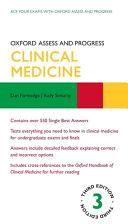
Clinical Medicine, Third Edition
Dan Furmedge and Rudy Sinharay
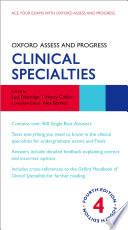
Clinical Specialties, Third Edition
Luci Etheridge and Alex Bonner
Clinical Surgery
Neil Borley, Frank Smith, Paul McGovern, Bernadette Pereira, and Oliver Old
Emergency Medicine
Pawan Gupta
Medical Sciences
Jade Chow and John Patterson
Psychiatry
Gil Myers and Melissa Gardner
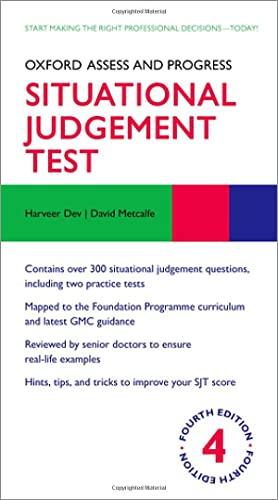
Situational Judgement Test, Third Edition
David Metcalfe and Harveer Dev
OXFORD ASSESS AND PROGRESS
Clinical Medicine
Third Edition
Edited by
Dan Furmedge MBBS MSc MRCP(UK) DRCOG
MAcadMEd FHEA AKC
Consultant Physician in Geriatric & General Internal Medicine
Honorary Clinical Lecturer in Medical Education
Guy’s and St Thomas’ NHS Foundation Trust London, UK
Rudy Sinharay MBChB MRCP(UK) MD(Res)
Consultant Physician in Respiratory & General Internal Medicine
Guy’s and St Thomas’ NHS Foundation Trust London, UK
1
Great Clarendon Street, Oxford, OX2 6DP, United Kingdom
Oxford University Press is a department of the University of Oxford. It furthers the University’s objective of excellence in research, scholarship, and education by publishing worldwide. Oxford is a registered trade mark of Oxford University Press in the UK and in certain other countries
The moral rights of the authors have been asserted
First Edition published in 200
Second Edition published in 204
Third Edition published in 209
Impression: 1
All rights reserved. No part of this publication may be reproduced, stored in a retrieval system, or transmitted, in any form or by any means, without the prior permission in writing of Oxford University Press, or as expressly permitted by law, by licence or under terms agreed with the appropriate reprographics rights organization. Enquiries concerning reproduction outside the scope of the above should be sent to the Rights Department, Oxford University Press, at the address above
You must not circulate this work in any other form and you must impose this same condition on any acquirer
Published in the United States of America by Oxford University Press 198 Madison Avenue, New York, NY 10016, United States of America
British Library Cataloguing in Publication Data
Data available
Library of Congress Control Number: 2018948241
ISBN 978–0–19–881296–8
Printed and bound in China by C&C Offset Printing Co., Ltd.
Oxford University Press makes no representation, express or implied, that the drug dosages in this book are correct. Readers must therefore always check the product information and clinical procedures with the most up-to-date published product information and data sheets provided by the manufacturers and the most recent codes of conduct and safety regulations. The authors and the publishers do not accept responsibility or legal liability for any errors in the text or for the misuse or misapplication of material in this work. Except where otherwise stated, drug dosages and recommendations are for the non-pregnant adult who is not breast-feeding
Links to third party websites are provided by Oxford in good faith and for information only. Oxford disclaims any responsibility for the materials contained in any third party website referenced in this work.
Series editor preface
The Oxford Assess and Progress series is a groundbreaking development in the extensive area of self-assessment texts available for medical students. The questions were specifically commissioned for the series, written by practising clinicians, extensively peer-reviewed by students and their teachers, and quality-assured to ensure that the material is upto-date, accurate, and in line with modern testing formats.
The series has a number of unique features and is designed to be as much a formative learning resource as a self-assessment one. The questions are constructed to test the same clinical problem-solving skills that we use as practising clinicians, rather than only to test theoretical knowledge. These skills include:
● gathering and using data required for clinical judgement
● choosing the appropriate examination and investigations, and interpretation of the findings
● applying knowledge
● demonstrating diagnostic skills
● the ability to evaluate undifferentiated material
● the ability to prioritize
● making decisions and demonstrating a structured approach to decision-making.
Each question is bedded in reality and is typically presented as a clinical scenario, the content of which has been chosen to reflect the common and important conditions that most doctors are likely to encounter both during their training and in exams! The aim of the series is to build the reader’s confidence in recognizing important symptoms and signs and suggesting the most appropriate investigations and management, and in so doing to aid the development of a clear approach to patient management which can be transferred to the wards.
The content of the series has deliberately been pinned to the relevant Oxford Handbook but, in addition, has been guided by a blueprint which reflects the themes identified in Tomorrow’s Doctors and Good Medical Practice to include novel areas such as history taking, recognition of signs (including red flags), and professionalism.
Particular attention has been paid to giving learning points and constructive feedback on each question, using clear fact- or evidencebased explanations as to why the correct response is right and why the incorrect responses are less appropriate. The question editorials are clearly referenced to the relevant sections of the accompanying Oxford Handbook and/or more widely to medical literature or guidelines. They are designed to guide and motivate the reader, being multi-purpose in nature and covering, for example, exam technique, approaches to difficult subjects, and links between subjects.
Another unique aspect of the series is the element of competency progression, from being a relatively inexperienced student to being a more experienced junior doctor. We have suggested the following four degrees of difficulty to reflect the level of training, so that the reader can monitor their own progress over time:
● graduate should know ★
● graduate nice to know ★★
● foundation doctor should know ★★★
● foundation doctor nice to know ★★★★
We advise the reader to attempt the questions in blocks as a way of testing their knowledge in a clinical context. The series can be treated as a dress rehearsal for life on the ward by using the material to hone clinical acumen and build confidence by encouraging a clear, consistent, and rational approach, proficiency in recognizing and evaluating symptoms and signs, making a rational differential diagnosis, and suggesting appropriate investigations and management.
Adopting such an approach can aid not only success in examinations, which really are designed to confirm learning, but also—more importantly—being a good doctor. In this way, we can deliver highquality and safe patient care by recognizing, understanding, and treating common problems, but at the same time remaining alert to the possibility of less likely, but potentially catastrophic, conditions.
David Sales and Katharine Boursicot Series Editors
A note on single best answer questions
Single best answer questions are currently the format of choice being widely used by most undergraduate and postgraduate knowledge tests, and therefore all of the assessment questions in this book follow this format.
Single best answer questions have many advantages over other machine-markable formats, such as extended matching questions (EMQs), notably the breadth of sampling or content coverage that they afford.
Briefly, the single best answer or ‘best of five’ question presents a problem, usually a clinical scenario, before presenting the question itself and a list of five options. These consist of one correct answer and four incorrect options or ‘distractors’ from which the reader has to choose a response.
All of the questions in this book, which are typically based on an evaluation of symptoms, signs, or results of investigations, either as single entities or in combination, are designed to test reasoning skills, rather than straightforward recall of facts, and utilize cognitive processes similar to those used in clinical practice.
The peer-reviewed questions are written and edited in accordance with contemporary best assessment practice, and their content has been guided by a blueprint pinned to all areas of Good Medical Practice, which ensures comprehensive coverage.
The answers and their rationales are evidence-based and have been reviewed to ensure that they are absolutely correct. Incorrect options are selected as being plausible, and indeed they may appear correct to the less knowledgeable reader. When answering questions, the reader may wish to use the ‘cover’ test, in which they read the scenario and the question but cover the options.
Katharine Boursicot and David Sales Series Editors
Contributors
Thomas Coryndon, Consultant in Emergency Medicine, University College London Hospitals NHS Foundation Trust, London, UK
Doug Fink, Specialty Training Registrar in Infectious Diseases and General Internal Medicine, Hospital for Tropical Diseases, University College London Hospitals NHS Foundation Trust, London, UK
Dan Furmedge, Consultant Physician in Geriatric and General Internal Medicine and Honorary Clinical Lecturer in Medical Education, Guy’s and St Thomas’ NHS Foundation Trust, London, UK
Shelly Griffiths, Specialty Training Registrar in Colorectal and General Surgery, Gloucestershire Hospitals NHS Foundation Trust, London, UK
James Harnett, Senior Clinical Fellow in Emergency Medicine, University College London Hospitals NHS Foundation Trust, London, UK
Chris Parnell, Clinical Fellow in Emergency Medicine, University College London Hospitals NHS Foundation Trust, London, UK
Ross Paterson, Academic Clinical Lecturer in Neurology, National Hospital for Neurology and Neurosurgery, University College London Hospitals NHS Foundation Trust, London, UK
Maria Phylactou, Academic Clinical Fellow in Endocrinology and Diabetes, North West Thames, Imperial College London, London, UK
Ricky Sinharay, Specialty Training Registrar in Gastroenterology and Hepatology, Addenbrooke’s Hospital, Cambridge University Hospitals NHS Foundation Trust, Cambridge, UK
Rudy Sinharay, Consultant Physician in Respiratory and General Internal Medicine, Guy‘s and St Thomas’ NHS Foundation Trust, London, UK
Laszlo Sztriha, Consultant Neurologist and Stroke Physician, King’s College Hospital NHS Foundation Trust, London, UK
Dominik Vogel, Senior Clinical Fellow in Critical Care, Echocardiography and ECMO, Guy’s and St Thomas’ NHS Foundation Trust, London, UK
William White, Specialty Training Registrar in Nephrology and General Internal Medicine, Royal Free London NHS Foundation Trust, London, UK
Normal and average values
Haematology
Normal value
White cell count (WCC) 4–11 × 109/L
Haemoglobin (Hb)
Packed cell volume (PCV)
M: 135–180 g/L
F: 115–160 g/L
M: 0.4–0.54 L/L
F: 0.37–0.47 L/L
Mean corpuscular volume (MCV) 76–96 fL
Neutrophils
Lymphocytes
Eosinophils
Basophils
Monocytes
2–7.5 × 10⁹/L
1.3–3.5 × 10⁹/L
0.04–0.44 × 10⁹/L
0–0.1 × 10⁹/L
0.2–0.8 × 10⁹/L
Platelets 150–400 × 109/L
Reticulocytes 25–100 × 109/L
Erythrocyte sedimentation rate (ESR) <20 mm/hour (but age-dependent; see OHCM, p. 356)
Prothrombin time (PT) 10–14 s
Activated partial thromboplastin time (aPTT) 35–45 s
SIADH syndrome of inappropriate antidiuretic hormone secretion
SIRS systemic inflammatory response syndrome
SL sublingual
SLE systemic lupus erythematosus
SMV superior mesenteric vein
SPC Summary of Product Characteristics
SpO2 oxygen saturation in blood
SpR specialty registrar
STAT immediately
STEMI ST-elevation myocardial infarction
SVT supraventricular tachycardia
T temperature
T3 tri-iodothyronine
T4 thyroxine
TB tuberculosis
Tc technetium
TDD total daily dose
tds three times daily
TIA transient ischaemic attack
TIBC total iron-binding capacity
TRALI transfusion-related acute lung injury
TSH thyroid-stimulating hormone
TTE transthoracic echocardiogram
TTP thrombotic thrombocytopenic purpura
U unit
U&E urea and electrolytes
UKELD United Kingdom Model for End-Stage Liver Disease
Ur urea
US ultrasound
USS ultrasound scan
UTI urinary tract infection
V/Q ventilation/perfusion
VF ventricular fibrillation
VKA vitamin K antagonist
VT ventricular tachycardia
VTE venous thromboembolic disease
WCC white cell count
WHO World Health Organization
WPW Wolff–Parkinson–White (syndrome)
How to use this book
Oxford Assess and Progress: Clinical Medicine has been carefully designed to ensure you get the most out of your revision and are prepared for your exams. Here is a brief guide to some of the features and learning tools.
Organization of content
Chapter editorials will help you unpick tricky subjects, and when it is late at night and you need something to remind you why you are doing this, you will find words of encouragement!
Answers can be found at the end of each chapter, in order.
How to read an answer
Unlike other revision guides on the market, this one is crammed full of feedback, so you should understand exactly why each answer is correct, and gain an insight into the common pitfalls. With every answer, there is an explanation of why that particular choice is the most appropriate. For some questions, there is additional explanation of why the distracters are less suitable. Where relevant, you will also be directed to sources of further information such as the Oxford Handbook of Clinical Medicine, websites, and journal articles.
→ www.nice.org.uk/guidance/cg43
Progression points
The questions in every chapter are ordered by level of difficulty and competence, indicated by the following symbols:
★ Graduate ‘should know’—you should be aiming to get most of these correct.
★★ Graduate ‘nice to know’—these are a bit tougher, but not above your capabilities.
★★★ Foundation Doctor ‘should know’—these will really test your understanding.
★★★★ Foundation Doctor ‘nice to know’—give these a go when you are ready to challenge yourself.