1 Introduction
Tamara Sonn
Historian Edmund Burke III defines Orientalism as, at root, “a field based on the study of original texts in Asian languages requiring a rigorous specialized training.” 1 In the context of Europe’s colonialism, programs in Asian studies were developed—termed “Oriental” or “Eastern,” because the geographic location of many of the subjects covered lay east of Europe, although others lay to the south, including North Africa. Beginning in the late eighteenth and early nineteenth centuries and flourishing well into the twentieth, the field produced careful philological studies of classical texts that contributed significantly to Europeans’ awareness of non-European languages and literatures.
However, as Burke notes, “Orientalism could not be understood apart from the circumstances of its production.” These included modern (“Enlightenment”) Europe’s self-image as uniquely rational and civilized and its imperialist sense of entitlement to the resources and markets of nonEuropeans. These perceptions inevitably crept into Orientalist interpretations of non-European societies, frequently producing disparaging analyses of the Oriental “Other.” French Orientalist Ernest Renan’s description of Islam in an 1883 lecture at the Sorbonne is paradigmatic:
Anyone with even the slightest education in matters of our time sees clearly the current inferiority of Muslim countries, the decadence of states governed by Islam, the intellectual sterility of races that derive their culture and education from that religion alone. All who have been to the Orient or to Africa are struck by what is the inevitably narrow-mindedness of a true believer, of a kind of iron ring around his head, making it absolutely closed to science, making it absolutely incapable of learning anything or of opening itself up to any new idea From the beginning of his religious initiation the Muslim child becomes fanatical, full of a foolish pride in possessing what he believes is the absolute truth, happy with what determines his inferiority, as if it were a privilege This senseless pride is the radical vice of the Muslim 2
Renan perhaps was unaware of the extraordinary contributions to the sciences made by Muslims, including Arabic numerals and the advanced mathematics they facilitated (“algebra” and “algorithm” both have Arabic roots), but he was no doubt aware of France’s vast imperial enterprises in Muslim lands. France had invaded Egypt in 1798, claimed control of Algeria in 1830, intervened in Syria in the 1860s, and established dominance over Tunisia in the 1880s, for example. In the view of contemporary critics of Orientalism, the combination of Enlightenment arrogance and colonialist concerns inevitably influenced Orientalists’ evaluations of those who would become their subjects.
Criticism of European scholars of Islam did not begin with Edward Said, but his 1978 Orientalism became the classic of the genre. Employing anticolonial analytical frameworks that linked the scholars’ (and artists’) “products” with the political power structures in which they worked, Said characterized Orientalism not as a discipline but an ideology or, more precisely, an ideological discourse whose participants inevitably reflect the political-economic objectives of the governments under which they live. In Said’s presentation, Orientalists are incapable of doing otherwise. In effect, therefore, they provide rationales for those very objectives.
The unidimensional nature of Said’s portrayal of Orientalism was subjected to serious criticism; it left no room for independent thought and scarcely acknowledged the enormous contributions of numerous scholars of antiquity. Nevertheless, its impact was so profound that the term “Orientalism” has had a decisively negative connotation ever since. There remain a great many European and American scholars of Asian languages and literatures, but none embrace the title “Orientalist.” Even the revered University of London School of Oriental and Arabic Studies, established in 1916—when Britain still controlled Egypt, Sudan, Nigeria, and the Indian subcontinent and was in the midst of a war that would result in its consolidation of control over Palestine, Jordan, and Iraq—now goes simply as SOAS.
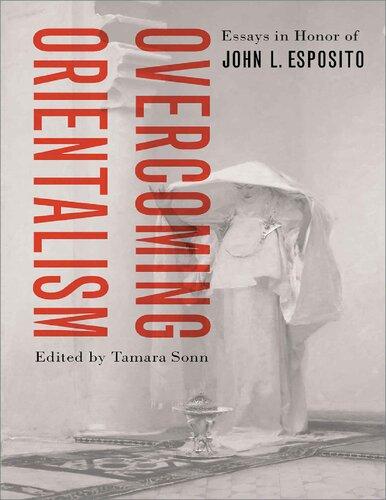
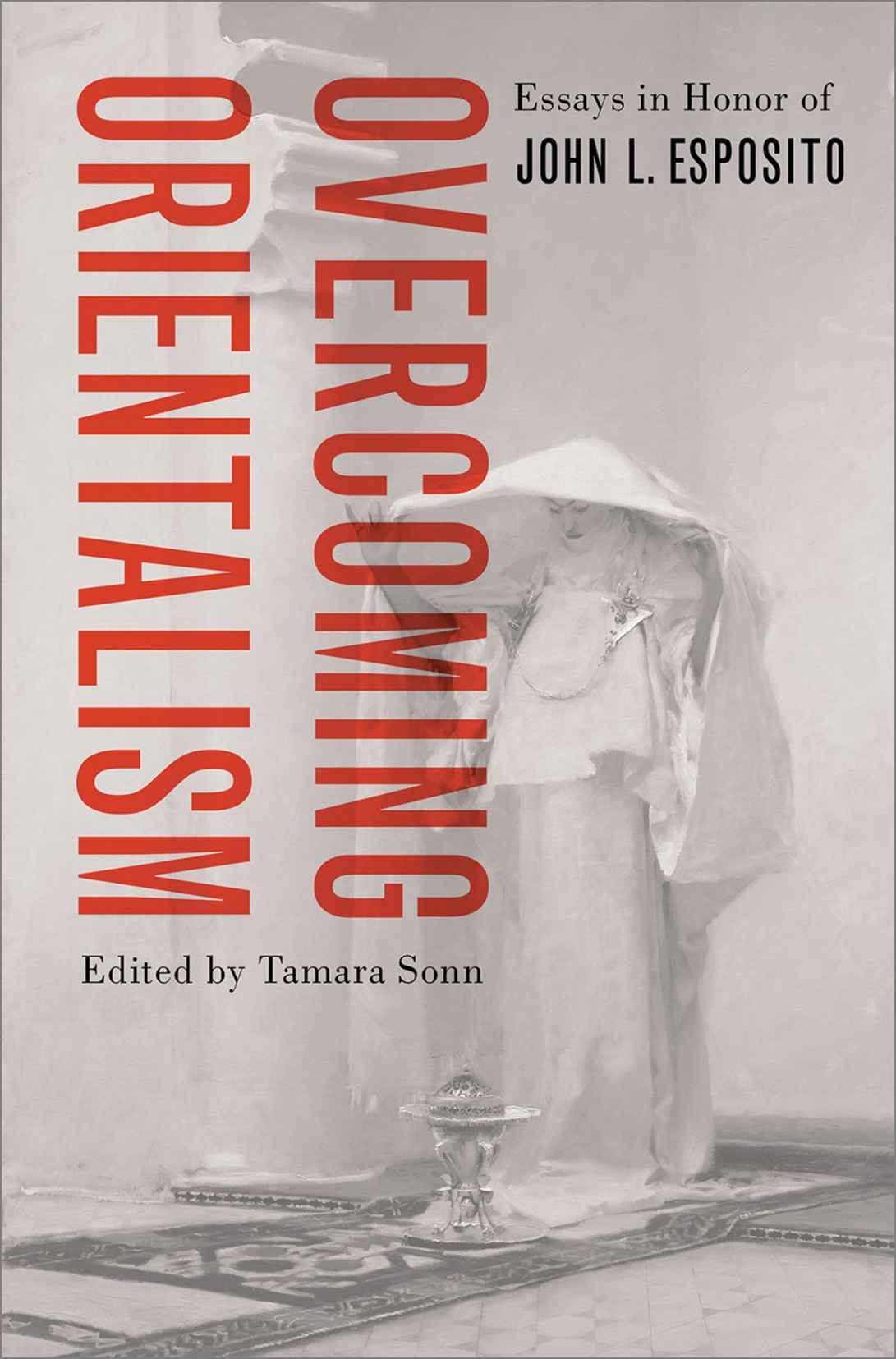
That negative connotation of Orientalism is the one intended in the title of this Festschrift in honor of John L. Esposito, certainly the best-known scholar of Islam in North America and, in scholarly circles, perhaps the world. His sheer productivity would ensure as much. He has not only published more extensively than his peers (over seventy books; see “John L. Esposito: Select Bibliography” in this volume) but has established a series of handbooks,
encyclopedias, and a dictionary that have become standard academic reference works. Recipient of countless scholarly awards, he has also provided tireless academic leadership, serving as president of the American Council for the Study of Islamic Societies (1989–1991), the Middle East Studies Association (1990), and the American Academy of Religion (2013). And as this volume demonstrates, he has been an inspiring educator. As of this writing, he has been teaching for nearly fifty years.
If Said is known for identifying Orientalist stereotypes of Islam and Muslims, Esposito is known for undermining those stereotypes. The hallmark of Orientalist tropes is the essentialization of Islam: the portrayal of Islam as a static set of doctrines and practices, uniform throughout the ages and across cultures. Essentialization involves the portrayal of beliefs or behaviors observed in specific geohistorical contexts as applicable to all Muslims in all times and places. Thus a Renan could portray all Muslims, from seventhcentury Arabia throughout the world until the present day, in a single paragraph describing perhaps an instance of ignorance that he observed on his only trip to Syria in the nineteenth century. Or a Winston Churchill could extrapolate from his experience with the British army as it tried to enforce its claim to Sudan in the late nineteenth century, to speak of Islam’s “fanatical frenzy” and “degraded sensualism.” Indeed, he observed, “No stronger retrograde force exists in the world.” 3 Unquestionably there are malevolent actors who use Islamic terms of reference to justify their actions, but they are no more representative of Islam overall than Christian racists and antiSemites are of Christianity. This is a point Esposito argued in The Islamic Threat: Myth or Reality? (Oxford University Press, 2nd ed., 1995), for instance. Esposito devoted numerous other works to demonstrating that Islam, like any other religion, is multifaceted, represented by countless individuals and institutions in radically diverse circumstances across the globe and throughout history. His Turkish Islam and the Secular State (with Hakan Yavuz; Syracuse University Press, 2003) and Asian Islam in the 21st Century (Oxford University Press, 2007) are examples. Featuring chapters by two scholars inspired by this aspect of Esposito’s work, this volume includes a section titled “Diversity in Islam: Whose Islam?”
Other Orientalist stereotypes claim that Islam is intolerant of other religions. Noted critic of Islam and self-styled vigilante against the “Islamization of America” Robert Spencer provides a ready example of this view in his bestselling The Truth about Muhammad: Founder of the World’s
Most Intolerant Religion (Regnery Publishing, 2006). Spencer emphasizes the classical Islamic law mandating capital punishment for apostasy, for example, which is still advocated by some Muslims but considered archaic by majorities, just as are Judaic and Christian prohibitions of apostasy. Esposito addresses this issue in a number of volumes dealing with the comparative study of religion, such as World Religions Today (Oxford University Press, 6th ed., 2017) and Pluralism in Muslim–Christian Relations (ACMCU Georgetown University, 2008). Indeed, he established Georgetown University’s Alwaleed Center for Muslim–Christian Understanding, which continues to provide programming on religious pluralism. 4 This volume therefore also includes a section titled “Islam and Pluralism: Interfaith Relations.”
But perhaps Esposito’s most enduring contribution is at the level of theory. Europe’s modernist paradigm of separation of church and state influenced the scholarly study of international affairs such that students of politics were rarely trained in matters religious. Religious actors’ involvement in political matters was considered an aberration. In the case of Muslims articulating political ideals in religious terms, an entirely new descriptor was deployed. They were not discussing Islam as such but rather a special genre dubbed Political Islam. Although Muslim scholars had discussed political themes at least since the first treatise devoted to matters of governance Ordinances of Governance by legal scholar al-Mawardi (d. 1058)—it was only in the late twentieth century that Western scholars began to comment on what they considered an anomalous injection of religion into politics. 5 Esposito’s first publications in the mid-1970s dealt with women’s legal rights, a fundamentally political issue, and he has continued to address political aspects of Islam throughout his career. 6 This volume therefore begins with chapters addressing Esposito’s contributions to overcoming the artificial separation of religious and political concerns in a section titled “Shaping the Discourse: Countering the Secular Bias.”
Finally, this volume addresses the question implied in the title: Has Orientalist bias been overcome? In 2010 Carl Ernst and Richard Martin suggested as much. In “Toward a Post-Orientalist Approach to Islamic Religious Studies,” they argue that “a growing number of historians of religion . . . are pursuing Islamic studies within newer theoretical frameworks, such as critical theory and cosmopolitanism.” 7 Those frameworks allow for multiple approaches to modernity, for example, rather
than limiting modernity to Europe’s model. Ernst and Martin present a number of analyses to support their claim. It may indeed be true that many trained historians of religion have moved beyond the exclusion or exceptionalization of Islam that characterized early twentieth-century religious studies. However, the demonization of Islam in the public sphere has returned with a vengeance and taken on a new, populist character. It is now known as Islamophobia.
The demonization of Islam in popular discourse—building upon the Orientalist essentialization of Islam—began even before the spectacular terrorist attacks of our era that shaped negative stereotypes for those otherwise unfamiliar with Muslims. Esposito noted the trend as early as 1994 when he wrote, “To equate Islam and Islamic fundamentalism uncritically with extremism is to judge Islam only by those who wreak havoc —a standard not applied to Judaism and Christianity.” 8 By 1996 concerns about the growth of popular anti-Muslim prejudice resulted in the establishment of the Commission on British Muslims and Islamophobia by the British anti-racist think tank the Runnymede Trust. Their report, “Islamophobia: A Challenge for Us All,” characterized Islamophobia as “an unfounded hostility towards Islam” that manifests in “unfair discrimination against Muslim individuals and communities” and the “exclusion of Muslims from mainstream political and social affairs.” 9 Since the terrorist attacks of 9/11, Islamophobia has spread, as demonstrated by numerous public opinion polls. Gallup, describing Islamophobia as “exaggerated fear, hatred, and hostility toward Islam and Muslims that is perpetuated by negative stereotypes resulting in bias, discrimination, and the marginalization and exclusion of Muslims from social, political, and civic life,” noted that following several years of growth, between 2008 and 2011 the increase had slowed. 10 In recent years, however, it has again surged. Hate crimes in general have increased since 2015. In 2018 the Federal Bureau of Investigation (FBI) reported a third year of increased hate crimes victimizing not only Muslims but also and primarily African Americans, Jews, and Latinx people. 11 And this trend is global, as demonstrated in the massacre of seventy-seven Norwegian citizens by a right-wing anti-immigration terrorist in 2011; nine African American worshippers in Charleston, South Carolina in 2015; eleven Jewish worshippers in Pittsburgh, Pennsylvania in 2018; and fifty-one Muslim worshipers in Christchurch, New Zealand in 2019, for example, as well as the massacre of Rohingya Muslims in Myanmar and the
incarceration of perhaps a million Muslims in China. In the context of escalating xenophobia and racism, Esposito has increasingly addressed Islamophobia. In 2011 he published Islamophobia and the Challenge of Pluralism in the 21st Century (ed. with Ibrahim Kalin; Oxford University Press) and in 2018 Islamophobia and Radicalization (ed. with Derya Iner; Palgrave Macmillan). In 2015 he established a research project on the topic, The Bridge Initiative, at Georgetown University. This volume therefore concludes with a section titled “Orientalism 2.0: Islamophobia.”
Chapter Summaries
Shaping the Discourse: Countering the
Secular Bias
Karen Armstrong’s “ ‘After Enlightenment, Return to the Marketplace’: The Scholar’s Responsibility for a Broken World” celebrates Esposito’s leadership in addressing the false dichotomy between studying religion and studying politics that has plagued Western modernity. Taking its title from the Buddhist teaching that those who are enlightened must guide others, the chapter analyzes both the novelty and artificiality of the modernist notion that religion and politics should be kept separate, both in governance and academia. Noting Thomas Jefferson’s Enlightenment-inspired insistence on “a wall of separation between Church and State” and increasingly strident violations of that principle in today’s political world, Armstrong explains why dealing with religion necessarily involves dealing with politics.
Armstrong begins by pointing out the problematic nature of the term “religion” itself, noting that until the sixteenth century “there was no concept of ‘religion’ as an activity that was distinct and intrinsically separate from political life”:
“[R]eligion” as a purely personal and spiritual pursuit was entirely absent from classical Greece, Japan, Egypt, Mesopotamia, Iran, China, and India The Hebrew Bible has no abstract term for “religion” and the Talmud was expressly designed to bring the whole of human life into the ambit of the sacred.
Indeed, she notes, “the only faith tradition that does fit the modern Western notion of ‘religion’ as something codified and private is Protestant Christianity, itself a product of the early modern period.” She then describes the long, difficult process that led to the isolation and construction of “religion” away from public life as a result of the peculiarities of modern
European history where religious authorities had always been involved in politics but were stripped of legislative and judicial power with the emergence of modern nation-states.
Surveying various religions’ moral teachings, Armstrong then demonstrates that throughout history, while “political power, ambition and wealth were corrosive of piety, . . . suffering, inequity, poverty, and exploitation—which are essentially political issues—were persistently regarded as matters of sacred import.” She points out that Jesus’s execution itself resulted from the profound political threat posed by his condemnation of injustice and the greed that drove it. She describes Jesus as “constantly surrounded by desperate people,” those “harassed and dejected,” “sick, hungry, psychologically disturbed,” and suffering from other ill effects of poverty, and argues that the gospels reflect overriding concern for them. They “clearly do not present religion as a ‘private search’, because such abject deprivation and fear cried out to Heaven for justice.” She presents Jesus’s teaching in this regard as thoroughly in keeping with Judaic tradition, offering a brilliant interpretation of the biblical story of Abraham and his search for a new habitat. That search, she says, was a rejection of a civilization that ignored its weakest constituents. “From the start, the religion of Israel was focused on the state of society. Challenging tyranny at every turn, it demanded that there ‘be special provision for the socially vulnerable—orphans, widows and foreigners.’ ” The prophets denounce those who ignore the plight of the poor and shatter kingdoms that neglect their sacred duties to those in need.
Transcendence of personal greed through spiritual reflection and social action is likewise central to Islam, Armstrong notes. Referring to the great scriptures of the past, the Qur’an teaches that the “wellbeing of the ummah (community) was a matter of sacred importance and politics was what enabled the divine to function effectively in the world.”
Armstrong notes as well the commonality of religio-political concerns in Asian traditions, and she focuses on their approach to education as both moral and political training. She begins with the idea of self-transcendence and, in particular, on the acute awareness of suffering in Buddhism, the importance of compassion, and the duty of the bodhisattva in helping others learn how to deal with it. “It is . . . ultimate detachment, inspired by practical compassion for a broken world, that makes [one] a true bodhisattva.”
Moving to Chinese traditions, Armstrong examines the traditional emphasis on governance that attends to the needs of “the little people.” “For centuries, . . . rituals urged participants not to forget the inconvenient truth that justice and peace, however difficult to realize, were required of them by the all-pervasive deepest forces of life.” She describes the Chinese emphasis on ritualized physical disciplines as designed to “develop the interior attitude of reverence for others.” For Confucius, ritual’s goal of perfecting the individual had profound social relevance. When asked how the core virtues related to political life, she recounts, Confucius replied that they teach you not to “impose on others what you yourself do not desire.” This ethic had allowed the ancestors to create a peaceful society, and it was taught by later Confucian and Daoist scholars as well, with particular emphasis on the role of education. Proper education begins with reforming oneself but must continue to manifest in cooperation with others in the effort to establish world peace.
Armstrong concludes with observations about the need for such an approach to education today and suggests that this classical model is indeed reflected in the work of John Esposito:
Instead of a detached, scholarly objectivity . . . [t]hey expected to be radically and spiritual transformed by their studies . . . propelled from the classroom and the library back into the mundane world of politics and business to bring healing and illumination to a dark and trouble world This is what John Esposito, whose work we are celebrating in this volume, has done throughout his career If more scholars followed his example, the world might be a less broken and dangerous place
While Armstrong contextualizes Esposito’s theoretical approach within the study of religious history, Nader Hashemi’s “The Secular Bias and the Study of Religious Politics: On Michael Walzer and Political Islam (with Insights from John Esposito)” contextualizes it within the study of politics.
Returning to uniquely European modernization theory, Hashemi focuses on “the persistent problem of misunderstanding religious politics in the ArabIslamic world” that he finds exemplified in preeminent American political theorist Michael Walzer’s work. Hashemi describes Walzer as “an intellectual giant.” But through an analysis of his 2015 The Paradox of Liberation: Secular Revolutions and Religious Counterrevolutions (Yale University Press), Hashemi argues that Walzer’s recent work is “ideologically biased and analytically distorting.”
Hashemi presents Walzer as utterly confused by the rise of religious politics in three states—Israel, India, and Algeria. Each was created or “liberated” following World War II under the leadership of Europeaninspired secular leftist movements and, theoretically, should have continued to follow the European model and become a progressive secular state. Due to his modernist “secular bias,” Walzer struggles to explain the rise of religious political movements that have emerged from each of his subject states. He resorts to theories of “auto-oppression,” suggesting after liberation from external oppressors, traditional elites can continue to inhibit a society’s progress. Walzer identifies these elites as traditional religious authorities and concludes that full liberation requires “the defeat of the people’s religious leaders and the overcoming of the people’s customary way of life.” 12 Secular leaders had failed to complete their countries’ liberation, says Walzer, leaving their populations at the mercy of traditional religious elites hungry for lost power.
Hashemi then identifies “the secular assumptions embedded in . . . mainstream development theory” that prevented Walzer from understanding the rise of religious politics, and he describes Esposito’s critique of that theory as among his major contributions. Hashemi characterizes the use of a globally predictive model of European history as a “conceptual block [that] produced analytical distortion” in Walzer’s later work, and he notes the irony that Walzer’s “early writings provided a nuanced and compelling framework for understanding this topic.” In The Revolution of the Saints: A Study in the Origins of Radical Politics (Harvard University Press, 1965), Walzer analyzes the rise of Puritanism in early modern England as an antidote to the widespread corruption and chaos in a rapidly changing world, and even allows that the Puritans’ opposition to politics as usual constituted a distinctly modern phenomenon. It strikes Hashemi as strange that Walzer was unable to apply this model in his analysis of the rise of religious protest movements in the Middle East.
The importance of sociopolitical context in explaining changing ideological currents seems to be lost on Walzer, particularly when it comes to analysis of political Islam. For example, Walzer portrays Algeria’s political Islamists as “uniformly and collectively” zealous terrorists. He presents religion as “monolithic, static, and threatening,” and ignores the political context, including the polarization of Algerian society between the French-speaking political elite and the majority who had not benefited from
colonialism. Walzer also ignores the distinctly liberal ideological inspirations for Algeria’s Islamists, Abd al-Hamid Ibn Badis (d. 1940) and Malek Bennabi (d. 1973), and their opposition to the injustices of secular authoritarianism as well as the liberal voices within Algeria’s umbrella Islamic Salvation Front (FIS ), their promotion of democracy, and their rejection of violence. And he ignores the banning of FIS and arbitrary imprisonment of its members following their electoral victory in 1990. Walzer looks only at the extremists and attributes their violence exclusively to their religion. Hashemi summarizes, “The postcolonial state in the Arab world was an autocratic modernizing state. Civil society was suffocated, and dissent was rarely tolerated. This generally forced oppositional activity into the more traditional sections of society, the mosque and the souk [marketplace], while inadvertently contributing to the rise of political Islam.”
Hashemi notes that Esposito coined the phrase “secular fundamentalism” to describe the theoretical weakness that led to misinterpretation of political Islam. Taking into consideration the specific socioeconomic and political challenges faced by populations that opt for political Islam, he says, is the theoretical genius of John Esposito. Considering that the devastating nearly decade-long civil war that followed the interruption of Algeria’s democratization and the rise of an al-Qaeda affiliate in the region are direct results of misunderstanding the rise of political Islam, Hashemi concludes that a proper analytical framework for politicized religion in general is “a necessity for any informed citizenry. To distort this basic reality is to misunderstand something basic about our world and how we should act responsibly in the face of the challenges posed by religious politics to good governance, democracy, and a just social order.”
Diversity in Islam: Whose Islam?
In “The Islamic Reformist Mosaic in Muslim Southeast Asia,” Khairudin Aljunied surveys diverse approaches to modern Islamic reform in a region that, although home to the world’s most populous Muslim country, is often overlooked by those who conflate Islam and the Middle East. Aljunied describes Southeast Asian reformers in terms of Esposito’s schema of three approaches to Islamic thought: conservatives or traditionalists, activists, and modernists or reformers, and identifies nine representatives of the third approach. They generally “look to the early Islamic period as embodying a normative ideal.” But rather than seeking to replicate the past, they seek to
identify “the principles and values of Islam’s immutable revelation” and determine ways to implement them in changed social circumstances. For them, Islam is “more than just an inherited identity”; it is a constant focus of reference as well as source of inspiration. They seek to “revitalize approaches to the Qur’an and Sunnah so as to offer innovative solutions to the social, political, economic, legal, and other associated problems confronting Muslim societies.”
Noting the diversity and pluralism among these reformers, Aljunied examines four areas of their reformist focus. Epistemic reform addresses the near hegemony of secularist paradigms imported by colonial powers. Representatives of Aljunied’s epistemic strand of reform stressed the devastating “spiritual and existential” impact of secularist thought on Muslim life, but his subject reformers promulgated instead “an integrated conception of knowledge,” arguing “for a form of reason that was rooted in faith and belief, and yet equally critical, philosophical, scientific, and humanistic.” Naquib Al-Attas is presented as an early proponent of this approach. His “Islamization of knowledge” project was meant to “bring back Islamic values in the conceptualization of all forms of knowledge.” Adding more specificity to the epistemic focus is Osman Bakar, who advocates the development of “Islamic science” based on the core Islamic concept of the oneness of God and the human aspiration to reflect awareness of the divine in daily life. This approach attempts to reintegrate religious values and scientific inquiry.
The systemic strand of reform focuses on recovery from the colonial displacement of traditional Islamic educational, legal, and political institutions. While conservatives opt for reviving traditional Islamic schools, and revolutionaries call for traditional legal and governance structures, reformers advocate establishing “Islamically oriented systems to be considered and implemented with full awareness of the cosmopolitan makeup of Muslim Southeast Asia.” Advancing this approach, Nurcholish Madjid (d. 2005) called for the desacralization of politics (desakralisasi politik ). Nurcholish “was skeptical toward Islamic parties which . . . were using religion as a mere tool for mobilization and thereby obscuring the spiritual dimensions of Islam.” But he “was equally critical of an extreme secularist stance.” Instead, he advocated what he believed was the classical model of Islam in which there was a “functional division of religion and politics.” He put forth the model of Medina under the leadership of Prophet Muhammad,
which he characterized as “an ideal political system that was both religious and ethical in its spirit and humanistic in its implementation.” In today’s world, that model would reflect “the ideals of democracy, justice, pluralism, inclusivity, egalitarianism, social justice, and, most importantly, rule of law.” In a similar vein, Ahmad Ibrahim (d. 1999) called upon Muslims to reform the education of both Muslims and non-Muslims in order to be able to devise “new legal systems that were congruent with Islam while ensuring their universal acceptance and functionality.”
The historicist strand of Islamic reform builds upon Muslims’ nostalgia for an idealized precolonial past, focusing on history as a “tool of reform” with “a transformative purpose.” Kuntowijoyo (d. 2005) saw Islamic history as a pillar of Prophetic Social Sciences (Ilmu Sosial Profetik ). The study of history “can stir the minds and souls of Muslims toward fulfilling the noble missions of the prophets of Islam” who, he insists, were driven by “humanism, liberation and transcendence.” Students will “realize that they are created to serve all of humanity and not just their own religious community.” Filipino historian Cesar Adib Majul (d. 2003) likewise advocated the study of history as “a lever for change” but only if it is purged of bias and misconceptions. He called on Muslims to approach both their own and others’ histories “with empathy in the effort to create a society that would appreciate each other’s contributions.”
Finally, the moralist strand of reform focuses on correcting the moral decline in Muslim societies resulting from “blind adoption of Western values and paying mere lip service” to their own Islamic identities. Representatives of this approach include the beloved religious scholar Haji Abdul Malik bin Abdul Karim Amrulla, more commonly known as Hamka (d. 1981), who focused on “the reconstruction of the Muslim peribadi (personality).” Drawing on Greek philosophers, European psychologists, and traditional Islamic moralists, he “envisioned a new generation of Muslims who would manifest charisma, intelligence, empathy, courage, wisdom, positive vision, accommodativeness, health, ingenuity, confidence, calmness, purposefulness, industriousness, a sense of social responsibility, and faith in the divine.” One of Indonesia’s most respected female scholars, Zakiah Daradjat (d. 2013), also addressed the moral decline of Muslims in psychological terms. She proposed a religiously oriented psychology (ilmu jiwa agama ) that would draw upon sacred sources as well as modern psychology to “aid in the
creation of morally upright youth, religiously robust families, and a spiritually centered nation.”
Aljunied concludes by noting that his profiles of Southeast Asian scholars have counterparts elsewhere across the globe. But, again, stressing the profound inaccuracy of a projected monolithic Islam, he notes that specific historical and political experiences give them each unique characteristics. They therefore must be studied in their own contexts.
Given the overwhelming impact of the twenty-first-century terrorist group ISIS in shaping negative stereotypes of Islam, this section includes two treatments of the group, each presenting aspects of its aberrant positions. Asma Afsaruddin’s “Looking for the Caliphate in All the Wrong Places: ISIS and Its Reading of Scripture” addresses the relationship between Islamic teaching as a whole and the status of politics within Islamic tradition. Arguing against Orientalist characterizations of Islam as essentially political, she contends that “the concept of the ‘Islamic State’ as conceived by militant ideologues . . . cannot withstand critical scrutiny.” The conflation of religion and politics is “unsubstantiated by any early religious or historical text.” In fact, the nature of the historical caliphate is “highly contested” among Muslims throughout history. There is no doubt that certain early political leaders of the Muslim community assumed the title of caliph but, regardless of title, whether or not that position was religiously mandated or simply an institution that arose to suit the needs of the time remains a question. In any case, ISIS’s claim that Muslims are obliged to establish a unitary caliphate to rule over all Muslims and ultimately over all people is utterly unfounded.
Afsaruddin begins by carefully scrutinizing ISIS’s key claims about the caliphate. In response to their insistence that Islam’s foundational texts and the earliest generation of Muslims, the Salaf, call for “a specific form of government—the caliphate,” she argues that the Qur’an neither addresses the nature of political authority nor calls for any specific form of government. The Qur’an does use the term khilafa (the source of “caliph”), but its referent is stewardship of the earth, assigned to all human beings in the view of early Islamic scholars. Furthermore, they interpreted the Qur’anic term hukm , sometimes interpreted as “government,” as judgment. And the term amr , often interpreted as “rule,” is more accurately understood in the Qur’an as “having authority.” For example, when the Qur’an states, “Obey God and the Messenger and those who possess authority among you” (4:59), it referred to moral authority. Although the term acquired political connotations by the
third century of Islam, it “was devoid of political signification in the early centuries of Islam.”
Afsaruddin also points out that the majority of Muslims (the Sunnis) hold that Prophet Muhammad left no instructions for the establishment of specific political institutions nor did he name a successor. “Political administration was a temporal matter and could be initiated, devised, and changed according to the dictates of human deliberation and public utility.” She finds this evidenced in the “remarkable lack of . . . sacralized politics” during the period of the first four Sunni successors to Prophet Muhammad’s role as political leader. They were chosen on the basis of administrative skill and their knowledge. They ruled through Qur’anically mandated consultation (shura ) with the community on practical matters and their consent (bay‘ah ).
Even after the period of these early “rightly guided” leaders, with the institution of dynastic caliphates and their claims that “state and religion” were unified, “the two usually operated independently of the other in actual praxis.” The Abbasids (750–1258 CE) in particular adopted “political absolutism and social hierarchy” but these had no basis in Islamic teaching; they were instead imported from regional pre-Islamic models, particularly ancient Persian kingship. Afsaruddin demonstrates that, in fact, a “diversity of views on the necessity of the caliphate . . . continued” right through the fourteenth century, after the destruction of the Abbasid caliphate.
ISIS’s further claim that the necessity of the caliphate can be traced to the Qur’an’s statements about Abraham is also discredited by Afsaruddin. She argues that the earliest exegetes insisted that the Qur’an designated Abraham as a leader in matters of religion (al-din ), not a political ruler. Authoritative scholars from the earliest period through the fourteenth century agreed that Abraham’s leadership “had to do with his knowledge and completion of the rites of the pilgrimage.” She concludes, “Not a single one of the influential premodern exegetes discussed earlier . . . understand[s] Abraham himself to have exercised any kind of political power.”
Afsaruddin then dismantles ISIS’s claim that the Muslim community is under divine command “to carry out military jihad in order . . . to vanquish all other ways of living and worshipping so that their version of Islam will prevail in the world.” ISIS ideologues call upon a Quranic instruction to “fight them until there is no fitnah and until the religion, all of it, is for Allah” (8:39). She notes that classical interpreters said the verse referred either to Arab polytheists in general or, more specifically, to the Arab polytheists who
were fighting the fledgling Muslim community. But in neither case was the verse meant as an open-ended command to fight all who refused to become Muslim. Indeed, modern Egyptian scholar Muhammad ʿAbduh (d. 1905) reads the verse as a command to stop those who prevent freedom of religious choice.
Finally, Afsaruddin critically evaluates ISIS’s insistence that all Muslims join (“migrate to”) their political organization. They support their claim not with Qur’anic verses but with hadith literature. She demonstrates that the hadiths marshaled by ISIS ideologues are contradicted by the more authoritative hadith, indicating that the time for migration ended with the migration of the Prophet’s Meccan community to Medina in 622. She then returns to the common perception that religion and politics are united in Islam, which forms a basis for Orientalist claims that Islam is inimical to modern forms of governance. Engaging with those tropes, she concludes with the ironic insight that “like Westernist ideologues, Islamic extremists subscribe to a form of Islamic exceptionalism which is understood to militate against the adoption of modern democratic principles. In a vicious circle, these two groups provide fodder for the other—the one could not exist without the other.”
Sohail H. Hashmi’s “How Islamic Is ISIS?” covers much of the material covered by Afsaruddin but focuses specifically on political theory and places more emphasis on the modern period. He looks at disputes between ISIS and other Salafi groups, eccentric interpretations of sectarian and intercommunal relations, and, overall, ISIS’s brutality. Noting that “[t]here is no objective reading of the Qur’an or an authentic understanding of the Prophet’s teachings” and that “there have always been debate and dissent” among Muslims, there is nonetheless “a broad consensus on core beliefs, values, and norms.” Categorizing ISIS as a cult, more similar to Joseph Kony’s Lord’s Resistance Army and Shoko Asahara’s Aum Shinrikyo than to mainstream Islam, he demonstrates that ISIS places itself outside that consensus in a variety of ways. Hashmi shows that ISIS is so extreme that even other extremists reject many of its claims. Not even the Taliban or alQaeda leaders assumed the title “caliph” nor do they accept ISIS claims to the office.
Hashmi then reiterates the Sunni position that neither the Qur’an nor Muhammad specified a particular political system. When Sunni theorists did construct a political edifice, “[t]heir motivation was to keep alive or to
resuscitate an initially improvised office.” He draws upon the interpretations of two modern Qur’an commentaries that are highly influential among Salafis, those of the Muslim Brotherhood’s Sayid Qutb (d. 1966) and South Asia’s Abu al-A`la Mawdudi (d. 1979), noting that neither one of them interprets the verses cited by ISIS as calling for a caliphate. Al-Qaeda ideologues consider re-establishing the caliphate merely a distant dream. The only contemporary group that does envision a reconstituted caliphate, Hizb al-Tahrir, projects a future time when it is possible to create a universal Islamic electorate to choose a caliph who would determine a “final constitution” of an Islamic state. Like the Taliban and al-Qaeda, they also reject ISIS’s claim to the caliphate. In their view, the caliphate can only be established “through peaceful means.”
Hashmi also draws attention to ISIS’s targeting of fellow Muslims. Selfidentifying as quintessentially Sunni, ISIS attacks both Sunni Muslims who disagree with their unconventional views, and Shi`i Muslims—who happen to be the majority of Muslims in Iraq and the sectarian identity of Syria’s ruling elite. ISIS not only considers the Shi`a to be misguided Muslims; they believe they are apostates, not Muslim at all. This condemnation of selfprofessed Muslims as apostates is known as takfir , and Hashmi demonstrates that it is itself rejected by mainstream Muslim authorities from classical times until the present. The great medieval scholar al-Ghazali (d. 1111) rebuked those who deployed the allegation against fellow Sunnis. In the modern era, the rector of Sunni Islam’s most prestigious university alAzhar, Mahmud Shaltut (d. 1963), promulgated a fatwa declaring that Twelver Shi’i Muslims (or Jaʿfari, the majority of Shi`a) to be “religiously correct” and warning Muslims to “refrain from unjust prejudice to any particular school of thought.” As recently as 2005, more than five hundred recognized Muslim authorities from around the world issued the Amman Message, reminding Muslims that takfir is forbidden, and they included other, smaller sects of Shi`i Islam among legitimate schools of jurisprudence. As the Qur’an affirms, only God can judge a person’s faith. The position was reiterated in a message to ISIS from over one hundred Muslim authorities in 2014.
With regard to religious pluralism, Hashmi notes that ISIS declares “Christians, Jews, and ‘those of their kind’ ” enemies with no status in Islam, to be tolerated only if they pay an extra tax and endure “other discriminatory measures.” Acknowledging that Islamic tradition does include some hostile
statements about Jews and Christians and bouts of intercommunal conflict, he notes that the standard nevertheless has been and remains acceptance of religious pluralism as a part of the divine plan, to be protected under Islamic law. This was confirmed by authoritative scholars in the 2014 letter to ISIS, as was the fact that while the tax levied on non-Muslims in early Islam was suitable for the time (particularly since it replaced their duty to serve in the military), in today’s era of nation-states with equality of all before the law, it is no longer. In any case, conflicts referred to in the Qur’an were based on groups’ hostilities toward Muslims, not on their religious identities.
Finally, Hashmi notes that ISIS’s sheer brutality places the group outside the norms accepted by the vast majority of Muslims. Special attention is paid to ISIS ideologues’ claim that “burning an unbeliever to death” is permissible. Hashmi describes early legal debates on the issue and notes that authorities disagreed on the matter. But the topic of discussion was not “burning an unbeliever”; it was the use of incendiary devices catapulted over the walls of fortified cities.
Hashmi concludes by drawing attention to the essentially political implications of the emergence and success of cults such as ISIS. Were it not for the collapse of Iraqi national sovereignty, a direct result of the 2003 US invasion, it is arguable that ISIS would never have emerged. That collapse, the subsequent collapse of Syrian sovereignty outside the capital, and foreign support for unpopular governments in general has allowed an otherwise marginal cult to flourish.
Islam and Pluralism: Interfaith Relations
This section includes chapters on two little-studied aspects of a recurrent theme in Esposito’s work, interfaith relations. In “Building Muslim–Buddhist Understanding: The Parallels of Taqwa /Allah Consciousness in the Qur’an and Satipatthana /Mindfulness in Anapanasati Sutta ,” Imtiyaz Yusuf addresses Muslim–Buddhist dialogue. Yusuf begins with an account of the “long history of mutual understanding and coexistence” between Muslims and Buddhists, starting in the seventh and eighth centuries when Muslims interacted with Buddhists in Central Asia. Muslim scholars of comparative religion dealt with Buddhism as early as the eleventh century. AlShahrastani’s (d. 1153) Kitab al-Milal wa al-Nihal (The Book of Religious Parties and Schools of Thought) described the Buddha as one of the prophets not named in the Qur’an but referred to when it declares that prophets are
sent to every nation (16:36). Fourteenth-century Persian historians Rashid alDin Hamadani and Hafiz-e Abru provided biographies of the Buddha. The great Sufi poet Rumi (d. 1273) sang the Buddha’s praises, as did “the Father of Pakistan,” Muhammad Iqbal (d. 1938). This history is particularly important in view of the strained relations between Muslims and Buddhists today in Southeast Asia resulting from heightened populist nationalism.
Yusuf then focuses on aspects of the “religious experience of breath and breathing as expressed in Islamic and Buddhist traditions.” He also compares the Islamic virtue of God-consciousness (taqwa ) with the Buddhist goal of mindfulness (satipatthana ), and the Quranic notion that life is characterized by struggle (kabad ) with the Buddhist notion that life is characterized by suffering (dukkha ). Regarding the similarities between the Islamic virtue of God-consciousness and the Buddhist notion of mindfulness, Yusuf demonstrates that each forms a basis for the cultivation of compassion, “essential both for individual and social well-being.” He claims that the Islamic virtue of God-consciousness, in particular, forms the basis for interfaith appreciation. “Practicing taqwa in peaceful social relations with the members of other religions can help in building social solidarity for the promotion of common social good.” It “requires of the Muslims to observe the freedom of religion for all and to come to a common ground of religious solidarity with members of different religions for the sake of building a just society.”
Yusuf notes with regret that much of the positive history of Muslim–Buddhist interaction is unknown to Muslims today. But he concludes, on a hopeful note: “In the light of the current state of heightened tensions between Buddhists and Muslims in Southeast Asia, it is of critical importance for the two communities to develop solidarity and inclusive societies. Understanding the similarities between taqwa /Allah consciousness and satipatthana /mindfulness can be a path toward building an understanding between Muslims and Buddhists.”
In “Televangelizing Muslims: Christian Satellite Television and Its Impact on Muslim–Christian Relations in Jordan,” Jordan Denari Duffner addresses the impact of religious othering by US-based Evangelical Christians on Christian–Muslim relations, using the kingdom of Jordan as a case study. Noting Jordan’s tradition of “Muslim–Christian ta‘āyush ,” or “coexistence,” that is often advertised on postcards and promotional material for the city,” she examines the nature and impact of anti-Muslim Christian satellite