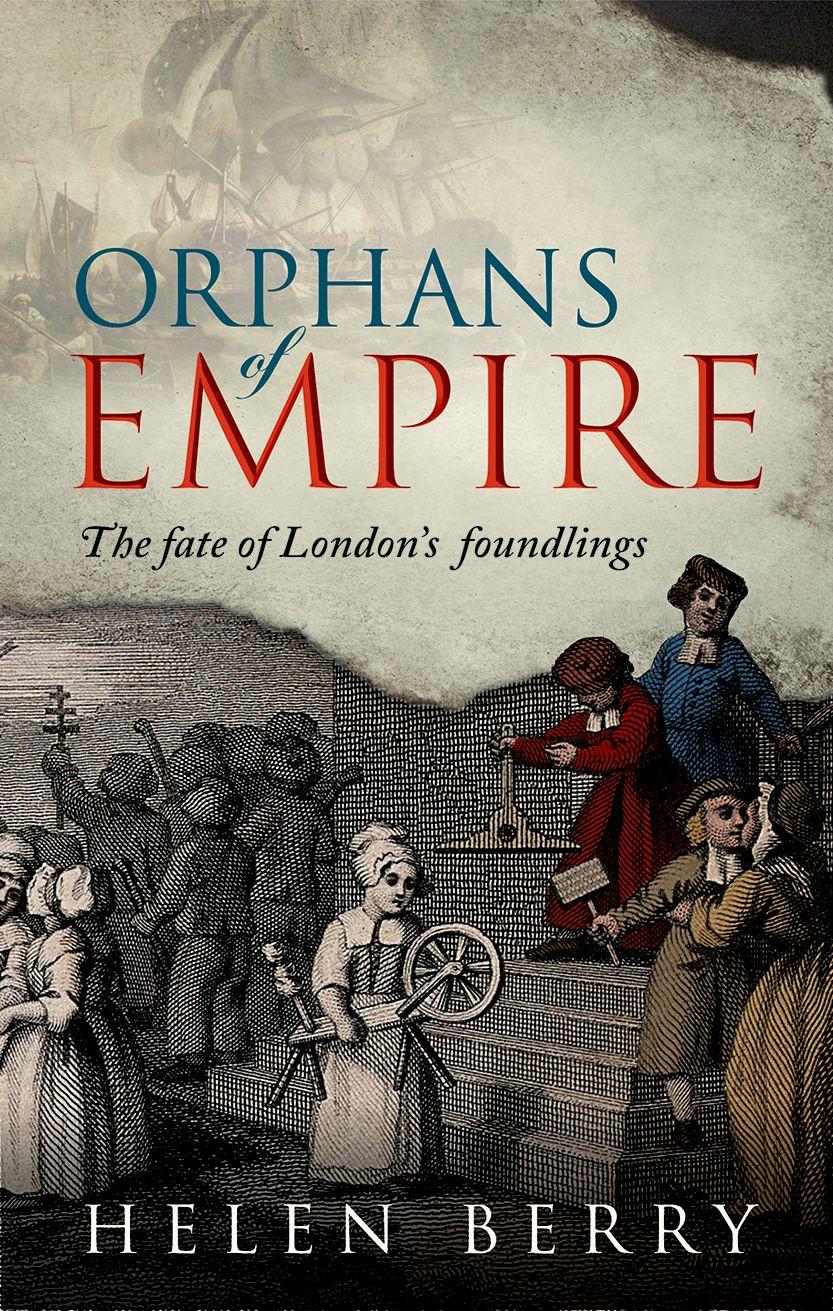
ORPHANS HELEN BERRY
Great Clarendon Street, Oxford, ox2 6dp, United Kingdom
Oxford University Press is a department of the University of Oxford. It furthers the University’s objective of excellence in research, scholarship, and education by publishing worldwide. Oxford is a registered trade mark of Oxford University Press in the UK and in certain other countries © Helen Berry 2019
The moral rights of the author have been asserted
First Edition published in 2019
Impression: 1
All rights reserved. No part of this publication may be reproduced, stored in a retrieval system, or transmitted, in any form or by any means, without the prior permission in writing of Oxford University Press, or as expressly permitted by law, by licence or under terms agreed with the appropriate reprographics rights organization. Enquiries concerning reproduction outside the scope of the above should be sent to the Rights Department, Oxford University Press, at the address above
You must not circulate this work in any other form and you must impose this same condition on any acquirer
Published in the United States of America by Oxford University Press 198 Madison Avenue, New York, NY 10016, United States of America
British Library Cataloguing in Publication Data Data available
Library of Congress Control Number: 2018950679
ISBN 978–0–19–875848–8
Printed and bound in Great Britain by Clays Ltd, Elcograf S.p.A.
Links to third party websites are provided by Oxford in good faith and for information only. Oxford disclaims any responsibility for the materials contained in any third party website referenced in this work.
This book is dedicated to Mary Bamsey (1914–2014) and to the mothers of lost children everywhere
PREFACE
At Russell Square tube station in central London, throngs of tourists gather daily, straight from their hotel breakfasts or discharged from long-distance coaches, and move off in packs towards Covent Garden. If they only took a moment and headed north-east in the opposite direction, they would find instead a much quieter corner, a seven-acre park known as Coram’s Fields just a few streets away. If it is a fine day, there will be the sound of children playing. The observant eye may spot a curious sign (‘Adults may only enter if accompanied by a child’). This green playground, with its children’s centre, nursery, and city farm, was once the site of the London Foundling Hospital. It was built upon fifty-six acres of land in Lamb’s Conduit Fields, purchased for the princely sum of £7000 in 1742 from the earl of Salisbury. All that survives today is a small colonnade, since the rest of the building was demolished in the 1920s. Nearby is the Foundling Museum, where the interior of some of the original Hospital has been preserved, complete with the valuable art work that was donated by famous artists of the day. Here in the Museum it is possible to stand in the reconstructed room, replete with fine wooden panelling and moulded ceiling, where poverty-stricken mothers brought their infants in a desperate attempt to have them admitted to the Hospital. The spectacle of
viii their misery has been imagined by countless visitors, recreating the public drama that was described by Georgian commentators in vivid detail.
This book relates the history of what happened to those infants who gained admission by chance to the London Foundling Hospital, and who survived long enough to go out into the wider world. Their stories are set within the context of Britain’s imperial history from the mid-eighteenth to the mid-nineteenth centuries, exploring the social, economic, and political forces that were behind the establishment and funding of the Hospital’s mission during the first 100 years of its existence. This is not a history of empire as told by military historians, but it explores instead the ways in which British imperial ambitions abroad shaped society at home. It reveals how empire shaped the fortunes and life chances of the very poorest members of society. This book sets out to explore how the dynamics of political, cultural, and economic forces shaped Georgian society, particularly in relation to maritime trade and warfare, and the interconnections between the charitable deeds and interests of the governing elite and the fortunes of the poor. It explores what living in London, the great metropolis at the centre of what was rapidly becoming the world’s leading superpower, meant for poor children at the mercy of charitable institutions. The eighteenth century witnessed new experiments in social welfare sponsored by the ruling elite through a combination of charity and direct government investment, among which the London Foundling Hospital was one of the most expensive and ambitious schemes. The Hospital was a voluntary response to the growing problem of urban poverty, an unprecedented venture for the English that had consequences, intended and unintended, not just in London but
throughout the nation for all concerned in the enterprise. Its influence extended globally in the pattern of the philanthropy it modelled among the rich and powerful, and among working communities in the life courses of the children it raised. Understanding this phenomenon will require a certain amount of openness to rethinking the motivation on the part of those who sought to ‘do good’ in their own time, and a nuanced understanding of the complicated motivations for people to engage in charitable works, both in the eighteenth century and today.

The sources of evidence relating to those whose lives depended upon charity are extremely difficult to piece together in the archives. First-hand accounts written by society’s poorest members who often had little or no literacy are almost non-existent, so the fragments that document their lives are usually mediated through others: the accounts of clerks, court scribes, and commentators. The voices of orphaned and abandoned children are very difficult to hear in modern times: recovering them from almost 300 years ago is almost but not quite impossible. The history of George King, a former foundling who wrote a detailed autobiographical account of his life, is woven through the narrative of this book, a single, precious thread. Other foundling voices join his in smaller, broken whispers. Together, they tell the story of what it was like to be raised without knowing the name you were given at birth, nor the identity of your parents, during the century before Queen Victoria came to the throne.
LIST OF FIGURES
1.1 An idealized view of eighteenth-century London. Canaletto (Giovanni Antonio Canal), London: The Thames from Somerset House Terrace towards the City, c.1750–1. Oil on canvas (1079 mm × 1880 mm).
1.2 Thomas Rowlandson, Miseries of London, 1807. Handcoloured etching (292 mm × 400 mm).
1.3 Good order and England’s prosperity. William Hogarth, Beer Street, 1751. Engraving (560 mm × 450 mm).
1.4 The evils of gin drinking. William Hogarth, Gin Lane, 1751. Engraving (390 mm × 321 mm).
2.1 The Foundling Hospital’s founder. William Hogarth, Captain Thomas Coram, 1740. Oil on canvas: full-length portrait (2387 mm × 1473 mm).
2.2 Admission day at the Foundling Hospital. Nathaniel Parr, An Exact Representation of the Form and Manner in which Exposed and Deserted Young Children Are Admitted into the Foundling Hospital, 1749. Engraving (560 mm × 620 mm).
2.3 In a custom adopted from other foundling hospitals on the continent, mothers left a token with their babies—a key, a charm or button, a broken coin, c.1700s.
14
15
20
21
29
43
45
2.4 Descriptions of each infant admitted to the Foundling Hospital were recorded in the billet book, with samples taken of the clothing the infant was wearing on the day they were taken in.
50
2.5 The Foundling Hospital, c.1750–80. Engraving (196 mm × 257 mm). 56
3.1 The Foundling Hospital: The Interior of the Court Room [undated, nineteenth century]. Engraving (105 mm × 142 mm).
3.2 William Hogarth, Moses Brought before Pharaoh’s Daughter, 1746. Oil on canvas (1727 mm × 2083 mm).
3.3 William Hogarth, Emblem of the Foundling Hospital (1747). Original drawing for the Letterhead for the Foundling Hospital (4⅜×8¼).
3.4 John Sanders, Foundling Hospital, Holborn, London: interior of the chapel, 1774. Etching (341 mm × 493 mm).
3.5 Joseph Highmore, Thomas Emerson, 1731. Oil on canvas (1220 mm × 1454 mm).
3.6 James Bretherton, Jonas Hanway, c.1770–80. Etching (214 mm × 161 mm).
71
72
74
77
82
86
4.1 The first page of the autobiography of George King. 104
4.2 Petition of Mary Miller, George King’s mother.
106
4.3 Frontispiece by William Hogarth, Anon., Account of the Hospital for the Maintenance and Education of Exposed and Deserted Young Children (1759). 125
6.1 Hogarth, Industry and Idleness, 1747. Engraving (265 mm × 348 mm).
179
8.1 George King’s refuge in old age: Greenwich Hospital for old sailors. Samuel Ware (1721–86), Greenwich Hospital 271
Whether ’tis Nobler in the minde to suffer The Slings and Arrowes of outragious Fortune, Or to take Armes against a Sea of troubles, And by opposing end them.
William Shakespeare, Hamlet (first fol., 1623), Act III, Scene 1
The public opening of Trafalgar Square, one of London’s most famous landmarks, on 1 May 1844 was not a great success. Building work had begun as far back as the 1820s to clear and develop the site, which was formerly occupied by the Royal Mews. The outlandishly extravagant monarch George IV had his horses moved to Buckingham Palace, leaving the premises empty, but progress on developing the site over the next two decades was slow. The leading architect of Regency style, John Nash, developed the south side of the square, but he died in 1835 before the work was completed. It was then decided that the square would be named after the Battle of Trafalgar in commemoration of Admiral Lord Nelson’s famous victory in October 1805. Plans for the new National Gallery on the north side were criticized for their lack of grandeur, whose architect William Wilkins also died before the work could be completed. By the 1840s a new architect,
Charles Barry, had been appointed, and the scheme became more costly and grandiose, with the addition of fountains, four granite plinths for sculptures, and pedestals for lighting. An extra committee was formed to commission a monument to Nelson, who had died a hero’s death at Trafalgar, but it took two years for them to decide how public subscriptions towards the cost of the monument could best be organized and managed. Eventually, an open competition was held. It was won by the architect William Railton, who produced a design for a monumental column topped by a statue of Nelson and flanked by four bronze lions. Charles Barry publicly declared his dislike of the winning scheme, and there was further widespread condemnation. The famous Trafalgar Square statues of lions by Sir Edward Landseer were not finished until the 1860s. Further delay this time was caused by Landseer’s insistence on sketching from a real lion’s corpse obtained from London Zoo, which decomposed before the artist had time to finish his drawings.
Amid this tortuously slow progress, there was recognition that the surviving veterans of the Battle of Trafalgar should be honoured. During the late spring and summer of 1844, The Times announced that a grand ceremony and dinner would be held at public expense for the men who had fought at Trafalgar, and at Nelson’s other great battles—Copenhagen, Cape St. Vincent, Tenerife, and the Nile.1 Some months later, the newspaper reported that this plan had been cancelled following complaints (‘earnest solicitations’) from local tradesmen that such an event would harm their businesses. The alternative suggestion was that a ceremony would be held at Greenwich Hospital, a naval school and charitable foundation which housed former seamen. The plan was to present each of the veterans who had served alongside Nelson with a medal and a gift of money.
And so, some miles away from Trafalgar Square, south of the River Thames, in the grand Painted Hall at Greenwich Hospital, approximately 350 elderly ‘Trafalgar men’, former seamen who were the survivors of that famous battle, assembled on the morning of 2 April 1845. The boys of the naval school marched on the parade ground in full regalia, to the sound of a military band that played ‘God Save the Queen’. Inside, under the vaulted magnificence of the Painted Hall, the veterans were called forward in turn by name, many with missing limbs and wooden legs that marked their sacrifice for the nation. One by one, each was solemnly presented by the governor with a medal and gratuity of ten shillings in tribute to his service. The medal bore Nelson’s effigy and an inscription of the admiral’s famous message, signalled to his men on the eve of the Battle of Trafalgar: ‘England expects every man will do his duty’. On the reverse, there was an engraving of the ‘Nelson Pillar’ (known to us today as Nelson’s column) with the words ‘To commemorate the opening of the Nelson Testimonial, Trafalgar-square, 21st October, 1844’. On the commemorative medal, Trafalgar Square was depicted in its idealized, completed form, not showing the reality of bare hoardings and empty plinths. The Times reported that not only did the elderly heroes ‘look healthy’, but they were universally praised for their ‘orderly behaviour’.2 Media attention that day was focused on the heroic deeds of Admiral the Rt. Hon. Sir Robert Stopford, governor of the Greenwich Hospital, the seventy-six-year-old former naval commander who had served with Nelson and, it was reported, ‘almost’ saw action at Trafalgar. At the upper end of the hall were the governor, lieutenant-governor, officers, and their friends, seated together with assembled dignitaries behind a high table flanked by the Union Jack and flags of the Admiralty.3
Another, somewhat less celebrated, invitee that day was George King, a former ordinary seaman, now nearly sixty years of age. Unlike many of the dignitaries who were present, he had actually taken part in the Battle of Trafalgar when he was just eighteen years old.4 George King was remarkable in that, unlike many of the rank-and-file sailors below decks, he was able to read and write, and so compiled his own arresting account of his experience of active service. On that fateful day he was eyewitness to ‘great slaughter’ at Trafalgar, but extraordinarily by his own account he ‘never received a Wound’.
The truth was that George King had been fighting to survive against the odds all of his life, for as an infant he had been given up to be raised in the London Foundling Hospital. His is the only detailed autobiography by a foundling child born and raised in the eighteenth century, and as such provides some of the few surviving clues as to what it was like to have been brought up in an institution founded for ‘orphaned and abandoned children’ over 250 years ago. George was an ‘orphan of empire’, someone whose parents had died or who had abandoned him (thereby effectively orphaning him, since very few children left at the Foundling Hospital were ever reunited with their birth families). George’s precarious life as a pauper infant was ‘saved for the nation’ via a publicly sponsored charity whose main purpose was to boost the workforce at home and manpower for the armed forces abroad in order to further Britain’s imperial mission. Almost no one at the time nor subsequently knew of George King’s story, nor his heroic service to his country. He surpassed expectations of the kind of modest, useful life that the Foundling Hospital’s supporters had planned for the poor children in their care by fighting at one of the most iconic
battles in British history.5 His remarkable autobiography is a vital part of the story that will be told for the first time in this book. But the exceptionalism of his life can only be fully appreciated if we uncover as much as it is possible to know about the thousands of other children who were raised in the Foundling Hospital, and expose some of the myths about what happened to them, where they were sent to work, and what they experienced of life’s ‘Slings and Arrowes of outragious Fortune’.
In order to understand how and why the lives of poor children like George King came to be deemed worthy of saving for the nation, we need to go back a century earlier, to the year 1720, and the politics and power relations that shaped the lives of ordinary women and men living at the epicentre of a rapidly expanding British Empire. In this year, a financial scandal rocked the City of London, the ramifications of which led to the rise to power of Sir Robert Walpole, who became de facto Britain’s first prime minister. Overspeculation had led to inflated share prices in the South Sea Company, which had seemed a safe bet for investors since it was effectively underwritten by leading British government ministers. In fact, rumours proved to be correct that the company’s claim to a trade monopoly on the asiento (the right to the trade in slaves with South American colonies) was entirely spurious. There was widespread reporting of the subsequent panic at the Royal Exchange when the ‘bubble’ burst, leading to bankruptcy and even suicide of speculators whose life savings vanished. Among those who lost a fortune was Sir Isaac Newton, whose mathematical genius could not defend him against the vicissitudes of stock market gambling.6
As first lord of the treasury, Walpole had unprecedented command of the intricacies of the financial markets (and indeed of a ‘vast spoils system’ of bribery that was spectacularly corrupt, even by Georgian standards).7 By 1722, he had re-established investor confidence in City institutions, and united the office of prime minister with first lord of the treasury, a dual title held by the British prime minister to this day.
The events known as the South Sea Bubble illustrate just how much the governance of Britain had come to be linked to the fortunes of the City of London and the creation of a so-called ‘fiscal-military state’, where both government and trade were organized to support and expand a growing overseas empire. In the late seventeenth and eighteenth centuries Britain emerged as ‘the military Wunderkind of the age’. As historian John Brewer has observed:
Dutch admirals learnt to fear and then admire its navies, French generals reluctantly conferred respect on its officers and men, and Spanish governors trembled for the safety of their colonies and the sanctity of their trade.8
This was far from being an era of peace and stability, as it has sometimes been portrayed. Britain was engaged in a series of continental European wars, starting with the Nine Years’ War under William III against France in the 1690s, and continuing with the Wars of Spanish Succession (1701–14), Austrian Succession (1740–48), and the Seven Years’ War (1756–63). These conflicts were waged often for dynastic reasons that reflected struggles for supremacy between Catholic France and her Protestant neighbours
in Europe. At the end of the seventeenth century, a new Anglo-Dutch alliance was fostered by William III, Prince of Orange and former Stadhouder of the United Provinces, whose seizure of the English throne in 1688/9 was a coup against the Catholic incumbent, James II. William’s successor, Queen Anne, died in 1714, and the throne passed to a new Hanoverian dynasty of experienced military princes, George I and George II, who strengthened Britain’s alliances with Protestant German states. Britain’s assertion of her military strength enabled defence of the maritime trade which in turn brought prodigious wealth to rival other European colonial powers. During the reign of George III, the Royal Navy became the ‘senior service’ among British forces, and by 1805, the Navy was the last line of resistance against the combined forces of their only maritime rival, the combined fleet of French and Spanish ships under the command of Napoleon Bonaparte.
The growth of British imperial ambition over the course of the eighteenth century would not have been possible without bankrolling by the City of London. In 1694, the newly formed Bank of England brokered enormous loans that enabled successive monarchs to wage war against continental European powers. In order to service the national debt, parliament levied taxes via customs and excise duties and paid interest to the stockbrokers, merchants, and bankers in the City of London who profited from government loans. The loans in turn paid for a vast network of bureaucratic offices operating on behalf of centralized government, procuring supplies to equip a standing British Army and Navy with everything it needed, from transportation and arms, to clothing, food, billeting costs, leather for horse saddles, and boots for the men. They also distributed wages to pay battalions and squadrons by newly
professionalized ranks of officers, as well as rank-and-file sailors and soldiers, and the civilian trades that were needed to support the activities of the armed forces, such as shipbuilders, rope makers, tanners, blacksmiths, and carriers for transportation of troops and supplies. In the Nine Years’ War, 76,000 men were mobilized, rising to 92,000 during the War of Spanish Succession.9 By 1794, the total number of Naval seamen and Marines had reached 86,000, with an additional 62,800 ‘volunteers’ (many of them press-ganged), of whom half were able seamen. Though these numbers fluctuated, depending upon whether the country was preparing for war or scaling back operations during peacetime, they give some idea of the scale of the logistical task in terms of manpower alone.10
The exercise of military and naval power in pursuit of territorial gains was seen as unashamedly desirable to the ruling elites of eighteenth-century Britain. The Georgian world-view was one of ‘mercantilist’ ideology. Unlike modern neoclassical economic theory, which rests upon the idea that economic growth is potentially infinite, mercantilism was predicated upon the empire builder’s world-view, which centred on territorial land grab and colonization as a means of gaining control of the world’s resources. Britain wanted a greater share of power in international relations, particularly in the ongoing rivalry with her near neighbour, France. Proponents of mercantilism deemed it necessary to wage war in order to expand the empire and protect British interests. This brought prosperity to the mother country, siphoning more and more raw materials and labour from imperial rivals, and safeguarding an ever-increasing British share of colonial territories and global maritime trade. Wars were usually enacted via complicated and shifting networks of alliances
with other European powers, such as the Grand Alliance between Britain, the Holy Roman Empire, the Dutch Republic, and the Duchy of Savoy. The War of Spanish Succession brought strategic territorial gains for the British Navy via the acquisition of Gibraltar and Minorca (and hence access to the Mediterranean), and trade advantages for British merchants in the granting of exclusive rights to the slave trade in Spanish America.
The foundations of Britain’s empire were in the New World, and went back to the late 1500s—the colonies of the eastern seaboard counties of what is now the United States, which grew out of settlements in New England during the Elizabethan era. Subsequent acquisitions in the West Indies provided further trading advantages (British dominion over Jamaica, for instance, dated back to 1655). This was the origins of the ‘triangular trade’ in slaves from West Africa, bought and sold in return for British manufactured goods and transported on the horrific ‘middle passage’ across the Atlantic to work on sugar and cotton plantations. For as long as this continued, the myth could be sustained that the ‘first British empire’ in the west was mutually beneficial to Britain and her dominions, based upon shared cultural ties (a common language and Protestant religion) and tacit consent won through mutual trading interests, since the American colonies were the prime market for British exports. The reality was somewhat different, however: the American colonies were beginning to assert their right to self-government and showed signs of questioning their obligations to the ‘old country’, specifically their obligation to pay taxes to Westminster.11
The Seven Years’ War (1756–63) showed both the strengths and weaknesses of Britain’s imperial policy at this time. It has been