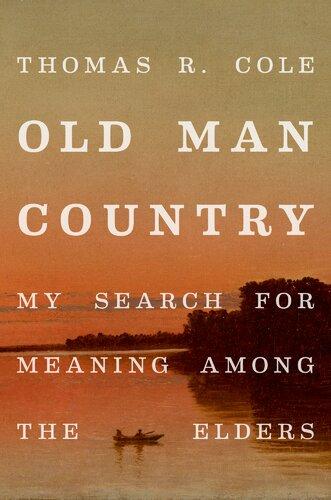
Old Man Country
My Search for Meaning Among the Elders
Thomas R. Cole
Professor and Director of the McGovern Center for Humanities and Ethics at the University of Texas Health Science Center in Houston
Oxford University Press is a department of the University of Oxford. It furthers the University’s objective of excellence in research, scholarship, and education by publishing worldwide. Oxford is a registered trade mark of Oxford University Press in the UK and certain other countries.
Published in the United States of America by Oxford University Press 198 Madison Avenue, New York, NY 10016, United States of America.
© Thomas R. Cole 2020
All rights reserved. No part of this publication may be reproduced, stored in a retrieval system, or transmitted, in any form or by any means, without the prior permission in writing of Oxford University Press, or as expressly permitted by law, by license, or under terms agreed with the appropriate reproduction rights organization. Inquiries concerning reproduction outside the scope of the above should be sent to the Rights Department, Oxford University Press, at the address above.
You must not circulate this work in any other form and you must impose this same condition on any acquirer.
Library of Congress Cataloging-in-Publication Data
Cole, Thomas R., 1949– author.
Title: Old man country : my search for meaning among the elders / Thomas R. Cole.
Description: New York : Oxford University Press, 2019.
Identifiers: LCCN 2019001345 | ISBN 9780190689988 (hardback)
Subjects: LCSH: Older men—United States. | Old age—United States. | Aging—Social aspects—United States. | BISAC: PSYCHOLOGY / Social Psychology. | PSYCHOLOGY / Developmental / Adulthood & Aging. | MEDICAL / Geriatrics.
Classification: LCC HQ1064 .U5 C5265 2019 | DDC 305.26/10973—dc23
LC record available at https://lccn.loc.gov/2019001345
9 8 7 6 5 4 3 2 1
Printed by Sheridan Books, Inc., United States of America
To my children, Jake and Emma
And to my grandson, Noah
CONTENTS
Acknowledgments ix
CHAPTER 1 What My Fathers Couldn’t Find 1
CHAPTER 2 Setting Out on Life’s Journey 5
PART I | Am I Still a Man?
CHAPTER 3 George Vaillant and the Good Life of the American Man 25
CHAPTER 4 Red Duke: The Cowboy Surgeon 37
CHAPTER 5 Sherwin Nuland: The Old Man Who Was Young and Strong 47
Interlude: A Family Letter 55
PART II | Do I Still Matter?
CHAPTER 6 The Moral World of Paul Volcker 61
CHAPTER 7 Denton Cooley and the Legacy of 100,000 Hearts 71
CHAPTER 8 John Harper Gets by with a Little Help from His Friends 79
Interlude: The Fall of Daedalus 89
PART III | What Is the Meaning of My Life?
CHAPTER 9 Hugh Downs: Television Broadcaster as Modern-Day Cicero 95
CHAPTER 10 Sam Karff and the Power of Stories 105
CHAPTER 11 James Forbes: Old Man by the Riverside 115
Interlude: Love Calls You by Your Name 125
PART IV | Am I Still Loved?
CHAPTER 12 Dan Callahan: Love in the (Old) Age of Ethics 131
CHAPTER 13 The Story of Walter Wink: Nonviolent Resistance and Dementia 141
CHAPTER 14 Ram Dass and Me 149
Interlude: Who Do You Think You Are? 159
CHAPTER 15 Gleanings for the Path Ahead 165
Sources and Further Reading 171 Index 175
ACKNOWLEDGMENTS
Ifirstthank the men who appear in this volume, who gave me their time and shared their lives with me in person, on the phone, and over Skype. It is not easy to be open about one’s experience of deep old age, a time of life that our culture fears and denigrates. I also thank others who spoke with me and do not appear in the book: Eugene Buday, Stanislav Grof, Phil Hardberger, Keith Jackson, Robert Lane, Edmund Pellegrino, William J. Schull, and Rick Smith. I have taken the liberty of altering some individual quotes to make their meaning clearer to the reader. The sources for biographical, historical, and gerontological material in each chapter can be found in the Sources and Further Reading section.
I am most indebted to my friend and collaborator Ben Saxton. We began working together in 2009, when Ben was my research assistant while a graduate student in the English Department at Rice University. The best part of my workweek was the hour or two we spent thinking and discussing academic literature about aging, gender, and old men; getting to know each other; and sharing ideas and plans. Ben went on to a postdoctoral fellowship and then moved to New Orleans to begin researching and writing a book about poker. As we both moved away from purely academic work and supported each other’s projects, Ben kept working as a research associate and colleague. When the seed for Old Man Country was planted, he helped water, fertilize, and nurture it. Every chapter bears the marks of his careful thoughts, editing and drafting suggestions, and support for a project that often seemed impossible or interminable.
Others helped me contact people I wanted to interview: Richard Buday, Bill Howze, Bob Goodrich, Emily Fine, Phil Montgomery, Rick Moody, Mark Ryan, John Schuster, and Steve Stein. I am grateful to others who spoke with
me: Edie Beaujean, Susan Cooley, Elizabeth Coulter, Penelope Hall, Diane Highum, and Rick McCarthy. Sydney Callahan was especially generous in sharing her own experience as an old woman who has been Dan Callahan’s wife for 65 years.
I am also indebted to many friends, colleagues, and others who made the book possible.
My agent, Beth Vesel, sought me out after reading a New York Times piece that quoted me. Over several years, she patiently but firmly shaped the proposal and the book itself. I am grateful to Abby Gross, my editor at Oxford University Press; Beth McLaughlin at Adept Word Management; and Andy Klein and David Kline for their research assistance and friendship.
My friends and colleagues in gerontology have saved me from many errors and brought new ideas as well as personal support for an unconventional project. Andy Achenbaum and I go back to the 1970s, when we were both graduate students in American history researching the nonexistent field of the history of aging. I am grateful for Andy’s listening skills, wide-ranging knowledge, careful readings of draft chapters and above all, his friendship. Kate deMedeiros was my student at the Institute for Medical Humanities in Galveston in the 1990s. From the beginning, she provided input, fresh ideas about the dignity of all elders, and a sharp critical mind. Now a distinguished gerontologist, she has generously shared ideas, sources of data, gerontological literature, and her expertise in narrative gerontology.
My dear friend Marc Kaminsky has shaped this book in many ways: from early conversations about the arc, structure, and conception of the book to careful readings and unstinting support. Connie Royster has been my deep friend since middle school. She has listened to me talk about this book, offered suggestions, and made key connections for me. Catherine Stephenson has listened for many hours to the confusion and turmoil beneath the surface of the words written here. I am grateful for her interpretations, words of support and caution, and for moments of silence.
I am privileged to work as Director of the McGovern Center for Humanities and Ethics at The University of Texas Health Science Center At Houston. I am grateful to the center’s faculty and staff colleagues—Nate Carlin, Rebecca Lunstroth, Angela Polczynski, and Alma Rosas—for their patience with and support for me these past several years. Alma efficiently helped organize the book’s electronic files, facilitated transcriptions, helped research various questions, and gave her quiet support throughout what seemed like a never-ending process.
Finally, my wife Thelma Jean Goodrich has made this book possible. Her talents as a writer, her countless readings, her feminist angle of vision, her sensitivity as a psychotherapist, and her unstinting love, emotional support, and patience over many years are woven into every one of this book’s pages.
What My Fathers Couldn’t Find
On September 22, 1953, my father, Burton David Michel, woke up early at our new house in New Haven, Connecticut. He turned over, kissed my mother, and wished her a happy 28th birthday. He came into my bedroom and kissed me. I was 4 years old. Next he kissed my brother and sister, 18-month-old twins sleeping in the next room. Then he dressed for work, ate breakfast, got into his brown four-door Packard, headed north on the Merritt Parkway, and drove his car into a bridge abutment.
I remember the phone ringing in the kitchen and our next-door neighbor, Mrs. Brownstein, rushing over. I remember the red and blue dots marking the white wrapping on the Wonder Bread waiting on the kitchen table. An ambulance took my father to a local hospital, where he lingered in a coma for a week. He never came home.
My mother seemed to disappear, too. She spent a week at his bedside, moved in with her parents for a while, and then went on a 2-week cruise with friends. My beautiful Aunt Carole came to stay with us.
It is said that everyone loved my father. People lined up around the block outside the funeral home for his funeral. The empty plot next to his grave at the Mishkan Israel Cemetery on Whalley Avenue still waits for my mother.
The family’s version of my father’s death is that it was an accident. Burt had been smoking, my grandmother said, and perhaps he lost control of the steering wheel. That story never made sense to me. It was a clear morning, there was no traffic on the highway, and the car crashed head-on.
In the late 1990s, Carole, still living in New Haven around the corner from my mother, was suffering from pancreatic cancer. My surgeon friend Steve Stein performed a “Whipple procedure” that extended her life. Just before the surgery, my aunt told Steve about a family secret that he thought
I should know, but he considered it a confidential element of their doctor–patient relationship. So he suggested that I do an oral history with Carole “to preserve her life story for the family.”
When Carole got to her memories of my father’s death, she hesitated.
“Oh, Tommy. . . . I’m so sorry . . . I don’t want to hurt you.”
“It’s ok,” I said. “I already know what you’re going to say.”
After the wreck, Carole spent several days keeping my mother company with the rest of the family gathered around my father’s bed. After he died, a nurse gave Carole my father’s belongings. In his wallet was a suicide note written for my mother. Carole tore up the note, flushed it down the toilet, and never spoke of it.
I never saw my mother cry or talk about my father’s death. His pictures came down from the fireplace mantle. His Lehigh University fraternity mug and long sleek Sheaffer ink pen disappeared from the living room desk, along with every other trace of him.
One afternoon about a year after my father’s death, I walked up the backyard stairs into the screened-in porch at our house. A big strong man was sitting next to my mother on our green-and-white-webbed aluminum glider. Magically, he had fixed my bicycle. This big man’s name was Bert Cole, and he was a veteran of World War II. I jumped into his lap. My mother married him soon afterward.
I had a long and difficult relationship with Bert Cole, who died in 2006 at the age of 88. Despite our struggles, I helped care for him at the end. I remember sitting one night in Room 452 of the Regional Hospital in Venice, Florida, watching him breathe as the clock silently witnessed our last time together, quieter and more serene than any before. That night, I slept on a sofa in his room. I was determined that my second father would not disappear like my first—without my being there.
The next morning, when my siblings and my mother arrived for the day’s death watch, Bert’s eyes were closed. His head hung to the left on the pillow, his slack mouth wide open—the look of the dying. No more use for the false teeth or glasses waiting on the nightstand. No more beeping from heart monitors or sounds of air whistling through breathing tubes. Only gurgling lungs and long irregular breaths disturbed the silence. As we watched over him, Bert suddenly woke up with a start, eyes wide as saucers. He looked around to see who was there—we three children and Jackie, all present and accounted for. Bert settled back against the pillow and closed his eyes. No one knew what he was thinking or what he understood. By turns, we talked to him, kissed him, and petted his head. He smiled and nodded each time. We contacted as many grandchildren as we could and held the phone up to
his ear as each one spoke to him. He gestured and spoke toothlessly back. When my sister’s daughter Sara spoke to him, he virtually shouted with joy, waving with his cold, bloated left hand. He spoke with his sister Sally. Then I suggested that we leave the room and give Jackie some private time to talk with him.
“I don’t think I can do it,” she sobbed.
“Of course you can,” I said, taking her face between my hands and kissing her forehead.
After my mother talked to Bert, the four of us drove a few miles up Route 41 to Mi Pueblo for dinner. Halfway through the meal, the hospital nurse called: He was gone. I drove back to the hospital and sat with him until his body was taken to the morgue.
When I turned 60, I began reading and thinking seriously about becoming an old man myself. The following year, I underwent a difficult neck surgery to take pressure off peripheral nerves that were causing pain and weakness in my right arm. I began to read scholarly work about men and old age; memoirs and essays by old men (in particular Cicero, Malcolm Cowley, Donald Hall, and Roger Angell); and the fiction of Philip Roth, especially his slim novel Everyman. At the same time, I was watching popular films whose main characters were aging men played by Hollywood stars who were themselves aging—Harrison Ford, Sylvester Stallone, Clint Eastwood, and Tommy Lee Jones.
Most of all, I was captivated and haunted by the film adaptation of Cormac McCarthy’s novel No Country for Old Men, whose main character, the aging Sheriff Ed Tom Bell, is faced with the overwhelming violence and terror of the Mexican drug trade. Set in a small Texas town, the movie is filled with bloody scenes of dead smugglers, mercenaries, and townspeople. But unlike the violent hypermasculine aging heroes in Westerns such as Unforgiven or Cowboys and Aliens, Sheriff Ed Tom Bell renounces violence and relinquishes the social scaffolding of middle-aged manhood. Faced with firepower that he cannot match and a kind of evil he cannot understand, Bell decides to retire. On a cold blustery day, he turns in his badge and walks out of the courthouse for the last time, the world utterly beyond his control. Bell sits in his truck for a few minutes, bitter and defeated. Like many aging men, Bell is no longer sure who he is or where he fits. He drives home to his wife Loretta to figure out what the next stage of his life will look like.
The film ends with a powerful dream. It is a cold snowy night. Bell is on horseback riding with his father through a mountain pass. His father moves on ahead and out of sight. Somewhere in the dark, he fixes a fire to warm and
light his son’s way. Bell knows that he will someday get to that place, and his father will be there. Then he wakes up.
Bell’s dream has always moved me to tears. It evokes my longing for a father to light the way. As I write these words in April 2018, I am 69 years old. My mother is 93. My father would have been 92. My stepfather would have been 100. As I grow older, I continue to make peace with my father’s suicide and with my stepfather’s domineering and difficult personality. My first father, as my mother wrote on his gravestone, was “a man of tender conscience.” He never found a way to live out his whole life. My second father lived into deep old age. He never found a way to share his life and love. He was, as my mother put it on his gravestone, “A Soldier to the End.” In writing this book, I am looking for what my fathers couldn’t find.
Setting Out on Life’s Journey
My father’s death broke the sequence of generations in my four-year-old life. I was fated never to live out childhood’s innocence or exuberance. But my father’s death also sowed seeds of wisdom. Inside the darkness, I knew, like Ed Tom Bell, that somewhere on the path ahead there would be light.
When I was a young boy, the old people in my family were a sheltering rock. My grandparents and great aunts always seemed the same. They were there every weekend, on holidays, whenever we needed them. My brother, my sister, and I ate at their tables, roamed their houses, climbed in their yards, ravished their presents, and assumed their immortality.
My grandfathers died when I was 9 and 16 years old. My father’s father Irving was a quiet, cigar-smoking blueprint shop owner who cried every day of his life after his son’s death. The night Irving died, I had been on a local television show with my Cub Scout pack. My mother said he must have died happily after seeing me on TV. I wondered about that. My mother’s father Jacob (known as Jack) was a hard-driving, self-made son of a Jewish immigrant tailor. Jack graduated from Yale University in 1912; his large, dark blue and white flannel Yale banner took up most of the wall over my brother’s bed in our childhood bedroom. Jack’s intensity, ambition, and success inspired and haunted me. I felt great pride at being a pallbearer at his funeral, where my uncontrollable crying disturbed an otherwise dignified affair.
My grandfathers were in their early 70s when they died. Their deaths were painful. But they didn’t undermine the continuity derived from my grandmothers, who seemed to go on without change. Until my late 30s, they maintained their independence, each somewhat stern and difficult in her own way, each fiercely loyal and proud. Their existence helped frame my own. They demanded little and gave much.
In the spring of 1987, my mother’s mother Helen entered the hospital for the first time since giving birth to my Aunt Carole. She died 2 weeks later. Helen was the family’s matriarch. She possessed an upper-class bearing and an unwavering sense of dignity—as well as the wealth accumulated by Jack. She had always seemed invulnerable, as if she might actually outlive death, if not the rest of us. Her death was shocking despite her 87 years. It felt as if the rope of a great anchor had suddenly unraveled.
At age 85, my father’s mother Reba, who was losing the ability to direct her own affairs, was forced out of the blueprint business she had run for 50 years. Her health was broken by cataracts and acute glaucoma, severe arthritis, stomach trouble, and, finally, Alzheimer’s disease. In the fall of 1986, both Reba and my newborn daughter Emma were in diapers. Neither could walk more than a few steps without falling.
My grandmother fought furiously against me when, in the absence of my father, I had to take over her affairs and arrange a conservatorship and round-the-clock care for her. Reba had always been histrionic. “Keep this up and you’ll kill your grandmother,” she screamed at me across 2,000 miles of phone lines between Connecticut and Texas. “Is that what you want?” And then, after a long pause, she sighed. “Ah, but what can you do.”
In 30 years, I would be having the same argument with my mother.
For 3 years, Reba stayed in her apartment with round-the-clock nursing care. At first, she tried to jump off her balcony and frequently hit or hollered at her caregivers, who once sent her to the emergency room in a straitjacket. After Reba had made several more traumatic visits to the hospital, I came to an understanding with her nurse’s aides and physician: She would remain at home until she died. Reba had often expressed the wish for an end to her suffering, and we had recently decided against heroic measures to prolong her life. In 1988, she stopped walking altogether. Most of her time was spent sleeping or sitting in a wheelchair. Her legs contracted and curled up like chicken wings. Her skin broke down, and the sores became painful. Toward the end, she still had daily periods of lucidity.
One evening in late May 1989, Reba’s caregivers telephoned. She had lost weight from vomiting and diarrhea, wasn’t eating, and couldn’t communicate. Would I give permission to insert an intravenous line for fluids and nutrition? I told them to keep feeding her with straws, bottles, or syringes and that we’d see how she was the next morning. After a guilt-ridden, sleepless night, I spoke to Beverly, who worked the day shift.
“Do you think she’d want an IV?” I asked.
“No, I don’t think she’d want to be poked any more. Last week she said to me, ‘Get out my blue dress and my shoes, because I’m going to die.’ ”
“OK,” I said, my heart sinking. “Keep feeding her as much as she’ll take by mouth, hold her, and tell her I love her.” That day, Reba ate well and seemed to be rallying. She died the next morning, while Beverly and Geri were giving her a bath.
If only my father had lived. If only he had stayed with us and cared for his mother and my mother. If only he had stayed to take care of me and walk with me on the path of life.
Although I didn’t realize it at first, my academic work as a historian, gerontologist, and professor of medical humanities has long been fueled by grief and by my search for guidance through the stages of life. Since the early 1980s, I’ve written and edited many books and produced films circling around the same questions: What does it mean to grow old? How do cultures weave the fabric of intergenerational relations to build meaningful lives? What is a good old age?
My thinking about aging has always been shaped by the image of life as a journey. In The Journey of Life a book I wrote more than 25 years ago—I traced the history of cultural meanings of aging in Western Europe and the United States. I came to see that between antiquity and modernity, Western ideas about growing old changed dramatically. Aging was removed from the ancient provinces of religion and mystery and transferred to the modern terrain of science and mastery. Old age was removed from its place as a way station along life’s spiritual journey and redefined as a problem to be solved by science and medicine.
If life is a journey, what shape does it take? Who accompanies us on the journey? How long does it last? Where does it begin and end? History and culture give us various answers. Sometimes, as the poet T. S. Eliot wrote in Four Quartets, the journey brings us full circle:
And the end of all our exploring
Will be to arrive where we started
And know the place for the first time.
Sometimes the journey appears as a kind of homecoming, as in Homer’s ancient Greek epic poem the Odyssey. Odysseus, after fighting heroically in the Trojan War and confronting the Cyclops and other monsters, ultimately finds his way home to his wife Penelope. The hero’s journey appeals to us when we realize that we too struggle against forces beyond our control. Worried and uncertain about how to confront our own monsters and find our direction, we remember that others share our struggle. In an interview for this
book, the physician–writer Sherwin Nuland regretted that it took until his 70s to realize the importance of Philo of Alexandria’s admonition: “Be kind, because everyone you meet is fighting a great battle.”
The hero’s journey takes the form of a fantastically popular religious allegory in 18th-century Englishman John Bunyan’s Pilgrim’s Progress, which charts Christian’s solo journey from the City of Destruction to the Celestial City. The appeal of the journey from sin to salvation, of course, is the idea that God grants eternal life to a virtuous person. Like the hero in Pilgrim’s Progress, American men tend to view the journey of life as an individual trip. We internalize the image of the self-made man who equates masculinity with independence and self-reliance and who thinks he can live as if middle age goes on forever. This way of thinking tends to view masculinity and femininity as polar opposites; it constrains our ability to accept dependence and the need for others.
Part II of Pilgrim’s Progress follows Christiana, Christian’s wife, as she travels with her children and her friend Mercy. Although Christiana’s journey barely has a place in our cultural memory, her path remains the prevailing one for women, who more often accept the limitations of their bodies and feel the desire and need to travel with others. On my own travels to the elders while researching this book, I spoke with Sydney Callahan, Dan Callahan’s wife, who put an unexpected twist on this pattern. “You’ve always had to deal with male privilege,” she told me,
And if you’ve been pregnant, which I have been seven times, you’d know what it’s like to be physically limited and totally unable to do this or that, and you have to become dependent and interdependent. So women are trained at interdependence, and that’s what I think is a great advantage.
How can men learn that dependence and interdependence are part of the journey? One way to begin is by acknowledging the fear, shame, and unhappiness we may feel because we inhabit bodies no longer as strong and conventionally beautiful as they once were. We can learn to accept and be compassionate toward our own declining body. The Irish poet William Butler Yeats struggled with these questions to the very end of his life. Yeats, who experimented with an early form of testosterone to maintain his vitality and sexual potency, also came to see the importance of spirituality. As he wrote,
An aged man is but a paltry thing
A tattered coat upon a stick, unless Soul clap and sing, and louder sing
For every tatter in its mortal dress.
What does it mean for “soul to clap and sing”? I think it can mean many things, from literally singing in a church choir to enjoying a sunrise, taking care of and playing with grandchildren, appreciating the gift of another day of life, being grateful for the presence and support of caregivers, gazing into the eyes of the love of one’s life, and celebrating and working toward a future that extends beyond one’s own life.
I often think of an old Jewish fable: When each of us is born, an angel swoops down and slaps us on our bottom and whispers: “Grow!” The problem is that most of us stop listening in midlife. We think there is no more growing to do. I believe that a good old age requires growth, which requires conscious effort and intention. It is an accomplishment made possible by social support, by favorable circumstances, and also by the love and care of others. Old Man Country is premised on the idea that however old we are, there is always a green growing edge in our story, always a hidden path of personal growth.
What do I mean by the terms “old” and “old age”? In truth, these words have multiple meanings and skirt any single definition. But history can help us understand these meanings and provide context for their usage today. Until the 18th century, most people in the West had little idea how “old” they were. Chronological age had little or no meaning in everyday life. Instead, people fell into a particular stage or “age” of life, based on their functioning and their place in family and community. The number of stages often varied. One scheme divided people into three ages: morning, noon, and evening. As in the ancient Greek riddle posed by the Sphinx to Oedipus: What goes on four legs in the morning, two legs at noon, and three legs in the evening? Answer: “man,” who crawls on all fours at the beginning of life, stands upright in the middle of life, and walks with a cane in the last third of life.
In As You Like It (ca. 1600), Shakespeare revealed the theatrical origin of the metaphor of the “stages of life”:
All the world’s a stage.
And all the men and women merely players; They have their exits and their entrances, And one man in his time plays many parts, His acts being seven ages.
In this scheme, the seven ages are infant, schoolboy, lover, soldier, justice, pantaloon, and old age. Many of us will remember the frightening words Shakespeare used to describe old age:
. . . Last scene of all, That ends this strange eventful history, Is second childishness and mere oblivion, Sans teeth, sans eyes, sans taste, sans everything.
In some Western societies, the use of chronological age became possible as early as the 17th century, when church registers were developed to keep track of births, baptisms, marriages, and burials. Even then, a person’s chronological age had little meaning in everyday life. In the 19th century, however, Western governments began using census data to track men for wartime purposes, chart the health of populations, and create a uniform age for retirement benefits in what became the welfare state. By the 20th century, Western countries used chronological age to channel people bureaucratically into the three boxes of life: school, work, and retirement. As mass longevity became a reality in many areas of the world, “old age” was of little use in describing people who could range in age from 55 to 100 years. Gerontologists introduced the concepts of “young old,” “old old,” and “oldest old.”
The last quarter of the 20th century saw a new awareness and encouragement of the youthfulness, health, and well-being of our aging population. Since then, a new version of the “ages” or “stages” model of the life course has appeared in scientific thinking and popular culture. In 1989, Peter Laslett’s book, A Fresh Map of Life: The Emergence of the Third Age, drew attention to masses of people who were retired, in reasonable health, welleducated, and living without any prescribed direction or activity (except the pressures of consumerism and remaining youthful). Laslett named that period of life—between the completion of careers and child-rearing and the onset of frailty—the Third Age. That name helped spawn an educational movement known as Universities of the Third Age in Europe, which paralleled the growth of Institutes for Learning in Retirement in the United States, along with movements for conscious aging, positive aging, successful aging, and sacred aging—all self-conscious ways of helping older people live more engaged and fulfilled lives. The concept of the Third Age corresponded to a sea change in perceptions of the possibilities and prospects of the Baby Boom generation (76 million born 1946 and 1964), which began turning age 65 in 2011.
Due to improved nutrition, public health measures, and medical care, Americans generally live much healthier and longer lives than ever before, although longevity is not distributed equally across race or class and is even declining is some areas. In 1900, the average American man lived to age 47, and the average woman lived to age 49. In 2017, the average American
man lived to age 79, and the average woman lived to age 81. Unfortunately, growing numbers of older people are financially vulnerable or falling into poverty due to the fraying of the welfare state and inadequate savings and pension plans.
Today, 10,000 Americans turn age 65 years every day; the average man who turns age 65 can expect to live to approximately age 85 and the average woman to age 87. What we usually fail to notice is the aging of the aging population, or the “Fourth Age”—a stage of life roughly demarcated by age 80 or older. Today, the number of people age 80 or older in the United States is growing twice as fast as those older than age 65 and almost four times the growth rate of the total US population. The Fourth Age is often—but not always—marked by increasing frailty; declining ability for self-care; and vulnerability to disease, disability, and dependence. And, of course, it always ends in death. The Fourth Age has been described as a Black Hole—a vague, frightening, and shadowy cultural space that evokes denial when it doesn’t provoke fear. In one sense, the Fourth Age today marks a return of Shakespeare’s characterization of old age, the last stage of life, as “second childishness and mere oblivion.” But the Fourth Age also contains periods of sheer fun, appreciation of beauty, powerful religious and/or spiritual experience, community and family engagement, and continued work and artistic development.
Old Man Country seeks to reclaim and enhance the humanity of men in the Fourth Age. (I seek, of course, to reclaim and enhance the humanity of old women as well. That is another project, well underway thanks to scholars, activists, artists, and the sheer force of example.) To learn more about men in the Fourth Age, I decided to talk to those who were living it. It is a strategy first made famous in Plato’s Republic, in which Socrates says to Cephalus,
There is nothing which for my part I like better, Cephalus, than conversing with aged men; for I regard them as travellers who have gone on a journey which I too may have to go, and of whom I ought to enquire, whether the way is smooth and easy, or rugged and difficult.
To begin, I made a list of men I admired and wanted to talk to. I asked friends for advice. Many people on my list declined, couldn’t be reached, or never responded to my inquiry. I couldn’t reach my childhood folk song hero Pete Seeger, on whose banjo were inscribed the words “This machine surrounds hate and forces it to surrender.” Pete died in 2014 at age 94. Bill Moyers, former Press Secretary for President Lyndon Johnson and longtime public television host and documentary film-maker, responded that he had
too much work to do and hadn’t given it much thought. Sidney Poitier’s agent told me that he was too busy working in civil rights and the struggle against racism. The novelist Philip Roth, who died in May 2018, never responded to my letters. I did reach the famed, longtime ABC sportscaster Keith Jackson, and we spoke by phone. When I asked what he looked forward to, he answered, “tomorrow.”
I was never able to contact the wise and melancholy singer–songwriter Leonard Cohen, whose song “Anthem” contains a verse stored deep in my spiritual rolodex:
Ring the bells that still can ring Forget your perfect offering. There is a crack in everything. That’s how the light gets in.
Some conversations took place but never made it into the book. Of these, the saddest and most vivid was my encounter with 99-year-old Robert Lane, a former Yale University political scientist and activist. Tortured by an untold past filled with pain and regret, Lane was weary of life when I met him at an assisted living facility in New Haven, Connecticut. Drool steadily slid off his chin and painted brown spots on his tan jacket as he poured his heart out to me. “You are like a therapist,” he said to me after 2 hours. Lane then spent a sleepless night horrified that his inner life might be made public. The next day, he contacted me in anger and revoked the written permission he’d given me to use the transcripts of the interview.
Old Man Country explores how 12 men face (or faced) the challenges of living a good old age. All who appear in this volume are highly accomplished. Some are friends. Some are strangers. Some are famous: Paul Volcker, the former head of the Federal Reserve under Presidents Reagan and Carter; Hugh Downs, veteran TV broadcaster and creator of “The Today Show”; Denton Cooley, the first surgeon to implant an artificial heart into a human being; and Ram Dass, his generation’s foremost American teacher of Eastern spirituality.
Others are less famous but no less accomplished. George Vaillant is a research psychiatrist who directed the pre-eminent longitudinal study of elite American men from their college years until death. Red Duke was a trauma surgeon who founded the nation’s second (and now busiest) lifeflight helicopter service. Sherwin Nuland was a physician–writer best known for How We Die, which won the National Book Award in 1994. John Harper
is a former English professor from the University of Iowa who came out as gay when it was dangerous to do so and has made countless contributions to the intellectual, social, and cultural life of Iowans. Sam Karff is one of the great rabbis of his era. James Forbes is a powerful preacher who served as the first African American Senior Minister at Riverside Church in Manhattan. Dan Callahan is co-founder of The Hastings Center, an independent think tank that studies key issues in bioethics and life sciences. Walter Wink was a radical Christian theologian, writer, and activist who was in the late stages of Lewy body dementia when we talked in 2011.
All of these men, when I talked to them, were in their 80s and 90s—in or verging on the Fourth Age. They were born long before feminism began to challenge male dominance and civil rights movements began to fight for the rights of African Americans and gay, lesbian, transgender, queer, and disabled persons. In addition to male privilege, most of these men also enjoy the advantages of being white, Protestant, heterosexual, and financially comfortable. Their privileged status, however, did not guarantee their success. Nor has it exempted them from suffering and loss. Several have become frail and in need of assistance since I talked with them. Some have lost partners. Others have died.
My interviews were not structured by the methodology of social science, conducted by asking identical questions, recording the answers, and categorizing and analyzing them. They were often highly personal conversations, aimed at a mutual listening and telling in which we might both learn something new about ourselves. I was more interested in their current experience than in their earlier accomplishments. Sometimes, the conversations simply flowed from an opening gambit: “So, how is your life now that you are old?” Sometimes I asked the following questions, although not in any particular order:
How did you spend the day yesterday? Do you have a daily routine?
What do you love? Whom do you love? What is the role of sexuality in your life?
What do you look forward to?
What are you afraid of?
What were the high points of your life? The low points?
How do you think about your legacy?
What do you regret? What would you do differently if given the chance? What does it mean to be an old man? A man?
What should old men be contributing to the world today?