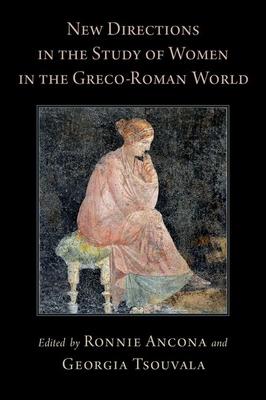
New Directions in the Study of Women in the Greco-Roman
World
Edited by RONNIE ANCONA AND GEORGIA TSOUVALA
Oxford University Press is a department of the University of Oxford. It furthers the University’s objective of excellence in research, scholarship, and education by publishing worldwide. Oxford is a registered trade mark of Oxford University Press in the UK and certain other countries.
Published in the United States of America by Oxford University Press 198 Madison Avenue, New York, NY 10016, United States of America.
© Oxford University Press 2021
All rights reserved. No part of this publication may be reproduced, stored in a retrieval system, or transmitted, in any form or by any means, without the prior permission in writing of Oxford University Press, or as expressly permitted by law, by license, or under terms agreed with the appropriate reproduction rights organization. Inquiries concerning reproduction outside the scope of the above should be sent to the Rights Department, Oxford University Press, at the address above.
You must not circulate this work in any other form and you must impose this same condition on any acquirer.
Library of Congress Cataloging-in-Publication Data
Names: Ancona, Ronnie, 1951– editor. | Tsouvala, Georgia, editor.
Title: New Directions in the Study of Women in the Greco-Roman World / edited by Ronnie Ancona and Georgia Tsouvala. Description: New York : Oxford University Press, 2021. | Includes bibliographical references and index.
Identifiers: LCCN 2020038365 (print) | LCCN 2020038366 (ebook) | ISBN 9780190937638 (hardback) | ISBN 9780190937652 (epub)
Subjects: LCSH: Women—History—To 500. | Greece—Social conditions | Rome—Social conditions. | Women—Greece—Social conditions. | Women— Rome—Social conditions. | Rome—Intellectual life. | Greece—Intellectual life. Classification: LCC HQ1134.N49 2021 (print) | LCC HQ1134 (ebook) | DDC 305.409/01—dc23
LC record available at https://lccn.loc.gov/2020038365
LC ebook record available at https://lccn.loc.gov/2020038366
DOI: 10.1093/oso/9780190937638.001.0001
1 3 5 7 9 8 6 4 2
Printed by Integrated Books International, United States of America
List of Figures vii
Acknowledgments ix
List of Contributors xi
Editions and Abbreviations xv
Introduction 1 Ronnie Ancona
1. Goddesses, a Whore-Wife, and a Slave: Euripides’ Hippolytus and Epistemic Injustice toward Women 11 Edith Hall
2. Periphrôn Pênelopeia: The Reception of Penelope in Fifth- Century Athens 29 H. A. Shapiro
3. The First basilissa: Phila, Daughter of Antipater and Wife of Demetrius Poliorcetes 45 Elizabeth D. Carney
4. Power and Patronage: Rethinking the Legacy of Artemisia II 59 Walter D. Penrose Jr.
5. The Murder of Apronia 79 Barbara Levick
6. A Century of Women’s History from the Papyri 95 Roger S. Bagnall
7. Cosmetics in Daily Life of the Ancient Mediterranean 123
Ann Ellis Hanson
8. Female Athletes in the Late Hellenistic and Roman Greek World 139 Georgia Tsouvala
9. Normalizing Illegality? The Roman Jurists and Underage Marriage 173 Bruce W. Frier
10. Augustus and the Economics of Adultery 187 Marilyn B. Skinner
11. Social Laws and Social Facts 205
Kristina Milnor
12. The Woman in the Street: Becoming Visible in Mid-Republican Rome 213 Amy Richlin
2.1 Penelope and Telemachos 31
2.2 The foot-washing of Odysseus 31
2.3 Odysseus and Penelope 34
2.4 Slaughter of the suitors 37
2.5 “Mourning Athena” 38
2.6 Nausikaa and Odysseus 43
8.1 Female athlete with diazoma/perizoma 150
8.2 Brauron, view of the stoa 151
8.3 Stadium at Olympia 154
8.4 Female charioteer 165
8.5 Girls going to school 171
Plate I Embassy to Achilles 00
Plate II Penelope 00
Plate III Foot-washing of Odysseus
Plate IV Female athlete with diazoma/perizoma and shoes00P00
Plate V Female athlete holding a strigil
Plate VI Athletes conversing 00
Plate VII Stamnos (jar) with female athletes bathing 00
Plate VIII Female athlete
Acknowledgments
We would like to acknowledge the help and support we have had for this project from many sources. First, we owe the greatest debt to Sarah B. Pomeroy, to whom we dedicate this book, for without her neither one of us would have had the involvement in the field of women in classical antiquity that we do. As Georgia Tsouvala’s teacher and as Ronnie Ancona’s colleague, she has been an inspiration. We both feel privileged to have continuing professional relationships with her now and to count her as a dear friend. Her work in women’s history for the past fifty years has fundamentally changed Greco-Roman studies for the better. She has been in our thoughts at each step of this book.
We are very grateful to our editor at Oxford University Press (OUP), Stefan Vranka, for his support of this project from the outset and for his guidance throughout. Editorial assistants at OUP, John Veranes, Emily Zogbi, Zara Cannon-Mohammed, and Isabelle Prince, have provided help as well. The anonymous peer reviewers chosen by OUP for our proposal and for the final manuscript offered valuable feedback at both stages of the writing and editing process that clearly made this a better book. We thank indexer, John Grennan, copyeditor, Judith Hoover, production manager, Aishwarya Krishnamoorthy, production editor, Leslie Johnson for their careful work. We thank our contributors for their scholarship, their patience, and their interest in this project.
Ronnie Ancona is grateful to The Pleskow Classics Fund of the Department of Classical and Oriental Studies, Hunter College, for help in funding the inclusion of color images for the book, and to her PSC- CUNY Award # 6203000 50 (2019–2020) of the PSC- CUNY Research Award Program for funding to hire an indexer. Georgia Tsouvala is grateful to Illinois State University for additional help with the funding for images.
Acknowledgments
Finally, we both feel fortunate to have had a chance to collaborate as coeditors for this project. We learned much from each other, both substantial things and technical things. It was particularly useful in editing an interdisciplinary volume to have been able to discuss the project with each other from our differing research backgrounds and perspectives.
Contributors
Ronnie Ancona is Professor of Classics at Hunter College and The Graduate Center (CUNY). She is the author of Time and the Erotic in Horace’s Odes (1994), Horace: Selected Odes and Satire 1.9 (2nd edition, 2014), Writing Passion Plus: A Catullus Reader (2013), and Writing Passion: A Catullus Reader (2nd edition, 2013). She is coeditor of Gendered Dynamics in Latin Love Poetry (2005) and editor of A Concise Guide to Teaching Latin Literature (2007). She served as series editor for the nineteen-volume BC Latin Readers series from Bolchazy- Carducci Publishers, coedits with Sarah Pomeroy the “Women in Antiquity” series from Oxford University Press, and is editor of The Classical Outlook. Her current research project focuses on Martha Graham’s Greek myth-based dances and her collaboration with Isamu Noguchi.
Roger S. Bagnall is Leon Levy Director and Professor of Ancient History Emeritus at the Institute for the Study of the Ancient World, New York University, and Jay Professor of Greek and Latin and Professor of History emeritus at Columbia University. His work focuses on the economic and social history of the Hellenistic to Late Antique eastern Mediterranean, particularly Egypt, and on ancient documents. Among his best known publications are Egypt in Late Antiquity (1993), Reading Papyri, Writing Ancient History (1995, second ed. 2019), Early Christian Books in Egypt (2009), and Everyday Writing in the Graeco-Roman East (2010). He is coauthor of The Demography of Roman Egypt (1994) and cofounder of a multi-university consortium creating the Advanced Papyrological Information System. His latest book, An Oasis City, presents the results of the Amheida excavations in the Dakhla Oasis in Egypt, which he directs.
Elizabeth D. Carney is Professor of History and Carol K. Brown Scholar in the Humanities Emerita at Clemson University. She has written dozens
List of Contributors
of essays on gender, naming practices, Ptolemaic Egypt, and women and military leadership. She has written on monarchy and the role of royal women in monarchy, including Women and Monarchy in Ancient Macedonia (2000), Olympias: Mother of Alexander the Great (2006), Arsinoë of Egypt and Macedon: A Royal Life (2013), and Eurydice and the Birth of Macedonian Power (2019).
Bruce W. Frier is the John and Teresa D’Arms Distinguished University Professor of Classics and Roman Law at the University of Michigan. He is the author of numerous books and articles about economic and social history. His publications include Landlords and Tenants in Imperial Rome (1980), The Rise of the Roman Jurists: Studies in Cicero’s Pro Caecina (1985), and A Casebook on the Roman Law of Delict (1989). He is coauthor of The Modern Law of Contracts (2019) and A Casebook on Roman Family Law (2003) and general editor of a three-volume annotated translation of the Codex of Justinian (2016). Currently, he is finishing several books, including Casebook on the Roman Law of Contracts, Four Treatises on Roman Law: The Fragmentum Dositheanum, The Tituli Ulpiani and the Epitomes of Gaius, The Gaian Tradition: Late Roman Elementary Treatises, and Sources for Roman Law: The Tituli Ulpiani and the Sententiae Pauli, all forthcoming by Oxford University Press.
Edith Hall is Professor of Classics at King’s College London, cofounder and consultant director of the Archive of Performances of Greek and Roman Drama at Oxford University, and chair of the Gilbert Murray Trust. She has published more than twenty-five books on ancient Greek and Roman culture and their continuing presences in modernity. Her most recent book is Aristotle’s Way: How Ancient Wisdom Can Change Your Life (2018).
Ann Ellis Hanson is a papyrologist and Senior Research Scholar and Lecturer at Yale University Emerita, and she was named a MacArthur Fellow in 1992; she has held visiting professorships at the Universities of Texas–Austin, California–Berkeley, and Michigan–Ann Arbor. She has published over 100 papyri, most of which are from the Roman period, in various periodicals and monographs, and served as editor of the monograph series of American Studies in Papyrology. She has also authored numerous articles on women’s bodies and ancient health.
Barbara Levick, fellow and tutor in Literae Humaniores at St. Hilda’s College, Oxford (1959–1998), is currently Emerita Fellow (1998–present).
List of Contributors
She has written numerous books in Roman Imperial history, the social life of Asia Minor, and women’s history. Her publications include Roman Colonies in Southern Asia Minor (1967), Tiberius the Politician (1976), The Government of the Roman Empire (1985), Claudius (1990), Julia Domna: Syrian Empress (2007), Imperial Women of the Golden Age: Faustina I and II (2014), and Catiline (2015). She is also the coauthor of Monuments from Aezanitis and the Tembris Valley (MAMA 9 and 10, 1988 and 1993) and coeditor of Women in Antiquity: New Perspectives (1994) and The Customs Law of Asia (2008).
Kristina Milnor is Professor of Classics at Barnard College. She is the author of Gender, Domesticity, and the Age of Augustus (2005) and Graffiti and the Literary Landscape in Roman Pompeii (2014). Her research interests lie in Roman literature and history, feminist theory, and the intersection of textual and material culture. She is currently at work on a book about women and money in Roman society.
Walter D. Penrose Jr. is Associate Professor of History at San Diego State University. He is the author of Postcolonial Amazons: Female Masculinity and Courage in Ancient Greek and Sanskrit Literature (2016). He has also published essays on Hellenistic queens, the Tomb of the Diver Paintings, pedagogy in the Classics classroom, conceptions of disability in ancient Greece, and the reception of Sappho from antiquity to the early Renaissance.
Amy Richlin is Distinguished Professor of Classics at UCLA. She got her start in the study of ancient women at the 1983 NEH Institute run by Helene Foley, Natalie Kampen, and Sarah Pomeroy. She has published widely on the history of sexuality, including The Garden of Priapus: Sexuality and Aggression in Roman Humor (1983), Rome and the Mysterious Orient (2005), Marcus Aurelius in Love (2006), and Slave Theater in the Roman Republic (2017). She is the editor of Pornography and Representation in Greece and Rome (1992) and coeditor of Feminist Theory and the Classics (1993). Her 2014 book, Arguments with Silence: Writing the History of Roman Women, collects essays written between 1981 and 2001. Most recently she has been working on Roman comedy.
H. A. Shapiro is W. H. Collins Vickers Professor of Archaeology Emeritus and Academy Professor at Johns Hopkins University. He has written numerous studies of Greek vase iconography, including Personifications in Greek Art (1993), Myth into Art: Poet and Painter in Classical Greece (1994),
and Art and Cult under the Tyrants in Athens (1989; Supplement, 1995). He is also coeditor of Greek Vases in the San Antonio Museum of Art (1995) and editor of the Cambridge Companion to Archaic Greece (2007) and Worshipping Women: Ritual and Reality in Classica Athens (2008). His current project is on a study of Theseus in fifth-century Athens.
Marilyn B. Skinner is Professor of Classics Emerita at the University of Arizona in Tucson. Her main research specialization is ancient gender and sexuality, including Catullus’ “Passer”: The Arrangement of the Book of Polymetric Poems (1981), Catullus in Verona: A Reading of the Elegiac Libellus, Poems 65–116 (2003), and Clodia Metelli: The Tribune’s Sister (2011). She coedited the essay collection Roman Sexualities (1997), which pioneered work on Roman sexual protocols, and published the first comprehensive textbook on ancient sexuality, Sexuality in Greek and Roman Culture (2005, 2013). She is presently working on Horace’s poetry from the Triumviral period.
Georgia Tsouvala is Associate Professor of History at Illinois State University and associate editor of the Brill “Research Perspectives in Ancient History” series. She is coauthor of Ancient Greece: A Political, Social, and Cultural History (2018) and A Brief History of Ancient Greece (2020) and coeditor of The Discourse of Marriage in the Graeco-Roman World (2020). Her publications include articles on epigraphy and on the history of Roman Greece, Greco-Roman women, Plutarch, and love and marriage in Greek and Roman literature.
Editions and Abbreviations
Greek and Latin texts reproduced or translated in this volume come from the standard editions published in Oxford Classical Texts, the Teubner series, or the Loeb Classical Library, unless otherwise noted. All translations are by the contributors unless otherwise noted. Abbreviations of ancient authors and works follow the Oxford Classical Dictionary (4th edition), the Greek-English Lexicon edited by Liddell, Scott, and Jones (9th edition), or the Oxford Latin Dictionary (2nd edition). Abbreviations of periodicals follow L’Année philologique and the American Journal of Archaeology.
Introduction
Ronnie Ancona
Part One
It seems appropriate that there be a volume dedicated to new directions in the history of women in Ancient Greece and Rome following the fortieth anniversary of the publication of the groundbreaking study by Sarah B. Pomeroy, Goddesses, Whores, Wives, and Slaves ([1975] 1995).1 Pomeroy’s book, the first full-scale scholarly treatment of women throughout Greco-Roman antiquity published in English, introduced a generation of students and scholars to a new field of study in classics and ancient history. This volume, inspired in part by the extremely well-received panel in Pomeroy’s honor at the 2015 annual meeting of the Society for Classical Studies (SCS), which was sponsored by the SCS Committee on the Status of Women and of Minority Groups and organized by Georgia Tsouvala and Celia Schultz, showcases through a set of original essays the current stage of and new directions in the now well-established field of women’s history in classical antiquity.
1. I would like to thank the following people who were of great assistance to me in the research for this introduction: Sarah Pomeroy; Claibourne (Clay) Williams, interim chief librarian and associate professor, Hunter College Library; Rebecca Altermatt, archivist, Archives and Special Collections, Hunter College Library; and Lilia Melani, professor emerita, English Department, Brooklyn College, CUNY (personal communication via email, January 3, 2019). I conducted a three-hour oral interview with Sarah Pomeroy on January 23, 2016, at her home in New York City so that she could expand upon some written answers to a set of questions about her career she had supplied me with via email. I value her openness during the interview as well as her interest in preserving the historical record. I am fortunate to have had her as a colleague at Hunter College and the CUNY Graduate Center and as a friend. Finally, I thank my coeditor, Georgia Tsouvala, for her welcome insights into our contributors’ chapters and, more generally, about the themes of our book, which she has so generously shared with me.
Ronnie Ancona, Introduction In: New Directions in the Study of Women in the Greco-Roman World Edited by: Ronnie Ancona and Georgia Tsouvala, Oxford University Press (2021). © Oxford University Press. DOI: 10.1093/oso/9780190937638.003.0001
While there have been edited volumes on various aspects of women in antiquity over the years, introductory scholarly handbooks on this topic and books on specific female figures from antiquity (for example, Foley [(1981) 2004]; Pomeroy [1991]; Hawley and Levick [1995]; James and Dillon [2012]; and Ancona and Pomeroy, eds., “Women in Antiquity” series from Oxford University Press, and earlier, “Women of the Ancient World” series from Routledge), surprisingly, there has not been a single recent edited volume of essays showing the diversity of new work in this field covering different time periods and utilizing varied approaches. While handbooks, like the excellent Blackwell Companion to Women in the Ancient World (James and Dillon 2012), serve an important purpose in terms of broad coverage of the field, they are less geared toward new directions and methodologies and more geared toward summarizing historiographical work that has already been done on specific topics. The recent volume from Routledge, Women in Antiquity: Real Women across the Ancient World, edited by Budin and Turfa (2016), while useful, will be used solely as a reference work due to size and cost. The other, older volumes mentioned, while still important, do not reflect the most up-to-date work in this field. The current volume, therefore, seeks to fill that gap. It does not represent one particular approach to the study of women in antiquity, nor does it favor the study of women in any one time period. In fact, it is its eclectic and inclusive quality that will be particularly valuable, for while each chapter provides a significant individual scholarly contribution, the book as a whole will enable readers to gain a picture of where the field is headed more broadly.
The “new directions” for the study of women in antiquity featured in this edited volume involve new methodological questions to be asked, new time periods to be explored, new objects of study, as well as new information to be uncovered. To address these new directions, the volume contains work by a distinguished and varied group of contributors. They are historians, philologists, literary critics, archaeologists, art historians, and specialists in subfields like ancient medicine, ancient law, papyrology, and epigraphy. The breadth of their training and interests will provide the reader with a real sense of the diversity of approaches in this multidisciplinary field.
The contributors to and editors of this volume have all been influenced by Sarah Pomeroy (1938–) and her work. Therefore, I begin with a look back and then forward, as our volume title invites. I will start with some remarks on the scholarship and career of Pomeroy, who is largely responsible for the study of women in antiquity becoming a recognized field of inquiry in classics and ancient history. Those remarks will take us back to the 1970s. I will then move
forward to the present, giving an overview of the chapters in this collection, situating them in the context of newer directions in the study of women in antiquity.
I have always found fascinating the following sentence, which begins the introduction to Sarah Pomeroy’s Goddesses, Whores, Wives, and Slaves: “This book was conceived when I asked myself what women were doing while men were active in all the areas traditionally emphasized by classical scholars.”2 Although Pomeroy has no recollection of why she might have chosen to use the word “conceived,”3 both the mental and physical senses of the word are more appropriate and central to the trajectory of Pomeroy’s scholarship and career than most might realize.
Readers of Goddesses, Whores, Wives, and Slaves, I suspect, have no knowledge of the conditions under which it was written. That it was a product of the mid-1970s, the decade that produced Ms. Magazine and the Roe v. Wade Supreme Court decision, is probably not a surprise. But after oral and written interviews with Sarah Pomeroy and my study of the Sarah B. Pomeroy Papers in the Archives and Special Collections of the Hunter College Libraries, it is impossible to avoid seeing the stark intersection between a groundbreaking book on women’s lives and the impediments to one woman’s career based on discrimination against women.4 I would suggest that the word “conception,” in its dual senses, permeated the thinking behind writing this book as well as professional consequences in the life of its author, while also pointing to issues that mattered for women in antiquity.
Pomeroy was a brilliant scholar from very early on, earning her BA from Barnard in 1957 and her PhD from Columbia in 1961 at the almost unheardof age of twenty-one.5 She was the youngest person at the time to have received a doctorate from the Graduate Faculties of Philosophy of Columbia University. Two papers she wrote as a graduate student were published virtually unchanged as her first two publications.6
2. Pomeroy (1975) ix (p. xiv in 1995 edition).
3. Personal communication with author, 2016.
4. For further information, see Claire Catenaccio’s 2019 interview with Pomeroy.
5. Sarah B. Pomeroy Papers, “History of Ongoing Discrimination at Hunter College CUNY,” 1, box 2, folder 8, Archives and Special Collections, Hunter College Libraries, Hunter College of the City University of New York.
6. These appeared in AJP in 1960 (Day and Porges [Pomeroy]) and in 1961 in TAPA (Porges 1961).
Pomeroy came to Hunter College in 1964, yet she did not have tenure until September 1, 1980, several years after the publication of Goddesses. Her first appointment, in spring 1964, was as a part-time lecturer; in fall of 1964 she was appointed a full-time lecturer. The delay in her achieving tenure was due to a combination of sexist attitudes and practices and a CUNY-wide practice common at the time, typically referred to as “forced maternity leave.”7 The New York City Board of Higher Education Bylaws, Section 13.4, stipulated that a faculty member who became pregnant must announce her pregnancy and must take leave.8 The Classics Department chair, Clairève Grandjouan, stated in a meeting with Pomeroy and administrators that she did not think a mother should work before her children were seventeen years old.9
Forced maternity leave was not leave a woman chose to take but one she was required to take. While this practice was later outlawed, it severely impacted Pomeroy’s career by forcing her, twice, to take a leave when she became pregnant with her second and third children. (Her first was born before she came to Hunter.)10 Pomeroy did file a Step 1 grievance seeking that “[she] be reappointed for a full-time position, that her past service be counted fulltime toward tenure and that she be granted back pay,” but it failed (1972).11 Pomeroy pursued things further. A settlement was finally reached in 1974 that appointed her a full-time assistant professor. It did not award anything else.12
Pomeroy was only one of many women discriminated against at CUNY and was one of the named plaintiffs in the class action suit Lilia Melani, et al.,
7. See Larson (1975) for a discussion of legal issues surrounding forced maternity leave. See Pedriana (2009) on the Pregnancy Discrimination Act of 1978: “This Article traces the historical, legal, and cultural forces that converged to place the rights of pregnant women at the forefront of employment discrimination policy in the early- to mid-1970s” (2).
8. See “Chancellor’s Advisory Committee on the Status of Women at CUNY” (1972), especially 40–48, for discussions of parenthood and pregnancy and CUNY women faculty.
9. Sarah B. Pomeroy Papers, “History of Ongoing Discrimination at Hunter College CUNY,” 3. 10. Larson (1975) 831ff.
11. Sarah B. Pomeroy Papers, “Grievance of Sarah Pomeroy,” 1, box 2, folder 8, Archives and Special Collections, Hunter College Libraries, Hunter College of the City University of New York. One of several bases for the opinion in the decision is worth quoting: “Maternity leave was not in such a category, it was not morally reprehensible; it did not treat one group of people, blacks or women, as being second class, and no violation occurred. If our views are different now on this, it does not mean that maternity leave existed for reprehensible reasons, rather our judgment is better now. The concept of continuing wrong does not apply here” (5).
12. Sarah B. Pomeroy Papers, “Settlement Agreement,” January 1974, letter from David Newton to Arnold Cantor, box 2, folder 8, Archives and Special Collections, Hunter College Libraries, Hunter College of the City University of New York.
Plaintiffs, v. Board of Higher Education of the City of New York, known as the Melani case, which was filed in 1973. The women against CUNY eventually won the case in 1983 in a ruling by a federal judge, based on salary discrimination. The case was a major victory for CUNY women. The compensation received provided only a tiny amount financially to redress the losses of the past for individual women.13 When Pomeroy became a CUNY distinguished professor, a position that includes both honor and extra salary, her salary increased, but those early financial losses could never be recovered.
Pomeroy claims that her experience at Hunter radicalized her. It is hard to imagine today what a long path it was for her to attain the professional status she deserved. Through her involvement in her own grievance case, the Melani case, the Women’s Classical Caucus, of which she was an original founder, and the Women’s Studies Program at Hunter College, many of us have benefited from that radicalization. It is easy to forget that prominent women classicists often did not arrive at their positions of prominence with ease. Hunter College is fortunate that it is the institution that Pomeroy chose to house her papers, which are a very valuable source on the career of one pioneer in the field of women in antiquity and the historical context of that career.
When asked what she thought her greatest contribution was to the field of women in classical antiquity, Pomeroy answered, “Interdisciplinarity.” Always interested in what could be learned of the reality of women’s life in antiquity, she utilized such fields as papyrology, epigraphy, archaeology, and art history to get at that reality. As a classicist, ancient historian, and scholar of women’s studies, Pomeroy sought multiple sources and methodologies for approaching her research.
Pomeroy’s work has clearly been foundational for the field of women in classical antiquity. In the time since she published Goddesses, Whores, Wives, and Slaves, the study of women in antiquity has become a recognized specialty within classics and ancient history.
How does this brief history of Pomeroy’s early career connect with the topic of this volume? It certainly should make us reconsider that perhaps unintentional but significant use of the word “conceived.” Just as matters of conception and their consequences affected women in Greco-Roman antiquity, so, too, did they affect this scholar’s career in ways that most in the profession have been unaware of. Hopefully this backstory makes Pomeroy’s beginning
13. See McFadden (1983) for coverage of the decision in the New York Times. For the text of the decision, see “Melani vs. Board of Higher Education of City University of New York” (1983).
to her introduction resonate more fully in the dual contexts of classical scholarship and the challenges to women classicists’ careers.
Part Two
The following twelve chapters employ a variety of methodologies to explore the topic of women in antiquity. They incorporate interdisciplinarity, reception, and the tools of historians as well as those of literary critics and philologists to attempt to recover the actual lived lives of women as well as how perceptions of women have been formed and have become influential. The volume highlights the ways in which the study of women in antiquity has evolved to a point where antiquity speaks to the present and the present to antiquity and where strict boundaries and limits of Greek and Roman are no longer useful. Even strict chronology is avoided, as the historical time in which researchers lived and the time period of the focus of their research topics become intertwined or, to put it another way, as research and reception bring past and present together.
The volume begins with a chapter that brings together a figure from fifthcentury bce Greek drama with current discussions in society today about false accusations of rape. In “Goddesses, a Whore-Wife, and a Slave: Euripides’ Hippolytus and Epistemic Injustice toward Women,” Edith Hall argues that Phaedra’s false accusation of rape against her stepson Hippolytus in Euripides’ tragedy Hippolytus has been instrumental in developing the common belief that women often make such false charges and thus are not trustworthy. The Phaedra story has become a classic and has been imitated by later authors, including Seneca and Racine. Hall uses arguments from the field of philosophy and from discussions about sexual harassment in the workplace to challenge this particular stereotype about women. Her chapter is especially timely amid current discussions of how the field of classics intersects with current social and political issues, such as the MeToo movement.
H. A. Shapiro contributes the second chapter, “Periphrôn Pênelopeia: The Reception of Penelope in Fifth- Century Athens.” Like Hall, he is inspired by a work from fifth-century Athens depicting a female figure. Specifically, Shapiro addresses the figure of Penelope and discusses why a statue of her that was found in the ruins of the palace at Persepolis, and now located in Teheran, might have been sent in 449 bce to the Great King of the Persians as part of negotiations for a peace treaty. He uses both literary and iconographical material to combine the history of art with diplomatic history between the Greeks and the Persians. While Hall moves from the fifth century forward
in time to today, Shapiro moves geographically outward from Athens and highlights the role the Athenian reception of a female figure so well-known to us from the Odyssey might have played in the intercultural context of Persia and Greece in the fifth century.
The third chapter, “The First basilissa: Phila, Daughter of Antipater and Wife of Demetrius Poliorcetes” by Elizabeth Carney, moves our attention away from Athens and fictional figures, like Phaedra and Penelope, toward a historical figure from the fourth century and her ramifications. Carney explores the life and career of Phila (c. 350–294 bce), the first woman to whom the title basilissa was applied. In her analysis, Carney identifies several factors that led to Phila becoming the prototype for Hellenistic queens and inevitably addresses issues of Hellenistic kingship as well. Her discussion contributes to our knowledge about terminology used to refer to a specific group of women in antiquity, namely royal women, and the circumstances that led to its use. She extends our knowledge of powerful historical women from antiquity and the role they can have in influencing those who come after them.
The fourth chapter, “Power and Patronage: Rethinking the Legacy of Artemisia II,” by Walter Penrose, continues Carney’s focus on royal women of the fourth century bce and focuses on another royal woman, Artemisia II of Caria, in Anatolia. Penrose uses the extant ancient sources to challenge recent scholars who have questioned Artemisia’s role in planning the building of the Mausoleum, the tomb of her husband and brother, Mausolus, which is considered one of the Seven Wonders of the Ancient World. Like Carney, Penrose contributes to work on non-Athenocentric topics for the study of women in antiquity, and, like Levick, he highlights the biases of modern historiography as well as some of the problems with which modern historians are faced when researching and writing about the lives of women in antiquity.
Barbara Levick’s chapter, “The Murder of Apronia,” the fifth in the collection, moves us to the Roman world of the first century ce, focusing on the power of an elite woman with close connections to the imperial Roman household. It discusses the motivation for the murder of Apronia by her husband, M. Plautius Silvanus, in the early first century ce in Rome, recounted by Tacitus. The role of Urgulania, a close associate of Livia and grandmother of Apronia’s husband, is examined to call into question what is usually considered a crime of passion. Unlike the chapters by Carney and Penrose, Levick’s does not have a royal woman as its focus but, rather, explores an elite woman and her ability to act in relation to the imperial figure of Livia.
Levick’s chapter, like Richlin’s, expands our notion of the contributions of women of different social groups to political culture in Rome.
The sixth chapter is entitled “A Century of Women’s History from the Papyri.” Building upon the work of Mondini (1917), Pomeroy (1981, 1984), and others, Roger Bagnall provides a retrospective of previous work that has been done to discover the lives of women through ancient papyri. He explores recent developments, like the contextualization of the papyrological finds in their archaeological sites and material artifactual remains, as well as the issue of how much what has been learned about women in the context of Hellenistic Egypt can be generalized beyond that society. His chapter is both retrospective and prospective, outlining what work still needs to be done.
The seventh chapter, “Cosmetics in Daily Life of the Ancient Mediterranean” by Ann Ellis Hanson, examines papyri and other relevant sources for evidence about the cosmetics used by women (and men) of the Roman province of Egypt in order to keep their faces and bodies attractive. Hanson provides a diachronic treatment of cosmetics and female embellishments in literature and medicine. This wide-ranging piece includes discussion of the famous passage about the young wife’s use of cosmetics in Xenophon’s Oeconomicus as well as the medical writing of Galen. Like Hall’s chapter, this one addresses an issue, in this case cosmetics, that has been closely connected with perceptions of women in antiquity, as it still is in today’s world.
Georgia Tsouvala, coeditor of this volume, contributes the eighth chapter, “Female Athletes in the Late Hellenistic and Roman Greek World.” Tsouvala’s contribution examines the literary and epigraphic evidence for women’s participation in athletic events and venues in the late Hellenistic and early Imperial period in Greece. Her chapter fills a gap in historiography on women’s athletics within the larger, and quite popular, field of sports in antiquity and within the growing field of Roman Greece more generally.
In the ninth chapter, “Normalizing Illegality? The Roman Jurists and Underage Marriage,” Bruce Frier explores how jurists in the late Roman Republic and early Empire handled marriages in which the bride was below the Roman legal age for marriage and how this impacted property and inheritance laws, as well as laws concerning adultery. Frier’s chapter advances work on legal matters concerning Roman women, specifically in the area of underage marriage. He helps to show how complicated the issue of marriage could be in antiquity and how looking at the legal issues involved expands our view of what women in antiquity would have experienced in their lives.
The tenth chapter, “Augustus and the Economics of Adultery” by Marilyn Skinner, looks at the intertwining of financial, legal, and moral issues in the late first century bce. Skinner examines the financial penalties for adultery in Augustan legislation with an eye to how they might relate to the increased wealth in women’s hands by this period in Roman history. Like Frier, Skinner is interested in legislation concerned with marriage and how it impacted women’s lives. While Frier looks at the underage bride, Skinner examines wives with increasing autonomy. Both chapters shed light on the elaborate web of issues involved with discussions of the institution of marriage.
Kristina Milnor is the author of the penultimate chapter, “Social Laws and Social Facts.” Like the chapter by Hall, Milnor’s is concerned with epistemological issues and with issues of truth in the study of women in antiquity. Milnor’s focus, like that of Frier and Skinner, is an aspect of Augustan legislation. Milnor’s starting points are a statement by Cassius Dio on the relative presence of elite women and men at Rome in the late first century bce and Pomeroy’s discussion of that statement in Goddesses, Whores, Wives, and Slaves as both a historical fact and a representational matter. Her discussion suggests additional questions that should be asked today about research on women in antiquity, expanding the inquiry to address wider matters related to the creation of or the absence of knowledge.
The twelfth, and final, chapter, “The Woman in the Street: Becoming Visible in Mid-Republican Rome,” is by Amy Richlin, who examines the Roman political culture of “the woman in the street” as well as of poor people and slaves in mid-Republican Rome and, like Hall, intertwines it with modern events and societal issues, making connections with the Mothers of the Plaza de Mayo and actions by women in Vietnam and Northern Ireland. Drawing upon literary sources, including the plays of Plautus and the historical writings of Livy, she uncovers a wide range of public political activity that has not been considered adequately in previous discussions of Roman political culture. Richlin’s analysis not only expands our knowledge of women in antiquity; it places our view of those women in a larger temporal and geographical context.
The field of the history of women in antiquity in Greece and Rome and beyond has made progress in the more than forty years since the publication of Pomeroy’s Goddesses, Whores, Wives, and Slaves. The understandable initial opposition of this history to that of men (see Pomeroy quoted earlier: “what women were doing while men were active in all the areas traditionally emphasized by classical scholars”) has flourished into a field that is no longer just a reaction to the history of great men or to the interpretation of