Oxford University Press is a department of the University of Oxford. It furthers the University’s objective of excellence in research, scholarship, and education by publishing worldwide. Oxford is a registered trademark of Oxford University Press in the UK and in certain other countries.
Published in Australia by
Oxford University Press
Level 8, 737 Bourke Street, Docklands, Victoria 3008, Australia.
All rights reserved. No part of this publication may be reproduced, stored in a retrieval system, or transmitted, in any form or by any means, without the prior permission in writing of Oxford University Press, or as expressly permitted by law, by licence, or under terms agreed with the reprographics rights organisation. Enquiries concerning reproduction outside the scope of the above should be sent to the Rights Department, Oxford University Press, at the address above.
You must not circulate this work in any other form and you must impose this same condition on any acquirer.
A catalogue record for this book is available from the National Library of Australia
ISBN 9780190310158
Reproduction and communication for educational purposes
The Australian Copyright Act 1968 (the Act) allows a maximum of one chapter or 10% of the pages of this work, whichever is the greater, to be reproduced and/or communicated by any educational institution for its educational purposes provided that the educational institution (or the body that administers it) has given a remuneration notice to Copyright Agency Limited (CAL) under the Act.
For details of the CAL licence for educational institutions contact:
Copyright Agency Limited
Level 11, 66 Goulburn Street
Sydney NSW 2000
Telephone: (02) 9394 7600
Facsimile: (02) 9394 7601
Email: info@copyright.com.au
Typeset by Newgen KnowledgeWorks Pvt. Ltd., Chennai, India
Proofread by Nick Tapp and Jane Fitzpatrick
Indexed by Max McMaster
Printed in China by Sheck Wah Tong Printing Press Ltd
Disclaimer
Indigenous Australians and Torres Strait Islanders are advised that this publication may include images or names of people now deceased.
Links to third party websites are provided by Oxford in good faith and for information only.
Oxford disclaims any responsibility for the materials contained in any third party website referenced in this work.
Using New Century Physics for Queensland Units 1 & 2 .........................................VI
16.5 Refraction of light .......................................... 446
16.6 Total internal reflection .................................452
16.7 Ray diagrams and lenses .............................. 456
16.8 Diffraction and interference of light ......... 462
16.9 Science as a human endeavour: Michelson- Morley experiment 464 Chapter 16 Review 466
2
.............................. 474
1.1 Heating water on a hotplate –graphing and analysing data 476
2.2 Specific heat of a metal –by calorimetry .................................................... 478
8.1 Finding resistance using current and voltage across an ohmic resistor ......... 480
10.1 Acceleration due to gravity on Earth’s surface ................................................ 482
10.2 Constructing and interpreting displacement–time and velocity–time graphs ....................................485
16.1 Refractive index of a transparent substance 488
Using New Century Physics for Queensland Units 1 & 2
New Century Physics for Queensland Units 1 & 2 has been purpose-written to meet the requirements of the QCAA Physics General Senior Syllabus. The first of a two-volume series, New Century Physics for Queensland Units 1 & 2 offers complete support for Unit 1 & 2 teachers and their students, providing unparalleled depth and comprehensive syllabus coverage.
Key features of the Student book
Unit openers
Each unit begins with a unit opener that includes:
• an overview of topics in the unit
• unit objectives from the syllabus.
Chapter openers
Physics toolkit
The Student book begins with a stand-alone reference chapter that includes:
• assessment advice
• a step-by-step guide to preparing for your exam
• methods for presenting and analysing physics data.
Each chapter begins with a chapter opener that includes subject matter from the syllabus.
Practicals
Each chapter opener includes a list of mandatory and suggested practicals from the chapter.
Case studies
Real-life examples illustrate theoretical points being explained in the text.
Study tip
Practical assessment advice helps students improve their performance in assessment tasks.
Science as a human endeavour
Section-based approach
Content is presented in clearly structured sections Each section is clearly labelled and numbered to help navigation.
Real-world contexts promotes curiosity and can be used as a starting point for research investigations.
Practical links
Mandatory and suggested practicals are linked in the relevant section of the Student book.
Full-colour diagrams and photos
Rich visual material illustrates concepts and engages students.
Challenges
Scenarios and questions encourage critical thinking.
Margin glossary
Key terms and definitions are highlighted to help students recall important information.
Chapter reviews
Each chapter review includes:
• a summary of key learning in each chapter
• revision questions written to target assessment through multiple-choice and short-answer questions
• key terms introduced throughout the chapter.
Every section includes links to a range of digital resources that support student learning and assessment.
Practical
manual
Each mandatory practical from the syllabus has suggested methodologies and materials included in the practical manual, and suggested practicals are included via obook assess. Each practical is flagged in the relevant section of the Student book.
Practice examination
Each unit includes a set of practice questions to prepare students for their end-of-year external examination. Questions include:
• multiple-choice questions to consolidate learning
• short-answer questions with additional guidance on how long students should spend on each question.
obook assess
New Century Physics for Queensland Units 1 & 2 is supported by a range of engaging and relevant digital resources via obook assess.
Students receive:
• a complete digital version of the Student book with notetaking and bookmarking functionality
• video tutorials demonstrating key skills
• write-in worksheets to accompany all mandatory and suggested practicals
• a range of engaging weblinks to support understanding
• access to work assigned by their teacher: reading, homework, tests, assignments.
In addition to the student resources, teachers also receive:
• detailed planning resources
• Student book answers
• printable (and editable) sample assessments, including data tests and exams with answers
• the ability to set up classes, set assignments, monitor progress and graph results, and to view all available content and resources in one place.
ACKNOWLEDGEMENTS
The author and the publisher wish to thank the following copyright holders for reproduction of their material.
Please note – any full or modified text, concept explanation, illustrative diagrams or photographs taken from the previously published Oxford University Press New Century Senior Physics textbook editions have been used in this third edition with the full knowledge and permission of the original co- author, Glenn Rossiter B.App.Sc., Dip.Ed., MAIP, and the estate of the late Greg Rapkins.
Martin Brabec for his reviews of the chapters and answer checking of the worked examples. Cover : Alamy/Science History Images. Unit 1 opening image: Alamy/ Rostislav Zatonskiy.
Chapter 14: Alamy/ Robert Lo Savio, 5.3/ RooM, 14.1/ Fundamental Photography, 5.4/ Richard Megna, 3.7; Getty Images/ John Lund, 6.1; Sc ience Source/ Berenice Abbott, 5.1; Shutterstock, 1.1, 1.5, 2.2, 2.10, 3.3, 4.8, 5.8, 14.6 (background).
Chapter 15: Alamy/ Frederick Kippe, 3.1; Image courtesy of State of Queensland (Department of Transport and Main Roads), 4.1; Shutterstock, 15.1, 1.1, 1.2, 2.4, 3.2, 15.4 (background).
Glossary image: Getty Images/istock. Every effort has been made to trace the original source of copyright material contained in this book. The publisher will be pleased to hear from copyright holders to rectify any errors or omissions.
0 CHAPTER
Physics toolkit
Physics, like the other sciences, is all about explaining the natural world. Measurement is at its very heart. Ever since humans have been thinking about their place in the universe, they have been making measurements. There are many different things that humans measure, and therefore there are different types of measurement and different ways of interpreting the measurements taken. As you study physics you will learn about how different questions have been solved. Eventually you will ask your own questions and make your own measurements.
This chapter is called the zeroth chapter to commemorate a highpoint in the history of physics. The zeroth law of thermodynamics is called the ‘zeroth’ law because it was developed after the first and second laws of thermodynamics had already been proposed and named, but was considered more fundamental and thus was given a lower number – zero. Just like this chapter.
OBJECTIVES
→ Use digital and other measuring devices to collect data, ensuring measurements are recorded using the correct symbol, SI unit, number of significant figures and associated measurement uncertainty (absolute and percentage); all experimental measurements should be recorded in this way.
Physicists use calipers to attain accurate measurements.
FIGURE 1
MAKES YOU WONDER
In this chapter you will learn about the different ways physics makes measurements and interprets these measurements, and answer questions such as:
→ What would have been the first sort of measurement made by humans?
→ Why did they call it the Kelvin temperature scale when William Thomson invented it?
→ What is the shortest length of time that can exist? Is there no limit?
→ Time passes, but why can’t it go backwards?
→ Just how heavy is the universe? How did scientists weigh it?
→ Is cream more dense than milk? Who came up with the concept of density?
What is physics?
KEY IDEAS
In this section, you will learn about: ✚ what physics is ✚ what a physicist does.
What is physics about?
Physics is the study of our amazing and strange universe and how it works.
A study of energy and matter
Physics is fundamentally concerned with energy and matter, and how they interact with each other. It deals with energy in the form of heat, radiation, electricity, motion, sound, light, magnetism and gravity – how it is transferred and transformed. Physics deals with matter on scales ranging from tiny subatomic particles to stars to galaxies to the edge of the universe and beyond.
An experimental science
Physics is not just about observing the universe. It is an experimental science – it measures and probes the world to formulate and test hypotheses. The results of these experiments are used to formulate models, laws and theories (usually expressed mathematically), and this allows us to predict other phenomena. However, models and laws are not unchanging – the ideas are quite dynamic. Some models used in physics a decade ago have been modified or discarded as new information and understandings have become known. Others have been around for a century or more and have not changed.
A practical science
Physics doesn’t just deal with theoretical ideas. It has a practical role in nearly every sphere of human activity, including:
• development of sustainable and efficient forms of energy production
• treatment of cancer through the selection of appropriate radioisotopes for medical imaging and treatment
• predicting and responding to climate change
• provision of a reliable electricity supply and advances in superconductivity
• biomechanics and the understanding of athletic performance
• monitoring earthquakes and tsunamis
• reducing noise pollution by acoustic design
• provision of satellites for weather, traffic and military uses.
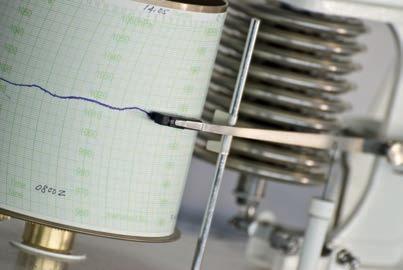
FIGURE 1 Physics has a role in monitoring earthquakes and tsunamis.
A theoretical science
Physics is also called upon to answer some of the most fundamental questions about human existence. The top 10 questions people ask repeatedly, and which physics tries to answer, are:
• What’s out there?
• What’s the universe made of?
• Are we alone?
• How did it all start, and when?
• How will it end?
• Why is the universe in three dimensions? Is this by accident?
• Can we travel backwards in time?
• If forces attract and repel, can you have antigravity?
• If matter makes up only a small bit of the universe, what’s the rest?
• What’s the smallest thing you can see – is it a quark?
What do physicists do?
It is surprising what physicists do. A simple answer is ‘they do physics’.
Develop technology
Many physicists are researchers, working to find answers to the types of questions listed above. Their answers often lead to unexpected technological applications. For example, all the technology we rely on today, including computers, mobile phones and the internet, is based on a theoretical understanding of electricity developed over a century ago.
Problem-solve
Whether physicists are researchers or work in industry developing new products, they all problem- solve. They take a situation and apply their knowledge and understanding of physics principles, models and laws to improve on what has been done before. Physicists are also the ones who say to manufacturers who ask for their product to be made faster, cheaper and safer, ‘You can only choose two of those’. A physicist will often be the one to remind others that you can’t break the laws of thermodynamics. They can give sound advice.
Work in diverse industries
Giving sound advice is why physicists are sought after in a range of diverse industries. Research and planning, analysis of evidence, interpretation and evaluation, and being able to communicate their findings are skills that see physicists employed in a range of unexpected workplaces.
FIGURE 2 Physicists are constantly trying to more precisely define the most fundamental measurable quantities in the universe.
Physicists don’t all work in research laboratories – they work in places such as museums, the military, teaching in high schools, lecturing at universities, in hospitals, power generation and distribution companies, the IT industry, astronomical and meteorological observatories, in law firms, the finance sector, engineering firms and in businesses. Physicists generally have outstanding analytical, mathematical and critical thinking abilities – characteristics that are worthwhile no matter which industry they are employed in.
Face challenges
One of the biggest ongoing challenges for research physicists is to more precisely define the most fundamental measurable quantities in the universe, ranging from the gravitational constant to the mass of a neutrino. The effort to find the most fundamental description of the universe has always been a big part of physics research and will continue to be while physics exists. Physicists try to understand the relationships between those fundamental quantities and develop laws about conservation of energy and the speed limit of the universe. These relationships are expressed using models, graphs, words, equations and diagrams in a way that helps us make sense of things.
Physics is the study of this truly amazing and strange universe and, more importantly, how it works.
Describe and explain
1 Define ‘physics’ in 10 words or less.
2 Recall whether physicists can work in finance and business sectors.
Apply, analyse and interpret
3 Distinguish between ‘problem-solving’ and ‘developing technology’ as applied to the use of physics.
4 Interpret the statement that ‘physics is a practical science’. Does it mean that all research has to have a practical outcome like saving energy or making more powerful satellites?
5 Judge whether this is true: ‘Physics is said to be an experimental science so all physics theories have to come from experiments’.
Investigate, evaluate and communicate
6 Propose a response to this question from a friend: ‘How can they say the Big Bang really occurred when no one was there?’
7 Propose how physics might be used in chemistry and biology; and how physics relies on mathematics.
Check your obook assess for these additional resources and more:
» Student book questions
Check your learning 0.1
» Video
What does a physicist do?
» Weblink
QCAA Physics General
Senior Syllabus
» Weblink
Physicists in action
0.2 Physical quantities
KEY IDEAS
In this section, you will learn about:
✚ prefixes used in physics
✚ the International System of Units, SI (Système international d’unités)
✚ converting from one unit to another.
There are a number of things in the world we want to measure. As well as length, time and mass, people are interested in measuring temperature, electric current and weight. These measurable features are called physical quantities.
SI units
The International System of Units called SI (from the French name for the system, Système international d’unités) is now commonly used around the world. It is often called the metric system (from the Greek metron = ‘measure’).
The seven fundamental (base) units of this system are shown in Table 1.
TABLE 1 The seven fundamental units of the Système international d’unités
Prefixes
To obtain multiples of the base units, prefixes are added. Table 2 lists some of the prefixes that will be used throughout your physics course. You should memorise these from nano to mega.
TABLE 2 Prefixes for units and their symbols
Example of using a prefix with a unit: 1 millimetre = 10 – 3 metre = 0.001 metre.
Derived units
New quantities can be made up of the base quantities. These are called derived quantities. For example, you can have combinations of the base units (such as metres per second and cubic metres) or you can have derived quantities that have been given specific names (such as newton, coulomb and watt).
TABLE 3 Derived units
Acceleration metre per second squared
Angle radian
squared
Capacitance farad F
Density kilogram per metre cubed kg m –3
Electric charge coulomb C Energy joule J Force newton N Frequency hertz Hz Momentum kilogram- metre per second kg m s–1 Potential difference volt
Velocity metre per second m s–1
Volume metre cubed m3
Converting units
It is important to know how to convert from one SI unit to another (for example, from millimetres to metres). This is needed when data is given in one particular unit but the answer has to be given in another form. This might occur when some constant is involved that is in a unit different from that of the data given. For example, if you had to calculate how far you would travel in 10 minutes at a speed of 5 metres per second, you would convert 10 minutes to seconds (10 × 60 = 600 seconds) and multiply this number of seconds by the speed (600 × 5 = 3000 metres).
Some other simple conversion examples are:
25 000 cm = 250 m (2.5 × 10² m)
23 km = 23 000 m or 2.3 × 10 4 m
6 hours = 21 600 s or 2.16 × 10 4 s
FIGURE 1 Measuring length, time, mass, temperature, electric current and weight is a fundamental part of physics.
WORKED EXAMPLE 0.2
Imagine you have made measurements of a block of wood in a density experiment and need to calculate its volume in cubic metres. Length 35 cm, depth 2.0 cm, width 1.5 cm.
SOLUTION
Step 1: Convert the measurements to SI units (metres):
Length = 35 cm = 35 × 1 × 10–2 m = 0.35 m (3.5 × 10⁻¹ m)
Depth = 2.0 cm = 2.0 × 1 × 10–2 m = 2.0 × 10⁻² m
Width = 1.5 cm = 1.5 × 1 × 10–2 m = 1.5 × 10⁻² m
Step 2: Calculate the volume: Volume = 0.35 m × 2.0 × 10–2 m × 1.5 × 10–2 m = 1.05 × 10– 4 m3
CHALLENGE 0.2
Use of newtons in physics
Explain in 50 words or less why we use newtons instead of pounds in physics.
CHECK YOUR LEARNING 0.2
Describe and explain
1 Identify the seven fundamental SI quantities and their symbols.
Apply your understanding of the quantities in the word list to select:
a two fundamental quantities
b two fundamental units
c two non-SI units.
3 Calculate the following conversions:
a 10.3 m to cm
b 1120 cm to m
c 1.8 mm to m
d 4.8 cm3 to m3
Apply, analyse and interpret
4 Distinguish between the SI symbols for time and temperature.
5 Determine the speed of light (3 × 10⁸ m s−1) in:
a km h−1
b kilometres per second.
Check your obook assess for these additional resources and more:
» Student book questions
Check your learning 0.2 » Challenge
0.2 Use of newtons in Physics » Weblink Converting SI units » Weblink SI
scientific notation a shorthand way of expressing very large or very small numbers in terms of a decimal number between 1 and 10 multiplied by a power of 10
Scientific notation
KEY IDEAS
In this section, you will learn about:
✚ scientific notation.
Things are not always human- sized. Some are very small and some are huge. The numbers used to express these measurements can get messy. For example, the time taken for light to travel from one side of an atom to the other is about one billion, billion, billion, billionth of a second. The mass of the Sun is two thousand billion, billion, billion kilograms.
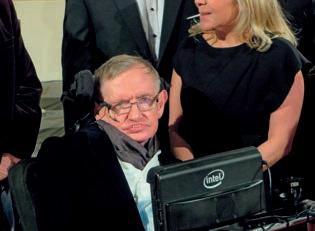
In his book A Brief History of Time , Stephen Hawking mentioned that the publisher told him not to use any numerals. It was argued that all numbers had to be spelt out because people couldn’t understand exponents and wouldn’t buy a book with them in it. Because of this, the speed of light appears in his book as three hundred million metres per second.
The time after the Big Bang that it took for electrons to be created was a thousand billion, billion, billion, billion, billionths of a second. There is a simpler way of expressing these values.
A shorthand way of expressing such numbers is called exponential notation. For example:
• 1 million (1 000 000) is written as 10 6
• 1 billion (1 000 000 000) is written as 10 9
• 1 millionth (1/1 000 000 or 0.000 001) is written as 10 – 6
• 1 billionth (1/1 000 000 000 or 0.000 000 001) is written as 10 – 9 .
Exponents tell us how many times 10 must be multiplied together and hence give the number of zeros. The expression 103 means 10 multiplied by itself three times (10 × 10 × 10) – in other words, 1 with three zeros following it (1000).
When writing numbers using exponents, it is common practice to use scientific notation. This involves the following conventions:
• Write numbers in exponential notation with just one numeral before the decimal point. For example, the Earth– Moon distance of 382 million kilometres could be expressed as 382 × 10 6 km or in scientific notation as 3.82 × 10 8 km.
• Leave numbers between 0.1 and 100 as they are. There is no need to express 60 seconds as 6.0 × 101 s.
WORKED EXAMPLE 0.3
Write the following in scientific notation:
a the speed of light: three hundred million metres per second.
b the diameter of a red blood cell: 2 millionths of a metre (0.000 002 m).
SOLUTION
a Three hundred million is 300 × 106, so the speed of light can be written as 3.00 × 10⁸ m s–1
b 0.000 002 m is written as 2 × 10– 6 m.
With scientific notation, only one numeral appears before the decimal place. The exponent has to be adjusted to allow for this. For example, when the number 300 × 10 6 became 3.00 × 10 8 , the decimal point in 300 was shifted two places to the left (made smaller) to become 3.00. To compensate, the exponent must be increased by two units from 10 6 to 10 8 (made bigger).
Negative exponents are used to indicate numbers less than 1. For example, an electron has a mass of 0.000 549 units. To make this 5.49 we have to shift the decimal point four places to the right (make it bigger by 10 000), so an exponent has to be included that compensates for this. In scientific notation the mass of an electron would be 5.49 × 10 – 4 units.
Further examples of scientific notation:
• The radius of Earth is 696 million metres or 6.96 × 10 8 m.
• The diameter of Saturn is 120 thousand kilometres or 1.20 × 10⁵ km.
• The diameter of an atom is 0.000 000 000 1 m or 1 × 10 –10 m.
Significant figures
Scientists imply the level of uncertainty in measurements by how they report the number. You will see later that we can state a measurement in three parts: the best estimate, the uncertainty and the unit. For example, when we say ‘length = 25.0 ± 0.5 mm’, we mean that the reading could be between 24.5 and 25.5 mm. However, if we just say the measurement is 25.0 mm and don’t state the (±) uncertainty, we are saying that it is somewhere between 24.9 and 25.1 mm. We have used three figures that are significant (the 2, the 5 and the 0) to say this. Unlike in mathematics, where 25 and 25.0 are identical, a measurement of 25 cm in science means something different than a measurement of 25.0 cm. The key principle is that scientific measurements are reported to one digit more than what is known with certainty.
A reported value of 25 cm implies that the actual value is somewhere between 24 cm and 26 cm, approximately. In contrast, a reported value of 25.0 cm implies that the actual value is somewhere between 24.9 cm and 25.1 cm, approximately. The measurement 25 cm is said to have two significant figures, whereas 25.0 has three significant figures.
You must be able to work out how many significant figures are in a result (these are shown in bold)
Rules:
• All non-zero figures are significant: 3.18 has three significant figures (3 sf).
• All zeros sandwiched between non-zeros are significant: 30.08 has 4 sf.
• Zeros to the right of a non-zero figure but to the left of the decimal point are not significant (unless specified with a bar): 109 000 has 3 sf (the 109). The rest just indicate where the decimal place is. If you wanted to show that the second zero from the right is significant, you could write 109 0 00 (5 sf).
• Zeros to the right of a decimal point but to the left of a non-zero figure are not significant: 0.050 has 2 sf. Only the last zero is significant. The first zero merely says where the decimal point is.
Study tip
It is much easier to write numbers in scientific notation if you want to show significant figures. Everything in a number written in scientific notation is significant. If it is not significant, you just leave that number out.
• Zeros to the right of the decimal point and following a non-zero figure are significant: 304.50 has 5 sf. significant figures the digits of a number that are used to express it to the required degree of accuracy (abbreviated: sf)
FIGURE 1 Stephen Hawking was initially asked to avoid using numerals when writing A Brief History of Time.
Some examples of the application of these rules are given in Table 1.
TABLE 1 Examples of scientific notation
Note: normally, numbers between 0.1 and 100 are not written in exponential form, but some are shown here for clarity.
Calculating with significant figures
A problem arises when performing calculations using significant figures, so you need to be careful.
Multiplying and dividing
Imagine you had to calculate the surface area of a road going through prime agricultural land. The traffic engineers said the road easement would be 95.5 m wide and 26 km long. When multiplying 95.5 m × 26 000 m, the answer would appear to be 2 483 000 m 2 . When multiplying or dividing, the answer should contain only as many significant figures as the number in the operation that has the least number of significant figures. In this case, 95.5 m has three significant figures and 26 000 m has two. The answer should only have two significant figures, so it should be written as 2 500 000 m 2 or 2.5 × 10 6 m 2 .
Other examples:
• 45.71 (4 sf) × 34.1 (3 sf) = 1558.711. This is rounded to 1560 or 1.56 × 10³, which has three significant figures (3 sf).
• 365 (3 sf) ÷ 2.4 (2 sf) = 152.083 333 3. This is rounded to 150 or 1.5 × 10² (2 sf).
Rounding
You should only round to the correct number of significant figures at the end of your calculations. Leave in your calculator (or write down) as many decimal places as you like during your calculations, and then adjust at the very end. When you have an answer in your calculator that has 11 decimal places, you shouldn’t write them all down – you must round them off.
• Numerals lower than 5: round off to zero.
• Numbers larger than 5: round off to 10.
• When the number to be rounded is 5: take it up to 10 if the number preceding is even, otherwise take it down to zero.
For example, when 16.586 is rounded to four significant figures it becomes 16.59. When 24.65 is rounded to three significant figures it becomes 24.7 (as the 6 is even and hence the 5 is rounded up to 10).
Addition and subtraction
If a 2.55 g bullet strikes a 1575 g target and becomes embedded in it, the mass of the target is now 1575 g + 2.55 g = 1577.55 g. Or is it? The final mass has more significant figures than either the target’s mass or the bullet’s mass. Intuitively, this should sound wrong. The final mass should be written as 1578 g. Calculations are rounded to the least significant decimal place value in the data. Decimal place is sometimes shortened to dp.
1 Explain the purpose of using scientific notation.
2 Calculate the following:
a (1.2 × 10–3) × (2.2 × 10– 4)
b (1.8 × 10³) ÷ (6.4 × 10⁻⁸)
3 Identify the number of significant figures in each of the following, and then write each in scientific notation using the correct number of significant figures:
a 100.010
b 1999
c 2.222 2
d 40 000
4 Calculate the following: (2.34 kg + 1.118 kg) ÷ (1.05 cm × 22.2 cm × 0.9 cm).
Apply, analyse and interpret
5 Determine which is larger: 1.5 × 10– 4 or 0.001 50.
6 Apply rules to express the following in scientific notation:
a 3558.76
b 40.00
c 79 000
d 200 326
7 Calculate the volume of an atom of diameter
0.000 000 001 m. (V = 4 3 π r 3)
8 A sheet of copper was measured as part of a density experiment. The dimensions were: length = 55.5 cm, breadth = 2.0 cm, thickness = 0.02 cm. Determine:
a the area of the largest surface
b the volume
c the perimeter of the largest face.
9 Earth is approximately a sphere of radius 6.37 × 10⁶ m. Determine its:
a circumference
b volume in cubic metres
c volume in cubic kilometres.
Investigate, evaluate and communicate
10 Isaac Asimov proposed a unit of time based on the highest known speed of light and the smallest measurable distance. The light-fermi is the time taken by light to travel a distance of 1 fermi (= 1 femtometre = 1 fm = 10 –15 m).
Determine how many light-fermis there are in 1 second. Recall that light travels at 3 × 10⁸ m s–1
Check your obook assess for these additional resources and more:
» Student book questions
Check your learning 0.3 » Video Scientific notation
Weblink
Hawking
Weblink
Scientific notation
Errors and error analysis
KEY IDEAS
In this section, you will learn about:
✚ uncertainty
✚ systematic errors
✚ random errors
✚ scale reading limitations.
A part of any physics experiment is to record and analyse your measurements for quality. This is called an error analysis. The word ‘error’ is a rather vague term about the ‘goodness’ of your observations, but specifically refers to the precision and accuracy of your results. Precision and accuracy mean vastly different things, so it is important that they are used correctly. We can say that for a set of measurements:
• Precision is the range of values found; that is, the uncertainty of the measurement.
• Accuracy is the difference between the measured value and the true or accepted value of the observed quantity.
We will consider these in the order met in an experimental report.
Uncertainty
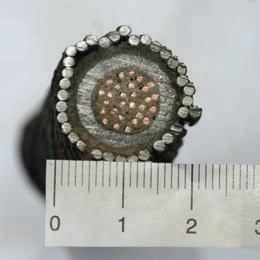
If you had to count the number of wires in a cable, such as in Figure 1, you would obtain an exact figure. However, if you had to measure the width of the cable with a ruler, your measurement would be an approximation (probably to the nearest millimetre). This is where problems start in experimental physics.
You may have learnt that measurements (data) can be:
• discrete (numeric) – such as numbers of wires, swings of a pendulum or layers of metal foil
• continuous (any value over a continuous range) – such as the diameter of a wire, the mass of an object or a thermometer reading
• categorical (types) – such as positive/negative, red/green/ blue (quarks), up/down, kinetic/ potential (energy).
Experiments in high school physics are full of measurements that are continuous. Unlike discrete measurements (whole numbers), continuous measurements can never be exact because they all have some amount of uncertainty.
Uncertainty is inevitable, so you should use it to your advantage. Showing that you understand uncertainty is the key to top marks in experimental reports and data analysis.
What causes uncertainty?
Uncertainties are also called errors. In science, you can use the words interchangeably, which is a problem. People tend to think of errors as mistakes, but they are not – particularly in error analysis. ‘Error’ comes from the Latin word meaning ‘wandering’. Errors are wanderings in the data – the data is all over the place. These precision the uncertainty of the measurement accuracy the difference between the measured value and the true or accepted value of the observed quantity
FIGURE 1 An old power cable – it is easy to count the number of wires, but it is hard to measure the diameter.