Oxford University Press is a department of the University of Oxford. It furthers the University’s objective of excellence in research, scholarship, and education by publishing worldwide. Oxford is a registered trade mark of Oxford University Press in the UK and certain other countries.
Published in the United States of America by Oxford University Press 198 Madison Avenue, New York, NY 10016, United States of America.
All rights reserved. No part of this publication may be reproduced, stored in a retrieval system, or transmitted, in any form or by any means, without the prior permission in writing of Oxford University Press, or as expressly permitted by law, by license, or under terms agreed with the appropriate reproduction rights organization. Inquiries concerning reproduction outside the scope of the above should be sent to the Rights Department, Oxford University Press, at the address above.
You must not circulate this work in any other form and you must impose this same condition on any acquirer.
CIP data is on file at the Library of Congress
ISBN 978–0–19–753880–7
DOI: 10.1093/oso/9780197538807.001.0001
Printed by Integrated Books International, United States of America
For Matthew
PART I. The Long Post-Ottoman Transition, 1878–1921
1. Muslim Rights and Political Belonging After the Congress of Berlin 23
2. Confessional Sovereignty and the Formation of a Muslim Legal Other 53
3. Survival and Autonomy: Lessons of the Balkan Wars and the First World War 81
4. Second- or Third- Class Citizens: Becoming Minorities after World War I 107
PART II. Yugoslav Experiments in Nation-Building, 1918–1941
5. The Shari’a Mandate and Yugoslav Nation-Building 135
6. “The Bonfire of Muslim Unity”: Muslim Politics and the Crisis of Yugoslav Democracy 164
7. Islamic Legal Revivalism and the Crisis of Europe 191
War and Political Reordering, 1941–1949
8. “Back to Islam!”: The Promise and Possibility of Hitler’s Europe 213
9. The Eradication of the Shari’a Legal Order in Tito’s Yugoslavia 231
Acknowledgments
This book is dedicated to my partner, Matthew Worsnick, without whom I would never have had the courage or wherewithal to travel to a dozen archives in five countries over the past ten years, pregnant, with dog, with dog and infant, with toddler and infant, with toddler and preschooler, and so on. As my editor, Matthew has revised some of the best lines of this book; as my champion, he not only enabled me, but encouraged me to undertake a research project that he knew was a labor of love. Through our annual research pilgrimages, our two curious sons, Thomas and Samuel, came to believe that mothers and fathers are scholars, and that historians have great adventures hunting for remote mountainside monasteries, abandoned forts, and secret caves where Tito may have hidden during World War II. They have lived this book since they were in the womb, and they have rarely called into question why their lives are not quite like those of their friends (except once, when they were 5 and 7 years old, as we were crossing the Serbia-Bosnia border by foot because I inadvertently hired an illegal taxi and we were denied entry at the border. As they rolled their little suitcases for a mile, hunched over with heavy backpacks filled with Pokémon cards and Legos, they asked whether next year they might go to summer camp instead). My debt to this incredible family is immeasurable.
My late father used to joke that I have an uncanny ability to convince people to join “Team Greble” to support me in my crazy endeavors. The team for this book has been particularly robust, and I am immensely grateful. In our weekly exchanges for nearly two decades, Aleksandar Gašić, my invincible research assistant, has offered his intellect, good humor, friendship, research acumen, and translation assistance. His tireless support has sustained me in more ways than I can count. Irena Rosić- Gašić regularly stepped in to decipher unintelligible handwritten Cyrillic sources; she also ensured that the children and I always had proper medical care when our lives (and bodies)
Acknowledgments x
turned upside down on Balkan research adventures. This book would not have happened without them.
In a project whose research involved many countries and many different archives, I have benefited immeasurably from the support and assistance of many talented archivists across the Balkans, who have protected the dominion of history through war, regime change, political instability, and economic crisis, and who opened every door to me with warmth and grace. There are far too many extraordinary archivists and librarians to thank by name, and any attempt to do so will inevitably exclude too many. These unsung heroes are the greatest possible gift to historians of southeastern Europe; they are the people who make books happen.
The late Ivo Banac, a pioneer in Yugoslav history, read the entire manuscript months before he died, offering advice and criticism all the way down to the diacritical marks in the footnotes. Historians Jane Burbank and Fred Cooper graciously read the complete manuscript and flew to Nashville to share their thoughts with me. Pieter Judson and Oxford University Press’s two anonymous readers provided wonderfully detailed, thoughtful, and encouraging reader’s reports, believing in this project even as they called out its unresolved corners. Over the past decade, Lâle Can’s sophisticated and nuanced readings of early drafts were pivotal to the book’s arguments and approach. Many generous friends and colleagues have read sections or provided other support along the way: Isa Blumi, Julia Cohen, Theodora Dragostinova, Robert Hayden, James McFarland, Paul Miller-Melamed, Rebecca Reich, James Robertson, Allison Schachter, and Samira Sheikh. Kathryn Ciancia, Malgorzata Fidelis, Irina Gigova Ganaway, Maureen Healy, Kate Lebow, and Andrea Orzoff have been reading and improving my work for over a decade. Daniela Blei marvelously edited an earlier version of the manuscript. Vladislav Lilić patiently revised the footnotes, while also challenging me to think differently about some of the book’s claims. Ivana Marinković inspired me to maintain my language skills in moments when travel was impossible. I owe a special debt of gratitude to Norman Naimark, Robert Donia, James Sheehan, and Larry Wolff, inimitable mentors and senior colleagues, who encouraged and supported my work even in moments when it seemed like I was heading off on a wild goose chase.
It is a privilege to be part of vibrant intellectual homes that nourish ideas and provide community. I am fortunate to have had two such homes while writing this book: I thank my colleagues in the History Department at the City College of New York, where I began this project, and in the German, Russian and East European Studies and History Departments at Vanderbilt
University, where I completed it. My gratitude extends especially to my former City College colleagues Beth Baron, Craig Daigle, Greg Downs, Jennifer Johnson, Andreas Killen, Adrienne Petty, and Cliff Rosenberg who read early drafts, and to my Vanderbilt colleagues Celia Applegate, David Blackbourn, Joel Harrington, Leor Halevi, Ari Joskowicz, and Helmut Smith, who spent a day rigorously critiquing the entire manuscript. I have been sustained by collegial departments, and thank Lutz Koepnick, Meike Werner, and Eddie Wright-Rios for their support and guidance.
The support and friendship of many remarkable scholars across the former Yugoslavia has nurtured me during my many months of research abroad. I thank especially historians Vanni D’Allesi, Andrea Feldman, Miloš Jagodić, Husnija Kamberović, Hikmet Karčić, Vjeran Pavlaković, Momčilo Petrović, and Vladimir Petrović, as well as Dragan and Saliha Marković, whose passion for publishing good scholarship is infectious.
This book has been generously supported by a Fulbright Award in Serbia, IREX, the Diane and Harold Wohl fellowship at the Advanced Institute for Holocaust Studies in Washington, DC, a National Endowment for the Humanities Faculty Award, a City College of New York Humanities and Arts award, the PSC- CUNY Research Fund, and Vanderbilt University’s College for the Arts and Sciences. At Vanderbilt, the Max Kade Center for European and German Studies provided material and intellectual support, as did a Provost Writing Studio award, which helped me workshop the manuscript. I completed this book as the William S. Vaughn fellow at the Robert Penn Warren Center for the Humanities at Vanderbilt and am grateful for the magnificent gift of time and the wonderful community of fellows.
My parents, Diane and Thomas Greble, instilled in me a love of travel and history that has become the foundation of my life and my work. The gift of supportive parents is invaluable, and I thank them. My mother’s dedication to my brother has taught me how to be a mother without losing myself and to fight for what I believe in with my family by my side. My sister, Julia Stensby, remains a loyal and critical reader, the person who will tell me when nothing makes sense. My brother, Matthew Greble, reminds me to find the joy in every part of this difficult journey. I also thank my supportive aunts, Susan O’Donnell and Joyce Koestenblatt, who never flinch to drop things to help me, and my Anderson, Hess, Knox, Metzger, Millen, Murphy, O’Donnell, Stensby, and Worsnick extended families. Chelsea and Rich Melé gave us the priceless gift of watching Roko when he could no longer travel to the Balkans. My in-laws, Susan and Greg Worsnick, cared for our family in some of the darkest moments of this book’s life, managing meals and childcare while I was
Acknowledgments
injured, wheelchair bound, and determined to write. The nourishing friendship of Emily Weltman and Jake Gamage, Ravit Reichman and Ted Weesner, Liz Cohen, Katie Brennan, Elise Molinelli Martin, Deb and Rob Wollner, Irfana and Dino Trampa, Indira and Eldar Telegrafčić, Asim Guhdija, Daniella Berman and Tony Cak, Ari Bryen, Kim Welch, Doug Shadle, Jesse Kauffman, Alex Distler, Erin Dillon, Karen Robbins, Jenny Hagel, Ashley Simone, and Christopher Johnson and Haydee Searcy has been instrumental.
Finishing a book during a pandemic and lockdown is grueling. I am grateful to Susan Ferber, whose faith in this project has persisted for over a decade, and who managed my anxieties and shepherded this book to publication. Jeremy Toynbee patiently and professionaly guided me through production. Allison Schachter and Ben Tran were a lifeline of friendship and neighborliness. I am also appreciative of Chuck Sabo, head of school at St. Bernard Academy, and the many SBA teachers who did everything they could to safely open school whenever it was possible. If school had remained closed for the 2020–21 academic year, as it did for millions of children across America, this book would not be finished. There is little that is more challenging to the intellectual life of academic parents than spending endless days managing the virtual learning of one’s young children, while attempting to write and do research. Anyone who has spent many months lecturing to college students from the floor of their bathroom or running PhD qualifying exams over Zoom on a patio under a blanket in the cold rain, their children peering through the glass door during a scheduled “brain break,” will understand this gratitude.
Finally, I am eternally indebted to Alison Frank Johnson, Aimee Genell, and Dominique Reill, whose convivial friendship and snarky, humorous, and loving daily text messages sustained me through the pandemic. Their willingness to read chapter after chapter with wit and wisdom and their uncanny ability to find the right words of encouragement in moments when it all seemed impossible, pushed me over the finish line.
Glossary of Islamic Terms
there are many Islamic, Ottoman, and regional-specific terms used throughout this book, some of which have alternative spellings in Turkish or Arabic, and some of which have different meaning in southeastern Europe than in other parts of the world. Where possible, I elaborate on these definitions in the text. This basic glossary includes some of the more commonly used terms that may be unfamiliar to readers. It is not intended to be exhaustive. Alternative spellings are provided in parentheses.
dervish, sufi a follower of Islamic mysticism
imam religious and prayer leader
Islamic Religious Community a formal administrative body created to oversee Islam in Austria-Hungary, which continued into the twentieth century
hodža (also hoca) regional term used broadly for Muslim teachers, professors, imams, and other religious professionals
mosque place of workshop
mufti Islamic legal expert
mutivelj administrator for a waqf
madrasa (also medresa) Muslim secondary school or religious college
mekteb
Qur’an (also Koran)
qadi (also kadi)
Muslim primary school
the central religious text of Islam, which Muslims believe to be a revelation from God (Allah)
Islamic judge
Reis-ul-ulema
head of the ulema, an administrative position created by Austria-Hungary in Bosnia-Herzegovina, which continued to be used by the Yugoslav state
tekke a Sufi lodge or place of worship
Shari’a (also sharia, šerijat, shari’ah)
divine law for Muslims, as imagined by God
Shari’a court judge the bureaucratized qadi in AustriaHungary, which continued into the Yugoslav state
ulema (also ulama) religious scholars
Ulema Medžlis a council of ulema that advised the Reis-ululema in Austria-Hungary and Yugoslavia waqf (also vakuf, vakīf) an inalienable charitable endowment constituted under Shari’a
List of Foreign Place Names
the towns below are referenced regularly in the text. Many had different historical names; some have different names in different languages. The most commonly used name by English speakers is listed first, followed by the place name (when relevant) in Ottoman Turkish, South Slavic languages, and Albanian.
Novi Pazar Yeni Pazar Novi Pazar Pazari i Ri (known as Sanxhaku)
Peć Ipek Peć Peja
Pljevlja
Taşlıca Pljevlja Plevla
Podgorica Podgoriçe Podgorica Podgorica
Prishtina Priştina Priština Prishtinë
Prizren Prizren Prizren Prizreni
Sarajevo Saraybosna Sarajevo Sarajeva
Shkodër İşkodra Skadar Shkodër
Skopje Üsküp Skoplje | Skopje Shkup
Tetovo Kalkandelen Tetovo Tetovë
Tuzla Tuzla Tuzla Tuzlla
Ulcinj
Ülgün Ulcinj Ulqin
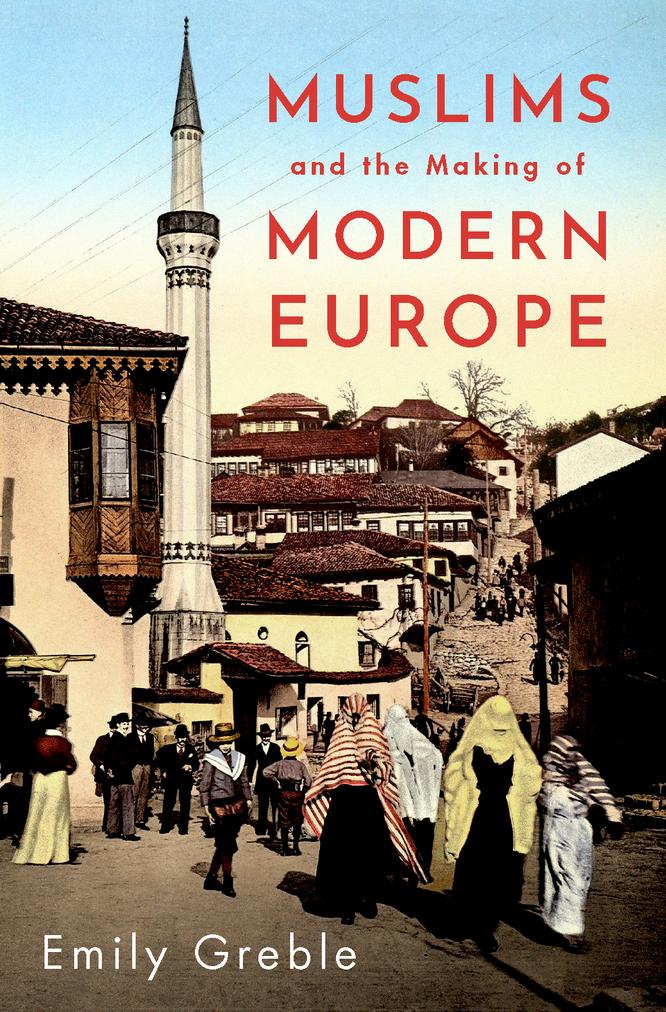
Muslims and the Making of Modern Europe
Introduction
In September 1945, a few months after the end of World War II, a Muslim peasant named Iljaza petitioned the district people’s court in the small town of Novi Pazar, Yugoslavia, to reject his wife’s request for a divorce. His wife, Džuzida, claimed that he did not provide her with adequate shoes or clothes, and that he beat her, which she presented as justification under Shari’a law to divorce him. Iljaza countered that he had worked for the recently victorious Yugoslav Partisan (communist) army for four months without pay, making it difficult to provide for his wife. This Partisan fighter swore to the local court that in the future, he would live according “to our Shari’a laws.” The discontinuities of this plea, and others found in courthouses across postwar Yugoslavia, were striking. Muslims were citing Shari’a law in an emerging communist state whose most recent predecessors were an overtly Christian nation-state and a fascist occupation regime. Moreover, they sought to assuage the court’s doubt by pledging fidelity not to Yugoslavia or civil law but to Islamic law. Why either spouse thought a civil court should rule on a matter of Islamic law is unclear, as is what happened to the Muslim judges who would have adjudicated the matter earlier. Iljaza and Džuzida were two Muslims caught up in the muddled and transitional nature of postwar justice. Since no civil marriage law existed, and newly arriving socialist judges lacked an alternative legal framework to resolve the matter, they applied Shari’a precedent, deciding in the husband’s favor. Džuzida was apparently undeterred and launched an appeal. Under Shari’a law, a wife was entitled to a divorce if her husband could not provide her with shelter. According to her furious husband, she had set out in November 1945 to prove definitively that this was the case. Her unconventional strategy: burn down her husband’s house.1
Beyond its sensational dimensions, the testimonies and rebuttals deployed in this court case and other disputes brought before postwar socialist courts
evinced a particular legal world that existed in mid-twentieth-century Europe, one in which Muslims interpreted rights; framed their collective cultures, political organizations, and social norms; and engaged with civil institutions, their neighbors, and each other from the perspective that they were, legally, Muslims. For them, being Muslim was not simply a confessional identity or a matter of belief but a legal category enshrined in decades of legal codes, institutionalized in the structures of state institutions, and embedded in the region’s frameworks for belonging. This book seeks to understand how this came to be and what it reveals about Muslims’ place in the post- Ottoman Balkans and the European political project of citizenship more generally.
It does so by tracing the stories of several generations of Muslim men, women, and children beginning in 1878, when over a million Ottoman Muslims became citizens of other European states, and ending in 1946–1949, when communists in Yugoslavia eradicated the Shari’a judiciary and imposed a centralized, socialist legal order. It follows the fortunes (and misfortunes) of merchants, peasants, and landowners, muftis and preachers, teachers and students, believers and non-believers, the literate and illiterate across a diverse landscape that spanned from seaside port towns on the shores of the Adriatic to mountainous villages deep in the heart of the Balkans, a multi-day journey to the nearest town. These were overwhelmingly local Muslim communities; that is, they were made up of families who had lived in the Balkans for centuries (at least). Their histories are European histories.
Looking at a map from the mid-nineteenth century, the geographic starting point of this study might seem arbitrary: it includes lands from several Ottoman provinces whose political boundaries would be sliced through and rearranged numerous times over the next seven decades, dividing communities with shared religious, linguistic, legal, and political cultures across different states. The Ottoman Muslims at the center of this study would find themselves after 1878 (or 1912–1913) residents of Serbia, Montenegro, and Austria-Hungary; successive generations would be citizens of two distinct Yugoslav states as well as a range of Axis occupation and satellite states in the twentieth century.
The geography of these lands where Muslims lived varied wildly. There were sweeping farmlands where Christian and Muslim peasants tilled land for Ottoman Muslim landowners; alpine mountains with rocky soil where wild goats roamed; waterfalls and crystal blue lakes whose tranquility attracted religious divines and became sites of Orthodox Christian monasteries and Sufi tekkes; and bustling cities where peasants sold produce and Muslim, Christian, and Jewish merchants traded in bazaars, a node to the vast Mediterranean
Tuzla
BosniaHe rz ego v ina
Sarajevo
Mostar
HABSBU
HA B SBU RG MONA RC HY
Belgrade
SERBIA
MONTENEGRO
Ottoman
Cetinje
(autonomous Ottoman principality)
Adriatic Sea
(autonomous Ottoman principality)
Novi
Pazar
Podgorica
Ottoman
Niš
Prizren
DANUBIAN PRINCIPALITIES
DANUBIA ALITIES
(autonomous Ottoman principalities)
(autonomous
odgorica So
LGARIA
MONTENEG Sea skub rizren
Shkodër
Skopje/Uskub
Monastir
onastir
OT T OMAN EM P IR E
Salonica
EMPIRE
GREECE
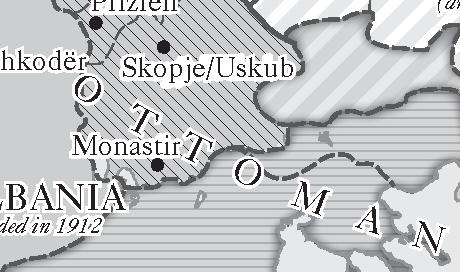
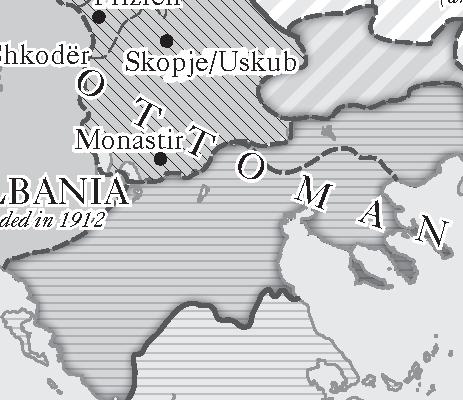
Figure I.1 Ottoman Europe, circa 1850, political boundaries.
economic networks that stretched beyond. Centuries of Ottoman rule left a physical imprint on these lands: minarets dotted the landscape; the sounds of the muezzin, the Muslim call to prayer, formed the aural backdrop to everyday life wherever Muslims lived.
The international system transformed rapidly in the decades that this book analyzes, and Muslims, like many European populations, were often left to their own devices in navigating political and economic changes. As
BULGARIA
AUSTR I ABOSNIA-
HERZEGO
Sarajevo
MONTENEG
MONTENEGRO AL
Adriatic Sea
SANJAK OF NOVI PAZAR
VILAYET OF
KOSOVO
BULG ARIA
GREECE
Black Sea
(anne ulgaria
(annexed by lgaria
M P I R E
International boundaries, 1878
International boundaries, 1878
International boundaries, 1913
Acquired by Serbia after 1913
cquired S
Acquired by Montenegro after 1913
cquired after 1913
Acquired by Romania after 1913
cquired Romania
Acquired by Greeceafter 1913
cquired eece after 1913
Acquired by Bulgariaafter 1913
cquired Bulgaria after 1913
Figure I.2 Political boundaries of Ottoman and post- Ottoman Europe between the Congress of Berlin in 1878 and the end of the Balkan Wars in 1913. Borders drawn are approximate: source maps served polemical purposes and in many places local boundaries remained contested.
the political boundaries of the Ottoman empire shrank, Muslims came under scrutiny. They were objects of international treaties deciding whether they could stay in their lands or would need to leave, whether their local trading patterns would fit within new commercial treaties and systems of taxation, whether their understandings of law and society would match those of new governments. In altering the political map of Ottoman Europe, European statesmen treated Muslim societies and desires as an afterthought. New
AUSTRIA
Ljubljana
HUNGARY
ROMANIA
Zagreb
Zagreb
Belgrade
Tuzla
YUGOSL AV IA
Sarajevo
Sarajev
Mostar
Cetinje
Bar
Adriatic Sea
Novi
Pazar
Niš
Prishtina
rishtina
Prizren
Skopje
Tetovo
Monastir
ALBANIA
ALBANI rizren
GREECE
BULGARIA
BULGARI
TURKEY
Figure I.3 Yugoslavia, 1918–1941. Some political boundaries changed during this period.
political boundaries zigzagged through Muslim villages and across historically contingent regions, at times leaving family members living in different states. The borders were woven around and through massive lakes, often unbeknownst to the local fishermen living there; they jutted into mountains where sheep grazed. Borders severed economic routes that connected interior towns to port markets. They cut through and redefined legal boundaries, undermining preexisting Ottoman, Islamic, Christian, and civil court systems. New rulers brought new languages and new bureaucratic norms, as well as new frameworks for ethics and new ways of organizing society. Local Muslims adapted, responded, and resisted. Some stayed. Others voluntarily left. Many faced expulsion.
For centuries, southeastern Europe was home to heterogeneous, multilingual, complex Muslim societies who lived among heterogeneous, multilingual, complex communities of Christians (Greek Orthodox, Bulgarian Orthodox, Serbian Orthodox, Roman Catholic, Evangelicals, and Armenian
Black Sea
Christians) and Jews (Sephardim and Ashkenazim). People in these lands spoke and wrote in numerous Slavic languages, Ottoman Turkish, Albanian, Romani, Tatar, Arabic, Ladino, German, and Greek. Many people were fluent in more than one language, as is common in multi-lingual imperial lands and their successor states. Most were illiterate, also unexceptional in nineteenthcentury Europe. With the withdrawal of the Ottomans, all of these people were encountering a new world order, and their responses would be as varied as the selection of the responses of the Muslims analyzed here.2
Precisely how many Muslims lived in the Balkans at any given moment is contested. In the region at the center of this book’s analysis, it was usually about 1 to 2 million people. Like many statistical questions about the late Ottoman period, there are conflicting data on how many Muslims fled or were expelled from Ottoman lands during and after wars and border changes as well as conflicting demographic data on how many people remained in their homes.3 Government censuses had varying political aims, with many new governments grossly underestimating Muslim populations in order to legitimize the conquest of their lands.4 There were also large numbers of Muslims who lived in political limbo as stateless people, refugees, or temporary migrants in the aftermath of the wars of the 1870s, the Balkan Wars of 1912–1913, the First World War, and the Second World War. Some mountainous and rural communities deliberately avoided the bureaucratic gaze, refusing to accept new political boundaries, instead living as outlaws and bandits within them.5 Many historians have settled on 12 percent as a good estimate for Muslims living in Yugoslavia in the mid-twentieth century—about 1.5 million people—but this number takes too seriously the 1921 Yugoslav census, whose methods and motives, like those of most censuses, were highly political. Subsequent censuses subsumed some Muslims under different national categories and failed to count others at all.
Explanations for the presence of Muslims in the Balkans also vary and are deeply politicized.6 Some descended from Christian converts to Islam; some had ancestors who migrated to Europe from other parts of the Ottoman Empire centuries earlier. Less contested is their variability. As in other parts of the world, Islam in southeastern Europe was locally inflected and malleable; it was a set of beliefs, cultural, and social practices and also a worldview. Pluralism extended also to religious practice, which included Sunni Muslims, who adhered to the Hanafi legal school of Islam, and a variety of communities whose members practiced a range of Sufi traditions and syncretic approaches that reflected the region’s Ottoman heritage.7 These distinctions would contribute to and also become layered on top of national and political
movements that Muslims formed in response to the changing political order. The era of modern politics, which called for people to divide into differently conceived groups, would galvanize schisms and factions within and across different Muslim communities. There was no one way of being Muslim in the Balkans or anywhere in Europe. There was also no consensus on how to respond to the many radical changes to the international and regional legal order that occurred from the 1870s to the 1940s. Where there is consensus is in the European consciousness: across time and space, and despite linguistic, religious, economic, national, and cultural divides, Muslims were understood first and foremost as Muslims.8
Familiar and Unfamiliar European Stories
Over the course of the nineteenth and early twentieth centuries, the majority of the world’s Muslims would be absorbed by non-Muslim European governments, radically transforming Muslim societies and Islamic institutions around the world.9 Muslims living under European empires faced similar challenges to the Muslim communities analyzed here. There were also important differences. The legacy of being part of an Islamic empire, the presence of Muslim majorities in towns and villages, the rapid and radical shifts in political boundaries, and the region’s geo-political position between Ottoman, Mediterranean, Middle East, southern European, and central European worlds—all of these things unquestionably shaped Balkan Muslim experiences in distinct ways. Indeed, the Muslims at the center of this book were not a product of the systems of European colonialism that shaped Muslim lives around the world well into the twentieth century.
And yet, readers will find here discussions reminiscent of twentieth- and twenty-first-century disputes about headscarves in French schools, migrants in Germany, mosques in Austria, and Shari’a courts in England. In the postOttoman Balkans, there are familiar stories of refugees, humanitarian crises, and mass violence, and familiar questions about how Islam operates in secular Western societies. Similar European anxieties arose over Muslim loyalty, fanaticism, and Islamism, and similar Muslim frustrations over discrimination, repression, and marginalization in the countries they call home. Indeed, well over a century before contemporary debates over headscarves, Shari’a courts, terrorism, refugees, assimilation, and Muslims’ place in European society would incite impassioned political battles and media frenzy, European diplomats and statesmen, legal theorists, and Muslim scholars and jurists were debating these same questions. Southeastern Europe was central to the