

Instant digital products (PDF, ePub, MOBI) ready for you
Download now and discover formats that fit your needs...
Public Speaking for College and Career 11th Edition –Ebook PDF Version
https://ebookmass.com/product/public-speaking-for-college-andcareer-11th-edition-ebook-pdf-version/
ebookmass.com
Understanding Business 11th Edition – Ebook PDF Version

https://ebookmass.com/product/understanding-business-11th-editionebook-pdf-version/
ebookmass.com
(eBook PDF) The Business Communication Handbook 11th Edition
https://ebookmass.com/product/ebook-pdf-the-business-communicationhandbook-11th-edition/
ebookmass.com
E of the Enemy: A Surprise Baby Mafia Romance (The Satriano Brothers Book 2) Josie Max
https://ebookmass.com/product/e-of-the-enemy-a-surprise-baby-mafiaromance-the-satriano-brothers-book-2-josie-max/
ebookmass.com

Turn Up the Heat Marie Harte
https://ebookmass.com/product/turn-up-the-heat-marie-harte-2/
ebookmass.com
Faye Longchamp 13-Wrecked Mary Anna Evans

https://ebookmass.com/product/faye-longchamp-13-wrecked-mary-annaevans/
ebookmass.com
Health Professions and Academia-How to Begin Your Career (Jun 29, 2022)_(3030942228)_(Springer).pdf John Paul (J.P) Sánchez
https://ebookmass.com/product/health-professions-and-academia-how-tobegin-your-career-jun-29-2022_3030942228_springer-pdf-john-paul-j-psanchez/
ebookmass.com
Islam in Malaysia: An Entwined History Khairudin Aljunied

https://ebookmass.com/product/islam-in-malaysia-an-entwined-historykhairudin-aljunied/
ebookmass.com
Intelligence Analysis: Domestic and Foreign Threats Confronting the Biden Administration John Michael Weaver
https://ebookmass.com/product/intelligence-analysis-domestic-andforeign-threats-confronting-the-biden-administration-john-michaelweaver/
ebookmass.com


https://ebookmass.com/product/explorations-in-analytic-ecclesiologythat-they-may-be-one-1st-edition-joshua-cockayne/
ebookmass.com

7. Music Licensing
Music Rights: An Overview
Performing Rights Organizations
Performance Licensing: The Nuts and Bolts
Keeping Track of the Music
Royalty Distribution
Foreign Collections
Membership Options
American Society of Composers, Authors and Publishers
Broadcast Music Inc.
SESAC
SoundExchange
Mechanical Licenses
Synchronization Licenses
Movie Rights
TV Program Rights
New Use Rights
Cable Television Licenses
Cable TV Network Licenses
Video Licenses
Transcription Licenses
Special Use Permits
TV Commercials
Video (Electronic) Games
Jukebox Licenses
Dramatic Music Rights
Creative Commons
Part 3 Managing Artist Relationships
8. Agents, Managers, and Attorneys
Agents
Regional and Boutique Agencies
National Full-Service Agencies
Regulation of Agents
Managers
Regulation of Managers
Disputes With Clients
Assistants to Management
Attorneys
Retaining Legal Counsel
9. Artist Management
Discovering Each Other
The Financial Relationship
Controlling Expense
Manager’s Commission Going Rates
The Money Flow A Possible Compromise
The Manager’s Role
Producing the Act https://jigsaw.yuzu.com/api/v0/books/9781506303154/print?from=...
Programming
Advancing the Career
Gaining Traction as an Aspiring Talent
Landing the Record Deal
Care and Feeding of the Media
Controlling Performances
Personal Management Agreement
10. Unions and Guilds
American Federation of Musicians
Union Finance
Other Services
SAG-AFTRA
The 4As
American Guild of Musical Artists
American Guild of Variety Artists
Actors’ Equity Association
International Alliance of Theatrical Stage Employees
Other Unions and Guilds
National Association of Broadcast Employees and Technicians–
Communications Workers of America
Dramatists Guild of America, Inc.
Related Unions and Guilds
Open Shop Agreements
Other Issues
Part 4 The Recorded Music Industry
11. Record Labels
Perspective
Major Labels
Independent Labels
Specialty Labels
Record Company Structure
Executive Officers (CEO, COO, CFO, General Manager)
Artist and Repertoire (A&R)
Distribution/Sales
Marketing
Special Products (Catalog)
International Department
Business and Legal Affairs
Accounting
Merchandise
Publishing Affiliates
Trade Associations
Recording Industry Association of America
The Recording Academy
12. Artists’ Recording Contracts
SAG-AFTRA Agreements
Vocal Contractors
Scale
Acquired Masters
https://jigsaw.yuzu.com/api/v0/books/9781506303154/print?from=...
Nonunion Recording
AFM Agreements
Sound Recording Labor Agreement
Sound Recording Special Payments Fund
Music Performance Trust Fund
Nonunion Recording
Royalty Artist Contracts
Types of Deals
Negotiations
The Issues
360 Deals
New Use and Legacy Royalty Rates
13. Record Production
Record Producers
Matching Producer to Artist
Production Deals
Royalties, Fees
The Recording Studio: Operation and Selection
Studio Operation
Studio Design
Selecting a Studio
Types of Studios
The Five Stages of Record Production
Preproduction: Budgeting and Planning
Basics and Tracking
Overdubbing
Mixing
Mastering
Getting Started in the Business
Starting as an Engineer
Starting as a Producer
Key Requirements of a Producer
The Do-It-Yourself Artist
Professional Associations
14. Record Label Marketing and Distribution
The Marketing Plan
SWOT
The Concept
The Marketing Team
The Elements of a Marketing Plan
The Strategy
Radio Promotion
Beyond Terrestrial Radio
Promotions
Publicity
Advertising
Digital Marketing
International Marketing
Record Distribution
https://jigsaw.yuzu.com/api/v0/books/9781506303154/print?from=...
Digital Distribution
Physical Distribution
Types of Distributors
Retail Merchandising
Mass-Merchant Chain Stores
Entertainment Retailers
Cutouts and Repackaging
Retail Terms and Inducements
Music Business Association
15. Marketplace Research
Understanding the Consumer
Research Topics
The Charts
Demographics
Record Categorization
Stylistic Preferences
Research Revolution
Data Sources
Nielsen
Mediabase
MusicWatch
Music Xray
Next Big Sound
Pandora AMP
Part 5 Live Performance
16. Concert Production
Concert Promotion
Getting Started
The Cost of Doing Business
Booking the Artist
Finding the Artist
Making an Offer
The Agent
Preliminaries
The Offer
The Art of the Deal
Negotiating Artists’ Fees
Potential Versus Reality
Contracts
Technical Rider
Production Planning
Marketing
Advertising Production
Publicity and Public Relations
Postering/Street Teams
Sponsorships
Record Company Sponsorship
Radio Station Sponsorship
Venue and Corporate Sponsorship
https://jigsaw.yuzu.com/api/v0/books/9781506303154/print?from=...
College Sponsorship
The Future of Live
Private Concerts
Live Virtual Reality
17. Concert Venues
Venue Contract
Performance Rights in Concerts
Ticketing
Ticket Purchasing
Ticket Terms
Secondary Ticket Market
Licensed Merchandise
Merchandise Contracts
Artist Merchandise at Concerts
Venue Trade Association
18. Arts Administration
Perspective
Representative Organizations
Symphonic Music
League of American Orchestras
Funding the Arts
Ticket Sales
Subscriptions
Foundations, Corporate Giving
Government Subsidy
National Endowment for the Arts
State Arts Councils
Volunteer Support
Classical Artist Management
Administration
The Need
Financial Management
Audience Development
Part 6 Music in the Marketplace
19. Music in Radio
Types of Broadcast Radio Stations
Audience Identification and Market Research
Spectrum of Formats
How Commercial Radio Stations Work
Staffing
Programming
Networks and Syndication
Satellite Subscription Radio
Internet Radio
20. Music in Television and Video
Variety and Talk Shows
Music Specials/Events/Awards Shows
Theme Songs
Background Music and Foreground Spotlights
https://jigsaw.yuzu.com/api/v0/books/9781506303154/print?from=...
The Evolving TV Picture
MTV and the Rise of the Music Video
Producing Short-Form Videos
Music Video Economics & Distribution
Music Videos Online
21. Dramatic Scoring for Movies, TV, and Games
Background
Changing Styles
Emergence of Soundtracks
The Craft
The Process
Spotting the Film
Composition
Recording to Film
The Final Mix
Music Scoring for TV
Music Scoring for Video Games
Production Music Libraries
Synch Fees
Hiring Practices
AFM Contracts
Package Deals
Composers
Music Supervisors
Copyists
Orchestra Musicians
Music Editors
Organizations
22. Music in Advertising
Influences on Style
Jobs
Music Uses
Budgets
Station Branding Logos
The Agency Role
Spot Production
Writing Copy
Scoring Music
Production Companies
Artists and Fees
Artists’ Contracts
Production Sequence
23. Music and Theater
Types of Musical Theater
Broadway Musicals
Off-Broadway Theater
School Productions
Regional Theater
Summer Theater
National Tours
Las Vegas and Other Entertainment Centers
Industrial Shows
Amusement Parks and Cruise Ships
Theater Associations
Production Components
The Producer
Subsidiary Rights
Original Cast Album
Option and Royalty Payments
Approvals
Costs
Grand and Small Rights
24. Music Products
Music Retailers
Full Line
The Combo Store
School Music
Specialty Shops
Consumer Audio Equipment
Keyboards
Print Music
Books, Magazines, and Trade Journals
Sales Leaders
Promotion of Musical Products
A Changing Industry
Mail Order and Online Sales
Product Manufacturing: A New World
Trade Associations
Opportunities for Employment
25. Business Music and Production Libraries
Foreground and Background Music
Business Music
Production Music Libraries
Part 7 The Entrepreneurial Musician
26. The DIY Toolkit
The Economics of Indie
The Direct-to-Fan Era
Doing the Math
Making Money With “Free”
Tools of the Trade
Sales/Promotion
Financing
Touring
Licensing
Online Platforms: Now You See It, Now You Don’t
Conclusion
27. Starting Your Own Business
Getting the Process Started https://jigsaw.yuzu.com/api/v0/books/9781506303154/print?from=...
https://jigsaw.yuzu.com/api/v0/books/9781506303154/print?from=...
Choosing a Name
Forms of Ownership
Sole Proprietorship
Partnership
Corporation
Permits and Legal Issues
Raising Funds
Marketing
Product
Price
Place Promotion
Accounting and Finance
When to Record a Transaction
Keeping Track of the Money
Balance Sheet
Income Statement
Cash Flow Statement
Operations Management
Gantt Charts
Management Where to From Here?
Part 8 Career Planning and Development
28. Career Options
Creative Careers
Professional Songwriter
Lyricist
Composer of Show Music
Composer of Educational Materials
Composer of Children’s Music
Composer of Classical Music
Arranger-Orchestrator
Music Editor
Music Copyist
Directing/Producing Careers
Music Director-Conductor
Record Producer
Performing Careers
Singer Instrumentalist
Teaching Careers
Studio Teacher
School Music Educator
College Music Instructor
Music Therapist
Broadcasting/Film/Video Game Careers
Radio Broadcasting
Film/TV Broadcasting
Music Video/Music Special Producer-Director
Video Game Scorer/Audio Programmer
Advertising Jingle Writer
Music-Related Careers
Critic/Journalist/Editor
Music Librarian
Science and Technology
Managerial/Executive
Sales
Legal Services
Visual Arts/Graphics
Entrepreneurs/Starting Your Own Business
29. Career Development
Defining Goals
Climbing the Ladder
Finding Work
Part 9 The Global View
30. The World Outside the United States
The International Scene Challenges
Performance and Performing Rights
New Patterns Around the World
File Sharing and Piracy
Digital Market Developments
Breaking Artists
Live Performance
Conferences and Contests
31. International Copyright
Copyright Conventions
Berne Convention
Buenos Aires Convention
Universal Copyright Convention
Rome Convention
Geneva Phonograms Convention
WIPO Copyright Treaty and Performances and Phonograms Treaty
Multilateral Agreements
Bilateral Treaties
Intergovernmental Bodies and International Industry Organizations
World Intellectual Property Organization
World Trade Organization
International Confederation of Societies of Authors and Composers
Bureau International des Sociétés Gérant les Droits d’Enregistrement et de
Reproduction Mécanique
International Federation of the Phonographic Industry
International Federation of Musicians and International Federation of Actors
Appendix A: Membership and Copyright Forms
Appendix B: Selected Readings
Books
Journals, Magazines, Newspapers, Newsletters
Glossary
Foreword
Nile Rodgers
Artists Need to Be Good Listeners, Too
I’ll never forget what David Bowie told me was his objective when I produced his album Let’s Dance. He said, “Nile, darling, what we’ve got to do is come up with something that’s the same but really quite different.”
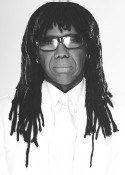
Photo by Roy Cox.
Don’t laugh, because David is the consummate artist with an impresario’s keen sense of the market. He knows the audience wants new musical sensations, but not so new that they are completely alien. Keeping your eye on the audience has been my philosophy ever since I was a skinny kid with glasses from the streets of New York, a musician who broke into the business playing in the house band at the Apollo Theater in Harlem.
My advice to the next generation of musical talent is to explore with an open mind and discover the musical world that’s out there. Don’t assume that you are so smart and talented that the world is absolutely going to find you on your terms.
The music business, after all, is business. And business requires focus. I make my songs for the specific gatekeeper that I see just in front of me. The gatekeeper could be an A&R dude, who I know will then take my song to the label boss. I’m not looking way down the road like when I drive a car. This philosophy focuses creativity on a simple and achievable objective.
I’ve never had a manager because I always want to figure out the marketplace myself and then plot my next move (although not having a manager is right for me, it may not be right for others). When I started out, it was the age of the rock star—the Rolling Stones, Yes, and Jimi Hendrix. I knew that I’d never make it as a rock star because I didn’t look the type. So I wrote songs that were catchier and more commercial than theirs.
When I broke into the business, all we could hope for was that our records would get on the radio and land on the Billboard charts. The business was like a distant fortress with high walls and just a few gatekeepers. As artists—the musicians, producers, and songwriters—we had to figure out how to get over that fortress wall.
In today’s digital age, music is everywhere, creating a flat, wide landscape with many points of entry. It’s not just record labels and radio stations anymore. In recent years, retailers ranging from coffee shops to clothing stores have sold select CDs, giving them national distribution. Clothing manufacturers, liquor marketers, tobacco companies, electronics companies, and other consumer product outfits sell and sponsor music in deals with artists, creating whole new classes of music financiers and enablers.
James Taylor, who is a friend of mine, made one of the single smartest moves of his entire career—and he has an incredible career going—when he did a Christmas album distributed through Hallmark Cards stores. This album sold over a million copies; Hallmark covered the cost of the recording, and James kept ownership of the master. Now that’s what I call knowing the audience and working the system!
Years ago, the business was more combative and appeared punctuated with endless battles between artists and labels. Today, the environment is much more collaborative, with fewer battles. That transformation requires listening with an open mind but doesn’t mean agreeing to what doesn’t sound right. Once, I was in a disagreement with a label over one of my songs. The label was slow to come around to my view but finally agreed to destroy hundreds of thousands of singles that were just about to ship and replaced them with Good Times, the song my band CHIC wanted. It ultimately went on to become one of our most influential songs and No. 1 on the Billboard chart.
That incident illustrates the big stick of leverage that the artist—who often is portrayed as powerless—actually wields in dealing with labels and other big entities that are partners in the
music industry. Despite their armies of executives and their mounds of corporate money, the big companies know deep down that they don’t really know. It’s the artist who has a feel for the music, and—if listening to my advice—it’s the artist who makes the effort to understand the audience.
The late Ahmet Ertegun—the legendary label executive known for his eye for up-and-coming talent —confided this little secret when I first met him. He told me, “Kid, the reason I’m letting you do whatever you want to do is because I learned early on that I am not the ultimate consumer.”
The lesson: Listen to the audience, and the audience will listen to you.
Nile Rodgers is a recording artist, songwriter, video game scorer, and record producer who has collaborated with David Bowie, Eric Clapton, Madonna, and Diana Ross. His guitar-driven CHIC funk recording “Le Freak” is Atlantic Records’ biggest single of all time. He is a trustee of The Recording Academy and founder of the We Are Family Foundation. Read more about him in his memoir, LeFreak: An Upside Down Story of Family, Disco and Destiny
Preface
It’s still big. One estimate from consulting firm PwC is that the global music market today is worth about $46 billion, a lot of money any way you count it. But, when you do count it, it is not what it used to be. When the first edition of this handbook rolled off the press decades ago, a lot of people were making a lot of money from selling pieces of plastic in which were encoded the cultural touchstones of the 20th century: The music business was largely the recorded music business, and recorded music was monetized in physical form.
Then technology happened. Just as it roiled other media—from newspapers to magazines to over-the-air television—it upended the comfortably predictable principles that governed artists, record labels, retailers, radio broadcasters, and the other vital cogs in the vast recorded music business machine. In fact, most of the titans in the business today—think Apple, Spotify, Sirius XM, SoundExchange, YouTube, Pandora, Amazon—a few decades ago weren’t even in the music business or weren’t in business at all.
That upending, and the adjustments that have been reverberating through the business ever since, are what we explore in this 11th edition.
What’s new, you ask?
Instead of buying particular pieces of music through a CD or download, consumers are doing more of their music consumption activity as an “experience.” That experience might include attending a live concert (Chapters 16 and 17) or listening to a curated digital stream (Chapter 19).
Instead of subsidizing live performances to boost record sales, labels now routinely use concert profits to fatten their take of an artist’s overall success through 360 deals (Chapter 12).
Instead of defining performance licensing as just the exploitation of compositions, the United States has significantly boosted the value of licensing the master recordings themselves (Chapter 7).
Instead of tracking the industry by looking at just retail sales charts and radio playlists, the quantitative analysts of today tap into a torrent of digitized behavioral data to spark discovery,
shape tastes, and one way or the other squeeze more money out of the complex ecosystem that is the music industry of the 21st century (Chapter 15).
Our narrative in this edition has changed as well. We’ve reordered some chapters to recognize today’s new alignment of the important issues. And we’ve added some more discussion questions to spark student inquiry.
Perhaps as important, we’ve humanized the story by offering vignettes illustrating how individuals in different industry roles are coping and indeed triumphing as the rules change. Notable examples include movie composer Jeff Beal (Chapter 21), music video producer Emmanuelle Cuny-Diop (Chapter 20), instrument merchants Stan and Jerry Keyawa (Chapter 24), and nonprofit venue executive David Asbell (Chapter 17).
Admittedly, with such fundamental changes, not everyone in every role is emerging unscathed. What these hundreds of pages illustrate, however, is with change can come genuine opportunity for players as diverse as the inventors of new digital tools as well as the DIY creators of the next big sound.
The band is tuning up. Let’s enjoy the show.
Tim Baskerville
September 2015
Santa Barbara Online Resources
Visit http://study.sagepub.com/baskerville11e for support materials that accompany the book.
Password-protected Instructor Resources include the following:
A test bank by Tim Baskerville is available containing multiple choice, true/false, and essay questions for each chapter. The test bank provides you with a diverse range of pre-written options as well as the opportunity for editing any question and/or inserting your own personalized questions to effectively assess students’ progress and understanding.
Carefully selected, web-based video links feature relevant interviews, lectures, personal stories, inquiries, and other content for use in independent or classroom-based explorations of key topics.
Editable, chapter-specific Microsoft® PowerPoint® slides by Tim Baskerville offer you complete flexibility in easily creating a multimedia presentation for your course.
Chapter-specific discussion questions help launch classroom interaction by prompting students to engage with the material and by reinforcing important content.
Teaching tips are designed for instructors to expand questions to students, or initiate class discussion.
Web exercises direct both instructors and students to useful and current web sites, along with creative activities to extend and reinforce learning or allow for further research on important chapter topics.
Web resources are included for further research and insights.
General resources include templates and forms students can use in the music business.
The open-access Student Study Site includes the following:
Mobile-friendly eFlashcards reinforce understanding of key terms and concepts that have been outlined in the chapters.
Carefully selected, video links feature relevant interviews, lectures, personal stories, inquiries, and other content for use in independent or classroom-based explorations of key topics.
Web exercises direct you to useful and current web resources, along with creative activities to extend and reinforce learning or allow for further research on important chapter topics. Web resources are included for further research and insights.
General resources include templates and forms to use in the music business.
Acknowledgments
We wish to thank those people who were helpful in generously sharing their knowledge of many facets of the music and entertainment business during the preparation of this 11th edition and its predecessors.
Once again, our anchor reporting for this edition comes from Robert Marich, a veteran entertainment journalist (The Hollywood Reporter, Variety) who for years has set the standard for coverage of entertainment and media. Key contributors for this edition also include project manager and photo editor Deborah Barber, marketing professional Lynne Dundas, and U.K.-based author Dave Laing. We also acknowledge with fond memory Dave’s writing partner, the late Phil Hardy, who contributed his knowledge of the global scene to many of our editions over the years.
Over time, a number of entertainment and music attorneys have kept us up to date with the shifting sands of law and regulation. Peter J. Strand of Leavens, Strand & Glover, LLC, served as a key adviser for portions of this 11th edition. In recent years, we’re also grateful for input from attorneys Mark J. Davis, David Hirshland, and Susan Rabin. Among the notable legal contributors to earlier editions have been Alan S. Bergman and Robert Clarida.
Key contributors to this edition include music video executive Nicole Acacio, Caviar music video executive producer Kim Dellara, film composer Ron Grant, AEG Ehrlich Ventures’ Renato Basile, Me Gusta Music owner Trina Smith, Kathy Marsh and Bill Archer of MusicNotes.com, Musical Merchandise Review editor Christian Wissmuller, NAMM Director of Public Relations Lora Bodmer, SAG-AFTRA historian Valerie Yaros, Mediabase VP of Marketing Dwight Douglas, and Phizzle VP of Marketing Jeffrey A. Ryznar.
Particularly helpful with the primary research we reference in these pages are the Future of Music Coalition; IFPI in London along with its U.S. affiliate, RIAA; professional services consultancy PwC; Russ H. Crupnick of MusicWatch; and numerous other sources that are credited within the text.
For help with our coverage of music and advertising, we thank the key players from ad agency Rubin Postaer and Associates: Senior VP, Chief Production Officer Gary Paticoff; VP, Executive Producer Isadora Chesler; Executive VP, Management Account Director Brett Bender; and Senior VP, Director Human Resources Lark Baskerville. We particularly appreciate that RPA and Honda allowed us to peek behind the scenes to excerpt the storyboard of their high-impact Matthew Broderick Super Bowl spot.
Other professionals, educators, and experts were generous with their time. Heartfelt thanks go to all of them: Santa Barbara community leader and philanthropist Jim Morouse of the Lobero Theatre Foundation, analyst Michael DeGusta, and digital music expert Anu Kirk.
As usual, we are grateful to the alphabet-soup collection of associations, performing rights organizations, unions, societies, for-profit companies, and nonprofits that have contributed input; their contributions are frequently referenced throughout the text.
Special thanks go to the many friends who gave us advice and information used throughout the book. We are especially grateful to Ira Mayer, Paul Sweeting, Ned Sherman, Joe Diamond, David Hazan, and Motion Picture Academy members Cathy Karol Crowther and Tee Bosustow. And, a grateful nod goes to close friend and industry veteran Barry Freeman, who contributed the quotation from Dinah Shore as well as his in-the-trenches insights from the Golden Age of the record business.
We have relied heavily through several editions for fresh insights from leading thinkers in music business education, most particularly Don Gorder of Berklee College of Music; Tim Hays of Elmhurst College; Kristel Kemmerer of Lamar State College Port Arthur; Carole Knisely of York College of Pennsylvania; Ava Lawrence of Northeastern University; David P. Leonard of TREBAS Institute; Stephen Marcone of William Paterson College; Richard McIlvery of the USC Thornton School of Music; Janet Nepkie of State University of New York, College of Oneonta; Catherine Fitterman Radbill of NYU Steinhardt; Kim Wangler of Appalachian State University; and Elizabeth Sellers, Professor and Director of Film Scoring, California State University, Northridge.
We’d also like to extend a great thank you to the reviewers who contributed their time and feedback to improve this edition. These reviewers include Michael Phillips, University of South Alabama; Carl Anderson, Bradley University; Denise A. Grupp-Verbon, Owens State Community College; Kim L. Wangler, Appalachian State University; Anthony McClure, Dallas Baptist University; Charles Denler, Colorado Christian University; Jason Vanselow, Anoka Ramsey Community College; Brian St. John, University of Evansville; Richard H. Bailey, Jr., University of Arkansas at Pine Bluff; and L. H. Dickert, Jr., Winthrop University.
Many people have contributed to the development of this book in earlier editions, including Dr. Alfred Reed, who, along with Dr. William Lee, established the first university degree program in music merchandising at the University of Miami. In more recent years, University of Miami’s Rey Sanchez and Serona Elton have been leaders in advancing the field.
We’re grateful to all those educators who have labored for decades to enhance scholarship and curricula in the field of music business education, notably Bruce Ronkin of Northeastern University and Jim Progris, retired from the University of Miami.
And, we are compelled to mention the ongoing role of the Music and Entertainment Industry Educators Association (MEIEA), which has trail blazed in the field—gaining respect in both the halls of academe and in the corridors of business.
To all of those mentioned here and to many other friends who have shared their knowledge of the music business with us—thank you.
About the Authors
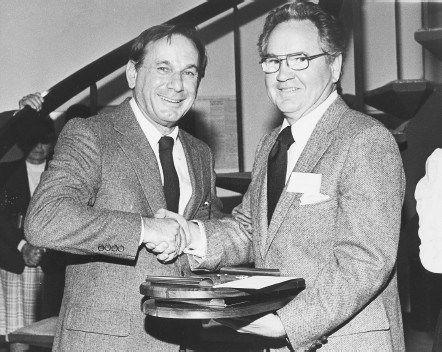
Author David Baskerville (right) receiving ASCAP’s Deems Taylor Award, given each year for outstanding books on music. The presentation is by Academy Award—winning songwriter Hal David, representing ASCAP.
David Baskerville
Author David Baskerville (1918–1986) received a PhD in music from UCLA. His background included staff composer-conductor for NBC-Hollywood; arranger for Nelson Riddle, Paramount Pictures, and 20th Century Fox; television producer for BBC-London; conductor at Radio City Music Hall; trombonist with the Seattle Symphony, Los Angeles Philharmonic, and NBC-Hollywood orchestra; Executive Vice President of Ad-Staff, Inc.; producer of awardwinning broadcast commercials; Executive Editor of Tor Music Publishing Company; and President of Sherwood Recording Studios, Los Angeles (subsequently operated by Warner Bros. Records).
He also served as a consultant to companies in the entertainment industry, such as Walt Disney Productions, and to research and marketing firms, such as Vidmar Communications, Los Angeles.
As an educator, Dr. Baskerville created and directed the music management program at the University of Colorado at Denver, where he became professor emeritus. He was a guest lecturer, consultant, or clinician at USC, UCLA, Chicago Musical College, Hartt School of Music, the Ohio State University, University of Miami, and Trebas Institute, Canada.
He was a featured speaker at national conventions of the Music Educators National Conference, College Music Society, National Association of Jazz Educators, and the National Association of Schools of Music.

Author Tim Baskerville has a diverse background in entertainment and media. He began his
https://jigsaw.yuzu.com/api/v0/books/9781506303154/print?from=...
career in broadcasting after receiving a BA in theater arts from UCLA. Early affiliations included CBS and Cox Broadcasting, where he served as a staff writer-producer. The first TV documentary he created for CBS TV stations was nominated for an Emmy.
As a publisher and entrepreneur, he launched business periodicals on the home video software industry, global film distribution, and multinational broadcasting. Today, a publishing company he founded in London in the 1990s is one of the world’s leading providers of data on mobile entertainment (www.informatm.com).
In recent years, he served as President of what is now the SNL Kagan unit of McGraw-Hill Financial, the leading provider of financial analysis on the media industry, and CEO of JupiterResearch (acquired by Forrester Research), a key source of consumer research on Web behavior and new media.
As a consultant, Baskerville’s clients have included the Motion Picture Association of America, Variety, Time Warner, IBM, International Data Corp., Young & Rubicam, JVC America, Apple, and The Rockefeller Foundation. He has been both a strategy consultant and weekly columnist for Billboard.
Baskerville was Vice President of the Music and Entertainment Industry Educators Association (MEIEA); member of the Writers Guild of America, West; and chapter founder of the Overseas Press Club of America. He has served on the boards of both public and private companies that publish and distribute business information.

© Getty Images/WIN-Initiative CHAPTER 1 Overture
Did someone say “music business”? What happened to the art of music? The shortest possible answer is, “Billions!”—the windstorm of money swirling around the art and business of music. But the question of what is happening to musical art in the modern marketplace calls for a serious answer, particularly when that marketplace is changing so rapidly. That is what this book is all about.
How much has the music business changed since the 20th century gave way to the 21st? More than many could have imagined only a few beats back. What remains the same? More than you might expect, given the chorus of questions about its future direction and shape. Yes, the music industry looks radically different today, having been reshaped by a still-evolving digital landscape, but the fundamentals of the business—the creation, publishing, packaging, marketing, distribution, and sale of music—are constant. Creators still create at one end, artists and merchants continue to “monetize” a music product at the other, and an array of equally passionate, talented individuals—agents, managers, producers, sound engineers, label1 executives, bookers, promoters, broadcasters, business advisers, lawyers, accountants —perform their vital roles throughout the process. The differences, of course, are in the details.
That, then, is what will be laid out in the following chapters: the core fundamentals of the music business (the term is used here to include the art, the profession, and the business of music), along with the industry’s current state of the art (those 21st-century details). Not only do we examine the major changes in music and its audiences, but we also set forth in detail just who produces the music, who “consumes” it, and how the artists, merchants, and others in that long music chain divvy up the billions of dollars that the industry produces. Armed with a thorough understanding of both, a music-industry hopeful will be well prepared for a career not only in today’s music business but also in the music business of tomorrow—one in which the next seismic shifts are surely only a few more beats away.
“I never cared much for poverty.”
—Igor Stravinsky
Music and Society: We’ve Got Music in Us
Prepare for some surprises: Perceptions of the profession and business of music are usually at wide variance from reality. This is partly because the field is so diverse and changes so rapidly, but it is also because its public face—the major record label and chart-topping superstar—reveals such a small piece of the whole picture. But it can be understood. It is argued that the music business, particularly the recording industry, is fundamentally irrational. But most of what really goes on in the business and the profession does submit to rational analysis.
We can begin to understand the music business, or any large and diverse activity, once we examine each of its components. That is our method here. But before we do this, let’s consider the overall magnitude of the industry today. These facts can provide some perspective:
Some 164 billion songs were streamed in just the United States during 2014 via audio and video platforms, according to researcher SoundScan, reflecting the consumer affection for free and flat-fee subscription media services.
Some 1.1 billion legal digital music downloads were sold in the United States in 2014. Although this figure experienced erosion in recent years, downloads today are still sharply higher than the 19 million tracks bought as recently as 2003.
The scourge of music piracy is declining as 62% of Internet users surveyed in nine countries employed legitimate digital music services in 2013, according to researcher Ipsos MediaCT.
From the format’s introduction in 1982, several hundred billion music CDs have sold worldwide, although this format is now in decline. One of five Americans plays a musical instrument. These musicians spend more than $6.8 billion a year on instruments, accessories, and sheet music.
The love affair starts young—listening to music is cited as the most popular activity among teens—and it’s not exactly monogamous: Our passion for music is not limited to any one genre, although a cursory glance through the major-media pop-culture lens might suggest so. The American Symphony Orchestra League reports that approximately 36,000 symphony concerts are given every year. This particular audience now numbers around 26.5 million patrons each season. Opera continues to attract its loyal audience, now being served by more than 1,800 professional, semiprofessional, and youth companies in this country.
Nor is the desire strong only in the United States: Recorded music is one of the primary forms of entertainment worldwide, ringing up more than $15 billion in annual trade-level sales.
Meanwhile, ever-cheaper digital production tools, along with the wide-open world of the Web, have combined to spark an explosion of choices for every possible music taste (or lack thereof), and those options are often only a click away from being pumped into the many varieties of pocket-size digital media devices attached to eager ears around the globe. Musicians are no longer restricted in their expression by the laws of acoustics—new electronic ways to make music are invented every year, offering a composer or video producer more controls than 10 fingers can handle. The people with access to newer technology are limited in their expressive capacities only by their imaginations.
In short, the music side of the music business is booming.
Art Versus Commerce: Music Changes Everything
What about the business side of the music business? A straight line between a strong consumer appetite for music and a fat, happy music industry is inarguably less certain than it once was. The early explosive growth of peer-to-peer file sharing in the 1990s, a shift toward nontraditional and online retail, the introduction of single-track downloads rather than full (more expensive) albums, and the acceleration of streaming have all altered the old equation. These new realities have spurred (some would say forced) new ways of thinking about how to connect “making music” with “making money.”
Art and commerce, of course, have always made strange bedfellows. This ever-present linkage is inherently tense, for musicians and merchants are, in many respects, natural enemies. They seem to hold generally conflicting views on what music should be and do. Musicians want their music to break creative boundaries and to be heard and appreciated by as many people as possible; they want to “connect” with an audience.
Music merchants and businesspeople want music to fit the mainstream sales taste of the moment and to make as much money as possible; they want to “connect” with an audience’s wallets. “Good” does not necessarily equal “popular.” Perhaps the reason so many hit songs sound bad is that they are. (One irony of the opening up of the creative process through cheaper digital tools and the Web is that there is more bad music being made than ever before—and more that is mind-blowingly good.)
Great music does still break through, as it always has, and great business is still being done. It is simply being done somewhat differently.
The major recorded music companies that continue to control the lion’s share of the U.S. market are exploring new business models and alliances, different types of artist contracts, and previously untapped licensing opportunities for current hits and their all-important catalog (“old”) titles. Musicians and recording artists—newcomers and veterans alike—are discovering that there are more ways than ever to “do-ityourself”: build a fan base, book shows, record music, and support themselves by selling music on the Web. Many artists are picking and choosing those areas where they need or desire professional muscle and those segments of their art or business that can be done better or cheaper with some DIY sweat.
Indeed, the very definitions of artist, label, retailer, and even “music product” are blurring and changing. An “artist” increasingly may be his own label—and his own retailer with direct online sales to consumers. A “composer” might compose music for a symphony, a commercial, a film, and a videogame. A “music store” might be a location in a local strip mall, a streaming service, a merchandising section in a big-box retailer, a site on the Web, or an app on a cell phone. These “stores” may sell music in the form of albums or singles, physically or digitally, or they may sell access to it for a fee. The “product”—the recorded music itself—can be a direct source of revenue for artists and labels, or it might be viewed more as a method of promotion for bringing in revenue from touring and merchandise (it’s hard to download and “share” a T-shirt).
The positives for the music business in this latest reinvention—for those already in it and those just starting out—are many. New technologies naturally equal new challenges. But, as the music industry has shown from its infancy, new technologies also bring vast new opportunities to evolve and expand—whether the technology in question is the Web, music-video channels, CDs, TV, radio, or the LP. History’s overarching lesson: The industry has been rocked by waves of always new technologies for more than a century, and after rocky adjustments, the business has always emerged healthier and more prosperous.
Historical Development
Finding a Paying Audience
History books provide only spotty information on how the musician fared in earlier times as a professional. We can assume that in the beginning, music making was undertaken by individuals and groups simply for their own pleasure. The performer was also the composer. If there was an audience, it was a social or religious gathering; it did not occur to the early musicians that they might develop an audience that would pay to hear them sing their songs.
Among the first important professional musicians in Western civilization were the mimes of the Greek and Roman theater. They were singingdancing actors. Roman law held them to be disreputable types, calling them infami (outlaws). In the Middle Ages, the minstrels of Germany and the jongleurs of France were the first professionals. Accounts of their activities read like a review from Variety. These musicians were actually vaudevillians, and their acts might include not only singing and dancing but also juggling, card tricks, and even knife throwing and trained animals. Show business had begun—in the Middle Ages!
A handful of musicians involved in secular music managed to earn at least part of their livelihood during the Middle Ages and Renaissance. But in the religious sector, almost no musicians enjoyed real professional status. The choirboys and men of the Western church performed in the cathedral choirs as just another part of their Christian service. Professional composers in the religious field seem to have first appeared in Paris around 1100 ad at Notre Dame Cathedral. But musicologists cannot provide a satisfactory account of how the profession of composing music took shape in the following centuries. To this day, church musicians in most communities are either unpaid or paid below professional rates.
Conditions for the working musician were somewhat better in Germany in the 15th and 16th centuries. The tradition of guilds included the music trade. Musicians’ guilds influenced not only working conditions but also creative and artistic standards. These early guilds were active in organizing composition and singing contests and formulated elaborate rules for them (an accurate account of these proceedings may be found in Richard Wagner’s opera, Die Meistersinger Von Nürnberg).
In the following period in Europe, increasing numbers of artists were employed by the nobility as house musicians. Composers and performers were put on the royal payroll to make music in the salons, ballrooms, and chapels for their wealthy patrons. But nobility looked on these artists as servants, and they were expected to use the rear entrances to royal buildings. In addition, musicians’ royal patrons would frequently pay them later than promised or not at all. Despite considerable advances in status, modern-day musicians sometimes complain that they still do not receive appropriate respect for their talents and professional stature.
In our own time and place, the champion for elevating the status of the music profession is the American Federation of Musicians (AFM), a labor union with members in the United States and Canada. AFM locals receive requests regularly from sponsors of civic events, political rallies, and community benefits. These requests are usually sung in the same key: “Please, would you just send over some musicians for our event? They’ll really enjoy it and, of course, we’ll have some nice refreshments for them.” Most musicians have been willing to play benefits, but they have also been exploited by those who would have them “share their art” just for the inherent pleasure of it. AFM locals have developed an effective response for unreasonable requests of this kind: They offer to supply union musicians without fee, provided the other trades and professions—stagehands, waiters, teamsters, bartenders—also work without pay. It is a fair offer; there are few takers.
Gradually, musicians acquired recognition as professionals with the development of a new phenomenon, the paying audience. This first occurred in the musical theater and opera, particularly in Italy and England. When the public began to pay its way into a room to hear music, the music business had begun. By the 1800s, the public had accepted the idea that you had to buy a ticket to hear a professional. Increasing numbers of paid concerts developed, not only in European cities such as Vienna, London, and Paris but also in New York, Philadelphia, and Boston.
We lack reliable accounts of who organized and promoted the earliest paid employment for professional musicians. Perhaps the earliest notable artist’s manager or agent was Mozart’s father, Leopold Mozart, who discovered his son’s talent before the youngster had barely
graduated from diapers. When Wolfgang was 6 years old, father Leopold started presenting his son to all of Europe. But Mozart’s father did not teach his son much about career management. Mozart junior earned considerable sums in his short lifetime but seems to have died a pauper. Mismanagement of money and careers is not unique to recent decades.
A more recent ancestor of today’s music entrepreneur was the circus genius, P. T. Barnum. In 1850, when opera singer Jenny Lind, “The Swedish Nightingale,” came to America, Barnum presented her around the country as if she were a star acrobat. Barnum’s bookings earned the artist $150,000 in her American tour, big money indeed in those days.
Barnum understood that the public likes a good show, and the music business grew, even in the classical field, in a razzle-dazzle, show-biz atmosphere. At the same time Barnum was touring Jenny Lind, other entrepreneurs were developing enthusiastic audiences for that unique American contribution to theater—the minstrel show. This is not the place to treat the racist aspects of that phenomenon; our interest in minstrelsy here must be limited to how it fostered the development of the popular music business. As early as the Middle Ages, musicians from Africa were in Europe entertaining whites. But it was not until the mid-19th century, with the development of the minstrel show, that blacks began to find a place in the white musical world as full professionals. Although most of the performers were white, increasing numbers of blacks began to take part. This development turned out to be of historical significance, for it would be impossible even to conceive of music in the 20th century without the pervasive influence of black musicians.
The increasing popularity of minstrelsy in the 1850 to 1900 period enlarged public awareness and appreciation of popular music and the entertainment business. Near the end of the Reconstruction period, the size and affluence of the middle class grew. By the 1890s, the piano was a standard adornment in the parlors of upper-middle-class families. On thousands of piano racks across the land, one would probably find, in addition to some Stephen Foster songs and a hymnal, a copy of After the Ball. The year was 1892, and this song was the first to sell more than a million copies in a 12-month period.
By this time, a number of large publishing houses had developed, such as E. B. Marks, Witmark Bros., T. B. Harms, Leo B. Feist, Mills Music, and Shapiro, Bernstein & Co. These popular music publishers took pride in being able to spot potential hits. When they couldn’t find them, the publishers wrote the songs themselves or put composers on weekly salaries to work in-house.
These late 19th-century publishers developed the merchandising methods that prevailed until radio became a key music marketing platform in the 1920s. Songs were introduced in a number of ways. In the final days of minstrelsy (which died around 1900), song pluggers would attempt to persuade performers to use material coming off the presses. When vaudeville and burlesque began to displace minstrel shows, pluggers contacted headliners and even lesser acts to try to get them to use the songs their firms were pushing at the time. A publisher who could come up with a piece of material that some vaudeville headliner like Al Jolson or Eddie Cantor would sing was almost ensured a hit, for these were the superstars of their day.
At this point in the music business story, technology stepped in to play a starring role, not unlike the one it occupies today. And also not unlike today, many in the industry first feared that it might be more villain than hero. That hot new innovation? Radio.
Mass Media: Yesterday, Today, and Tomorrow
The world has always been full of music lovers, but it was not until the development of mass communication technology that so many “new” audiences were discovered. Until the 1920s, most professional music making was addressed to a small, elite audience that was accustomed to buying tickets to attend the opera, the symphony, perhaps a Broadway musical. When radio (and, later, records and television) came along, that elite audience not only continued but also grew. But now it was joined and immeasurably augmented by whole new audiences for folk music, country and western songs, blues, and jazz. Mass media forever changed the size and composition of the music audience, and merchants were quick to respond to the new millions of paying customers.
Not that this tremendous upside was clear from the start. Industry leaders misjudged radio broadcasting: When it started in the 1920s, the publishers fought it, believing that “giving music away” through this medium would hurt sheet music sales. Overexposure via radio broadcasting, they argued, was killing songs in 6 weeks; potential customers could not get down to the store to make a purchase before the song’s popularity had waned. It should be pointed out that publishers’ income from broadcast performances at that time was zero.
Another significant technological development in the entertainment field occurred in 1927 when the “talkies” began. Movie producers discovered, with the very first sound film (a musical titled The Jazz Singer, starring Al Jolson), that audiences would buy a lot of theater tickets to hear songs sung on “the silver screen.” The major studios began scrambling for synchronization rights to enable them to add music to films and turn out musical films in rapid succession.
During the Great Depression of the 1930s, million-selling records disappeared, and sales of sheet music collapsed. Attendance at vaudeville theaters dropped, too, with the growing popularity of the movie musical. Concurrent with these depressions in the music market, radio broadcasting grew rapidly. Music publishers now shifted their attention from plugging vaudeville performers to the new stars of radio. The network broadcasts at that time emanated mostly from New York, Chicago, and Los Angeles. Publishers closed their regional offices across the land and focused their plugging efforts on these new broadcasting centers. It worked. The publishers quickly discovered that they should point their promotional efforts toward the big bands and their singers who had weekly, sometimes nightly, radio broadcasts (which, at that time, were referred to as “remotes”). Song-plugging had grown from a local to a national enterprise with the development of network radio. Publishers were not the only ones to benefit from the coming of network broadcasting. Big bands became name bands because of network radio. Then the name bands became the record stars. Management noticed that the best-selling big band records featured the band’s singer. Alert talent handlers pulled the singers off the bandstand (Frank Sinatra, Doris Day, Ella Fitzgerald, etc.) and started them working alone—for much more money. This was the beginning of the present era of the dominance of the popular singer; they became the new stars and superstars, with the help of recordings and films.
During World War II, the whole world seemed to discover the appeal of America’s popular music, enchanted by its glossy, up-tempo big-band
tunes. Much of this worldwide popularity was fostered by the Armed Forces Radio network. With over 90 stations broadcasting American-made records around the world, millions of listeners, not just the GIs for whom the broadcasts were intended, heard the great entertainment available from this kind of music. By the late 1940s, the American style had become a world style.
When the GIs returned home, they bought large quantities of records. Music instrument factories, which had been shut down earlier to produce weapons, were now spewing out guitars, organs, pianos, and wind and percussion instruments in quantity. The music industry was reaching a mass market.
Record companies were moving millions of singles in the 1940s. When Columbia came out with the long-playing (LP) vinyl platter record, the music business again experienced a development of overwhelming significance. Now, instead of two songs per record, songwriters and publishers could place 12 songs on each release. On the new LP, record buyers could hear an entire Broadway show; opera buffs could carry home an entire opera in a box; complete symphonies could easily fit on one LP. The dollar volume of classical records grew to 10% of the market (versus 2% these days).
Concurrent with the growing popularity of LPs was the increasing availability of low-cost tape recorders. Add to this the boom in high-fidelity sound. For a relatively low cost, consumers could hear recorded or broadcast music with a quality of sound that was better, audiophiles believed, than that offered at their local concert halls.
The music business began to attract a new breed of merchants, inventors of new distribution and merchandising methods. The most significant marketing development at the time was the discovery that people would buy records wherever they shopped. Enter the rack jobber. This new kind of music merchant set up record racks in supermarkets, variety stores, department stores—anywhere shoppers passed by.
Large corporations began to notice that people in the music publishing and record business were making lots of money. They decided to buy in. By the 1970s, even conservative bankers got the message: Music enterprise was now an acceptable risk. They began making loans to music publishers, record producers, and artists’ managers—types of people they used to classify with street vendors. The main attraction to these new investors was record production. In what other kind of business enterprise could someone invest, say, $20,000 in a master tape, then receive from it royalties one hundred times that amount for distribution rights, if the record hit? To the inexperienced investor, the music business began to look like a money tree. By the 1970s, the buying and selling of music companies resulted in the majority of industry revenue becoming controlled by a handful of giant corporations (to become the longtime “Big 6,” a number that would shrink further in later years).
This belief in a “money tree” seemed almost justified when another game-changing innovation was introduced in 1982: the compact disc. Labels shook their analog catalogs, and out poured dollars as consumers replaced their record collections with the digital discs and then scooped up new CD-only releases. Although audiophiles initially balked, the CD soon overtook both the LP and the previously unveiled “new” format, the music cassette; that complete symphony now fitted on one side of one disc. Music television was simultaneously taking root—having become a cultural force with the debut of MTV in 1981—and the two together helped usher in a period of creative and business growth.
Cue new technology once more, and underscore the arrival of the MP3 format onto the scene in the 1990s with a somewhat unsettling composition. When digital music was further compressed into files that could be distributed over the Internet freely (in every sense of the word), a new form of mass media became, in part, a medium controlled by the masses. The ability of consumers to make duplicate recordings shattered the grip that labels held on music when play-only media such as the LP were the standard. The most fervent of music fans were now tastemakers, although not yet hit-makers, as they sought out, chatted up, and “distributed” songs online. Musicians were quick to tap into this newfound promotional base, and record labels followed.
The Internet, vast and far-reaching as it is, allowed a direct, intimate, and interactive connection with fans in ways never before possible outside of a small concert. If the 20th century was about discovering new audiences, the 21st may prove to be about finding new, better, and—here is the still-open billion-dollar question—profitable ways to connect with them wherever they are and through whatever medium they desire—live venues, streaming, downloads, music stores, TV, radio, film, social networking sites, cellular phones, videogames, and whichever next new thing is just over the horizon. In the next chapter, we examine the implications of the nascent digital millennium.
Note
1. Words in boldface type indicate inclusion in the glossary section.
Chapter Takeaways
Despite the upheavals of transformational change, global recorded music sales (in all forms) remain impressive, amounting to more than $15 billion to record labels alone.
Tensions have always persisted between artists who want to connect with audiences and business enablers who want to connect to an audience’s wallets.
The rise of the middle class in the late 19th century made possible the first blockbuster music publishing hit, After the Ball, which sold more than a million units in 1892.
Technology, in its many forms, has been a consistent driver of the changing business—from the invention of radio, to movies, to TV, to vinyl LPs, to CDs, to the Web.
Transition to a new legal recording medium, such as cassette tapes being supplanted by CDs, created short-term prosperity for record labels. That’s because consumers bought their favorite tunes in the new format, even as they owned the same music in the old format.