Prologue
Before the Curtain Rises
LONG BEFORE THE DOORS OPENED, a crowd gathered outside the theater. Noisily, they bustled in, country folk and urban dandies alike, to find themselves good seats. The old mansion’s walls reverberated with their footsteps on the hardwood floors, spirited greetings, idle gossip, and talk of politics.
The playhouse had once been the country home of Aaron Burr, who nearly thirty years earlier returned across the Hudson River to his Richmond Hill estate from the New Jersey palisades after his notorious duel with Alexander Hamilton. As Burr’s fortunes waned and the growing city encroached from the south and east, John Jacob Astor purchased the mansion, lifted it and rolled it a few blocks closer to the center of Manhattan, and converted it into the Richmond Hill Theatre.
Earlier the same summer a teen-aged Walt Whitman had described feeling mesmerized by the dark green curtain of a New York theater. Transfixed when it lifted, with “quick and graceful leaps, like the hopping of a rabbit,” Whitman knew that behind the drapery lay a “world of heroes and heroines, and loves, and murders, and plots, and hopes.” As the Richmond Hill’s curtain rose this September night, a cotton factory at sunrise came into view. Young women conversed as they commenced their work, beginning the night’s feature, SarahMariaCornell:or,TheFallRiverMurder.1
Surely the audience erupted as Matilda Flynn entered as the title character. Playing opposite drama’s biggest male stars the previous autumn in New York, the twenty-something actress found herself now headlining a company full of amateurs and unknowns.2 As Sarah Maria Cornell, she breaks into the factory-floor gossip of her co-workers:
“Good morning sisters. I have been a lazy girl; you have got a-head of me.”
“What detained you Sarah? You are not usually behind us at work.”
“I have had such a dreadful dream . . . ”
As Cornell relays her premonition that she will die a violent death at the hands of another, the girls gather around, occasionally interrupting her to remind the audience that, no matter her fate, Cornell is a “good, virtuous, and industrious” woman.3
And so an onstage whirlwind began, carrying the audience from a cotton mill with its “factory girls” to a farmhouse of guileless Yankees —familiar stock characters—to an isolated, wooded glade where a camp meeting and a Methodist minister evoked chaos, sex, violence, ambition, and greed, before drawing to a close at a haystack with the killing foretold in the play’s title.
None of this surprised the Richmond Hill audience. Entering the theater, they passed enormous posters depicting in graphic detail the scene of a man strangling a woman. They had seen similar images in handbills plastered on street corners, with smaller versions adorning their playbills.
They knew the characters and the story before the curtain rose because it mirrored a real-life drama that played out in newspapers for months in 1833. By summer’s end, the factory girl and the preacher had become cultural celebrities, immortalized in at least two plays and in songs about the affair that were performed in Broadway revues for months on end.
Young America had little experience yet with a phenomenon that would one day be a defining feature of popular culture in the United States: sensational criminal cases that garnered the label “crime of the century”—no matter how frequently such crimes occurred. Here was the nation’s first spectacular trial, and Americans couldn’t get enough of it. Theatergoers had come that evening—and would return night after night—to experience a scandal performed in accelerated time.4
When theatergoers purchased a ticket in the 1830s, they expected a smorgasbord of entertainment Shakespeare plays, farces, a
medley of popular songs, circus stunts, equestrian troupes— sometimes all on the same night. Or they might be hoping for a melodrama, a play depicting a morally polarized universe of good and evil, of innocent virtue and depraved villainy. Audiences sought out melodramas because, as Herman Melville observed, they wanted performances that offered “more reality than real life itself can show.” Yet in Cornell’s story, real life itself resounded with the unmistakable qualities of melodrama. Passion, virtue, seduction, a vulnerable young woman, a hypocritical villain, dark plotting, and irrepressible urges to speak incessantly in order to leave nothing unsaid, all were on full view in this scandalous murder case.5
Still, Sarah Maria Cornell at the Richmond Hill was not a typical melodrama. It borrowed from comedies and Gothic horror, and most important, its virtuous heroine neither triumphed over nor escaped from her villainous, seducing foe. Instead, this protagonist met her demise through rape and murder.
The real-life demise of Sarah Maria Cornell and all that followed illuminate the very essence of a transformative moment in history, unveiling what anthropologists call a social drama. Such a drama begins when normal and peaceful means of redressing a crime fail to satisfy longings for more complete explanations. Social dramas prompt two questions: Why did thishappen? and What does it tell us about who we are? An ensuing scandal reveals deep cleavages emanating from the struggle to come to grips with a world seeming to change before one’s very eyes. Public fascination with the crime exceeds the bounds of normal curiosity surrounding everyday gossip and news. In search for answers people look to cherished beliefs about politics, religion, and family. They turn to familiar stories and plots to make sense of human actions and their repercussions. Collectively, they participate in an enveloping drama that, in turn, transforms the world they sought to comprehend.6
Audiences flocked to the theater or purchased popular reading about the factory girl and the preacher so they could take part in a scandal rich in personal meaning. In the stories of the saga’s key characters they saw the experiences of their neighbors and families,
sensing keenly that issues that mattered in their own changing lives were being played out in a legal thriller. They understood that women in a new workplace called the factory had uncharted opportunities to live independent lives, but they could also be exposed to sexual threats and to rumors and gossip, threatening their livelihoods and reputations. They knew too the disparity of power brandished in sexual violence and its double standard of culpability. Long before organized movements to confront sexual harassment and sexual violence, Americans understood and explained these real dramas with their own ideas about vulnerability and coercion.
Those who were captivated by this story sensed too what was at stake when evangelical religion began to take center stage in their culture and politics. At a dizzying pace, religious beliefs and personal identities were becoming intertwined with the economic marketplace and partisan politics of a young democracy. Even if they couldn’t foresee the long history of a politics that construed personal choices and a changing society as contests over moral values, Americans knew the cultural battles exposed by such a scandalous case. They sensed especially that fast-changing new forms of communication— an explosion of new print media—mirrored the incessant movement of individuals into new communities and new professions.
If this shocking tale of a preacher and a factory girl constitutes a social drama, it is a drama with a multitude of narrators, scripts, and performers—a contest over stories and storytelling. Stories reveal what mattered most to people in the past; how they lived their lives; how they explained their own actions and the behavior of friends, neighbors, and strangers; and how they communicated their most deeply prized values. Stories expose as well how little people understood the historical transformations that shaped their personal lives, their society, and their culture.
As the curtain rises on the pages that follow, a real rather than an imagined drama of the preacher and the factory girl begins. It is a tale in which violence and storytelling expose the personal histories of two complicated people whose lives intersected amid an everchanging world that each of them tried to embrace but could not
control. Although they lived in an exceptional time, they were not themselves exceptional human beings. Their personal histories survive as narratives of ordinary people whose experiences embodied the spirit of a new world taking shape right before their own—and our—eyes.
ACT I
Murder
The Haystack
STEPPING OUT OF HIS FARMHOUSE, John Durfee noticed a chill had set in. The earth crackled under each step of his boots. It was the first day of winter: December 21, 1832, a Friday. The previous day had been a seasonably pleasant autumn afternoon, with clear skies and a full moon rising early in the evening. Overnight the temperature had dropped to near twenty degrees, and a steady wind blew from the west.
Durfee’s farm lay along the main road in the sleepy village of Tiverton, Rhode Island, where Durfee and his neighbors made the most of farming small plots of coastal land. They toiled for generations, supplementing their modest income by fishing and by exchanging paid labor with one another. Tiverton sat a quarter mile south of the Massachusetts state line. Across that line stood the bustling textile manufacturing town of Fall River.1
Durfee walked to the barn, hitched up his team of horses, and set off downhill toward the Taunton River. It was nine o’clock in the morning.
He got no farther than a few hundred yards when he saw a woman’s body hanging from a fence post inside his haystack yard. Approaching the figure, uncertain if she were dead or alive, he parted the hair that had fallen in front of her face. One look must have sent a shiver through the farmer’s already cold body. A rope stretched six inches above the woman’s neck, securing her rigid form to the stake. No longer was it a typical winter morning. Glimpsing two men within view, he shouted out to them.2
While the farmer waited, he observed that the woman wore a calash (a bonnet in the shape of a pleated hood), and that her cloak was fully fastened down the length of her torso, except for one hook open at her breast. Her arms rested awkwardly underneath. Her shoes had been removed and set aside to her right. Her body hung with her knees bent at a right angle, her toes resting on the ground. Within moments Durfee’s two neighbors arrived, along with his elderly father, Richard, who heard his son’s cry from the farmhouse door. The four men gazed at the woman for a moment, examining just how she was hanging. Then John Durfee climbed over the fence into the stack yard and tried to hoist her body so that he could slip the rope off the top of the pole. Unable to lift the body with one arm and slip off the rope with the other, he heard his father’s impatient holler: “Cut her down.” Handed a knife, Durfee cut the rope near the top of the stake and laid the body on the ground. Then he ran to get the coroner.3
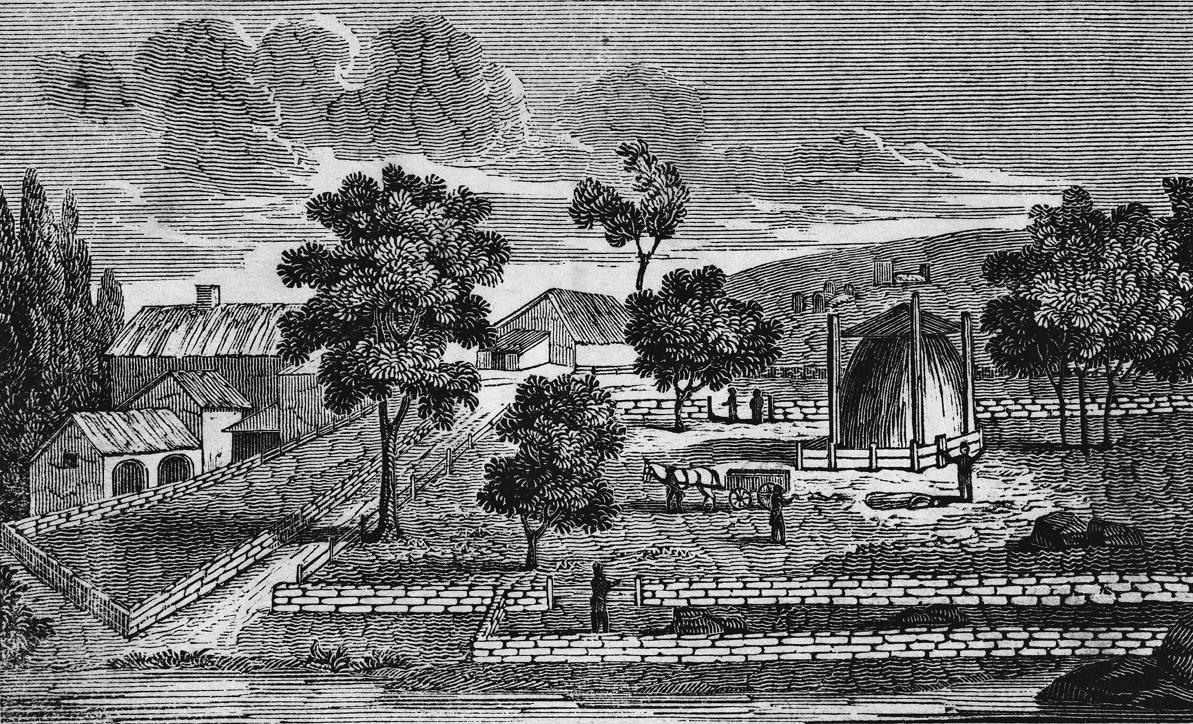
Durfee farm and haystack, Tiverton, Rhode Island, where a farmer found Maria Cornell’s body hanging. From Catherine R. Williams, Fall River, An Authentic Narrative (Boston, 1833). Courtesy of the Huntington Library, San Marino, California.
News spread quickly. Within minutes a young constable from Fall River named Seth Darling arrived, along with a crowd of onlookers. Darling surveyed the grass surrounding the stack yard and observed —and others agreed—that there appeared to be no evidence of a struggle. No one in the small crowd knew the young woman. She must surely be, Darling thought, one of Fall River’s “factory girls,” as workers in the textile mills were commonly called. A young woman’s violent death, no matter the cause, signaled trouble for a factory town.4
Within the next hour, Fall River’s Methodist minister, Ira Bidwell, made his way to the scene and identified the woman as thirty-yearold Sarah Maria Cornell. He had no idea that she had gone by several different names during her brief life. For most of her adulthood she called herself Maria. Only two months earlier, she had
moved to Fall River, found work in the mills, and been admitted as a probationary member of Bidwell’s church.
By the time the coroner, Elihu Hicks, arrived, he had already selected six men for a jury of inquest, the customary procedure for investigating sudden, unexpected, or violent deaths. This remnant of English common law placed full responsibility for determining the cause of death in the hands of ordinary men. The most important qualification for serving on a coroner’s jury was to be a “freeholder,” a property owner. While Cornell’s body lay at their feet, Hicks gave the jury its charge, administered their oath, and ordered that the corpse be moved to Durfee’s farmhouse for further examination.5
As people began to talk on the streets of Fall River that morning, Dr. Thomas Wilbur overheard that a woman named Sarah Maria Cornell lay dead at John Durfee’s Tiverton farm. The doctor hurried to the scene. Unlike the gawkers, Wilbur bent down close to the body, opened the cloak, and placed his hand on the woman’s abdomen.
When the hastily convened coroner’s jury was ready, they summoned Wilbur into a room where they had laid out Cornell’s body. One juror struggled to remove the rope from her neck using only his hands, but it was too deeply embedded in her skin. Another man wielded a knife to cut the rope loose. No one asked the only physician in the room to intervene.
The jury instead asked Dr. Wilbur what he knew about the young woman, casting him as the first in a long line of storytellers in this mystery. Cornell had visited his office several times, Wilbur told the jury, and he suspected that she was pregnant. That’s why he opened her cloak while her body lay on the ground, to observe whether “she was fuller about the abdomen than women generally are,” as he put it. During her visits to the doctor, she confided to him that the father was a Methodist preacher named Avery from nearby Bristol, Rhode Island, a married man with children.6
What’s more, she had told him that Avery forced her to have sex at a religious camp meeting in Connecticut in August, that she’d relocated to Fall River to seek Avery’s financial support, and that
she’d spoken and exchanged letters with the preacher. When she informed Avery of her condition, Cornell explained, Avery advised her to take a large dose of oil of tansy to induce an abortion. She then asked the doctor whether ingesting tansy would be safe, and when Wilbur warned her that it could be fatal, she promised not to take it.7
While the inquest jury continued its work, John Durfee was busy searching for other clues. Early that afternoon Durfee went to the home of Harriet Hathaway, where Cornell had boarded for the past few weeks. The women of his family had instructed him to retrieve Cornell’s belongings so they could dress the body for burial. Durfee also understood from Dr. Wilbur that Cornell had letters in her possession that might incriminate the Bristol preacher. Mrs. Hathaway handed over all of Cornell’s possessions—a locked trunk and a small bandbox—informing the farmer that Cornell always kept the trunk’s key in her pocket. Back home, the women found three letters in the trunk. Opened but unsigned by their author, they were addressed to “Sarah M. Connell.” Durfee also noticed a slip of worn and dirty paper in the bandbox, and a pencil near it. His wife stored the bandbox under a bed.8
That afternoon a gathering of women laid out Cornell’s body. They followed long-standing customs that assigned healing and burial duties to women, with younger women deferring to the experience of their elders. These women alone witnessed the corpse undressed, and they talked among themselves about suspicious marks and bruises that neither the coroner, nor any physician, nor the inquest jury had seen. As they speculated about acts of violence and motives, the women coalesced into another band of witnesses and storytellers.
For their part, the coroner’s jury read the unsigned letters in Cornell’s possession and found vague allusions to meetings in Fall River, instructions for letters to be sent to Bristol, and requests to “keep your secret.” Still hesitant to draw a conclusion, they arranged to meet again the next morning. On Saturday, the men of the jury became the next group of storytellers, offering up a written verdict
stating that “the said Sarah M. Cornell committed suicide by hanging herself upon a stake,” and that she “was influenced to commit the crime by the wicked conduct of a married man, which we gather from Dr. Wilbur together with the contents of three letters found in the trunk” of the deceased.9
With no further clues, these men embraced a story line familiar to nearly every reader in early nineteenth-century America. A seduction tale was a plot repeated across decades in hundreds of novels and magazines. The particulars mattered little in the familiar saga of a fallen woman—a “love-ruined female.” The men of the jury assumed they knew how to complete a tale that began with an unmarried pregnant woman seduced by a married man and found hanging from the end of a rope. And this explanation was expedient: If the cause of death was suicide, the married man need not even be identified.10
Once the jury declared its decision, the coroner gave permission for Cornell’s body to be buried.
It was still Saturday morning when Fall River’s Congregational minister recited a funeral prayer over Maria Cornell as she was buried in the Durfee family’s cemetery on their farm. As John Durfee helped lower the coffin into its grave, he remained unsettled by the previous day’s events. After the burial, his wife, Nancy, prepared Cornell’s personal effects to be sent to her family. Combing through the bandbox stowed under the bed, Nancy came upon the rumpled sheet of paper that John had seen the day before and saw that it was a note—it seemed to have been written hastily—dated the day of the woman’s death. It read:
If I am missing inquire of Rev. Mr. Avery Bristol he will know where I am gone. S. M. Cornell. Dec. 20th
Suddenly, vague details in the unsigned letters seemed less a mystery, and assumptions about suicide less convincing. Combined with Dr. Wilbur’s story and the suspicions of the women who laid out the body, the note suggested more plainly that an act of violence had been committed by the Rev. Ephraim K. Avery of Bristol.