Oxford University Press is a department of the University of Oxford. It furthers the University’s objective of excellence in research, scholarship, and education by publishing worldwide. Oxford is a registered trade mark of Oxford University Press in the UK and certain other countries.
Published in the United States of America by Oxford University Press 198 Madison Avenue, New York, NY 10016, United States of America.
All rights reserved. No part of this publication may be reproduced, stored in a retrieval system, or transmitted, in any form or by any means, without the prior permission in writing of Oxford University Press, or as expressly permitted by law, by license, or under terms agreed with the appropriate reproduction rights organization. Inquiries concerning reproduction outside the scope of the above should be sent to the Rights Department, Oxford University Press, at the address above.
You must not circulate this work in any other form and you must impose this same condition on any acquirer.
Library of Congress Cataloging-in-Publication Data
Names: Gent, Stephen E., 1976– author. | Crescenzi, Mark J.C., 1970– author. Title: Market power politics : war, institutions, and strategic delay in world politics / Stephen E. Gent and Mark J.C. Crescenzi. Description: New York, NY : Oxford University Press, [2021] | Includes bibliographical references and index.
Identifiers: LCCN 2020034295 (print) | LCCN 2020034296 (ebook) | ISBN 9780197529812 (paperback) | ISBN 9780197529805 (hardback) | ISBN 9780197529836 (epub)
LC record available at https://lccn.loc.gov/2020034295
LC ebook record available at https://lccn.loc.gov/2020034296
DOI: 10.1093/oso/9780197529805.001.0001
1 3 5 7 9 8 6 4 2
Paperback printed by Marquis, Canada
Hardback printed by Bridgeport National Bindery, Inc., United States of America
For Nick and Anita
1.1.
1.2.
3.1.
5.1.
5.2.
5.3.
5.4.
5.5.
5.6.
6.2.
6.3.
7.1.
7.2.
7.3.
7.4.
7.5.
3.1.
4.1.
4.2. Cases of Market Power Prevention
6.1. Top Ten Importers of Russian Pipeline Gas, 2017
6.2. Percentage of Pipeline Gas Imports Coming from Russia, 2017
Preface
In its broadest strokes, Market Power Politics is a book about politics, economics, and law in the global arena. The politics we cover here deal with peace and conflict between countries (we will call them states in the book). With respect to economics, we are interested primarily in trade and investment that crosses international borders. Lastly, we care here about the use of international laws and institutions that states have created to manage either the first (politics) or the second (economics) component, or both. Sometimes these three things fit together efficiently, making it easier for firms and their governments to exchange goods, services, and capital in ways that tie the world together and make it more peaceful. When that happens, the three components start to work together as a team. Legal institutions make it easier to trade goods and services or invest capital, for example, and increased wealth from trade may minimize the desire to interrupt that trade with political violence.
Other times, however, at least one of the pieces is out of alignment with the others. When that happens, the same connectivity that brings these three dimensions of human interaction together as a team can lead to difficult or even disastrous consequences. When institutions cannot offer a legal solution to disputes, states will seek their own solutions, often at the expense of others. When those disputes are motivated by market power, or the ability to influence prices, supply, or demand within markets—particularly in markets that are important to governments and their leaders—then the logic of minimizing political violence in the interest of wealth can flip on its head. This is a book about the consequences of that flip. The consequences can be quite dramatic, resulting in the use of military force and even the outbreak of war. But often the consequences of market power fall in between the two extremes of prosperous peace and the catastrophic consequences of war. Instead, states sometimes opt out of cooperation with one another; but rather than jumping right into a fight, they delay a resolution to their dispute. They may even push one another around while they are doing it,
Preface
engaging in bellicose talk and small territorial or maritime grabs without ever boiling over into full-scale war.
The view we take in this book is that even in these situations where the synergy of politics, economics, and law fails to materialize and market power opportunities trigger conflict, the three components still work together in important ways. By studying their interaction even when things aren’t going smoothly, we believe we can identify why some states boil over into war while others seem to simmer incessantly. We illustrate our intuition by applying our theory of market power politics to three of the most important places and moments in the last fifty years: the Persian Gulf War in the 1990s, Russian conflict with its neighbors such as Georgia and Ukraine in the previous decade, and China’s interactions with its neighbors in the East and South China Seas over the last thirty years.
This already sounds complicated, so let us pause here to reassure the reader that we have designed this book to be widely accessible. Our hope is that anyone with an interest in world politics can read the book, and we have removed as much of the technical jargon as we could in pursuit of this goal. Non-academic readers may want to skim through Chapter 4, however, as we do spend a little time talking about how we chose these cases and why that matters. Even so, anyone who has taken an introductory course in international relations should have the tools to read the entire book.
In some ways, this book represents the partnership of its two authors. Stephen Gent has long held an interest in the interactions between international institutions and peace. His expertise in the goals and structures of these institutions helped us see the cause of their failure to resolve the disputes that we examine in the second half of the book. Mark Crescenzi has studied the link between economics and conflict in world politics for a quarter of a century. When he wrote his first book on economic interdependence and conflict, and how interdependence can sometimes keep states from fighting, this flip side of the relationship nagged in the back of his mind. Both of us found that we were unable to complete our thoughts on these matters on our own. But while sitting on a bench on the balcony of the UNC Student Bookstore, we hatched a plan to work together. This book is the product of those efforts.
Along the way we have had a tremendous amount of help. We presented nascent pieces of the research at academic conferences and meetings, gathering feedback from scholars such as Kyle Beardsley, Stephen Chaudoin, David Cunningham, Scott Gartner, Paul Hensel, Kelly Kadera, Pat McDonald, Sara Mitchell, Desiree Nilsson, Jack Paine, Michael Reese, Aisling Winston, and especially Krista Wiegand, whose work was also foundational for our own. At UNC we sought feedback and moral support from Cameron Ballard-Rosa, Navin Bapat, Graeme Robertson, and Tricia Sullivan. We simply could not ask for more supportive
colleagues. Our students were amazing, too, and we would like to thank Michelle Corea, Tyler Ditmore, Bailee Donahue, Derek Galyon, Dan Gustafson, Austin Hahn, Rebecca Kalmbach, Justin Kranis, Emily Rose Mitchell, Lauren Morris, Eric Parajon, Michael Purello, Steven Saroka, Maya Schroder, Stephanie Shady, Zach Simon, Michelle Smoler, Kai Stern, Anna Sturkey, and Rob Williams for all of their research assistance. Thanks also to David McBride, Holly Mitchell, Gopinath Anbalagan, and the production team at Oxford University Press for guidance and support throughout the publication process. We are also grateful to Don Larson and the team at Mapping Specialists, who created the original maps for the book.
Finally, Stephen would like to thank Ed and Joy Gent for providing unwavering support and encouragement over the years. He would also like to thank Michael Cain and J. P. Singh, who introduced him to the study of political science and international relations as an undergraduate at Ole Miss. Their classes undoubtedly laid the seed for many of the questions tackled in this book. Mark would like to thank Jim Crescenzi for patiently serving as an early reader, but also for a lifetime of inspiration, friendship, and encouragement. And, of course, we never would have made it to the end of the project without extraordinary support from Nick Siedentop and Anita Crescenzi. We couldn’t imagine better partners as we sorted this out, and we are so thankful that they put up with us.
Abbreviations
BIS Bank of International Settlements
DPR Donetsk People’s Republic
DSB Dispute Settlement Body (of the World Trade Organization)
EEZ exclusive economic zone
EU European Union
FDI foreign direct investment
GATT General Agreement on Tariffs and Trade
ICJ International Court of Justice
INOC Iraq National Oil Company
ISA International Seabed Authority
JCG Japanese Coast Guard
KOC Kuwait Oil Company
LNG liquified natural gas
LPR Luhansk People’s Republic
NATO North Atlantic Treaty Organization
NEE normal economic exchange
OPEC Organization of the Petroleum Exporting Countries
PCA Permanent Court of Arbitration
PRC People’s Republic of China
REE rare earth element
TANAP Trans-Anatolian Natural Gas Pipeline
TAP Trans-Adriatic Pipeline
tcm thousand cubic meters
UAE United Arab Emirates
UN United Nations
UNCLOS United Nations Convention on the Law of the Sea
WTO World Trade Organization
Introduction
A midnight invasion of Iraqi troops into Kuwait in 1990 set off a chain of events that have reshaped politics in the Middle East with devastating and deadly consequences. Nearly twenty-five years later, Russia annexed the Ukrainian territory of Crimea and pushed the envelope of using military might without triggering war. Meanwhile, in the South China Sea, China has made bold moves to expand its territory island by island, triggering legal disputes from its neighbors, and yet the fear of militarized violence seems relatively low compared to Russia or Iraq. What do these crucial geopolitical moments in history have in common, besides their importance in the lives and prosperity of dozens of countries and millions of people? Could it be that all three cases are being driven by a common political-economic process? If so, what explains the variance in their outcomes? How do we know when a situation like these will become violent?
Answering these questions is the goal of this book. Here we develop a theory of market power politics that helps us understand why states abandon the post–World War II institutions that help states navigate territorial disputes such as these. In this analysis we identify three potential outcomes when market power politics dominate: war, cooperation, and strategic delay. Understanding the context of political institutions and economic ties that surround market power opportunities is key to knowing which outcome is likely to result when states pursue a strategy of dominating a market. In an era where we have come to expect institutions, trade, and investment to knit governments together and prevent violence, in this book we identify one source of motivation that unravels the fabric of peace and increases the risk of war.
Strategic Delay in the “Gray Zone”
The ambition of states to expand their geographic reach can create or exacerbate disputes over the control of territory or maritime areas. We refer to such disagreements as international property rights disputes because they involve competing claims over the sovereign control of resources. States have several strategies to choose from as they try to resolve these property rights disputes in their favor. Some, like Iraq in 1990, choose to press their claims on the battlefield. In fact, disputes over territory have historically been one of the most predominant causes of international war.1 Alternatively, states may try to avoid a costly war and instead work toward a peaceful resolution of their dispute. Through bilateral negotiations or with the assistance of international institutions, states can reach agreements over how to divide disputed territory or maritime areas.
However, sometimes states choose to go down neither of these paths. Instead, they opt to pursue a policy of strategic delay. Strategic delay is the purposeful postponement of a violent or nonviolent settlement of a dispute with the hope of achieving a more preferable outcome in the future. The use of strategic delay is not uncommon in property rights disputes, which are often long lasting.2 In some cases, these delay strategies are largely passive in nature. States may simply want to maintain the status quo because they do not expect that they would achieve a more favorable outcome through military force or negotiation.3 At other times, though, we see states taking a more proactive approach and using strategic delay as a way to further their expansionist goals. By delaying, these states have the opportunity to pursue so-called gray zone tactics that allow them to gradually shift the strategic environment in their favor over time.
Gray zone tactics lie somewhere in the “gray zone” between diplomacy and war. They do not involve the overt use of lethal force by a country’s military, so they fall short of what we would call strategies of war. On the other hand, they also fall outside the bounds of the behavior traditionally acceptable within international diplomacy. These gray zone activities often take the form of salami tactics. Like consuming an entire salami by cutting a series of small slices, salami tactics involve a country taking small steps that accumulate and achieve a larger goal over time.4 In property rights disputes, such a gradual approach can be very effective, as each of the individual steps is less likely to provoke an armed response
1. Holsti 1991; Vasquez 1993.
2. Wiegand 2011.
3. Fravel 2008; Huth, Croco, and Appel 2011.
4. Schelling 1966.
than more aggressive actions. In this way, gray zone tactics allow states to press their territorial and maritime claims while also hoping to avoid major armed conflict. To get a sense of how this combination of strategic delay and gray zone tactics plays out empirically, let us take a look at some of the expansionist activities pursued by China and Russia in recent years.
Mischief in the South China Sea
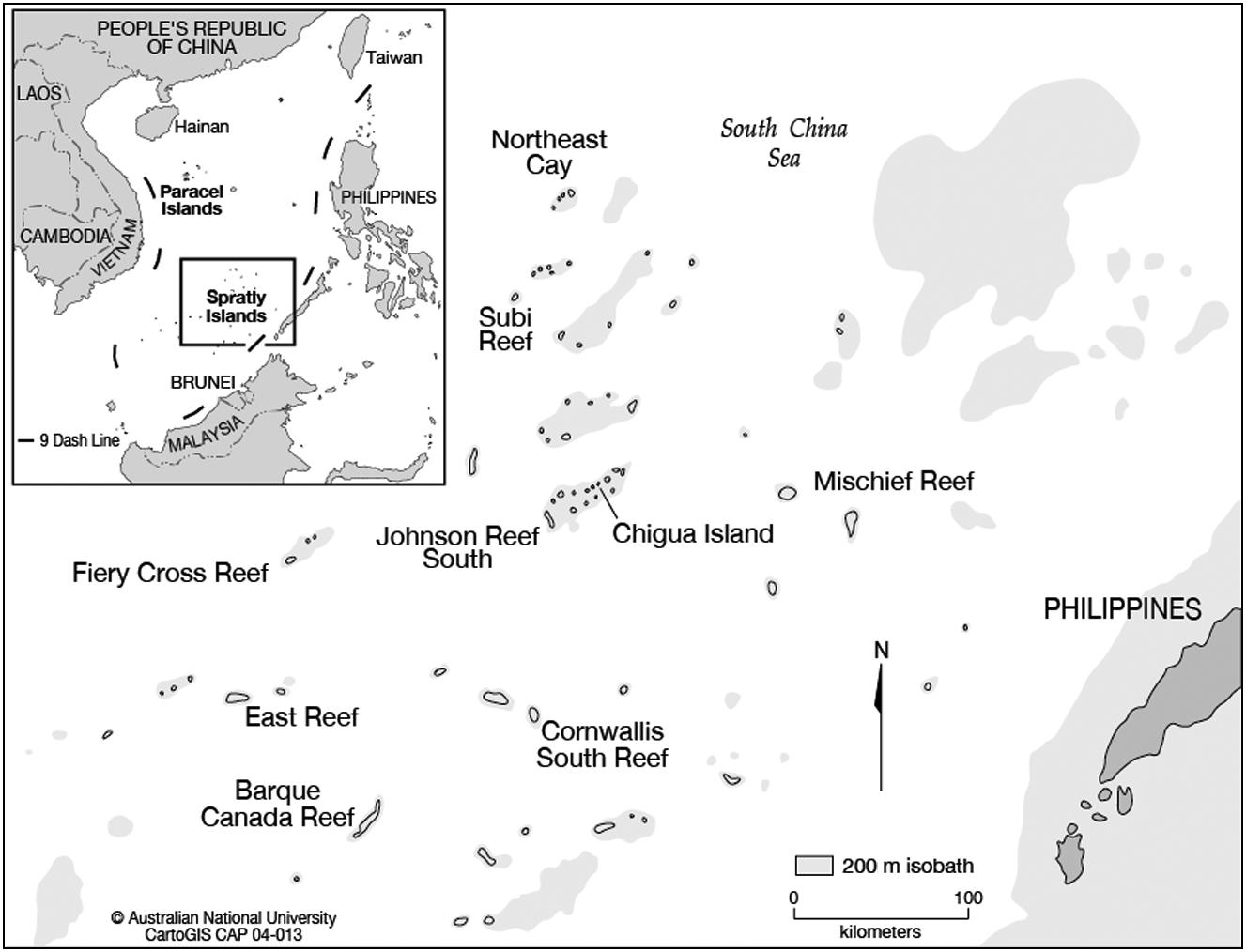
Consider, for example, the case of Mischief Reef and the ongoing dispute between China and the Philippines. Mischief Reef (Figure 1.1) is an atoll in the South China Sea, roughly 135 miles west of the Philippines. Part of the Spratly Islands, it consists of a narrow coral reef that surrounds a large lagoon. Up until a few years ago, Mischief Reef was what hydrographers and international lawyers would call a low-tide elevation, as it only rose above the level of sea during low tide. Needless to say, for most of its history, Mischief Reef has been home only to marine life and was primarily visited by fishermen. All of that began to change in the mid-1990s, however, and today the atoll lies at the center of one of the world’s
Copyright: CartoGIS Services, College of Asia and the Pacific, The Australian National University, Creative Commons License, CC BY-SA 4.0.
Figure 1.1. Mischief Reef in the South China Sea.
most contentious maritime disputes. What was once a tiny slice of earth that only poked its head above water at low tide has now been launched out of obscurity and is a serious source of international tension in the Asia-Pacific region.
While four countries— China, the Philippines, Taiwan, and Vietnam—make claim to Mischief Reef, China and the Philippines have taken the most active steps to assert control over the atoll.5 China’s claim to Mischief Reef is historical. Based upon mid-twentieth-century maps that include the so-called Nine-Dash Line, China contends that it has jurisdiction over almost all of the South China Sea. Thus, despite the fact that Mischief Reef lies over 600 miles from China’s Hainan Island and about 800 miles from the Chinese mainland, China claims that the reef is part of its territory. The Philippines, on the other hand, claims that Mischief Reef lies within its own exclusive economic zone (EEZ), a maritime area in which it has jurisdiction over the exploration and exploitation of marine resources.6 The Philippine government’s claim is based upon its interpretation of the rules for drawing international maritime boundaries laid out in the United Nations Convention on the Law of the Sea (UNCLOS). Both China and the Philippines are parties to UNCLOS, which prioritizes the type of rules-based claim made by the Philippines over historical claims. However, this international institution designed to improve cooperation does not seem to be working in this case.
In 1995, China established control over Mischief Reef by building four platforms on stilts that housed several bunkers equipped with a satellite dish, which it claimed were shelters for fishermen.7 Three years later, China expanded and fortified these structures with the support of armed military supply ships.8 Since then, China and the Philippines have engaged in on-and-off-again bilateral negotiations to try to resolve their competing claims over Mischief Reef, as well as other Spratly Islands and the nearby Scarborough Shoal, but they have not been able to reach an agreement on the matter. Similar attempts to resolve the many other overlapping, competing maritime claims of the seven countries that surround the South China Sea have also largely been unfruitful. Notably, China has been reluctant to turn issues of maritime control in the South China Sea over to a tribunal established under UNCLOS. In 2013, the Philippines decided to
5. Throughout the book, we will use the terms “China” and “Chinese” to refer to the People’s Republic of China and the terms “Taiwan” and “Taiwanese” to refer to the Republic of China.
6. An EEZ is an area in international waters in which the state has a sovereign right to all economic resources below the surface of the sea.
7. Shenon 1995; Storey 1999.
8. Zha and Valencia 2001.
take matters into its own hands and notified China that it was going to unilaterally bring its case to the Permanent Court of Arbitration (PCA). China quickly refused to participate. While the Philippine government was eager to use legal institutions to resolve this dispute, China seemed equally eager not to do so.
While the Philippines turned to the courts, China began to take more aggressive steps to expand its presence in the South China Sea. A significant part of China’s strategy involved the construction of artificial islands on its occupied features in the Spratly Islands, including Mischief Reef. In January 2015, China began dredging sand and pumping it on top of the coral at Mischief Reef while an amphibious warship patrolled the entrance to the reef’s lagoon.9 By June of that year, the Asia Maritime Transparency Initiative estimated that over two square miles of land had been already been reclaimed.10 Since then, Chinese development on Mischief Reef has moved apace, and it continues to construct more permanent facilities on the island. A three-kilometer-long runway was completed in 2016, along with several hangars for large aircraft. Additional construction projects on the island have included underground storage for ammunition, communications towers, and structures to house defensive weapons systems.11
An adverse ruling by the PCA in June 2016 hardly provided a speed bump to China’s expansionist plans on Mischief Reef. The Court ruled that the reef was a low-tide elevation before China’s reclamation efforts and thus does not generate any entitlement to a territorial sea. Moreover, the Court found that Mischief Reef lies within the Philippines’ EEZ. China, however, refused to accept the court’s ruling and continued to claim sovereignty over much of the South China Sea. Rather than taking a step back, China pushed forward with its efforts to militarize the Spratly Islands, including Mischief Reef. By mid-2018, the Chinese military had quietly installed communications jamming equipment, anti-aircraft guns, anti-ship cruise missiles, and surface-to-air missile systems on its outposts in the Spratly Islands.12
The pattern of activities on Mischief Reef mirrors similar Chinese projects on other islands in the Spratly archipelago, including Fiery Cross Reef and Subi Reef. Whether or not it had initially aimed to just build structures to provide shelter for fishermen in the mid-1990s, China has clearly moved toward a slow but steady militarization of its claimed territory in the South China Sea. Rather
9. Sanger and Gladstone 2015.
10. Asia Maritime Transparency Initiative 2015.
11. Asia Maritime Transparency Initiative 2018.
12. Macias 2018.
than accepting a legal settlement or turning to military force, China has preferred a policy of strategic delay. By delaying, China has been able to pursue a campaign of gray zone activities to expand its presence in the South China Sea. In the case of Mischief Reef, China’s strategy provides a textbook example of salami tactics. China first installed platforms on the reef, followed by the construction of an artificial island that could house larger structures and an airstrip. It is now moving forward with the installation of military weapons on the island. These steps have allowed China to gradually consolidate its control of Mischief Reef and other islands the South China Sea without sparking a major armed conflict.
Russian Expansion: A Land-Based Analogue
While China has been building islands to expand its reach into the South China Sea, Russia has pursued territorial ambitions of its own in the Black Sea region. South Ossetia is a landlocked breakaway region of north-central Georgia that borders Russia. It has little in the way of natural resources, and its citizens largely rely upon subsistence farming. In the wake of the breakup of the Soviet Union, South Ossetia declared independence from Georgia, sparking the first of a series of civil wars that Georgia suffered in the early 1990s. Since then, South Ossetia has often been described as being a “frozen conflict,” and the region has largely remained outside the effective control of the Georgian government, relying upon the support of Russia for survival. As part of the civil war peace settlement in 1992, Russia deployed a peacekeeping force to the region that has never left. In the mid-2000s, Russia gradually increased its military capabilities in South Ossetia, and during a brief five-day war in August 2008, Russian and Ossetian troops pushed out any remaining Georgian presence in the region. Later that month, Russia officially recognized South Ossetia’s independence, but very few other countries followed suit.
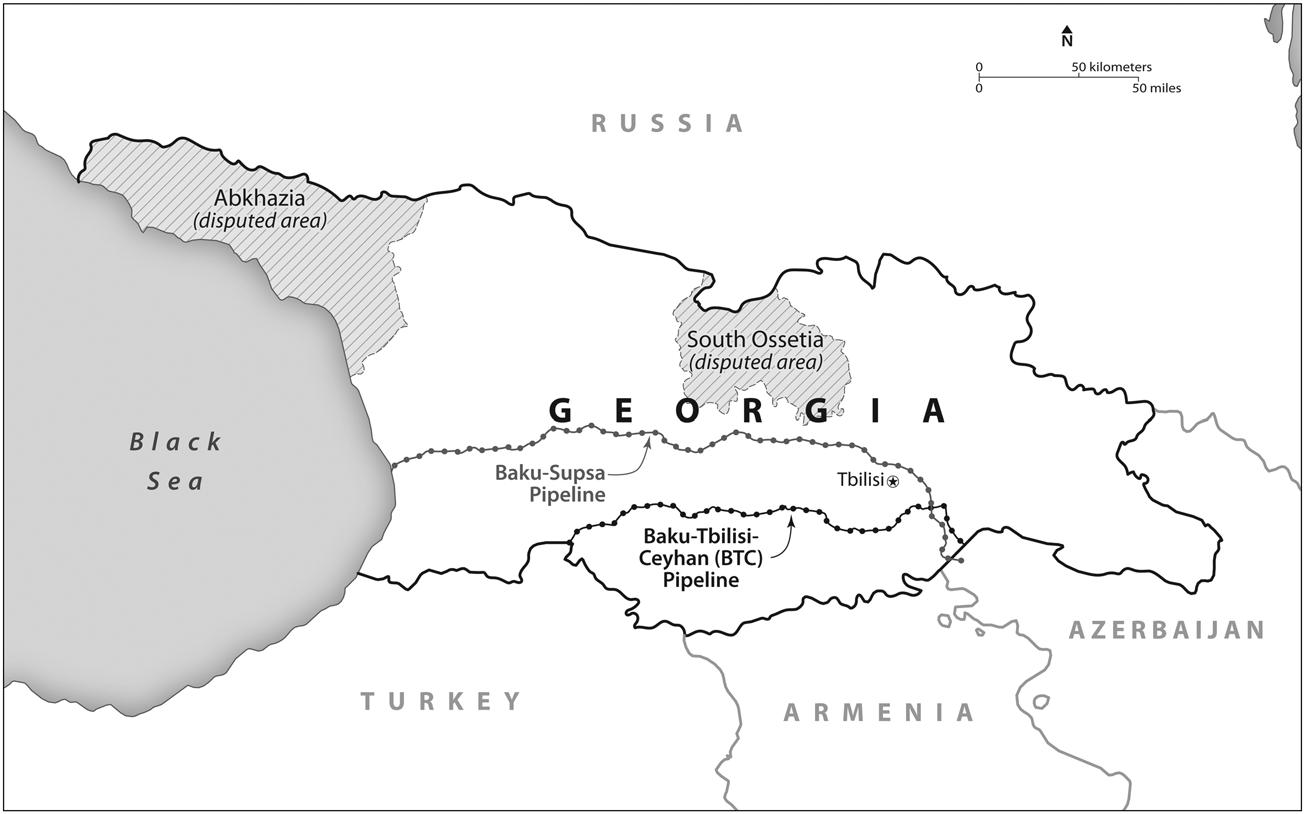
Since the 2008 conflict, Russia has continued to expand its influence in South Ossetia, as it gradually integrates the region militarily, politically, and economically with Russia. To secure the territory of South Ossetia, Russia routinely engages in a “borderization” strategy that Georgia calls a “creeping occupation.” Since South Ossetia was not a formal administrative unit of Georgia, its boundaries were not clearly defined. Thus, Russian forces have taken it upon themselves to demarcate this largely unrecognized “international” border by erecting border fences and signs. As part of the strategy, on multiple occasions since 2013, Russia has literally shifted the boundary posts of the border to expand South Ossetia’s territory. 13 For example, in a land
13. A report by the Heritage Foundation identifies ten cases of borderization from May 2013
Figure 1.2. Russia’s borderization strategy in Georgia.
grab in July 2015, South Ossetia gained access to a mile-long stretch of the Baku- Supsa oil pipeline and pushed the border to within 500 meters of the E60 highway connecting Azerbaijan and the Black Sea (Figure 1.2). Media reports indicate that residents have gone to bed thinking that their house was located in Georgia proper and have woken up finding themselves living in South Ossetian territory. 14 Slowly but surely, these Russian encroachments into Georgian territory continue unabated, despite objections from Georgia and the West.
As Russia pursues its borderization strategy in Georgia, it has also utilized unconventional methods to expand its territorial reach in another neighbor, Ukraine. Crimea is a strategically located peninsula in the northern Black Sea. Home to the Russian Black Sea Fleet and a largely Russian-speaking population, Crimea had been part of Russia from 1783 to 1954, until the Soviet Union transferred control of the peninsula to Ukraine. In late February 2014, in the midst of the Euromaidan protests in Ukraine, reports of sightings of “little green men” emerged in Crimea. These men in question were Russian-speaking armed soldiers wearing green military gear without any insignia. While it was commonly
to August 2017 that resulted in additional Georgian territory falling within South Ossetian territory (Coffey 2018).