Recognising Human Rights in Different Cultural Contexts: The United Nations Convention on the Rights of Persons with Disabilities (CRPD) 1st ed. Edition Emily Julia Kakoullis
The Egyptian Revival: Ancient Egypt as the Inspiration for Design Motifs in the West (London & New York: Taylor & Francis Group 2005)
Classical Architecture: An Introduction to its Vocabulary and Essentials, with a Select Glossary of Terms (London & New York: W.W. Norton 2003)
Piety Proclaimed: An Introduction to Places of Worship in Victorian England (London: Historical Publications Ltd. 2002)
Kensal Green Cemetery: The Origins & Development of the General Cemetery of All Souls, Kensal Green, London, 1824–2001 (edited, with various contributions from other scholars) (Chichester: Phillimore & Co. Ltd. 2001)
The Honourable The Irish Society 1608–2000 and the Plantation of Ulster. The City of London and the Colonisation of County Londonderry in the Province of Ulster in Ireland. A History & Critique (Chichester: Phillimore & Co. Ltd. 2000)
Encyclopaedia of Architectural Terms (London: Donhead Publishing 1992)
The Londonderry Plantation 1609–1914: The History, Architecture, and Planning of the Estates of the City of London and its Livery Companies in Ulster (Chichester: Phillimore & Co. Ltd. 1986)
The Life and Work of Henry Roberts (1803–76), Architect: The Evangelical Conscience and the Campaign for Model Housing and Healthy Nations (Chichester: Phillimore & Co. Ltd. 1983)
A Celebration of Death. An Introduction to some of the buildings, monuments, and settings of funerary architecture in the Western European tradition (London: Constable & Co. Ltd. 1980)
The Erosion of Oxford (Oxford: Oxford Illustrated Press Ltd. 1977)
City of London Pubs: A Practical and Historical Guide (with Timothy M. Richards) (Newton Abbot: David & Charles [Holdings] Ltd. 1973)
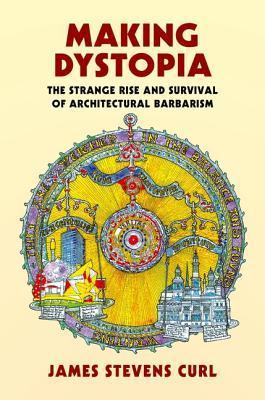
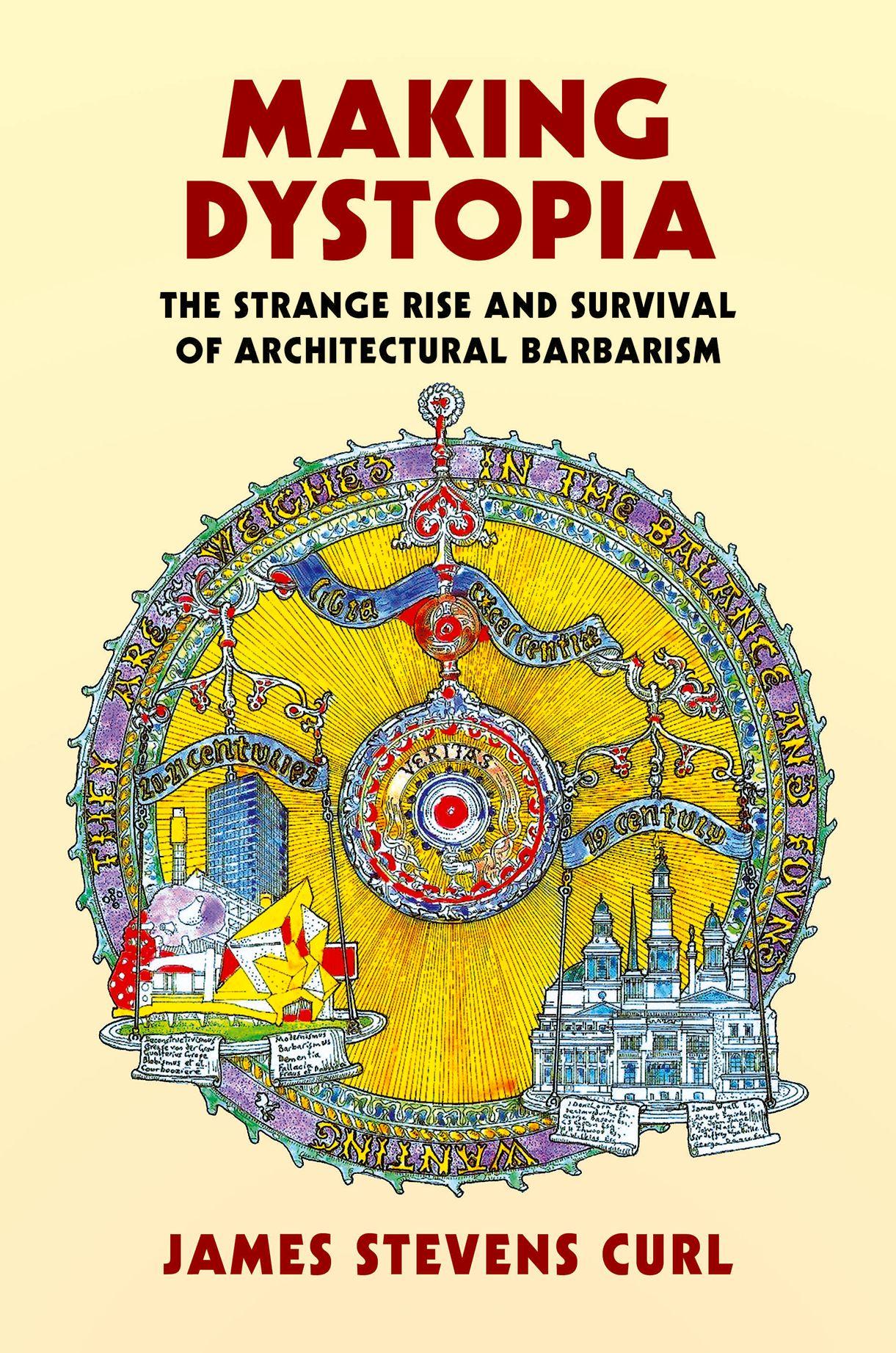
MAKING DYSTOPIA
Th e Strange Rise and Survival of Architectural Barbarism
JAMES STEVENS CURL
with a Prolegomenon by Timothy
Brittain-Catlin
1
Great Clarendon Street, Oxford, ox2 6dp, United Kingdom
Oxford University Press is a department of the University of Oxford. It furthers the University’s objective of excellence in research, scholarship, and education by publishing worldwide. Oxford is a registered trade mark of Oxford University Press in the UK and in certain other countries
All rights reserved. No part of this publication may be reproduced, stored in a retrieval system, or transmitted, in any form or by any means, without the prior permission in writing of Oxford University Press, or as expressly permitted by law, by licence or under terms agreed with the appropriate reprographics rights organization. Enquiries concerning reproduction outside the scope of the above should be sent to the Rights Department, Oxford University Press, at the address above
You must not circulate this work in any other form and you must impose this same condition on any acquirer
Published in the United States of America by Oxford University Press 198 Madison Avenue, New York, NY 10016, United States of America
British Library Cataloguing in Publication Data
Data available
Library of Congress Control Number: 2017959394
ISBN 978–0–19–875369–8
Printed and bound by CPI Group (UK) Ltd, Croydon, cr0 4yy
Links to third party websites are provided by Oxford in good faith and for information only. Oxford disclaims any responsibility for the materials contained in any third party website referenced in this work.
AdfG
Gratia, Musa, tibi: Nam tu solacia praebes
Tu curae requies, tu medicina venis . . .
PUBLIUS OVIDIUS NASO (43 bc-c.ad 17): Tristia iv x 117–18
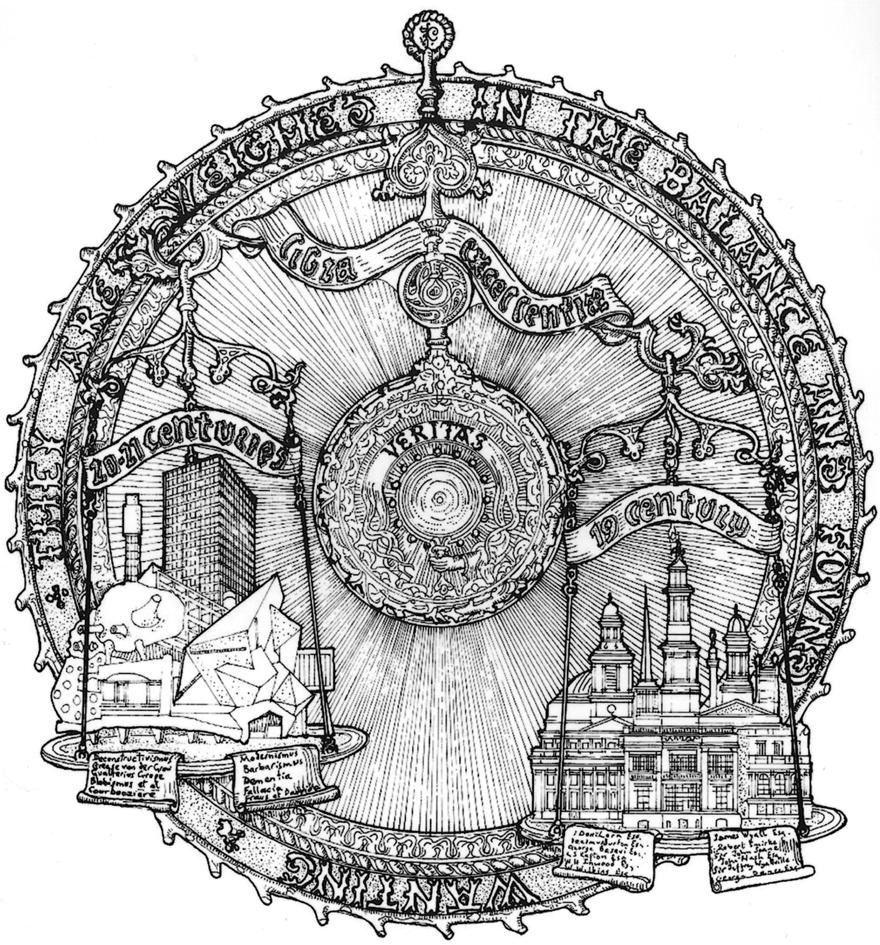
Frontispiece They are Weighed in the Balance and Found Wanting: with respectful apologies to A.W.N. Pugin. An assortment of structures, including an International-Style tower resembling a pile of sandwiches, a tortured piece of Deconstructivism, some Blobism, pilotis, a sub-Corbusian block, and other familiar Modernist elements, is weighed against a selection of Classical works of architecture by John Nash, Robert Smirke, and others, and found unworthy
Contents
Prolegomenon ix
by Timothy Brittain-Catlin
Advance praise for Making Dystopia xiii
List of Plates xv
List of Figures xix
Preface & Acknowledgements xxi
Essence of the Argument; Afterword & Acknowledgements
I. Origins of a Catastrophe 1
Introduction: A Few Definitions; The Modern Movement; A Strange Aberration; Pugin, the Ruskin Problem, Perils of Uncritical Acceptance, & Some Perceptive Critics; Hermann Muthesius; Harry Kessler, van de Velde, & Weimar; The Deutscher Werkbund; The Werkbund Exhibition, Cologne, 1914; Epilogue
II. Makers of Mythologies & False Analogies
Introduction;Voysey as a Pevsnerian ‘Pioneer’; Further Objections to the Pevsnerian Position; Baillie Scott; The Religious Factor; Unfortunate Treatment of Berlage, Comper, & Dykes Bower
49
III. Modernism in Germany in the Aftermath of the 1914–18 War 87
Introduction: Expressionist Interlude; The Bauhaus at Weimar; The Bauhaus at Dessau; A Department of Architecture at Dessau; Epilogue
IV. The International Style 1920s & 1930s 121
Introduction: The Transformation of Ludwig Mies; The Weißenhofsiedlung, Stuttgart; The Strange Case of Erich Mendelsohn; Later History of the Bauhaus at Dessau & Berlin; Epilogue
V. The International Style Truly International 171 Impresarios of the International Style; The Style Becomes Widely Accepted Outside Germany: Czechoslovakia, The Soviet Union, Hungary, Poland, Belgium, Brasil, Scandinavia, United States of America, Switzerland, The Netherlands, Austria; France & ‘Le Corbusier’; Fascist Italy & The International Style: A Problem for Apologists; Early Modernism in England
VI. Universal Acceptance of the International Style: A Surprising Aftermath of 1945
217 The Style Established; Not All Were Convinced; The Situation from 1945; A Curious Shift; Transformation & Acceptance
VII. Descent to Deformity
247 Revolution in Architecture & Planning; Destructive & Unwholesome Events in Britain from 1945; Philip Johnson: ‘Sourcerer’ & Tastemaker
VIII. Dangerous Signals
293 Alleged Demise of Modern Architecture; Imposition, Packaging, Deformation, & Rejection; Deconstructivism & After; Cults, Compounds, & the Grand Narrative; A Religious Dimension; 9/11 & Other Uncomfortable Matters; Epilogue
IX. Some Further Reflections
327 Something Was Missing; Measurable & Unmeasurable Aspects; High & Mass Culture; A Pessimistic Future?; Royal Intervention; Coda
X. Epilogue 361 Loss of Meaning; The Failure of Architectural Education; Suggested Reforms of Architectural Education; Hubris: The End of Architecture?; Afterword: Nemesis
Prolegomenon
It is a foolish thing to make a long prologue, and to be short in the story itself.
Apocrypha ( Before ad 70): ii Maccabees ii 32
This revealing and well-argued book is about a cultural and environmental Catastrophe, a process by which the accumulated knowledge of expertise in construction and ornament that architects used to pass on from one generation to the next in the West over many centuries was abandoned after the First World War. There had been previous periods of rise and fall in construction standards—many of the decorative applied arts in building had been forgotten in Britain before A.W.N. Pugin and the Puginites revived them in the 1840s—but this Catastrophe was something new: it was the result of a divisive and active campaign to destroy knowledge and a practicebase, perpetrated mainly by people who were not only members of peculiar cults and held extreme (and wildly swinging) political convictions, but who had, for the most part, limited design skills. Walter Gropius, it emerges from the author’s researches, is unlikely to have designed singlehandedly any of the works conventionally attributed to him, and Le Corbusier appears to have been associated with Fascist sympathies, but found the collaborationist Vichy régime in France uncongenially liberal for his tastes.
However, it cannot be doubted, as the author acknowledges, that experimental architecture after 1918 varied tremendously in quality and content. Some of the best-known Western buildings of that period, such as the Bauhaus complex at Dessau (completed 1926) and the Villa Savoie at Poissy (1928–31), inspired many as forms of inhabited sculpture (so long as they were well maintained and the weather was good). Furthermore, there were buildings by Miës van der Rohe, as he was known in the 1920s and 1930s, that brought aesthetic gratification to some, whilst at the same time, according to Detlef Mertins’s recent study,1 were intended to represent the ideas
of the philosopher of religion, Romano Guardini, by imposing an external visual ‘order’ onto the various demands of what were then modern building programmes. However weird and unpleasant Le Corbusier was as a person—and he was evidently both of these—his wildly original sculptural buildings such as the pilgrimage chapel of Notre-Dame-du-Haut, on its isolated site at Ronchamp, near Besançon, on the edge of the Jura mountains in France (1950–5), are known to have had, and continue to have, strong effects on people, perhaps in part because of their disruptive effect on their immediate surroundings. Many who grew up in dismal architectural environments felt elevated by their first encounters with Modernist pavilions in gardens, festivals, or on the beach, which instilled a lifelong love of bright, cheery spaces.
But the Catastrophe is not that experimental architecture existed at all: it is that eventually any kind of architecture that deviated from the style of one or other of its most famous and warring protagonists was gradually dismissed by critics and by fashionable people.The results of this were extreme, and absurd, and the examples many. The ‘architecture’ section of the Thirties exhibition at the Hayward Gallery in London (1979) consisted only of a handful of freak Modernist buildings;2 architectural historians would not be taken seriously if they deviated from a dogmatic Modernist line; young architects were for a period no longer taught the primacy of construction method and the basic organization of form; historical references in buildings were abandoned entirely, for irrelevant reasons; pseudo-scientific processes were introduced all over the place, no more useful than phrenology in its day; a kind of crude simplistic aesthetics was applied to the detailing and shape of huge buildings that demanded much more to make their bulk acceptable; ornament was jettisoned almost completely, apart from an unrelated high-art panel or a sculpture arbitrarily added here and there; and the language used to describe new buildings became declamatory, abusive, moralistic, and above all, unconnected with the experiences of most people who had to use them.
Architects are not good at describing what they are doing; they tend to cling on to what they hear, especially from their potential clients. All creative artists therefore need critics if they want to make a public case for their work, but the puritanical streak in Anglo-Saxon culture is perpetuated by the fact that, generally speaking, the eloquence of cheap literary style is taken more seriously than costly aesthetics. Thus loquacious critics from John Ruskin to Reyner Banham exerted short-term influence apparently
greater than that of the designers they championed. There was a debate some years ago about whether the then Lord Chancellor should have decorated his rooms in the Palace of Westminster with revived Pugin wallpaper at public expense: we all heard from prim commentators about the supposed disgrace of ‘wasting public money’, but that Pugin was one of the most creative designers Britain has ever seen, which in turn led to a flowering of design and, not least, the employment of many talented craftsmen, was something ignored. The argument often resurfaces when critics who see themselves as ‘progressive’ or ‘left-wing’ discuss the future of abandoned country houses; the impression is that they would rather see such buildings burn down than be restored or recreated for other uses, no matter how rich their history, or the fact that they often stand as the only records of the hardworked people who invested their life-skills in designing, constructing, and decorating them. And this burning down of the house is what the Catastrophe brought about.
The Catastrophe has had a major and long-lasting impact on the way in which architecture is taught: one can still witness its terrible effects at first hand. One phenomenon that never ceases to astonish is when students, not even twenty years old, justify their design for a white-rendered block of a building with long horizontal windows as ‘modern’ or even ‘contemporary’ when in fact it would have been familiar or even old-fashioned to their great- or even great-great-grandparents. Far worse is the habit of using affected, poisonous, bullying language at public critiques of student work, which seems to have emerged from banter between tutors at the Architectural Association and, earlier, at Harvard (Marcel Breuer finally walked out on his mentor Walter Gropius after one of these).3 There may have been occasional humour in some of these early performances, but, as the method filtered down to reach every critique in every architectural school across the Western world, their entertainment value somewhat palled. Thus it came about that, for at least a couple of decades towards the end of the twentieth century, discussion at critiques of students’ work focused more on whether the young designer had fallen in line with the mesmeric appeal of their tutors’ current fashionable preoccupations—political, social, or whatever they were—than on the construction, or tradition, or even simply the visual appeal of the project in hand.
It was and it remains a mystery to me how this approach—the direct, unadulterated progeny of the Catastrophe, completely unrelated to design, to material, to spirit, to anything positive at all—has a useful rôle to play in
architectural education. The world has changed a lot since then, but this particular mine of bombastic aggression has probably not yet been exhausted. A short film posted to YouTube in August 2008 shows one of the world’s most celebrated architects humiliatingly laying into a student’s work in a way that viewers have described as rude, self-righteous, and narcissistic.4 Where did this nonsense come from?
This book offers a scholarly and passionate analysis of the whole unfortunate and destructive process, written by a distinguished architectural historian, one of the very few whose authority, accuracy, and incisiveness are beyond question in every subject he addresses.
Timothy Brittain-Catlin
Broadstairs Kent
Summer 2017
Advance praise for Making Dystopia
‘This brilliant text is a timely marvel… Making Dystopia is unquestionably a major contribution to the history of architecture and quite possibly the most important publication in Stevens Curl’s enormously prodigious oeuvre.’
Frank Albo, Adjunct Professor of History, University of Winnipeg
‘A milestone in architectural history… this marvellous book suggests that study of the past (denied in Modernist ideology) can liberate the present from what has been a damagingly restrictive straitjacket.’
Nikos A. Salingaros, Professor of Mathematics, University of Texas at San Antonio
‘Making Dystopia, the most gripping and complete account of how architecture and urban planning were corrupted in the twentieth and twenty-first century leading to a catastrophic deterioration of the built environment, is a brilliant, thoroughly researched, and completely novel book… This book, surely the greatest of the many written by Professor Stevens Curl, should be read by staff and students in all schools of architecture who are still pursuing destructive, irrelevant, outdated paths, as well as by everyone concerned about the erosion of civilisation itself.’
David Watkin, Emeritus Professor of the History of Architecture, University of Cambridge
‘This is a coruscating, driven, and passionately committed book which should be read by anyone who believes that a house is more than a machine for living.’
Katharine Wilson, author of Fictions of Authorship in Late Elizabethan Narratives: Euphues in Arcadia
2.7 Front of the remains of the mansion of Sir Paul Pindar, Bishopsgate, London (photograph of 1878 by the Society for Photographing Relics of Old London, London Metropolitan Archives, ref. no. Collage 25737 [q231873x] ) 62
3.3 Auerbach house, Jena, by Gropius & Meyer ( from Wattjes [ed.] [1927] 105, Collection JSC) 117
4.1 Design by Kreis for a war-memorial in Norway (from Troost ii [ed.] [1943] 12, Collection JSC) 124
4.2 Testing-hall of the former Heinkel aircraft-factory, Oranienburg (from Troost [ed.] ii [1943] 75, Collection JSC) 136
4.3 Apartment-block based on designs by Bruno Taut, Berlin-Zehlendorf (photograph c.1935 by Otto Hagemann, GEHAG Collection, Zehlendorf VII–VIII, No. 2246, Bauhaus-Archiv, Museum für Gestaltung, Berlin) 137
4.4 Corner of the Mossehaus, Berlin, by Mendelsohn (from Hegemann [1929] 221, Collection JSC) 140
4.15 Villa Stroß by Thilo Schoder (from Wattjes [ed.] [1927] 133, Collection JSC) 154
4.16 Housing at Hermsdorf, Thuringia, by Schoder (from Wattjes [ed.] [1927] 130, Collection JSC) 155
4.17 Letter from Miës van der Rohe to the Prussian Academy of Arts, 1937 (Akademie der Künste, Berlin, Archiv der Preussischen Akademie der Künste, PrAdK 1106 p. 37) 164
4.18 Autobahn service-station by Hofer & Fischer (from Troost [ed.] i [1942] 103, Collection JSC) 165
4.19 Assembly-hall, Heinkel aircraft-factory, Oranienburg, Brandenburg, by Rimpl & Bernard ( from Troost [ed.] ii [1943] 73, Collection JSC) 166
4.20 Opel works, Brandenburg-an-der Havel, by Bärsch ( from Troost [ed.] i [1942] 113, Collection JSC) 166
4.21 Accommodation for workers, Nuremberg, by Albert Speer ( from Troost [ed.] ii [1943] 86, Collection JSC) 167
7.6b The former City Terminus Hotel, Cannon Street Station, London (London Metropolitan Archives, City of London. Collage: The London Picture Archive No. 320138) 281
7.7 Portico of the Pazzi Chapel, Santa Croce, Florence (Collection JSC) 287
Essence of the Argument; Afterword & Acknowledgements
The preface is the most important part of the book . . . Even reviewers read a preface.
Philip Guedalla (1889–1944): ‘Conversation with a Caller’ in The Missing Muse: and Other Essays (London: Hodder & Stoughton 1929) viii
Should you, my LORD,5 a wretched Picture view; Which some unskilful Copying-Painter drew, Without Design, Intolerably bad, Would you not smile, and think the Man was mad? Just so a tasteless Structure; where each Part Is void of Order, Symmetry, or Art: Alike offends, when we the Mimick Place; Compare with Beauty, Harmony, or Grace. 6
Robert Morris (1703–54): The Art of Architecture, a Poem. In Imitation of H orace ’ s Art of Poetry (L ondon: R D odsley 1742) 7
Essence of the Argument
This is not a history of Modernism8 in architectural or urban design. The term presents difficulties of definition, and it is probably easier to think of it as opposed to academicism, historicism, and tradition, embracing that which is self-consciously new or fashionable, with pronounced tendencies towards abstraction. The word was used from the 1920s to suggest the new architecture from which all ornament, historical allusions, and traditional forms had been expunged: promoted by architects such as Miës van der Rohe, Le Corbusier, and Walter Gropius, it had ‘flat’9 roofs, plain, smooth, white rendered walls, long horizontal strips of window, some sort of frame construction so that external and internal walls were non-structural, and often depended on factory-made components (see Figures 4.2, 4.4, 4.5, 5.1, 5.2).
Indeed there would be a ‘general consensus’ regarding what can be ‘readily identified’ as Modernist buildings that began to appear shortly after the end of the 1914–18 war,10 and that, despite denials they were in any ‘style’, their progeny continued to proliferate well into the 1970s. Stylistically recognizable, often with ‘curtain-walled’ façades (see Figure 6.4), such buildings were representative of what became known as the ‘Modern Movement’ in architecture, more specifically of what was termed ‘The International Style’,11 so called because its protagonists insisted it must be applied globally, no matter what were local conditions of climate, skills, industrialization, traditions, culture, or much else, for that matter.
Nor is this study an attack on that Modern Movement in architecture as such. There were certain aspects of Modernism, such as the liberation of rooms from being boxes and experiments in the flowing of one internal space into another (made easier by structural innovations), that were positive, but there was a coercive, dogmatic side to it (especially in the pronouncements of Le Corbusier and his followers) that was unattractive, and that has led to a great deal of bad architecture and disruptive interference with old-established urban fabric. It questions some of the means by which the Modern Movement in architecture and town planning became not only accepted, but virtually compulsory, the only ‘appropriate’ way of designing buildings and urban structures, according to its devotees, after 1945.12 It assumes in the reader a smattering of knowledge concerning the subject, otherwise the volume would have to be very much larger than it actually is.
The aims of this book are to attempt to explain, expose, and outline the complex factors13 that have managed to create so many Dystopias in which, arguably, an ‘architecture’ devoid of any coherent language or meaning has been foisted on the world by cliques convinced they knew or know all the answers, yet demonstrated or demonstrate an incompetence with buildings that fail as architecture at almost every level and by almost every criterion. It became clear many years ago that all was not well, and that enormous damage had been done to cities, towns, and the countryside, and was continuing, backed by spurious arguments and questionable posturings, including the central tenet of Modernism that tradition was dead (it was Modernism which did its best to kill it, and put enormous numbers of craftsmen out of a job).
Osbert Lancaster’s Pillar to Post: English Architecture without Tears14 first appeared in 1938, followed in 1939 by Homes Sweet Homes: 15 consisting of cleverly economical drawings, each opposite a page of pithy text. These volumes describe styles with clarity and wit. Together, they comprise what is
probably the best and most succinct textbook on architecture ever published, even though the author, in the Foreword to Pillar and Post, entitled ‘Order to View’, opens with a disclaimer: the ‘book is not a text-book’16 at all. A great satirist, Lancaster knew exactly when something was both true and untrue. He used irony (something clearly beyond the comprehension of Le Corbusier and other Modernists) with devastating effect, at the same time pointing out that everything built is architecture (in contrast to the questionable and dogmatic positions adopted by Sigfried Giedion, Nikolaus Pevsner, John Ruskin, and others). Moreover, Lancaster demystified architecture, and, by so doing, enabled everybody uncowed by the pretensions of aggressive architectural critics to have opinions of their own about the subject. He deplored the establishment of critical ‘compounds’17 and obfuscatory ‘specialist’ language that excluded normal people from all debate about their surroundings in daily life. He even had the temerity, having worked for a time (from 1934) as an assistant editor at The Architectural Review, to refer to the outpourings of certain enthusiasts of the Modern Movement as ‘that Bauhaus balls’.18
In 1949, Lancaster brought out Drayneflete Revealed, 19 in which he showed that of all ideologies which threatened British urban and rural landscapes, the most destructive was that of Corbusianity (ubiquitous worship of the Swiss-French architect, C.-É. Jeanneret-Gris, who from c.1920 pretentiously called himself ‘Le Corbusier’), as the hearts were torn out of countless towns and cities in the dubious name of ‘progress’. People were condemned to an unpleasant existence in badly designed and built high-rise blocks of flats and to rat-runs of dark, smelly, threatening underpasses, leaving what was left of the earth’s ruined surface to motor traffic. Drayneflete chronicled the historical evolution and final wrecking of an English town from prehistoric times to its terrible demise (‘The Drayneflete of Tomorrow’)20 as a Modernist Dystopia dominated by roads and tower blocks on pilotis, with only four old buildings ludicrously ‘preserved’ as ‘Cultural Monuments’ (one marooned on a traffic roundabout) (Figure P.1). The Corbusian device of piloti (one of several piers supporting a building above the ground), which elevated the lowest floor to first-floor level, leaving an open area below, was widely adopted, and resulted in countless unpleasant spaces.21 Drayneflete’s remaining fabric was completely obliterated to create an inhumane environment of empty, stupefying, memoryless banality, devoid of beauty or anything uplifting to the spirit: its succinctly observed fate, as recorded by Lancaster in his wonderful book, sums up what happened up to 1949 and was to happen in
Figure Preface P.1. ‘The Drayneflete of Tomorrow’. Osbert Lancaster’s vision of an English Town with virtually everything of its old fabric obliterated, apart from: ‘Poet’s Corner’; the former stately home of the Littlehamptons, now serving as a Lunatic Asylum, set in its Park; the parish church with all traces of its burial-ground obliterated; and the gateway to the former Augustinian Priory marooned on a traffic-island. Nothing resembling a traditional street remains: Le Corbusier had decreed streets should be abolished
Key to Illustration
Top:
A: Cultural Monument scheduled under National Trust (‘Poet’s Corner’)
B: Gasometer
C: Clover-leaf Crossing and Bridge
D: Communal Housing-Block on pilotis
E: Lunatic Asylum and Littlehampton Memorial Park
F: Cultural Monument scheduled under National Trust
G: Municipal Offices including Community Centre, Psychiatric Clinic, Crèche, and Helicopter Landing-Strip on the Roof
H: Housing-Estate for Higher-Income Brackets
I: Communal Sports-Centre,Yacht-Club, and Football-Ground
J: Floating Concert-Hall for Audience of 2,500 and full Symphony Orchestra
K: Power-Station
Bottom:
A: Communal Housing-Blocks on pilotis
B: High-Level Pedestrian Road Bridge
C: Cultural Monument scheduled under National Trust
D: People’s Restaurant, Swimming-Club, Bathing-Pool, Cinema, and Amenities Centre
E: Underground Station
the next three decades, as Modernists enforced ‘a monopoly of uglifiers’,22 as Sir Roger Scruton has aptly put it.
As each year passes, so-called ‘iconic’23 erections become more and more bizarre, unsettling, outrageous, incredibly expensive, and wasteful, ignoring established contexts, destroying townscapes, and cutting across old-established geometries and urban grain. If these represent a ‘new paradigm’, as some have claimed,24 then an unpleasant future for a Dystopian universe is assured. This is especially true as something resembling gross irresponsibility was manifest in London,25 where the property bubble was being inflated to obscene dimensions at the expense of social cohesion at the time this study was being written. When cities become dominated by enormously wasteful ‘icons’ and affordable housing lies beyond the reach of most people, the development of shanty-towns around them is more than likely.
Such models exist elsewhere in the world where Modernists were given free rein. Brasília, Federal Capital of Brasil, designed (1956–7) by the ‘left-wing’ Modernists Oscar Niemeyer and Lúcio Costa,26 encapsulated many principles laid down by the Congrès Internationaux d’Architecture Moderne (CIAM) in Le Corbusier’s Athens Charter:27 these included demands for ‘autonomous sectors’ for four major ‘functions’ of cities, and thus enshrined the notion of rigid zoning in urban planning widely adopted for urban reconstruction after the 1939–45 war with disastrous results. The plans for Brasília were praised to the skies in Modernist architectural circles when they were first revealed, but the place has not worn well.28 It is completely lacking in human scale. Dominated by the motor-car,29 it has dated painfully, with a handful of large official ‘iconic’ buildings as its centre, but around it satelliteand shanty-towns in the outskirts have proliferated. Exacerbation of this trend on a global scale can only lead eventually to social disintegration and ungovernable violence.
The world has already experienced several manifestations of extreme anger against aspects of Western life not unconnected with architecture.The prognosis is not encouraging, as, almost daily, Modernist architects inflict damage on the already weakened fabric of cities that have been subjected to nearly a century of ideological tinkering, and even export their outlandish computer-generated Parametricist30 fancies to places where their incongruities insult and contribute to the wrecking of what survives of indigenous cultures. Parametricism owes its origins to digital animation techniques. It implies that all elements and aspects of an architectural composition are parametrically malleable, and makes unprecedented use of computational