Studies in Musical Genesis, Structure, and Interpretation
Terry Riley’s In C
Robert Carl
Beethoven’s Diabelli Variations
William Kinderman
Beethoven’s “Appassionata” Sonata
Martha Frohlich
Richard Strauss’s Elektra
Bryan Gilliam
Wagner’s Das Rheingold
Warren Darcy
Beethoven’s Piano Sonata in E, Op. 109
Nicholas Marston
Mahler’s Fourth Symphony
James L. Zychowicz
Vaughan Williams’s Ninth Symphony
Alain Frogley
Debussy’s Ibéria
Matthew Brown
Bartok’s Viola Concerto
Donald Maurice
Mendelssohn’s “Italian” Symphony
John Michael Cooper
Berg’s Wozzeck
Patricia Hall
Wagner’s Parsifal
William Kinderman
Webern and the Lyric Impulse
Anne C. Shreffler
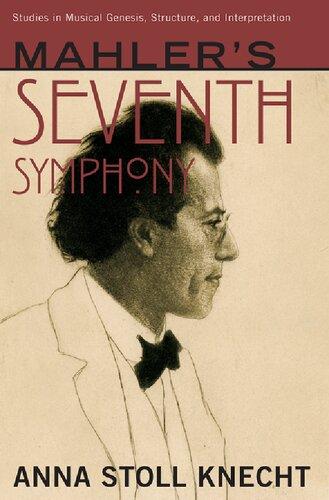
Mahler’s Seventh Symphony
Anna Stoll Knecht
ANNA STOLL KNECHT
MAHLER’S SEVENTH SYMPHONY
1
Oxford University Press is a department of the University of Oxford. It furthers the University’s objective of excellence in research, scholarship, and education by publishing worldwide. Oxford is a registered trade mark of Oxford University Press in the UK and certain other countries.
Published in the United States of America by Oxford University Press 198 Madison Avenue, New York, NY 10016, United States of America.
All rights reserved. No part of this publication may be reproduced, stored in a retrieval system, or transmitted, in any form or by any means, without the prior permission in writing of Oxford University Press, or as expressly permitted by law, by license, or under terms agreed with the appropriate reproduction rights organization. Inquiries concerning reproduction outside the scope of the above should be sent to the Rights Department, Oxford University Press, at the address above.
You must not circulate this work in any other form and you must impose this same condition on any acquirer.
Library of Congress Cataloging-in-Publication Data
Title: Mahler’s Seventh symphony / Anna Stoll Knecht.
Description: New York, NY : Oxford University Press, 2019. | Series: Studies in musical genesis, structure, and interpretation | Includes bibliographical references and index.
Identifiers: LCCN 2018045906 | ISBN 9780190491116 (hardcover : alk. paper) | ISBN 9780190050573 (epub)
Classification: LCC ML410 .M23 K64 2019 | DDC 784.2/184—dc23 LC record available at https://lccn.loc.gov/2018045906
9 8 7 6 5 4 3 2 1
Printed by Integrated Books International, United States of America
This volume is published with the generous support of the AMS 75 PAYS Endowment of the American Musicological Society, funded in part by the National Endowment for the Humanities and the Andrew W. Mellon Foundation.
The Oxford series Studies in Musical Genesis, Structure, and Interpretation extends back to 1985, when Philip Gossett’s landmark volume on Donizetti’s Anna Bolena was published. Since then, each volume in the series has sought to elucidate the detail of musical creation in a single work by a major composer. Originally, this activity was more concentrated on the relationship between genesis and the final structure of the work. From around the turn of the millennium, however, the series expanded its purpose to include issues of interpretation, with a view to placing individual works within a continuum not just from sketch to score but also on to premiere and subsequent reception. Under Lewis Lockwood’s founding editorship, the Genesis series looked primarily to Romantic-era works, while since then it has embraced many key compositions of the twentieth century, and looks forward soon to embrace questions of genesis, structure, and interpretation within the digital world of the twenty-first century.
In this book Anna Stoll Knecht’s subject is Mahler’s “Cinderella” symphony, his “jubilant” Seventh, often considered a poor cousin to the “tragic” Sixth. Stoll Knecht provides a powerful addition to all aspects of the Genesis series’s purposes. To the study of musical genesis she brings a strong focus on “discarded” materials. While so many sketch studies are mainly concerned with showing how early ideas developed into the content of the ultimate piece, Stoll Knecht shows how materials that were discarded between sketch and final score often play a crucial role in explaining Mahler’s compositional process. In her analyses she draws particular attention to the relevance of the world of theater and circus to this symphony, and thereby asserts the “profound nature of theater, using fiction and humor, to expose truths.” She warns, in her Conclusion, that “a reconstruction of a work’s genesis . . . [offers] a picture that does not necessarily correspond to an assessment of the finished work.” Her study is, as well, a major contribution to vexed questions of interpretation: what does the Seventh tell about Mahler’s reception of Wagner, and not just in the Symphony’s triumphalist Finale? Is the Seventh Symphony a sequel to, or rather a companion of, the Sixth?
Stoll Knecht’s volume is the first in this series to turn the series template so thoroughly on its chronological head. Most Genesis studies begin with a dutiful chronicling of genetic materials, and over time relate this genetic account to their analyses of the published work; they then go on to
address some aspects of interpretation, whether in performance, publication, recording, legalities, or audience reception. Stoll Knecht begins her chapter roll-call, however, with the work’s premiere and reception (Chapter 1), and the first movement she subjects to detailed investigation is the work’s RondoFinale (Chapters 4 and 5), while the last (and last completed) movement she accounts for is the first (Chapter 8). Hence, my suggestion that a reader of this volume might well follow suit, and choose first to read her concise Conclusion, which begins with the enticing quotation: “Mahler is a Shakespearean clown” (William Ritter). There, in a few pages, she explains what she sees as this book’s contributions to Mahlerian knowledge, as well as to the essential purposes of the Genesis series. Then, with this summary tutorial in beginnings and endings firmly in mind, it is time for your reading to begin, at the book’s beginning.
No study of musical genesis can exist today without sustained reference to materials held in archives and libraries across the world. A small portion of those relevant materials can appear in the volume itself, with appropriate acknowledgment, but many more materials cannot be made available within the confines of this single book. They are, however, still very important in understanding the wider context of its contents, hence, the occasional footnote references to external repository websites, as well as to the many materials that are placed upon Oxford University Press’s web pages that accompany this book.
Malcolm Gillies Australian National University King’s College London
ACKNOWLEDGMENTS
A great number of individuals and institutions provided support during the writing process. Postdoctoral fellowships from the Swiss National Science Foundation (2014–2015) and the British Academy (2015–2018) allowed me to complete the book. Along with a non-stipendiary Junior Research Fellowship (2015–2018), Jesus College in Oxford offered the best working conditions I could ever dream of. My thanks also go to the Claire and Barry Brook Endowment of the American Musicological Society (partly funded by the National Endowment for the Humanities and the Andrew W. Mellon Foundation) for the AMS Publication Subvention 2016 that covered the costs of facsimiles reproduction.
I am particularly grateful to Suzanne Ryan at Oxford University Press, who provided invaluable advice and feedback along the road, to Victoria Kouznetsov for her editorial work; and to the series editor Malcolm Gillies, who had the patience to work with me all the way to help me improve the manuscript, and whose steady support was critical in moments of discouragement. My anonymous reviewers offered insightful comments, which proved useful at each stage of the “compositional process.”
Special thanks are due to my successive PhD advisors and postdoctoral mentors, in New York and Oxford: the late Robert Bailey, Michael Beckerman, Laurence Dreyfus, and Laura Tunbridge. They all helped more than they know, by accompanying me through the difficult task of beginning and finishing a book. Stanley Boorman has been another mentor during my years of apprenticeship at New York University. Other friends and colleagues generously took time to read and comment on selected chapters: Barry Millington, Peter Davison, Peter Franklin, Stephen Hefling, Julian Johnson, William Kinderman, Seth Monhanan, Marilyn McCoy, Vera Micznik, Thomas Peattie, Friedemann Sallis, Lola San Martin, and Merel van Tilburg. My thanks to Lukas Beck, Katinka Urbanovici, and Yasha Knecht for their editing work.
Peter Poltun opened the secret door of the music archive in Vienna, always ready to talk about Mahler, Wagner, and manuscripts, and making me feel at home at the Staatsoper. Christiane Mühlegger-Henhapel and Lydia Groebl at the Theatermuseum, Thomas Leibnitz at the Österreichische Nationalbibliothek, Thomas Aigner at the Wienbibliothek im Rathaus, Renate Stark-Voit and Severin Matiasovits at the Internationale Gustav
Mahler Gesellschaft, and Robert Kaldy-Karo at the Circus & Clown Museum Vienna granted me access to their material and offered advice when needed. Special thanks to Stefan Buchon and Renate for helping me read Mahler’s handwriting and sharing Viennese beer.
In Paris, the team of the Médiathèque Musicale Mahler have been welcoming and wonderful for many years, and my heartfelt thanks go particularly to Alena Parthonnaud, who encouraged me through each stage of the writing process. The soul of the place is deeply missed today: Henry-Louis de La Grange passed away on January 27, 2017, leaving a great void, and I owe him more than I can say. Other libraries in Munich and in New York granted me access to their collections and offered ideal working conditions, particularly Dr. Schaumberg at the Bayerische Staatsbibliothek, Maria Molestina and Fran Barulich at the Morgan Library & Museum, Barbara Haws at the New York Philharmonic Archives, and Robert Kosovsky at the New York Public Library for the Performing Arts.
I feel very privileged to be surrounded by so many colleagues and friends, Mahlerians and non-Mahlerians. The fellows of Jesus College know when to ask the right question (at port time)—particularly the principal Sir Nigel Shadbolt, Ash Asudeh, Philip Burrows, Andrew Dancer, Paulina Kewes, Tosca Lynch, Jean-Alexandre Perras, and Dominic Wilkinson. The Faculty of Music at Oxford provided another stimulating environment and much appreciated conversations, particularly with Roger Allen, Eric Clarke, Jonathan Cross, Daniel Grimley, Jason Stanyek, and Laura Tunbridge. The MahlerFest in Boulder, Colorado, gave me the opportunity to talk about Mahler for days in a stunning landscape with other “fanatics”—particularly Peter Davison, who was the first to listen and encourage me on the circus track, David Auerbach, Steven Bruns, and Marilyn McCoy. Other inspiring scholars whose support has proved indispensable include Jeremy Barham, Scott Burnham, Warren Darcy, Walter Frisch, Thomas Grey, Kevin Karnes, Richard Kramer, Karen Painter, and Morten Solvik. I am grateful to the friends who graciously hosted me during my research trips: Katinka in Paris, Walter and Marilyn in New York, Didier and Chantal in Vienna, and Pierre, Françoise, and William Stonborough who became my Viennese family. To my friends Aloïse Fiala-Murphy, Bobby Grampp, Christophe Imperiali, Inspector Morse, Ned O’Gorman, Marlyse and Maxime Pietri, Mathilde Reichler, and Merel Van Tilburg: thank you for being there. Last but not least, my loving thanks to our families, the Knechts and the Stolls, particularly to our parents, Nina and my late father Pierre, Giovanna and Ueli, and to my godmother Silvia, who all provided limitless support and comfort over the years. My husband Luca and our sons Arturo, César, and Teodoro are at the heart of this book, as in everything else in my life.
Oxford, September 2018 (Liber primus finitus!)
NOTE ON SOURCES
The author thanks the following institutions for permission to reproduce source materials: the Theatermuseum, Österreichische Nationalbibliothek, and Internationale Gustav Mahler Gesellschaft in Vienna; the Médiathèque Musicale Mahler in Paris; the Morgan Library & Museum and the New York Public Library for the Performing Arts in New York; and the Bayerische Staatsbibliothek in Munich.
Excerpts from Chapters 1, 3, 5, and 6 appeared in Naturlauf: Scholarly Journeys Toward Gustav Mahler. Essays in Honour of Henry-Louis de La Grange for His 90th Birthday, ed. Paul-André Bempéchat (Peter Lang, 2016); excerpts from Chapter 8 appeared in Texts and Beyond: The Process of Music Composition from the 19th to the 20th Century, ed. Jonathan Goldman (Ut Orpheus, 2016); and an earlier version of Chapter 9 appeared in Rethinking Mahler, ed. Jeremy Barham (Oxford University Press, 2017).
Translations of quotations are mine, unless otherwise indicated. Original versions are not systematically given in footnotes, only when the original text is particularly difficult to translate. References to scores are made with measure numbers, but some rehearsal numbers are provided as additional clues. I use Roman numerals for Mahler’s symphonies and Arabic numerals for the movements (VII/1 = first movement of the Seventh Symphony).
I refer to specific passages in Meistersinger Acts I, II, and III with the page number in the Peters/Dover orchestral score, followed by the measure number on that page (651/1 = p. 651 Dover score, measure 1).
In musical examples, I refer to specific locations on the sketches by indicating the staff number followed by the measure number on the staff (4/3 = staff 4, measure 3). Transposing instruments are all noted in C.
Cells and motives are indicated in small bold letters in the text, to distinguish them from themes indicated in capital letters. However, selected motives (like Motive B in VII/4) are also indicated in capital letters because of their structural importance.
Transcriptions of sketches in musical examples are not always exhaustive, as I only transcribe what I seek to highlight. Readers should consult facsimiles hosted on the companion website for a complete vision of the document.
Oxford has created a password-protected website to accompany Mahler’s Seventh Symphony. Material that cannot be made available in a book, namely a large number of facsimiles and source descriptions, is provided here. The reader is encouraged to consult this resource in conjunction to the chapters. Material available online is indicated in the text with Oxford’s symbol .
GMF Gesellschaft der Musikfreunde Library, Vienna.
HLG1 La Grange, Henry Louis de. Mahler. Volume One. New York: Doubleday, 1973.
HLG2 La Grange, Henry Louis de. Gustav Mahler. Vienna: The Years of Challenge. Oxford and New York: Oxford University Press, 1995.
HLG3 La Grange, Henry Louis de. Gustav Mahler. Vienna: Triumph and Disillusion. Oxford and New York: Oxford University Press, 1999.
HLG4 La Grange, Henry Louis de. Gustav Mahler. A New Life Cut Short. Oxford and New York: Oxford University Press, 2008.
IGMG Internationale Gustav Mahler Gesellschaft, Vienna.
KGA Symphonie Nr. 7 in fünf Sätzen für grosses Orchester. Partitur. Kritische Gesamtausgabe. Band VII. Ed. Erwin Ratz for the Internationale Gustav Mahler Gesellschaft. Vienna: Bote & Bock, 1960.
LPA New York Public Library for the Performing Arts.
MMM Médiathèque Musicale Mahler, Paris.
NBL Bauer-Lechner, Natalie. Gustav Mahler, Erinnerungen von Natalie Bauer-Lechner. Ed. Herbert Killian, annotated and
commented by Knud Martner. Hamburg: Karl Dieter Wagner, 1984.
NBLE Bauer-Lechner, Natalie. Recollections of Gustav Mahler. Ed. and annotated by Peter Franklin, trans. Dika Newlin. London, Faber and Faber, 2013 (1980).
NKG Symphonie Nr. 7 in fünf Sätzen für grosses Orchester. Partitur. Neue Kritische Gesamtausgabe. Ed. Reinhold Kubik for the Internationalen Gustav Mahler Gesellschaft.
Vienna: Boosey & Hawkes—Bote & Bock, 2012.
ÖNB Österreichische Nationalbibliothek, Vienna.
ÖTM Österreichisches Theatermuseum, Vienna.
PML Morgan Library & Museum, New York.
SBW Wienbibliothek im Rathaus, Vienna.
Mahler’s Seventh Symphony
Introduction
This book aims at fulfilling the purposes of the series Studies in Musical Genesis, Structure, and Interpretation: to offer an interpretation of a major work based on a close reading of the score combined with a reconstruction of its genetic history, and to show how these perspectives interact with each other. In investigating how the Seventh Symphony was conceived and what kinds of experiences led Gustav Mahler to make his compositional choices, it offers a reassessment of one of his most controversial works. Far from being limited to providing information on the chronology of the compositional process, genetic studies can generate a new hearing of the work and allow us to raise broader interpretive issues.
In the case of the Seventh Symphony, analyzing the sketches leads us to ponder the question of Mahler’s reception of Richard Wagner, and therefore to rethink much-debated questions concerning Mahler’s cultural identity. In showing how these questions can be addressed through an examination of the preliminary sketches, my study encourages us to grant more attention to the socalled discarded material and to consider it as an integral part of the compositional history and identity of an artwork. Mahler’s compositional materials for the Seventh have been only partially published so far, and existing analyses tend to focus on the material that has been “used” in the finished version.
This book provides the first thorough analysis of the sketches and drafts for the Seventh, and sheds new light on its complex compositional history. While all of the sources are considered, my exploration concentrates on the early phase of the composition, documented by a large number of preliminary sketches, thus placing less emphasis on the later evolution of the work.1
Mahler’s Seventh Symphony, completed in 1905, stands out as one of the most provocative symphonic statements of the early twentieth century.
Mahler’s musical past is summoned in a particular way in this work, weaving a complex web of associations that provide multiple hermeneutic leads. At the time of its first performance in 1908, the reception of the Seventh was rather positive. But when Mahler’s music began to be performed, recorded, and discussed more broadly in the 1960s, the Seventh was left behind and progressively acquired the status of “Cinderella” in the Mahlerian canon. Even though interest for the Seventh has increased in the last decades, it is still generally considered as an “enigma” or a “puzzle,” which implies that there is a key to find that would unravel its mystery.
I isolate two main factors in the reception of the Seventh as “problematic.” First, it has been often perceived as “existing in the shadow” of the Sixth Symphony. The common assessment of the Seventh as a fragmented, disengaged, and even bombastic work appears to stem from comparison with the Sixth, considered to be fundamentally unified, sincere, and tragic. When Mahler’s music is discussed in close connection with his biography, the Sixth is used as a crucial point in a linear narrative, seen as foreshadowing sorrowful events in the composer’s life. In turn, the Seventh has been characterized merely as what comes after “music after the catastrophe,” as Hans-Klaus Jungheinrich put it.2 According to some commentators, not a single trace of Mahler’s spiritual struggle is to be found in this puzzling work, concluding as it does with an apparently happy ending in C major, which would inappropriately follow the fatal hammer blows of the Sixth. This happy ending constitutes the second “problem” of the Seventh. It has been heard as too noisy, too jubilant; and, most of all, “too reminiscent” of Wagner’s opera Die Meistersinger von Nürnberg. 3 In a way, the first movements of the Sixth and Seventh would be too similar and their last movements too different.
Close examination of the sketches shows that, in fact, the composition of the Seventh was deeply entangled with that of the Sixth, even more than previously thought. It suggests that besides composing the two Nachtmusiken in the summer of 1904, Mahler was also at work on the Finale of the Seventh while he was completing the outer movements of the Sixth. This challenges the usual chronological division between the Nachtmusiken completed first in 1904, and the first, third, and fifth movements that were previously assumed
the Seventh Symphony, eds. Donald Mitchell and Edward Reilly (Amsterdam: Rosbeek Publishers, 1995), 75–95.
2 Hans-Klaus Jungheinrich, “Nach der Katastrophe: Anmerkungen zu einer aktuellen Rezeption der Siebten Symphonie,” in Mahler eine Herausforderung: Ein Symposion, ed. Peter Ruzicka (Wiesbaden: Breitkopf & Härtel, 1977), 197.
3 Deryck Cooke, Gustav Mahler: An Introduction to His Music (Cambridge: Cambridge University Press, 1988), 91.
to have mostly been composed in 1905. Thus, large parts of the Sixth and Seventh were composed around the same period of time and were drawn from a common reservoir of compositional materials. This brings them even closer to each other, like twins. But it necessarily challenges the view of the Seventh as a consequence of the Sixth and pleads for a hearing of the work in its own terms, as revealing another aspect of Mahler’s world, complementary to the one presented in the Sixth.
The sketches for the Seventh also provide insight into the Meistersinger question. Mahler’s open allusions to Wagner’s Meistersinger in the Finale are, I argue, merely the audible remainder of a deeper compositional interpretation of Wagner’s music. Indeed, Meistersinger references can be traced throughout the whole symphony and concentrate on the character of Beckmesser.4 Mahler’s treatment of Wagner parallels Beckmesser’s onstage performance, in that both “borrow” musical material from another composer and radically transform its original meaning. Mahler’s musical allusions have been often cited by his detractors to demonstrate a supposed lack of originality; and this critique, implicitly addressed to Beckmesser in Meistersinger, relates to anti-Semitic stereotypes such as those conveyed in Wagner’s Das Judentum in der Musik. By using Beckmesser’s own music as a structural element in his symphony, Mahler casts new light on that character’s artistic potential and presents him as an unsuspected kind of innovator, whose art contains the germs of future developments in twentieth-century music. The fact that Beckmesserian references are more explicit in the preliminary sketches than in the final version suggests that Mahler, while openly alluding to the Mastersingers Guild theme in the Finale, sought to obscure his interest in Beckmesser’s music. Therefore, what has been considered as “problematic” about the Seventh—its relationship to the Sixth Symphony and to Wagner’s Meistersinger lies at the core of Mahler’s compositional project and can be taken as a key to interpreting the work.
My analysis of the finished work adds another dimension to this reading that does not emerge from my study of the compositional materials: the relevance of the world of theater and circus for the Seventh. If the Sixth Symphony ends with destruction, the Seventh concludes on a nose-thumbing gesture defying death. Mahler’s “happy endings” raise unique interpretive problems. Theodor Adorno condemned Mahler’s affirmative movements as too “theatrical.” He acknowledged Mahler’s close affinities with opera but reserved his praise for tragic endings, criticizing the composer’s “vainly
4 For references to Wagner’s Meistersinger, see the synopsis of the opera in the Appendix.
: Mahler’s
jubilant” finales as insincere and triumphalist.5 The circus offers a powerful metaphor to rethink Mahler’s theatricality, particularly in terms of humor. This form of “slapstick” comedy, based on gesture and sound, throws new light on Mahler’s affirmative music: excessive and noisy joy does not necessarily imply artificiality and irony. Rather, we might see it as expressing the profound nature of theater, using fiction and humor to expose truths.
I stumbled across Mahler’s Seventh Symphony by chance in 2007. Wandering about the New York Public Library for the Performing Arts, I was looking for a topic for my “Introduction to Musicology” archival report. The Bruno Walter papers caught my attention, and I picked the “Sketches for the Scherzo of the Seventh Symphony by Gustav Mahler.” I pondered how to persuade the curator of the music manuscripts to let a first-year graduate student look at a Mahler autograph, thinking that if my plan did not work out, I could try with Ernest Chausson (sketches for the Symphony in B♭ Major in the Rose Bampton collection). Miraculously, my plan succeeded. This was my first close contact with a music sketch and my first serious encounter with Mahler. I thus entered into the Seventh through Mahler’s handwriting, studying a written trace of his compositional process for a work I knew very little about.
Ten years ago, I was far from imagining that the sketches for the Scherzo of the Seventh would lead me to discuss Mahler’s relationship to Wagner’s anti-Semitism, or the arrival of the “Greatest Show on Earth” in Vienna in 1900. In fact, the origins of the circus topic seem as coincidental as my first encounter with the Seventh in New York. It is to the late Henry-Louis de La Grange that I owe this recent development in my approach to the Seventh. (One could say that the circus is a late thought, added in my own “orchestral draft.”) The last time we met, in June 2015, La Grange caught me by surprise, asking me abruptly about the Finale of the Seventh: “I don’t understand this movement. Can you give me one word, just one word to describe it?” Without thinking, I answered, “The circus.” He seemed happy with my answer, even if it came out of nowhere. A year later, having forgotten all about this conversation, I began exploring the circus lead in the Finale, and since then the topic began to expand in unexpected ways.
In this book, each movement of the Seventh Symphony is considered through a double perspective, genetic and analytic, with the intent to show how sketch studies and analytical approaches complement each other. To avoid disruption in my argument, a description of each manuscript source, with an analysis of its contents, is found in the Appendix. Some Appendices
5 Theodor Adorno, Mahler: A Musical Physiognomy, trans. Edmund Jephcott (Chicago: University of Chicago Press, 1992), 137.
Introduction : 5 are located in the book, others on the companion website. The book includes the following: Manuscripts and Editions of the Seventh Symphony (A), Mahler Discography (B), Formal Tables for each movement (F), Motivic Tables for each movement (M), Correspondences between the Sketches (CSk), Motivic Table for the Sketches (MSk), and a synopsis of Wagner’s Meistersinger. On the companion website, the reader will find descriptions and selected facsimiles of the manuscripts for the Seventh (MS), as well as Alban Berg’s comments on selected sketches (BC). Some facsimiles and transcriptions are included in the book when necessary to follow my arguments.
The first three chapters provide a background for the analyses unfolding in Chapters 4 to 9. Chapter 1 begins with the premiere of the Seventh and retraces the history of its reception. Chapter 2 examines the overall structure of the work, outlines my main interpretive leads, and raises questions on the relationships between genesis, structure, and interpretation. In Chapter 3 I present biographical and musical evidence used to reconstruct the genesis of the Seventh. Chapters 4 to 8 discuss each movement of the work separately, beginning with the finished version before turning to the compositional materials (though, at times, consideration of a specific sketch is inserted in my analysis of the movement). Two factors led me to begin with the end: first, the Finale plays a crucial role in the perception of the Seventh as a “problematic” work; second, most of the extant compositional materials relate to the Finale. Due to the high volume of preliminary sketches connected to the Finale, I discuss the movement in its final version and its genesis in two separate chapters (Chapters 4 and 5). The following chapters examine the other movements in their order of composition: the Nachtmusiken (Chapter 6), the Scherzo (Chapter 7), and the first movement, which was completed last (Chapter 8). The last chapter offers a reading of the Seventh from the perspective of its association with Wagner’s Meistersinger, which sounds loud and clear in the Finale, and in a more subtle way in other movements. Replacing the movements in the right order, the conclusion offers a broader picture of the Seventh, presenting it as moving away from the tragedy of the Sixth toward comedy. This symphony shows, in a unique way within Mahler’s output, that humor can be taken as a form of sublimation. The relevance of Mahler’s Seventh Symphony for our polarized times is clear: it reminds us that we need to cultivate and transmit a comical spirit, for it feeds on contradictions and allows them to coexist, in ourselves and in the world.