Oxford University Press is a department of the University of Oxford. It furthers the University’s objective of excellence in research, scholarship, and education by publishing worldwide. Oxford is a registered trade mark of Oxford University Press in the UK and certain other countries.
Published in the United States of America by Oxford University Press 198 Madison Avenue, New York, NY 10016, United States of America.
All rights reserved. No part of this publication may be reproduced, stored in a retrieval system, or transmitted, in any form or by any means, without the prior permission in writing of Oxford University Press, or as expressly permitted by law, by license, or under terms agreed with the appropriate reproduction rights organization. Inquiries concerning reproduction outside the scope of the above should be sent to the Rights Department, Oxford University Press, at the address above.
You must not circulate this work in any other form and you must impose this same condition on any acquirer.
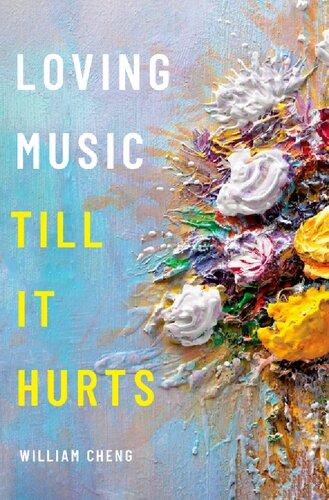
Library of Congress Cataloging-in-Publication Data Names: Cheng, William, 1985– author.
Title: Loving music till it hurts / William Cheng. Description: New York : Oxford University Press, [2019] | Includes bibliographical references and index.
Identifiers: LCCN 2019021008 | ISBN 9780190620134 (hardback) | ISBN 9780190620141 (updf) | ISBN 9780190620158 (epub) | ISBN 9780190620165 (oso)
Subjects: LCSH: Music—Social aspects. | Music—Moral and ethical aspects. Classification: LCC ML3916 .C49 2019 | DDC 781.1/1—dc23 LC record available at https://lccn.loc.gov/2019021008
Printed by Integrated Books International, United States of America
In memory of Ellen Wang—愛倫老師 my first piano teacher (1970–2017)
Acknowledgments
Friends, family, and colleagues sustained the long labors of love poured into this project since its inception in 2013. Linda Shaver-Gleason, Marcus Pyle, Mark Katz, and two anonymous reviewers took time to provide vital feedback on the full manuscript. Editor Norm Hirschy at Oxford University Press offered keen guidance and advice. Book production and copy-editing benefited from the patience and expertise of Aishwarya Krishnamoorthy, Santhosh Kumar, and Leslie Safford. Among the friends who read and improved one or more chapters were Alexander Rehding, Andrea Moore, Andrew Dell’Antonio, Anna-Lise Santella, Brandi Neal, Braxton Shelley, Brianne Gallagher, Charles Hiroshi Garrett, Dale Chapman, Dana Gooley, Dana Gorzelany-Mostak, Diane Pecknold, Eric Smialek, Francesca Inglese, Frank Lehman, Fritz Trümpi, Ian Copeland, Jacqueline Warwick, Jessica Holmes, Katherine Meizel, Lily Hirsch, Loren Kajikawa, Melinda O’Neal, Michael Heller, Naomi André, Oliver Wang, Pamela Pilch, Paula Harper, Phil Ford, Richard Beaudoin, Sebastian Smallshaw, Ted Levin, Tom Wetmore, Wade Dean, Will Robin, William Osborne, and Yana Stainova. Other companions who variously enriched this book via conversations and morale boosts include Alisha Lola Jones, Amy Wlodarski, Anabel Maler, Anna Maria Busse Berger, Anne Shreffler, Annegret Fauser, Ashley Fure, Barbara Will, Berthold Hoeckner, Blake Howe, Byrd McDaniel, Carol Oja, Daniel Goldmark, Danielle Fosler-Lussier, Darrell Tong, Don Pease, Ellie Hisama, Eric Lubarsky, Erin Maher, Eva Kim, Felicia Miyakawa, Gabriel Solis, George Lewis, Gregory Barz, Gundula Kreuzer, Hannah Lewis, Heather Hadlock, Imani Mosley, Ingrid Monson, James Deaville, Jeannette DiBernardo Jones, Jennifer Iverson, Jen-yen Chen, Jeremy Denk, Joseph Auner, Joseph Straus, Karol Berger, Kay Kaufman Shelemay, Kiri Miller, Krystal Klingenberg, Kyounghwa Kim, Laurie Lee, Louis Epstein, Lucy McBath, Manish Mishra, Mary Francis, Mary Lou Aleskie, Michael Austin, Michael Beckerman, Michael Casey, Mitchell Morris, Nancy Shafman, Neil Lerner, Noah Feldman, Rachel Edens, Regina Bradley, Rena Roussin, Richard Leppert, Rob Walser, Roger Moseley, Rosemarie Garland-Thomson, Rowland Moseley, Ron Davis, Samantha Bassler, Sarah Coulter, Scott Burnham, Scott DeVeaux,
Stephan Pennington, Stephanie Jensen-Moulton, Stephen Hough, Steve Rings, Steve Swayne, Susan Brison, Susan McClary, Susan Thomas, Susana Kwon, Suzanne Cusick, Tom Grey, Tom Kelly, Trica Keaton, and William Bares. Any semblance of composure or organization in my research process owed largely to the staff of the Dartmouth Music Department and Music Library, notably Bevan Dunbar, Catherine LaTouche, Craig Pallett, David Bowden, Memory Apata, Patricia Fisken, and Samantha Candon, as well as Amrit Ahluwalia, Abigail Mihaly, Aditya Hans Prasad, Alexandria Chen, Amy Zhang, Anna Raley, Betty Kim, Chelsea Lim, Cheryl Chang, Christina Reagan, David Ramirez, Faith Rotich, Grant Cook, Hannah F. Hua, Hanting Guo, Isabel Hurley, Katie Wee, Laura Barthold, Lexington Foote, Marcus Gresham, Matthew Levine, Michael Ortiz, Sally Yi, Sophia Kinne, Sophie G. Huang, Tyné Freeman, and Zoe Yu. Without the loving support of Chris Schepici and my parents, this book wouldn’t exist at all.
Excerpts of Loving Music Till It Hurts were presented at Bates College, Carleton University, Case Western Reserve University, Columbia University, CUNY Graduate Center, Dalhousie University, Dartmouth College, Florida State University, Hanyang University, Harvard University, Howard University, McGill University, National Taiwan University, Tufts University, UNC Asheville, UNC Chapel Hill, Universität für Musik und darstellende Kunst Wien, University of British Columbia, University of Chicago, University of Georgia, University of Illinois at Urbana-Champaign, University of Michigan, University of Tennessee, UT Austin, and Yale University.Earlier versions of chapters have appeared in journals: Chapter 4 as “Staging Overcoming: Narratives of Disability and Meritocracy in Reality Singing Competitions,” Journal of the Society for American Music (2017): 184–214; Chapter 5 as “So You’ve Been Musically Shamed,” Journal of Popular Music Studies 30 (2018): 1–30; and Chapter 6 as “Black Noise, White Ears: Resilience, Rap, and the Killing of Jordan Davis,” Current Musicology 102 (2018): 115–89.
Prelude
Loving Music and Loving People
Love is not based on great works as unperformed abstractions. Carolyn Abbate1
Love is the core of it all. The rest is just sounding brass and tinkling cymbal.
Cornel West2
People love music for how it sounds and how it feels. At least this is the way many of us, through our early years, fall in love with music: the ears magnetized by a croon on the radio, the broken heart soothed by a ballad on infinite loop, the limbs ensorcelled by the perfect groove, the deaf body attuned to the creative powers of vibrational experience. We come to love music for its palpable events, less so for its status as an unsounded object. True, people can declare a love of music without overt mention of performances, and instead with shorthand references to specific musicians, works, or genres. I love Prince. I love Cats. I love K-pop. With any of these loves, nonetheless, a sensory encounter is likely what once kindled the flame.
For me, it’s the voice of Eva Cassidy. In high school, I came across her exquisite cover of “Autumn Leaves,” which led me to discover her solo album Live at Blues Alley, which led me to an Internet search revealing she had died of cancer in 1996 at age thirty-three, just months after Blues Alley’s release. Ever since, I’ve never gone more than a few months without finding my way back to Cassidy, if only nowadays to stream a song or two, and falling in love all over again. You probably have musical treasures you call your own, along with vivid stories of how you chanced upon them.
So you probably also know how it feels to love music so much, it hurts. Hurts because music can be excruciatingly beautiful, quickening the breath
and teasing out tears. Hurts because a musician you love is no longer alive to hear you declare how much they’ve meant to you. Hurts because a part of you wants a sublime harmony or high note to last forever, yet you realize the moment means something precisely because it is, as with the searing paradox of mortal existence, gone too soon. In the grandest scheme, maybe loving music can hurt because you’re all but overwhelmed with gratitude for the sheer fact of music’s existence in a universe that didn’t owe us music, or really owe us anything at all.
We love music so much that we might talk about it as an animate, sentient being. Music theorist Joseph Straus explains how some scholars analyze a composition as if it were “a human body, a living creature with form and motion, and often with blood, organs, limbs, and skin as well.”3 We anthropomorphize music the way we anthropomorphize—well, just about everything. But does a musical work have dignity? Can it sense pain? Does it have rights? Of course not, one might reason. Yet think of the colloquialisms we use for music, especially when we believe music has been violated. An underrehearsed cover band made a mockery (dignity) of Led Zeppelin’s classics. A singer butchered or mangled (pain) the “Star-Spangled Banner.” An orchestra didn’t quite do justice (rights) to the grandiosity of Mozart’s Requiem. As art historian W. J. T. Mitchell points out, similar language and feelings pop up when people witness the “violation” and “mutilation” of visual art and physical objects—a painting slashed by a knife, a teddy bear with a torn arm, a sofa abandoned on the curb, a violin broken in two.4
As music vibrates our bodies sympathetically, it can move us to react empathetically. When we perceive our beloved music hurting, we hurt a little, too. It sounds illogical. We know music isn’t truly an organism, so we should rest easy knowing it’s free of pain receptors. In another sense, the fantasy is not strange at all. As a companion, music can do so much for us, mean so much to us, and even grant us a profound sense of self and humanity. We feel called to love and protect music, as parents would defend their young, or as lovers would guard each other.
Is it possible for our love and protection of music to go too far? Can such devotion ever do more harm than good? Can our intense allegiances to music distract, release, or hinder us from attending to matters of social justice?
Consider a 2012 Washington Post article by music critic Anne Midgette, who recalled an unpleasant experience at the Port Authority Bus Terminal in New York. She described hearing a recording of a Franz Schubert piano trio piped through overhead loudspeakers. “I’ve long heard that the Port
Authority is one of many public spaces across the country that uses classical music to help control vagrancy,” Midgette noted. Upon hearing this music firsthand, she started to believe its efficacy. “Schubert’s piano trios are among my favorite pieces in the universe,” she declared, “but as I listened, I found that I wasn’t relaxing; quite the contrary. The music sounded awful: tinny, hard-edged, aggressive. I wanted to get away.”5 Although Midgette prudently acknowledged that playing classical music “to ‘civilize’ a space” is a form of “supreme elitism,” her article focused on the insults to this music. In short, she took issue with the reduction of Schubert to the status of sonic wallpaper, saying “what we’re actually talking about is Muzak,” while lamenting how the subpar speakers and acoustics could not do right by the repertoire she profoundly loved. “In that windowless, ugly space, with pigeons strutting across the grimy floor, announcements blaring unintelligibly over the loudspeaker and the sound system giving the music a harsh edge, as if impaling it on a jagged chunk of metal, my sympathies were all with the homeless people that such music is widely thought of as attempting to repel,” Midgette concluded. “If I’d had a choice, it would have driven me away, too.”6 (Implied here is that Midgette couldn’t choose to leave. With an eventual bus to catch, yet having arrived somewhat early at Port Authority “with enough time” so that she “actually noticed the music,” she found herself ostensibly stuck.)
Midgette might be correct that some of the homeless people at Port Authority were irked by grating renditions of Schubert. Or maybe these concerns are only a fraction of daily crises involving the bare necessities of food, warmth, and shelter. Despite Midgette’s sympathies, this Washington Post article dwelled far more on the metaphorical wounds inflicted on an “impaled” Schubert than on the material injuries and structural injustices perpetrated against homeless individuals. Not that compassion is a zero-sum game. One can feel pain on behalf of music while trying to feel and assuage the pain of people. But here’s a useful hypothetical. If Anne Midgette had heard a high-fidelity, captivating rendition of Schubert at the Port Authority that day—say, an undistorted recording of his piano trios by the legendary Beaux Arts Trio—would she have thought to document her outrage about the recording’s gentrifying utility? Would she have ended up writing an op-ed denouncing, as she astutely states, the “supreme elitism” of this antivagrancy practice? Or would she have been content to bask in the beauty of what she calls her “favorite pieces in the universe,” even praising the good taste of Port Authority’s administrators?7
It’s only fair to ask the same questions of ourselves. Had I found myself in a similar situation—enjoying some recordings of Chopin or Eva Cassidy through a transit hub’s crystal-clear loudspeakers, despite harboring vague suspicions of this music’s anti-loitering functions—would I have thought to object? I’m not sure. I would like to think so. Yet chances are just as good that I would have ended up lulled into auditory bliss by music I thoroughly love.
Audible performances aren’t the only manifestations of music that activate our protective instincts. Although the origins of our love for music may depend on, as musicologist Carolyn Abbate points out, how its performed “realities” profoundly speak to us, we can be ferociously defensive of the idea of music as well—namely, our differing ideas about what qualifies as good music, where this music should be played, under which circumstances, with what technologies, how and how loudly, and by and for whom.8 Instincts to protect music (and one’s own ideal of music) can crop up in the insistence that not a single sacred note of Beethoven’s sonatas must ever be changed, or that someone who posthumously seeks to finish a composer’s unfinished symphony is as presumptuous as “an archaeologist adding a missing arm of his own making to a recovered Venus.”9 Preservationist instincts toward music can come out more coarsely, as when a chorus of shhhh! descends on a fellow concertgoer whose vibrating cell phone has sorely punctured a pair of lovers’ onstage duet. More grievously, a protectiveness of your favorite music could motivate you to defend and continue to patronize the music of a superstar who has been multiply accused of sex crimes. In all of these cases, it’s not just about protecting music itself, but also about safeguarding one’s entitlements to musical pleasures.
At times, it’s as if people care more about music—and in particular about their own beloved music and musical ideals—than about fellow human beings. This attitude isn’t unthinkable when we realize how love in general, and the fierce loyalty it engenders, can make us do things far out of the ordinary, often beyond the typical sweeps of our moral compasses. Chaotic minds, irrational actions, questionable ethics: these are ingredients of love stories writ large. Why would people’s lifelong love affairs with music prove any less complicated?
Impassioned and vigilant, one can love music to the point of hurting or neglecting other people, whether directly or indirectly, consciously or not. Conversely, one’s own enjoyment of music can come under fire. You might be “singing and dancing around the apartment” to the rhymes of Notorious B.I.G., or relaxing to a “bikram yoga CD” in your parked car, and someone
might call the cops on you. It’s what happened respectively in mid-2018 to Mary Branch and Ezekiel Phillips—both black, both playing music they loved.10 Such cases bring up questions about why some people’s displays of music loving face higher evidentiary thresholds of legitimacy and respectability. Here, with feasible elements of race and prejudice in play, one takeaway is how disputes involving music are rarely just about the music itself, even or especially when arguments flare over whether there’s such a thing as “the music itself.”11 If, while listening to music you love, you find yourself shamed, chided, or reported to the authorities, then music is likely only one factor in a much larger, messier equation.
Loving Music Till It Hurts explores how we can love music to the point of hurting one another. It is a book about how such interpersonal hurt emanates in part from our fantasy that music itself can be hurt and therefore must be protected. Ultimately, this book is about how human relationships with music—relationships often founded on an aching love, yes, but also potentially rooted in ambivalence, pragmatism, dysfunction, or covetous intensity—resonate with the just and unjust relationships among people. Driving this book is a single question:
How do we love music, even embrace it as vital to human thriving, without intentionally or unintentionally weaponizing this love—that is, without allowing such love to serve oppressive, discriminatory, and violent purposes?
Your instinct might be to read this question as a rhetorical one. Its aims are not achievable, you could say. And you’d likely be right, for humans have always found ways to make weapons out of tools, and music is a tool because it can do things. More than lovable, music is useful. It can appease or annoy, heal or harm, bring people together or break communities apart.
At the heart of this book, however, is a naive refusal to hear the preceding question as merely rhetorical. Taking an optimistic page from feminist and queer scholars such as Sara Ahmed, José Esteban Muñoz, and Michael Snediker, I want to think that a better world is possible—or recursively, at the very least, to think that a better world is thinkable.12 Here, then, is my answer to the question.
Love music and love people. If ever in doubt—or if forced to choose— choose people.
Orbiting this answer is a burning constellation of interrogative asterisks. Why prioritize people? Is it simply because people are mortal beings who feel pain—and sometimes need alleviation from suffering—whereas music does not? Why would we ever need to choose between music and people anyway? Can’t we have it all? And must we love all people? What about the people who hurt us? Crucial considerations all around. More than insisting that we always blithely choose a love of people over a love of music, my answer is an invitation to contemplate the potential falsity of the choice itself. In other words, it’s an opportunity to ask why there’s ever doubt in the first place, and indeed who or what is even capable of making us choose or making us believe a choice does or doesn’t exist. Plenty of internal and external forces—stubborn personal habits and loyalties, or powerful institutions and creeds—can seemingly present us with a choice between loving music and loving people. In this book, we will encounter examples of human beings who do appear to pick sides. Some choose music, opting to lovingly protect it even to the detriment of other people. Some choose people, letting musical concerns take a back seat. Some implicitly challenge the choice, resisting the either/or. And some, all the while, show amazing ways of channeling musical love to empower interpersonal love, and vice versa.
Humans have committed plenty of dubious or outright abominable deeds in the name of love. Going to war for the love of country. Persecution and genocide for the love of god. Crimes of passion for the love of your life. Concerning the deleterious consequences of love-borne actions, then, music isn’t exceptional.
Or is it? Consider discourses of musical exceptionalism—writers’ characterizations of music in exceptional, even mystical, terms. Music is indescribable and ineffable, invisible and ephemeral, transcendent and sublime. Our love of music, along with our awe at its power, can move us to talk about it in these high-minded terms. Equally revealing is that such love often remains implied rather than spoken aloud. Although numerous writers persuasively address the dangers and abuses of music, notably fewer do so through a critical lens of love. Many don’t use the L-word at all, maybe because it comes across too sentimental, embarrassing, or obvious. Yet given that our love of music is part of what makes music worth fighting for and fighting over, it is curious how frequently love gets the silent treatment, not least in academia.
Six chapters in Loving Music Till It Hurts try to coax love out of the shadows, progressively shining light on the real and imagined tensions between loving music and loving people. I anchor my case studies primarily in the contemporary United States. By contemporary, I really mean since 2007, from the bursts of post-racial fantasies surrounding the election of Barack Obama to the pendular swing that handed nuclear codes to Donald Trump. I settled on this modest scope for a few reasons. First, because it makes enough room for close cultural readings—unpacking US-specific conceptions of music, race, sex, disability, meritocracy—without attempting giant leaps toward transcultural claims. Second, because this scope shows that the controversies explored here are ongoing, urgent, and (for readers living in the United States) close to home. And third, because musical exceptionalism shares prominent similarities with American exceptionalism, notably, what historian Donald Pease calls “the new American exceptionalism”: a post-Cold War ethos that has doubled down on the nation’s status as a “moral exception,” the proverbial shining City upon a Hill.13 Exceptionalism, whether national or musical, is inherently an ideology of power. For this reason, it can be dangerous, and calls for scrutiny.
My opening two chapters delve into people’s enduring beliefs in music as a humanizing force: the first chapter moves fast, cycling through diverse examples to flesh out preliminary ideas; the subsequent chapter slows things down, mapping out a single story from multiple perspectives.
Chapter 1 demonstrates how people’s love of music can enable myths of music as an instrument of edification and civilization. Some traditions, such as those of classical music, are alleged to ennoble, while other repertoire is conversely said to reveal its patrons’ incivility. Although it sounds obvious that loving masterpieces doesn’t make someone a good person (think of the Beethoven-loving Nazis), I emphasize here that this presumption of obviousness can itself pose problems. How immune are we really to the seductive myths of music-as-morality? Even if we claim immunity out loud, how might our verbal quandaries and silences about music loving nevertheless speak to our deep-seated vulnerabilities?
Chapter 2 examines a famous experiment conducted in the name of musical love and loss: the 2007 undercover busking effort by famed violinist Joshua Bell, recounted in a Pulitzer-winning Washington Post article by journalist Gene Weingarten. Playing Bach and other classical repertoire, the disguised Bell attracted few eager listeners. Many readers declared their love of this story, lamenting its proof of how easily beauty
gets drowned out in our busy lives. Other responses to Weingarten fell into traps of intellectual elitism, rushing to proclaim that “obviously” this article was hokum and that no reader would be gullible enough to buy what Weingarten was selling. Three themes emerge from my critiques of musical and academic exceptionalism: one, how we mismeasure beauty and its scarcity; two, how we productively or harmfully imbue musicianship with humanizing values; and three, why lovable dreams of musical universalism (we are all musical, music is everywhere) may elude or even impede agendas of social justice.
Following these introductory critiques of music as a humanizing force, the book’s middle pair of chapters turns to the power of music as a de-humanizing force—that is, the way people’s love of “the music itself” encourages auditory and adjudicatory practices that minimize, hide, or wholly reject the relevance of performers’ identities or needs.
Chapter 3 drops in on “blind” auditions, commonly upheld as a gold standard in appraisals of musical excellence. Using screens and anonymizing apparatus, judges evaluate auditionees on sound alone, thereby doing right by the music they love. But a hidden cost of such auditions, whether for the Boston Symphony Orchestra or the reality show The Voice, is the wholesale severing of musicianship from human identity at large. With auditionees out of sight, the conceits of meritocracy enable all parties to avoid talking about issues of discrimination altogether—that is, why anonymity is desirable or necessary to begin with. A short case study ventures outside the United States to consider the illustrious, nearly all-white and all-male Vienna Philharmonic Orchestra. Tellingly, recent criticisms of this orchestra have come overwhelmingly from the United States, with music lovers exporting American brands of liberal feminism and social justice to protest the ensemble’s hiring practices.
Chapter 4 continues to chase down myths of meritocracy and the musical mystique across the stages of reality television competitions, which often feature disabled auditionees and their moving tales of overcoming adversity. Musical abilities in general and singing talents in particular are shown to normalize and humanize disabled contestants while once again silencing vital conversations about the exploitation, stigmatization, and corporate politics at work. One wrinkle I stress here is that critiques of “inspiration porn” are neither easy nor obvious: chronicles of overcoming can emotionally overcome consumers; heartwarming tales about disability can seemingly disable
a beholder’s emotional, intellectual, and rhetorical faculties. As we either resist or succumb to the tearfulness induced by lovable stories and gorgeous songs, we must chart tricky routes through the heady skepticism of Scylla and the naive waterworks of Charybdis.
My two closing chapters show how musicians and music lovers stand to face dehumanization in a crueler sense: subjection to public shaming, harassment, and even physical violence—all because their production or consumption of music has violated others’ expectations of what (good) music is or how it should sound.
Chapter 5 focuses on the modern epidemic of public shaming. In 2014, someone leaked the raw, out-of-tune vocals of pop star Britney Spears attempting a studio take of her song “Alien.” Shame storms promptly followed. By connecting voice shaming to concomitant practices of sex shaming and slut shaming, I ask what we think we gain when we judge, police, and dehumanize musicians at their worst moments. Do people shame musicians out of a putative love for music? Or is music simply an excuse, an accomplice? Given the deluge of leakable data today, some provocative analogies materialize between our myths of secure networks (a technical impossibility) and our idealizations of pitch-perfect (infallible, unassailable) lyric voices. I invite readers to relisten to Spears’s naked voice not as shameworthy detritus best left on the cutting room floor, but rather as an object of clickbait that always already implicates our own aural vulnerability and consumer complicity.
Chapter 6 closes the book with an extended investigation into how musical judgments can kill—how someone can be killed while listening to music they love, and for refusing to turn it down when asked. In 2012, a forty-seven-year-old white man named Michael Dunn heard loud rap music coming from a nearby red car containing four black youths. Loud words were exchanged. Minutes later, Dunn fired ten bullets at the car and killed one of its passengers, seventeen-year-old high school student Jordan Davis. Dunn claimed Davis had threatened him with a shotgun. No such gun was ever found. Concerning the murder trial that followed, I show how Dunn’s lawyer, Cory Strolla, leveraged racist stereotypes of rap to paint dehumanizing (uncivilized, savage, criminal) and superhumanizing (formidable, fearsome, brawny) portraits of these youths. As for Dunn, the defendant? Strolla depicted him as someone who himself loved music, including “any type of hip-hop,” the stuff “that the kids listen to.”14 I supplement my research into
this trial with materials that were either purposely excluded from or inadvertently overlooked by media coverage: Michael Dunn’s jailhouse letters and phone calls, transcriptions of courtroom sidebars, pretrial documents, evidence technicians’ reports, and 911 records. I end with brief recollections of my conversations with Jordan’s parents, Ron Davis and Lucy McBath.
1
Misjudgments of Humanity
We write symphonies. We pursue innovation. [. . .] And above all, we value the dignity of every human life, protect the rights of every person, and share the hope of every soul to live in freedom.
President Donald J. Trump, 2017 speech in Warsaw1
What can music tell us about people? Specifically, what can the music someone loves (or otherwise feels strongly about) reveal about that person’s character and values? Plenty, insists the romantic. Pretty much nothing, scoffs the skeptic. Probably something but who really knows? shrugs the agnostic.
In a 2007 New Republic article, “The Musical Mystique,” Richard Taruskin reviewed three books. Each book, in its own way, voiced a passionate defense of classical music and its role in the twenty-first century.2 As Taruskin read these volumes, he recalled how
the question that throbbed and pounded in my head was whether it was still possible to defend my beloved repertoire without recourse to pious tommyrot, double standards, false dichotomies, smug nostalgia, utopian delusions, social snobbery, tautology, hypocrisy, trivialization, pretense, innuendo, reactionary invective, or imperial haberdashery. On the evidence before me, the answer is no.
Following this litany, Taruskin described how some defenders of classical music evince a dangerous elitism that, in turn, perpetuates myths of this music as a civilizing and humanizing force. Western art music has long served ambitions to colonize land, educate “noble savages,” edify children, and, increasingly today, rehabilitate prisoners.3 Any genre of music, though, can generate mystique, so long as this music is perceived to have human and moral value. All told, the musical mystique is a kind of aesthetic moralism,
a leap of faith (or dogma, per the -ism) bridging artistic taste with moral humanity.4
In practical terms, then, what are the consequences of overestimating music’s ability to tell us things—that is, of judging people by their beloved music, and of mysticizing music as a second sight into human minds, bodies, and souls? We should know, logically speaking, that no music can sound out the full measure of a person. We’re also taught that jumping to conclusions in general can be impolite, unethical, and perilous. But conventional wisdom isn’t always enough to stop us from rushing to judgment. And to be clear, the validity of prejudging people, whether on the basis of music or other limited information, isn’t dependent on whether the appraisal turns out to be right or wrong. Warnings of don’t judge a book by its cover aren’t appended with . . . unless you happen to judge correctly. Landing one lucky guess doesn’t foreclose the broader hazards of continuous guesswork and stereotypes.
With a parade of vignettes, this chapter shows how our love of music can compel us to buy into its mystique, enticing us to attribute musical performances and ideas alike with preternatural powers of revelation. I underscore the immediately hurtful as well as systemically harmful ramifications of judging and misjudging people by their musical tastes, affinities, and abilities. I also ask why we are susceptible to mystiques if, as the word itself implies, we should rationally know better. The staying power of the musical mystique, I argue, is indebted to a trio of partners in crime. First in this trio is what I call the musicological mystique—the idea that knowledge about the musical mystique necessarily makes one immune to its overwhelming seductions. Second is the limitation of language when it comes to defining some of the big ideas around the musical mystique: love, human, and music, all of which invite poetic yet evasive tautology, as in our soaring declarations that love is love, or people are people. Last in this trio is the loud silence around love altogether in critical dialogues about music, insofar as ideas of intimacy, pleasure, and erotics have long been treated as irrelevant or even (in music theorist Marion Guck’s terms) “embarrassing.”
The Musical Mystique: Humanization, Dehumanization, Superhumanization
On the surface, there’s nothing wrong with believing your beloved music and your moral center are somehow connected. You’re entitled to derive a sense
of self, self-love, and existential awareness from your musical craft or personal playlist. So far, so good. But the problem is we rarely stop with selfappraisal; we tend to judge other people, too.5 What happens when someone else sees or hears your musicality as a precondition—a prerequisite—for your humanity? “Black music serves as durable cultural and social evidence that blacks have survived America,” wrote the black jazz musician and activist William H. McClendon in 1976.6 “[But] Blacks did not and never have needed to find themselves and learn of their humanity in order to produce music.”7 Alas, the same cannot be said, McClendon remarks, for the many white people who have become alerted to the fact of black humanity primarily through delightful encounters with jazz, blues, spirituals, and gospel music. A beautiful performance by a black musician can jolt a previously racist or indifferent listener into epiphanic acceptance of this musician’s humanity. Yet surely the listener’s change of heart must not derail the question of why any epiphany was ever required, much less the question of how, going forward, one should make amends for prior racist actions.8
Even if lovable music has the power to humanize, we cannot lose track of why the burdens of proof for humanity weigh more heavily on some individuals than on others to begin with.
To grasp the word humanize, we can bring in two of its lexical companions— dehumanize and superhumanize. I situate these terms in part within the vantages of moral philosophy and critical race theory. Alexander Weheliye, for example, has offered the phrase “pernicious logics of racialization” to describe a culture’s “sociopolitical relations that discipline humanity into full humans, not-quite-humans, and nonhumans”—people treated humanely, people treated poorly, and people, such as slaves or detainees, treated with utmost cruelty.9 An addition to Weheliye’s catalog is the superhuman, an insidious construct for a pair of diametric reasons: one, because someone lionized as a superhuman lives above the law; two, because the superhuman, in some cases, is actually a dehumanizing label wrapped up in a bow (the preternaturally musical “Magic Negro,” the “supercrip” who “overcomes” disability by dint of specialized proficiencies, and similar patronizing tropes that fetishize freakery and circle back to the not-quite-human).10
People have found countless ways to humanize, dehumanize, and superhumanize themselves and others through music. Humanize: by attaching a sense of self or self-worth to the music one loves, performs, or promotes. Dehumanize: by degrading, mistreating, or harming someone else for their perceived lapses in musical taste, ability, or decorum. Superhumanize
(nearly always pernicious, despite the lofty prefix): by deifying, say, a brilliant conductor, thereby allowing such idol worship to mitigate or cover up his history of grave misconduct.
Let’s begin with music’s humanizing potential. Recall one of the most popular YouTube clips ever, singer Susan Boyle’s 2009 audition for the reality competition show Britain’s Got Talent. Judges and audience members initially sneered and rolled their eyes at this middle-aged woman who prefaced her performance by stating a desire to be as successful as the musical theater star Elaine Paige.11 As Boyle began singing “I Dreamed a Dream” from Les Misérables, however, the room’s condescending milieu melted into warm smiles and dropped jaws. The rest became viral-video history, with the web feasting on a real-life “ugly duckling” tale.12 As observed by ethnomusicologist Katherine Meizel, motifs of the “noble savage” peppered the media’s exaltation of Boyle’s “natural voice” and romanticization of this amateur singer’s “village background, her self-described virginity, and the mild brain damage she suffered at birth.”13 Or as a Sun writer characterized: “Untouched by human hand, this girl. Literally. Kicking 50, never had a boyfriend. Eyebrows you could knit into a jumper, dress sense nicked from the drag queens on the paper towel adverts. But the voice? Borrowed from heaven itself.”14 Despite judges and fans eventually showering Boyle with praise, the shock value of the narrative arc can make us wonder how people would have treated this woman had she not sung beautifully and elevated herself as someone deserving of human decency. Not that there was anything inherently wrong with celebrating Boyle; reality shows are, by their nature, premised on the sensationalism of unlikely triumphs. What’s problematic is that people were able to prejudge Boyle terribly—for her appearance, class (perhaps discernible by her accent and dialect during her pre-audition remarks), and comportment—and then, after the big musical reveal, to anoint themselves as founding members of the Susan Boyle fan club. Amid the thunderous applause and consequent lovefest, all is forgiven, and earlier prejudice forgotten. Again: someone’s display of musicality can awaken others to this person’s humanity. It just shouldn’t be necessary. With the musical mystique at work, a beautiful singing voice ended up validating Boyle in the eyes of her prior skeptics. Most listeners didn’t know anything about Boyle before her audition, and this is why they prejudged her. Yet the humanizing powers of the musical mystique can just as easily creep into cases of people about whom a great deal is already known. Consider,
in the arena of high-stakes politics, the Russian president Vladimir Putin, whose well-documented actions have been variously called authoritarian, cruel, and inhumane. In May 2017, Putin attended a “One Belt, One Road” summit hosted in Beijing. As he waited at the state guesthouse for the arrival of Chinese president Xi Jinping, Putin sat down at a grand piano and played excerpts of two Soviet pieces from the 1950s: Vasily SolovyovSedoi’s “Evening Song” and Tikhon Khrennikov’s “Moscow Windows.” Putin played hesitantly, falteringly. By his own admission, he is an amateur, “someone who plays with two fingers.”15 Cameras were present to capture the minute-long performance. In a New York Times report, journalist Ivan Nechepurenko perceived in this impromptu pianism “a softer side of Mr. Putin, an authoritarian leader who has been in power since 1999 and has often appeared eager to be seen as manly.”16 (Nechepurenko’s assumption is that piano playing doesn’t qualify as “manly,” because manliness is portrayed by the Internet’s copious photos of Putin’s judo training, weight lifting, hunting, and bare-chested horseback riding.)17 A Boston Globe article similarly described how Putin, “known for his passion for the outdoors, showed off his softer side during a visit to China when he sat down to play the piano Sunday.”18 And a Financial Express piece bore the title, “Russian President Vladimir Putin Shows His Soft Skills, Plays Piano.”19 Several of these articles took care to note that the two pieces performed by Putin were “tunes from his childhood,” as if this remembrance of songs of yesteryear were a lifeline to an innocent and vulnerable child nesting within the brawny adult body of a nefarious world leader.20 Remarks about Putin’s amateurism and how he “plays piano like a 3rd grader” compounded this fantasy of illusory infantility.21 Some readers agreed with the sentimental gloss of Putin’s musicality, whereas others rebuffed the reports as false narratives that were “normalizing” and “humanizing” the president by sole virtue of pianistic aptitude.22 Comparisons to Adolf Hitler popped up on cue. Hitler loved music, loved theater, and loved to paint.23
Intentionally or not, we sometimes mysticize music as a humanizing force. What about music’s dehumanizing force? In his book Less Than Human, philosopher David Livingstone Smith posits that dehumanization is not a kink in human relationships. It’s a feature. Proof, argues Smith, is everywhere, from the way people climb corporate ladders by stepping on others, to the homo sapiens survivalist instincts of tribalism and natural selection, to human vocabularies in general (calling one another bitches, dogs, cockroaches, leeches, rats, snakes, pigs, and vermin).24 If someone intends to dehumanize