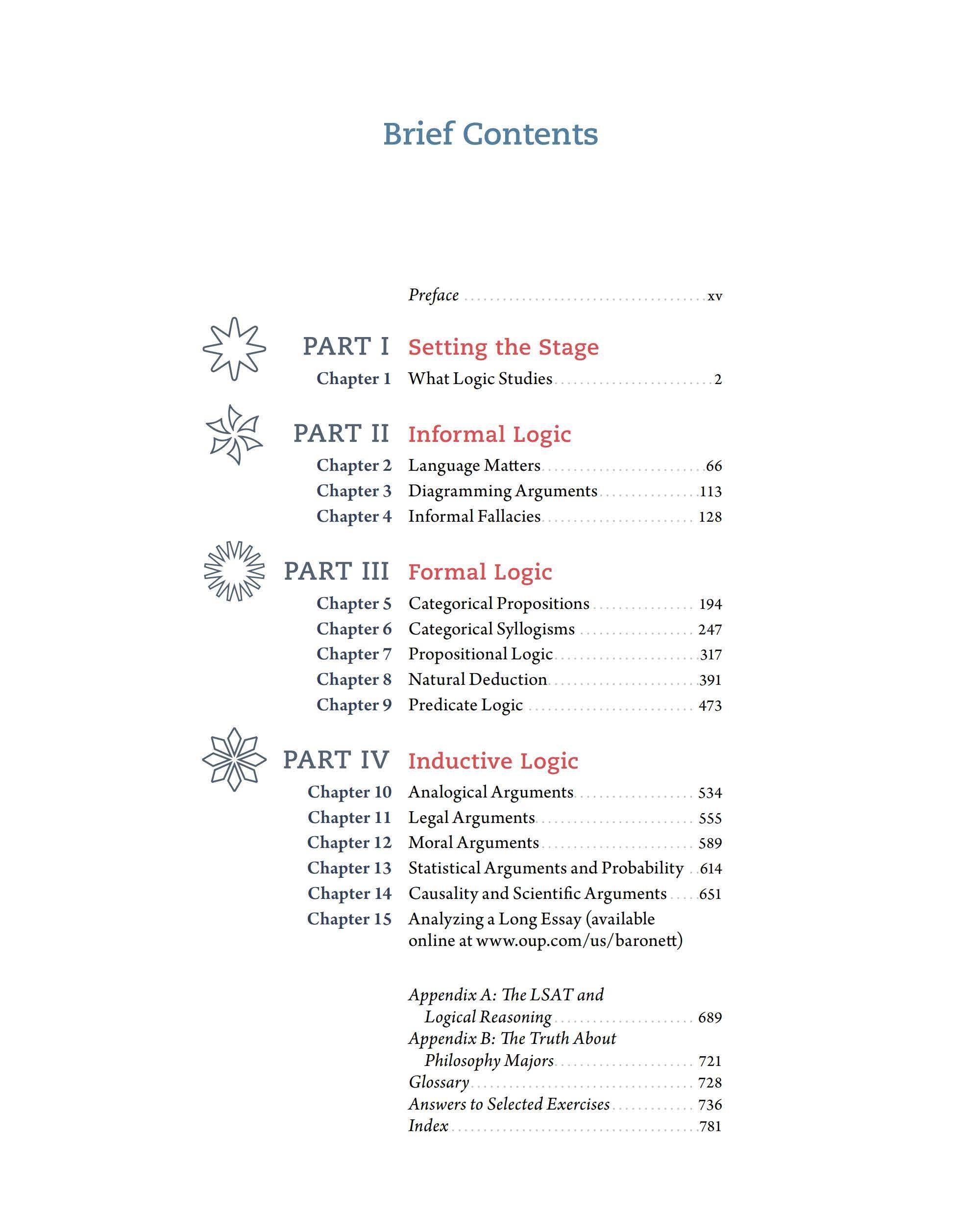
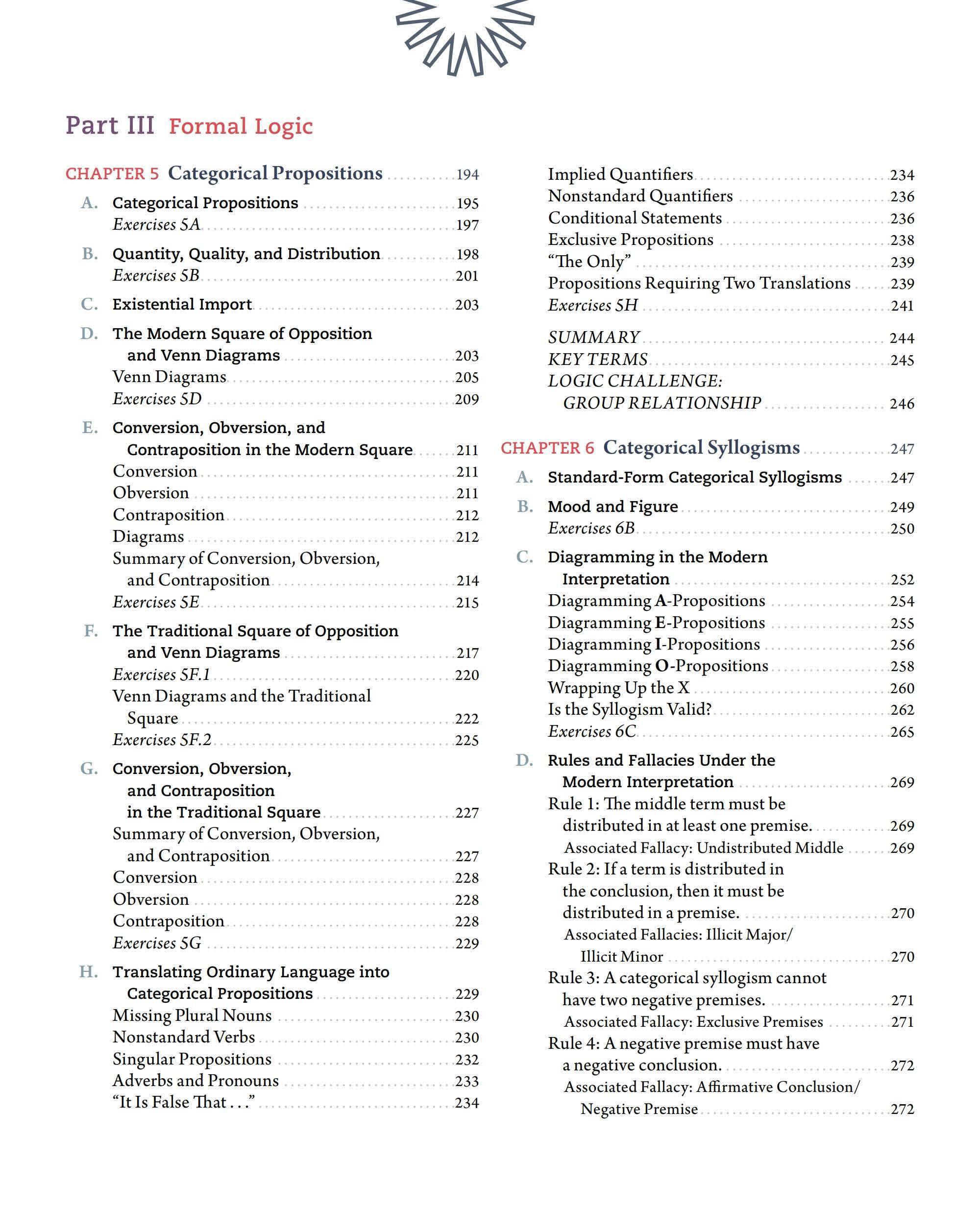
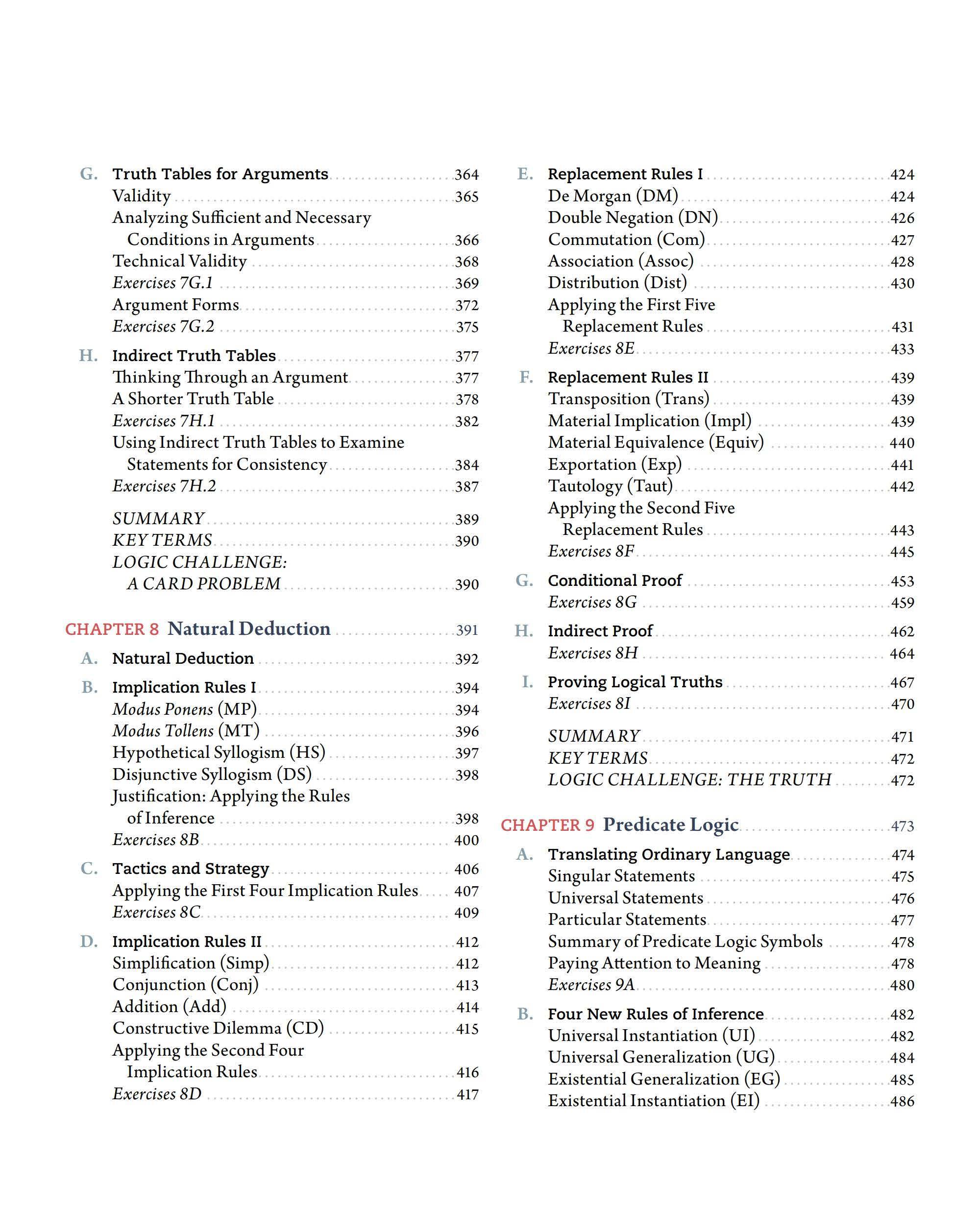
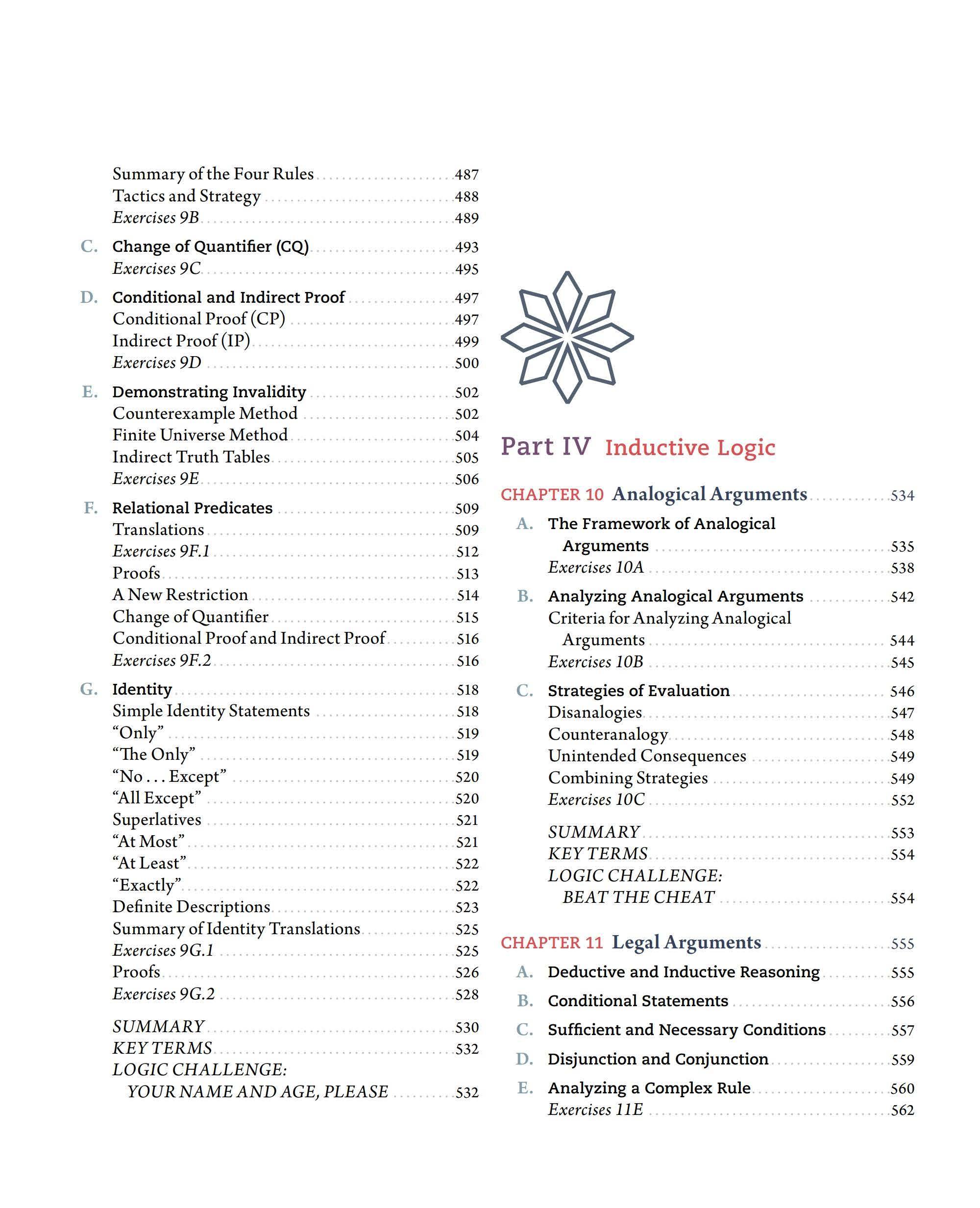
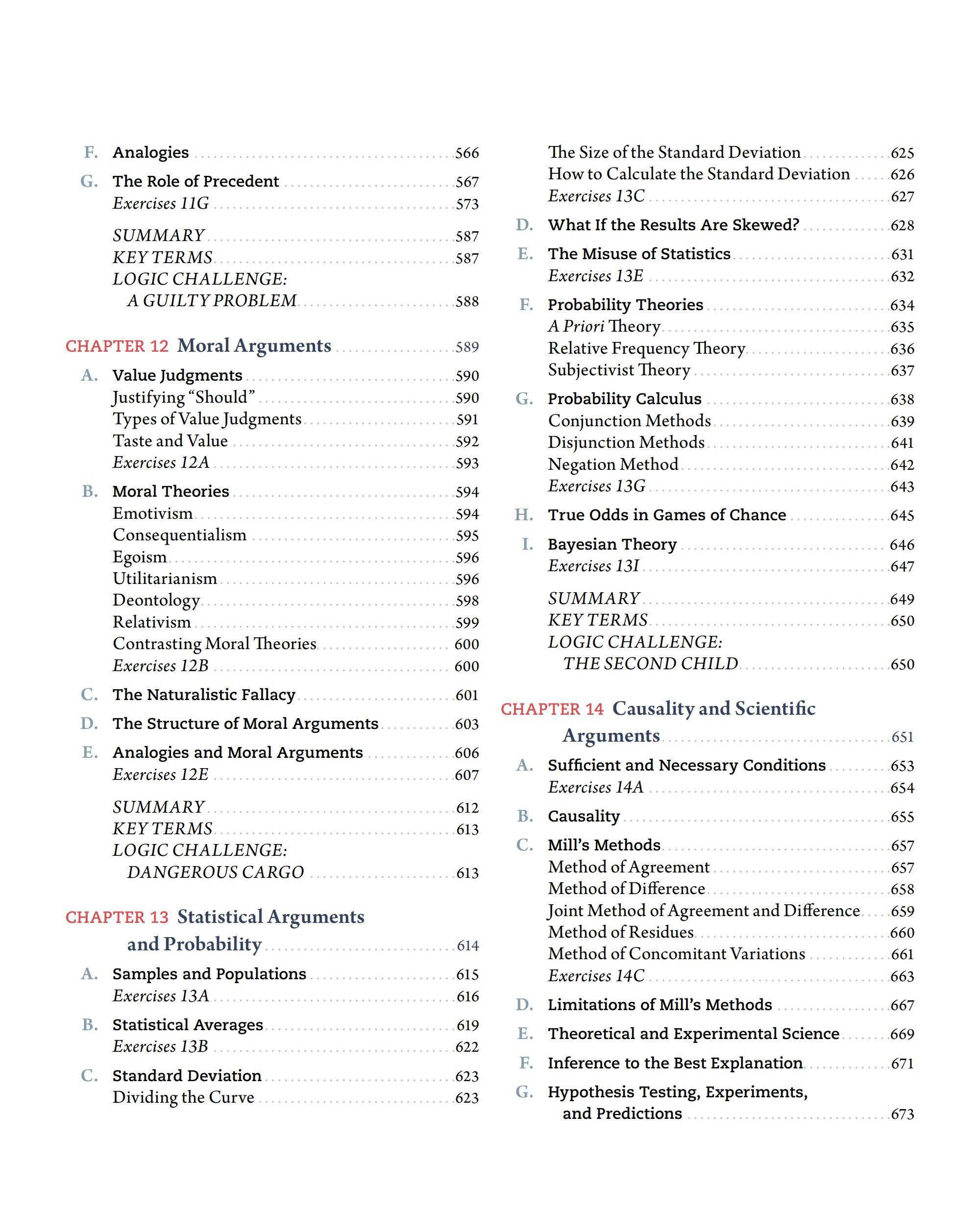
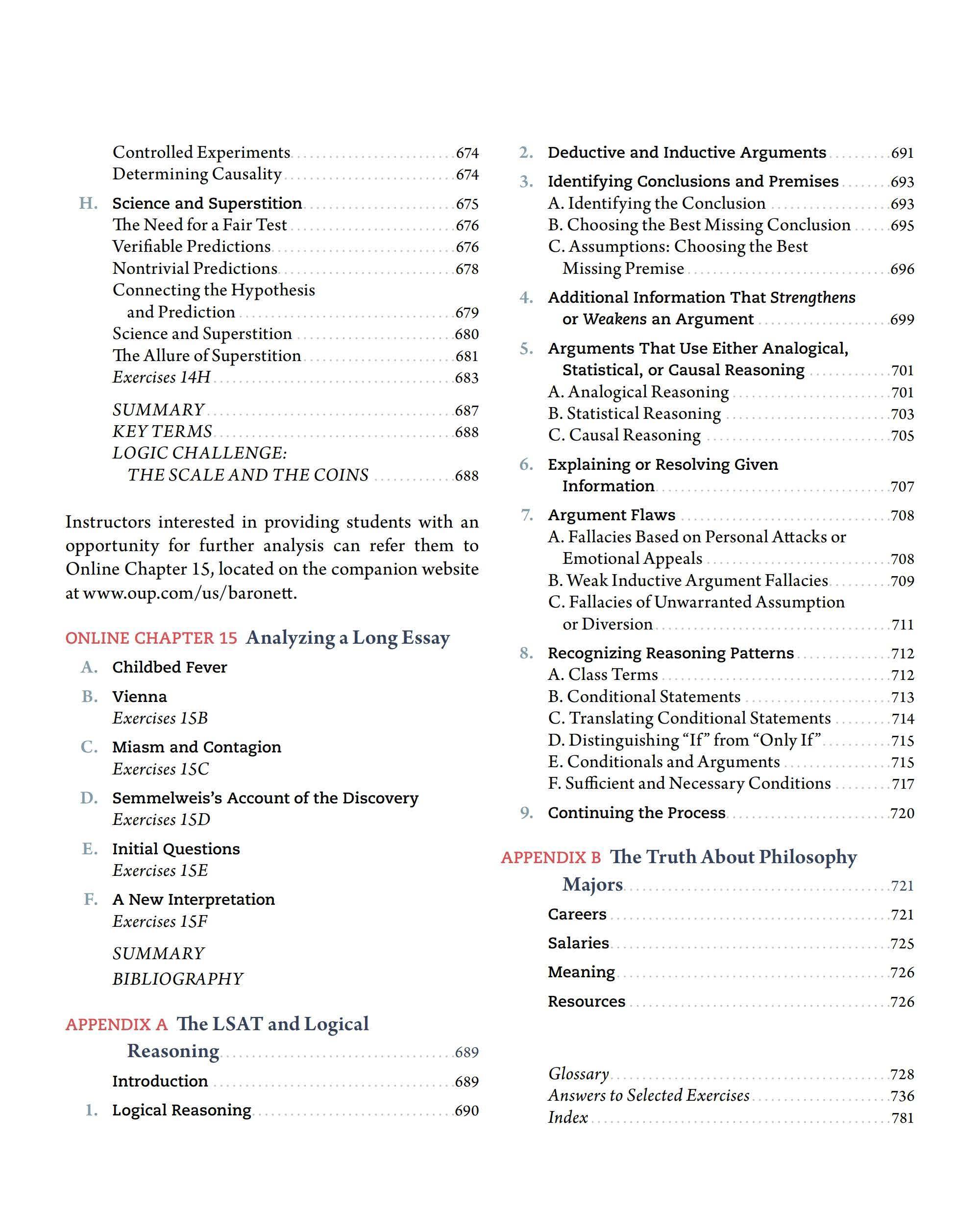
Part III Formal Logic
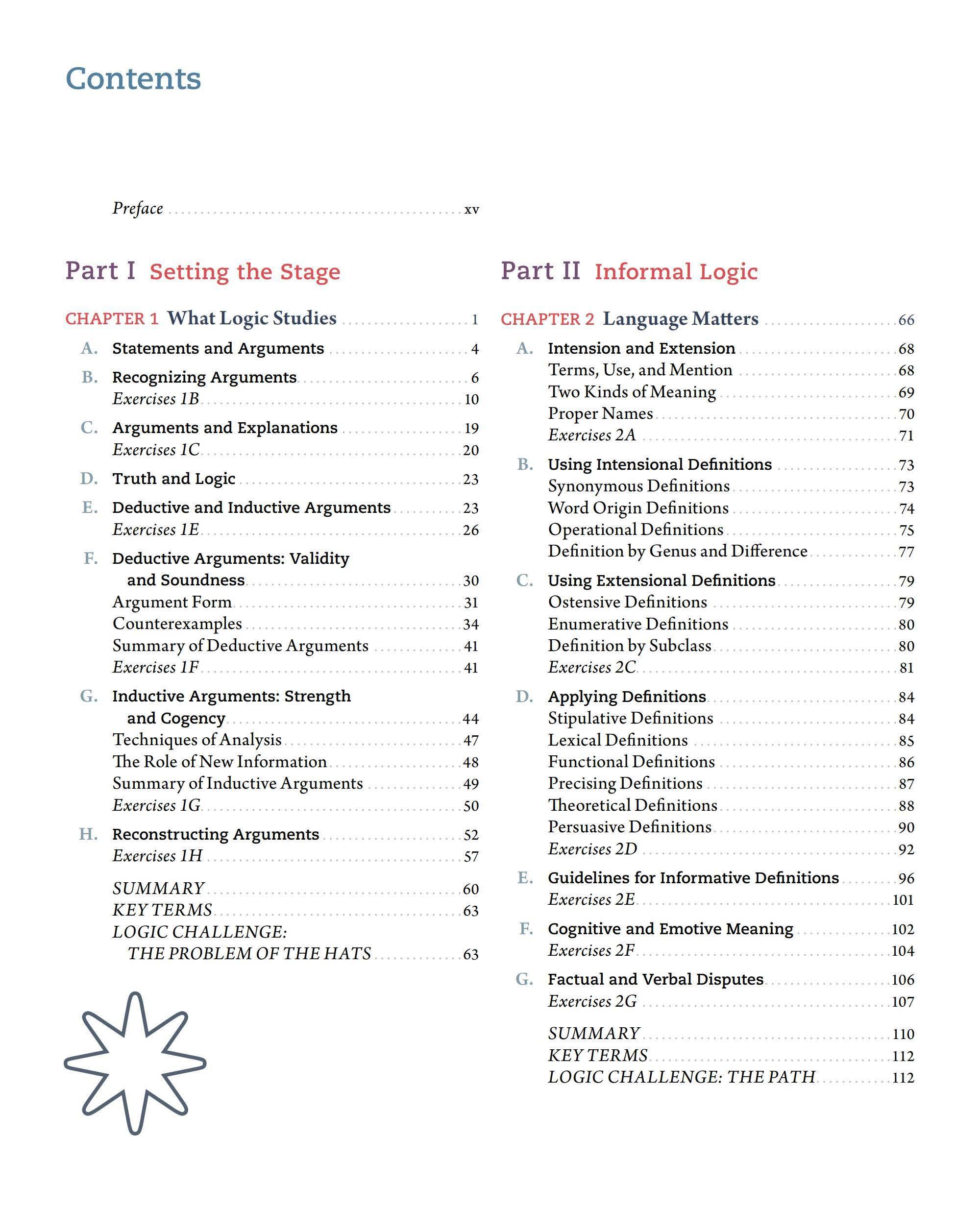
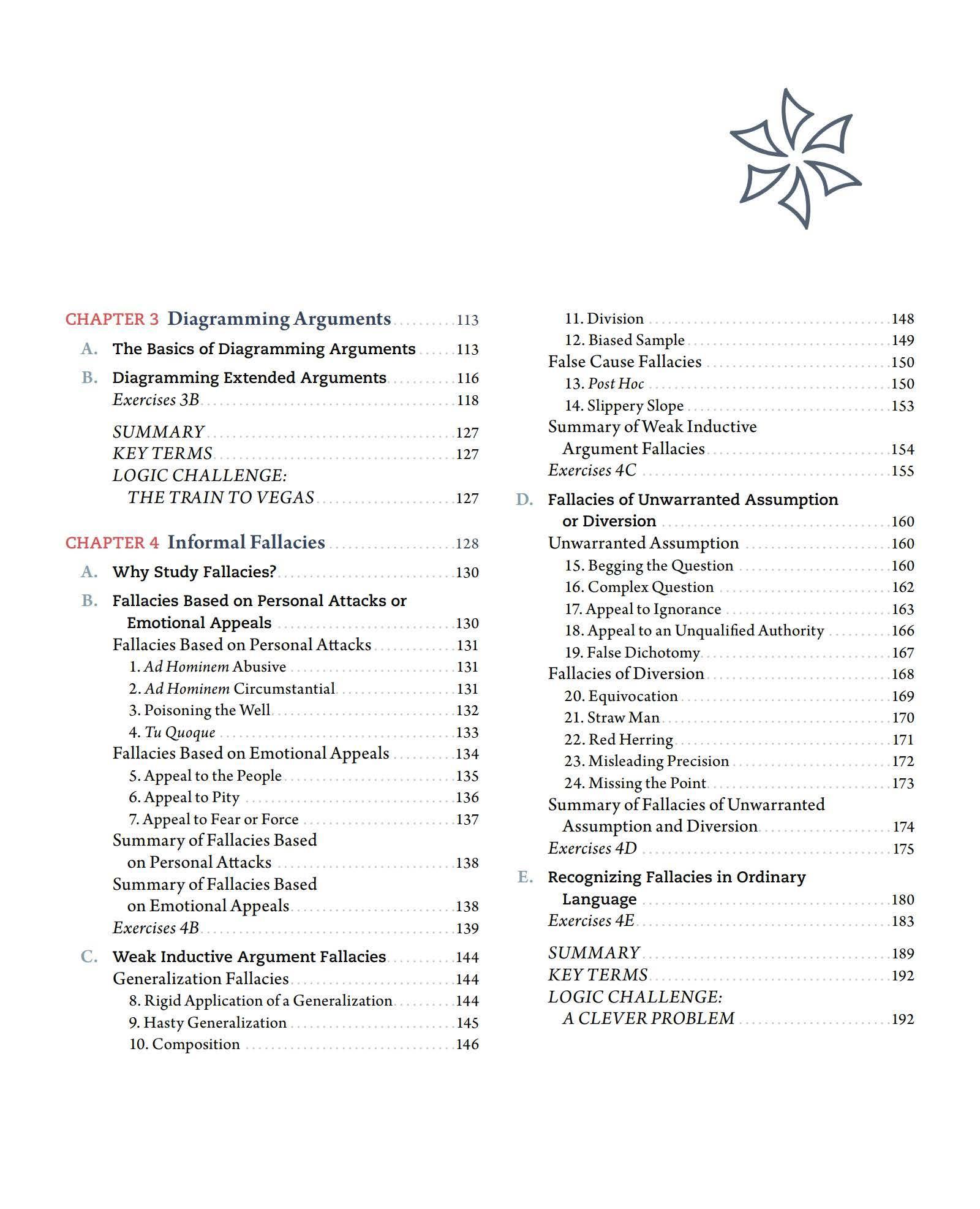
A. Categorical Propositions
Exercises
B. Quantity, Quality, and Distribution
Exercises
D.
E. Conversion, Obversion, and Contraposition
F. The Traditional Square of Opposition and Venn
G. Conversion, Obversion, and Contraposition in the
H. Translating Ordinary Language into Categorical
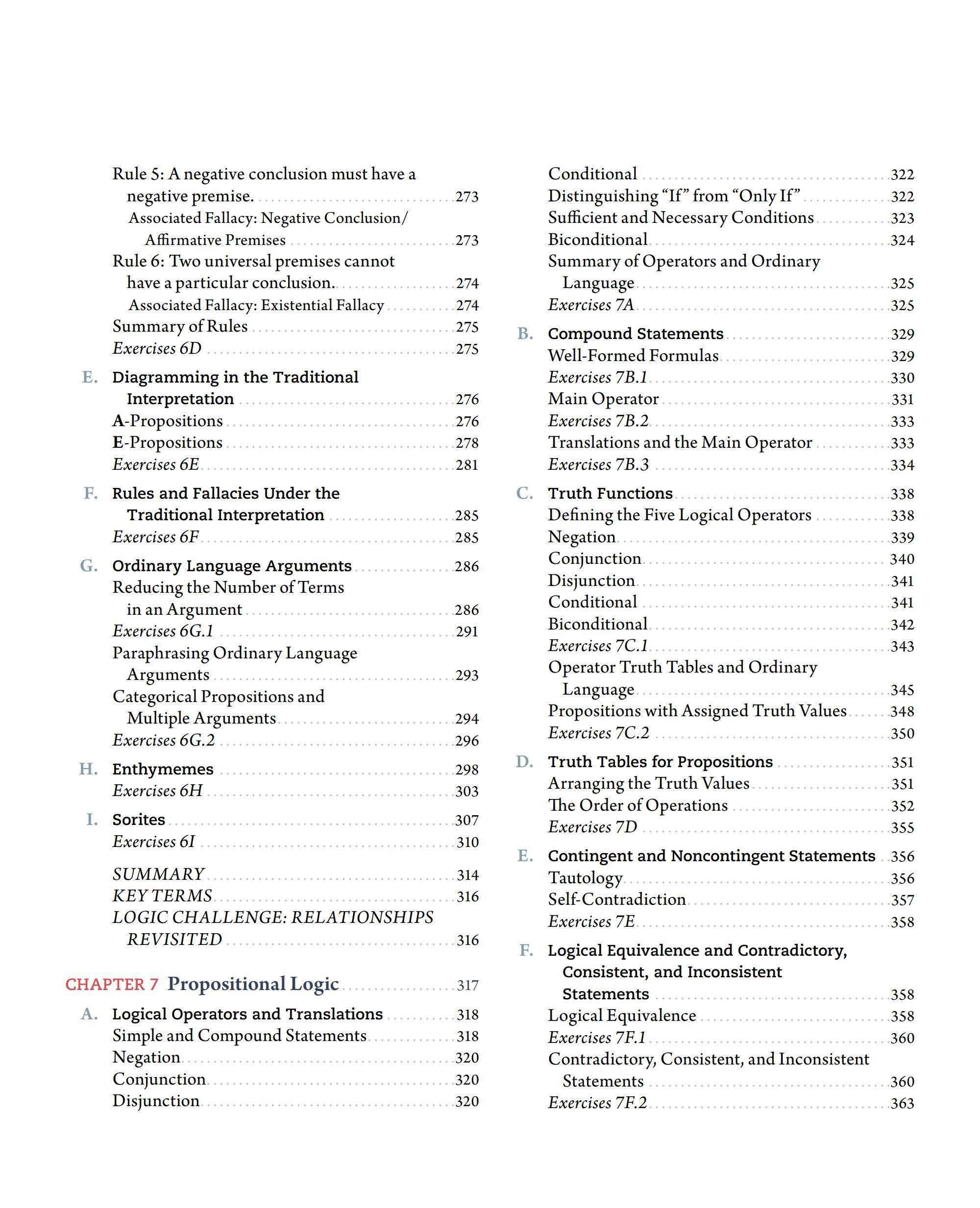
Rule 5: A negative conclusion must have a negative premise.
Associated Fallacy: Negative Conclusion / Affirmative Premises
Rule 6: Two universal premises cannot have a particular conclusion
Associated Fallacy: Existential Fallacy
Summary of Rules
Exercises 6D
E. Diagramming in the Traditional
Exercises 6E
F. Rules and Fallacies Under the
6F
G. Ordinary Language
Reducing the Number of Terms in an Argument
G. Truth Tables for Arguments
Validity
Analyzing and Necessary Conditions in Arguments
Technical Validity 7G.1
Argument Forms
Exercises 7G.2
H. Indirect Truth Tables
’Thinking Through an Argument
A Shorter Truth Table Exercises 7H.l
Using Indirect Truth Tables to Examine Statements for Consistency . Exercises 7H.2
SUMMARY
C.
C.
D.
E.
F.
“'At Most'' 521
“'At Least" 522 “ Exactly''
Part IV Inductive Logic
F.
G.
CHAPTER 12 Moral Arguments
A. Value Judgments
B.
Controlled Experiments
Determining Causality
H. Science and Superstition …·
Need for a Fair Test
the Hypothesis
Allure of Superstition .
Exercises 14H
Instructors interested in providing students with an opportunity for further analysis can refer them to Online Chapter 15, located on the companion website at www.oup.com / us / baronett.
ONLINE CHAPTER 15 Analyzing a Long Essay
A. Childbed Fever
B. Vienna 15B
C. Miasm and Contagion Exercises 15C
D. Semmelweis ’ s Account of the Discovery 15D
E. Initial Questions 15E
F. A New Interpretation 15F
SUMMARY
BIBLIOGRAPHY
APPENDIX A The LSAT and Logical
B. Choosing the Best Missing Conclusion
C. Assumptions: Choosing the Best Missing Premise
4. Additional Information That Strengthens or Weakens an Argument
5. Arguments That Use Either Analogical, Statistical, or Causal Reasoning 701
Preface
Today’s logic students want to see the relevance of logic to their lives. ’They need motivation to read a logic textbook and do the exercises. Logic and critical thinking instructors want their students to read the textbook and to practice the skills being taught. ’They want their students to come away with the ability to recognize and evaluate arguments, an understanding of formal and informal logic, and a lasting sense of why they concerns meet head-on in the textbook is designed to help alleviate these concerns.
THE CONTINUING STORY
focus of the fourth edition has been on fine-tuning an already student-friendly and comprehensive introduction to logic book. To that effect, several passages have been reworked with an eye toward more clarity and goal has been to define, explain, and illustrate those key logical concepts that require an in-depth understanding based on the many possible applications of those idea is to provide as much information as possible regarding key concepts so students are well equipped to tackle the exercise sets.
driving force behind writing the fourth edition has been the continuing effort to make logic relevant, interesting, and accessible to today ’ s students, without sacrificing the coverage that instructors demand and expect. An introduction to logic is a student ’s only exposure to rigorous thinking and symbolism. It should prepare them for reasoning in their lives and careers. It must balance careful coverage of abstract reasoning with clear, accessible explanations and vivid everyday examples. book was written to meet all those challenges. Relevant examples provide a bridge between formal reasoning and practical applications of logic, thereby connecting logic to students' lives and future careers. Each chapter opens with a discussion of an everyday example, taken directly from contemporary events, to pose the problem and set the narrative tone. ’This provides an immediate connection between logic and real-world issues, motivating the need for logic as a tool to help with the deluge of information available today.
challenge of any introduction to logic textbook is to connect logic to students' lives. Yet existing texts can and should do more to reinforce and improve the basic skills of reasoning we all rely on in daily life. Relevant, real-life examples are essential to making logic accessible to students, especially when they mesh seamlessly with the technical material. To accomplish this, quotes and passages from modern and classic sources illustrate the relevance of logic through some of the perennial problems that impact everyone ’s lives. Examples concerning the workplace, careers, sports, politics, movies, music, TV, novels, new inventions, gadgets, cell phones, transportation,
newspapers, magazines, computers, speeches, science, religion, superstition, gambling, drugs, euthanasia, capital punishment, the role of government, taxes, military spending, and unemployment are used to show how arguments, and thus the role of logic, can be found in nearly every aspect of life. The examples were chosen to be interesting, thought-provoking, and relevant to students, and the writing style was to engage students by connecting logic to their lives.
AN INCLUSIVE TEXT
fourteen chapters are designed to provide a comprehensive logic textbook, but also one that can be tailored to individual courses and their result is a full five chapters on deductive logic, but also a uniquely applied five-chapter part on inductive logic. Here separate chapters on analogical arguments, legal arguments, moral arguments, statistical arguments, and scientific arguments allow students to apply the logical skills learned in the earlier parts of the book. As with previous editions, exp lanations and examples have been created to facilitate student comprehension, and to show students that the logical skills they are learning do in fact have practical, realworld material also provides more resources to help students when they do the exercise sets.
Since each chapter has been developed to provide maximum flexibility to instructors, some sections can be skipped in lecture without loss of continuity. In addition, those wishing for a briefer text can choose a text tailored to their course. They may choose to emphasize or omit certain chapters on formal logic or critical reasoning, and they may choose a selection of the five applied chapters to reflect their and their students' interests.
ALTERNATE FORMATS AND CUSTOM EDITIONS
Because every course and professor is unique, Logic, Fourth Edition, is available in a variety of formats to fit any course structure or student budget.
The full text can be purchased in numerous formats:
• Print, ISBN: 9780190691714
• Loose leaf, ISBN: 9780190691738
• eBook, ISBN: 9780190691745
Additionally, Dashboard, the book ’ s optional online homework system, includes a full interactive version of the text that can be assigned alongside or in place of the print text. Please see the Instructor and Student Resources section of the preface for more information on Dashboard.
For those who do not wish to assign the complete text, Alternate and Custom Editions are available in print and digital format. Each Alternate Edition comes
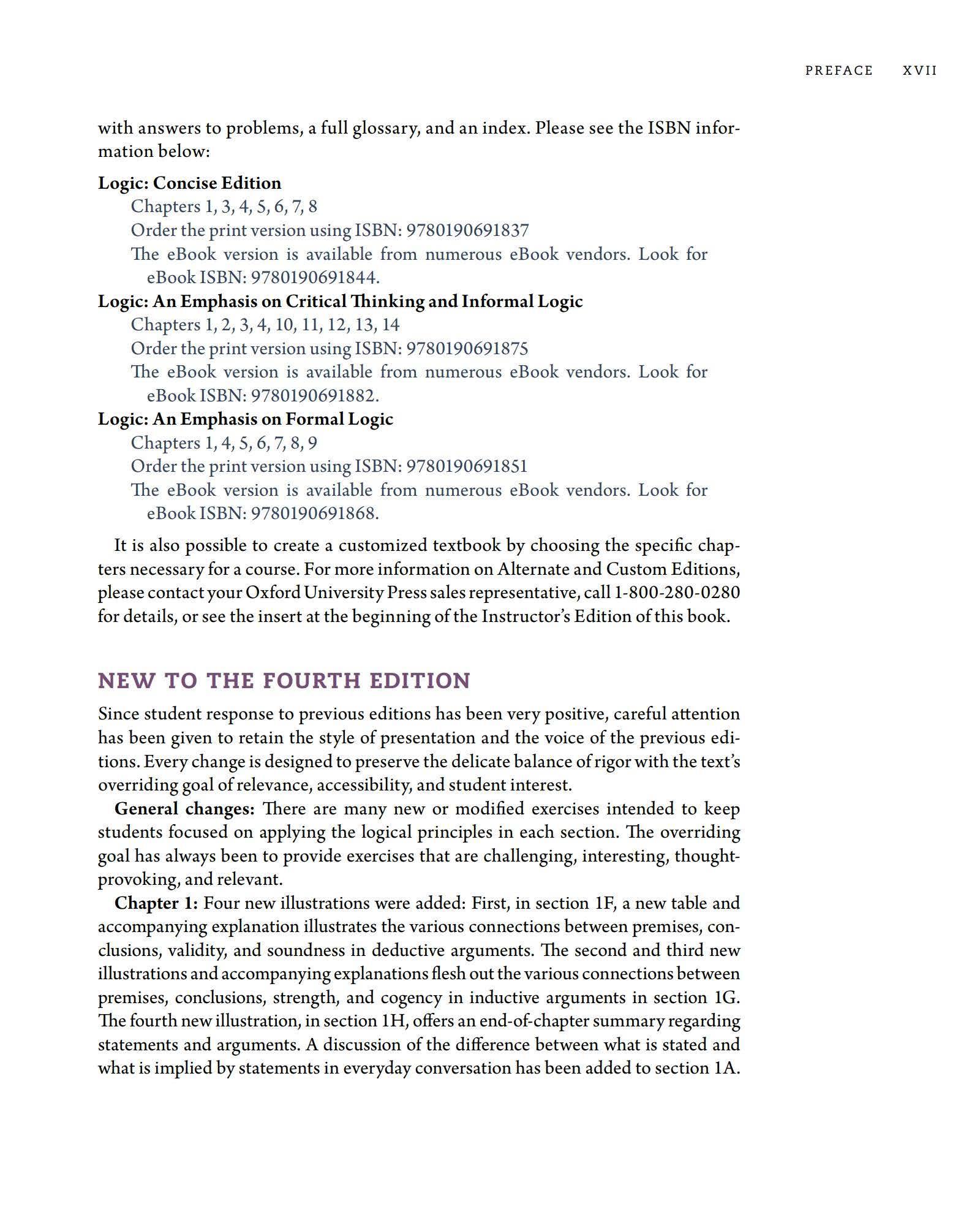
with answers to problems, a full glossary, and an index. Please see the ISBN information below:
Logic: Concise Edition
Chapters 1, 3, 4, S, 6, 7, 8
Order the print version using ISBN: 9780190691837
eBook version is available from numerous eBook vendors Look for eBook ISBN: 9780190691844 .
Logic: An Emphasis on Critical Thinking and Informal Logic
Chapters 1, 2, 3, 4, 10, 11, 12, 13, 14
Order the print version using ISBN: 9780190691875
eBook version is available from numerous eBook vendors Look for
eBook ISBN: 9780190691882 .
Logic: An Emphasis on Formal Logic
Chapters 1, 4, S, 6, 7, 8, 9
Order the print version using ISBN: 9780190691851
eBook version is available from numerous eBook vendors. Look for eBook ISBN: 9780190691868.
It is also possible to create a customized textbook by choosing the specific chapters necessary for a course. For more information on Alternate and Custom Editions, please contact your Oxford University Press sales representative, call 1-800-280-0280 for details, or see the insert at the beginning of the Instructor ’s Edition of this book.
NEW TO THE FOURTH EDITION
Since student response to previous editions has been very positive, careful attention has been given to retain the style of presentation and the voice of the previous editions. Every change is designed to preserve the delicate balance of rigor with the text's overriding goal of relevance, accessibility, and student interest.
General are many new or modified exercises intended to keep students focused on applying the logical principles in each overriding goal has always been to provide exercises that are challenging, interesting, thoughtprovoking, and relevant.
Chapter 1: Four new illustrations were added: First, in section lF, a new table and accompanying explanation illustrates the various connections between premises, conclusions, validity, and soundness in deductive second and third new illustrations and accompanying explanations flesh out the various connections between premises, conclusions, strength, and cogency in inductive arguments in section lG.
fourth new illustration, in section lH, offers an end-of-chapter summary regarding statements and arguments. A discussion of the difference between what is stated and what is implied by statements in everyday conversation has been added to section lA.
In section IE, the definitions of deductive and inductive arguments now incorporate the role of the inferential claim. In section lG, the definitions of strong and weakinductive arguments the probable truth of the conclusion the truth of the emphasis leads to the discussion of an inductive argument in which premises that are irrelevant to the conclusion fail to provide any probabilistic support for the conclusion, resulting in a weak the "principle of charity" discussion has been expanded to stress its role in the search for truth.
Chapter 2: Two new reference boxes were added to help students with exercise sets 2C and 2D. Several new examples have been added to the discussion of operational definitions. The discussions and have been reworked to offer more clarity.
Chapter 3: Additional explanation and examples of dependent premises, independent premises, and diagramming techniques associated with extended arguments are provided. Anew key term has been added: A simple diagram consists of a single premise and a single conclusion. Finally, several new exercises have been added.
Chapter 4: Several definitions of key terms have been revisions bring out additional aspects of the concepts involved, thereby making it easier for students to apply the definitions to the exercise sets. The revised terms include informal f allaquoque, appeal to the people, and rigid application of a generalization.
Chapter 5: The terms and “ undistributed " have been clarified for categorical statements. A new set of exercises has been added to Exercises SE to give students more practice in analyzing immediate inferences under the modern interpretation. The discussion of existential import in SC has been modified to clarify its use in both the modern and traditional interpretations of universal propositions. Also, the discussion of the traditional square of opposition in SF has been rewritten to clarify the understanding and application of existential import and the “ ass umption of existence " for universal propositions. A new set of exercises has been added to Exercises SF to give students more practice in analyzing immediate inferences under the traditional directions for Exercise set SG have been rewritten to offer more guidance to students.
Chapter concept of a well-formed formula has been reworked to offer more clarity and precision for students, and to help with the related discussions of inclusive and exclusive have been clarified. Several exercises in 7A have been moved to a later exercise set where students have additional information to apply to the concept of a truth-functional proposition has been concept of negation has been concept of a tautology has been question of whether or not a set of statements is consistent has been expanded to reveal its practical applications.
Chapter 8: A new discussion illustrates how natural deduction proofs allow for creativity by showing how more than one correct proof is possible for a given problem. is coupled with examples of questions that naturally arise when students start creating their own discussion of misapplications of has been expanded along with new examples.
The discussions of universal and generalization have been expanded and clarified by the addition of new change of section now has additional examples to help facilitate understanding the four logical identity rules have been modified to include special symbols that are more in line with the way the inference rules for predicate logic are presented. Additional examples further illustrate each identity rule.
Chapter 12: Additional discussion of the role that logic plays in moral reasoning is presented, especially in the analysis, evaluation, and construction of moral arguments. new Profiles in Logic have been added: Rudolf Carnap in Chapter 2; Francis Bacon in Chapter 4; and G. E. Moore in Chapter 12.
New Appendix: Many instructors have asked for material that directly applies the logical skills introduced in the book to the Law School Test (LSAT) . In a new appendix to the book, LSAT-type questions are presented and analyzed by reference to specific logical reasoning techniques that occur in Logic. This new section offers an in-depth look at the skills and techniques needed to do well on the LSAT logical reasoning questions. By working through the study guide, students can readily see that what they learn in Logic has direct application to the LSAT.
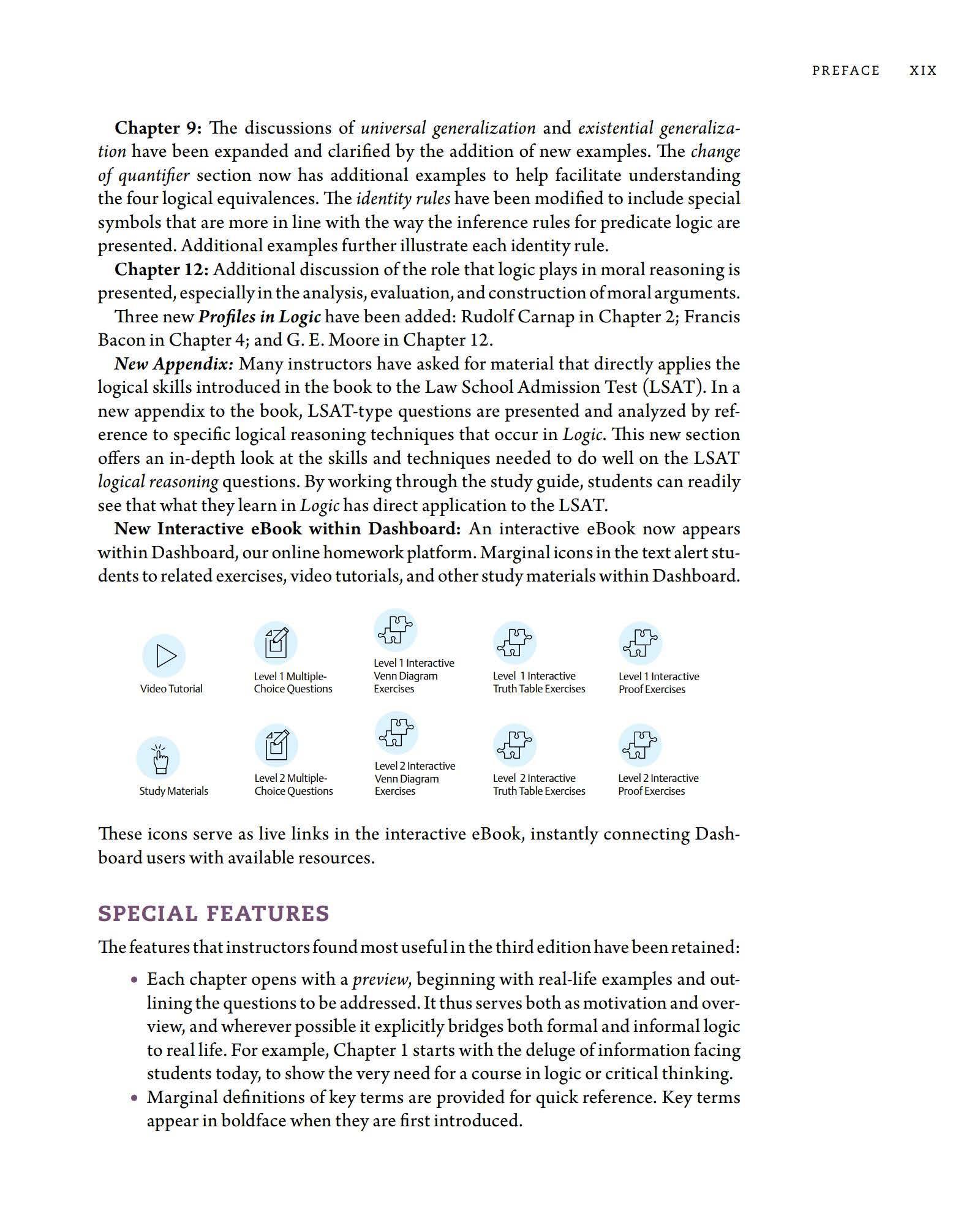
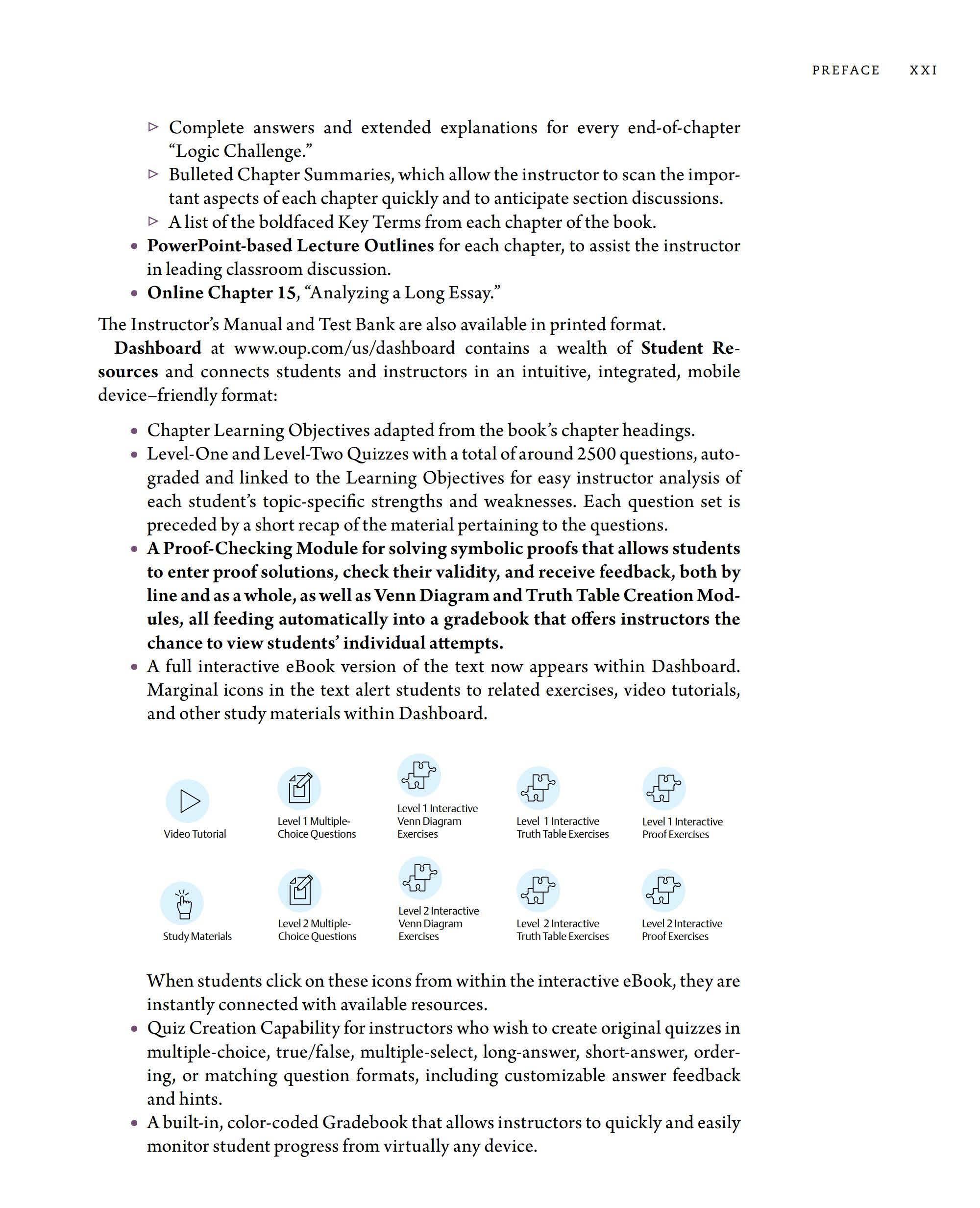
New Interactive eBook within Dashboard: An interactive eBook now appears within Dashboard, our online homework platform. Marginal icons in the text alert students to related exercises, video tutorials, and other study materials within Dashboard.
icons serve as live links in the interactive eBook, instantly connecting Dashboard users with available resources.
SPECIAL FEATURES
features that instructors found most useful in the third edition have been retained:
• Each chapter opens with a preview, beginning with real-life examples and outlining the questions to be addressed. It thus serves both as motivation and overview, and wherever possible it explicitly bridges both formal and informal logic to real life. For example, Chapter 1 starts with the deluge of information facing students today, to show the very need for a course in logic or critical thinking.
• Marginal definitions of key terms are provided for quick reference. l(ey terms appear in boldface when they are first introduced.
use of reference boxes has been expanded, since they have proven useful to both students and instructors. They capture material that is spread out over a number of pages in one place for easy reference.
• Pro.files in Logic are short sketches of logicians, philosophers, mathematicians, and others associated with men and women in these sketches range in time from Aristotle and the Stoics to Christine Ladd-Franklin, the early ENIAC programmers, and others in the past century.
• Bulleted summaries are provided at the end of each chapter, as well as a list of key terms.
Ex ercises include a solution to the first problem in each set. Explanations are also provided where additional clarity is provides a model for students to follow, so they can see what is expected of their answers. In addition, approximately25 % of the exercises have answers provided at the back of the book.
• End-of-chapter Logic Challenge problems are included for each chapter. ’These are the kind of puzzles-like the problem of the hats, the truth teller and the liar, and the scale and the coins-that have long kept people thinking. They end chapters on a fun note, not to mention with a reminder that the challenges of logic are always lurking in plain English.
• A full glossary and index are located at the end of the book.
STUDENT AND INSTRUCTOR RESOURCES
A rich set of supplemental resources is available to support teaching and learning in this supplements include Instructor Resources on the Oxford University Press Ancillary Resource Center (ARC) at www.oup-arc.com / access / intuitive, auto-graded assessments and other student resources on Dashboard by Oxford University Press, at www.oup.com / us / dashboard; a free Companion Website for students available at www.oup-arc.com / access / baronett4e; and downloadable Learning Management System Cartridges. ARC site at www.oup-arc.com / access / baronett4e houses a wealth oflnstructor Resources:
• A customizable, auto-graded Computerized Test Bank of roughly 1500 multiple-choice and true / false questions.
• An Instructor's Manual, which includes the following:
t> A traditional “ Pencil-and- Paper'' version of the Test Bank, containing the same 1500 questions as the Computerized Test Bank, but converted for use in hard-copy exams and homework assignments, including some openended questions that allow students to develop extended analysis, such as drawing Venn diagrams, completing truth tables, and doing proofs.
t> A list of the 1500 questions from the Computerized Test Bank (in their closed-ended, multiple-choice and true / false format).
t> Complete answers to every set of exercises in the book-around 2800 exercises in total-including extended explanations for many of the questions that require additional discussion and clarification.
l> Complete answers and extended explanations for every end-of-chapter “ Logic Challenge. ”
l> Bulleted Chapter Summaries, which allow the instructor to scan the important aspects of each chapter quickly and to anticipate section discussions.
l> A list of the boldfaced Key Terms from each chapter of the book.
• PowerPoint-based Lecture Outlines for each chapter, to assist the instructor in leading classroom discussion.
• Online Chapter 15,“'.Analyzing a Long Essay."
Instructor ’s Manual and Test Bank are also available in printed format.
Dashboard at www.oup.com / us / dashboard contains a wealth of Student Resources and connects students and instructors in an intuitive, integrated, mobile device-friendly format:
• Chapter Learning Objectives adapted from the book's chapter headings.
• Level-One and Level-Two Quizzes with a total of around 2500 questions, autograded and linked to the Learning Objectives for easy instructor analysis of each student ’s topic-specific strengths and weaknesses. Each question set is preceded by a short recap of the material pertaining to the questions.
• Module for solving symbolic proofs that allows students to enter proof solutions, check their validity, and receive feedback, both by line and as a whole, as well as Venn Diagram and Truth Table Creation Modules, all feeding automatically into a gradebook that offers instructors the chance to view students' individual
• A full interactive eBook version of the text now appears within Dashboard. Marginal icons in the text alert students to related exercises, video tutorials, and other study materials within Dashboard.
When students click on these icons from within the interactive eBook, they are instantly connected with available resources.
• Quiz Creation Capability for instructors who wish to create original quizzes in multiple-choice, true / false, multiple-select, long-answer, short-answer, ordering, or matching question formats, including customizable answer feedback and hints.
• A built-in, color-coded Gradebook that allows instructors to quickly and easily monitor student progress from virtually any device.
• Video Tutorials that work through specific example questions, bringing key concepts to life and guiding students on how to approach various problem types.
• Interactive Flashcards ofl(ey Terms and their definitions from the book.
• A Glossary of Key Terms and their definitions from the book.
• Chapter Guides for reading that help students to think broadly and comparatively about the new ideas they encounter.
• Tipsheets that help students to understand the particularly complicated ideas presented in each chapter.
• Online Chapter 15,“'Analyzing a Long Essay. ”
• Tools for student communication, reference, and planning, such as messaging and spaces for course outlines and syllabi.
Access to Dashboard can be packaged with Logic at a discount, stocked separately by your college bookstore, or purchased directly at www.oup.com / us / dashboard. For information about bundling Dashboard in a money-saving package with the print text, please contact your Oxford University Press sales representative or call 1-800-280-0280.
free Companion Website at www.oup-arc.com / access / baronett4e contains supplemental Student Resources:
• Level-One and Level-Two Student Self-Quizzes, containing roughly 1500 multiple-choice and true / false questions. The “ Pre-Chapter” quizzes feature questions taken from and answered in the book itself, while the “ Post-Chapter” quizzes are unique to the Student Resources and give students a chance to review what they encountered in each chapter. Each question set is preceded by a short recap of the material pertaining to the questions.
• Interactive Flashcards of Key Terms and their definitions from the book.
• Video Tutorials that work through specific example questions, bringing key concepts to life and guiding students on how to approach various problem types.
• Chapter Guides for reading that help students to think broadly and comparatively about the new ideas they encounter.
• Tipsheets that help students to understand the particularly complicated ideas presented in each chapter.
• Online Chapter IS ,“'Analyzing a Long Essay. ”
Instructor Resources from the ARC and the Student Resources from the Companion Website are also available in Course Cartridges for virtually any Learning Management System used in colleges and universities.
To find out more information or to order a printed Instructor’s Manual, Dashboard access, or a Course Cartridge for your Learning Management System, please contact your Oxford University Press representative at 1-800-280-0280.
ACKNOWLEDGMENTS
For their very helpful suggestions throughout the writing process, I would like to thank the following reviewers:
• Mohamad Al-Hakim, Florida Gulf Coast University
• Guy Axtell, Radford University
• Ida Baltikauskas, Century College
• Joshua Beattie, California State University-East Bay
• Luisa Benton, Richland College
• Michael Boring, Estrella Mountain Community College
• Daniel Brunson, Morgan State University
• Julia R. Bursten, University of Kentucky
• Jeremy Byrd, Tarrant County College
• Bernardo Cantens, Moravian College
• John Casey, Northeastern Illinois University
• Darron Chapman, University of Louisville
• Eric Chelstrom, Minnesota State University, Moorhead
• Chen, Humboldt State University
• Kevin DeLapp, Converse College
• Tobyn DeMarco, Bergen Community College
• William Devlin, Bridgewater State University
• Ian Duckles, Mesa College
• David Lyle Dyas, Los Angeles Mission College
• David Elliot, University of Regina M. Faller, University of Portland
• Craig Fox, California State University, Pennsylvania
• Matthew Prise, Baylor University
• Dimitria Electra Gatzia, University of Akron
• Cara Gillis, Pierce College
• David Gilboa, University Oshkosh
• Nathaniel Goldberg, Washington and Lee University
• Michael Goodman, Humboldt State University
• John Grey, Michigan State University
• Mary Gwin, San Diego Mesa College
• Matthew Hallgarth, Tarleton State University
• Anthony Hanson, De AnzaCollege
• Merle Harton, Jr., Everglades University
• John Helsel, University of Colorado, Boulder
• Will Heusser, Cypress College
• Ryan Hickerson, Western Oregon University
• Charles Hogg, Grand Valley State University
• Jeremy D. Hovda, Katholieke Universiteit Leuven
• Debby D. Hutchins, Gonzaga University
• Brian Huth, Kent State University
• Daniel Jacobson, University of Michigan-Ann Arbor
• William S. Jamison, University of Alaska Anchorage
• C. Jantzen, Virginia Polytechnic Institute & State University
• Gary James Jason, California State University, Fullerton
• William M. Kallfelz, Mississippi State University
• Robert Larmer, University of New Brunswick
• Lory Lemke, University of Minnesota-Morris
• Court Lewis, Owensboro Community and Technical College
• David Liebesman, Boston University
• Brandon C. Look, University of Kentucky
• Ian D. MacKinnon, University of Akron
• Erik Meade, Southern Illinois University Edwardsville
• Alexander Miller, Piedmont Technical College
• James Moore, Georgia Perimeter College
• Allyson Mount, Keene State College
• Nathaniel Nicol, Washington State University
• Rosibel 0 ’ Brien-Cruz, Harold Washington College
• Joseph B. Onyango Okello, Seminary
• Stephen Russell Orr, Solano Community College
• Lawrence Pasternack, Oklahoma State University
• James Pearson, Bridgewater State University
• Christian Dowling College
• Adam C. Podlaskowski, Fairmont State University
• Michae.l Methodist University
• Mark Reed, Tarrant County College
• Greg Rich, University
• M iles Rind, Boston College
• Linda Roll in, Colorado State University
• Marcus University of Connecticut
• Kent State University
• Eric Saide!, George Washington University
• Kelly Sa lsbery, Stephen F. Austin State University
• David Sanson, Illinois State University
• Stephanie Polytechnic I nstitute & State University
• Robert Shanab, of Nevada-Las Vegas
• David ton State University
• Aeon). Skoble, Bridgewater State
• Nancy Slonneger- Hancock, Northern Kentucky University
• Basil Smith, Saddleback College
• Joshua Smith, Central Michigan University
• Paula Smithka, of Southern
• Deborah Hansen State University
• Charles Stein, St.
• David Stern, University of Iowa
• Tim Sundell, University of
• EricSwanson, UniversityofMichigan,Ann Arbor
• Talbert, West Virginia University
• Erin Tarver, Emory University
• James of NewJersey
• Ramon Tello, Shasta College
• Joia Turner, St. Paul College
• University of
• Michael Ventimiglia, Sacred Heart University
• Marl< C State University
• Reginald Williams, Bakersfield College
• Mia Wood, Pierce College
• Kiriake Xerohemona, Florida International University
• Jeffrey Zents, South T exas Co llege
Many thanks also to the staff at Oxford University Press, Robert Miller, e xecutive editor; Maegan Sherlock, development editor; A.lyssa Palazzo, associate editor; Barbara Mathieu, senior production editor, and Michele Laseau, art director: for their work on the book. The Logic portraits ,vere drawn by Katie Klasmeier.