Licensed to Emily Du, from Nossal High School until 2022-01-01.
LEGAL STUDIES FOR VCE
ACCESS & JUSTICE
14TH EDITION
LISA FILIPPIN
PETER FARRAR
ANNIE WILSON
MARGARET BEAZER
JOSIE GRAY
1Oxford University Press is a department of the University of Oxford. It furthers the University’s objective of excellence in research, scholarship, and education by publishing worldwide. Oxford is a registered trademark of Oxford University Press in the UK and in certain other countries.
Published in Australia by Oxford University Press
Level 8, 737 Bourke Street, Docklands, Victoria 3008, Australia
The moral rights of the authors have been asserted
First published 1994
This edition published 2021
All rights reserved. No part of this publication may be reproduced, stored in a retrieval system, or transmitted, in any form or by any means, without the prior permission in writing of Oxford University Press, or as expressly permitted by law, by licence, or under terms agreed with the appropriate reprographics rights organisation. Enquiries concerning reproduction outside the scope of the above should be sent to the Rights Department, Oxford University Press, at the address above.
You must not circulate this work in any other form and you must impose this same condition on any acquirer.
ISBN 978 0 19 032626 5
Reproduction and communication for educational purposes
The Australian Copyright Act 1968 (the Act) allows educational institutions that are covered by remuneration arrangements with Copyright Agency to reproduce and communicate certain material for educational purposes. For more information, see copyright.com.au.
Edited by Naomi Saligari
Text design by OUPANZ
Typeset by Newgen KnowledgeWorks Pvt. Ltd., Chennai, India
Indexed by Neil Daly
Printed in China by Sheck Wah Tong Printing Press Ltd
Disclaimer
Indigenous Australians and Torres Strait Islanders are advised that this publication may include images or names of people now deceased.
Links to third party websites are provided by Oxford in good faith and for information only. Oxford disclaims any responsibility for the materials contained in any third party website referenced in this work.
UNIT 2 SANCTIONS, REMEDIES
11.11 ALTERNATIVE APPROACHES TO SENTENCING .........369
CHAPTER 11 REVIEW TOP TIPS, REVISION QUESTIONS AND PRACTICE ASSESSMENT TASK .................................378 CHAPTER 12 RECENT CRIMINAL CASES .....380
12.1 RECENT CRIMINAL CASE 1: A WEEKEND AT AN AIRBNB ENDS IN MURDER ....................................382
12.2 RECENT CRIMINAL CASE 2: THE CASE THAT CAPTIVATED VICTORIA ...................................................389
12.3 RECENT CRIMINAL CASE 3: THE ASSAULT OF A PARAMEDIC..................................................................396
12.4 RECENT CRIMINAL CASE 4: THE TRIAL AND ACQUITTAL OF CARDINAL GEORGE PELL ..................405
CHAPTER 12 REVIEW TOP TIPS, REVISION QUESTIONS AND PRACTICE ASSESSMENT TASK .................................414
CHAPTER 13 REMEDIES
.................................416
13.1 INTRODUCTION TO REMEDIES .....................................418
13.2 THE PRINCIPLES OF JUSTICE IN CIVIL LAW ..............420
13.3 METHODS USED TO RESOLVE A CIVIL DISPUTE ........422
15.1 INTRODUCTION TO RIGHTS ...........................................498
15.2 THE PROTECTION OF RIGHTS THROUGH STATUTE LAW AND THE VICTORIAN CHARTER...........................500
15.3 THE PROTECTION OF RIGHTS THROUGH COMMON LAW .................................................................505
15.4 THE PROTECTION OF RIGHTS THROUGH THE AUSTRALIAN CONSTITUTION ..............................511
15.5 INTERNATIONAL TREATIES, DECLARATIONS AND THE RIGHTS OF AUSTRALIANS ....................................517
13.7 THE ROLE AND CIVIL JURISDICTIONS OF THE VICTORIAN COURTS .......................................................442
13.8 THE ROLE OF THE JURY IN A CIVIL TRIAL ...................449 13.9 THE PURPOSES AND TYPES OF REMEDIES ...............453 CHAPTER 13 REVIEW TOP TIPS, REVISION QUESTIONS AND PRACTICE ASSESSMENT TASK ..................................458
CHAPTER 14 RECENT CIVIL
14.1 RECENT CIVIL CASE 1: THE CRIME REPORTER WHO SUED THE AGE .......................................................462
14.2 RECENT CIVIL CASE 2: UBER SUCCESS DRIVES TAXIS TO CLASS ACTION .................................471
14.3 RECENT CIVIL CASE 3: DOCKLANDS HIGH-RISE FIRE EARNS $5M IN DAMAGES ................478
15.6 THE APPROACH ADOPTED BY THE UNITED STATES IN PROTECTING RIGHTS ................................................524
15.7 POSSIBLE REFORMS TO THE PROTECTION OF RIGHTS IN AUSTRALIA ...................................................532
15.8 THE MABO CASE – THE PROTECTION OF RIGHTS IN AUSTRALIA .................................................................537
CHAPTER 15 REVIEW TOP TIPS, REVISION QUESTIONS AND PRACTICE ASSESSMENT TASK ..................................542
14.4 RECENT CIVIL CASE 4: THE SHOCKING REVELATIONS OF LAWYER X ........................................485
14.5 RECENT CIVIL CASE 5: R EBEL WITH A CAUSE (OBOOK ASSESS TOPIC)
CHAPTER 14 REVIEW TOP TIPS, REVISION QUESTIONS AND PRACTICE ASSESSMENT TASK ..................................494
SUMMARY OF LEGAL SCENARIOS
CHAPTER 1 LEGAL TOOLKIT
No legal cases
UNIT 1 GUILT AND LIABILITY
CHAPTER 2 INTRODUCTION TO UNIT 1 – GUILT AND LIABILITY
No legal cases
CHAPTER 3 LEGAL FOUNDATIONS
Deing v Tarola [1993] 2 VR 163 ..........................................54
Donoghue v Stevenson [1932] All ER 1 .............................. 55
Lansell House Pty Ltd v Commissioner of Taxation (2011) 190 FCR 354 ...................................................................58
State Government Insurance Commission (SA) v Trigwell (1979) 142 CLR 617 ........................................................59
DPP v Webster [2019] VCC 2239 (19 December 2019) .......61
Wyong Shire Council v Shirt (1980) 146 CLR 40 .................62
Wilson v Bauer Media Pty Ltd [2017] VSC 521 (13 September 2017) .....................................................63
DPP v Djokovic [2019] VCC 1848 (12 November 2019) .......67
Fraser v Walker [2015] VCC 1911 (19 November 2015) ...179
CHAPTER 7 CIVIL LIABILITY
Werfel v AMACA v The State of South Australia [2019] SAET 159 (6 August 2019) ...........................................201
State Rail Authority of New South Wales v Chu [2008] NSWCA 14 (6 March 2008) ..........................................206
CHAPTER 8 TORT LAW
Chester v Waverley Municipal Council (1939) 62 CLR 1 ....223
Roman Catholic Church Trustees for the Diocese of Canberra & Goulburn v Hadba (2005) 221 CLR 161 .....225
Woolworths Ltd v Grimshaw [2016] QCA 274 (28 October 2016).........................................................227
Mickle v Farley [2013] NSWDC 295 (29 November 2013) ...233
Rush v Nationwide News Pty Ltd (No 7) [2019] FCA 496 (11 April 2019) ...............................................234
Voller v Nationwide News Pty Ltd; Voller v Fairfax Media Publications Pty Ltd; Voller v Australian News Channel Pty Ltd [2019] NSWSC 766 (24 June 2019) ..................239
Hallett v City of Port Phillip [2015] VSC 313 (30 June 2015) ..244
Gales Holdings Pty Ltd v Tweed Shire Council [2011] NSWSC 1128 (21 September 2011) .............................245
Hollywood Silver Fox Farm Ltd v Emmett [1936] 2 KB 468...246
Courtney & Jackson v Howell [2016] VMC011 (26 July 2016) ...............................................................248
Public Health and Wellbeing Amendment (Safe Access Zones) Act 2015 (Vic) ................................249
CHAPTER 9 OTHER AREAS OF CIVIL LAW
Jusrut v Ensure Recruitment Pty Ltd (Human Rights) [2020] VCAT 126 (7 February 2020)..............................259
Maloney v The Queen [2013] HCA 28 (19 June 2013) ......264
Kirvan & Tomaras [2018] FamCA 171 (21 March 2018) ...........................................................268
Chirag & Kanelka [2018] FamCA 476 (5 June 2018) ........271
Attorney-General for the Commonwealth v Kevin & Jennifer (2003) 172 FLR 300 ........................................274
Joyner v Intrepid Travel Pty Ltd (Civil Claims) [2017] VCAT 233 (17 February 2017)............................279
Carlill v Carbolic Smoke Ball Company [1892] EWCA Civ 1...................................................................281
UNIT 2 SANCTIONS, REMEDIES AND
RIGHTS
CHAPTER 10 INTRODUCTION TO UNIT 2 – SANCTIONS, REMEDIES AND RIGHTS
Wright v McMurchy (2011) 42 WAR 113 ...........................308
R v Eckersley [2020] VSC 22 (30 January 2020) ...............311
CHAPTER 11 SANCTIONS
Kingston City Council v Wong & Lapont International (Criminal) [2013] VMC 6 (10 April 2013) ......................329
Certain Children by their Litigation Guardian Sister Marie Brigid Arthur v Minister for Families & Children [2016] 51 VR 473 (21 December 2016) and Certain Children v Minister for Families & Children (No 2) [2017] VSC 251 (11 May 2017) ...............................................................336
Bradley v The Queen [2017] VSCA 69 (30 March 2017) ....339
DPP v Hilton-Taylor [2020] VCC 105 (19 February 2020) ..340
R v Skaf (2004) 60 NSWLR 86 ..........................................346
DPP v Kendall [2020] VCC 74 (24 January 2020) .............349
DPP v Lam [2020] VCC 160 (20 February 2020) ...............351
Cottrell v Ross [2019] VCC 2142 (19 December 2019) .....354
DPP v Larkins [2020] VCC 15 (29 January 2020)..............356
Cemino v Cannan [2018] VSC 535 (17 September 2018) ...373
CHAPTER 12 RECENT CRIMINAL CASES
DPP v AK (Sentence) [2019] VSC 852 (20 December 2019) ....................................................382
DPP v Ristevski [2019] VSC 253 (18 April 2019); DPP v Ristevski [2019] VSCA 287 (6 December 2019)............389
Tang v Haberfield (2019) VMC (28 August 2019); DPP v Haberfield [2019] VCC 2082 (16 December 2019) .......396
DPP v Pell (Sentence) [2019] VCC 260 (13 March 2019); Pell v The Queen [2019] VSCA 186 (21 August 2019); Pell v The Queen [2020] HCA 12 (7 April 2020) ............405
CHAPTER 13 REMEDIES
Hingst v Construction Engineering (Aust) Pty Ltd (No 3) [2018] VSC 136 (29 March 2018) ..................................418
Director of Consumer Affairs Victoria v Gibson [2017] FCA 240 (15 March 2017) .............................................436
Clarke v Great Southern Finance Pty Ltd (in liquidation) [2014] VSC 516 (11 December 2014) ...........................444
Obudho v Patty Malones Bar Pty Ltd [2017] VSC 28 (9 February 2017) .........................................................446
Humphris v ConnectEast Nominee Company Pty Ltd (No 2) [2016] VSC 419 (27 July 2016) ...........................449
Coleston v Carney [2019] VCC 177 (26 February 2019) ....454
Cruse v State of Victoria [2019] VSC 574 (27 August 2019) 455
CHAPTER 14 RECENT CIVIL CASES
YZ (a pseudonym) v The Age Company Limited [2019] VCC 148 (22 February 2019); The Age Company Limited v YZ (a pseudonym) [2019] VSCA 313 (19 December 2019) 462
Andrianakis v Uber Technologies Inc. S ECI 2019 01926 ..471
Owners Corporation No 1 of PS613436T v LU Simon Builders Pty Ltd (Building and Property) [2019] VCAT 286 (28 February 2019).......................................478
Orman v State of Victoria (2020)........................................485
Wilson v Bauer Media Pty Ltd [2017] VSC 521 (13 September 2017); Bauer Media Pty Ltd v Wilson (No 2) [2018] VSCA 154 (14 June 2018) ....................obook
CHAPTER 15 RIGHTS
Dietrich v The Queen (1992) 177 CLR 262 ........................506
Attorney-General for the Commonwealth v Kevin & Jennifer (2003) 172 FLR 300 ........................................506
Love v Commonwealth; Thoms v Commonwealth [2020] HCA 3 (11 February 2020)............................................507
Certain Children by their Litigation Guardian Sister Marie Brigid Arthur v Minister for Families and Children (2016) 51 VR 473 ............................................508
Attorney-General (Vic); Ex Rel Black v Commonwealth (1981) 146 CLR 559 ......................................................513
Australian Capital Television Pty Ltd v Commonwealth (1992) 177 CLR 106 ......................................................514
Clubb v Edwards; Preston v Avery (2019) 366 ALR 1 ........515
McGarrigle v National Disability Insurance Agency (2017) 252 FCR 121 ......................................................520
Brough v Australia (2006) Communication No 1184/2003 (27 April 2006) ......................................521
District of Columbia v Heller 54 US 570 (2008) and McDonald v Chicago 561 US 742 (2010) .......................526
Snyder v Phelps 562 US 443 (2011) ..................................527
Griswold v Connecticut 381 US 479 (1965) and Roe v Wade 410 US 113 (1973) .....................................529
Northern Territory v Griffiths (deceased) & Jones on behalf of the Ngaliwurru & Nungali Peoples [2019] HCA 7 (13 March 2019) ................................................540
USING LEGAL STUDIES FOR VCE UNITS 1 & 2
Legal Studies for VCE Units 1 & 2 (14th edition) o ers complete support for teachers and students completing Units 1 & 2 of VCE Legal Studies.
Key features of the Student book
Legal toolkit
The legal toolkit at the front of the book is a stand-alone reference section for students that includes:
The toolkit at the front of the book is a stand-alone reference section for students that includes:
• an overview of the structure of the VCE Legal Studies course
Chapter openers
• a range of helpful study tips
• tips for success in assessment tasks
• advice on mastering legal citation
• information about careers in the law.
• an engaging and relevant image that links to core content in the chapter
• links to expert authored content hosted on Quizlet, where it can be used anywhere, anytime
• a summary of outcomes, key knowledge and key skills dot points from the VCE Legal Studies Study Design (2018–2023)
• a list of key legal terms that appear in the chapter (with supporting defi nitions).
Clear topic-based approach
Content is sequenced in structured topics that are aligned to the Study Design. Each topic contains the following elements:
Key legal terms
Defi nitions are provided in the margin to support student understanding the fi rst time they appear in each chapter All key terms also appear in the glossary at the end of the book.
Study tip
Targeted study tips are provided in the margin where relevant. These are designed to explicitly help students to achieve better results on school-based and external assessment tasks.
Hypothetical scenario
Hypothetical situations that raise legal points are provided to stimulate discussion and illustrate how laws work in di erent contexts.
Extract Extracts from relevant legislation, Acts, reports, speeches and websites support learning.
Did you know? Interesting, quirky or fun facts about the law are provided to engage students and bring content to life.
Actual scenario
Relevant legal cases and media articles with accompanying citation help students understand real world examples of the law in action and provide opportunities for students to practise responding to scenario-based questions.
Chapter and unit review
Check your learning
Structured questions and tasks appear at the end of every topic. These provide opportunities for students to consolidate and extend their understanding. They are levelled under the following headings to allow for di erentiation:
• Defi ne and explain
• Synthesise and apply
• Analyse and evaluate.
Links to supporting digital resources on obook assess
Links to a range of supporting digital resources appear at the end of every topic. These include links to videos, worksheets, interactive quizzes, revision notes and weblinks.
Each chapter and unit wraps up with opportunities for review and revisions.
Each and unit wraps up with opportunities for review and revisions.
Chapter review
A chapter review appears at the end of every chapter and includes:
• three top tips from the chapter that provide succinct summaries of key points
• graded revision questions
Unit review
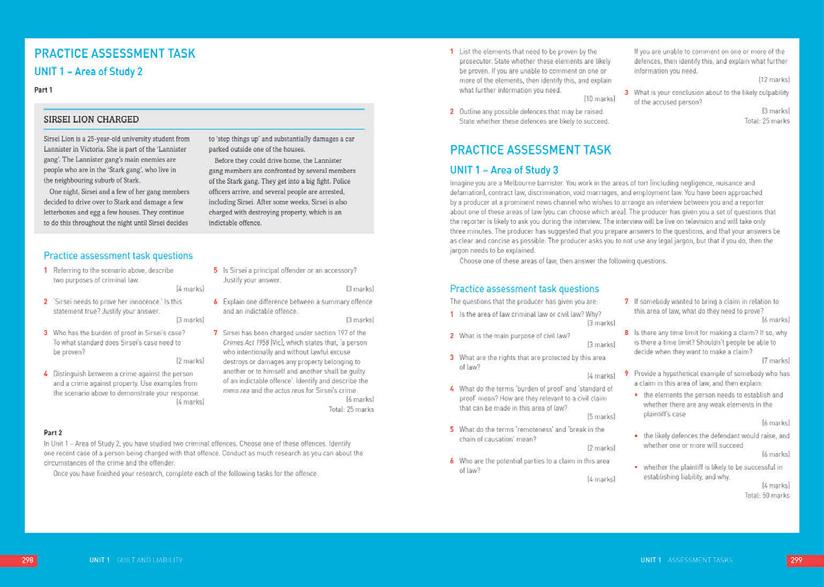
Unit assessment tasks appear at the end of Unit 1 and Unit 2.
These cover the key knowledge dot points for the whole Area of Study and are structured in line with a range of suggested assessment tasks covered in the VCE Legal Studies Study Design
• a practice assessment task.
Key features of digital support
Legal Studies for VCE Units 1 & 2 (14th edition) o ers complete support for teachers and students completing Units 1 & 2 of VCE Legal Studies.
Students receive:
• a complete digital version of the Student book with notetaking and bookmarking functionality
• targeted instructional videos by some of Victoria’s most experienced Legal Studies teachers, designed to help students prepare for exams and assessment tasks
• a range of engaging worksheets for every chapter, designed to consolidate and extend understanding on key points from the study design
• additional scenarios and examples for extension
• annotated on level, below level and above level responses
• auto-correcting quizzes for each chapter, which assess students’ level of understanding, monitor progress and feed into the markbook
• direct access to Quizlet.
Each chapter of Legal Studies for VCE Units 1 & 2 is supported by expert-authored content on Quizlet. Accessing Quizlet via a web browser or app, students have access to di erent interactive learning tools, including:
• interactive flashcards to help students learn key legal terminology
• multiple-choice questions to test students on their knowledge
• ‘type what you hear’ exercises to help students memorise key legal defi nitions.
also provides students with fun revision games to support their learning, including:
• Quizlet Live, where students battle in teams or individually against other members of their class
• ‘match’ card game, where students must match the correct term to its defi nition
• ‘gravity’ timed test, where students test their knowledge against the clock.
Teachers receive:
• access to all student resources
• detailed course planners, teaching programs and lesson plans
• answers to every question in the Student book
• chapter summary PowerPoint presentations ideal for whole-class revision
• practice exams and assessment tasks with answers
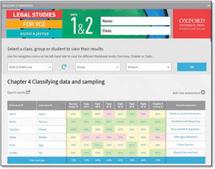
• access to markbook, where teachers can:
° fi lter online test and quiz results by class or group
° add custom results from self-administered assessments
° view student progress reports in HTML or PDF
• direct access to Quizlet.
Instructions for teachers launching a game of
1 When prompted in the Student book, log onto Oxford Digital and launch the Quizlet website.
2 Follow the prompts as to how you would like to host the game for your students (i.e. as individuals or in teams).
3 Your game is now set up with students ready to join. They can join by opening the Quizlet app or website and:
− manually entering the six-digit code that appears on the screen, or
− scanning the QR code that appears on the screen.
4 Once all students are ready, click the large ‘Create game’ button and a summary of which students are playing will appear. Click ‘start game’.
5 As the teacher, your screen will display a leaderboard that updates in live time as students answer questions.
CHAPTER1 LEGAL TOOLKIT
Source 1 Congratulations on choosing VCE Legal Studies! This chapter provides you with an introduction to and overview of the course, and contains handy hints and tips that can be revisited throughout the year. Licensed to Emily Du, from Nossal High School until 2022-01-01.
WELCOME TO VCE LEGAL STUDIES
UNITS 1 & 2
Congratulations on choosing Legal Studies as part of your VCE studies!
Legal Studies is an exciting, relevant and engaging course that explores the meaning of justice and helps you become active and informed citizens. It will provide you with opportunities to develop problem-solving skills as you navigate your way through criminal and civil cases and legal scenarios – both real and hypothetical.
This student book has been purpose-written to meet the requirements of the VCE Legal Studies Study Design (2018–2023) and includes content you are required to cover in Units 1 & 2.
This legal toolkit contains a range of useful and relevant information to help you get the most out of VCE Legal Studies. It can be used as an introduction
and overview to the course, but is also designed as a handy reference that can be revisited throughout the year.
TOPICS COVERED
This chapter provides an introduction to the following topics:
• 1.1 Understanding the VCE Legal Studies course
• 1.2 Setting yourself up for success in VCE Legal Studies
Make sure you visit the VCAA website and download a copy of the VCE Legal Studies Study Design. It sets out all the information you are expected to learn and provides important information on how you will be assessed.
A link to the current Study Design is provided on your obook a ssess.
UNDERSTANDING THE VCE LEGAL STUDIES COURSE
The Study Design
The requirements of the VCE Legal Studies course are set out in a document known as a Study Design. The VCE Legal Studies Study Design is published by the Victorian Curriculum and Assessment Authority (VCAA).
The Study Design is the most important document supporting the VCE Legal Studies course. It sets out all the information you are expected to learn and provides important details about the way you will be assessed.
Structure of the VCE Legal Studies course
VCE Legal Studies is a two-year course made up of four units:
Unit 1 – Guilt and liability
Unit 2 – Sanctions, remedies and rights
Unit 3 – Rights and justice
Unit 4 – The people and the law
Source 1 Structure of VCE Legal Studies Units 1–4
• Units 1 & 2 are most commonly completed in Year 11
• Units 3 & 4 are most commonly completed in Year 12
• You do not have to complete Units 1 & 2 to undertake Units 3 & 4
Each unit of the course is separated into Areas of Study. You are required to achieve an Outcome for each Area of Study. Sources 2 and 3 show how Units 1 & 2 of the course are broken down into Areas of Study and Outcomes. It also shows the chapters in this book that cover this content.
UNIT 1 – GUILT AND LIABILITY
Area of Study 1
Legal foundations
Area of Study 2
Outcome 1
On completion of this unit, the student should be able to describe the main sources and types of law, and assess the effectiveness of laws.
The presumption of innocence Outcome 2
On completion of this unit, the student should be able to explain the purposes and key concepts of criminal law, and use legal reasoning to argue the criminal culpability of an accused based on actual and/or hypothetical scenarios.
• Chapter 3 Legal foundations
Area of Study 3
Civil liability
Outcome 3
On completion of this unit, the student should be able to explain the purposes and key concepts of civil law, and apply legal reasoning to argue the liability of a party in civil law based on actual and/or hypothetical scenarios.
On completion of this unit, the student should be able to explain key concepts in the determination of a criminal case, and discuss the principles of justice in relation to the determination of criminal cases, sanctions and sentencing approaches.
Area of Study 2 Remedies Outcome 2
On completion of this unit, the student should be able to explain key concepts in the resolution of a civil dispute, and discuss the principles of justice in relation to the resolution of civil disputes and remedies.
Area of Study 3 Rights Outcome 3
On completion of this unit, the student should be able to evaluate the ways in which rights are protected in Australia, compare this approach with that adopted by another country and discuss the impact of an Australian case on the rights of individuals and the legal system.
Each Outcome in the course includes a series of key knowledge dot points and key skills dot points:
• the key knowledge dot points tell you what you should know and learn
• the key skills dot points tell you what you should do with that knowledge.
You will find the key knowledge and key skills for each Outcome at the start of each chapter of this book. It is important that you read and become familiar with these before you begin each chapter.
Source 4 The VCE Legal Studies course is a two-year course made up of four units. Units 1 & 2 are covered in Legal Studies for VCE Units 1 & 2 Access & Justice (14th edition). Units 3 & 4 are covered in Legal Studies for VCE Units 3 & 4 Justice & Outcomes (15th edition).
Assessment and reporting
As you complete Units 1 & 2 of the VCE Legal Studies course, your teacher will use a variety of learning activities and assessment tasks to assess your knowledge and understanding of key knowledge and key skills.
Satisfactory completion
The award of satisfactory completion for each unit of the VCE Legal Studies course is based on your teacher’s decision that you have demonstrated achievement of the set of Outcomes for that unit. For example, to be awarded satisfactory completion in Unit 1 – Guilt and Liability, you will need to demonstrate the required achievement for Outcomes 1, 2 and 3.
At the end of each unit, your school will submit a result for each student to the VCAA:
• students who demonstrate the required level of achievement will receive an S (Satisfactory)
• students who do not demonstrate the required level of achievement will receive an N (Not Satisfactory)
Your teacher’s decision to give you an S or N is based on your performance in a range of learning activities and tasks, known as assessment tasks. Your teacher’s decision to give you an S or N in each unit is separate from the levels of achievement (i.e. mark) you receive on your assessment tasks.
Assessment tasks
Your level of knowledge and understanding of the Outcomes in each Area of Study (shown in Sources 2 and 3) will be demonstrated through the completion of assessment tasks. All the assessment tasks that you complete in VCE Legal Studies Units 1 & 2 are decided by your school. This means all the assessment tasks are developed and assessed within your school. Your level of achievement (i.e. your mark) will not be reported to the VCAA. Note that for Units 1 & 2, there is no external end-of-year examination.
The types of assessment tasks that you may be required to complete include:
• a folio of exercises
• structured questions
• a classroom presentation
• a role-play
• a debate
• a report
• a q uestion-and-answer session.
Tasks can be presented orally, in writing or by using presentation technology. Your school will determine what these tasks are and will provide guidance on how the tasks will be assessed.
Source 5 Your knowledge and understanding of the Outcomes in each Area of Study will be demonstrated through the completion of assessment tasks. These assessment tasks may take the form of a written report, a class debate, or even a role-play.
Key themes of the VCE Legal Studies course
Several key themes flow through VCE Legal Studies Units 1–4. Being aware of these themes and understanding them will help you to connect the information you learn in each unit of the course and place it in a broader context. The key themes are discussed in Source 6 below.
KEY THEME
Active citizenship
DESCRIPTION
Many parts of the course demonstrate the ways in which we can become active and informed citizens. This is known as active citizenship. You will study this through both Units 1 & 2 in understanding and appreciating how individuals can influence changes in the law and how individuals can use the court system to enforce their rights.
The principles of justice ‘Justice’ refers to the fair and equitable treatment of all individuals under the law. It is a common concept and something that Australians often want to see being upheld – particularly when it comes to serious crimes that have been committed. In this course you will look at the three principles of justice:
• fairness
• equality
• access.
Problem-solving and application skills
A key focus in this course is developing your problem-solving and application skills. Legal Studies requires you to consider a range of real and/or hypothetical scenarios, and apply your knowledge and skills to those scenarios. You will consider areas of the law such as:
• criminal cases and civil disputes
• problems with the law and the legal system
• problems with the way in which our law-makers operate. In each of these areas, you may be expected to develop possible strategies to help resolve problems and issues.
Recent focus An important part of this course requires you to be up-to-date with what is happening in Australia’s legal system. For example, in Unit 2 you are required to study recent criminal cases and civil cases. ‘Recent’ means within four years in Legal Studies.
Source 6 Key themes covered in VCE Legal Studies Units 1 & 2
fairness one of the principles of justice; fairness means having fair processes and a fair hearing. This means that the parties in a legal case should have an opportunity to know the facts of the case and have the opportunity to present their side of events, and the pre-hearing and hearing processes should be fair and impartial equality one of the principles of justice; equality means people should be equal before the law and have an equal opportunity to present their case as anyone else, without advantage or disadvantage access one of the principles of justice; access means that all people should be able to understand their legal rights and pursue their case
SETTING YOURSELF UP FOR SUCCESS IN VCE LEGAL STUDIES
Successfully completing your VCE is not an easy thing to do. For many people, it can be a challenging and stressful time. This topic is designed to help you plan and prepare so you can successfully complete the course. Some of the tips provided below relate specifically to VCE Legal Studies, but other tips are more general and apply to all of your VCE subjects.
These tips are just a starting point. You might already have your own strategies. If so, stick with those. Your friends and teachers might have some great study tips too, so be sure to ask them, and implement the strategies that work best for you!
Top 10 tips for study success
Tip 1 – Get hold of key documents and read them carefully
One of the quickest and simplest things you can do to set yourself up for success in VCE Legal Studies is to get your hands on key documents and read them carefully.
• T he most important document in VCE Legal Studies is the Study Design. It sets out all the information you are expected to learn and provides important details about the way you will be assessed. The current Study Design has been accredited from 1 January 2018. You can download a copy from the VCAA website link on your obook a ssess.
• T he VCAA makes several other useful documents available at no charge on its website. These include past exam papers, examination reports and other support materials. The examination reports are particularly important to read.
• You should make sure you keep all documents from your teacher relating to assessment tasks, and read them carefully. Understanding exactly what is required in an assessment task is your first step towards doing well on it. Make sure you also get copies of any assessment advice related to assessment tasks (e.g. marking criteria or assessment rubrics). These are the documents that your teacher will use to assess your level of achievement, so understanding mark allocation and high-scoring responses will ensure that you give yourself the best chance of success.
Source 1 Understanding exactly what is required in an assessment task is your first step towards doing well on it. Make sure you also get copies of any assessment advice related to assessment tasks (such as marking criteria or assessment rubrics).
Tip 2 – Study
Success in VCE Legal Studies doesn’t just begin and end in the classroom. If you’re going to perform at your best, you will need to make time for regular periods of study and revision outside school hours. This doesn’t mean you have to study for hours every day, but it does mean you should incorporate short periods of revision into your daily routine. Studying daily will help you to continually reinforce new concepts in your mind and help you avoid the stress of last-minute cramming. Here are some tips to help you study e ectively.
Choose the best place to study
• Everyone has their own idea about the best study environment. Whether it’s in your bedroom, at your local library, or at your favourite cafe, you need to find a regular study space that works for you. Ideally, your study space should be quiet, comfortable, bright and airy, and free from distractions.
• Make sure your study space is stocked with the things that you need (such as stationery) and decorated with things that make you feel calm (such as artworks or plants).
• If you like to listen to music while you study, make sure you can do this without disturbing others.
Choose the best times to study
• C hoosing the best time of day for regular study is important. Some people find it easier to concentrate early in the morning, while other people find it easier to concentrate at night. Decide what works best for you and plan for regular study sessions at this time of day. Do not work too late into the evenings though, as this can make you tired for school the next day.
Remember that studying can take many di erent forms
Source 2 Whether it’s in your bedroom, at your local library, or at your favourite cafe, you need to find a regular study space that works for you.
• Finding time for study can sometimes be di cult, so keep in mind that e ective studying can take di erent forms and happen almost anywhere:
• you might read over your notes for 10 minutes on the bus on your way to school
• you might have a chat to your friends at lunch about a concept that you found di cult in class or organise regular group study sessions with your friends
• you might make an audio recording of your notes and listen to them while you are exercising.
Tip 3 – Manage your study time effectively
Now that you have your study space set up and have chosen a regular time to study, it helps to put some practical strategies in place to stay on track. Try one or more of the following time management strategies.
TIME MANAGEMENT STRATEGY
Create a study timetable
Use a diary, wall planner or calendar to record key dates
DETAILS
• Creating a study timetable that helps you schedule periods of regular study and revision in all your subjects is key to your success.
• Once you set your study timetable, be sure to stick to it. If your timetable is not working, revisit it and make a new one.
• Recording key dates is essential to your success. Adding due dates for assessment tasks and assignments will help you manage your time effectively and meet your deadlines (especially in weeks when you have multiple assessment tasks due).
• Recording the dates of tests and exams will also help you keep your preparations on track.
Make lists• A simple ‘to do’ list can be a great tool to help you manage your time and achieve your goals. Creating a short list of daily goals for each study session can also be a great way of keeping you on track each day.
• A separate list of weekly or monthly goals can help you keep the bigger picture in mind.
• Using lists is a great way to help you break big tasks down into smaller, more manageable tasks, so that you gain a sense of achievement.
Set reminders• Setting a regular alarm to remind you it is time to study can keep you on track.
Source 3 Time management strategies
Tip 4 – Discover your learning style
Everyone learns di erently, so get to know the way you learn the best so you can use strategies for study that are most e ective for you.
TYPE OF LEARNER WAYS IN WHICH YOU LEARN THE BEST
Visual learner
Auditory learner
Verbal learner
Physical learner
STRATEGIES AND TOOLS
You learn best by seeing and looking You learn best by using pictures, images, diagrams, colour coding and mind maps
You learn best by hearing and listening You learn best by using sounds, music, audio recordings and mnemonics (songs, rhymes or phrases designed to aid memory)
You learn best by using words, both in speech and writing
You learn best by reading content aloud, engaging in discussions and using word-based memory techniques (such as scripting)
You learn best by touching and doing You learn best by drawing diagrams and using physical objects and role-playing situations
Source 4 Strategies for different learning styles
Tip 5 – Take care of yourself
Once of the most important things you can do during your VCE is look after yourself. Staying healthy is key to your success. Make sure you:
• eat a balanced diet – try to avoid consuming too much ca eine and junk food
• get enough sleep – ideally around 7–8 hours per night
• stay hydrated – try to drink lots of water and limit your intake of soft drinks and energy drinks
• get regular exercise – a brisk 30-minute walk every day is a great place to start and any more is a bonus.
As part of staying healthy, it is important to maintain not only good physical health, but also good mental health and wellbeing. Reach out for support when you need it. Support comes in many ways, including face-to-face support (families, friends, carers, social workers and health professionals) as well as digital support. There are some excellent apps and websites dedicated to young people’s mental health and wellbeing.
Tip 6 – Use different strategies to review and revise
At the end of each week of class it’s a great idea to summarise your notes so that you can review and revise what you’ve learnt ahead of any assessment tasks, tests or exams. Regular revision will help you understand concepts more fully and recall key information when you need to. A range of common revision strategies and ideas are provided below. Try one or more of the following revision strategies.
REVISION STRATEGY
Create detailed revision notes
Write dot-point summaries on index cards
DETAILS
• Creating your own revision notes can be time consuming, but it is time well spent!
• Taking the time to create your revision notes reinforces what you have learnt and means that they will be written in language that makes sense to you, not someone else.
• Detailed revision notes are great, but you may also benefit from creating brief study notes in the form of dot-point summaries.
• Copy these summaries onto index cards so you can carry them with you and revise on your way to school or at home on the couch.
REVISION STRATEGY
Record your revision notes and listen to them
Quiz yourself
Do practice questions, essays and exams
DETAILS
• Record yourself as you read your revision notes or dot-point summaries aloud.
• Listen to yourself.
• Quizzes are quick, fun, and a good way to test what you know and find out your areas of weakness.
• Use your textbook, revision notes or quiz cards to quiz yourself.
• Ask friends or family members to quiz you on key legal terms and key concepts.
• Practice makes perfect, so the more you test your knowledge and develop your skills by completing practice questions, essays and exams, the better.
• Ask your teacher to provide feedback on your practice responses to help you improve.
Source 5 Revision strategies
Cuecardsareyour new best friend!
Source 6 Detailed revision notes are great, but you may also benefit from creating brief study notes in the form of dot-point summaries. Copy these summaries onto index cards or cue cards that you can carry with you and use them to revise on your way to school or at home on the couch.
Tip 7 – Stay up-to-date with current events
This course focuses on our law-makers and our justice system, which are constantly evolving and reforming. So are our laws. It’s important to stay up-to-date with developments in our legal system so you can incorporate current details and facts into your coursework and assessment tasks.
Newspaper articles, digital news feeds, television programs and journal articles are all good sources of current information. Keep your eye out for ongoing developments in legal cases and current events and file these away for later! One way to do this is by creating an automatic internet search. Alert services (such as Google Alert) can send you emails when they find results that match your search terms – such as webpages, newspaper articles, blogs, or even legal cases.
As you collect current information, make sure you label it and save it carefully so you can easily find the information when you need it.
Study tip
Setting up automatic alerts is a great way of keeping up-to-date with developments in legal cases and legislation. Just enter the keywords you want to search for, and your email address. You’ll receive regular updates on anything you’re interested in –and it’s free! A link to Google Alerts is provided on your o book a ssess.
Tip 8 – Make time for breaks
Make sure you plan to take regular study breaks. You should aim to work in 50-minute blocks and then take a meaningful 10-minute break.
Your break should have nothing to do with your studies. Get up from your desk and leave your study space. Take the dog for a quick walk, make something to eat or chat to your family or friends.
Some days are tough, so if you’re feeling tired, upset or frustrated you might need to take a break or take a night o from study. Just make sure you don’t do this too often!
Tip 9 – Ask for help
Completing your VCE can be a challenge sometimes – especially if you have other commitments like work, sport, or music outside school hours. If you’re feeling stressed or overwhelmed, make sure you talk to people around you and get support if you need it. Your teachers, friends and family are there to help you and many schools have services and programs that can assist you.
If you’re having problems understanding a particular concept or completing a certain task, make sure you ask for help! Your teacher is there to help you in class and will make time to explain things you don’t understand. If your teacher isn’t available, talk to your friends and other students in your class to see if they can help.
Tip 10 – Keep a positive attitude
Source 7 Some people find it motivating to decorate their study space with inspirational quotes or pictures of the people they care about. These things can help you stay motivated by reminding you of your goals and the reasons why you are working so hard.
Keeping a positive attitude is important during your VCE. Tips for staying positive include:
• rewarding yourself for achieving your daily and weekly goals
• trying not to compare yourself with other students in your class; instead, set goals that are right for you and focus on achieving these personal goals
• decorating your study space with inspirational quotes or pictures of the people you care about; these things can help to remind you of your goals and the reasons why you are working so hard
• remembering that many concepts in t he VCE Legal Studies course are complex, and you may not understand them the fi rst time you come across them. These concepts require repetition, practice and resilience to master. Don’t give up! Try some of the di erent tips and strategies listed above to understand them.
TIPS FOR SUCCESS ON ASSESSMENT TASKS
As you work your way through the VCE Legal Studies course, your teacher will use a variety of learning activities and assessment tasks to assess your understanding of the key knowledge and the key skills of the course. To give yourself the best chance of success on these assessment tasks, be sure to follow these tips.
Tip 1 – Use key legal terminology
One of the key skills you are expected to demonstrate throughout Units 1 & 2 is the ability to define and use key legal terminology.
A list of key legal terms (with definitions) is provided at the start of every chapter of this student book. These words then appear throughout each chapter and are also listed in the glossary at the end of the book.
Some simple strategies to help you learn and remember key legal terms include:
• writing words and definitions on sticky notes and sticking them around your room or house
• making flashcards that you can carry with you and use to quiz yourself and others
• u sing the digital flashcard glossary interactive provided on your obook assess to quiz yourself and others
• getting into the habit of using legal terms in your responses (e.g. use ‘plainti ’ instead of ‘a person who is suing another person’).
Source 1 Learning key legal terms and using them correctly in your assessment tasks will show your teacher that you understand them.
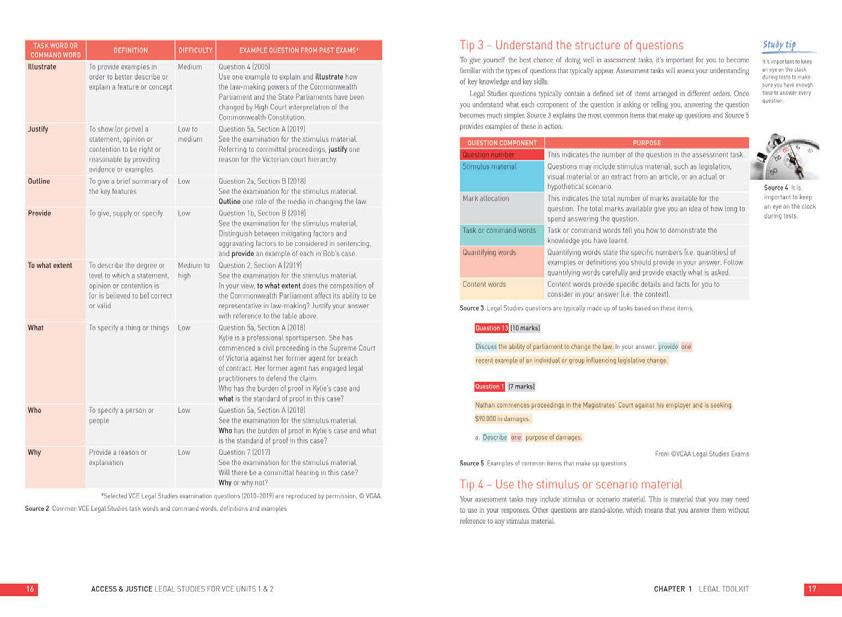
Tip 2 – Understand task words and command words
In the assessment tasks you are asked to complete throughout the year, it is likely that questions and tasks will include a ‘task word’ or a ‘command word’. In Legal Studies, task words and command words are words that tell you how to demonstrate the knowledge you have learnt.
Task words range in level of di culty. Some (such as identify or define) are simple to understand and master. Others (such as evaluate or justify) are more challenging to understand and will take practice to master.
Command words tend to start with a ‘w’ – with, why, what and who are the more common ones in Legal Studies assessment tasks. Another command word is how. Like task words, they range in di culty. For example, ‘who’ questions are generally simple and require you to identify a person or party. Others, such as ‘how’, can be more challenging.
Source 2 lists a range of common task and command words, their definitions, and an indication of their level of di culty. The di culty level can depend on the task or command word, and also the key knowledge being assessed – so an ‘explain’ question, for example, can range from medium to high in terms of di culty.
The table also provides example questions so you can see each task word and command word in context. Some of these questions have come from exam papers for past Study Designs, so they may or may not reflect key knowledge and key skills that are in the current Study Design. You should check with your teacher about this. Because these questions come from actual VCAA Legal Studies exams and examine content from Units 3 & 4, you are not expected to know many of these concepts at Units 1 & 2!
Advise To offer suggestions about the best course of action or make recommendations
Analyse To examine a complex feature, issue or concept by breaking it down into smaller parts and showing how they relate to one another
Comment on To express an opinion or reaction (in order to demonstrate your understanding of it)
Compare To explain or discuss how concepts, definitions or features are similar and different (by identifying the qualities or features they have in common as well as those they don’t)
Define To state the exact nature, features or meaning of a term, feature or concept
Describe To give a detailed account of a system, process or feature
Medium to high Question 1a, Section B (2018)
See the examination for the stimulus material. Advise Ada on one enforcement issue she should consider before initiating this claim.
HighQuestion 12 (2013)
Using one successful referendum and one High Court case, analyse the impact of referendums and the High Court’s interpretation of the Commonwealth Constitution on the division of law-making powers.
MediumQuestion 5 (2009)
‘Pre-trial procedures are designed to speed up the resolution of civil disputes.’ Comment on this statement. In your answer, describe one civil pre-trial procedure.
Low to medium
Question 5 (2010)
Jane and David have been involved in an ongoing dispute. They have been advised to use either mediation or arbitration as a dispute resolution method. Compare mediation and arbitration as methods of dispute resolution.
Low Question 1 (2015)
A plaintiff is seeking an injunction and damages of $1 million in the Supreme Court of Victoria. Define the term ‘injunction’.
Low Question 1b, Section A (2019)
John has been charged with an indictable offence. He has pleaded not guilty. The victims are worried about giving evidence at the upcoming trial, which is expected to last for six weeks. John’s lawyer has recommended that John should apply to the court for a sentence indication and consider pleading guilty. Describe one impact that a guilty plea may have on John’s criminal case.