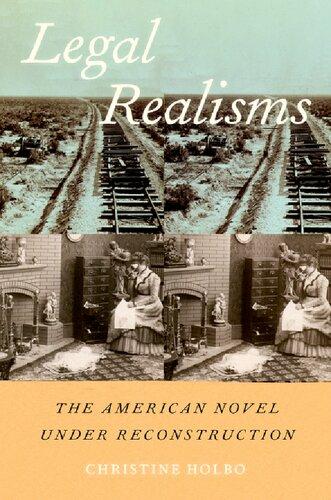
Legal Realisms
The American Novel under Reconstruction
CHRISTINE HOLBO
Oxford University Press is a department of the University of Oxford. It furthers the University’s objective of excellence in research, scholarship, and education by publishing worldwide. Oxford is a registered trade mark of Oxford University Press in the UK and certain other countries.
Published in the United States of America by Oxford University Press 198 Madison Avenue, New York, NY 10016, United States of America.
© Oxford University Press 2019
All rights reserved. No part of this publication may be reproduced, stored in a retrieval system, or transmitted, in any form or by any means, without the prior permission in writing of Oxford University Press, or as expressly permitted by law, by license, or under terms agreed with the appropriate reproduction rights organization. Inquiries concerning reproduction outside the scope of the above should be sent to the Rights Department, Oxford University Press, at the address above.
You must not circulate this work in any other form and you must impose this same condition on any acquirer.
CIP data is on file at the Library of Congress ISBN 978–0–19–060454–7
1 3 5 7 9 8 6 4 2
Printed by Sheridan Books, Inc., United States of America
Preliminary portions of Chapter 2 were previously published. “ ‘Industrial & Picturesque Narrative’: Helen Hunt Jackson’s California Travel Writing for the Century,” appeared in American Literary Realism © 2010, University of Illinois Press, and is reprinted with permission. “Moral Suspension and Aesthetic Perspectivalism in ‘Venice in Venice’ ” was printed in The Howellsian, 2011, © Christine Holbo
This book is for Eric, in voller Freiheit.
1. The Novel in the Era of Plessy
1. When Is a Novelist Not a Novelist? The Case of Harriet Beecher Stowe
2. Realism and Realisms in Nineteenth-Century American Literature
3. The Sentimental Public, Social Despair, and the Problem of “Concealment”
4. William James between the Rationality of Sentiment and the Sentiment of Rationality: Knowing and Feeling in a Residual Formation
5. What Henry James Knew: Concealment as the Novel’s Knowledge
6. Plessy v. Ferguson and the Limits of the Law’s Knowledge
7. Albion Tourgée among the Sentimental Fools: The Cruel Humor of de jure Equality
8. From Sympathy to Society: Realism in an Age of Incomplete Emancipation
2. Perfect Knowledge: Sympathetic Realism between the Rational and the Real
1. A Bleeding Heart Reads Ramona
2. Helen Hunt Jackson’s Will to
3. The Poncas, Public Sentiment, and the Right to Have Rights
4. The Legal Realism of A Century of Dishonor
5. The Hope for Scandal Proves a Stumbling Block
6. Traveling Saleswoman for Native Rights
7. Realism in the Venice of Prodigal Sons: Twain, James, and Howells
8. Mugwump Aestheticism: The Relativism of Virtue
9. The Picturesque of Genocide in the Century
10. Ramona and the Fracturing of Sentimental Universalism
3. Imperfect Knowledge: William Dean Howells, Perspectival Realism, and Social Politics 196
1. Howells, Sentimental and Modern 196
2. Howells’s West: Arcadia, Utopia, Exile 208
3. Sentimental Alienation and the Zeitschriftsteller 217
4. “Andenken”: Speaking in Code from Heinrich Heine to John Brown 223
5. Venice: The Patriot in Exile, the Tourist in Everyday Life 227
6. From The Liberator to The Nation: Minor Topics and Phosphorescent Heresies 237
7. The Politics of Representational Inclusion, 1872: De Forest’s Alligatorville 247
8. The Politics of Representational Inclusion, 1874: Twain’s Sentimental Revelations 254
9. Between the Polis and the Police: Man and Brother in the Suburbs, 1871–72 259
10. Studies in Incomplete Emancipation: “A Day’s Pleasure” 268
11. Mrs. Johnson and the Problem of Social Recognition, 1868 272
12. Realisms Legal and Literary, and the Black Maria 282
13. Romances and Divorces of the Republic: Hayes, Mugwumpery, and the Novel 293
14. A Modern Instance: On the Corrupting Power of Sympathy 301
15. Juridical Representation and the Fragmentation of Social Knowledge 306
16. Equal Protection and the Conflict between Community and Society 315
4. A Double-Barreled Novel: Huckleberry Finn and the Great American Novel as Perspectival Realism 323
1. Howells, Twain, and Politics: “The Canvasser’s Tale” 327
2. The Perspectival Instability of Huckleberry Finn 331
3. Where Does Huckleberry Finn Go Wrong? Tragedy, Comedy, and the Fine Art of “Cheating” 338
4. Reading for the Plot; or, The Phenomenology of the Canoe 344
5. The Law’s Perspectives: Child and Slave between Community and Society 355
6. Equality Before (and After) the Law: Emancipatory Storytelling 369
7. Immanence and Evasion, Literary Quality and Literary Seriousness 378
Introduction
The first self-consciously modern sketch of the American literary landscape was executed in Boston in 1886. In the inaugural installment of his “Editor’s Study” column, the series with which William Dean Howells established the novel as a topic of household discussion and himself as the nation’s most prominent literary critic, Howells began by describing the prospect of American literature as it appeared from the editor’s chair at Harper’s Monthly. Though Howells has largely been remembered for his earnestness, for his advocacy of a realism of the ordinary and the natural, the image with which this programmatic column opened hardly attested to either seriousness or simplicity. The editor looked out, Howells boasted, from a building designed by Ariosto and adapted by an American architect—“originally in the Spanish taste,” with “touches of the new Renaissance . . . [and a] . . . colonial flavor.” The study was a derivative jumble, an imitation of an imitation. And the landscape the editor surveyed was a fantastic one, a scene in which the Hudson flowed into the Charles, the Mississippi and the Golden Gate occupied the middle distance, and the Seine and the Tiber appeared in the background, while the “peaks of the Apennines, dreamily blending with those of the Sierras, form the vanishing-point of the delicious perspective.”1
As is the case with much of Howells’s theoretical writing, this commentary upon the pleasures of mimesis requires decoding. At once a parody of the grand vistas of the Romantic imagination and an appeal for an expansion of the horizons of American representation, Howells’s jokey trompe-l’oeil fusion of continental landscapes implied three distinct claims about the past and future of the American novel. The first claim was about representation, the novel’s orientation toward the world. Howells suggested that realism, the dominant mode of the mid-nineteenth-century novel, had failed to be true to the plurality of experience: American literature needed to reject the idea of a unitary national identity, a single origin or vanishing point, and to recognize that literature must emerge from multiple imaginative as well as cartographic horizons. The second claim was that the novel had overinvested in transparency and forgotten that art was artifice. An imposed unity of perspective
brought art to life: but literature needed to break with the notion that unity was natural, that beauty escorted truth into a world of harmony. The third claim was political. Communicated in code—to those capable of reading American geographies in the light of global history—was an argument for why Americans must cultivate a more broadly cosmopolitan understanding of power in order to understand America’s place among what Howells later in the column called the “federal nationalities.”2 Invoking the old Sibyl of the Apennines, meditating on a site whose Greek etymology and foundational position in Roman history bore witness to the intertwinements of republic and empire, virtue and violence, identity and hybridity, Howells’s imaginary landscape hinted at something delusional in the dream of American exceptionalism. However much it might wish to evade this fact, literary realism must start from the recognition that America, which imagines itself so far from Europe, is not immune to the problems of domination rooted in Aeneas’s soil.
Howells’s “delicious perspective” presented the novel as a form of art, as a mirror of national self-representation, and as a bearer and decipherer of the logic of domination. In articulating the connection among these three moments of the novel’s representation, he spoke to the aspirations of his generation, a collective conviction that the historical moment of the late nineteenth century required a new openness to the world and a departure from rigid theories of unified knowledge and self-knowledge. Legal Realisms examines the writers of this generation in terms of the three concerns exposed by Howells’s refractive image. It asserts, broadly, that the idea of a literary “realism” was transformed in the years after the American Civil War, and that this transformation was rooted in the ways in which Reconstruction and its failures reshaped possibilities of knowing and imagining community and society, citizenship and alterity. This reorientation at once expanded the novel’s subjects and redefined its claim to provide knowledge about the world. In the decades between the Civil War and the First World War, the increasing social prestige of the novel—its claim to be autonomous art—was bound up with its forms of knowing, with the problem of what it meant to write realistically about a divided nation.
The late nineteenth century marked the first moment in which the ambitions of an American literature were explicitly defined in terms of the ideal of inclusive diversity. In the years after the Civil War, a cohort of American writers went out to explore a nation which, newly reunited, was also newly expansive in scope, extending for the first time across an entire
continent. They defined the novel’s work to be that of addressing the whole of modern life by bringing this new wealth of “material” into the novel’s representation. They went looking for diversity, and they found it: the literature of the era is characterized by the exuberant representation of regional, cultural, social, gendered, and ethnic and racial difference. They did not, however, produce unified vistas commensurate with a celebratory sense of restored national Union. Rather, their work is distinguished by what Nancy Bentley has called “frantic panoramas”: fractured literary landscapes which, like Howells’s, attested at once to the memory of violence and to the necessities of art.3
The idea that the essential work of the novel was to expand representation to new social groups was not a new one in the late nineteenth century. It did, however, crystallize an older set of expectations, and in this sense it constituted a distinctive interpretation of the rise of the novel. Midnineteenth-century readers and writers assumed that the expansion of representation in the mimetic sense accompanied expanding representation in a political sense. That the novel had grown from a popular mode of entertainment, a purveyor of “novelty,” into the most prestigious literary genre of the later nineteenth century, had everything to do with its increasing association with bourgeois seriousness and Enlightenment knowledge during an age of democratic revolution. Realist truth claims were linked, in nineteenthcentury novels, with the impulse to believe that the empirical world is, or should be, knowable, and with a sense of the agency, on the part of the reader, corresponding to a world that is potentially masterable. Accordingly, the novel’s epistemological claim was inextricable from a political vision, the nineteenth century’s faith in universality and in a history moving toward the telos of human freedom and equality. Presenting readers with a world that they could know and in which they could act meaningfully, the realist novel thought of itself as contributing to the progress of emancipation by extending sympathy to the socially marginal and the oppressed. It claimed to extend recognition by bringing the dominated into representation: to make the abject subjects, in the strong sense of the word.4
To begin writing in the postbellum moment was to feel oneself an inheritor of a triumphal moment in this literary-political history. The Reconstruction Amendments had inaugurated a new era of formal liberty. Citizenship was now universal: this fact appeared to sponsor the possibility of a panoramic representation whose unity of perspective would be grounded in the equality of all subjects before the law. Yet American writers’ assumptions concerning
the emancipatory nature of novelistic representation ran into difficulty at the very moment at which writers set out to bring all of America’s subjects into representation. The first source of these difficulties lay in the unresolved legacies of slavery and its defeat. The postwar Amendments had ended slavery de jure, but they left the fact of domination largely unchanged. The problems of equality and recognition that had seemed simple to the antislavery imagination of the antebellum moment now appeared fraught with implications extending out into all areas of life. But the challenge also grew out of the changes in the material that American writers had set out to depict. The end of the Civil War ushered in a period of western expansion. Wartime measures intended to strengthen the Union in the West, including the Homestead Act, the Morrill Act, and the Pacific Railway Act, contributed to rapid continental consolidation after the war—with effects rather different than the Republican authors of these measures had contemplated. Differences of civilization—or, as Americans were learning to say, “culture”—persisted between North and South, and appeared in the West; social conflicts in the East were increasingly expressed in the languages of ethnicity and class. As the axes of American difference shifted from the binary oppositions of the antebellum imagination to more heterogeneous populations and more complex geographies of domination and oppression, writers encountered an increasing number of situations that did not conform to their expectations of how a knowledge that could produce identity across difference would naturally lead to justice. America was no longer divided into two worlds of slave and free, but riven by the uneven logics of race and ethnicity, gender and class, by partial and overlapping modes of legal and cultural citizenship, by the distorting optics of continental distance and local particularity.
In encountering the world of incomplete emancipation, American writers found themselves in a situation that was the inverse of the one they historically expected. The rise of the novel, as they understood it, had allied the novel’s knowledge to a conception of Higher Law: the novel made visible, through sympathetic representation, the universal humanity that the law should acknowledge but did not. In the wake of Reconstruction and its failures, equality was formally affirmed by positive law but nowhere to be seen in reality. This fact—of real difference within an empty equality— complicated the idea of inclusion, and confronted American writers with a puzzle. Many agreed with Howells’s hopeful observation that “equality is such a beautiful thing that I wonder how people can ever have any other ideal. It is the only social joy, the only comfort.”5 But if equality was so powerful as
an ideal, why was it so weak in practice? The postwar generation responded to this admission of weakness with a strategy they themselves recognized as highly risky: that of orienting the novel’s realism toward difference in the hopes of discovering real equality within it.
This book will present this transformation of the realist novel, and the debates it engendered, as literary history in intellectual-historical context. The following chapters explore a number of writers who represent a spectrum of different stances vis-à-vis the reorientation of realism toward difference, ranging from enthusiastic embrace to outright rejection. These chapters will approach these writers’ shifting conception of the novel biographically, in terms of the lived process by which epistemological particularism became an option that American writers could not ignore. The literary debates in which they engaged were shaped by cultural and political forces; the categories of reasoning writers asserted, the ways they thought about justice and knowledge, were cognate with that of the philosophy and legal thought of their day. But these literary debates were not reducible to transcriptions of the history of ideas. This book will approach the epistemological shift in the novel, thus, neither in the pure realm of the novel’s theory, nor in the pure realm of discourse, but in terms of the density of experience, the shifting decisions and revisions that characterize the intersections of concept, history, and genre.
The fraught nature of the novelists’ project may be briefly comprehended through an extraliterary comparison to the transformation of legal thought that occurred during the same years. The title of this book invokes an important tradition in the jurisprudence of the United States. “Legal realism” was initiated with the doctrine, articulated on the first page of Oliver Wendell Holmes Jr.’s 1881 The Common Law, that “the life of the law has not been logic: it has been experience.” Holmes’s appeal to “realism” had a great deal in common with that of the novelists of his generation: both rejected philosophical idealism; both asserted that values emerged from historical societies; both recognized, as Holmes put it, that “the substance of the law at any given time pretty nearly corresponds, so far as it goes, with what is then considered to be convenient”;6 and both acknowledged that this meant that justice was necessarily articulated not as the absence of domination, but in terms of domination. Yet literary and legal realists did not draw identical conclusions from these common perceptions. While early legal realism turned away from claims about rights or about justice, condoning the postwar decades’ increasingly circumscribed readings of the Reconstruction Amendments, literary realists repeatedly sought to work through epistemological and moral
relativism to imagine broader forms of emancipation and to affirm the rights of the socially dominated.
That American literary realism could share philosophical assumptions with legal realism points to some of the strange alliances characteristic of the postwar world; that the literary realists nonetheless oriented themselves toward quite different ends reminds us that political and literary history do not move in lockstep, and that the logic of literary representation, while it may reproduce and sometimes reinforce the logics of social domination, also, by the nature of mimesis, stands opposed to it. If, indeed, the possibilities of the late nineteenth-century novel were framed by the increasing circumscription of the emancipatory imagination, this very fact played into one of the most important literary developments of the late century, the assertion of the novel’s autonomy as literature. As the novel became the preeminent form of literature and the categories of fiction organized around it supplanted older conceptions of literature as “letters,” literary realists increasingly believed in the freedom of the novel from direct political responsibilities, increasingly argued that the novel was the bearer of its own kinds of knowledge. They hoped, at the same time, that the novel’s unique capacity to mobilize perspectives, to address the relativity of truth and value, could itself be a source of political emancipation. A new sense of the novel’s status as autonomous literature emerged simultaneously with its orientation toward new ways of thinking about politics, law, and social power.
This book tells the story of how concepts of knowledge and of literariness associated with the novel were transformed as American writers began to write in the light of incomplete emancipation. Accordingly, it tells a story of collective bafflement and individual failures, of the extended self-doubt of a generation. The more the novel’s literary prestige came to rest on its claim to produce knowledge out of alterity, the more writers came to question what this knowledge meant. They asked what the ethical implications were of trying to understand others’ experience, and whether—as they had once assumed—this knowledge could not only register but also bridge difference, creating the kinds of social solidarity that readers in an age of emancipatory idealism could recognize as progress. They asked, in other words, how the true and the good were supposed to be united in a literature defined by nonidentity.
Legal Realisms is not a comprehensive history of multicultural literature in late nineteenth-century America, nor is it a history of socioliterary “diversity” more broadly conceived. This book is instead interested in how diversity
came to be understood as important: as a definiens of the literary. A history of transformations in conceptions of the novel’s knowledge, it seeks to tell a series of interconnected stories: first, how the representation of diverse perspectives moved to the center of the literary enterprise; second, how this defined the moment in which literary “realism” came to occupy the most prestigious position in American letters; third, how the realist project became occupied with questions of the connection between the novel’s epistemology and its ethics; fourth, how the realist response to these questions changed the way that realists, and later generations, would imagine the novel’s ethics and its engagement in “politics.”
At the heart of this study is a transition between two paradigms of literary knowledge that part company across the problem of universality and difference. I will argue that the transition that has traditionally been understood in terms of the passage from the sentimental novel to literary realism can be better explained in terms of the crisis of one form of realism and the articulation of another: the failure of a sympathetic realism oriented toward an ideal equality, and the emergence of a realism grounded in a pluralist epistemology and concerned with the exploration of real inequality. As sympathy, which was conceived in the eighteenth century as an epistemological category, was demoted in the late nineteenth century to being a mere affect, a matter of individual psychology, so the novel of sympathy, which equated the work of literary realism with its capacity to communicate human universals, was replaced by a new kind of realism that insisted upon the perspectival quality of all knowledge. Promoting the idea of limited or partial knowledge to a virtue, the writers who embraced realism in the years after the Civil War asserted that not presuming to know the feelings and experience of another was a form of recognition. Even as they struggled to uphold the ethics and politics of the sympathetic paradigm’s notion of universalism, these newly self-defined “realists” ceased to associate the novel’s highest values with the ideal of transparency, and they began to explore the idea that the novel’s distinctive contribution—in terms of both the novel’s epistemology and its ethics—involved the possibilities of concealment. This dynamic tension between transparency and concealment, perspective as recognized difference and perspective as a limit on knowledge, bore implications for how the novel’s realism might relate to the political tradition of emancipatory struggle. Late nineteenth-century novelists explored the possibility that the novel’s knowledge might be qualitatively different than the law’s knowledge: that the novel could recognize forms of particularity and cultivate modes of blindness
that the law could not. Revising the emancipatory history of the novel, they came to argue that political representation and literary representation were connected but different in nature, that they stood in different relations to the ideal of universal human liberation. In this sense, late nineteenth-century American writers at once acknowledged limits to the novel’s agency and staked out a claim for its autonomy.
Central to the transformation of realism surveyed in this book stands Howells’s work as a novelist, editor, and cultural commentator. The foremost man of letters of his generation, Howells shaped the field of literature from the 1860s onward by bringing his interlocutors into an extended conversation about the status of the novel as art and about its capacity to produce social knowledge. While Howells has long been considered the leading (and in some accounts, the only) proponent of realism in the late nineteenth century, the way he thought about the novel’s art as a mode of “social” politics has been largely misunderstood. The third chapter of this study addresses the first half of Howells’s long and eventful career, up through the moment in the early 1880s when he fully embraced the form of the novel, and when his model of perspectival realism became a recognized standard for literary prestige. Howells, I will argue, remained committed throughout his life to conceptions of emancipation as human equality that were rooted in the antislavery struggles of the antebellum period. This continuity of political and ethical commitment led Howells, however, to articulate a strikingly new conception of the novel’s knowledge and of the novel’s role as a form of political discourse. Howells challenged his contemporaries to expand the field of literary “politics” to imagine society as a space suffused with political power, and by doing so to confront the barriers to equal social recognition that remained in an era of de jure universal citizenship. Calling into question the idea that writers could simply assume the universal position as either a moral given or as an ideal, he insisted that the novel’s essential contribution rested in a perspectivalist epistemology, its capacity to confront readers with the irreducible particularities of a world shaped by incomplete emancipation. The novel’s “delicious perspective”—its aesthetic freedom to explore the nonidentity of the true and the good—became a model for a more expansive conception of the enjoyment of human freedom. Building on this understanding of the novel’s epistemology, Howells advanced a program for his generation that paired a mandate of completeness with a new
ethics of nescience centering on the limits of expression and the incommensurability of moral experience. Under Howells’s inspiration, writers of the postwar period confronted alterity in a double sense. They sought to include all American “subjects” in the novel’s field of representation, but they also asked, with increasing urgency, what it meant to try to represent others’ experiences, and what Americans could not understand about each other.
Arrayed around this book’s central reconsideration of Howells are explorations of a range of figures whose differing views on the novel and its politics map out a geography of the postwar novel. Albion Tourgée and Helen Hunt Jackson have largely been remembered in the canon as “minor writers.” Their political and legal commitments to the rights of African Americans and Native Americans have at once justified their ongoing inclusion in the canon and warranted the lack of scholarly attention directed to their aesthetic concerns, their self-understanding as novelists. This study, by contrast, attends to the connections between their conceptions of jurisprudence and their conceptions of the novel, arguing that neither was the naive or merely instrumental practitioner of the novel they have been remembered as. They cultivated, rather, a different conception of the novel, imagining the configuration of the novel’s aesthetics, its epistemology, and its commitment to the socially marginalized in different ways than did Howells. The world of incomplete emancipation made for strange alliances; it also produced what appear, retrospectively, to be inexplicable antipathies. Recovering Tourgée as a stalwart defender of sympathetic, universalistic realism against Howells’s perspectival realism, and Jackson as a reluctant recruit into perspectivalism, these chapters explore at once what Howells’s conception of the novel defined itself against and why novelists who shared many of his political values might oppose his project for the novel. If we can understand the philosophical grounds for Tourgée’s rejection of a perspectivalist realism, we gain insight into the literary and intellectual aspirations of two generations of writers. Politically and morally, Howells and Tourgée had a great deal in common. A jurist, novelist, and civil rights campaigner, Tourgée shared Howells’s belief in social equality as the highest human good. Both, moreover, began their careers as writers with similar conceptions of the way the creative artist contributed to the sphere of republican letters. But where Howells saw the end of universalist, sympathetic realism in the antebellum mode as potentially emancipatory for individuals and for the form of the novel itself, Tourgée believed that relativism undercut the very ability of Americans to speak, think, or write about freedom. For Tourgée, the great achievement
of the nineteenth century, as embodied in the nineteenth-century novel, had been its combination of the cultivation of republican virtue with an expansion of the scope of human sympathy. And he felt that contemporary Americans were losing their grasp on this foundational idea.
The opening chapter presents the conflict between these two visions of realism by looking ahead to the end of Tourgée’s career, exploring the story of how Tourgée, who, in his role as the lawyer for Homer Plessy, had in 1896 just suffered a crushing seven-to-one Supreme Court rejection of the idea of “color-blind justice,” reacted to this defeat by writing an essay memorializing Harriet Beecher Stowe and defending the “literary quality” of her sympathetic realism against Howells’s perspectivalism. Reading Tourgée’s defense of Stowe in relation to his arguments in Plessy v. Ferguson, the opening chapter reconsiders why Tourgée and his generation considered Stowe’s work to be a mode of realism, why Tourgée associated the rise of a perspectivalist epistemology with the majority decision in the Plessy v. Ferguson case, and why he saw the defense of civil rights as intertwined with the problem of defining the novel as a literary genre.
The second chapter examines Helen Hunt Jackson as an exemplary figure for the way the Reconstruction generation of American writers found themselves turning toward a perspectivalist understanding of the novel. Nurtured on the sympathetic universalism animating the antebellum realism of Harriet Beecher Stowe’s 1852 Uncle Tom’s Cabin, Jackson, like many writers who came of age in the wake of the Civil War, witnessed the collapse of this model at the moment of its triumph. The defeat of Radical Reconstruction amid rapid territorial expansion and the rampant growth of both state and corporate power had underscored how little vignettes of “life among the lowly” could overcome deep-rooted social antagonisms. The novel, a form which in Stowe’s hands appeared capable of having “caused” the Civil War, seemed powerless to do anything but witness the decay of the traditional alliance between literary conventions of imaginative sympathy and what Howells would later dub the “emotional tradition in politics.”7 If the Reconstruction generation felt that their writings could no longer achieve what the antebellum novel had, they registered this sense of lost agency as an aesthetic-epistemological rift: a new tension within the novel, impassable, imponderable, between the need for individual feeling and the structures of legitimate public sentiment. Nowhere were these dilemmas more evident than in the making and unmaking of Jackson’s Ramona, a work of carefully researched social engagement that has generally been received as a historical romance
devoid of either political or intellectual ambition. Chapter 2 examines the divide between conception and reception not as a mere product of changing attitudes toward the melodramatic in fiction, but in terms of a shift in the epistemology of social sympathy, reading Jackson’s investigation of international and human rights law in A Century of Dishonor against the way her travel writing engaged her in a generational rebellion against the high political moralism of the prewar generation. Tracing out Jackson’s affiliation with other writers of the 1870s and 1880s, this portion of the book offers an overview of the varying ways in which the “sentimental tourists” and “mugwump aesthetes” of postbellum literature transformed the sentimental tradition, and it suggests how the 1870s and 1880s prepared the ground for a literary field defined by the paired ideals of autonomous literary experimentalism and authentic, pluralistic cultural expression. This chapter uses Ramona to consider the role of the American West in structuring the literary and political imagination of the late nineteenth century, and it argues that Ramona must be read as an allegory of public agency in an age of violent territorial expansion and divided fields of discourse. The novel’s subject, rightly understood, is the bewilderment of the thinking citizen among the forces of domination; its romance the transformation of universal human rights claims into picturesque heritage.
While Tourgée and Jackson can be better understood as literary artists through an understanding of their opposition to perspectival realism, Mark Twain and Henry James, recognized already by many in their time as the greatest literary artists of their generation, have also been seen from the first as representing opposing impulses. Strange alliances, strange antipathies: that the “Turn West and the Turn East American” should dislike each other has not been hard to understand.8 The fact, however, that they should have in common an enduring friendship with Howells has remained as underexamined as it is well known. Scholars of both James and Twain have assigned Howells the same role: that of the cheerleader, the helpful editor— and the straight man whose more modest achievements highlight the genius of his friends. This study does not seek to overturn these relative judgments any more than it expects a restructuring of the canon with Tourgée or Jackson at the center. Yet we may learn from the exercise in imagining a different canon. By inverting the organizational logic of canonization—by taking the paired achievements of Twain and James as a frame within which to consider the literary biographies of lesser-known writers, and by approaching James’s and Twain’s work through their relationship with Howells—this study seeks
to accomplish three ends: to make visible the common ground these two writers occupied with Howells, the new ways of thinking about the novel’s knowledge and its freedom these writers shared; to make evident what it was about Howells’s style that could make him a model, inspiration, and interlocutor for these two apparently very different writers; and to understand what was at stake when other writers resisted the approach represented by this triumvirate.
Legal Realisms is part of a two-volume project that explores the transformation of the novel that occurred when the genre’s concept of literary value became bound up with its commitment to difference. The story of this transformation, which has both a literary-historical and a more broadly legal, political, and cultural dimension, involves a revision of our understanding of literary realism, and it necessitates reimagining realism’s position within the chronologies of the nineteenth-century novel. Specifically, the two volumes consider realism within three time frames: a long history of realisms in the nineteenth century; a long history of modern novelistic aesthetics, with its dual commitment to modernism and multiculturalism; and the period between the 1860s and the 1890s that has traditionally been considered the moment of “American literary realism.”
The present volume argues that the history of literary “realism” can be better understood if explored across a long chronology extending back across the nineteenth century. In the course of this book it will become clear that American literary realism cannot be understood in terms of the single moment in the postwar period to which this movement has often been assigned. The “realists” of the 1870s and 1880s took the antebellum models of Stowe and Hugo, Dickens and Thackeray as the achieved form of a genre that had attained international prominence and currency in the antebellum period, even though they felt the need to reinvent the epistemological, aesthetic, social, and legal foundations of “the real.” This book follows their lead and describes American literary realism not in terms of a single moment (oddly belated in relation to the global history of the genre) but as part of a progression of “realisms” oriented toward an ever-receding telos of emancipation. At stake in this first volume is thus the transition between two different kinds of realism, two different ways of thinking about mimesis, literary value, and political commitment. The fact that the realists of Howells’s generation defined their perspectivalism in terms of its modernity and its fragmentation of
perspective, however, opens a different horizon on the history of the novel. In the second volume I will thus consider American literary realism as a founding moment in a long history of modernism, taking its commitment to difference—temporal as well as cultural—as a way of understanding the common origins of avant-gardistic modernism and what we have come to call multicultural literature. Taken together, these two volumes argue for a link between the long history of realism and that of the sentimentalist conception of universal human rights; but they also suggest that realism was not simply modernism’s precursor, but served as its incubator and interlocutor. The space defined by the overlap between these two chronologies points to the social content of aesthetic form and makes it possible to achieve a clearer sense of what was at stake in realism as a literary mode that became—and remained, despite some critical discomfiture—the “normal” form of the novel in the nineteenth and twentieth centuries.9
Legally and politically speaking, these two long histories pivot around the Plessy v. Ferguson decision. Telling the story of the failure of sympathetic realism involves following it forward to the moment when, with the Plessy decision, sympathetic realism’s universalistic ethics and its claims to literary prestige appeared to collapse simultaneously. Telling the story of a multicultural modernism involves understanding how the kinds of emancipation to which literature aspired changed when Plessy inscribed divided citizenship on the American landscape. Together the two volumes grapple with the literary field’s response to the advent of formal equality and its limitations between the Civil War and the early twentieth century. This analysis turns around legal transformations that took decades to unfold, including the changing definition of citizenship provoked by the wartime amendments and Reconstruction, and around a comparably complex set of transformations in concepts of the literary. Though novelists did not always directly engage with technical legal concerns, their understanding of the national literature they sought to create was informed by ideas of citizenship: questions of who is included in a nation, whose rights are protected, whose concerns are the object of moral seriousness, laughter, or derision. This volume, though it looks forward to the Plessy decision as an endpoint, therefore focuses on the decades of the 1860s through the early 1880s, when the writers of the Reconstruction generation sought to develop new modes of social, legal, and moral perception. In the second volume, I will examine how, once the idea of universal equality was defeated, perspectival realism’s embrace of diversity as a central source of literary value promoted the rise of both multicultural
literatures and a modernist avant-garde. Collectively, the two volumes seek to interrogate the implications of placing difference at the heart of the literary endeavor. Recognizing that the turn to difference was not inevitable, they explore both what was gained and what was lost when “modern” literature was defined on these terms.