Learning from Our Mistakes
Epistemology for the Real World
WILLIAM J. TALBOTT
Oxford University Press is a department of the University of Oxford. It furthers the University’s objective of excellence in research, scholarship, and education by publishing worldwide. Oxford is a registered trade mark of Oxford University Press in the UK and certain other countries.
Published in the United States of America by Oxford University Press 198 Madison Avenue, New York, NY 10016, United States of America.
© Oxford University Press 2021
All rights reserved. No part of this publication may be reproduced, stored in a retrieval system, or transmitted, in any form or by any means, without the prior permission in writing of Oxford University Press, or as expressly permitted by law, by license, or under terms agreed with the appropriate reproduction rights organization. Inquiries concerning reproduction outside the scope of the above should be sent to the Rights Department, Oxford University Press, at the address above.
You must not circulate this work in any other form and you must impose this same condition on any acquirer.
CIP data is on file at the Library of Congress
ISBN 978–0–19–756765–4
DOI: 10.1093/oso/9780197567654.001.0001
Printed by Integrated Books International, United States of America
For Judy
The whole strength and value, then, of human judgment, depending on the one property, that it can be set right when it is wrong, reliance can be placed on it only when the means of setting it right are kept constantly at hand.
John Stuart Mill
Just because it is asked about techniques of persuasion, or about argument and counterargument in a situation in which there can be no proof, our question is a new one, demanding a sort of study that has not previously been undertaken.
Thomas Kuhn
12. The Evolutionary Naturalist Challenge to Non-Naturalist Normative
V. CLARIFICATIONS, RESPONSES TO OBJECTIONS, AND CONCLUSION
13.
Acknowledgments
This book has been a long time in gestation. This is actually my third version. The first version was written with the support of a National Endowment for the Humanities Fellowship for University Teachers in 1996–1997 (Grant No. FA33699-96). I am grateful for their support. When I finished that first version, I was not satisfied with the result, so I did not try to publish it. I tried a different approach during 2010–2012, but I was not satisfied with that version either. For this version, I started again almost completely from scratch. The third time was the charm.
One of my biggest debts is to my professor in my undergraduate course in epistemology, Gil Harman. It was Harman who taught me how to appreciate skeptical arguments—not as arguments that established their conclusions, but as manifestations of shared, and typically problematic, presuppositions about rationality.
Many of the ideas in this book were first conceived in my work on my doctoral dissertation. I was fortunate to be able to try out these ideas and get feedback on them from my dissertation advisor, Bob Nozick.
I have been fortunate to have received helpful feedback on this version from five colleagues who read and gave me invaluable comments on an earlier draft: Larry BonJour, Alvin Goldman, Hilary Kornblith, Elliott Sober, and Tom Nagel. It was a great gift to me that they were willing to read and comment on the entire manuscript.
Many people have given me feedback on parts of the manuscript. Ted Paradise gave me comments on about ten chapters. Thanks to his comments, many passages have been improved. I have also received helpful feedback on earlier drafts of individual chapters from Ann Baker, Paul Franco, and Tyler Hildebrand on Chapter 5; Jamie Mayerfeld on Chapter 7; and from Colin Marshall, really transformative comments on Chapter 2. Cass Weller helped me on an interpretive question about Hume. And I received helpful feedback on several chapters from members of our Metaphysics and Epistemology Reading Group in the summer of 2020, including Colin Marshall, Conor Mayo-Wilson, Ian Schnee, Matt Benton, Anthony Fisher, Paul Franco, and Mike Raven.
Thanks to you all.
Substantial parts of Chapters 9 and 10 were previously published in the journal Synthèse. To my chagrin, my Acknowledgments for that paper were not included in the published version, and I failed to notice. I am pleased to have an
opportunity now to thank those who gave me helpful comments on earlier drafts of that paper: Arthur Fine, Tyler Hildebrand, John Manchak, and Conor MayoWilson, as well as three anonymous referees.
Substantial parts of Chapter 12 were previously published in the journal Philosophy & Phenomenological Research. I was able to obtain valuable feedback on an earlier draft at a University of Washington philosophy department workshop session on November 16, 2015. I especially benefited from the comments of Paul Franco, Colin Marshall, Conor Mayo-Wilson, and Ian Schnee.
My sister Madeline Talbott and my friend Richard Zerbe also read an earlier version of the entire manuscript and gave me very useful feedback. My friend Tom Wood proofed parts of an earlier draft of the manuscript for me. My daughter Rebecca Talbott also proofed parts of an earlier draft. My son-in-law, Shane Drew, checked an important calculation for me. Final proofreading and indexing was a family affair. I got help from my wife, Judy, my sisters, Maria and Madeline, my daughters, Rebecca and Kate, and a neighbor, Luca Millard-Kish. I am grateful to all of you.
Special thanks to Dr. Renato Martins, Jennifer Jacky, Karen Baker, and the rest of my care team at SCCA. You are the best!
I would also like to express my gratitude to my editorial and production team at Oxford University Press: Peter Ohlin, editor; Madeleine Freeman, editorial assistant; Sindhuja Vijayabaskaran, production manager; and Joann Woy, copy editor.
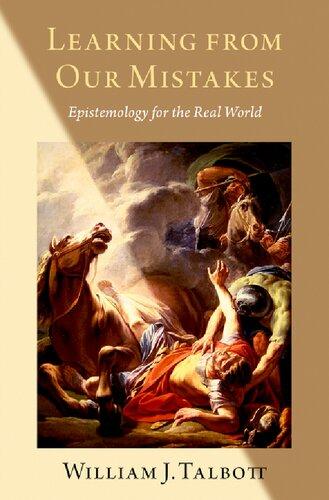
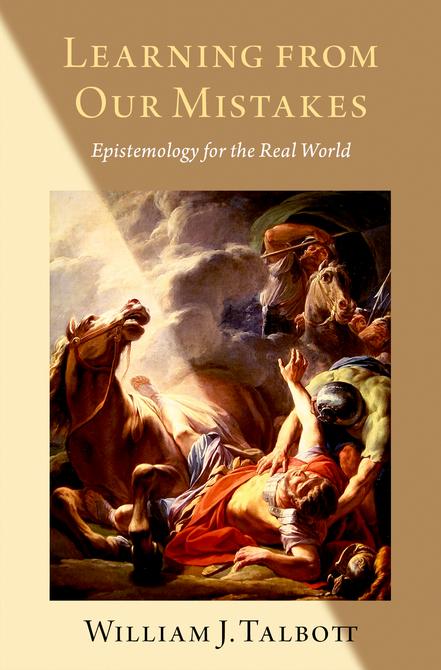
I want to especially acknowledge the cover design by James Perales. He beautifully incorporated the artwork, “The Conversion of St. Paul,” by Nicolas Bernard Lépicié, into the cover design. I chose the Lépicié painting not for its religious significance, but because I think that it captures the force of the conversion experience, which is a metaphor used by Thomas Kuhn for the conceptual transformation that takes place in a scientific revolution. (For more on Kuhn, see Chapter 3.) I use the Lépicié painting to represent the psychological impact of a conceptual revolution in any area of inquiry. When you make the transition for the first time, it often feels as if you have been knocked off your horse. And when you get up, the world never looks the same again.
Substantial parts of the manuscript were written at the Helen Riaboff Whiteley Center in Friday Harbor, Washington. I know of no better place in the world to do productive work. I am grateful to Kathy Cowell and the rest of the excellent staff for treating me so well.
I am most grateful to my wife, Judy, for her love and support during the entire process over twenty-four years through three different versions of the manuscript. I dedicate the book to her.
Portions of Chapters 9 and 10 are reprinted with permission from my article “A Non-Probabilist Principle of Higher-Order Reasoning,” in Synthèse (Springer Nature, 2016).
Portions of Chapter 12 are reprinted with permission from my article “A New Reliability Defeater for Evolutionary Naturalism,” in Philosophy & Phenomenological Research (Wiley, 2016).
PART I
THE PROOF PARADIGM AND THE CAUSAL REVOLUTION IN EPISTEMOLOGY
Introduction
Epistemology is the branch of philosophy that deals with knowledge and justified or rational belief. For reasons that I explain later, this is not a book about knowledge; for other reasons that I explain later, it is a book about rational rather than justified belief. To be precise, it is a book about epistemic rationality as opposed to practical rationality or any other kind of rationality. What is epistemic rationality? In a sense, this entire book is an extended answer to that question. But to begin with, I can contrast epistemic rationality with practical rationality by saying that epistemic rationality is aimed at truth, while practical rationality is aimed at other goals.
I begin with a science fiction story.
A Philosophical Anthropologist
Recently I met an alien, a resident of a planet orbiting one of the Alpha Centauris, the name of which roughly translates as “Home.” There are no sexes or genders on Home; all species are hermaphroditic. The alien I met was called Zee. Zee’s profession was philosophical anthropologist. I asked Zee what a philosophical anthropologist does. This led to the following conversation:
Zee: We Homeans have discovered many different civilizations in our universe. I study some of these civilizations. Through my research, I have shown that the intellectual health of a civilization or culture is highly correlated with the intellectual health of its epistemology. This is because epistemology functions as part of the intellectual immune system of a civilization or culture. Having a compromised epistemology can make a civilization or culture extremely susceptible to intellectual pathologies. For example, when I began studying your Earth, I was immediately struck by the number and variety of intellectual pathologies that are well-established in the popular culture here.
Me: Well, I can’t argue with you there. Almost everywhere you look in the media and on social media today you find purveyors of alternative “facts” broadcasting them to a large gullible public. But it makes no sense to blame philosophy for this sorry intellectual state of affairs. On Earth, practically no one pays any attention to philosophy.
Learning from Our Mistakes. William J. Talbott, Oxford University Press. © Oxford University Press 2021. DOI: 10.1093/oso/9780197567654.003.0001
Zee: Epistemological ideas don’t infect the population because the population reads philosophy. But epistemology has the potential to provide the culture with a kind of intellectual immunity to at least the most virulent pathologies. Ideas from a healthy epistemology can spread as memes through the population and provide immunity even to people who have never read a word of philosophy.
On Earth, the opposite has happened. Ideas from Western epistemology have spread through the population and compromised—where they have not simply disabled—immunity to intellectual pathologies. The result is a compromised intellectual immune system that has little or no resistance to “alt-truth” or “alt-facts.”
Me: I think you are being a little unfair to Western philosophy. Western philosophy has provided us with many examples of great intellectual probity and courage. To name only one, Socrates is a model for philosophy students around the world.
Zee: OK, let’s consider Socrates. Do you tell your students that Socrates, the man whom the Delphic oracle said was the wisest man in Athens—or, at least, that there was no one wiser (Apology 21a)—summed up his wisdom by saying that, while his fellow Athenians mistakenly think that they know many things: “I neither know nor think that I know” (Apology 21d)? If the pinnacle of human wisdom is to know nothing, then how could there be a rational basis for opposing the ideologies based on alt-facts and alt-truth?
Studying Socrates would prepare students to study the doctrine of Protagoras, who said, “Man is the measure of all things.” This is the relativist doctrine that there is no non-relative truth, but only truth-for-someone. Socrates regarded Protagoras’s relativism as the opposite of his own philosophy, but it is really closer to a mirror image of it. If there can be no good reason to believe anything to be true, non-relatively, then the two alternatives, to believe nothing and to believe that my beliefs are only true-for-me, are two sides of the same coin.
I don’t need to tell you how many philosophical movements in the 20th and 21st centuries there have been that are variations on Protagorean relativism. Such relativism represents the complete collapse of one’s intellectual immune system, the inability to resist even the most virulent intellectual pathogens. It just so happens that this is an apt description of the state of contemporary culture on Earth.
Me: I must admit that most students who read Socrates end up doubting much of what they thought they knew. But that can be a good thing if they are prompted to think more carefully about their reasons for their beliefs.
Zee: Why is it that in the history of Western philosophy, when epistemologists set out to think more clearly about the reasons for their beliefs, they so often end up in skepticism—that there are no good reasons for what they believe—or some form of relativism—for example, that each person is entitled to their own beliefs
or that they or their society or the rules of their language game or even their evolutionary heritage sets their standards for rational belief, standards that may be different for other individuals or groups or for those with a language game with different rules or for those with a different evolutionary heritage?
Me: I think you are being a little unfair to Western epistemology to evaluate it so superficially. It has produced many outstanding philosophers who have much to teach us.
Zee: Let’s look at some of the most prominent philosophers of the past 100 years. As you know, Ludwig Wittgenstein is generally regarded by philosophers and nonphilosophers alike as the greatest philosopher of the 20th century. He is most famous for his later work. In that work, Wittgenstein left no doubt that he thought philosophy itself was a mistake. He wrote his most famous work, Philosophical Investigations, to, in his own words, “show the fly the way out of the fly bottle” (1958, §309). The fly trapped in the fly bottle was, of course, the philosopher.
For Wittgenstein, epistemology was only good for generating unanswerable doubts, so why not jettison the whole enterprise? In Wittgenstein’s antiepistemology, justification (or rationality) is grounded in the rules of our language game, in how we think and live, and, most generally, in our form of life.1 Ultimately, fitting in with one’s social group, understood as one’s linguistic community, replaces rationality in Wittgenstein’s anti-epistemology. To the extent that this is a view about rationality at all, rather than just an attempt to stop philosophers from doing epistemology, it is a version of relativism about rationality
Or consider W. V. O. Quine, who wrote “Two Dogmas of Empiricism,” probably the most influential article in Western epistemology of the past 100 years and an article that remains influential today. In that article, Quine argued that confirmation in science is holistic, so that when observational evidence seems to require a revision in our beliefs, there are many ways of modifying our beliefs to accommodate the “recalcitrant experience” ([1951], 44). And he added: “Any statement can be held true come what may, if we make drastic enough adjustments elsewhere in the system” (43). Of course, this immediately implies that no amount of evidence can require that a holocaust denier or climate change denier give up their denialism
Me: But Quine did not say that all ways of modifying our beliefs in response to “recalcitrant experience” are equally rational.
Zee: Quine himself rarely uses the word “rational.” When he does, he gives it a pragmatic spin. For example, in describing the process by which observation leads us to modify our background beliefs—our “scientific heritage”—Quine says that the considerations that guide us “are, where rational, pragmatic” ([1951], 46). This makes Quine a pragmatist about rationality. There are many different kinds of pragmatism about rationality, but all of them make the goal of rational
belief some function of usefulness or convenience or some other desirable feature rather than truth. This makes them relativist, as I explain shortly
Finally, consider perhaps the most influential book in Western epistemology of the past 100 years, Thomas Kuhn’s Structure of Scientific Revolutions, a book that remains influential today. In that book, Kuhn ultimately argues that truth plays no role in the process by which one scientific paradigm replaces another in a scientific revolution. Kuhn gives the example of the transition from an earth-centered universe to a Kepler-Newtonian universe as just such a revolution. Since all contemporary science is post-revolutionary, Kuhn would be committed to holding that rationality does not by itself favor believing any part of contemporary science to be true.2
Wittgenstein, Quine, and Kuhn are only the tip of a very large iceberg. In American philosophy, the largest philosophical movement of the 20th century was and continues to be pragmatism.
Me: Don’t you think you are being a little unfair to the pragmatists? They are just acknowledging that the old philosophical quest for absolute truth is not an appropriate goal for inquiry for human beings, so they propose that we replace it with something that is more accessible and, yes, more useful, for human inquirers.
Zee: When you call truth “absolute,” it makes it sound as though you are talking about some austere, humanly unapproachable goal—something that only gods could apprehend. But most “absolute” truth is very ordinary. To say that it is absolutely true that increases in CO2 emissions are contributing causes to global warming is not to say that our belief that it is true is infallible. It is just to say that it is true from any point of view, regardless of what anyone else may believe or desire or hope. Human beings are fallible, so we would not expect our beliefs about global warming to be infallible. But they don’t have to be infallible to be true, in this absolute sense.
Me: OK, I see what you mean. If we understand an absolute truth as something that is true regardless of what anyone believes, then we can say that it was true in this absolute sense, before any human being realized it, that lunar eclipses were caused by the earth blocking the sun’s light and casting a shadow on the moon. We don’t have to think that there is some way of infallibly knowing it.
Zee: There are two main kinds of pragmatist: pragmatists about truth and pragmatists about justified or rational belief. I want to address both of these kinds of pragmatism. Both of them attempt to replace a fundamental concept in epistemology—truth or justification or rationality—with a non-epistemic notion of what works, understood in terms of being instrumental to whatever goals the agent or some group the agent is a part of (the agent’s family, community, religion, nation, ethnic group—or even the agent’s species) may have.3
There are also two kinds of pragmatists about truth: those who discard the idea of truth altogether, and those who redefine it, which is really only another way of discarding it.
First, consider the pragmatists who propose to discard the idea of truth altogether (e.g., Rorty 1979). Every one of them gives reasons for thinking that the idea of truth serves no useful role. Is that conclusion true? And what about the reasons on which that conclusion is based? Are their reasons true (or, at least, approximately true)? If their reasons are not true, nor even approximately true, how can they provide support for the conclusion that the idea of truth serves no useful role? In reasoning, a conclusion cannot get support from premises that are not, at least, approximately true. These pragmatists typically answer with a pragmatist conception of justification or rationality, so I postpone their answer to the discussion of that kind of pragmatism.
Second, consider the pragmatists who redefine truth—for example, as beliefs that work (e.g., James 1896). There are many different ways of explaining what it means for a belief to work, but they all face similar problems. Those who redefine truth also provide reasons for doing so. When we ask them if their reasons are true, they have a ready answer: Yes, believing them works. There is an obvious problem for this answer, which is illustrated by the following question:
(1) Is it true that believing their reasons works?
It would seem that these pragmatists are committed to thinking that we should believe what really works that is, we should believe things that actually have some kind of benefit. That’s what working would be. When we read question (1) with the ordinary sense of truth, it asks whether believing their reasons really does have those benefits. But when we translate the question (1) into their own pragmatist framework, it becomes:
(1′) Does it work to believe that believing their reasons works?
This is not even a question about the potential benefits of believing their reasons; it is a question about the potential benefits of a different belief (the belief that believing their reasons works). And, thus, this sort of pragmatist lacks the conceptual resources to actually have an opinion on the answer to question (1), as ordinarily understood. Of course, if we ask whether believing (1′) really works, we are off on an endless regress of questions, none of which can ever be answered by this kind of pragmatist because they lack the conceptual resources to have an opinion on any of them
Any pragmatist proposal to discard or redefine the very idea of truth would prevent us from being able to distinguish between beliefs that confer positive benefits because they are true and beliefs that confer positive benefits even if they are not true. There are many examples of false beliefs that produce all sorts of positive benefits for the person believing them (e.g., Taylor 1989). For example, many people derive great comfort from believing that they will be reunited with
their relatives and friends in an afterlife. If that belief is true, they will have an enjoyable afterlife. But even if it is not true, it can provide great solace and comfort in this life.
Me: Yes, but those pragmatists would ask: Why care about truth? If a false belief works, why isn’t that good enough?
Zee: The preceding discussion raises a deep problem for this pragmatist answer: Do they care about whether their belief really works? If so, then they need the ordinary concept of truth to even express that concern, as well as to address it
Me: It is hardly fair to single out the pragmatists about truth for this criticism. There are many philosophical movements that advocate getting rid of the idea of truth or redefining it to make it more accessible to human inquirers.
Zee: Yes, there are many, many philosophical movements that reject truth—for example, some postmodernist accounts. Like the pragmatists about truth, the postmodernists who give reasons for rejecting truth make their position incoherent since their reasons would only support their conclusion if they were true (or approximately so).
On other postmodernist accounts, facts are merely social constructions. This is clearly a form of epistemological relativism, for who is to say that one construction is better than another? Advocates of “alt-facts” and “alt-truth” would find such accounts quite congenial.
Me: As you have already mentioned, not all pragmatists give up truth or redefine it. You seem to think that even pragmatists about justification or rationality also make a mistake. Why?
Zee: Yes, many pragmatists do not reject or redefine truth, but rather focus their pragmatism on justification or rationality: What we are justified in believing or what it is rational to believe is what works, understood as what it is convenient or useful to believe or as what confers some benefit on the person or group believing it.
Let’s focus on rationality. The topic of rational belief is a big one. You could write a book about it. But one feature of pragmatic accounts of truth carries over to pragmatic accounts of rationality. Consider the following statement:
(2) Human greenhouse gas emissions are part of the cause of increases in the average terrestrial temperature over the past two centuries
Suppose the pragmatist about rationality asserts the following:
(3) It is rational for me to believe (2).
Is (3) true? The pragmatist about rationality with a genuine truth concept can at least formulate that question. But the pragmatist about rationality translates (3) into:
(3′) It works for me or my group to believe (2).
Unlike the pragmatist about truth, the pragmatist about rationality can insist that for (3) to be true (3′) must really be true—that is, believing (2) must
really work: Believing (2) must really confer some benefit on me or my group. But, unfortunately, when the question turns to whether or not it is rational for me to believe (3′), the question becomes whether the following is true: (3″) It works for me or my group to believe the following: It works for me or my group to believe (2)
Thus, when we ask whether it is rational to believe (2)—that greenhouse gas emissions are part of the cause of hotter temperatures—the pragmatist about rationality translates that into (3′)—that it works for me or my group to believe (2). And when we ask whether it is rational to believe (3′), the pragmatist about rationality translates that into (3″) whether it works for me or my group to believe that it works for me or my group to believe (2).4
Like the pragmatists about truth, the pragmatists about rationality find themselves on a potentially infinite regress of questions about what works, none of which they have the resources to give a rational answer to. So very much the same puzzle arises for all forms of pragmatism, whether about truth or about rationality.
As I have previously mentioned, pragmatism about truth or rationality is also typically a form of epistemological relativism. Consider climate change again. Pragmatists about truth and pragmatists about rationality focus on the effects of a belief, not the evidence for or against it. Thus, no matter how much evidence there is in favor of the climate change hypothesis, for the owners of a coal company, climate change denial might well be pragmatically true and it might well be pragmatically rational for them to believe climate change denial. By contrast, the climate change hypothesis might well be pragmatically true for those whose livelihoods have been upended by drought and for those living on islands in the Pacific only a few feet above sea level, and it might well be pragmatically rational for those people to believe the climate change hypothesis. This is an example of the relativism of pragmatist epistemologies.
But how could what is true or what it is rational to believe vary in this way? It would seem that either the available evidence supports the climate change hypothesis or it does not. We may understand why the interests of coal company owners might make it pragmatically rational for them to want to believe that the climate change hypothesis is false. But epistemic rationality is aimed at truth, not at what it is desirable to believe. Their interests in continuing to mine coal might so bias them that they are unable to impartially evaluate the evidence on the issue, but how could overlooking, discounting, and reinterpreting strong evidence as a result of one’s self-interested biases be anything other than a prototypical example of an epistemically irrational response to evidence?
Me: Again, you must be careful not to imply that pragmatism about rationality is the only kind of relativism about rationality.
Zee: Yes, there are many, many kinds of relativism about rationality. Think of the cultural relativists who argue that different cultures have different concepts of rationality and that it is a form of cultural imperialism for one culture to “impose” its concept of rationality on another. Or think of the feminist accounts that hold that the very concept of rationality is a patriarchal concept to be rejected in favor of a feminist conception of rationality.5 Now I would be the first to agree that Western colonial powers have given flawed reasons to justify their colonization of other nations and that the leaders of patriarchal societies have given flawed reasons to justify the oppression of women, but the problem with their reasons was not that they were given by white men: the problem with their reasons was that they were motivated by a desire to be able to justify the oppression of colonial peoples and to be able to justify men’s power over women. To distinguish between colonial and anti-colonial rationality or between patriarchal and feminist rationality is to implicitly grant that colonial or patriarchal reasons are good reasons according to colonial or patriarchal standards. What is needed is a conception of rationality that applies to both colonial and anti-colonial reasoners and to both patriarchal and feminist reasoners that would explain why the reasoning of the colonial reasoners or the patriarchal reasoners was not good reasoning.
The history of Western epistemology for the past 150 years has been largely, though not completely, a history of skepticism and relativism. By skepticism, I mean arguments that our beliefs in some area are not or could not be rational. By relativism, I mean arguments that our truth or rationality are relative to some factor about us or our social group that is arbitrary from the point of view of truth. As illustrated by Socrates and Protagoras, relativism itself typically originates as an attempt to put the best face possible on skeptical conclusions. No wonder Western epistemology is so poorly equipped to deal with real-world problems like climate change or alt-facts and alt-truths
Me: Are you saying that all Western epistemology is hopeless and that it should all be discarded?
Zee: Good question. It is important for me to acknowledge that my description does not apply to all of Western epistemology. But even epistemologists who have done or are doing valuable work can find themselves trapped by the presuppositions of Western epistemology. Consider, for example, Karl Popper. Writing in 1943, at a time when what I would call a fascist epistemology had become dominant in fascist Nazi Germany and when the same kind of epistemology had become dominant in non-fascist Stalinist Russia, Popper wrote The Open Society and Its Enemies. In that book, Popper [1966] contrasted the closed societies of Germany and Russia with the open societies of the major democracies. The main distinction was that in open societies rational criticism was permitted, so there was a process of correcting mistakes. In the closed societies, dissent was forcibly suppressed. Popper’s work remains today one of the
most eloquent and insightful discussions of the epistemic advantages of an open over a closed society. He called the view that he advocated critical rationalism
For Popper, true scientific inquiry was the model of critically rationalist inquiry. Sadly, Popper lacked an adequate epistemology on which to ground his advocacy of critical rationalism. In the work in which he set out his epistemology of science, The Logic of Scientific Discovery, Popper [1935] argued that scientific hypotheses could be falsified, but he denied that they could be verified or confirmed—in fact, he could see no way that we could have any reason to assign any scientific hypothesis any positive degree of probability.6 Thus, on Popper’s account, we could not have any reason to believe the climate change hypothesis over climate change denial or even have any reason to think that the climate change hypothesis was any more probable than its denial. All that Popper would have been able to say in favor of the climate change hypothesis was that it had so far survived refutation or falsification in the process of critical rationalism. Moreover, when he reflected on what reasons, if any, he had for favoring the method of critical rationalism over any other belief-forming method, he could find none. He could only describe his commitment to his method as a matter of “irrational faith.”7 Why did he feel powerless to give any rational defense of his method of critical rationalism? Because he assumed that any rational defense would have to take the form of a logical proof from rationally unquestionable premises. This is one of the legacies of Western epistemology.
Like Socrates, Popper should be thought of as a tragic figure in Western epistemology. He articulated an important ideal of rationality, but his own epistemological presuppositions made it impossible for him to provide any rational defense of it—he could only regard it as one kind of “irrational faith.”
Me: You have persuaded me that Western epistemology has been a rich source of arguments for skepticism and relativism, and I can see direct and indirect effects of those arguments for skepticism and relativism on the larger culture. But not all of the epistemic pathologies in popular culture can be traced to Western epistemology. Surely, philosophy cannot be held responsible for the explosion of conspiracy theories on social media. There are now a large number of websites that multiply conspiracy theories. By citing each other, they can create the illusion that there are multiple sources of evidence, when, really, there is no evidence except their own credulous reliance on each other. Surely, philosophy is not responsible for that.
Zee: Philosophy is not responsible, by itself, for any of the phenomena that we have discussed. However, Western epistemology is responsible for not providing the culture with an intellectual immunity to the various manifestations of irrationality, including conspiracy theories. In the 17th century, long before there were social media, Descartes articulated the archetypal conspiracy theory. He asked us to suppose that there was an Evil Demon who systematically deceived us by
completely controlling all of our sensations to produce a life of illusion. Almost all of our external world beliefs were false. Clearly, none of our apparent evidence of the physical world could conclusively rule out such a “conspiracy” to deceive us. Descartes used the example to argue that none of our external-world beliefs is certain, and, thus, that we cannot know whether or not we are being deceived by such an Evil Demon
Descartes’s conspiracy theory was updated in the Matrix Trilogy, which is about a world in which most of the inhabitants are hooked up to brain inputs that create a totally illusory world. So there is no doubt that philosophical conspiracy theories have spread to the popular culture. But it is not the conspiracy theories themselves that Western epistemology bears responsibility for. Western epistemology’s responsibility is for the culture’s susceptibility to conspiracy theories, because of its failure to be able to articulate what makes them irrational (when they are).
Me: Isn’t it a little unfair to use Descartes, who died 350 years ago, to implicate Western epistemology in the conspiracy theories found on social media today?
Zee: Western epistemology does not promote or endorse conspiracy theories. But it is more than a little surprising to realize that today, more than 350 years after Descartes introduced the example of the Evil Demon, Western epistemology has no generally agreed upon answer to why it is irrational to take seriously the Evil Demon hypothesis, and many contemporary epistemologies have no way of excluding the conspiracy theories on social media as irrational. Under the influence of Quine, many American epistemologists believe that the only objective constraint on rational belief is empirical adequacy—that is, fitting the evidence. Conspiracy theories are a problem for these epistemologists because conspiracy theories are designed to fit the evidence. Alex Jones’s theory that the killings at Sandy Hook Elementary School in 2012 were a hoax was designed to fit the evidence of the event, including the testimony from witnesses to the killings and from parents who had lost their children. Jones claimed they were all paid actors (Trotta 2019). If the only objective constraint on rational belief is empirical adequacy, then those who believe that the Sandy Hook killings occurred and those who believe it was a conspiracy are equally rational. They just place their trust in different sources.
Or consider another very widespread theory of rationality in current American epistemology, subjective Bayesianism.8 Subjective Bayesians place very weak coherence constraints on rational belief. Conspiracy theorists such as Alex Jones can easily satisfy those constraints. On subjective Bayesian accounts, Jones’s conspiracy theories are as rational as the beliefs they are meant to replace. Subjective Bayesians sometimes argue that, as more evidence is discovered, disagreements among subjective Bayesians will disappear as their opinions
converge. This result is limited to subjective Bayesians who start with some basic agreements. Conspiracy theorists don’t accept those starting points. So, there is no guarantee that the opinions of subjective Bayesian conspiracy theorists will ever converge to the opinions of subjective Bayesian non-conspiracy theorists, no matter how much evidence is discovered. In fact, it is easy to design coherent subjective Bayesian agents who will never agree with their non-conspiracy counterparts, no matter how much evidence is discovered.
Both of these widespread and influential epistemological views, the Quinean and the subjective Bayesian, as well as many more that I could cite, leave the culture rationally defenseless against the conspiracy theories on social media. And conspiracy theories are only one of the intellectual pathologies that these theories provide no rational defense against I should emphasize that the epistemologists who hold these views are not writing articles advocating conspiracy theories as rational. I do not hold them personally responsible for the proliferation of conspiracy theories on social media today. They use their theories to address other issues. But it is surprising and disturbing that, more than 350 years after Descartes first raised the issue, there is no consensus, or even agreement by a substantial plurality of Western epistemologists, on what makes Alex Jones’s conspiracy theory about the Sandy Hook killings irrational.
At this point in the conversation, I really could not think of a reply. Zee had only mentioned a few of the luminaries of Western epistemology, but I could easily have added many, many more to reinforce the story he was telling.
Me: Well, you have surely given me a lot to think about. Is there anything else you think I should know?
Zee: There is one more thing. I have studied many different intelligent life forms in the universe. I have hardly ever seen a social species that is susceptible to so many and such profound intellectual pathologies. As a culture, humanity’s intellectual immune system is so severely compromised that I would seriously wonder if there will ever be a time when it is strong enough to defend against the irrationality of fascism or racism or anti-Semitism or against any of the other intellectual pathologies that periodically sweep through the population like an epidemic. Western epistemology has been almost useless in building defenses against them. On balance, Western epistemology has served more to enhance the virulence of these pathologies than to protect against them
With that disquieting thought, I left the conversation thinking: Why? Why have Western epistemologists so often found themselves denying that we can have knowledge or rational beliefs about morality and justice? About theoretical