Oxford University Press is a department of the University of Oxford. It furthers the University’s objective of excellence in research, scholarship, and education by publishing worldwide. Oxford is a registered trademark of Oxford University Press in the UK and in certain other countries.
Published in Australia by Oxford University Press Level 8, 737 Bourke Street, Docklands, Victoria 3008, Australia.
The moral rights of the authors have been asserted.
First published 2000 as Key Features of Modern History
Second edition 2003
Third edition 2005
Fourth edition 2008
Fifth edition 2019
All rights reserved. No part of this publication may be reproduced, stored in a retrieval system, or transmitted, in any form or by any means, without the prior permission in writing of Oxford University Press, or as expressly permitted by law, by licence, or under terms agreed with the reprographics rights organisation. Enquiries concerning reproduction outside the scope of the above should be sent to the Rights Department, Oxford University Press, at the address above.
You must not circulate this work in any other form and you must impose this same condition on any acquirer.
A catalogue record for this book is available from the National Library of Australia
ISBN 978 0 19 031189 6
Reproduction and communication for educational purposes
The Australian Copyright Act 1968 (the Act) allows a maximum of one chapter or 10% of the pages of this work, whichever is the greater, to be reproduced and/or communicated by any educational institution for its educational purposes provided that the educational institution (or the body that administers it) has given a remuneration notice to Copyright Agency Limited (CAL) under the Act.
For details of the CAL licence for educational institutions contact:
Copyright Agency Limited
Level 11, 66 Goulburn Street
Sydney NSW 2000
Telephone: (02) 9394 7600
Facsimile: (02) 9394 7601
Email: info@copyright.com.au
Edited by Natasha Broadstock
Typeset by Newgen KnowledgeWorks Pvt. Ltd., Chennai, India
Proofread by Jocelyn Hargrave
Indexed by Tina Hutchings
Printed and bound in Australia by Ligare Book Printers Pty Ltd
Disclaimer
Indigenous Australians and Torres Strait Islanders are advised that this publication may include images or names of people now deceased.
Links to third party websites are provided by Oxford in good faith and for information only. Oxford disclaims any responsibility for the materials contained in any third party website referenced in this work.
PART A CORE STUDY
1.3
1.4
PART B NATIONAL STUDIES
Chapter 6
USA 1919– 41 ...................................151
6.1 Introduction 153
6.2 Survey: The USA in the aftermath of the First World War and its policies in the 1920s 156
6.3 The Great Depression and its impact 162
6.4 US society 1919–41 ............................173
6.5 US foreign policy 1919–41 ..................186
PART C PEACE AND CONFLICT
Chapter 7
Con ict in Indochina 1954–79 ......195
7.1 Introduction
7.2 Survey: Decolonisation in Indochina 1946–54 ..............................201
7.3 Con ict in Vietnam 1954–64 ..............205
7.4 The Second Indochina War 211
7.5 The spread of the con ict to Cambodia and Laos............................228
9.5 Civilians at war ...................................299
9.6 End of the con ict ..............................309
Chapter 10 The Cold War 1945– 91 ..................315
Introduction 317 10.2 Survey: Origins of the Cold War 1945–53 .............................................320 10.3 Development of the Cold War to 1968 ...............................................327
10.4 Détente ..............................................339 10.5 Renewal and end of the Cold War 345
PART D CHANGE IN THE MODERN WORLD
Chapter 11
The Cultural Revolution to Tiananmen Square 1966– 89 [obook- only chapter]......................359
11.1 Introduction
11.2 Survey: Political and social conditions in China 1949–66
13.3 The rst use of atomic weapons and nuclear deterrence 419
13.4 The nuclear threat ..............................423
13.5 Towards nuclear disarmament ...........436
13.6 The bene ts and risks of the Nuclear Age .......................................442
Chapter 14 Apartheid in South Africa 1960– 94 ...............................449
14.1 Introduction 451
14.2 Survey: the nature of the apartheid system in 1960 454
14.3 National resistance to apartheid.........459
14.4 Repression and control by South African governments ...............471
14.5 The end of apartheid ...........................476 Glossary 482
USING KEY FEATURES OF MODERN HISTORY 2
New South Wales’ most trusted modern history series has been updated for the new Stage 6 Modern History syllabus. e second of a two-volume series, Key Features of Modern History 2 offers complete support for Year 12 teachers and their students, providing unparalleled depth and coverage and a range of new chapter features that will give students of all abilities the best chance of achieving success in Modern History.
Key enhancements:
> All content has been explicitly aligned to the new Modern History Stage 6 syllabus (Year 12).
> Subject experts Bernie Howitt, Bruce Dennett, Christopher Kenna, Hamish Bragg and Stephen Dixon have developed comprehensive, engaging and appropriately levelled content.
> Unambiguous language is used throughout the book, with plenty of visuals to engage students and support learning.
> obook a ssess provides comprehensive student and teacher digital support, including answers to every question in the book, assessment and exam preparation support, videos and more.
‘Focus questions’, ‘Key concepts and skills’, and ‘Learning goals’ are clearly stated at the beginning of each chapter to guide teachers and students through the content.
Margin glossary defi nitions help students to quickly and easily fi nd the meaning of unfamiliar terms to aid understanding
Content includes up-to-date case studies, maps and rich visual and written source material.
Every chapter features a ‘Pro le’ that allows for more in-depth learning about a historically signi cant person, event or phenomenon.
obook assess
Students receive:
Key Features of Modern History 2 is supported by a range of engaging and relevant digital resources via obook a ssess.
> a complete digital version of the Student book with notetaking and bookmarking functionality
> targeted instructional videos by one of Australia’s most experienced Modern History teachers
> access work assigned by their teacher, such as reading, homework, tests and assignments
‘Check your learning’ questions are given for each topic.
‘Understanding and using the sources’ questions throughout each chapter enhance student understanding of how to use and critically analyse historical sources.
> the ability to use their cloud-based obook anywhere, anytime on any device.
In addition to the student resources, teachers also receive:
> detailed course planners and teacher notes
> answers to every question in the Student book
> printable (and editable) practice exams with answers
> the ability to set up classes, set assignments, monitor progress and graph results, and to view all available content and resources in one place.
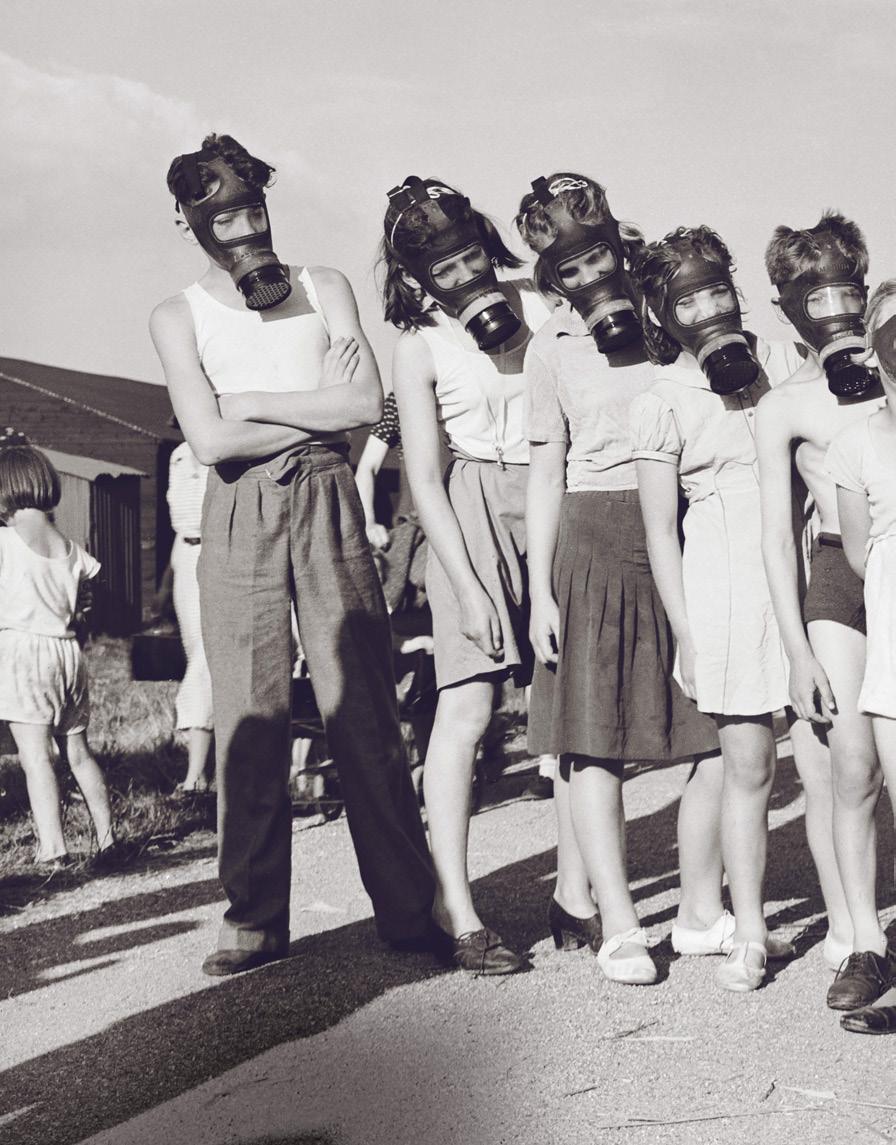
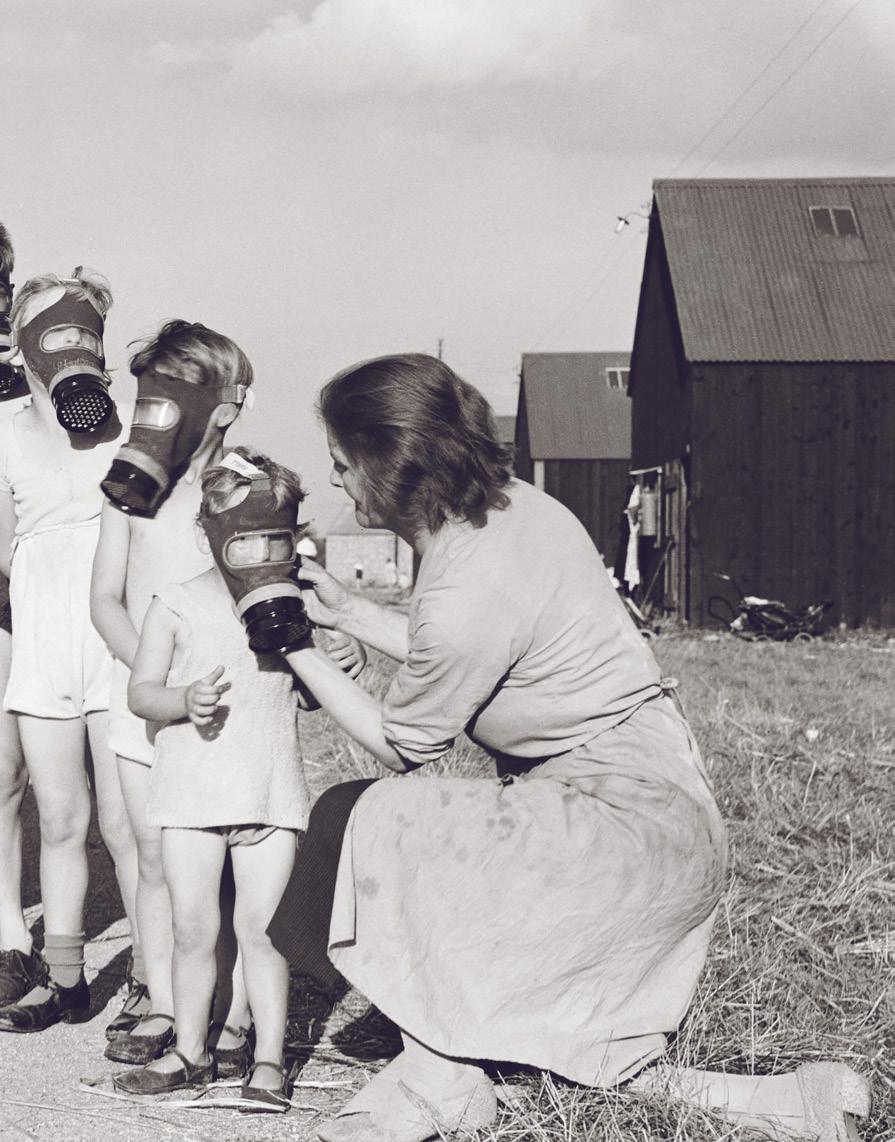
The children of seasonal workers on a hop farm at Paddock Wood, Kent, have their gas masks checked, 29 August 1939. The outbreak of the Second World War is less than a week away.
FOCUS QUESTIONS
1 What is meant by the concepts of ‘power’ and ‘authority’ and how do they apply to the study of history in the period 1919– 46?
2 What were the peace treaties that ended the First World War and what consequences did they have?
3 What were the features of the fascist, totalitarian and militarist movements that emerged after the First World War and how did they differ from each other?
4 How and why did democracy collapse in Germany in the 1930s?
5 What was the nature of the Nazi dictatorship?
6 How and why did the search for peace and security fail between 1919 and 1939?
KEY CONCEPTS AND SKILLS
Analysis and use of sources
7 How was the search for peace and security renewed between 1939 and 1946?
The historical skills involved in considering the nature, usefulness and reliability of sources are critical to the Core Study and to success in the HSC exam. This means that you will need to consider the context of each source before you analyse its content. Always note when your source was produced, who the author is and the likely intended purpose behind the source. Remember that all sources are biased and that even maps and tables of statistics were selected with a purpose and an audience in mind. It is for you to think about the nature of that bias and whether or not it was intentional.
Historical interpretation
As you study the Core and the relationships between power and authority in the modern world, it is important to focus on the nature of those concepts and how they can help us understand and explain the historical events of this period. Interpretation is key to any successful historical study, as historians seek not only to describe, but also to explain and understand the causes and nature of events. In the process, historical interpretations change as new evidence comes to light and old evidence is viewed from new perspectives.
1 Power and Authority in the Modern World 1919–
46
Historical investigation and research
All historical investigations start with questions. What is it that you want to learn? What are the best ways to nd answers to your questions? Always consult a range of sources throughout your process. These should be selected to re ect different perspectives. Remember that a perspective can be in uenced by the time when the source was produced, the national origin of the source and the political af liation of the producer of the source.
Explanation and communication
Keep in mind that the Core Study does not only require you to study and learn about events that took place between 1919 and 1946. To be successful in your HSC, you will need to be able to analyse and interpret sources, as well as integrate these sources with your own knowledge. Finally, you will need to be able to present this ability in a structured and coherent response in your HSC exam.
LEARNING GOALS
> Understand the relationships between the concepts of power and authority in the modern world.
> Explain the failure to maintain peace and security following the First World War.
> Understand the ambitions of Germany in Europe and Japan in the Asia– Paci c Region in the period 1919– 46.
> Understand and account for the nature of the different dictatorships that emerged after the First World War.
> Understand and explain the nature of Hitler’s dictatorship in Germany up to 1939.
> Understand the authority and intentions of the League of Nations and the United Nations.
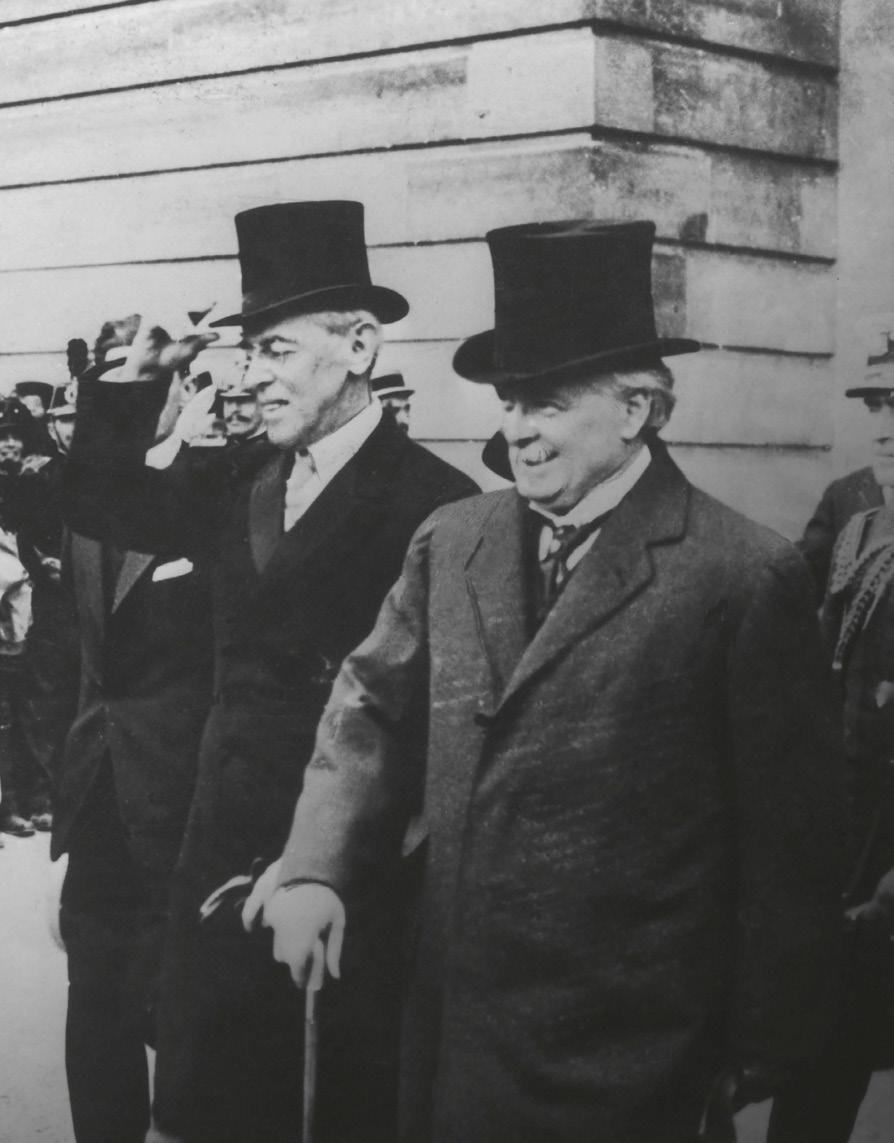
(From left) French Prime Minister Georges Clemenceau, US President Woodrow Wilson and British Prime Minister David Lloyd George attend the Versailles Peace Conference at the end of the First World War, 1 June 1919.
fascist a right- wing nationalist political movement that originated in Italy but then gave its name to any nationalist, conservative, authoritarian movement or ideology totalitarian a concept developed by social scientists to describe an extreme form of dictatorship with what appears to be total or near total control over a society; historians regard the term as being useful as a general description, but not for the purpose of explanation militarist (adj) a strong military in uence on a society or its government
realpolitik
a type of politics where decisions are based on practical a nd ‘real’ concerns about gaining and retaining power and in uence, rather than questions of justice or right and wrong
plutocracy a society or form of government dominated by wealth; the plutocrats were the rich and their money gave them power
Introduction
Before addressing any of the content that follows in this Core Study, it is vital to consider the nature of the two concepts of power and authority and to understand that, although often linked, they are two separate ideas. As a modern history student, considering these concepts will provide you with the opportunity to develop a broader, transnational perspective – that goes beyond the history of individual nation states – when investigating the rise of fascist , totalitarian and militarist movements after the First World War. is chapter will consider why people were attracted to these movements and the con icts associated with them, why struggles to preserve the peace through collective security failed. Collective security was an approach to international peace developed after the First World War whereby nations promised to support one another, in a collective fashion, to ensure their security if threatened. It did not work in practice because nations were reluctant to give up their individual rights to make decisions about their foreign policy. e chapter will further consider why, in some cases, democracies (in this case, the democratic governments in Germany and Italy) collapsed as a result. is Core Study also provides an opportunity for you to develop an understanding of the impact of dictatorships, especially on individual freedoms and on peace and security. In the process, you will be o ered insights into the contemporary world and a critical perspective on the nature of power and authority.
The concept of power
It is widely acknowledged by both historians and political scientists that at the heart of political power are the twin elements of fear and reward. Power comes in many di erent forms linked to one or both of these elements. roughout history, some people and groups have held power because of their physical or military strength. Others have wielded power because they have been wealthy or controlled other people’s or groups’ nances. erefore, having strength and wealth has historically often meant having power.
In a realpolitik sense, leaders or nations hold power because they control more weapons and more troops than any other group. Many dictatorships – including those that you will learn more about in this book, such as Fascist Italy, Nazi Germany, Stalinist Russia and the militarists in the Japan – held power because they held a monopoly (that is, complete, or almost complete control) of coercive force. Coercive force is the power to punish people who do not obey. Punishments can involve death, imprisonment, beatings, nes, con scation of property, exile and so on. is type of power has been frequently exercised under dictatorships, as the governments in dictatorships control the army and the police.
In contrast, societies where power sits with those having the greatest wealth are called plutocratic societies, and the people in power are plutocrats. Historical examples of plutocratic societies include the Roman Empire and some of the city states of Ancient Greece.
Regardless of whether power comes from strength or wealth, all of the dictatorships that you will study in this chapter attained power and held on to it because they were able to command the obedience of their people. eir power to control their population came from a combination of fear and reward: the fear of punishment and the hope of reward. Rewards could be in the form of higher wages, better housing or status; that is, rank within society.
The concept of authority
e concept of authority is more complex. In a democracy, by de nition, authority comes rst from the people. In other words, the authority behind every decision that is made in a democracy – including the allocation of power – is meant to come from ordinary citizens. In a democracy, therefore, elected representatives exercise power on behalf of the people.
In religious societies, sometimes called theocracies, authority comes from religion and the idea that whoever is in power has a divine mandate to rule.
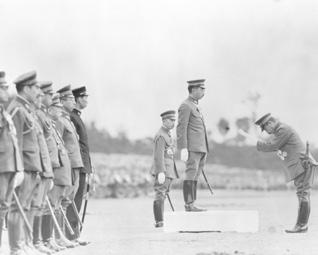
SOURCE 1 The Japanese military dictator General Hideki Tojo (right) bows to Emperor Hirohito, October 1940. Tojo’s power was linked to the authority of the emperor.
In Hitler’s Germany, authority rested with the Führer (leader), Nazi leader Adolf Hitler, who claimed that his authority and his right to make decisions and exercise power came from the Volk, the ethnic German people. Hitler claimed that he served the Volksgemeinschaft – the ‘people’s community’. In Stalin’s Russia, authority came from the Communist Party that claimed to represent both communist ideology and the proletariat (the Russian urban, industrial working class). In Italy, fascist dictator Benito Mussolini tried to link his authority to the glories of Ancient Rome and even spoke about wanting to create a ‘ ird Rome’ (where the ‘First Rome’ referred to the Roman Empire, while the ‘Second Rome’ referred to Constantinople).
In militarist Japan, the authority of the army was based on loyalty to the emperor, and the generals exercised power in his name. As the Japanese people saw Emperor Hirohito as a God, there was also an element of theocracy in the Japanese system.
In summary, authority justi es the use of power and power gives meaning to authority and can make people accept it. As noted above, the concepts are di erent but nonetheless linked, and one rarely exists without the other. Both will be explored further throughout this Core Study.
1.1 Check your learning
1 What are the twin elements of political power? Provide examples of how each one can be exercised.
2 What is a plutocracy? List some examples of plutocratic powers within Australian society.
3 What is the foundation of authority in a theocratic society?
4 Explain how the idea of power is different from the idea of authority.
5 Identify the various authorities behind the respective powers of Hitler, Stalin, Mussolini and Tojo.
1.1 Understanding and using the sources
Source 1 was published in Japan in 1940. Analyse the source and consider the implied message that the militarist government of Japan wanted to send to the Japanese public. Make reference to the source in your response.
mandate a claim to power, authority, control or the right to govern
theocracy a society or form of government dominated by religious ideas
Central Powers the coalition of countries in opposition to the Allies in the First World War; they included Germany, Austria- Hungary, Bulgaria and Turkey
Survey: Peace treaties that ended the First World War and their consequences
In the beginning of winter 1918, the First World War seemed to come to an unexpected end as, one by one, the Central Powers crumbled. Bulgaria surrendered on 29 September, followed by Turkey on 31 October. Austria-Hungary followed on 4 November. e German armies on the Western Front were under increasing pressure and the German High Command informed Kaiser (Emperor) Wilhelm II that the war was lost. e Kaiser ed Germany for the Netherlands on 9 November and two days later, on 11 November, a new German Government signed the armistice (that is, an agreement to cease ghting). However, while the armistice ended the ghting in the First World War, it did not end international con ict, nor did it end the struggles for power.
Allies the coalition of countries in opposition to the Central Powers in the First World War; they included Britain, the Commonwealth, France, Russia, the United States, Serbia and Italy
e First World War, or the ‘Great War’ as it has also been called, had raged for four years, from 1914 to 1918, with the Allies on one side and the Central Powers on the other. e war had been triggered by the assassination of the heir to Austro-Hungarian throne, the Archduke Franz Ferdinand, in late June 1914. e assassination followed a series of disputes over power in the Balkans and the authority of the Austro-Hungarian Empire to rule a number of di erent ethnic communities.
imperial/ imperialism relating to the creation and extension of an empire of territories and possessions controlled and administered for economic gain
arms race an escalation of arms development by nations, seeking to ensure that each side has more powerful weapons than the other
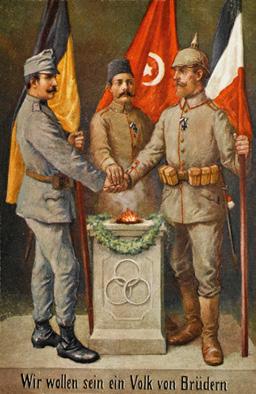
SOURCE 2 A patriotic postcard from around 1918 shows the three main Central Powers: (from left) Austria- Hungary, Turkey and Germany. The caption reads: ‘We want to be a people of brothers.’
e ‘July Crisis’, as it became known, soon expanded into a general European war – only Spain, Switzerland, the Netherlands and the Scandinavian countries managed to stay out of it. At the time, the war was blamed on Germany and, in turn, on the nationalism, the imperialism and the arms race that had been taking place in Europe in the years leading up to the outbreak of the con ict.
e war killed over nine million people and a further ve million died as a result of food shortages. Financial estimates have placed the cost of the war – which was fought across Europe and in parts of Asia, Africa, the Paci c and the Middle East – at over $300 billion. e Great War saw the collapse of four imperial powers: Germany, Russia, the Ottoman Empire (Turkey) and Austria-Hungary. In the long term, the war also marked the decline of Europe and the rise of the United States, while in Asia, Japan emerged as a growing political force in international a airs.
The Paris Peace Conference
e Paris Peace Conference took place at the start of January 1919 and led to a range of debates about the foundations of authority in the new post– First World War world. e Paris Peace Conference is still sometimes mistakenly referred to as the Versailles Conference. However, the Treaty of Versailles – the treaty between Germany and the Allies, which was signed in the Palace of Versailles – while important, was only one of the agreements that came out of the Paris Peace Conference.
It is almost impossible to understand the world today, or indeed the history of much of the twentieth and twenty- rst centuries, without an understanding of the Paris Peace Conference. Historian Margaret Macmillan has called the conference ‘six months that changed the world’. is is a fair comment, as the delegates to the conference, representing 32 countries, not only redrew the map of Central Europe, but also created new countries in the Middle East, including Iraq, Lebanon, Jordan and Syria. ey also established the foundations for the creation of the modern state of Israel, which emerged in 1948. At the outset, however, the conference attendees mainly had two goals in mind. e rst was to prevent a repeat of the disaster in the form of another major war. e second was to justify the vast costs in terms of both lives and money that had been paid during the war.
All the victorious nations except Russia attended the conference. Russia was excluded because it had made a separate peace treaty with the Central Powers in 1918. On the losing side, Germany, Austria-Hungary, Bulgaria and Turkey were not invited to attend until the terms of the treaty had been nalised. is was because the conference began as a preliminary conference, but gradually changed into a full conference. e rules for the conference were drawn up by ve of the countries regarded as ‘Great Powers’: Britain, France, the United States, Italy and Japan. ey stated that the conference members were to be divided into three groups. e rst group, made up of all ve of the Great Powers, was entitled to attend all sessions at the conference. e second group included lesser powers that had fought in the war and had special claims. is group included members of the Commonwealth, Belgium and Greece, among others. e third group, including Peru and Bolivia, had not fought in the war but had broken o diplomatic relations with the Central Powers.
Germany, Italy and Japan all left the conference dissatis ed with the results, and many historians trace the origins of the Second World War back to the decisions made at the Paris Peace Conference.
1.2a Check your learning
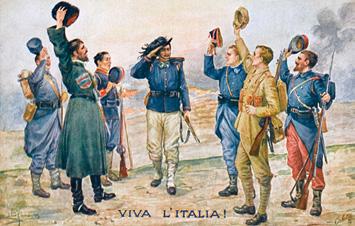
SOURCE 3 A postcard from around 1916 shows Italy (centre) joining the Allies. Italy had previously been part of the Triple Alliance with Germany and Austria- Hungary, but changed sides. Italy therefore came to the Paris Peace Conference with high expectations of making major territorial gains. These expectations were not met.
1 Explain why the Paris Peace Conference is so important to understanding the world today.
2 Why do you think historian Margaret Macmillan chose to use the words ‘six months that changed the world’ to describe the conference?
The role of the ‘Big Four’
Even though Japan had become a member of the ve Great Powers, the real power at the Paris Peace Conference rested with the ‘Big Four’: Britain, Italy, France and the United States. e leaders of the ‘Big Four’ were all very di erent people and their temperaments and the needs of their individual countries saw them clash, compromise, argue and negotiate as they attempted to meet the challenges of making lasting peace.
Georges Clemenceau (France)
e French Prime Minister Georges Clemenceau was 78 years old in 1919. He had seen his country invaded by Germany twice in his lifetime and was determined to make sure it would never happen again. Clemenceau had insisted the conference be held in Paris. When this idea, and his other demands, were challenged, the French leader argued that his authority to exercise this power came from the huge sacri ce that France had made during the war. Clemenceau recognised that because France shared a border with Germany, and because of the di erence between the birth rates of the two countries (around three or four children per family in Germany, compared with around two in France), France would always be at risk of invasion. He was therefore determined that Germany should be weakened to reduce the possible threat. He advocated a harsh peace with the following consequences for Germany:
> the payment of reparations (money that Germany was required to pay as a penalty for damage and loss of life during the war)
> loss of territory
> limits to the size of its army (to 100 000 troops)
conscript/ c onscription a soldier who did not volunteer for service and is serving a period in the armed forces as mandated by the government blockade sealing off a place to prevent people or goods arriving or leaving
> a ban on conscription
> a navy limited to six battleships
> a loss of all colonies
> a ban on having an air force.
David Lloyd George (Britain)
e British Prime Minister David Lloyd George was a complex, clever and ruthless politician. His role during the Paris Peace Conference – and, in particular, in the making of the Treaty of Versailles – is often misunderstood. Like Clemenceau, Lloyd George wanted to guarantee his nation’s security. He had therefore, before arriving at Paris, taken control of the German Navy. Naval power was the only means by which Germany could pose a threat to Britain, and so Lloyd George had acted to remove that threat. He also approved the continuing of a Royal Navy blockade, which limited food to the starving Germany population until the treaty was signed. Beyond these demands, Lloyd George was willing to side with US President Wilson’s softer approach. After all, the British did not want Germany completely crippled, as they feared that this would make France too strong. Britain also wanted the German postwar economy to be healthy enough to buy British manufactured goods.
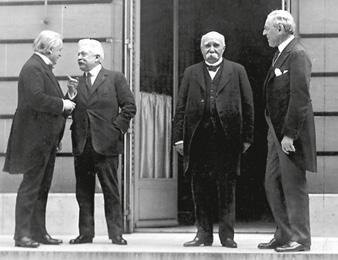
SOURCE 4 The leaders of the ‘Big Four’ at the Paris Peace Conference: (from left) David Lloyd George of Britain, Vittorio Orlando of Italy, Georges Clemenceau of France and Woodrow Wilson of the United States
TERRITORIAL CHANGES AS A RESULT OF THE TREATY OF VERSAILLES
LEGEND
Land taken away from Germany
Demilitarised zone
IRELAND
UNITED KINGDOM
NORTH SEA BALTIC SEA
To Denmark after a vote (or plebiscite)
North Schleswig
NETHERLANDS
Eupen and Malmedy to Belgium
BELGIUM
0200400600 km
Saarland: a plebiscite to be held after 15 years
Danzig (Free city). This was to give Poland a sea port
Alsace–Lorraine ‘Polish corridor’
To France
SWITZERLAND
West Prussia and Posen
Union forbidden
RUSSIA
EAST
LITHUANIA
To Lithuania Lithuania, Estonia and Latvia became independent states. Germany had taken these from Russia in 1918
To Poland
Upper Silesia
CZECHOSLOVAKIA
Source: Oxford University Press
SOURCE 5 In addition to the losses shown here, Germany also lost territory to the new state of Czechoslovakia.
Vittorio Orlando (Italy)
e Italian leader Vittorio Orlando came to Paris with high hopes of major territorial gains, especially control of the Adriatic coastline. is was not to happen. Instead, he was often isolated among the ‘Big Four’ and regularly clashed with Wilson. In his memoirs, Lloyd George complained that both Orlando and Clemenceau would cry when they did not get their way; but by the end of the conference, Orlando had more to cry about than Clemenceau. Italy did not receive many of the territories it had been hoping for, as the other Great Powers were suspicious of Italy’s imperial ambitions. is saw Orlando leave the conference deeply dissatis ed. e failure in Paris ended Orlando’s political career and paved the way for a right-w ing dictatorship in Italy under Benito Mussolini, who took power in October 1922.
Woodrow Wilson (United States)
President Woodrow Wilson regarded himself as an idealist and believed that he and America (the new world) could save Europe (the old world) from itself and from further war. He believed that America could o er leadership and make the world a better and safer place. Importantly, Wilson and the United States did not have the same security fears as France and Britain. Nor did the United States need more territory, like Italy, to justify entering the war. It was therefore easier for Wilson to take the ‘high road’. If Orlando needed territory to justify Italy entering the war, Wilson needed the League of Nations (see page 14) to justify having broken the election promise he had made to the American people when he was re- elected in 1916 – to keep the United States out of the war. He hoped that founding a League of Nations to ensure enduring peace would make the American people agree that entering the war was the right decision.
League of Nations an intergovernmental organisation founded as a result of the Paris Peace Conference; it was the rst international organisation whose principal mission was to maintain world peace
Before the United States entered the war on 22 January 1917, Wilson delivered a speech to Congress that set out the idea of ‘Peace without victory’. is came after he had written to both sides and asked for their war aims. e speech included some ideas that would appear the following year in the famous ‘Fourteen Points’, set out below:
1 no secret treaties
2 freedom of the seas in peacetime or wartime
3 free trade between countries
4 international disarmament
5 colonies to have a say in their own future
6 German troops to leave Russia
7 independence for Belgium
8 France to regain Alsace-L orraine
9 the frontier between Austria and Italy to be adjusted
10 self-determination for the people of Eastern Europe
11 Serbia to have access to the sea
12 self-determination for the people of the Ottoman Empire
13 Poland to become an independent state with access to the sea
14 a League of Nations to be established.
Neither the British nor the French were willing to support the Fourteen Points when Wilson rst proposed them in January 1918, but this did not seem to matter because Germany had already rejected some of the provisions when it turned down the conditions included in the earlier ‘Peace without victory’ speech. However, the position had changed by October 1918, when the Germans realised that the war seemed lost. e Germans then asked Wilson to arrange a peace on the basis of the original Fourteen Points, but Wilson replied that new peace terms would have to be decided after an armistice.
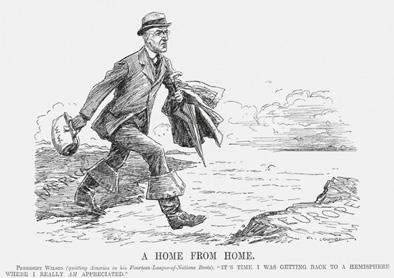
SOURCE 6 A cartoon from March 1919 shows Wilson in his ‘FourteenLeague- of- Nations’ boots coming to Europe.
1.2b Check your learning
After the fact, some people in Germany argued that they had only agreed to an armistice on the basis of the Fourteen Points. is is one of the many ‘half truths’ that became part of the myth of the ‘stab in the back’ and German claims of unfair treatment in the conditions of the Treaty of Versailles.
1 Identify the states that made up the ‘Big Four.’
2 Account for the key French demands.
3 Describe Britain’s position and analyse how it differed from that of the French.
The Treaty of Versailles
Even though the Treaty of Versailles (the treaty that made the peace with Germany at the end of the First World War) is by far the most famous and perhaps the most important treaty signed during the Paris Peace Conference, it was not the only one. ere were in fact four other treaties that made up the peace settlements:
1 the Treaty of Trianon with Hungary
2 the Treaty of Neuilly with Bulgaria
3 the Treaty of Saint- Germain with Austria
4 the Treaty of Sevres with Turkey.
e Treaty of Versailles would, however, have the arguably biggest in uence on postwar Europe. It included many of the harsh conditions that Clemenceau had wanted. Germany lost its overseas colonies and was forced to give up territory in Europe to new neighbours. It had its military vastly reduced. It had to pay reparations and accept responsibility for causing the war. is acknowledgment of blame was formally set out in Article 231: the so-called ‘War Guilt Clause’.
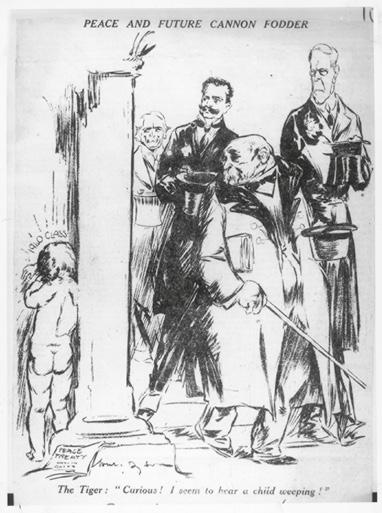
e Treaty of Versailles became famous, or infamous, because of what followed. e idea of the treaty, and what it was perceived as having led to, became more important and powerful than the treaty itself. It is not uncommon – as is evident in the cartoon in Source 7 – to blame the Second World War on the Treaty of Versailles.
SOURCE 7 This 1920 cartoon by Australian Will Dyson is highly critical of the Treaty of Versailles. The French leader Clemenceau (the Tiger) comments that he thinks that he hears a child crying. The child is labelled ‘1940 class’.
Yet as a history student it is crucial that you rely on facts to come to your own conclusion about the role of the treaty in setting Germany up to initiate the Second World War.
In the decades between the two World Wars, the most important consequences of the Treaty of Versailles were:
1 the failure of the US Senate to ratify the Treaty of Versailles; as the League of Nations was established within the Treaty of Versailles, this also meant that the United States did not become a member of the League – a personal failure for Wilson who had been championing the creation of the League since before the United States joined the war
2 the resentment towards the treaty in Germany that was inspired and exploited by conservative groups.
Many historians have argued that the Treaty of Versailles was neither excessively harsh nor unreasonable, but, as noted above, the fact that the treaty would be used as a means to mobilise dissatis ed leaders and groups ended up being as signi cant in shaping modern history as the treaty itself. ratify to agree to or support; to give formal con rmation of a treaty or agreement
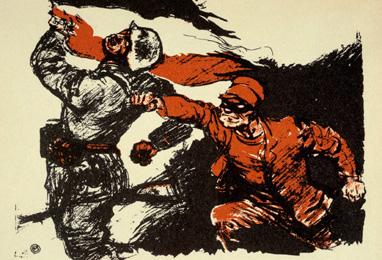
SOURCE 8 A German right- wing propaganda poster blaming Germany’s defeat in the First World War on the ‘stab in the back’ propaganda biased or misleading information used to in uence people towards a particular point of view
diktat a harsh settlement unilaterally imposed on a defeated nation armaments the collective term for all the weapons of war – guns, tanks, aircraft, warships etc.
Did the Treaty
of Versailles treat Germany unfairly?
e ‘stab in the back’ was one of the most important and in uential myths to emerge in twentieth- c entury history. Like all powerful myths, this one was not pure ction. It has elements of truth.
e German claim that the Treaty of Versailles was a diktat – a t reaty that simply dictated to the German delegates – i s in part true. e Paris Peace Conference was originally intended to be a preliminary conference, where the Allies would meet to decide on the terms of a treaty that would then be negotiated with the German delegates. However, the preliminary meeting turned into a full conference and the phase of negotiation with German delegates never took place. is fact was often pointed to by conservatives, in particular Hitler, who campaigned against the treaty and against the democratic politicians who had been forced to sign it.
1.2c Check your learning
Conduct research to nd evidence to help you determine whether the Treaty of Versailles was unreasonably harsh and unfair to Germany. Discuss your ndings in a 300- word article.
1.2a Understanding and using the sources
1 Analyse and interpret the usefulness of Source 7 to a historian studying the Treaty of Versailles. Consider the context of the source, when it was produced and the theme of the cartoon.
2 Analyse and assess the effectiveness of the poster in Source 8 as an example of propaganda. What are the themes and motifs (consider images and colours) used by the artist, and how might these choices impact on the effectiveness of the poster?
The League of Nations
e Covenant of the League of Nations – the document setting out the organisation’s structure and aims – claimed that its key objective was to ‘promote international co-operation and to achieve international peace and security by accepting obligations not to resort to war’.
Even though the League of Nations is closely linked to US President Wilson, it was not his idea alone. During the war, a series of proposals were put forward favouring some kind of international organisation that would aim to maintain the peace and limit the growth of armaments. Proposals by General Jan Smuts of South Africa and Lord Robert Cecil of Britain formed part of the basis for the League, making it clear that there was support for the concept before the end of the war.
THE LEAGUE OF NATIONS
LEGEND
League of Nations
Founding member that stayed until the end
Founding member that left and joined
Founding member that left
Joined later and stayed until the end
Joined later and left later
Colonies of members
Colonies of members that left Colonies/territories of non-member
SOURCE 9 Member states of the League of Nations, 1920– 45
Source: Oxford University Press
e participants at the Paris Peace Conference established a League of Nations Commission, which was in charge of drawing up plans for the League. e conference attendees then approved the commission’s proposal, which became the Covenant of the League of Nations on 28 April 1919. e 26 articles of the covenant initially focused on implementing the peace treaties ending the Great War. Despite its authority, and despite it having been sanctioned by the members of the Paris Peace Conference and having 42 founding members, the League did not have a military force of its own, unlike the modern United Nations, and its power was therefore limited.
e headquarters of the League was placed in Geneva, Switzerland, and the League’s structure was based on three main branches: the Assembly, the Council and the Secretariat.
e Assembly included all of the member states, where each state, large and small, had a single vote. e Assembly met once a year.
e Council met more regularly – four times a year – a nd although it was meant to represent the ve Great Powers of Britain, France, Italy, the United States and Japan, the fact that the US Senate failed to ratify the Treaty of Versailles meant that the Council started out with four members. ese Great Powers were balanced by four non-permanent powers, elected to represent the smaller nations. From 1922, more non-permanent members became part of the Council, which gave the smaller powers a majority.
e Assembly was also responsible for supervision of the Secretariat, which was made up of 600 full-t ime professional administrators under a Secretary General. ey were responsible for managing everyday League business.
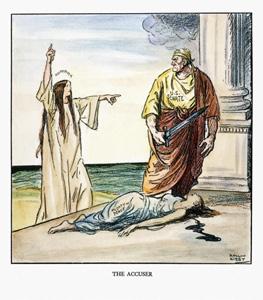
SOURCE 11 An American cartoon from 1920 critical of the US Republican- led Senate for failing to ratify the Treaty of Versailles
Under these three main groups there were also the Permanent Court of International Justice, the International Labour Organization and a series of technical organisations, dealing with economics, health, transport and communication.
SOURCE 10
Power involves will, as the United States and the world are discovering today: the will to spend, whether in money or lives. In 1919 that will had been crippled among the Europeans; the Great War meant that the leaders of France or Britain or Italy no longer had the capacity to order their peoples to pay a high price for power … It is tempting to say that the United States lost an opportunity to bend Europe to its will before competing ideologies of fascism and communism could take hold … In 1919, however, the United States was not yet signi cantly stronger than the other powers.
Armies, navies, railways, economics, ideologies, history: all these are important in understanding the Paris Peace Conference. But so too are the individuals because, in the end, people draw up reports, make decisions and order armies to move. e peacemakers brought their own national interests with them but they also brought their likes and dislikes. Nowhere were these more important than among the powerful men – especially Clemenceau, Lloyd George and Wilson – who sat down together in Paris.
Margaret Macmillan, Peacemakers: Six Months that Changed the World, 2001
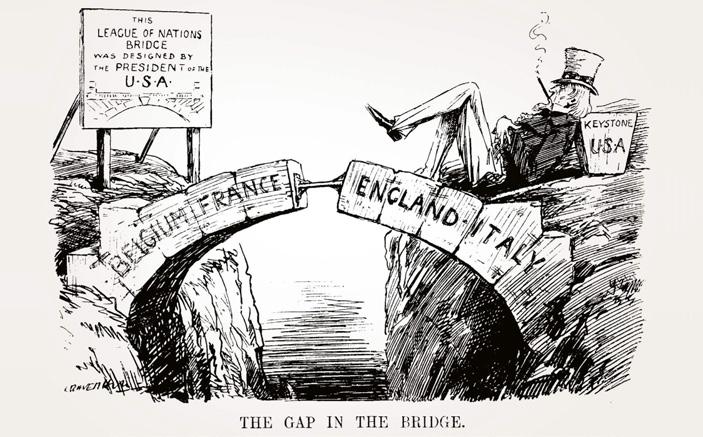
SOURCE 12 This 1920s cartoon blames the failure of the United States to join the League of Nations for a critical weakness in the structure.
1.2d Check your learning
1 Analyse the importance of individual leaders to the events in Paris in 1919.
1.2b Understanding and using the sources
1 Identify what Margaret Macmillan argues is the key to power in Source 10.
2 With speci c reference to Source 10 and the ideas expressed by Macmillan, what are, in your view, the lessons of power that the world today can learn from 1919?
3 Study Source 7 and Source 10. Choose one of the ‘Big Four’ leaders and write a 250- word newspaper- style obituary summing up his life and career. In the process, assess the validity of the views of your chosen gure presented by these sources.
4 Using Sources 9–12 and the information available in this chapter, assess the importance of the United States to the process of making peace.
5 What insights can be gained about the relationship between power and authority by studying Sources 1–12?
The role of power and authority in the peace process
e victors at the Paris Peace Conference maintained that their authority for exercising the power to impose the terms of the peace after the First World War came from their victory. For example, US President Wilson repeatedly asserted a moral authority for the creation of the League of Nations, while French leader Clemenceau spoke of the millions of French dead and the enormous damage done to France by a war fought largely on French soil as the basis of his authority at the conference.
In terms of power, however, the power of the ‘Big Four’ was already in decline by the time their leaders arrived for the conference in 1919. e armies that had won the war were going home and returning to civilian life. erefore, the power of the ‘Big Four’ to assert their authority was weaker in 1919 than it had been when their armies were at full strength in November 1918. When David, Lloyd George, Vittorio Orlando, Wilson and Clemenceau met to make decisions, they appeared powerful; and yet, because they came from democratic societies, their power was always limited to the authority granted to them by their voters at home.
e clearest example of the complex relationship between power and authority that emerged from the Paris Peace Conference was the part played by Wilson. e authority of the democratic process in his own country ultimately overruled him, despite his apparent power at the conference. e US Senate refused to endorse American membership of the League of Nations, the very body that Wilson had vigorously championed. In turn, the absence of the United States from the League of Nations, and America’s decision to adopt a more isolationist position, weakened the power of the League as Europe moved away from democracy and into a time that would be dominated by the rise of dictatorships.
isolationism the idea that a country needs to isolate itself from world affairs and focus on its own selfinterest
1.3 The rise of the dictatorships after the First World War
As noted earlier in the chapter, the three countries that produced the most famous right-wing dictatorships after the First World War – Germany, Italy and Japan – were all dissatis ed when they left the Paris Peace Conference, as was the new left-wing communist dictatorship in Russia, which had been banned from the conference. It would be wrong, however, to assume that this dissatisfaction was the primary cause for the rise of any of these dictatorships. Rather, there were speci c local, national, social, economic and cultural factors at work in each of these countries that played a part in the rejection of democratic governments. Furthermore, it would also be wrong to view all four of these dictatorships as the same. Each of them was unique, or, to use the Latin term, sui generis. e factors that led to the rise of communism in Russia and Stalin’s dictatorship were very di erent from the circumstances in Italy that saw Benito Mussolini become dictator, or those in Germany where Adolf Hitler created Nazi rule.
SOURCE 13
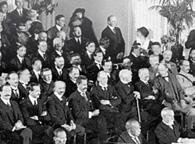
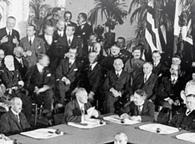
The Paris Peace Conference 1919: within two decades the world order championed by the victors at this conference had been challenged and, for a time, overturned.
e historical factors at work in creating each of the European dictatorships were also clearly di erent from the cultural heritage that saw Hideki Tojo become rst Prime Minister and then leader of a military dictatorship in Japan. To properly understand how and why these dictatorships emerged, each of them must be studied individually.
All these societies did, however, have two things in common. ey all rejected democratic values, and they all placed loyalty to the state above the rights and freedoms of individuals.
As discussed in the introduction to this Core Study, the power exercised by each of these dictatorships was based on a combination of fear and reward. Further, their authority rested on loyalty to a particular leader, ideology or set of values.
As a history student it is important that you stay clear of the dangerous assumption that liberal democracy and representative government – of the kind that exists in Australia, the United States and Britain, for example – are somehow the natural order and the logical result of social progress and modernity. is view is both misguided and historically short-sighted. In the immediate aftermath of the First World War, as you will have noted earlier in this chapter, the democracies appeared to have prevailed. However, within two decades the world order championed by the victors at the Paris Peace Conference had been challenged and, for a time, overturned. Dictators had taken power in Italy, Russia, Spain and Germany in the 1920s and 30s. At the time, many people in Europe had in fact come to feel that these dynamic nationalist dictatorships represented the future.
Columbia University historian Mark Mazower called Europe between the First and Second World Wars the ‘Dark Continent’. He was referring to the ideas that led to the rise of the dictatorships and the war and bloodshed that became part of these dark times.
SOURCE 14
[W]e should certainly not assume that democracy is suited to Europe. ough we may like to think democracy’s victory in the Cold War proves its deep roots in Europe’s soil, history tells us otherwise. Triumphant in 1918, it was virtually extinct twenty years on. Maybe it was bound to collapse in a time of political crisis and economic turmoil, for its defenders were too utopian, too ambitious, too few. In its focus on constitutional rights and its neglect of social responsibilities, it often seemed more tted to the nineteenth than the twentieth century. By the 1930s the signs were that most Europeans no longer wished to ght for it; there were dynamic non- democratic alternatives to meet the challenges of modernity. Europe found other, authoritarian, forms of political order no more foreign to its traditions, and no less e cient as organizers of society, industry and technology.
Mark Mazower’s e Dark Continent: Europe’s Twentieth Century, 1999, p. 3
1.3a Check your learning
1 Identify the meaning of the Latin term sui generis and explain why it is important for historians studying the nature of dictatorships.
2 Account for the general qualities that the dictatorships had in common.
3 Explain why historian Mark Mazower would describe Europe in the interwar period as the ‘Dark Continent’? Is the description justi ed?
1.3a Understanding and using the sources
1 Examine Source 14. What do you think that Mazower meant when he suggested that the defenders of democracy had neglected their ‘social responsibilities’?
2 As you read this chapter, think about Mazower’s argument and decide whether or not you agree with his argument that democracy was not necessarily ‘suited to Europe’ in the 1920s and 30s.
3 Mazower suggests that democracy might have been bound to collapse in a time of political and economic turmoil. Do you agree that democracy is better suited to rich and stable countries? Justify your response.
liberal democracy a form of democratic government where liberal freedoms –meaning freedom of religion, freedom of the press and free enterprise – are valued and protected representative government government run by elected of cials
Cold War a state of geopolitical tension that arose after the Second World War between powers in the communist nations of the Eastern Bloc and capitalist- democratic powers in the West
authoritarian favouring strict obedience to authority; a term normally associated with dictatorships, where the authority of the government is not to be challenged