Michael Beaney, Ursula Coope, Karen Detlefsen, Lisa Downing, Tom Hurka, Pauline Kleingeld, Robert Pasnau, Dominik Perler, Houston Smit, Allen Wood
Oxford Guides to Philosophy presents concise introductions to the most important primary texts in the history of philosophy. Written by top scholars, the volumes in the series are designed to present up-to-date scholarship in an accessible manner, in order to guide readers through these challenging texts.
Anscombe’s Intention: A Guide John Schwenkler
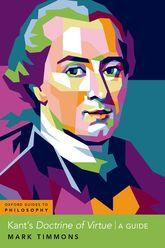
Kant’s Doctrine of Virtue: A Guide Mark Timmons
Kant’s Doctrine of Virtue
A Guide MARK TIMMONS
Oxford University Press is a department of the University of Oxford. It furthers the University’s objective of excellence in research, scholarship, and education by publishing worldwide. Oxford is a registered trade mark of Oxford University Press in the UK and certain other countries.
Published in the United States of America by Oxford University Press 198 Madison Avenue, New York, NY 10016, United States of America.
All rights reserved. No part of this publication may be reproduced, stored in a retrieval system, or transmitted, in any form or by any means, without the prior permission in writing of Oxford University Press, or as expressly permitted by law, by license, or under terms agreed with the appropriate reproduction rights organization. Inquiries concerning reproduction outside the scope of the above should be sent to the Rights Department, Oxford University Press, at the address above.
You must not circulate this work in any other form and you must impose this same condition on any acquirer.
Library of Congress Cataloging-in-Publication Data
Names: Timmons, Mark, 1951– author.
Title: Kant’s Doctrine of virtue : a guide / Mark Timmons. Description: New York, NY : Oxford University Press, [2021] | Includes bibliographical references and index.
Identifiers: LCCN 2020052410 (print) | LCCN 2020052411 (ebook) | ISBN 9780190939229 (hardback) | ISBN 9780190939236 (paperback) | ISBN 9780190939250 (epub)
LC record available at https://lccn.loc.gov/2020052410
LC ebook record available at https://lccn.loc.gov/2020052411
DOI: 10.1093/oso/9780190939229.001.0001
1 3 5 7 9 8 6 4 2
Paperback printed by Marquis, Canada
Hardback printed by Bridgeport National Bindery, Inc., United States of America
For Betsy
Preface
This book, included in the Oxford Guides series, is a concise guide to Kant’s last publication in ethics, Part II of the 1797 The Metaphysics of Morals, The Doctrine of Virtue. The Metaphysics of Morals comes after the two foundational works, the 1785 Groundwork of the Metaphysics of Morals and the 1788 Critique of Practical Reason and represents Kant’s exposition and defense of his normative doctrine of morals. Part I, The Doctrine of Right, contains Kant’s legal and political philosophy, while Part II is his ethical theory. The Doctrine of Virtue is relatively short, only 116 pages as it appears in volume VI of the Academy edition of Kant’s works. Because it is short and yet intended to cover the science of ethics (on Kant’s understanding of “science”), it moves rapidly over much ground, challenging any reader’s understanding of it. The Metaphysics of Morals includes a general introduction that is crucial for understanding the entire book. In it, Kant explains what a metaphysics of morals is, relates the idea of moral law to the faculties of the human mind, reviews core concepts that figure in such a metaphysics, and explains the basis of the division between its two parts. Given, then, its importance for understanding The Doctrine of Virtue, this guide also includes chapters devoted to it.
I have written the guide to be read alongside Kant’s text. My hope is that it will help readers navigate the complexity of Kant’s thought, due in part to his rich philosophical vocabulary expressing concepts he needed to employ to articulate his thought. To help readers with this vocabulary, I have included a Guide to Terminology. Throughout I make occasional contact with some of the ever-expanding secondary literature on Kant’s ethics. However, given the aim of the series, I have largely refrained from explicitly engaging this literature. I do, though, point readers to select secondary works in the Further Reading sections at the end of each chapter. In the book’s conclusion I review elements of Kant’s doctrine of virtue, calling attention to its features that distinguish it from others and briefly indicate its continuing influence on normative ethics.
Acknowledgments
Thanks to the following students who read an early draft of this book that I used along with teaching The Doctrine of Virtue in my fall 2018 graduate seminar on Kant’s ethics: Gavriel Aryah, Josh Cangelosi, Cristos Chuffe, Max Kramer, Robert Lazo, Andrew Lichter, Shuai Liu, Xihe Ouyang, Susan Puls, Will Schumacher, Jacquelyn Sideris, Robert Wallace, Justin Westbrook, and Ke Zhang. A special thanks to Santiago (“Santi”) de Jesus Sanchez Borboa, who contributed substantially to the seminar and for the many helpful conversations we’ve had about parts of this book.
I made many improvements throughout the book thanks to Adam Cureton’s thoughtful comments and suggestions on the book’s penultimate draft, saving me from some mistakes and encouraging me to elaborate certain themes and arguments.
Robert Audi read and commented on the penultimate manuscript and offered many helpful suggestions for improving the book’s content.
Over the years I have greatly benefitted from discussions with my colleague Houston Smit on many of the topics covered in this book.
Thanks finally to Peter Ohlin, editor at Oxford University Press, and to my co-editors of this series, Becko Copenhaver and Chris Shields, for their help and encouragement.
Abbreviations for Kant’s Works
All references to Kant’s work include the volume number (in roman numerals) followed by the page number of the German Academy edition of Kant’s works: Immanuel Kants gesmmelte Schriften, edited by the Königlich Preußischen Akademie der Wissenschaften (Berlin: Walter de Gruyter, 1900–).
The Academy edition page numbers are included in the margins of most English language translations, including the Cambridge Edition series of the Works of Immanuel Kant listed here. The following abbreviations are used throughout.
Anth Anthropology from a Pragmatic Point of View, trans. R. B. Louden (2006)
CJ Critique of the Power of Judgment, trans. P. Guyer and E. Matthews (2000)
Col Moral Philosophy from the Lectures of Professor Kant, Winter Semester 1784–85, Georg Ludwig Collins, ed., included in Lectures on Ethics, trans. P. Heath (1997)
CprR Critique of Practical Reason, trans. M. J. Gregor (1996)
CpuR Critique of Pure Reason, trans. P. Guyer and A. Wood (1998)
DR Doctrine of Right, part I of the Metaphysics of Morals, trans. M. J. Gregor (1996)
DrMM Drafts for the Metaphysics of Morals, trans. K. R. Westphal in F. Rauscher, ed., Lectures and Drafts on Practical Philosophy (2016)
DV Doctrine of Virtue, Part II of the Metaphysics of Morals, trans. J. Timmermann and J. Grenberg (forthcoming).
EMH Essay on the Maladies of the Head, trans. R. B. Louden (2007)
G Groundwork of the Metaphysics of Morals, trans. M. J. Gregor and J. Timmermann (2011)
JL Jäsche Logic, trans. J. M. Young (1992)
LA Lectures on Anthropology, trans. R. B. Clewis, R. B. Louden, C. F. Munzel, and A. W. Wood (2012)
xiv Abbreviations for Kant’s Works
LM Lectures on Metaphysics, trans. K. Ameriks and S. Naragon (1997)
MFNS Metaphysical Foundations of Natural Science, trans. M. Friedman (2004)
MM Introduction to The Metaphysics of Morals, trans. M. J. Gregor (1996)
MPT “On the Miscarriage of All Philosophical Trials,” trans. A. W. Wood (1996)
NF Notes and Fragments, trans. C. Bowman, P. Guyer, and F. Rauscher (2005)
Ped Lectures on Pedagogy, trans. R. B. Louden (2006)
R Religion within the Boundaries of Mere Reason, trans. G. di Giovanni (revised edition, 2018)
TP “On the Common Saying: That May Be Correct in Theory, But It Is of No Use in Practice,” trans. M. J. Gregor (1996)
Vig Notes on the Lectures of Mr. Kant on the Metaphysics of Morals, begun October 14, 1793, Johann Friedrich Vigilantius, ed., included in Lectures on Ethics, trans. P. Heath (1997)
Note on Translations
For The Doctrine of Virtue (DV), I am using the new English translation by Jens Timmermann and Jeanine Grenberg that includes the German and English side by side.
James W. Ellington’s Ethical Philosophy by Hackett Publishing Co., besides his translation of DV, also includes translation of the general introduction to The Metaphysics of Morals, which I cover in Part II of this guide. (This book also includes translations of Kant’s Groundwork and the essay “On a Supposed Right to Lie.”)
1 Life and Work
Immanuel Kant was born in 1724 in Königsberg, the capital of East Prussia, a bustling harbor city located on the Baltic Sea, where he spent most of his life.1 His parents were devout Pietists, a form of Protestantism that emphasized “independent Bible study, personal devotion, the priesthood of the laity, and a practical faith issuing in acts of charity.”2 About his parents Kant wrote in a letter: “my two parents (from the class of tradesmen) were perfectly honest, morally decent, and orderly. . . . Moreover, they gave me an education that could not have been better when considered from the moral point of view.”3 He entered the University of Königsberg in 1740 at the age of seventeen, where he studied philosophy and natural science. His father died in 1746, and without finances to continue his studies Kant earned money as a private tutor, returning to the university in 1754, completing his degree the following year. It was not until 1770 at the age of forty-six that Kant finally obtained a professorship of logic and metaphysics at the University of Königsberg, where he taught until his retirement in 1797. After becoming ill in October 1803, Kant died on February 12, 1804, just shy of his eightieth birthday.
Some of Kant’s earliest writings address topics in physical science, including the 1755 General History and Theory of the Heavens, in which he speculated that the solar system could have evolved entirely by mechanical means, and so without divine intervention. This same idea was later put forth independently in 1796 by French philosopher Pierre-Simon Laplace (1749–1827), and has become known as the Kant-Laplace nebular hypothesis. The decade of Kant’s life in the 1770s
1 Before World War II, Prussia was part of Germany; after the war, it was divided between Poland and the Soviet Union. Kant’s city of birth is now Kaliningrad, Russia.
is known as his “silent years” during which he published very little while working out elements of his mature philosophy, culminating in his 1781 Critique of Pure Reason, followed by the Critique of Practical Reason in 1788, and finally, the Critique of the Power of Judgment in 1790. These three books (often referred to, respectively, as the first, second, and third Critiques) comprise the major works of Kant’s socalled critical philosophy, which, roughly speaking, involves an examination of the character and limits of fundamental human mental faculties as a basis for explaining the possibility of a true metaphysics of both nature and morals. The first Critique investigates the nature and limits of human theoretical cognition—cognition of what is— arguing against traditional “dogmatic metaphysics” that sought cognition of a supersensible realm of being. The second Critique is Kant’s second of three major works in moral philosophy, about which more in a moment. The third Critique provides an account of judgments of aesthetic taste and an examination of the role of teleological thinking in regulating the scientific investigation of the natural world.
Kant wrote three works of moral philosophy, beginning with the 1785 Groundwork of the Metaphysics of Morals, followed by the second Critique, and finally, toward the end of his life, the 1797 The Metaphysics of Morals. The relatively short but exceedingly dense Groundwork provides a foundation for a comprehensive normative moral theory by articulating and then establishing the supreme principle of morality, which Kant referred to as “the categorical imperative.” The second Critique represents a systematic investigation of the foundation of morality that Kant traces to our nature as beings with free will. He also explains how God and immortality of the soul figure in a complete account of morality. (More on this in the next chapter.) Both are primarily works in metaethics—investigating the nature and possibility of morality.4 The Metaphysics of Morals by contrast represents Kant’s normative moral theory in which he sets forth and justifies a system of duties. Part I of the book, The Doctrine of Right (DR), presents the elements of his legal and political philosophy and features duties,
4 However, they also include some elements of Kant’s normative ethics, including an articulation of the supreme principle of morality that he later employs in deriving a system of moral principles in DV.
compliance with which is susceptible to legitimate coercion from the state or other people. In Part II, The Doctrine of Virtue (DV), the focus of our study, Kant turns to that part of moral philosophy—the ethics— concerning duties not properly subject to such coercion. These two parts comprise Kant’s doctrine of morals: his normative theory of law, politics, and ethics. For Kant, a philosophical doctrine of morals can only be a metaphysics of morals.
1.1 Situating Kant’s moral philosophy
It is helpful to situate the development of Kant’s moral philosophy against two traditions: the seventeenth- and eighteenth-century debate among British philosophers between rationalists and sentimentalists over the foundation of morality, as well as the works of select German philosophers who fell into one of these two camps. Very roughly speaking, the British rationalists, including Ralph Cudworth (1617–1688), Samuel Clarke (1675–1729), and others, held that it is possible to know fundamental ethical principles on the sole basis of reason, and thus know them a priori without needing to conduct scientific experiments, use our five senses, or otherwise experience them. They drew an analogy between moral and mathematical judgments.5 In opposition to this view, the British sentimentalists, including Anthony Ashley Cooper, the third Earl of Shaftsbury (1671–1713), Francis Hutcheson (1694–1746) and David Hume (1711–1776), held that moral judgments are analogous to judgments of beauty in that sentiment (feeling) is the basis for both. For instance, based on his analysis of moral thought, David Hume famously concluded, “Morality, therefore, is more properly felt than judg’d of” (1739: 470).
Early in his career, Kant expressed sympathy toward the British sentimentalist school, writing in an announcement for a course he was to teach in winter semester 1765–66, “The attempts of Shaftesbury, Hutcheson, and Hume although incomplete and defective, have
5 In Germany during Kant’s time, a perfectionist version of rationalism was defended by Christian Wolff (1679–1754) and others, largely inspired by the earlier work of Leibniz (1646–1716).
nonetheless penetrated furthest in the search for the fundamental principle of morality.”6 However, two decades later, and by the time Kant writes the 1785 Groundwork, he has developed a distinctive form of rationalism, differing significantly from his rationalist predecessors.
1.2 History and significance of The Doctrine of Virtue
As early as 1767, Kant wrote to a former student (Johann Gottfried Herder) that he hoped to complete work on a metaphysics of morals in the following year. However, writing the book was delayed by various things, including Kant’s felt need to first complete other philosophical projects, including the Groundwork and the second Critique. According to one scholar,7 it is likely that Kant did not begin the actual writing of The Metaphysics of Morals until 1795. Its eventual publication was delayed for thirty years after mentioning the project to Herder. DV is critical for understanding Kant’s moral philosophy for several reasons. First, it presents a side of his moral philosophy—a normative ethical theory set forth systematically—not found in the two earlier works in moral philosophy. One gets a glimpse of this system from the Groundwork’s four sample applications of the supreme principle of morality to the cases of suicide, false promises, helping others, and self-perfection. However, in DV we find a fully worked out system of midlevel duties and associated virtues divided into duties to oneself and duties to others, each of these divisions further subdivided. Second, as a treatise about virtue it focuses on one’s inner moral life— one’s attitudes and motivations in complying with duty and thus with moral character. This aspect of the book combats the impression one might get from the Groundwork and second Critique that Kant’s moral philosophy is overly abstract and does not connect with ordinary moral experience and concrete moral problems. Third, DV also discusses topics not treated in other works, including Kant’s distinctive
6 This announcement is contained in volume 2, pages 311–12 of the Academy edition of Kant’s works.
7 Kuehn 2010.
conceptions of conscience and moral friendship. A complete moral philosophy addresses metaethical questions about the foundation of morality, as well as general normative questions about what one ought to do and what sort of person to be. In addressing these latter questions, DV (together with [DR]) represent the completion of Kant’s moral philosophy.
DV is also not a work of mere historical significance. It is a contribution to normative ethical theory, especially as it compares to other approaches, including forms of consequentialism, contemporary virtue ethics, natural law theory, the ethics of prima facie duty, and religious ethics. These comparisons will emerge as we proceed and are briefly summarized in the book’s conclusion as well as how Kant’s ethics is relevant to contemporary moral problems
1.3 Reading Kant
As many readers know, reading Kant is challenging, and understanding his writings is often a slow and painstaking process. Part of the challenge is mastering Kant’s technical vocabulary, which, as I mentioned in the Preface, he needed to express his complex thought. I hope this book, including the Guide to Terminology, helps overcome this challenge and others. I have just been touting some of DV’s virtues, however, it has certain shortcomings as a philosophical treatise. It moves rapidly over many topics, some of its arguments are unclear, others are unconvincing, while sometimes we don’t find arguments for claims that need support. Perhaps these shortcomings are due to the fact the Kant wrote the book toward the end of his life when he might not have been at the height of his mental powers. Still, I stand by my positive remarks about the book’s importance, which I hope to partly if not fully vindicate with this guide.
1.4 Why the general introduction?
Let me emphasize the importance of the general introduction to the entire Metaphysics of Morals and explain why I spend time covering it.
In it, Kant explains what a metaphysics of morals is and why there must be one. Reading DV without this background would likely be puzzling, since contemporary philosophy treats metaphysics as exclusively concerned with the most fundamental constituents of what is and not what we are required to do and the kind of person to be. Normative ethical theory that deals with these issues is thus not taken to be part of metaphysics. Yet, Kant has his own conception of the field of metaphysics which concerns the nature and possibility of synthetic a priori cognition, including cognition of basic moral principles, material covered in chapter 3. Furthermore, Kant’s normative ethical theory presupposes familiarity with the concepts and doctrines that Kant only summarizes in the general introduction. This includes how moral laws are related to basic mental faculties of human beings (the focus of chapter 4) and articulation of such basic ethical concepts as obligation, duty, and moral worth, the focus of chapter 5. Kant’s treatment of these topics in the general introduction is dense and requires elaboration to be adequately understood; hence, the need for three chapters devoted to it.
1.5 Looking ahead
This guide, written so that it can be read along with Kant’s text, has five parts:
Part I: Background (this chapter and the next). Chapter 2 acquaints some readers and reminds others of some basic theses of Kant’s metaphysics and epistemology as a lead-in to his mature moral philosophy. It includes remarks about the roles of freedom, God, and immortality of the soul in Kant’s ethical theorizing. Of importance for our study is Kant’s distinction between human beings as members of the sensible (phenomenal) world and human beings as members of an intelligible (noumenal) world.
Part II: General Introduction to The Metaphysics of Morals (chapters 3–5). Although The Doctrine of Virtue (DV) is the focus of this study, as I’ve just explained, material from the general introduction to the entire Metaphysics of Morals (MM) is crucial background for understanding DV.
Part III: Introduction to The Doctrine of Virtue (chapters 6–9). Besides the general introduction to MM, Kant wrote dedicated introductions to The Doctrine of Right and The Doctrine of Virtue. The introduction to DV comprises eighteen sections and includes material that Kant thought essential for understanding his theory of virtue, to which I have devoted four chapters.
Part IV: The Doctrine of Elements (chapters 10–15). The Elements is where Kant spells out and defends his system of duties of virtue that constitutes his normative ethical theory. Here we find various divisions, the most fundamental between duties to oneself and duties to others. Kant fittingly concludes his discussion of duties to others with remarks about friendship.
Part V: The Doctrine of Methods of Ethics and Conclusion (chapter 16). Finally, the Methods concerns moral education and the practice of virtue, outlining the practical import of Kant’s normative ethical theory. The conclusion explains why ethics, as a science, does not include religion as a doctrine of duties to God.
Concluding Reflections on Kant’s Doctrine of Virtue. This brief chapter calls attention to some of the more salient features of Kant’s ethical theory, comparing it to others, and suggesting topics for further study.
LL
In his years as a teacher, Kant taught ethics close to thirty times. What survives from some of those courses are student notes. A set of notes from a course offered winter semester 1784–85 is attributed to Georg Collins and is referred to as the Collins notes. Another set (the Vigilantius notes) is attributed to Johann Vigilantius, a lawyer and friend of Kant’s whose notes are from a course on the metaphysics of morals Kant taught in 1793–94. Compared to Kant’s Metaphysics of Morals, the student lecture notes sometimes contain far richer discussions of many of the topics covered in Kant’s own writings than in his published works. This is particularly true of the various duties and associated virtues that comprise Kant’s normative ethical theory. Besides the Groundwork and second Critique, two other important
sources for understanding Kant’s theory of virtue are his 1793 Religion within the Boundaries of Mere Reason and the 1798 Anthropology from a Pragmatic Point of View. These works and some others will figure in my exposition and elaboration of Kant’s doctrine of virtue in the chapters to follow.
Further reading
• For a concise overview of Kant’s life and work, see Guyer 2021.
• Kuehn 2001 is an extensive, authoritative biography.
2 Philosophical Background
Kant’s ethical theory is embedded in his epistemology and metaphysics. Before beginning our study of his ethics, then, we should acquaint ourselves with some of these views, relating them to key elements of Kant’s ethics—freedom, the moral law, and the highest good.
2.1 The nature and limits of human theoretical cognition
Kant’s 1781 masterpiece, The Critique of Pure Reason (CpuR), contains a detailed account of the nature and limits of human theoretical cognition. This account claims to provide a priori principles that are inherent in our capacity for such cognition. Theoretical cognition (explained further in the next chapter) is cognition of what is. By appeal to these a priori principles, Kant argues that we can have theoretical cognition only of things making up the natural world. Our theoretical cognition of things is limited to properties they have, and the changes they undergo, insofar as they are subject to the laws that govern and explain what goes on in nature. All theoretical cognition of things comes about, on Kant’s account, through the distinct operations of two fundamental capacities: sensibility and understanding.
Sensibility, which includes the five senses of sight, hearing, touch, taste, and smell, is the capacity to receive representations through the way in which one is affected by things.1 Every sensibility has a “form” in which representations that are presented to us must be ordered to provide experience. Our sensibility has two forms: space and time. Space is the form of our outer sense through which we order things outside
us. Time is the form of our inner sense whereby the representations we are presented with are temporally ordered. Through the operation of understanding, one subsumes what is given in sensibility under basic concepts including <cause> and <effect> yielding experience of objects. In his masterwork, Kant explains the operations of sensibility and understanding and how, together, they produce theoretical cognition of things. These details are not our concern. The important point for now is that the forms of space and time are contributed by us which, together with how we are affected by the senses, yields experience. Our theoretical cognition based on such experience is therefore limited to things as they appear to us and not as they are in themselves. Thus, Kant distinguishes appearances from things in themselves arguably, a metaphysical distinction. Let us consider this further.
It is common to distinguish what merely appears to be the case from what really is the case—between appearance and reality. For example, as one drives along a highway, there appears to be a pool of water ahead on the road, but it turns out that (in reality) there is no water, it is only, as we say, an appearance of water—a mirage. Importantly, Kant’s contrast between appearances and things in themselves is not the same as the appearance/reality distinction just mentioned. For Kant, theoretical cognition yields knowledge of an objectively existing world of objects and their properties. However, it is knowledge of the world as it appears to human beings given their form of sensibility. It is possible, according to Kant, for there to be creatures that have a completely different sensibility or no sensibility at all (as in God’s purely discursive understanding) and so do not experience objects as situated in space and time, despite the fact that we are not able to imagine what such experiences would be like. Kant uses various terms in referring to the world as we experience it, including: ‘phenomenal world’ and ‘sensible world.’ For Kant all appearances as elements of the sensible world (events, objects, and their properties) are subject to causal explanation—in particular, that every event in time is the inevitable causal result of previous events together with the laws of nature that relate them.
In limiting our theoretical cognition of things to objects (events, properties) of experiences possible for us, and denying any theoretical cognition of things as they are in themselves, Kant stresses that we
can and must indeed be able to think of the things that appear to us as things in themselves belonging to ‘the noumenal world.’ Inhabitants of the noumenal world, insofar as we think of them, are ‘supersensible objects.’ Some concepts, including those of freedom, soul, and God, are concepts of what is supersensible. Because such objects (if they exist) cannot be objects of human experience, no (human) theoretical cognition of the nature of freedom, souls, or God is possible. However, according to Kant, since the concepts of these things do not involve any sort of incoherence, it is conceptually possible that there are things that these concepts refer to. Thus, human beings can consistently think such things, even if they cannot theoretically cognize them. Yet, all three concepts play an important role in Kant’s moral philosophy. Let us see how.
2.2 Freedom, the moral law, and the highest good
The phenomenal/noumenal distinction applies to human beings. As members of the phenomenal, sensible world (as homo phenomena), one’s choices and actions are causally determined. Kant puts the point dramatically, writing that if one had enough insight into someone’s mind, together with knowledge of relevant causal laws, one “could calculate a human being’s conduct for the future with as much certainty as a lunar or solar eclipse” (CprR 5:99). Yet, as members of the noumenal “intelligible world” (as homo noumena), human beings have the power to choose and act without being causally determined by laws of nature. This is Kant’s negative conception of freedom of the will. Kant’s positive conception, or what he refers to as autonomy of the will, involves being subject to the law of freedom—the moral law.2 His notions of negative and positive freedom and their relation to the moral law are discussed in more detail in chapter 4. (Of course, how to reconcile causal determinism with freedom of choice poses a difficult challenge
2 Autonomy of the will is contrasted with “heteronomy of the will,” which refers to exercises of one’s faculty of choice based on nonmoral reasons grounded in one’s sensible nature—reasons Kant refers to as ones of self-love.
which Kant dealt with at some length. Kant’s attempted reconciliation of determinism and free will need not detain us, given our focus on Kant’s normative ethical theory.)
As already explained, freedom (as autonomy) refers to something that cannot be an object of sense experience, nor does one need to postulate it in order to causally explain human actions as events in the sensible world; freedom of the will, then, is not something that can be experientially cognized. However, Kant claims that we can affirm our freedom of the will because (i) it is a presupposition of being subject to moral requirements (and thus subject to the moral law), and (ii) we are able to confirm that we are subject to moral requirements. Metaphysically speaking, then, freedom (autonomy) grounds being subject to the moral law and its requirements. Epistemologically speaking, one can affirm that one is free by affirming that one is subject to the moral law and its requirements.
What about souls and God? Here, again, although Kant denies that human beings can cognize and thus gain theoretical knowledge about the nature of such “supersensible” things, he argues that one can affirm their reality as necessary presuppositions of morality. To fully explain this would require delving into Kant’s conception of the foundation of morality, taking us beyond the scope of the present study. However, the basic idea is that the moral law requires that there be some “object” of morality, understood as a possible highest, most complete good. 3 For Kant, this good has two components: virtue and happiness. Virtue involves a commitment to morality (a good will) and the acquired strength to comply with this commitment. It also makes one deserving of happiness, so that the highest good for an individual is being as virtuous as possible together with being happy in proportion to one’s level of virtue because of one’s virtue.
How, then, is Kant’s conception of the highest, most complete good related to souls and to God? Virtue in its highest form is, for Kant, an ideal of complete perfection that human beings, as mortal beings, are morally required to strive toward. However, as Kant remarks, “virtue is always progressing” (DV 6:409), and thereby something one can never
3 Kant’s various arguments for the necessity of the highest good are nicely summarized in Laurence R. Pasternack 2014: chaps. 1 and 2.
fully achieve as a mortal being. Since realization of the highest, most complete good must be possible, one is entitled to postulate having an immortal soul that survives one’s physical death, allowing one to progress toward the ideal. Furthermore, since being virtuous does not on its own guarantee happiness in proportion to the level of one’s virtuousness, one must postulate the existence of God to ensure that virtue is rewarded with an appropriate level of happiness. Thus, conceiving the possibility of the highest, most complete good requires postulating immortality of the soul and the existence of God. Because postulating immortality and God is based on moral considerations, Kant refers to them as “practical postulates” that we must, as moral beings, assume or have faith in even though we cannot know that they are true.
Thus, while freedom is a necessary presupposition of being subject to the requirements of morality, i.e. the moral law, immortality and God must be postulated to conceive the possibility of the highest, most complete good. Kant’s doctrines of the relation between the moral law and autonomy, and the significance of highest good and its relation to the practical postulates, are set forth in his 1788 Critique of Practical Reason. In chapter 4, Kant’s conceptions of the moral law and autonomy will be further elaborated. And virtue, of course, will occupy center stage once we reach The Doctrine of Virtue.
2.3 Concluding reflections
This chapter has described in a very bare-bones manner some of Kant’s epistemological and related metaphysical views, and how they connect to aspects of his moral philosophy. Let us conclude with a few remarks about Kant’s “two-world” metaphysics and associated epistemological views as they bear on his moral philosophy. Regarding the metaphysics, when we examine The Doctrine of Virtue we will see how Kant’s distinction between human beings as both homo phenomena and homo noumena figures in his ethical theory at various points. However, Kant’s conception of virtue and the system of duties of virtue featured in DV—his normative ethical theory—is arguably not dependent on his general metaphysical view. One could reject Kant’s two-world metaphysics and yet embrace key elements of his normative
ethical theory, a common theme among contemporary Kantians. (There is a centuries-old debate over whether Kant’s phenomena/ noumena distinction literally commits Kant to two worlds, or whether the distinction is one of two perspectives on a single world. Although in the text I refer to two worlds, I remain officially neutral over which interpretation is correct.)
Regarding epistemology, while theoretical cognition concerns questions about what is, practical cognition concerns what ought to be, including what one ought to do. As we have seen, Kant’s epistemology of theoretical cognition involves the skeptical claim that human beings are unable to cognize things that are not part of the spatiotemporal (sensible) world (or based on the pure forms of our sensibility, which for Kant includes mathematics). However, practical cognition of moral obligation does not involve skepticism of the sort we find in his theory of theoretical cognition. One of Kant’s fundamental tenets regarding the foundation of morality is that its supreme principle is knowable a priori; as supreme it provides a foundation for the duties of ethics. Kant’s project in DV, as we shall see, is to derive and thus justify a system of duties and associated virtues from this principle. This is Kant’s “grounding project” in DV. It represents a “foundationalist conception” of such grounding—the categorical imperative is the foundation, and the system derivable from this single principle is the superstructure.
Note finally, that were Kant to follow the sentimentalists and claim that moral obligation is grounded in human sentiments, he could only conclude that moral obligation applies to human beings, or perhaps to beings subject to similar sentiments. Indeed, sentimentalist (empiricist) views, according to Kant, cannot really make sense of the commonsense notions of obligation and duty; they lack the resources to account for the categorical nature of moral requirements that have their source in pure reason. Kant, as noted in the previous chapter, is a moral rationalist. And one of the most fundamental tenets of his moral philosophy is that the moral law is a law for all rational beings, whether they are human beings, and whether they have a sensible nature like ours. As we proceed, we will learn more about Kant’s moral rationalism.
We are now ready to begin our study of Kant’s ethical theory, beginning with chapters on the general introduction to The Metaphysics of Morals, which precedes its two main parts: The Doctrine of Right and The Doctrine of Virtue.
Further Reading
• For a concise discussion of Kant’s attempt to reconcile determinism with freedom of the will, see Wood 1984. For a detailed discussion see Allison 1990, chaps. 1–4. Noteworthy is that Kant’s attempted reconciliation is not a version of free will compatibilism as such views are understood in contemporary philosophy.
• Kant’s doctrines of the relation between autonomy and the moral law, the highest good, and the postulates of immortality and God are developed in his Critique of Practical Reason. Besides Allison 1990, Beck 1960, and the 2010 collection by Reath and Timmermann are helpful guides to this work of Kant’s.
3 On the Idea of and Necessity for a Metaphysics of Morals
General Introduction, Section I
As mentioned previously, The Metaphysics of Morals has two principal parts: Metaphysical First Principles of the Doctrine of Right (DR) and Metaphysical First Principles of the Doctrine of Virtue (DV), each including its own introduction. However, in addition, the entire work features a general introduction, divided into four sections. In the first section, Kant explains what a metaphysics of morals is and why it is necessary. In the three remaining sections, he turns to matters that are fundamental to understanding moral theorizing, including the relation between morality and the faculty of desire, concepts preliminary to the study of moral philosophy, and finally the basis for the division between DR and DV. Because, as mentioned in chapter 1, Kant’s introduction is extremely compact in its presentation of key ideas, yet crucial for understanding his moral philosophy, I have devoted this chapter to Section I, the next chapter to Section II, and the one following that to III and IV. It will not be possible or necessary to comment on everything in these sections; coverage is selective, with an eye on what is essential for understanding The Doctrine of Virtue.
LL
Kant explains the idea of and necessity for a metaphysics of morals by situating it within his conception of the field of philosophy, which he divides into its pure and empirical parts. This division is the basis for distinguishing a pure doctrine of morals from an empirical practical anthropology—the two main parts of moral philosophy, according to