Gerhard Sauter, Rheinische Friedrich-Wilhelms-Universität Bonn
Susan E. Schreiner, University of Chicago
John Van Engen, University of Notre Dame
Robert L. Wilken, University of Virginia
THE UNACCOMMODATED CALVIN
Studies in the Foundation of a Theological Tradition
Richard A. Muller
THE CONFESSIONALIZATION OF HUMANISM IN REFORMATION GERMANY
Erika Rummell
THE PLEASURE OF DISCERNMENT
Marguerite de Navarre as Theologian
Carol Thysell
REFORMATION READINGS OF THE APOCALYPSE
Geneva, Zurich, and Wittenberg
Irena Backus
WRITING THE WRONGS
Women of the Old Testament among Biblical Commentators from Philo through the Reformation
John L. Thompson
THE HUNGRY ARE DYING
Beggars and Bishops in Roman Cappadocia
Susan R. Holman
RESCUE FOR THE DEAD
The Posthumous Salvation of NonChristians in Early Christianity
Jeffrey A. Trumbower
AFTER CALVIN
Studies in the Development of a Theological Tradition
Richard A. Muller
THE POVERTY OF RICHES
St. Francis of Assisi Reconsidered
Kenneth Baxter Wolf
REFORMING MARY
Changing Images of the Virgin Mary in Lutheran Sermons of the Sixteenth Century
Beth Kreitzer
TEACHING THE REFORMATION
Ministers and Their Message in Basel, 1529–1629
Amy Nelson Burnett
THE PASSIONS OF CHRIST IN HIGH-MEDIEVAL THOUGHT
An Essay on Christological Development
Kevin Madigan
GOD’S IRISHMEN
Theological Debates in Cromwellian
Ireland
Crawford Gribben
REFORMING SAINTS
Saint’s Lives and Their Authors in Germany, 1470–1530
David J. Collins
GREGORY OF NAZIANZUS
ON THE TRINITY AND THE KNOWLEDGE OF GOD
In Your Light We Shall See Light
Christopher A. Beeley
THE JUDAIZING CALVIN
Sixteenth-Century Debates over the Messianic Psalms
G. Sujin Pak
THE DEATH OF SCRIPTURE AND THE RISE OF BIBLICAL STUDIES
Michael C. Legaspi
THE FILIOQUE
History of a Doctrinal Controversy
A. Edward Siecienski
ARE YOU ALONE WISE?
Debates about Certainty in the Early Modern Church
Susan E. Schreiner
EMPIRE OF SOULS
Robert Bellarmine and the Christian Commonwealth
Stefania Tutino
MARTIN BUCER’S DOCTRINE OF JUSTIFICATION
Reformation Theology and Early Modern Irenicism
Brian Lugioyo
CHRISTIAN GRACE AND PAGAN VIRTUE
The Theological Foundation of Ambrose’s Ethics
J. Warren Smith
KARLSTADT AND THE ORIGINS OF THE EUCHARISTIC CONTROVERSY
A Study in the Circulation of Ideas
Amy Nelson Burnett
READING AUGUSTINE IN THE REFORMATION
The Flexibility of Intellectual Authority in Europe, 1500–1620
Arnoud S. Q. Visser
SHAPERS OF ENGLISH CALVINISM, 1660–1714
Variety, Persistence, and Transformation
Dewey D. Wallace, Jr.
THE BIBLICAL INTERPRETATION OF WILLIAM OF ALTON
Timothy Bellamah, OP MIRACLES AND THE PROTESTANT IMAGINATION
The Evangelical Wonder Book in Reformation Germany
Philip M. Soergel
THE REFORMATION OF SUFFERING
Pastoral Theology and Lay Piety in Late Medieval and Early Modern Germany
Ronald K. Rittgers
CHRIST MEETS ME EVERYWHERE
Augustine’s Early Figurative Exegesis
Michael Cameron
MYSTERY UNVEILED
The Crisis of the Trinity in Early Modern England
Paul C. H. Lim
GOING DUTCH IN THE MODERN AGE
Abraham Kuyper’s Struggle for a Free Church in the Netherlands
John Halsey Wood, Jr.
CALVIN’S COMPANY OF PASTORS
Pastoral Care and the Emerging Reformed Church, 1536–1609
Scott M. Manetsch
THE SOTERIOLOGY OF JAMES USSHER
The Act and Object of Saving Faith
Richard Snoddy HARTFORD PURITANISM
Thomas Hooker, Samuel Stone, and Their Terrifying God
Baird Tipson
AUGUSTINE, THE TRINITY, AND THE CHURCH
A Reading of the Anti-Donatist Sermons
Adam Ployd
AUGUSTINE’S EARLY THEOLOGY OF IMAGE
A Study in the Development of ProNicene Theology
Gerald Boersma
PATRON SAINT AND PROPHET
Jan Hus in the Bohemian and German Reformations
Phillip N. Haberkern
JOHN OWEN AND ENGLISH PURITANISM
Experiences of Defeat
Crawford Gribben
MORALITY AFTER CALVIN
Theodore Beza’s Christian Censor and Reformed Ethics
Kirk M. Summers
THE PAPACY AND THE ORTHODOX
A History of Reception and Rejection
A. Edward Siecienski
DEBATING PERSEVERANCE
The Augustinian Heritage in PostReformation England
Jay T. Collier
THE REFORMATION OF PROPHECY
Early Modern Interpretations of the Prophet & Old Testament Prophecy
G. Sujin Pak
ANTOINE DE CHANDIEU
The Silver Horn of Geneva’s Reformed Triumvirate
Theodore G. Van Raalte
ORTHODOX RADICALS
Baptist Identity in the English Revolution
Matthew C. Bingham
DIVINE PERFECTION AND HUMAN POTENTIALITY
The Trinitarian Anthropology of Hilary of Poitiers
Jarred A. Mercer
THE GERMAN AWAKENING
Protestant Renewal after the Enlightenment, 1815–1848
Andrew Kloes
THE REGENSBURG ARTICLE 5 ON JUSTIFICATION
Inconsistent Patchwork or Substance of True Doctrine?
Anthony N. S. Lane
AUGUSTINE ON THE WILL
A Theological Account
Han-luen Kantzer Komline
THE SYNOD OF PISTORIA AND VATICAN II
Jansenism and the Struggle for Catholic Reform
Shaun Blanchard
CATHOLICITY AND THE COVENANT OF WORKS
James Ussher and the Reformed Tradition
Harrison Perkins
THE COVENANT OF WORKS
The Origins, Development, and Reception of the Doctrine
J. V. Fesko
RINGLEADERS OF REDEMPTION
How Medieval Dance Became Sacred
Kathryn Dickason
REFUSING TO KISS THE SLIPPER
Opposition to Calvinism in the Francophone Reformation
Michael W. Bruening
FONT OF PARDON AND NEW LIFE
John Calvin and the Efficacy of Baptism
Lyle D. Bierma
THE FLESH OF THE WORD
The extra Calvinisticum from Zwingli to Early Orthodoxy
K.J. Drake
JOHN DAVENANT’S HYPOTHETICAL UNIVERSALISM
A Defense Of Catholic And Reformed Orthodoxy
Michael J. Lynch
RHETORICAL ECONOMY IN AUGUSTINE’S THEOLOGY
Brian Gronewoller
GRACE AND CONFORMITY
The Reformed Conformist Tradition and the Early Stuart Church of England
Stephen Hampton
MAKING ITALY ANGLICAN
Why the Book of Common Prayer Was Translated Into Italian
Stefano Villani
AUGUSINE ON MEMORY
Kevin G. Grove
UNITY AND CATHOLICITY IN CHRIST
The Ecclesiology of Francisco Suarez, S.J.
Eric J. DeMeuse
RETAINING THE OLD EPISCOPAL DIVINITY
John Edwards of Cambridge and Reformed Orthodoxy in the Later
Stuart Church
Jake Griesel
CALVINIST CONFORMITY IN POSTREFORMATION ENGLAND
The Theology and Career of Daniel Featley
Gregory A. Salazar
BEARDS, AZYMES, AND PURGATORY
The Other Issues that Divided East and West
A. Edward Siecienski
BISSCHOP’S BENCH
Contours of Arminian Conformity in the Church of England, c.1674–1742
Samuel David Fornecker
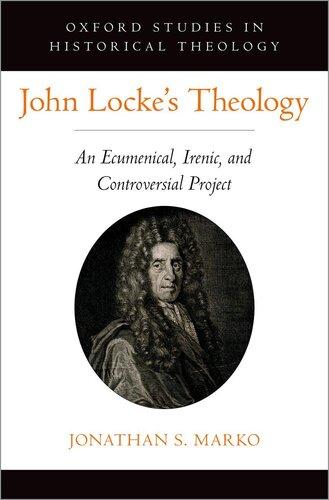
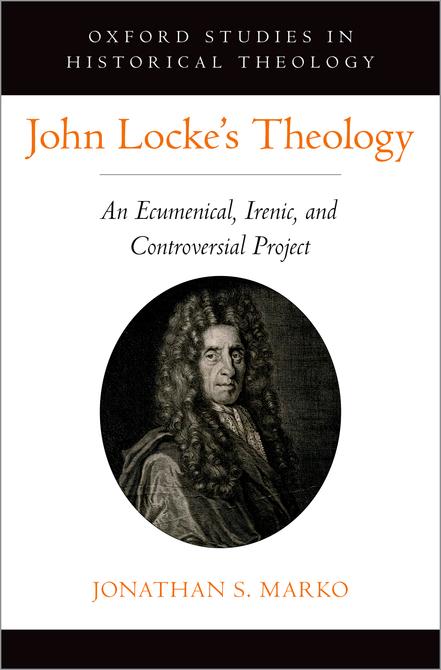
JOHN LOCKE’S THEOLOGY
An Ecumenical, Irenic, and Controversial Project
Jonathan S. Marko
John Locke’s Theology
An Ecumenical, Irenic, and Controversial Project
JONATHAN S. MARKO
Oxford University Press is a department of the University of Oxford. It furthers the University’s objective of excellence in research, scholarship, and education by publishing worldwide. Oxford is a registered trade mark of Oxford University Press in the UK and certain other countries.
Published in the United States of America by Oxford University Press 198 Madison Avenue, New York, NY 10016, United States of America.
All rights reserved. No part of this publication may be reproduced, stored in a retrieval system, or transmitted, in any form or by any means, without the prior permission in writing of Oxford University Press, or as expressly permitted by law, by license, or under terms agreed with the appropriate reproduction rights organization. Inquiries concerning reproduction outside the scope of the above should be sent to the Rights Department, Oxford University Press, at the address above.
You must not circulate this work in any other form and you must impose this same condition on any acquirer.
Library of Congress Cataloging-in-Publication Data
Names: Marko, Jonathan S., author.
Title: John Locke's theology : an ecumenical, irenic, and controversial project / Jonathan S. Marko.
Description: New York, NY, United States of America : Oxford University Press, [2023] | Series: Oxford STU in historical theology series | Includes bibliographical references and index.
LC record available at https://lccn.loc.gov/2022053518
LC ebook record available at https://lccn.loc.gov/2022053519
DOI: 10.1093/oso/9780197650042.001.0001
Printed by Integrated Books International, United States of America
For
Craig Stevens Marko and Pamela Susann Marko, née Beahn
Proverbs 1:8–9
4.
5.
PART II: THE REASONABLENESS OF REVELATION
6.
PART III: PARALLELS IN LOCKE’S LARGER CORPUS
7. John Locke and the “Free Will” Controversies: Why “Of Power” Is
9. Can One Assent to The Doctrine of the Trinity According to
Preface
My fascination with John Locke and the thinkers of his era sprouted through two concurrent doctoral seminars at Calvin Theological Seminary in 2009, one led by Ronald J. Feenstra (“Prolegomena”) and the other led by Richard A. Muller (“17th-century Metaphysics”). These two loved doctors opened new vistas for us and trained us to be clear, careful, and charitable. My main fruits from the seminars were a paper on the categories of propositions promulgated by John Locke and John Toland and another on the Anthony Collins–Samuel Clarke debate on liberty and necessity. By the end of the term, I was hooked on this era, especially philosophical and theological thinkers coming from the British Isles. I went on to write my dissertation (later published), building upon the work I had already done on Locke and Toland. It proved to be a fine beachhead for further exploration of the Enlightenment.
This book is mostly the culmination of my research to date in Locke while joyfully teaching at Cornerstone University and through conference papers mostly delivered at the Evangelical Theological Society’s regional and national conferences. These two institutions have been crucial to the writing of my book. One provided me with a “due date” for drafts of chapters and venues in which to receive feedback, among many other benefits. The other gave me supportive colleagues, financial resources, insightful and fun students, and time. Cornerstone awarded me a full-semester sabbatical for this book in the fall of 2019. And its librarians, particularly Gina Bolger, consistently and quickly delivered works to me that were not part of our library’s holdings.
There are so many other people for whom I am grateful. I am thankful for the individuals in whose company I happily find myself on occasion who have given me theologically rich conversations and friendship: John Duff, Matthew Everhard, Benjamin Marko (brother), Drew McGinness, and Michael Wittmer, just to name a few. They all love the Lord and truth. The person to whom I owe the most gratitude in this group is Richard A. Muller. His best scholarly accomplishments might not be the great number of
brilliant articles, chapters, books, and series he has penned and edited, but rather the great number of scholars he has mentored and the camaraderie he has helped cultivate amongst his students. We are not only better scholars, but better people because of him.
I would also like to express gratitude for my families. There is of course my church family. They have been a constant source of friendship, support, and theological dialogue. Also, without the support of my wife, this book would never have been written. While I have cheered on or come alongside of her for the last seventeen years, she has done likewise for me but much better. I am thankful to my three daughters. They have brought me unforeseen joy. I dedicate this book to my parents, Craig Stevens Marko and Pamela Susann Marko, née Beahn, residing in my hometown, Cuyahoga Falls, Ohio. They taught me and my beloved siblings much. Two mindsets they instilled in us often come to mind when I think about our upbringing: the importance of valuing good company and how to persist.
I also need to thank the unknown reviewers, editors, and the many people who have had a hand in the completion of this book. The insights of the initial reviewers and Muller were invaluable. I count them as collaborators on this work. I learned so much from them along the way.
Gratitude is due to a few others as well. Without the work of the collaborators and collectors of the Post-Reformation Digital Library (PRDL), my work would have been greatly slowed. I visit it and recommend it often. I also want to thank the editors of the Journal of Markets and Morality (Acton Institute) (JMM) and Philosophy and Theology (Marquette University) (PT) for publishing some of my work on Locke and allowing me to publish greatly expanded and re-worked journal articles as chapters in this book: Chapter 3 (PT), Chapter 5 (JMM), and Chapter 7 (PT).
Finally, I have a few comments on the structure of this book. Each chapter can stand on its own. I give a full bibliographical first reference of works used in each chapter, partly for this reason. But each chapter also has a complementary chapter. The final arrangement of the book has separated two companion chapters into different ends of the book. Chapters 3 (justification in The Reasonableness of Christianity [ROC]) and 4 (fundamental articles in ROC) are mutually supportive, as are Chapters 5 (special revelation in ROC) and 6 (miracles in ROC). Chapters 8 (the question of Locke’s use of “above reason”) and 9 (the question of Locke’s position on the Trinity) are also mutually reinforcing. But Chapters 2 (soteriology and theology in
Preface xix
Locke’s “non-theological” works) and 7 (free will in the Essay) nicely complement each other. But the foci of Chapter 2, its introduction of Locke’s body of writing, and its comparative simplicity make it the most fitting chapter with which to start Part I.
Jonathan S. Marko Cascade Township, MI
1 Introduction
The Problems of Understanding John Locke
Inconsistent Labeling
John Locke published The Reasonableness of Christianity (ROC) in 1695. It is a somewhat lengthy theological treatise that starts with explication of certain points of doctrine that was deemed heterodox by traditional Protestants. The bulk of the book contains a painstaking proof of what the fundamental articles of the Christian faith are and why. He does discuss miracles, morality, and other theological and philosophical topics. But, interestingly, it perhaps received more attention for what was not in it. Locke avoided making explicit references to standard Christian doctrines such as the doctrine of the Holy Trinity and the atonement. Theologian John Edwards lambasted Locke’s writings for being Socinian and this resulted in a protracted debate that pulled in others. Edwards attacked Locke in a number of works and the latter responded in kind. From this debate came two vindications of Locke’s theological treatise: the first, A Vindication of The Reasonableness of Christianity, was a shorter work; and A Second Vindication was a comparatively massive work that contains many cutting responses, clarifications of ROC, and reveals much of Locke’s theological programmatic intent of ROC. 1
1 John Locke, The Reasonableness of Christianity, as Delivered in the Scriptures, 2nd ed. (London: Printed for Awnsham and John Churchil, 1696); John Locke, A Vindication of the Reasonableness of Christianity, etc., From Mr. Edwards’s Reflections (London: Awnsham and John Churchil, 1695). This was published along with the 1696 second edition of ROC. John Locke, A Second Vindication of the Reasonableness of Christianity, etc. (London: A. and J. Churchil, 1697); John Locke, An Essay Concerning Human Understanding, ed. Peter H. Nidditch (Oxford: Clarendon Press, 1979). Pertinent works from Edwards and Bold are as follows: John Edwards, Some Thoughts Concerning the Several Causes and Occasions of Atheism, Especially in the Present Age. With Some Brief Reflections on Socinianism: And on a Late Book Entituled The Reasonableness of Christianity as Deliver’d in the Scriptures (London: Printed for J. Robinson, 1695); John Edwards, Socinianism Unmask’d. A Discourse Shewing the Unreasonableness of a Late Writer’s Opinion Concerning the Necessity of Only One Article of Faith; and of His Other Assertions in His Late Book, Entituled, The Reasonableness of Christianity as Deliver’d in the Scriptures, and in His Vindication of It. With a Brief Reply to Another (Professed) Socinian Writer (London: Printed for J. Robinson, 1696); John Edwards, The Socinian Creed: or, A Brief Account of the Professed Tenents and Doctrines of the Foreign and
Locke would soon have other issues. Bishop Edward Stillingfleet soon accused Locke not of heresy, but for unwittingly paving the way for the heterodox opinions promulgated in the infamous book, Christianity Not Mysterious, by John Toland. Locke’s works were again associated with Socinian thought. Even though Locke defended himself well in both controversies, getting the best of both of his interlocutors in the minds of many, he would never be rid of a dogged association with Socinianism. There is wisdom, then, in Locke’s comment to Stillingfleet amidst their debate: “It is an Observation, I have somewhere met with, That whoever is once got into the Inquisition, Guilty or not Guilty, seldom ever gets clear out again.”2 Yet, in the minds of some he did escape. Instead of being portrayed as heterodox, he is consistently portrayed as being “orthodox” (or at least relatively so) by scholars who focus upon the rise of natural religion or deism narrative. There he is routinely juxtaposed against John Toland who is portrayed as appropriating his epistemological fundamentals not into Socinianism, as was the original charge, but deism.
There are a few observations I would like to make about the above account that has pertinence to this present work. First, the application of labels like heterodox and orthodox (and even Socinian) all depend upon against whom Locke is being compared. This is perhaps not so surprising. Second, the context in which Locke wrote and thought was very contentious and complicated. It is convenient and somewhat efficient to discuss him in the context of the advancement of Socinianism or in the rise of deism or natural religion, but there is so much more going on during that period. England was rife with theological and philosophical controversy, not to mention similar trends in other spheres of life and thought. So, in this present book we will
English Socinians. Wherein Is Shew’d the Tendency of Them to Irreligion and Atheism. With Proper Antidotes Against Them (London: Printed for J. Robinson, 1697). Samuel Bold’s A Collection of Tracts, Publish’d in Vindication of Mr. Lock’s Reaosnableness of Christianity, as Deliver’d in the Scriptures, etc. (London: Printed for A. and J. Churchil, 1706) has the following relevant tracts: A Short Discourse of the True Knowledge of Christ Jesus (London: Printed for A. and J. Churchil, 1697); Some Passages in The Reasonableness of Christianity, etc. and Its Vindication. With Some Animadversions on Mr. Edwards’s Reflections on the Reasonableness of Christianity, and on His Book, Entituled, Socinianism Unmask’d (London: Printed for A. and J. Churchil, 1697); and A Reply to Mr. Edwards’s Brief Reflections on A Short Discourse of the True Knowledge of Christ Jesus, etc. To Which is Prefixed a Preface, Wherein Something Is Said Concerning Reason and Antiquity, in the Chief Controversies with the Socinians (London: Printed for A. and J. Churchil, 1697). For a nice collection of excerpts of contemporary works related to ROC: John Locke and Christianity: Contemporary Responses to The Reasonableness of Christianity, ed. and intro. Victor Nuovo (Bristol: Thoemmes Press, 1997).
2 John Locke, Mr. Locke’s Reply to the Right Reverend the Lord Bishop of Worcester’s Answer to His Letter, Concerning Some Passages Relating to Mr. Locke’s Essay of Humane Understanding: In Late Discourse of His Lordships, In Vindication of the Trinity (London: Printed by H. Clark, for A. and J. Churchill, 1697), 107.
not only explore the theological and philosophical works of Locke, but also the controversies in which they were forged.
Overall Argument
The primary argument of this book is that John Locke’s intent for ROC was to describe and defend his version of the foundational or fundamental doctrines of Christianity during a very theologically and philosophically controversial time and not his own personal views. Locke desired to describe what makes one a Christian in the simplest and most irenic terms and to argue for the necessity of Scripture and the reasonableness of God’s means of conveying his messages. Both revelation and the promulgated redemption are eminently reasonable.
Locke’s theological writings, namely ROC and its two vindications, are an intentionally ecumenical and irenic project written amidst numerous complex theological and philosophical controversies. He argued for the simplicity of the Christian faith, to which the uneducated and the laborers could assent. The writings themselves were inadvertently controversial and regarded as suspect due in part to Locke’s refusal to assert more than he thought warranted or desired, his lack of accommodation to the theological terminology and paradigms of his day, a studious avoidance of metaphysical pronouncement, and his failure to realize that most readers will not make a distinction between his personal and programmatic positions. His lack of doctrinal specificity often incensed self-professed orthodox thinkers and nettled metaphysicians, who did not recognize or accept the aims of his program. And the project was personal or individually focused in the sense that through it he foisted the burden of understanding the Bible and arriving at theological convictions on the autonomous individual, including the uneducated, and dismissed basing one’s doctrinal opinions on so-called authorities as epistemologically illegitimate. This advancement of an individualized or personal orthodoxy and his accompanying theological framework for Christians to build upon was intended to refine the Reformation and counter certain Post-Reformation trends: adherence to his project would yield more and better Christians, less negative priestly influence and thus fewer unhelpful controversies and less sectarianism, and a thriving society. What is more, the claim of his intentional ecumenicity is bolstered by the ease of appropriation of his thoughts by orthodox and heterodox thinkers alike, a particular point not dealt with here, but demonstrated elsewhere by others. All
of this helps explain the difficulty scholarship has had in labeling Locke along the lines of more traditional Christian sects. Of course, there were certain theological positions and worldviews that he vigorously opposed, such as deism, enthusiasm, and antinomianism.
Scholarship
Problematic Tendencies
There are a few trends that are present in many works on Locke that have been counterproductive to understanding his writings. First, there are far too many compartmentalized approaches. Locke was not simply an epistemologist, or political scientist, or a theologian, etc. He was a polymath, and a rather systematic one. As I will note in the next chapter, even his major “nontheological” works have strands of theological thought in them. As a case in point, his A Letter Concerning Toleration is arguably just as much a theological work as it is a political one. Thus, approaching one of his works attempting to isolate one of Locke’s mental spheres makes one’s reading of him liable to distortion. Second, the theological context of Locke’s works is far more complex than most realize. For instance, Calvinism and Arminianism, terms frequently used in recent Locke scholarship, do not describe two monoliths at odds. Not only do these terms reference varied theological movements, but there are also other traditions engaged in Locke’s conversation, notably the Lutherans and Anabaptists. Third, there has been a lack of appreciation that Locke’s theology in ROC is more programmatic than it was personal. He says as much in ROC, but there are some reasons many conflate the two. As I will argue, there are important differences between understanding Locke’s ROC as programmatic as opposed to being personal. In what follows, I am less interested in trying to decipher Locke’s personal views than in understanding his theological program, its implications, and to some degree how it ties in to or is adumbrated in other Lockean works.
On the Ecumenical Intent of ROC
In the main, I will be interacting with scholarship that focuses on ROC, what Locke intended to do with it, and why it is notably different in certain
respects from his Essay, etc. There is no perfect way in which to divide them, but there are certain patterns of argument into which scholars have frequently fallen pertaining to Locke’s professed ecumenical and irenic intent for ROC and the authority of Scripture advanced therein. First, there is what I will call the surreptitious group. This is a significant group of scholars, like Leo Strauss, Michael S. Rabieh, and Steven Forde, who read Locke as religiously surreptitious (because corrosive). They think that such characteristics such as inconsistencies between the Essay and ROC or a seeming meager defense of miracles is evidence that Locke appeals to the Bible (exoterically) while simultaneously trying to undercut its authority (esoterically). His claims of irenicism and ecumenism are, thus, wholly feigned. There is a small and related group, consisting at least of Nicholas Jolley and Michael Ayers— who focus on the Essay who think Locke is undercutting Christianity but do not emphasize an attempt on Locke’s part to hide it.3 The next group, the sectarian group, find his ecumenical claims insincere or Locke to be rather obtuse in making them and read ROC as being religiously sectarian. While earlier this group tended to frame him and ROC as Socinian (as John Edwards did) some more recent thinkers have described both as Arminian.4 There are some well-noted scholars in this group, such as Victor Nuovo, John Marshall, and Stephen D. Snobelen, to name a few.
The other group of scholars that stand in contrast to those named immediately above, I will call the sincere group. They tend to read Locke’s claims
3 The following are notable examples of those who read Locke as being religiously surreptitious: Steven Forde, “Natural Law, Theology, and Morality in Locke,” American Journal of Political Science 45, no. 2 (April 2001): 396–409 [ref. pp. 407–8]; Leo Strauss, Natural Right and History (Chicago: The University of Chicago Press, 1953); Leo Strauss, Persecution and the Art of Writing (Chicago: The University of Chicago Press, 1952; Reprint, 1988); Michael S. Rabieh, “The Reasonableness of Locke, or the Questionableness of Christianity,” Journal of Politics 53, no. 4 (November 1991): 933–57; Jonathan Donald Conrad, “Locke’s Use of the Bible in: The Two Treatises, The Reasonableness of Christianity, and A Letter Concerning Toleration” (Ph.D. diss., Northern Illinois University, 2004); David Foster, “The Bible and Natural Freedom in John Locke’s Political Thought,” in Piety and Humanity, ed. Douglas Kries (Lanham: Rowman and Littlefield, 1997), 181–212. Foster’s earlier claims are in the same vein as Conrad’s. He concludes his essay with the suggestion that Locke rejects “crucial elements of the biblical teaching on God, property, and the family.” See also: Nicholas Jolley, “Locke on Faith and Reason,” in The Cambridge Companion to Locke’s “Essay Concerning Human Understanding”, ed. Lex Newman (Cambridge: Cambridge University Press, 2007), 436–55; Michael Ayers, Locke Volume 1: Epistemology (New York: Routledge, 1991), 122.
4 Maurice Cranston, John Locke: A Biography (New York: The MacMillan Company); John Marshall, “Locke, Socinianism, ‘Socinianism’, and Unitarianism,” in English Philosophy in the Age of Locke, ed. M. A. Stewart (Oxford: Clarendon Press, 2000), 111–82; Victor Nuovo, “Locke’s Theology, 1694–1704,” in English Philosophy in the Age of Locke, ed. M. A. Stewart (Oxford: Clarendon Press, 2000), 183–216; Victor Nuovo, Christianity, Antiquity, and Enlightenment: Interpretations of Locke (New York: Springer, 2011); Stephen D. Snobelen, “Socinianism, Heresy and John Locke’s Reasonableness of Christianity,” Enlightenment and Dissent 20 (2001), 88–125; Dewey Wallace, “Socinianism, Justification by Faith, and the Sources of John Locke’s The Reasonableness