Mechanisms:
Gualtiero Piccinini
Explaining Biological Cognition
https://ebookmass.com/product/neurocognitive-mechanisms-explainingbiological-cognition-gualtiero-piccinini/
ebookmass.com
Curriculum Leadership: Strategies for Development and Implementation Fifth
https://ebookmass.com/product/curriculum-leadership-strategies-fordevelopment-and-implementation-fifth/
ebookmass.com
Existential Risks in Peace and Conflict Studies Noah B. Taylor
https://ebookmass.com/product/existential-risks-in-peace-and-conflictstudies-noah-b-taylor/
ebookmass.com
Hydrometallurgy: Theory 1st Edition Michael Nicol
https://ebookmass.com/product/hydrometallurgy-theory-1st-editionmichael-nicol/
ebookmass.com
The War Guilt Problem and the Ligue Des Droits de l'Homme
Norman Ingram
https://ebookmass.com/product/the-war-guilt-problem-and-the-ligue-desdroits-de-lhomme-norman-ingram/
ebookmass.com
https://ebookmass.com/product/philosophical-methodology-from-data-totheory-john-bengson/
ebookmass.com
Jewish Piety in Islamic Jerusalem
RELIGION IN TRANSLATION
SERIES EDITOR
John Nemec, University of Virginia
A Publication Series of The American Academy of Religion and Oxford University Press
DAMASCIUS’ PROBLEMS & SOLUTIONS
CONCERNING FIRST PRINCIPLES
Translated with Introduction and Notes by Sara Ahbel-Rappe
THE SECRET GARLAND
Āṇṭāḷ’s Tiruppāvai and Nācciyār Tirumoli
Translated with Introduction and Commentary by Archana Venkatesan
PRELUDE TO THE MODERNIST CRISIS
The “Firmin” Articles of Alfred Loisy
Edited, with an Introduction by C. J. T. Talar
Translated by Christine Thirlway
DEBATING THE DASAM GRANTH
Robin Rinehart
THE FADING LIGHT OF ADVAITA ĀCĀRYA
Three Hagiographies
Rebecca J. Manring
The Ubiquitous Śiva
Somānanda’s Śivadṛṣṭi and His Tantric Interlocutors
John Nemec
PLACE AND DIALECTIC
Two Essays by Nishida Kitarō
Translated by John W.M. Krummel and Shigenori Nagatomo
THE PRISON NARRATIVES OF JEANNE GUYON
Ronney Mourad and Dianne Guenin-Lelle
DISORIENTING DHARMA
Ethics and the Aesthetics of Suffering in the Mahābhārata
Emily T. Hudson
THE TRANSMISSION OF SIN
Augustine and the Pre-Augustinian Sources
Pier Franco Beatrice
Translated by Adam Kamesar
FROM MOTHER TO SON
The Selected letter of Marie de l’Incarnation to Claude Martin
Translated and with Introduction and Notes by Mary Dunn
DRINKING FROM LOVE’S CUP
Surrender and Sacrifice in the Vārs of Bhai Gurdas
Selections and Translations with Introduction and Commentary by Rahuldeep Singh Gill
THE AMERICA’S FIRST THEOLOGIES
Early Sources of Post-Contact Indigenous Religion
Edited and translated by Garry Sparks, with Sergio Romero and Frauke Sachse
GODS, HEROES, AND ANCESTORS
An Interreligious Encounter in EighteenthCentury Veitnam
Anh Q. Tran
POETRY AS PRAYER IN THE SANSKRIT HYMNS OF KASHMIR
Hamsa Stainton
THE UBIQUITOUS ŚIVA VOLUME II
Somānanda’s Śivadṛṣṭi and His Tantric Interlocutors
John Nemec
FIRST WORDS, LAST WORDS
New Theories for Reading Old Texts in SixteenthCentury India
Yigal Bronner and Lawrence McCrea
THE LUMINOUS WAY TO THE EAST
Texts and History of the First Encounter of Christianity with China
Matteo Nicolini-Zani
RELIGIOUS READING AND EVERYDAY LIVES IN DEVOTIONAL HINDUISM
Emilia Bachrach
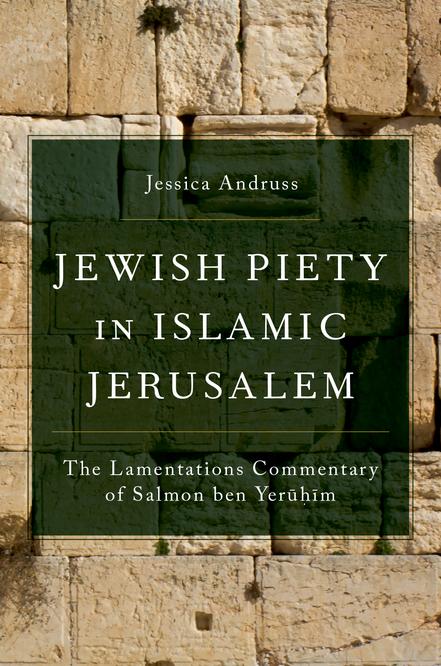
JEWISH PIETY IN ISLAMIC JERUSALEM
The Lamentations Commentary of Salmon ben
Yerūḥīm
Jessica Andruss
Acknowledgments
I would like to express my appreciation for the individuals and institutions that have supported me in the completion of this work. I am deeply grateful to Daniel Frank, Meira Polliack, and James T. Robinson for their erudition and exceptional mentorship over many years. They have read drafts of the manuscript and offered countless suggestions that improved my translation and expanded my sensitivity to the implications of this study for our knowledge of Jewish life and thought in the Islamic world. Daniel Frank and James T. Robinson generously provided me with their transcriptions or preliminary editions of unpublished manuscripts.
Many other scholars supported my efforts with their time and expertise. I thank Michael Fishbane and Tahera Qutbuddin for their constructive advice on the project in its early stages; Camilla Adang, Miriam Goldstein, and Michael Rand for their guidance during my research at the Institute for Microfilmed Hebrew Manuscripts at the National Library of Israel in 2012–13; Sabahat Adil, Shatha Almutawa, and Uri Shachar for their intellectual camaraderie; and W. Randall Garr for his incisive counsel throughout my scholarly endeavors.
My current academic home is the department of Religious Studies at the University of Virginia, where colleagues have encouraged me in the final stages of this work. The department chairs— first Kurtis Schaeffer, then Willis Jenkins—assisted me in securing time and funding for research and writing. Elizabeth Alexander, Martien Halvorson- Taylor, Sonam Kachru, Jane Mikkelson, and Janet Spittler each helped to move the project forward.
I thank the following institutions for their generous support: the Chicago Center for Jewish Studies, the Martin Marty Center for the Advanced Study of Religion, and the Fuerstenberg Fellowship, all at the University of Chicago; Fulbright (Israel); and the Memorial Foundation for Jewish Culture. At the University of Virginia, I benefitted from two course releases from the Institute for Humanities and Global Cultures, as well as summer research funding and a Sesquicentennial Leave in fall 2020 from the College and Graduate School of Arts and Sciences.
It has been a pleasure to work with the staff of Oxford University Press. John Nemec has been an exemplary editor from start to finish. Cynthia Read, Steve A. Wiggins, and Brent Matheny at OUP-New York guided the book through the stages of production with professionalism and care. Jubilee James and Maria Cusano gave meticulous attention to a complex text. I thank the two anonymous reviewers for their valuable comments on the initial draft. I am especially indebted to the second reviewer, whose lucid observations led me to reframe parts of chapters 5 and 6. I thank Samuel Stafford for proofreading the Arabic and Hebrew portions of the book, and Jess Klaassen-Wright for preparing the index. I am grateful that this book appears in the “Religion in Translation” series alongside the book of my dear friend Rahuldeep Singh Gill, of blessed memory.
Most of the writing and revision of this volume took place during the COVID-19 pandemic. My family supported my work with love, kindness, and genuine curiosity. My husband, Brian Campbell, has been a constant source of good sense and good humor. My children, Leila and Marina, brought joy to my efforts just by being themselves. I offer my heartfelt thanks to them all.
Jessica Andruss February 2022
Abbreviations
For full references, see the Bibliography. Standard abbreviations for scholarly journals are not included in this list.
MANUSCRIPT COLLECTIONS
BL London, British Library
BN Paris, Bibliothèque National
JTSA New York, Jewish Theological Seminary of America
RNL St. Petersburg, Russian National Library
TEXTS AND REFERENCE WORKS
Abdul-Karim Mohammed Abdul-Latif Abdul-Karim, ed., Commentary of Salmon Ben Yeruham on Lamentations
Al-Fāsī Solomon Skoss, ed., Kitāb Jāmiʿ al-Alfāẓ (Agron) of David ben Abraham al-Fāsī
BDB Brown, Driver, and Briggs, eds., Hebrew and English Lexicon of the Old Testament
Blau, Dictionary Joshua Blau, A Dictionary of Medieval Judaeo-Arabic Texts
BT Babylonian Talmud
EALL Encyclopedia of Arabic Language and Linguistics
EI2 The Encyclopedia of Islam, 2nd ed.
EJIW Encyclopedia of Jews in the Islamic World
EJM Études sur le Judaïsme Médiéval
EQ Encyclopedia of the Qurʾān
Gil, History Moshe Gil, A History of Palestine, 634–1099
Hava J. G. Hava, Arabic English Dictionary
HB/OT Hebrew Bible/Old Testament: The History of Its Interpretation
Ibn Nūḥ, Diqduq Geoffrey Khan, The Early Tradition of Hebrew Grammatical Thought: Including a Critical Edition, Translation, and Analysis of the Diqduq of Abū Yaʿqūb Yūsuf ibn Nūḥ on the Hagiography
Jastrow Marcus Jastrow, A Dictionary of the Targumim, Talmud Bavli, Talmud Yerushalmi and Midrashic Literature
JSAI Jerusalem Studies in Arabic and Islam
Abbreviations
KA
Karaite Judaism
KTS
Leon Nemoy, ed., Karaite Anthology: Excerpts from the Early Literature
Meira Polliack, ed., Karaite Judaism: A Guide to Its History and Literary Sources
Karaite Texts and Studies
Lam R Midrash Lamentations Rabbah
Lane Edward W. Lane, An Arabic-English Lexicon
LK Simha Pinsker, ed., Liqqute qadmoniyyot
PdRK Pesikta de Rav Kahana
Qirqisāni Studies
Qūmisī, Sermon
Robinson, Asceticism
Saadia, Dan
Saadia, Esth
Hartwig Hirschfeld, Qirqisāni Studies
Leon Nemoy, trans., “The Pseudo-Qūmisīan Sermon to the Karaites”
James T. Robinson, Asceticism, Eschatology, Opposition to Philosophy: The Arabic Translation and Commentary of Salmon ben Yeroham on Qohelet (Ecclesiastes)
Joseph Alobaidi, The Book of Daniel: The Commentary of R. Saadia Gaon, Edition and Translation
Michael Wechsler, The Book of Conviviality in Exile (Kitāb al-īnās bi-ʾl-jalwa): The Judaeo-Arabic Translation and Commentary of Saadia Gaon on the Book of Esther
Saadia, Job Joseph Derenbourg et al., eds. Version Arabe du Livre de Job de R. Saadia ben Iosef al-Fayyoûmî
Saadia, Lam Yehuda Ratzaby, “Targum of Rabbenu Saadia Gaon on Lamentations”
Salmon, Pss 1–10
Salmon, Pss 11–41
Salmon, Pss 42–72
Salmon, Pss 73–89
Salmon, Pss 90–106
Salmon, Pss 107–150
Joseph Alobaidi, ed. Le commentaire des Psaumes par le Qaraïte Salmon ben Yeruham: Psaumes 1–10
Salmon b. Yerūḥīm, Commentary on Psalms, RNL Evr. Arab. I 1345
Lawrence Marwick, ed., The Arabic Commentary of Salmon ben Yeruham on the Book of Psalms, Chapters 42–72
Salmon b. Yerūḥīm, Commentary on Psalms, RNL Evr. I 557
Salmon b. Yerūḥīm, Commentary on Psalms, RNL Evr. I 558
Salmon b. Yerūḥīm, Commentary on Psalms, RNL Evr. I 556
Tg. Lam Targum on Lamentations
Yefet, Esth
Michael G. Wechsler, The Arabic Translation and Commentary of Yefet ben ʿEli the Karaite on the Book of Esther
Yefet, Gen Marzena Zawanowska, The Arabic Translation and Commentary of Yefet ben ʿEli the Karaite on the Abraham Narratives (Genesis 11:10–25:18)
Yefet, Isa Yefet ben ʿEli, Commentary on Isaiah, BL Or. 2502 (Marg. 281)
Abbreviations xv
Yefet, Jer Joshua A. Sabih, Japheth ben Ali’s Book of Jeremiah: A Critical Edition and Linguistic Analysis
Yefet, Lam Yefet ben ʿEli, Commentary on Lamentations; preliminary edition by Daniel Frank, based on RNL Evr.-Arab. I 213 and RNL Evr.-Arab. I 3806
Yefet, Prov Ilana Sasson, The Arabic Translation and Commentary of Yefet ben ʿEli on the Book of Proverbs, vol. 1: Edition and Introduction
Preface
The tenth century marks a turning point in Jewish intellectual history: the transition from ancient rabbinic culture to the Arabized Judaism of the medieval period. Medieval Jews inherited an expansive tradition of biblical interpretation from their rabbinic predecessors, yet the formal commentary genre, with its programmatic introductions, discussions of grammar, and interests in the historical context and literary construction of the Bible, was their own innovation. Jewish scholars of the Islamic world shifted away from the languages, genres, and hermeneutical frameworks of the rabbinic academies, and created in their place an exegetical corpus shaped by the Arabic language and its intellectual resources. By translating the Bible into Arabic and interpreting it with insights gleaned from the nascent fields of linguistic and literary theory, religious philosophy, and the natural sciences, Jewish thinkers simultaneously contributed to the scholarly discourse of the ArabicIslamic world and transformed their own religious culture.
This book traces the cross-pollinations of Jewish and Muslim modes of exegesis, homiletics, and historiography through one of the oldest Jewish Bible commentaries, the tenth-century Arabic translation and interpretation of Lamentations by Salmon ben Yerūḥīm. Salmon was a prominent figure among the “Mourners for Zion,” the Karaites of Jerusalem whose dedication to biblical scholarship was central to their comprehensive spiritual program of piety, penitence, and preparation for the redemption of the Jewish people. As the earliest Karaite exegete with an extant corpus in Arabic, Salmon demonstrates a nuanced negotiation between rabbinic hermeneutics and the intellectual offerings of the Islamic world. His writings on Lamentations in particular display his genius for redefining Jewish piety through the work of biblical translation and commentary.
For Salmon, the biblical book of Lamentations was God’s “instruction for Israel”—spiritual guidance for the Jewish people in exile. While he subscribes to the normative view of Lamentations as the prophet Jeremiah’s response to the historical destruction of Jerusalem by the Babylonians in the sixth century bce, he directs the book’s moral message to the Jews of his own time. Thus, the historical suffering of the ancient Israelites becomes an admonition
for medieval Jews, who continue to endure the humiliations of exile because they continue to sin. Within this pious interpretive frame, Salmon embeds de facto sermons that draw on his hermeneutic of biblical history and his Karaite sensibilities. This homiletical approach to exegesis positions Salmon at the center of a dynamic cultural reorientation, as he both borrows rabbinic explanations and contradicts them outright, and he interprets Lamentations with the tools of Arabic homily, historiography, and literary theory at the same time that he purports to dismiss Islamic-Arabic learning as an impediment to true knowledge.
Salmon stands at the dawn of Karaite commentary writing, yet scholars tend to define Karaite exegesis by the magisterial corpus of Yefet ben ʿElī, the biblical translator-interpreter who followed a generation afterward. However, while Yefet’s commentaries represent a high point of Jewish exegetical practice in Arabic, they would not be possible apart from the foundational efforts of Salmon, which occurred when the purpose and conventions of the commentary genre were still undefined. Salmon’s commentaries on the Psalms and the Five Scrolls (Song of Songs, Ruth, Lamentations, Ecclesiastes, and Esther) constitute the first commentary series of the Jerusalem Karaites, and reveal the experimental beginnings of the Jewish commentary form. In their wide scope, they also preserve significant elements of the liturgy, homily, polemic, historical thought, and pious practice of the emerging Karaite community in Jerusalem. This book resists the characterization of Salmon’s thought as not properly exegetical, and instead posits Salmon’s writings as formative in establishing a genre whose contours were just coming into focus. The homiletical excursuses of Salmon’s commentary are not digressions from his exegesis, but the very substance of it: if Lamentations is God’s “instruction for Israel,” as Salmon insists, then the only authentic approach to exegesis must be homiletical. Thus, Salmon’s commentary on Lamentations is also a manual for Jewish piety in Islamic Jerusalem, designed to educate and inspire the tenth-century Jewish community in the practices and perspectives that will lead to their redemption.
Jewish Piety in Islamic Jerusalem explores Salmon’s construction of Karaite Judaism through his commentary on Lamentations. It examines the intraJudaic context of Salmon’s writings as well as the emerging Arabic scholarly discourse through which he formulates his exegetical and pietistic approach to the Scriptures. By considering Salmon’s intellectual world, informed not only by the Bible but also by rabbinic tradition and Karaite, Rabbanite, and Muslim scholarship of the ninth and tenth centuries, this study explores
the methods and sources that Salmon relied on to reshape Jewish piety in an Arabic environment, consolidating and communicating a distinctively Karaite spiritual program.
The book begins by introducing Salmon’s own community, the “Mourners for Zion,” and identifying the themes of Lamentations that resonate with their communal aspirations and affirm the biblical foundations of their penitential rituals and attitudes (chapter 1). As one of the earliest examples of Arabic biblical exegesis, Salmon’s commentary provided a model for the genre that defined the Karaite community and influenced Jewish biblical study ever afterward. The book includes a systematic treatment of Salmon’s Lamentations commentary, presenting its unique features and describing the elements that became standard in later commentaries (chapter 2). This chapter also functions as a guide to the abridged translation of Salmon’s Lamentations commentary that appears in Part 2 of this volume.
The next chapter explores Salmon’s engagement with texts and ideas from the broader Jewish tradition, including rabbinic hermeneutical methods and Midrashic traditions, which he reformulates for his own purposes. Salmon’s familiarity with rabbinic precedents proves that even though Karaites rejected the authority of the rabbis and their Rabbanite successors, they were not ignorant of their teachings. Salmon creatively reinterprets rabbinic traditions to attack his Rabbanite rivals and advocate for Jewish piety on strictly Karaite terms (chapter 3).
Having established the Jewish background for Salmon’s project, the book also explores its Arabic-Islamic dimensions by focusing on three interwoven aspects of the commentary: Salmon’s analysis of figurative language (chapter 4), his penchant for admonition and exhortation in a homiletical style (chapter 5), and his hermeneutic of reflection on history to determine its ethical teaching (chapter 6). In each case, we find evidence of Salmon drawing on rabbinic and Arabic-Islamic resources as he constructs and frames his religious message for a medieval Jewish audience. These elements of Salmon’s approach illustrate the depth of his engagement with, and active participation in, an intercommunal Arabic cultural and intellectual sphere.1
1 The fields of Arabic scholarship that I explore in this book—literary theory, homiletics, and historiography—are not the only areas of intersection between Salmon’s commentary and the broad spectrum of Jewish and Muslim culture. Elements of the commentary suggest possible lines of connection to Sufi pietism, Ismaʿīlī missionizing, and early strains of Muʿtazilite theology, for example, as well as the Jewish tradition of Piyyuṭ (synagogue poetry). I have indicated some of the more enticing resonances in the footnotes, and I hope to return to them in future studies.
Figurative language was a shared challenge for Jews and Muslims, especially in the context of Scripture, where metaphors or analogies risk obscuring the meaning of sacred writ. Salmon relies on terminology from the Arabic literary tradition to explain the figurative imagery of Lamentations. In chapter 4, I show that Salmon’s fluid use of this technical vocabulary places him alongside Muslim exegetes, who also implemented such terminology experimentally as its meaning evolved over the course of the tenth century. For Salmon, linguistic and rhetorical analysis was not an end unto itself, but rather a technique for understanding biblical language, establishing the spiritual meaning of Lamentations, and conveying it persuasively to a Jewish audience.
In chapter 5, I explore the homiletical dimensions of Salmon’s project by examining the words of pious exhortation embedded within his excursuses and comparing them to rabbinic homiletical Midrash, literary exhortation in Karaite and Rabbanite texts, and Islamic sermon culture. Salmon reworks rabbinic homilies and adapts the structural and rhetorical features of ArabicIslamic oratory to support the Karaite program of mourning and penitence. His homilies aim to rouse Jews to weeping and other expressions of grief. In this way, he both subverts Muslim concerns that excessive mourning belies faith in God, and undermines Rabbanite efforts to moderate Jewish mourning over the ruined Temple.
In chapter 6, I examine the hermeneutical work that Salmon performs in order to read the Bible along Karaite lines. The most extensive analysis concerns Salmon’s hermeneutic of reflection on history. In this project, as well, Salmon positions himself between the rabbinic tradition and the currents of Arabic thought. Like the rabbis of antiquity, Salmon is attuned to the moral message of the biblical past. However, where the rabbis constructed a Midrashic homiletical meaning by reading biblical details atomistically and paradigmatically, Salmon evinces genuine historical thinking. He evaluates and corroborates biblical and post-biblical accounts, determining a timeline of events and interpreting biblical passages with respect to their historical context. He discovers the homiletical meaning of history through a hermeneutical process of reflection, which he draws from the emerging field of Arabic historiography but develops in a distinctively Karaite vein. He refers to this hermeneutic as iʿtibār reflecting on history in order to take warning from the sins of the wicked and emulate the deeds of the righteous. By reflecting on the destruction of the Temple and the sins that caused it, Salmon determines that the end of exile will come only when the Jews of his own day
cease to sin, and return to Jerusalem in a spirit of penitence. This formulation censures the Rabbanites as those who extend the exile by failing to reflect on history and realize the errors of their Oral Law. Thus, Salmon applies a concept from Arabic historiography to long-standing Jewish debates over religious authority and the path toward redemption, in order to locate within Lamentations an affirmation of the Karaite program of repentance and mourning in Jerusalem.
Notes on the Translation
Readers will find selected translations from Salmon’s Lamentations commentary in Part 2 of this book. There, I translate the passages in which Salmon articulates his religious message most explicitly and extensively, and which most clearly demonstrate his distinctive homiletical approach to exegesis. These passages include Salmon’s introduction to the commentary, his excursuses and embedded homilies, and his comments on the first verse of each chapter (which function as a preface to that chapter and a presentation of its major themes). Also included are Salmon’s running commentary on the entire third chapter of Lamentations—which he treats as a coherent pietistic composition—and the full translation of the passages from which I draw textual evidence within the analytical chapters. My aim has been to provide a broadly representative sample of the commentary, enabling readers to experience for themselves the erudition and variety of Salmon’s remarks.
I have treated the verse comment—that is to say, Salmon’s Arabic translation of and comment on a single biblical verse—as the basic textual unit of the commentary. Therefore, each verse comment that appears in Part 2 is presented in its entirety, without elisions. While elements of Salmon’s writings may suggest affinities with prayer books, grammatical manuals, or theological treatises, it is through the framework of biblical exegesis that Salmon discovers, substantiates, and communicates his ideas. The inclusion of complete verse comments thus preserves the structure of the commentary and offers an array of linguistic, theological, historical, and pietistic content for scholars of Jewish and Islamic intellectual history. This organization should also prove useful for biblical scholars who may be curious about how Salmon handles a certain exegetical conundrum or the translation of a difficult verse.
My English translation is based on the edition of Mohammed Abdul-Latif Abdul-Karim (Ph.D. dissertation, St Andrews, 1976).1 Abdul-Karim’s work is effectively a diplomatic edition of BL Or. 2516, a complete manuscript that was copied in the mid-eighteenth century. Abdul-Karim consulted
1 Now accessible online through the St Andrews Research Repository: https://research-repository. st-andrews.ac.uk/handle/10023/11285
three additional manuscripts (from the British Library [BL] in London, the Bibliothèque Nationale [BN] in Paris, and the Jewish Theological Seminary of America [JTSA] in New York) as well as nine short fragments from the British Museum, and he notes the variants, which are generally minor and overwhelmingly orthographic in nature.2 I consulted additional, older manuscripts from the Firkovitch Collections of the Russian National Library [RNL] in St. Petersburg on microfilm at the Institute for Microfilmed Hebrew Manuscripts in the National Library of Israel in 2012–13, before they were readily available online. I observed remarkable consistency across the catalogued manuscripts. The unusual degree of standardization suggests that Karaite communities were quick to adopt the commentary and that it enjoyed heavy rotation in their scholarly circles and liturgical sessions. Older manuscripts were replaced with newer copies after they were worn out from repeated use. This explanation would account for the prevalence of late manuscript witnesses to Salmon’s Lamentations commentary as well as their remarkable uniformity.
Abdul-Karim’s edition of the commentary went uncited and apparently unknown for over three decades. To my knowledge, it surfaced in the scholarly record only when Barry Dov Walfish and Mikhail Kizilov listed it in their exhaustive Bibliographica Karaitica. 3 The few studies that addressed Salmon’s Lamentations commentary prior to the publication of the Bibliographica Karaitica drew independently on manuscripts, without recourse to AbdulKarim’s dissertation.4 In the years since Abdul-Karim completed his project, Karaite manuscript holdings have become increasingly accessible, initially in microfilm and now in digital formats, thus facilitating and expanding manuscript research. The National Library of Israel lists over one hundred separately indexed manuscript fragments of Salmon’s Lamentations commentary. These resources make it possible, in some cases, to propose emendations and resolve textual difficulties by consulting other manuscript witnesses, although frequently the most stymieing textual corruptions recur across the
2 The four principal MSS of Abdul-Karim’s edition are: BL Or. 2516 (= A); BL Or. 2515 (= B); BN Heb. 295 (= P); JTSA Ms. Mic. 3362 (Adler 114) (= J). For descriptions of these MSS and the fragments from the British Museum, see Abdul-Karim, 43–55.
3 Barry Dov Walfish and Mikhail Kizilov, Bibliographica Karaitica: An Annotated Bibliography of Karaites and Karaism, EJM 43; KTS 2 (Leiden: Brill, 2011).
4 See e.g., Haggai Ben-Shammai, “Poetic Works and Lamentations of Qaraite ‘Mourners of Zion’— Structure and Contents” [Hebrew], in Kenesset Ezra: Literature and Life in the Synagogue; Studies Presented to Ezra Fleischer, ed. S. Elizur et al. (Jerusalem: Ben Zvi, 1994); Daniel Frank, Search Scripture Well: Karaite Exegetes and the Origins of the Jewish Bible Commentary in the Islamic East, EJM 39 (Leiden: Brill, 2004).
known manuscripts. It may be impossible to reconstruct an original text in spite of the numerous manuscript witnesses, simply because the scribal errors that were fossilized early in the transmission of the text were preserved in later copies. Manuscript evidence did make it possible, however, to restore the Arabic invocation that opens the commentary, which is missing from Abdul-Karim’s edition. This passage, drawn primarily from a seventeenthcentury manuscript, is included in my English translation.5 I have relied on manuscript sources and parallel texts from Salmon’s corpus to support my translation of Abdul-Karim’s edition, which remains valuable for its astute scholarly notes in addition to the text of the commentary that it provides.
Salmon’s commentary, of course, is also an Arabic translation of the Hebrew Bible, which means that my English translation must represent Salmon’s Arabic translation of biblical Hebrew. There are many challenges in translating a translation, and no solutions are entirely satisfactory. My goal has been to represent Salmon’s understanding of the biblical Hebrew text— which he conveys through Arabic translation, Arabic paraphrase, reference to biblical prooftexts, and direct explanation—and to note the occasions on which his reading departs from the Hebrew source text. To this end, I have cited biblical verses from the Revised Standard Version (RSV) of the Bible, freely modifying them to accord with Salmon’s usage and noting the divergences in the footnotes when necessary.6 References to these differences are intended to highlight the ingenuity or angle of Salmon’s reading, not to promote the RSV as uniformly preferable to Salmon’s translation. It is a truism that all translation is interpretation, and the RSV has no greater or lesser claim to veracity than Salmon does.
In the commentary, I begin each verse comment with the fully pointed Masoretic Hebrew verse and Salmon’s Arabic translation of it, followed by my English rendering of Salmon’s verse translation and then his Arabic comment. When Salmon enlarges his Arabic verse translation with material that does not originate in the Masoretic Text of the Hebrew Bible, I underline these additions.
In my translation of the verse comments, I have included significant Hebrew and Arabic terms parenthetically. Vocabulary that Salmon uses
5 I thank Daniel Frank for sharing his collation of manuscript evidence for this section from JTSA Ms. Mic. 3362 (Adler 14) and RNL Evr. I.561.
6 In addition, I routinely adjust the RSV to match contemporary style, e.g., replacing archaisms such as “thou” and “thine” with “you” and “your.” I also capitalize pronouns referring to God, which reflects Salmon’s practice of referring to God with pious epithets throughout the commentary. These deviations are standard and thus not noted in individual footnotes.