Oxford University Press is a department of the University of Oxford. It furthers the University’s objective of excellence in research, scholarship, and education by publishing worldwide. Oxford is a registered trade mark of Oxford University Press in the UK and certain other countries.
Published in the United States of America by Oxford University Press 198 Madison Avenue, New York, NY 10016, United States of America.
All rights reserved. No part of this publication may be reproduced, stored in a retrieval system, or transmitted, in any form or by any means, without the prior permission in writing of Oxford University Press, or as expressly permitted by law, by license, or under terms agreed with the appropriate reproduction rights organization. Inquiries concerning reproduction outside the scope of the above should be sent to the Rights Department, Oxford University Press, at the address above.
You must not circulate this work in any other form and you must impose this same condition on any acquirer.
Library of Congress Cataloging-in-Publication Data
Names: Dalsheim, Joyce, 1961- author.
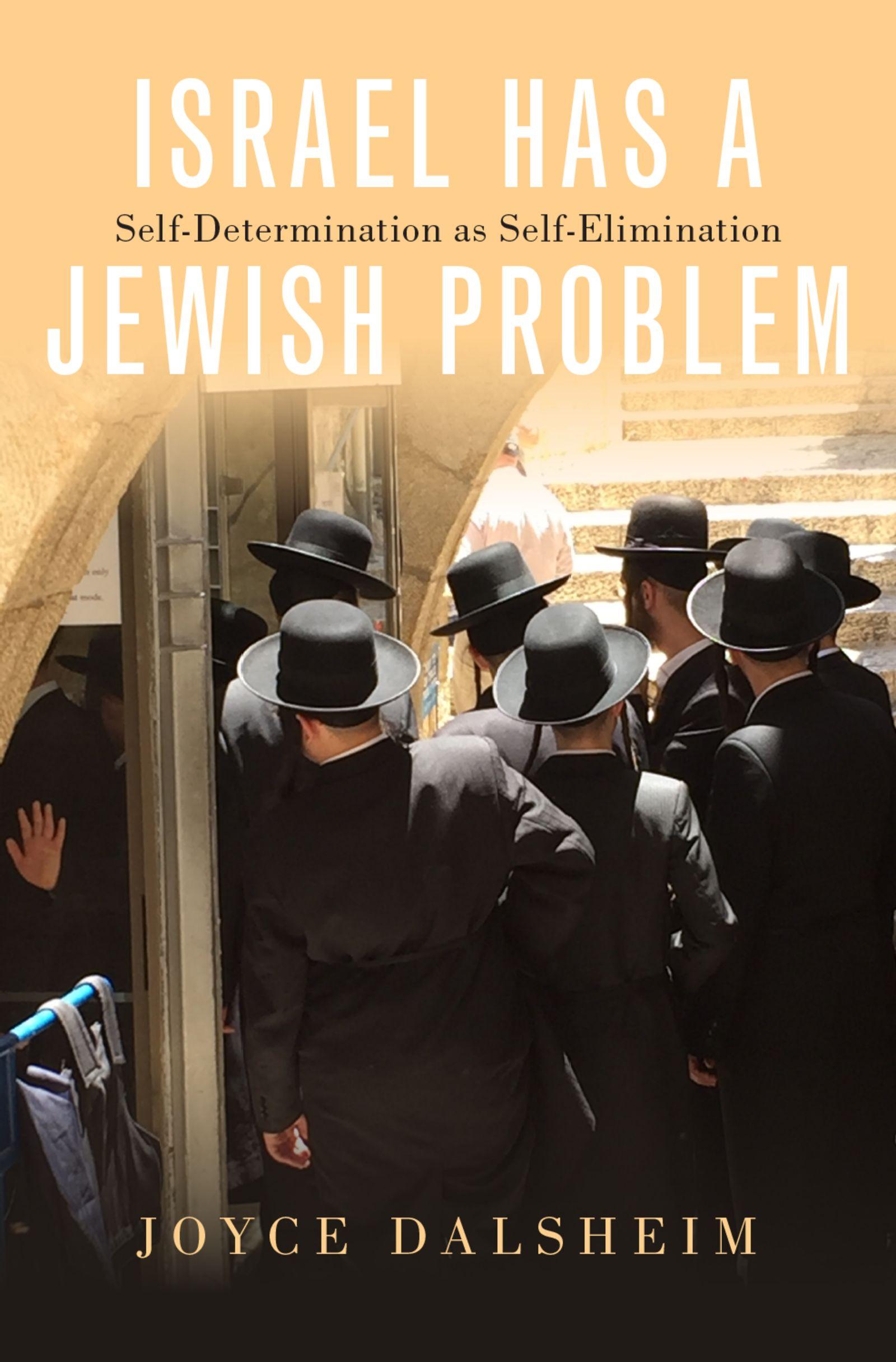
Title: Israel has a Jewish problem : self-determination as self-elimination / Joyce Dalsheim.
Description: New York : Oxford University Press, [2019] | Includes bibliographical references.
Identifiers: LCCN 2019017903| ISBN 9780190680251 (hardback) | ISBN 9780190680268 (updf) | ISBN 9780190680275 (epub) | ISBN 9780190068943 (online)
Subjects: LCSH: Jews—Israel—Identity. | Jewish nationalism. | Self-determination, National—Israel. | Jews—Israel—Politics and government. | National characteristics, Israeli. Classification: LCC DS143 .D25 2019 | DDC 956.9405—dc23 LC record available at https://lccn.loc.gov/2019017903 1 3 5 7 9 8 6 4 2
Printed by Integrated Books International, United States of America
To the memory of my father, Stephen Dalsheim, a righteous man in his time, who taught me so much about what it means to be a mensch. I’m still trying.
Acknowledgements
The Trees
For we are like tree trunks in the snow. In appearance they lie sleekly and a little push should be enough to set them rolling. No, it can’t be done, for they are firmly wedded to the ground. But see, even that is only appearance.
Franz Kafka (1971: 382)
This is a book about Israel. But it isn’t. It is a book about what nationalism does, how it limits the possible ways of being because it needs a “people” who are sovereign. More than that, it needs its population to be legible, relatively easy to put to work and tax and conscript into the armed forces. So while there is room for certain kinds of differences, the state also requires a fundamental homogeneity among its population. James Scott (2017) would likely explain this as a form of domestication, like the domestication of grains and animals, or of forests and trees. This is a kind of self-domestication, a limiting of general ways of being. But the limitations—like tree trunks in the snow—are not immediately obvious. It takes some digging, both historically and theoretically, to figure out what’s going on.
Books, of course, are like that as well. Their many surfaces, smooth and sleek, hide multitudes of encounters, connections, and dependencies with people whose names may never appear in the stories they tell. This book deals with troublesome modern categories like “nation” and “religion” that may seem arbitrary but come to be taken for granted. They, like the roots beneath the soil and snow, work in ways that may confound us. Many people
have helped me along the way to uncover the roots of an understanding of how political self-determination also involves forms of self-elimination. It’s been a difficult process, because of the complexity of the issues and the counter-intuitive nature of the analysis, and because the topic itself remains politically charged. So it is hard to get people to see what’s going on under the blanket of beautiful white snow.
Some people agreed with the ideas I share here, and many disagreed, but all made me think. For that I am grateful. I would like to thank my editor, Cynthia Read, the wonderful anonymous reviewers who provided such insightful comments, and Katherine Ulrich for her meticulous and thoughtful copyediting. For providing the time and space in which to think and write I am grateful to my Chair, Dale Smith, and to the Luce/ACLS Fellowship in Religion, Journalism, and International Affairs, and to the Buffet Institute for Global Affairs at Northwestern University where Elizabeth Shakman Hurd and Brannon Ingram hosted me. Thanks are due to Jean Clipperton for making me feel welcome and to Ben Schontal for being a great office mate. A special thanks to the Deering Library at Northwestern and its librarians, as well as to the wonderful librarians at UNC Charlotte’s Atkins Library. Many thanks to Sean, Sol, Sofia, Cecelia, Nora, and Gabriela, for providing a home away from home.
For providing a forum in which to present the material and get feedback, I would like to thank Rebecca Bryant for the conference on sovereignty she organized in Cyprus where I presented a very early version of some of this work. I am grateful to Jonathan Boyarin for many wonderful conversations and to the Department of Anthropology at Cornell University for sponsoring my talk there. I also am grateful to all the faculty and students at the Kroc Institute for International Peace Studies at the University of Notre Dame who shared their thoughts during my presentation. Special thanks to Asher Kaufman for his detailed comments on an early draft of one of the chapters. Thanks to Danny Postel and all the
scholars who engaged with my work at Northwestern. Many thanks to Rebecca Bryant, David Henig, and all the wonderful colleagues in Utrecht who provided feedback. For arranging a forum to present my work in Amsterdam and for her insightful comments, I would like to thank Yolande Jansen.
For support and encouragement along the way—whether or not they liked my ideas—I would like to thank Gil Anidjar, Zvi Bekerman, Sam Brody, Peggy Cidor, Hillel Cohen, Assaf Harel, Martin Land, Abe Rubin, Amalia Sa’ar, Ben Schonthal, Gershon Shafir, Jackie Smith, Rebecca Stein, and Lorenzo Veracini. In particular, I am grateful to Gregory Starrett for always listening, reading, and pushing me to think further, to follow my instincts and stand firmly behind my ideas. To all those who raised challenging questions—like Jackie Feldman, who could ask a single question that would occupy me for months—thank you. And, to all those who disagreed with the arguments presented here, I appreciate those challenges, which ultimately made the book stronger, I think, I hope.
This book would not have been possible without all the people who remain unnamed, my interlocutors in the field who gave generously of their time, welcomed me into their homes, and shared their thoughts with me. Finally, I would like to thank Rafi for his endless support and patience, and Edan and Ziev for believing in me. And, of course, I am forever grateful to Ursula, for long walks and constant companionship.
Notes on Terms
Israeli Ways of Being Jewish
Israeli Jews are often thought of in terms of a number of distinct categories. What those categories are, precisely, depends on whom you ask. We could, for example, begin with the distinction between religious (dati) and secular (hiloni). Each of these two groups might then further be categorized by the type of religious observance, or by ethnic origin, or by the political positions that are thought to characterize them.
Of course, all of these categorical determinations are overstated. No group is ever homogenous, and each contains all sorts of differences. And no group is ever static; they are all always changing, and they often overlap. In addition, distinctions that might once have been typical can shift and change over time, making what seem like distinct groups more similar. For these reasons, any list of the ways of being Jewish in Israel or elsewhere will at once seem obvious and reasonable and helpful, but at the same time would in reality be misleading, inadequate, and already outdated as soon as it is written. In many ways these “groups” are best understood as locations of political, theological, and cultural contestation. Any way of constructing such categories, in other words, seems arbitrary. But although arbitrary, they are the distinctions through which social and political groups are constituted. They define inclusions and exclusions, but may be misleading both for those involved in these contestations, and for analysts, scholars, and readers who seek to make sense of them from different points of perspective.
That having been said, some readers may think it helpful to have a general sense of what is meant here by terms like “hilonim” or “Haredim” or “national-religious.” For those unfamiliar with the social-religious-political scene in Israel, I offer the following as a place to begin to think about Israeli Jewishness.
Secular (Hiloni, pl. Hilonim) The majority of Israeli Jews selfidentify as “secular.” However, according to recent polls, 60 percent of the secular also say they believe in God, and similarly significant percentages observe particular religious practices. “Secular” might describe Israelis who observe fewer religious practices than more observant Jews. The secular are those for whom religion or religious practice does not define their Jewishness. Of course, within both the religious and the secular communities, there are debates about what the term “secular” means in the first place, and what it has to do with one’s sense of identity or with one’s cultural practices, or one’s sense of Israeliness. “Hiloni” can be a term that people apply to themselves, but which they might also find offensive under some conditions. It might be hurled as an accusation by those who consider themselves “religious,” with the connotation that hilonim are ignorant of Jewishness, or that they are lacking in ethics and only interested in material possessions and pleasures.
Religious (Dati, pl. Dati’im, or Dosim, from Yiddish, which is generally used by the non-religious in derogatory ways) The term “religious” is mostly used to refer to anyone who would not identify as hiloni. That, of course, includes a lot of different kinds of people! It includes religious Zionists, who are often called “nationalreligious.” Out of the religious Zionist population emerged an anti-Zionist strain rebelling against their parents’ generation for not resisting the state. Sometimes called the “hilltop youth,” they don’t think that the state always works in the best interests of the Jewish people, and so work on their own to colonize “illegally” in the Israeli-occupied territories of the West Bank. Thus, the term “religiously motivated settlers” (Dalsheim 2011) might be a more accurate description. But the term “religious” also might refer to
the Orthodox, the ultra-Orthodox, and the modern Orthodox, not to mention the very minor strains of Reform and Conservative Jews, traditions imported from Germany and the United States, but not recognized by the Israeli state or its Rabbinate. And, among the Orthodox and ultra-Orthodox are various theologies and practices as well as political affiliations. The term religious can also include the “traditional” Jews discussed below.
Traditional (Masorati, pl. Masoratiim) is a term generally used in reference to Jews from the Middle East and North Africa (Mizrahim) who keep traditional Jewish practices, but whose observance of Halakha is considered more flexible than other observant Jews. What unites Moroccan Jews and Iranian Jews—not to mention those from Azerbaijan or Iraq or Egypt or Yemen—is simply that they are not of European origin. But this term doesn’t cover Ethiopians. They’re just “Ethiopians.” Obviously what we’re talking about here is different from what we generally think of as “religious” identity, because it has to do with “nationality” or “national origin” or language or “ethnicity” or skin tone or racialized categories rather than “religiousness.” Mizrahim can be proud atheists, as are/were many Jewish immigrants from Iraq, but that doesn’t necessarily mean they get called “hilonim,” or secularists. That term is largely reserved for Ashkenazim, Jews of European origin. On the other hand, so many people are intermarried anyway, that who gets called what by whom for what purpose is, in technical social science terms, “highly contextual.”
Haredi (pl. Haredim) is generally translated as ultra-Orthodox. Ultra? What does that mean, anyway? As Martin Land once said to me, “What, if the commandment is Thou Shalt Not Kill, so they ultra-don’t kill?” The term only makes sense if one thinks of Jewishness as some kind of continuum in which some people are not very Jewish and others are extremely Jewish. But such an idea raises all sorts of problems. Those referred to as ultra-Orthodox do not use that term to describe themselves and might even find that term offensive. While the word “Haredi” is broadly used to refer to the very
strictly orthodox, it includes a range of theologies, and followers of different rabbinic leaders, who are associated with particular Jewish communities in different parts of the world. The term Haredi can be used as an adjective or a noun. In general, the term refers to those Jews who strictly follow Halakha. They aspire to absolute reverence for the Torah, including both the Written and Oral Law, as the central and determining factor in all aspects of life. Consequently, respect and status are often accorded in proportion to the greatness of one’s Torah scholarship, and leadership is ideally linked to learnedness. Foundationally, the Haredim are not supporters of political Zionism. Nonetheless, several Haredi groups have their own political parties in Israel. These groups are sometimes distinguished by ethnic origin. So, for example, the political party Sephardi Torah Guardians (Shas) represents observant Sephardi Jews (those of Spanish or Portuguese ancestry) and those from the Middle East and North Africa. It is distinguished from other Haredi political parties that represent Ashkenazi Jews (those of Western, Central, or Eastern European ancestry). Shas has been analyzed as gaining wide support among Mizrahim, regardless of their levels of observance, because it provided social welfare, including childcare. Thus, socioeconomic issues are also interspersed with religion and ethnicity. But these parties sometimes split from within for all sorts of reasons. Recently, Adina Bar Shalom, the daughter of the former chief rabbi of Shas, Ovadia Yosef, started her own party and she has supported other religious women political candidates from other streams of Judaism. Thus, gender also plays a role. In addition, Hasidic Jews (Hasidim) are usually distinguished from other Haredim. Hasidic communities were generally formed around a charismatic rabbinic leader and came to be known by the name of the town in Eastern Europe (e.g., the Gur Hasidim, the Lubavitch, or the Belz) in which they originated. In Israel today, there are all kinds of combinations of theology in which Hasidic thought combines with national-religious thought, or Haredi ideas combine with the ideas and practices of religiously motivated settlers. In the occupied
West Bank today, one can find yeshivas among religiously motivated settlers that take their inspiration from a particular Hasidic rabbinical tradition, or settlers whose theology has come to more closely resemble Haredi anti-Zionist ideas. And, of course, among the Haredim are those who are more inclined toward Zionism and service to the state. But, according to The Jewish People Policy Institute, Haredim in Israel are best defined as “the population whose males generally do not serve in the Israeli military, because they receive a Torah study deferment. About half of the male Haredi population works. The other portion studies Torah full time.” They are defined here, in other words, in terms of their relationship to the state, or to Zionist ideologies of duty and responsibility.
Other Terms/Translations
Aliyah: Literally, to “go up.” Refers to Jewish immigration to Israel. It can be used as a verb when a person is said to “make aliya.” But it also refers to specific waves of Jewish immigration to Israel/ Palestine (e.g., the First Aliyah was a major wave of Zionist immigration to Palestine that occurred between 1882 and1903.)
Halakha: Halakha can be translated in reference to its linguistic root in the word “to go,” signifying a path or direction, and designates the proper path or guide to life actions and decisions. The term Halakha sometimes refers to a particular law or ruling or to the entire system of law. It includes biblical commandments as well as interpretations of the great sages of rabbinical Judaism.
Haskalah: Generally refers to an ideology of modernization in 19th-century Europe. It is sometimes called the Jewish Enlightenment and is traced to the thinking of Moses Mendelsohn. Its central ideals included ways of combining traditional study with secular subjects that would help integrate Jews in European societies.
Ketubah: Marriage contract.
Mikveh: Ritual bath.
Mitzvah (pl. mitzvot, mitzvoth): The term used in reference to biblical or religious commandments. There are said to be 613 commandments. Although this number is disputed, its origin is traced to a 3rd-century-ce rabbi who explained that the 613 commandments included 365 negative commands (do not), which correspond to the number of solar days in a year, and 248 positive commands, corresponding to the number of human bones covered with flesh. This emphasizes that one should fulfill the mitzvot every day and with every bone in one’s body. Indeed, among observant Jews, mitzvot are part of everyday life, for example, eating only kosher food and resting on the seventh day (Shabbat). Keeping the mitzvot is a fundamental good; it involves doing the good that God has commanded of His people. As such, the mitzvot are not only good for the person who keeps them, but for the world. In some interpretations, living according to the mitzvot contributes to repairing the world and preparing for the messianic age, a time when it will be possible to perform all mitzvot in their ideal context. In order to live according to the mitzvot, one must study and learn them. Thus understanding and action, study and performance are intimately intertwined. The term mitzvah is used in common parlance to mean a good deed.
Torah: The physical Torah scroll, handwritten on parchment and prepared by a Torah scribe, that is opened and read aloud in synagogue. The content of the Torah refers to the five books of Moses, but may also include other Jewish sacred literature.
Israel Has a Jewish Problem
Introduction
“Western thought works by thesis, antithesis, synthesis, while Judaism goes thesis, antithesis, antithesis, antithesis . . .”
The Rabbi, in The Rabbi’s Cat (Sfar 2005: 25)
John Emmerich Edward Dalberg-Acton, the 1st Baron Acton, lived from 1834 until 1902. He was perhaps most famous for the idea that “power tends to corrupt and absolute power corrupts absolutely,” one of those quotes we easily recognize, but can’t quite place. Acton’s book, Essays on Freedom and Power, appeared posthumously in 1948. I came across that book at the Hannah Arendt Library at Bard College, where I found Arendt’s underlining in her paperback copy. It was the 1955 edition, its pages yellowing with age. More than a century after his death, I found myself intrigued by Acton’s words and captivated by Arendt’s underlining and her small, precise handwritten notes in the margins. It was as though, more than four decades after her death, I was thinking with the brilliant woman herself.
Acton was writing about political systems and the history of freedom, beginning in antiquity. In a section about the position of citizens within the state, Arendt underlined a sentence that said, “The passengers existed for the sake of the ship.” That sentence struck me as encapsulating the essence of nationalist projects and the production of national communities, which I had been
studying for some time.1 “That’s the whole story,” I thought to myself—“nationalism in a nutshell.” The passengers are there so that the ship can make its voyage, not the other way around. But the passengers can’t see things that way. That would ruin everything. They (we) have to purchase or somehow acquire their tickets and experience that purchase as their decision. It matters little whether those tickets were acquired with the ease of wealth and privilege or through enormous struggle; the passengers must experience the voyage as their choice and for their benefit.
All such metaphors involve a level of oversimplification. We might continue the metaphor and think about whether everyone on such a ship counts as a “passenger,” especially people who are captives on that ship, people who did not choose to be there, or who want to mutiny or to escape. Issues such as these will be explored later in the book. Nonetheless this idea of the ship, I thought to myself, is an apt metaphor for the case of the modern state of Israel. Its passengers, “the people” of the nation, enable state projects, and despite ideas about social contracts and popular sovereignty, those projects seem to have a life of their own. Samuli Schielke (2018) recently suggested that scholars sometimes treat abstract concepts the way animists treat non-humans, inanimate objects, or processes of nature. We attribute responsibility and intentionality to them. My theorizing in this book is surely implicated in that observation.
I have been engaging with and thinking about Israel/Palestine for nearly four decades, and count myself as among those scholars who have found the theoretical framework of settler colonialism most productive for thinking about this case.2 Much to the chagrin
1 For example, see Dalsheim (2003; 2007) on how conflict over the content of national history does not weaken national identity, as one might expect. Instead it strengthens a sense of national pride. See Dalsheim (2004) for a comparison of settler nationalism in Australia and Israel and how representing the past works to produce social and political identities for national projects.
2 Maxime Rodinson (1973) was probably the first scholar to write about Israel as a “colonial-settler state,” a designation that has become increasingly popular among critical scholars and political activists who seek to decolonize Palestine. Later, critical Israeli sociologists and historians began to analyze Israel in terms of colonialism. Baruch
of many Israelis I know, I continue to see its value. But I am also convinced that settler colonial theorizing requires some expansion and rethinking. Seeing social formations through a settler colonial frame provides clarity. Like any frame, it helps focus the eye on some things while also excluding other things from the picture. While we should take care not to ignore important details, such framing can be very helpful. It allows us to see patterns and recognize processes that repeat in other contexts. Unlike other forms of colonialism, “settler-colonization is at base a winner-take-all project whose dominant feature is not exploitation but replacement. The logic of this project, a sustained institutional tendency to eliminate the Indigenous population, informs a range of historical practices that might otherwise appear distinct—invasion is a structure not an event” (Wolfe 1999: 163).
Contemplating that last, powerful phrase and its implications, it became clear to me that Wolfe was right. Settler colonialism is indeed a structure, and one that is discernable in the United States, Australia, Canada, and elsewhere, but it is also a process (Dalsheim 2004, 2005, 2011b) in much the same way that capitalism is a structure and also a process. Settler colonialism may shift and readjust its route, but the course remains set, unless somehow the entire ship is dismantled.
I have written about the ways that settler colonialism can fool us by separating itself from itself through social, cultural, religious, and political categories that appear as binary oppositions (Dalsheim 2011b). In the case of Israel one of the ways this happens is when the term “settlers” is applied only to those who are ideologically driven to expand the size of the state and who live in Israeli
Kimmerling called Israel an “immigrant-settler” state. Gershon Shafir (1989b) analyzed Israel as a “pure settlement” colony, where state policies have been based on attempts to control the land and labor markets. Shafir wrote that “what is unique about Israeli society emerged precisely in response to the conflict between the Jewish immigrant-settlers and the Palestinian Arab inhabitants of the land” (1989b: 6). See Uri Ram (1995) for more details on the history of Israeli sociology and the emergence of this school of thought.
Occupied Palestinian Territories. The term settlers is juxtaposed to other Jewish Israeli citizens, some of whom might oppose expanding settlement. It marks a part of the population as settlers rather than understanding the whole of the Zionist project as a settler colonial enterprise. Here, I continue thinking about those categories and oppositions in order to untangle some of the ways that the Israeli nation-state produces the passengers for the sake of its ship, whose primary goal is the establishment and maintenance of a self-proclaimed Jewish state in the space of Israel/Palestine.
Scholars like Rachel Busbridge (2017) have been critical of the settler colonial “turn” in Israel/Palestine studies because the term itself can offend people and therefore close down debate or limit certain kinds of political processes. Much in the same way as the word “apartheid” in Israel or the word “socialism” in the United States have been decried as divisive, settler colonialism carries too much weight, too much meaning. It evokes too much affect, which only causes people to get angry and stop listening. If you are offended, dear reader, I ask that you bear with me for just a little longer. It’s about to get worse.
I do not disagree with Busbridge’s assessment, but suggesting that a form of theoretical analysis is not palatable for particular kinds of political activism is not the same as demonstrating that the analysis is wrong. Indeed, as I have argued elsewhere, abandoning theory for praxis has the potential to subvert the goals of those who do so (Dalsheim 2013c, 2014). My purpose here is not to undermine the conceptual framework of settler colonialism, but to explore and expand parts of its analysis in order to gain additional insight into some of the processes I am calling Israel’s Jewish problem.
One of the ways I am expanding on that conceptual framework is by putting it in conversation with a much earlier critique of Zionism that preceded settler colonial studies, but to which the latter rarely refers. Doing so is one way that I refuse the secular/ religious divide, which is not only a predominant way of understanding the issues I raise about Israel’s Jewish problem, but also
works to keep (secular) scholars from thinking with (religious) sages. This separation, I think, is part of what Eduardo Viveiros de Castro meant when he wrote about “the vicious dichotomies of modernity” (2014: 49). Like Viveiros de Castro, I too am convinced that most important anthropological theory can be understood as versions of knowledge practices of the people we study, “indigenous practices of knowledge” (Viveiros de Castro 2014: 42). Comparing two forms of criticism that are rarely considered in concert, I have been intrigued by an interesting convergence around the question of assimilation.
Writing about Australia, Patrick Wolfe asserted that “assimilation completes the project of elimination” of the Indigenous population (1999: 176). When he wrote about Israel/Palestine, Wolfe made very clear that the modern state of Israel is a settler colonial formation established by Jews who primarily came from Europe, and that Palestinian Arabs were the Indigenous at whom the project of elimination was aimed. He was not wrong. Given the ongoing suffering of the Palestinian population in the space of Israel/ Palestine—the constant precarity and endless forms of spacio-cide (Hanafi 2012) aimed at them—it might seem frivolous or irresponsible to shift the focus toward those positioned as settlers in the settler colonial structure. Patrick Wolfe and other scholars of settler colonialism have written about settler ideologies, erasures of the past, and the production of national narratives that glorify the settler project and make heroes of its protagonists. They have primarily focused on how settler imaginings work together with dispossession of native lands, and Wolfe in particular has shown how dispossession can also work through assimilation. But it seems to me that the processes of assimilation/elimination are even broader than Wolfe has suggested.
This book is concerned with processes of assimilation aimed at producing Jews as “the nation.” It looks at how Jewishness is constrained in the Israeli context through myriad struggles over meanings and practices of being Jewish. The book adds to the