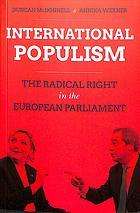
INTERNATIONAL POPULISM
DUNCAN McDONNELL ANNIKA WERNER
International Populism
The Radical Right in the European Parliament
3
Oxford University Press is a department of the University of Oxford. It furthers the University’s objective of excellence in research, scholarship, and education by publishing worldwide. Oxford is a registered trade mark of Oxford University Press in the UK and in certain other countries.
Published in the United States of America by Oxford University Press 198 Madison Avenue, New York, NY 10016, United States of America
© Duncan McDonnell and Annika Werner, 2019
First published in the United Kingdom in 2019 by C. Hurst & Co. (Publishers) Ltd
All rights reserved. No part ofPublication may be reproduced, stored in a retrieval system, or transmitted, in any form or by any means, without the prior permission in writing of Oxford University Press, or as expressly permitted by law, by license, or under terms agreed with the appropriate reproduction rights organization. Inquiries concerning reproduction outside the scope of the above should be sent to the Rights Department, Oxford University Press, at the address above.
You must not circulate this work in any other form and you must impose this same condition on any acquirer
A copy of this book’s Cataloging-in-Publication Data is on file with the Library of Congress.
ISBN 9780197500859
Annika dedicates this book to her mother, Hella. Duncan dedicates this book to his parents, Pat and Phyllis.
ACKNOWLEDGEMENTS
Without the counsel and helpful comments of many colleagues, this book would not have come to fruition. We would like to thank Niklas Bolin, Lucas Dolan, Diego Fossati, Reinhard Heinisch, Zoe Lefkofridi, Benjamin Leruth, Marta Lorimer, Gary Marks, Ferran Martinez i Coma, Lee Morgenbesser, Matt Wood and the two anonymous reviewers who have all helped improve and enrich the content of this book.
Furthermore, we have benefitted greatly from the opportunity to present findings at the UC Berkeley Center for Right-Wing Studies, the City University of New York Comparative Politics workshop, the Center for European Studies at the University of North Carolina (Chapel Hill), the MacMillan Center at Yale University, the Department of Political Science at the University of Copenhagen, the Department of Politics at the University of Turin, the OECD in Paris, C-Rex at the University of Oslo, the Centre for European Research at Queen Mary University of London, the Crick Centre at the University of Sheffield, the Sydney
Democracy Network at the University of Sydney and the Department of Political Science and Sociology at the University of Salzburg. The participants at numerous conference panels over the past four years have also provided invaluable comments. At Griffith University, we would like to thank Dr Malin Karlsson, a postdoctoral fellow, as well as Diego Leiva, Melodie Ruwet and Pandanus Petter, all doctoral students, for their assistance with the research. We would also like to express our deep gratitude to the many party representatives and officials from across Europe who were extremely generous with their time and insights. Finally, we would like to thank the European Commission’s Marie Curie Fellowship program, the Centre for Governance and Public Policy at Griffith University, and the Australian Research Council’s Discovery Projects scheme for their support of different elements and stages of this project.
LIST OF TABLES AND FIGURES
Tables
Table 1.1: Radical Right Populists in the 2014–2019 European Parliament 7
Table 2.1: The main radical right populist parties of ECR, EFDD and ENF since 1999 30
Table 3.1: Main members of ECR 58
Table 3.2: Positions on immigration and deviation within ECR 65
Table 3.3: Financial resources per MEP, EFDD and ECR 2017 70
Table 4.1: Main members of EFDD 96
Table 4.2: Positions on immigration and deviation within EFDD 102
Table 4.3: Financial resources per MEP, ENF and EFDD 2017 106
Table 5.1: Main members of ENF 129
Table 5.2: Positions on immigration and deviation within ENF 139
Table 5.3: Financial resources per MEP, ENF and EFDD 2017 143
Table 6.1: Group cohesion by policy area 169
Table 6.2: Loyalty of individual parties to groups 171
Table 6.3: Rapporteurs 2014–2019 174
Table 6.4: Press release analysis, six months before national election 181
Table 6.5: Party switches between groups, July 2014-January 2019 188
Table 7.1: The two most important issues facing our country 224
Table 7.2: The two most important issues facing the EU 226 Figures
Figure 3.1: ECR parties 2009 and 2014, European integration 63
Figure 3.2: ECR parties 2009 and 2014, leftright positions 66
Figure 4.1: EFDD and ENF parties 2014, European integration 100
Figure 4.2: EFDD and ENF parties 2014, leftright positions 103
Figure 5.1: ENF parties 2009 and 2014, European integration 137
Figure 5.2: ENF parties 2009 and 2014, leftright positions 140
Figure 6.1: Group cohesion in the EP 2014–2018 167
Figure 7.1: Positions of nine radical right populist parties in 2014 202
INTERNATIONAL POPULISM
Radical right populism is on the rise internationally. From the United States to India, from Brazil to Italy, radical right populist leaders and parties are doing better than ever electorally and, increasingly, are entering government. If in some areas of the globe their rise has been sudden, their recent achievements in Western Europe follow decades of successes and setbacks, but, ultimately, continued presence and growth. Countries like France, Italy, Belgium and Austria have had radical right populist (RRP) parties since the 1970s and 1980s. Not only have they survived, but a new generation of leaders such as Marine Le Pen of the Front National (FN—National Front), Matteo Salvini of the Lega Nord (LN— Northern League), and Kristian Thulesen Dahl of the Dansk Folkeparti (DF—Danish People’s Party) has shown that these parties can outlast charismatic founderleaders and thrive.1 Meanwhile, countries we previously thought immune to radical right populism, such as
Sweden, Germany and Spain, have proven us wrong over the last decade.2
R adical right populists in most of Western Europe are exerting greater influence than ever and it seems they are here to stay. Having once been seen as sporadic and marginal pariahs, they are now counted amongst the largest, and sometimes the ruling, parties in their countries. This has raised questions about their effects on politics nationally and internationally.
One issue that has received particular interest over the past five years is the extent to which radical right populists co-operate with one another in the European Union’s elected representative body, the European Parliament (EP). This book seeks to understand and explain that co-operation. Which alliances do radical right populists form in the EP? What are the logics underpinning them? How and why have they changed over time? What does international co-operation mean for these parties and how does it function inside and outside parliament? And finally, what does all of this tell us about the past, present and future of one of the key phenomena affecting politics in twenty-first century Europe?
The upsurge in attention paid to international populist co-operation can be traced back to 13 November 2013, when the FN leader Marine Le Pen and Geert Wilders of the Dutch Partij voor de Vrijheid (PVV— Party for Freedom) announced in The Hague that their parties would form the core of a prospective new EP
group after the European elections in May 2014.3 In the months that followed, scholars and commentators speculated about how radical right populist parties would perform electorally, how many of them would band together in parliament and what impact they might have.4 This represented a new and exciting element (finally!) in European Parliament politics. Radical right populists had long been the ‘odd ones out’ in the EP when compared to the other party families of Christian Democrats, Social Democrats, Liberals, the Radical Left and Greens. The latter all fit the main theoretical explanation for EP alliances of ‘policy congruence’ and tend to sit together in lasting and relatively stable groups (McElroy and Benoit 2010, 2011). Or, to put it another way, European ideological birds of a feather tend to flock (and stay) together. Radical right populists traditionally have not done this. Instead, they have usually either been dispersed into small, short-lived, ideologically heterogeneous groups that are ‘marriages of convenience’ (to secure funding) or they have been isolated among the parliament’s non-inscrits (non-aligned). Of the few EP groups before 2014 that had had radical right populists among their leading members, none had remained intact beyond a single legislature (and others had been much shorter lived).
Reflecting this history of disunity, the prevailing view among academics for many years was that radical right populists in the EP were ‘unlikely bedfellows’ due to
mutual antipathy, fear of being tainted by association and conflicting nationalist agendas (Fieschi 2000; Startin 2010). Thus, Minkenberg and Perrineau (2007: 51) concluded just over a decade ago that, in the EP, ‘there is nothing more difficult to establish than an international group of nationalists’.
So, does that still hold true? Are radical right populists still the odd ones out in the European Parliament? In this book, we explore what actually happened after the 2014 election, when seventy-three of the 751 elected Members of the European Parliament (MEPs) were radical right populists, their highest number to date.5 We explain the parliamentary alliances they formed and what they mean for our understanding of these parties today. Our focus is therefore on the three groups in the 2014–2019 parliament that contained radical right populists: European Conservatives and Reformists (ECR), Europe of Freedom and Direct Democracy (EFDD) and Europe of Nations and Freedom (ENF).
The UK Conservative-led ECR included in 2014 the Danish People’s Party and the Finnish Perussuomalaiset (PS—Finns Party), alongside less radical and non-populist right-wing parties. The EFDD, dominated by the UK Independence Party (UKIP), brought in the Swedish Sverigedemokraterna (SD—Sweden Democrats), along with a mixture of non-radical right MEPs, including those from the Italian Movimento Cinque Stelle (M5S—Five Star Movement). Finally, the ENF
created in June 2015 the largest ideologically homogenous radical right populist group in the parliament there had ever been up until that point. This brought together the Front National, the Dutch Party for Freedom, the Northern League, the Austrian Freiheitliche Partei Österreichs (FPÖ—Austrian Freedom Party) and the Flemish Vlaams Belang (VB—Flemish Interest). These nine ECR, EFDD and ENF parties, which are listed below in Table 1.1, have all been consistently recognised as radical right populist parties in the literature by contemporary scholars (e.g. Mudde 2019; Rooduijn et al. 2019) and are the only radical right populist parties in 2014/15 to have joined EP groups.
Looking at Table 1.1 (p. 7), the reader might wonder why we do not include other parties which gained MEPs in 2014, such as the Polish Prawo i Sprawiedliwość (PiS—Law and Justice), the Alternative für Deutschland (AfD—Alternative for Germany), the Greek Chrysí Avgí (Golden Dawn), the Hungarian Jobbik Magyarországért Mozgalom (Movement for a Better Hungary, commonly known simply as ‘Jobbik’), or Hungary’s ruling party Fidesz. There are a number of reasons for this. First, we share the widely-held view that Golden Dawn is a neo-fascist, rather than a radical right populist, party and therefore we do not consider it (Ellinas 2015; Vasilopoulou and Halikiopoulou 2015). Second, while Jobbik has been considered ‘radical right’ (i.e. democratic) rather than ‘extreme right’ (anti-democratic) by
experts for many years (e.g. Pirro 2015; Pytlas 2016), all of the radical right parties in our study have shunned it. As a result, Jobbik, like Golden Dawn, spent the legislature amongst the non-inscrits. Since we want to understand why radical right populists join particular groups, they are therefore of less interest (although we do discuss briefly in Chapter 5 the reasons for Jobbik’s exclusion by its former allies in the FN).6 We also omit from our main analysis two ECR parties that were not commonly recognised by scholars as radical right populist in the period around the 2014 elections, namely the Polish PiS and the German AfD, even though both had a radical right populist ‘turn’ in subsequent years (Arzheimer 2015; Stanley and Cześnik 2019). However, since both were in the ECR, we did conduct interviews with MEPs from the two parties and include this material (where relevant) in this book. Finally, we faced the question of how to treat Fidesz. Given that Fidesz’s longstanding (albeit controversial) membership of the European People’s Party continued during the 2014–2019 parliament and the disagreement among scholars surrounding its classification as ‘radical right populist’ during this period, we do not discuss its group strategies in this book.7 However, since we believe that Fidesz—like PiS and the AfD—had become a fully radical right populist party by the end of the legislature, we do consider the roles of these parties within the broader radical right populist family in the post-2019 parliament in the course of drawing our conclusions.
Table 1.1: Radical Right Populists in the 2014–2019 European Parliament
Note: Votes in percentages. Number of MEPs at first session of the new EP in July 2014.
* The Sweden Democrats moved from the EFDD to ECR in July 2018.
** The FN lost one MEP to the EFDD before parliament sat for the first time.
Our explanations of radical right populist alliances and actions in the EP are based on a mixture of qualitative and quantitative methods (see Chapter 2). As regards the former, we believe this is the first study to have enjoyed access to senior figures in so many different European radical right populist parties (see the appendix for the full list of interviewees). From June 2014, imme-
diately after the elections and when EP groups were being created, until November 2018, when the legislature was nearing its end, we conducted interviews with thirty-one key national and European-level figures from all of the nine RRP parties shown in Table 1.1 and their main non-radical right partners (such as the UK Conservatives and the M5S). In a number of cases, we interviewed the same people at different points during the parliamentary term to get their perspectives over time.
We complement this extensive interview material with party position data from the 2009 and 2014 waves of the Chapel Hill Expert Survey (Bakker et al., 2015). Specifically, we compare the parties’ positions on two key RRP policy areas, immigration and Euroscepticism, in addition to the social and economic left–right dimensions, which structure the space of European party competition generally (Marks et al. 2006). We also consider the salience that parties attributed to these issues. Finally, we use EP voting data and press releases to examine the policy fit between parties, how they have acted in the EP and how they have presented (and used) their international alliances domestically.
‘ This is all well and good’, you might say, ‘but who really cares about what parties do in the European Parliament? Most citizens in the EU do not bother to vote in European elections and even those that do have little knowledge of what happens in Brussels and
Strasbourg’. This is all true. Until 2019 when it rose back to just above 50 per cent, turnout declined at every single EP election after 1979, hitting a new low of 42.6 per cent in 2014.8 And, as our interviews with radical right populist and mainstream politicians conducted for this book reveal, most of them acknowledge that their grassroots members and the wider public have little idea about their allies in the EP. Indeed, one current radical right populist party leader even told us that, when he was first elected to national parliament in 2011, he did not know with whom his party sat in the EP!9
This perceived lack of importance may explain the lack of attention that European-level politics has received within the vast literature on radical right populism. As Cas Mudde (2016: 2) notes, since the early 1980s, more articles and books have been written about right-wing populist parties than all other ideological party types combined. And yet, while researchers such as Almeida (2010), Brack (2015), Bolin (2015), Bressanelli (2012), Fieschi (2000), Leruth (2017), Startin (2010) and Whitaker and Lynch (2014) have produced extremely useful articles and book chapters that discuss radical right populist parties and their elected representatives in the EP, ours is the first booklength study on the topic.
Of course, just because something has not been done before does not mean that it should be done. There are often good reasons why, to use a hackneyed academic
phrase, ‘a gap in the literature’ exists and why it should probably persist. However, as we show in the chapters that follow, an examination of EP group choices and actions can tell us a great deal about how parties see themselves, how they want to be seen by others, how other parties actually do see them, and where parties are going both nationally and internationally. In a period when radical right populists are transitioning from being marginal to becoming major parties throughout Europe, this perspective may be especially useful.
Take, for example, the Sweden Democrats, a party with an extreme right-wing history, which entered national parliament in 2010 and the EP in 2014. In the 2018 Swedish general election, the party finished third, just a couple of percentage points behind the main Swedish centre-right party.10 As we explain in Chapter 4, despite previous good relations with the Front National, the Sweden Democrats decided not to join the ENF group due to the perceived domestic image costs of being associated with FN and the Austrian Freedom Party. They were then themselves rebuffed—for precisely the same reasons—in their attempt to join the Danish People’s Party and Finns Party in the more moderate ECR. Interviewees from the UK Conservatives told us how they drew a clear distinction between the SD and the other two Nordic radical right populist parties based on their very different histories—something the Danish People’s Party and Finns Party, eager to polish their own