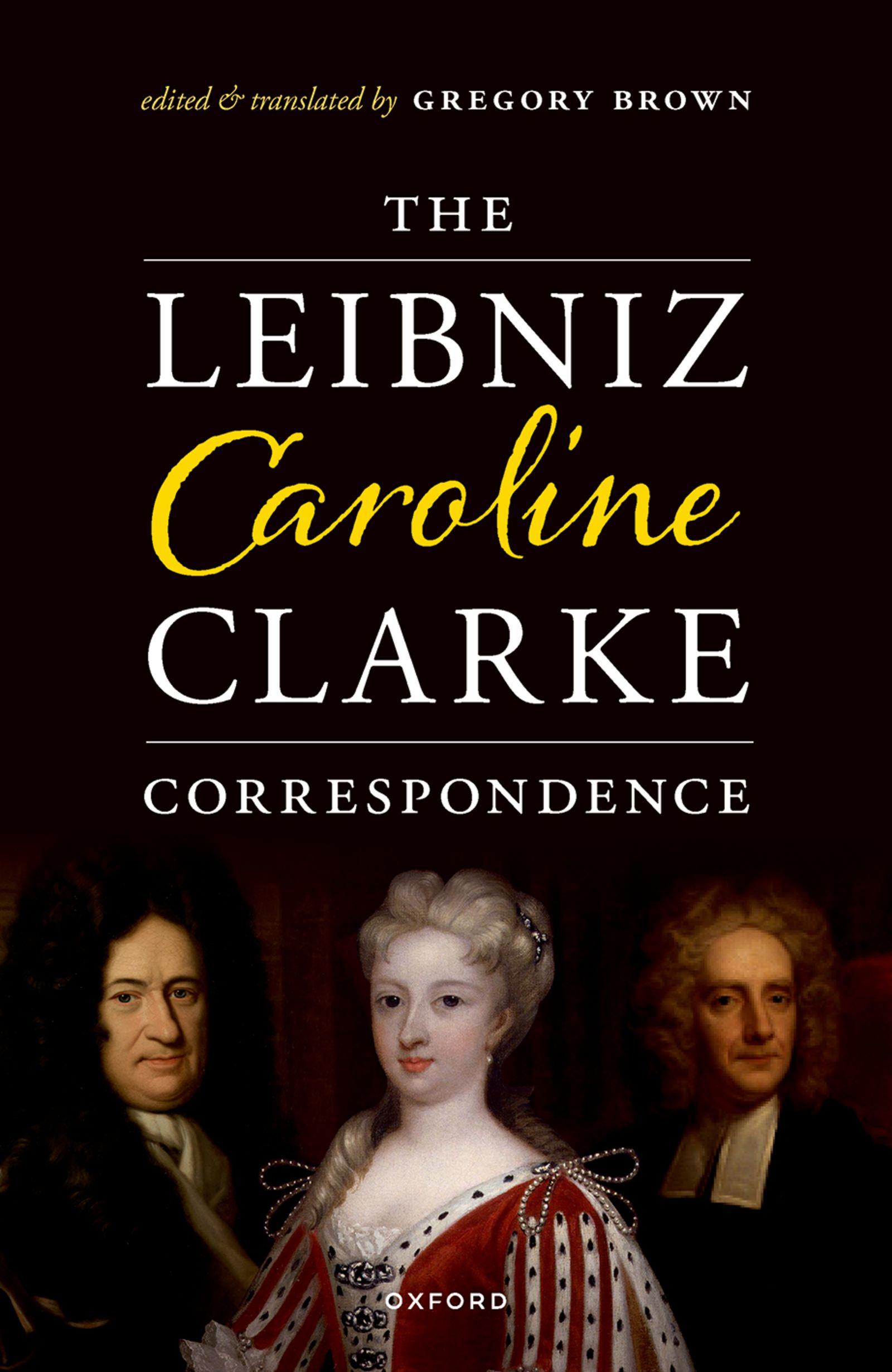
The Leibniz–Caroline–Clarke Correspondence
Edited and Translated by GREGORY BROWN
Great Clarendon Street, Oxford, OX2 6DP, United Kingdom
Oxford University Press is a department of the University of Oxford. It furthers the University’s objective of excellence in research, scholarship, and education by publishing worldwide. Oxford is a registered trade mark of Oxford University Press in the UK and in certain other countries
© Gregory Brown 2023
The moral rights of the author have been asserted
All rights reserved. No part of this publication may be reproduced, stored in a retrieval system, or transmitted, in any form or by any means, without the prior permission in writing of Oxford University Press, or as expressly permitted by law, by licence or under terms agreed with the appropriate reprographics rights organization. Enquiries concerning reproduction outside the scope of the above should be sent to the Rights Department, Oxford University Press, at the address above
You must not circulate this work in any other form and you must impose this same condition on any acquirer
Published in the United States of America by Oxford University Press 198 Madison Avenue, New York, NY 10016, United States of America
British Library Cataloguing in Publication Data Data available
Library of Congress Control Number: 2022950600
ISBN 978–0–19–287092–6
Printed and bound in the UK by Clays Ltd, Elcograf S.p.A.
Links to third party websites are provided by Oxford in good faith and for information only. Oxford disclaims any responsibility for the materials contained in any third party website referenced in this work.
J’espère que S. A. R. ne nous aura point abandonnés entièrement pour les Anglois, ni voulu diminuer ses bontés pour nous par le partage. Comme le soleil ne luit pas moins à chacun, pour luire à plusieurs. V. E. qui nous appartient aura soin de nous à cet égard, et j’espère que vous voudrez, madame, me protéger en particulier contre les mauvais effets de l’absence, que je n’ai que trop de sujet de craindre.
—Leibniz’s letter to Johanne Sophie of 29 January 1715 (document 63)
Vous estes ferme et constante dans les choses grandes et importantes, mais je dois craindre, madame, que vous ne le soyez pas également dans les petites, comme doit être à votre garde tout ce qui a rapport à moi, et particulièrement la version de la Théodicée.
—Leibniz’s letter to Caroline of 28 April 1716 (document 113)
Mais d’où vient que vous me soupçonnez de n’être la même pour vous?
—Caroline’s letter to Leibniz of 5 May 1716 (document 115)
[. . .] V. A. Royale a paru un peu chancelante, non pas dans sa bonne volonté à mon égard, mais peut-être dans sa bonne opinion de moi et de mes opinions, surtout depuis qu’il semble que la version de la Théodicée demeure en arrière
—Leibniz’s letter to Caroline of 12 May 1716 (document 117a)
Vous me trouverez malgré vos soupçons toujours la même.
—Sign-off, Caroline’s letter to Leibniz of 15 May 1716 (document 119)
Je chercherai avec empressement les occasions à vous marquer que je suis toujours la même.
—Sign-off, Caroline’s letter to Leibniz of 26 June 1716 (document 128)
[. . .] et vous me trouverez toujours la même.
—Sign-off, Caroline’s letter to Leibniz of 6 October 1716 (document 151)
[. . .] et je serais toujours la même pour vous.
—Sign-off, Caroline’s letter to Leibniz of 29 October 1716 (document 156)
Vous me trouverez comme toujours la même personne qui vous estime infiniment.
—Sign-off, Caroline’s last letter to Leibniz, 4 November 1716 (document 158)
Hence these tears.
—A. Rupert Hall, Philosophers at War, p. 9
1. Essais de Théodicée sur la Bonté de Dieu, la Liberté de l’Homme et l’Origine du Mal: Discours de la Conformité de la Foy avec la Raison §§ 18–19 (1710)
2. Leibniz to Nicolaas Hartsoeker (10 February 1711)
Unpublished
Andreas Gottlieb von Bernstorff to Leibniz (3 March 1714)
John Chamberlayne to Leibniz (10 March 1714)
Leibniz to Andreas Gottlieb von Bernstorff (21 March 1714)
7. Leibniz to John Chamberlayne (21 April 1714)
Leibniz to Sophie of the Palatinate, Dowager Electress of Braunschweig-Lüneburg (24 May 1714)
11. Leibniz to Caroline of Brandenburg-Ansbach, Electoral Princess of Braunschweig-Lüneburg (24 May 1714)
12. Queen Anne to Sophie of the Palatinate, Dowager Electress of Braunschweig-Lüneburg (30 May 1714)
13. Queen Anne to Georg Ludwig, Elector of Braunschweig-Lüneburg (30 May 1714)
14. Queen Anne to Georg August, Electoral Prince of Braunschweig-Lüneburg (30 May 1714)
15. Caroline of Brandenburg-Ansbach, Electoral Princess of Braunschweig-Lüneburg, to Leibniz (7 June 1714) 53
16. Johanne Sophie, Gräfin (Countess) zu Schaumburg-Lippe, to Baroness Mary Cowper (12 June 1714) 57
17. Benedictus Andreas Caspar de Nomis to Leibniz (13 June 1714) 61
18. Leibniz to Caroline of Brandenburg-Ansbach, Electoral Princess of Braunschweig-Lüneburg (16 June 1714) 67
19. Leibniz to Caroline of Brandenburg-Ansbach, Electoral Princess of Braunschweig-Lüneburg (7 July 1714) 73
20. John Chamberlayne to Leibniz (11 July 1714) 77
21. Johanne Sophie, Gräfin (Countess) zu Schaumburg-Lippe, to Louise, Raugravine Palatine (12 July 1714) 79
22. Caroline of Brandenburg-Ansbach, Electoral Princess of Braunschweig-Lüneburg, to Baroness Mary Cowper (13 July 1714) 87
23a. John Chamberlayne to Leibniz (7 August 1714) 91
23b. Enclosure: Extract from the Journal of the Royal Society (20 May 1714) 91
23c. Enclosure: Copy of a letter from John Keill to John Chamberlayne (20 July 1714) 93
24. Benedictus Andreas Caspar de Nomis to Leibniz (19 August 1714) 93
25. Leibniz to Andreas Gottlieb von Bernstorff (22 August 1714) 97
26. Philipp Ludwig Wenzel von Sinzendorff to Johann Caspar von Bothmer (4 September 1716) 99
27. Philipp Ludwig Wenzel von Sinzendorff to Friedrich Wilhelm von Görtz (4 September 1714) 99
28. Philipp Ludwig Wenzel von Sinzendorff to Leibniz (8 September 1714) 101
29. Leibniz to the Dowager Empress Wilhelmine Amalie of Braunschweig-Lüneburg (16 September 1714) 101
30. Leibniz to Charlotte Elisabeth von Klenk (16 September 1714) 105
31. Leibniz to Georg August, Prince of Wales (17 September 1714) 107
32. Leibniz to Andreas Gottlieb von Bernstorff (20 September 1714) 109
33. Leibniz to Ernst Friedrich von Windischgrätz (20 September 1714) 113
34. Leibniz to Philipp Ludwig Wenzel von Sinzendorff (20 September 1714) 119
35. Leibniz to Claude Alexandre de Bonneval (21 September 1714) 121
36. Leibniz to Johann Matthias von der Schulenburg (30 September 1714)
37. Leibniz to Eléonore Desmiers d’Olbreuse, Dowager Duchess of Celle (3 October 1714) 127
38. Leibniz to Caroline of Brandenburg-Ansbach, Princess of Wales (3 October 1714) 129
39. Claude Alexandre de Bonneval to Leibniz (6 October 1714) 135
40. Leibniz to Johann Matthias von der Schulenburg (7 October 1714) 139
41. Leibniz to Johann Matthias von der Schulenburg (12 October 1714) 141
42. Leibniz to Andreas Gottlieb von Bernstorff (14 October 1714) 143
43. Johann Matthias von der Schulenburg to Leibniz (15 October 1714) 147
44. Leibniz to Charlotte Elisabeth von Klenk (16 October 1714) 147
45. Leibniz to Claude Alexandre de Bonneval (Beginning of November 1714) 151
46. Andreas Gottlieb von Bernstorff to Leibniz (1 November 1714) 163
47. Andreas Gottlieb von Bernstorff to Leibniz (24 November 1714) 165
48. Leibniz to Johann Matthias von der Schulenburg (3 December 1714) 167
49. Leibniz to Andreas Gottlieb von Bernstorff (8 December 1714) 169
50. Leibniz to Caroline of Brandenburg-Ansbach, Princess of Wales (8 December 1714) 175
51. Leibniz to Caroline of Brandenburg-Ansbach, Princess of Wales (18 December 1714) 179
52. Caroline of Brandenburg-Ansbach, Princess of Wales, to Leibniz (28 December 1714) 185
53. Leibniz to Andreas Gottlieb von Bernstorff (28 December 1714) 187
54. Leibniz to Johanne Sophie, Gräfin (Countess) zu Schaumburg-Lippe (28 December 1714) 187
55. Leibniz to Friedrich Wilhelm von Görtz (28 December 1714) 189
56. Isaac Newton: An Account of the Book entitled Commercium Epistolicum Collinii & aliorum, De Analysi promota; published by order of the Royal-Society, in relation to the Dispute between Mr. Leibnitz and Dr. Keill, about the Right of Invention of the Method of Fluxions, by some call’d the Differential Method (February 1715) 195
57. Some Remarks by Leibniz on Roberval, Descartes, and Newton (1715?) 201
58. Leibniz to Caroline of Brandenburg-Ansbach, Princess of Wales (Beginning of January 1715) 201
59. Nicolas Rémond to Leibniz (9 January 1715) 205
60. Caroline of Brandenburg-Ansbach, Princess of Wales, to Leibniz (16 January 1715) 207
61. Leibniz to Nicolas Rémond (27 January 1715) 207
62. Leibniz to Caroline of Brandenburg-Ansbach, Princess of Wales (29 January 1715) 209
63. Leibniz to Johanne Sophie, Gräfin (Countess) zu Schaumburg-Lippe (29 January 1715) 211
64. Caroline of Brandenburg-Ansbach, Princess of Wales, to Leibniz (12 February 1715) 213
65. George Smalridge, Bishop of Bristol, to Caroline of Brandenburg-Ansbach, Princess of Wales (15 March 1715) 215
66. Leibniz to Andreas Gottlieb von Bernstorff (15 March 1715) 221
67a. Leibniz to Caroline of Brandenburg-Ansbach, Princess of Wales (29 March 1715) 225
67b. Enclosure: Leibniz to Caroline of Brandenburg-Ansbach, Princess of Wales (29 March 1715) 227
68. Nicolas Rémond to Leibniz (1 April 1715) 231
69. Andreas Gottlieb von Bernstorff to Leibniz (5 April 1715) 231
70. Leibniz to Johann Bernoulli (9 April 1715) 233
71. Henriette Charlotte von Pöllnitz to Leibniz (c.10 May 1715) 235
72. Leibniz to Caroline of Brandenburg-Ansbach, Princess of Wales (10 May 1715) 237
73. Leibniz to Charlotte Elisabeth von Klenk (28 June 1715) 243
74. Leibniz to Dowager Empress Wilhelmine Amalie of Braunschweig-Lüneburg (28 June 1715) 245
75. Charlotte Elisabeth von Klenk to Leibniz (6 July 1715) 249
76. Leibniz to Caroline of Brandenburg-Ansbach, Princess of Wales (3 August 1715) 253
77. Leibniz to Louis Bourguet (5 August 1715) 255
78. Caroline of Brandenburg-Ansbach, Princess of Wales, to Leibniz (13 September 1715) 265
79a. Nicolas Rémond to Leibniz (18 October 1715)
79b. Enclosure: Extracts from letters of Antonio Schinella Conti to Nicolas Rémond Concerning Newton (30 June, 12 July, and 30 August 1715)
79c. Enclosure: Antonio Schinella Conti to Leibniz (April 1715)
80. Leibniz to Caroline of Brandenburg-Ansbach, Princess of Wales (21 October 1715)
81. Leibniz to Johanne Sophie, Gräfin (Countess) zu Schaumburg-Lippe (21 October 1715)
82. Leibniz to Caroline of Brandenburg-Ansbach, Princess of Wales (not sent) (late October to mid-to-late December 1715)
83. Charlotte Elisabeth von Klenk to Leibniz (13 November 1715)
84. Caroline of Brandenburg-Ansbach, Princess of Wales, to Leibniz (14 November 1715)
85. Leibniz to Caroline of Brandenburg-Ansbach, Princess of Wales (Late November 1715)
86.
First Paper (Late November 1715)
87. Leibniz to Johann Bernoulli (December 1715)
88a. Leibniz to Nicolas Rémond (6 December 1715)
88b. Enclosure: Leibniz to Antonio Schinella Conti (6 December 1715)
88c. Leibniz to Nicolas Rémond (early December 1715)
89. Caroline of Brandenburg-Ansbach, Princess of Wales, to Leibniz (6 December 1715)
90. First Reply of Samuel Clarke (c.6 December 1715)
91. Leibniz to Caroline of Brandenburg-Ansbach, Princess of Wales (Mid-to-late December 1715)
92. Leibniz’s Second Paper (Mid-to-late December 1715)
93. Leibniz to William Winde (23 December 1715)
94. Leibniz to Christian Wolff (23 December 1715)
95. Caroline of Brandenburg-Ansbach, Princess of Wales, to Leibniz (10 January 1716)
96. Second Reply of Samuel Clarke (c.10 January 1716)
97. Leibniz to Caroline of Brandenburg-Ansbach, Princess of Wales (c.14 January 1714)
98. Leibniz to Louis Bourguet (24 February 1716)
99. Leibniz to Caroline of Brandenburg-Ansbach, Princess of Wales (25 February 1716)
100. Leibniz’s Third Paper (c.25 February 1716)
101a. Isaac Newton to Antonio Schinella Conti (c.8 March 1716)
101b. Isaac Newton to Antonio Schinella Conti (c.8 March 1716)
101c. Isaac Newton to Antonio Schinella Conti (c.8 March 1716)
101d. Isaac Newton to Antonio Schinella Conti (c.8 March 1716)
101e. Isaac Newton to Antonio Schinella Conti (c.8 March 1716
101f. Isaac Newton to Antonio Schinella Conti (c.8 March 1716)
101g. Isaac Newton to Antonio Schinella Conti (17 March 1716)
102. Nicolas Rémond to Leibniz (15 March 1716)
103.
Bourguet to Leibniz (16 March 1716)
104. Antonio Schinella Conti to Leibniz (26 March 1716)
105. Leibniz to Nicolas Rémond (27 March 1716)
106. Louis Bourguet to Leibniz (31 March 1716)
107. Leibniz to Louis Bourguet (3 April 1716)
108. Leibniz to Antonio Schinella Conti (9 April 1716)
109. Leibniz to Nicolas Rémond (9 April 1716)
110. Leibniz to Johann Bernoulli (13 April 1716)
111. Leibniz to Caroline of Brandenburg-Ansbach, Princess of Wales (14 April 1716)
112. Leibniz to Louis Bourguet (20 April 1716)
113. Leibniz to Caroline of Brandenburg-Ansbach, Princess of Wales (28 April 1716) 501
114. Leibniz to Johann Caspar von Bothmer (28 April 1716)
115. Caroline of Brandenburg-Ansbach, Princess of Wales, to Leibniz (5 May 1716) 513
116. Johann Caspar von Bothmer to Leibniz (5 May 1716) 519
117a. Leibniz to Caroline of Brandenburg-Ansbach, Princess of Wales (12 May 1716) 521
117b. Leibniz to Caroline of Brandenburg-Ansbach, Princess of Wales (P.S.) (12 May 1716) 529
118. Louis Bourguet to Leibniz (15 May 1716)
119. Caroline of Brandenburg-Ansbach, Princess of Wales, to Leibniz (15 May 1716)
120. Third Reply of Samuel Clarke (c.15 May 1716)
121. Johann Bernoulli to Leibniz (20 May 1716)
122. Caroline of Brandenburg-Ansbach, Princess of Wales, to Leibniz (26 May 1716)
123. Johann Caspar von Bothmer to Leibniz (29 May 1716)
124. Leibniz to Caroline of Brandenburg-Ansbach, Princess of Wales (2 June 1716)
125a. Leibniz’s Fourth Paper (c.2 June 1716)
125b. Leibniz’s Proposed Additions to his Fourth Paper (c.2 June 1716) 573
126. Leibniz to John Arnold (5 June 1716) 577
127. Leibniz to Johann Bernoulli (7 June 1716)
128. Caroline of Brandenburg-Ansbach, Princess of Wales, to Leibniz (26 June 1716) 583
129. Fourth Reply of Samuel Clarke (c.26 June 1716) 591
130. Leibniz to Henriette Charlotte von Pöllnitz (30 June 1716) 605
131. Leibniz to Louis Bourguet (2 July 1716)
132. Johann Caspar von Bothmer to Leibniz (10 July 1716) 609
133. Johann Bernoulli to Leibniz (14 July 1716) 611
134. Pierre Des Maizeaux to Philipp Heinrich Zollmann (14 July 1716) 613
135. Leibniz to Caroline of Brandenburg-Ansbach, Princess of Wales (31 July 1716) 613
136. Leibniz to Robert Erskine (Areskin) (3 August 1716) 623
137. Johann Caspar von Bothmer to Leibniz (11 August 1716) 625
138. Leibniz to Nicolas Rémond (15 August 1716) 627
139. Leibniz to Caroline of Brandenburg-Ansbach, Princess of Wales (18 August 1716) 629
140a. First Draft of Leibniz’s Fifth Paper (c.18 August 1716) 633
140b. Leibniz’s Fifth Paper (c.18 August 1716) 661
141. Leibniz to Pierre Des Maizeaux (21 August 1716) 715
142. Caroline of Brandenburg-Ansbach, Princess of Wales, to Leibniz (1 September 1716) 719
143. Caroline of Brandenburg-Ansbach, Princess of Wales, to Leibniz (8 September 1716) 725
144. Leibniz to Caroline of Brandenburg-Ansbach, Princess of Wales (11 September 1716) 727
145. Leibniz to Dowager Empress Wilhelmine Amalie of BraunschweigLüneburg (20 September 1716) 733
146. Leibniz to Charlotte Elisabeth von Klenk (20 September 1716) 739
147. Leibniz to George Cheyne (25 September 1716) 739
148. Charlotte Elisabeth von Klenk to Leibniz (30 September 1716) 741
149. Leibniz to Caroline of Brandenburg-Ansbach, Princess of Wales (End of September to mid-October 1716) 743
150. Nicolas Rémond to Leibniz (2 October 1716) 749
151. Caroline of Brandenburg-Ansbach, Princess of Wales, to Leibniz (6 October 1716) 751
152. Caroline of Brandenburg-Ansbach, Princess of Wales, to Leibniz (9 October 1716) 753
153. Leibniz to Nicolas Rémond (19 October 1716) 757
154. Leibniz to Johann Bernoulli (23 October 1716) 759
155. Johann Caspar von Bothmer to Leibniz (27 October 1716) 761
156. Caroline of Brandenburg-Ansbach, Princess of Wales, to Leibniz (29 October 1716) 763
157. Fifth Reply of Samuel Clarke (c. 29 October 1716) 763
158. Caroline of Ansbach, Princess of Wales, to Leibniz (4 November 1716) 801
159. Johann Bernoulli to Leibniz (11 November 1716) 803
160. Antonio Schinella Conti to Isaac Newton (10 December 1716) 805
161. A Note by Isaac Newton Concerning his Dispute with Leibniz (after 10 December 1716) 809
1717–1718
162. Dedication and Advertisement to the Reader, Clarke’s 1717 edition of the Correspondence (1717) 813
163. Clarke’s Appendix to his 1717 edition of the Correspondence (1717) 819
164. Isaac Newton to Pierre Des Maizeaux (c.August 1718) 835
165. Isaac Newton to Pierre Des Maizeaux (c.August 1718) 837
List of Abbreviations
A Leibniz, G. W. Sämtliche Schriften und Briefe. Edited by the Academy of Sciences of Berlin. Series I–VIII. Darmstadt, Leipzig, Berlin: 1923 ff. Cited by series, volume, and page.
AAK Briefe von Christian Wolff aus den Jahren 1719–1753. Ein Beitrag zur Geschicte der Kaiserlichen Akademie der Wissenschaften zu St. Petersburg. Edited by Arist Aristovich Kunik (Ernst Eduard Kunik). St Petersburg: Eggers (and Leipzig: Leopold Voss) in Commission der Kaiserlichen Akademie der Wissenschaften.
AG G. W. Leibniz: Philosophical Essays. Edited and translated by R. Ariew and D. Garber. Indianapolis: Hackett, 1989.
AT Oeuvres de Descartes. Edited by Charles Adam and Paul Tannery. 11 vols. Paris: Vrin, 1974–1989.
Bodemann-BR Der Briefwechsel des Gottfried Wilhelm Leibniz in der Königlichen Bibliothek zu Hannover. Edited by Eduard Bodemann. Hanover, 1889. Reprint, Hildesheim: Olms, 1966.
Bodemann-HS Die Leibniz-Handschriften der Königlichen öffentlichen Bibliothek zu Hannover. Edited by Eduard Bodemann. Hanover and Leipzig, 1895. Reprint, Hildesheim: Olms, 1966.
CHH The History of Parliament: the House of Commons 1690-1715. Edited by Eveline Cruickshanks, Stuart Handley, and David W. Hayton. 5 vols. Cambridge: Cambridge University Press, 2002. Cited by volume and page.
Dutens Leibniz, G. W. Opera omini, nunc primum collecta, in classes distributa, praefationibus et indicibus exornata. Edited by Ludovici Dutens. 6 vols. Geneva: De Tournes, 1768; reprint Hildesheim Georg Olms, 1989. Cited by volume and page.
Erdmann Leibniz, G. W. Opera philosophica quae extant Latina Gallica Germanica omnia. Edited by J. E. Erdmann. Berlin, 1839–1840.
FC Oeuvres de Leibniz. Edited by Louis-Alexandre Foucher de Careil. 7 vols. Paris: Firmin Dido frères, fils et Cie, 1861–1875.
FXF Biographie Universelle, ou Dictionnaire Historique des Hommes qui se sont fait un Nom par leur Génie, leurs Talens, leurs Vertus, leurs Erreurs ou leurs Crimes. Tome Troisième. 13 vols. Edited by François-Xavier Feller and François Marie Pérennès. Paris: Gauthier Frères et Cie. Paris: Gauthier, 1833–1838. Cited by volume and page.
GB Der Briefwechsel von Gottfried Wilhelm Leibniz mit Mathematikern. Edited by C. I. Gerhardt. Berlin: Mayer & Müller, 1899.
GLW Briefwechsel zwischen Leibniz und Christiaan Wolff. Edited by C. I. Gerhardt. Halle: H. W. Schmidt, 1860.
GM Leibnizens mathematische Schriften. Edited by C. I. Gerhardt. 7 vols. Berlin –Halle: A. Asher H. W. Schmidt, 1849–1863. Cited by volume and page.
GP Die philosophischen Schriften von Gottfried Wilhelm Leibniz. 7 vols. Berlin, 1875–1890. Cited by volume and page.
H Theodicy: Essays on the Goodness of God, the Freedom of Man, and the Origin of Evil. Translated by E. M. Huggard. LaSalle, IL.: Open Court, 1985.
HALS Hertfordshire Archives and Local Studies (Hertford, England).
HC The Encyclopædia Britannica. Edited by Hugh Chisholm. 11th edn. 28 vols. Cambridge: Cambridge University Press, 1910. Cited by volume and page.
HGA The Leibniz-Clarke Correspondence. Edited with introduction and notes by H. G. Alexander. New York: Manchester University Press, 1956.
JGHF Commercii epistolici typis nondum vulgati selecta specimina. Edited by Johann Georg Heinrich Feder. Hannover: Gebrüder Hahn, 1805.
JHC Journals of the House of Commons. Reprinted by order of the House of Commons, 1803. Cited by volume and page.
JK Neue Beiträge zum Briefwechsel zwischen D. E. Jablonsky und G. W. Leibniz Edited by J. Kvacala. Jurjew (Dorpat): C. Mattiesen, 1899.
Kemble State Papers and Correspondence Illustrative of the Social and Political State of Europe from the Revolution to the Accession of the House of Hanover. Edited by John M. Kemble. London: John W. Parker and Son, 1857.
Klopp Die Werke von Leibniz Erste Reihe. Historisch-politische und staatswissenschaftliche Schriften. Edited by Onno Klopp. 11 vols. Hannover, 1864–84. Reprint, New York: Georg Olms Verlag, 1973.
L Gottfried Wilhelm Leibniz: Philosophical papers and letters. Edited and translated by Leroy E. Loemker. 2nd edn. Dordrecht and Boston: Reidel, 1969.
LBr Leibniz-Briefwechsel. Hanover, Gottfried Wilhelm Leibniz BibliothekNiedersächsische Landesbibliothek.
LDB The Leibniz-Des Bosses Correspondence. Translated by Brandon Look and Donald Rutherford. New Haven, CT: Yale University Press, 2007.
LH Leibniz-Handshriften. Hanover, Gottfried Wilhelm Leibniz BibliothekNiedersächsische Landesbibliothek.
MJM G. W. Leibniz: Dissertation on Predestination and Grace. Translated and edited by Michael J. Murray. New Haven, CT: Yale University Press, 2011.
NC The Correspondence of Isaac Newton. 7 vols. Edited by H. W. Turnbull, J. F. Scott, A. Rupert Hall, and Laura Tilling New York: Cambridge University Press, 1959–1977.
OB Lahonton, Œuvres complètes. Edited by Réal Ouellet and Alaine Beaulieu. Montreal: Les Presses de l’Université de Montréal, 1990.
Pertz Gesammelte Werke. Aus den Handschriften der Königlichen Bibliothek zu Hannover. Edited by Georg Heinrich Pertz. 4 vols. Hannover: Hahnschen HofBuchhandlung, 1843–1847. Reprint, Hilesheim: Georg Olms, 1966. Cited by volume and page.
R Leibniz Political Writings. Translated and edited by Patrick Riley. 2nd edn. New York: Cambridge University Press, 1988.
RB G. W. Leibniz. New Essays on Human Understanding. Translated and edited by Peter Remnant and Jonathan Bennett. New York: Cambridge University Press, 1996.
List of Abbreviations xxi
SHS Œuvres Complètes de Christiaan Huygens, published by La Société Hollandaise des Sciences. 22 vols. La Haye: Martinus Nijhoff, 1888–1950. Cited by volume and page.
SMJ The New Schaff-Herzog Encyclopedia of Religious Knowledge. 13 vols. Edited by Samuel Macauley Jackson, George William Gilmore, Clarence Augustine Beckwith, Henry King Carrol, James Francis Driscoll, James Frederic McCurdy, Henry Sylvester Nash, and Albert Henry Newman. New York: Funk and Wagnalls, 1908–1914.
Preface
The documents gathered in this volume cut a winding path through the tumultuous final thirty-three months of Leibniz’s life, from March 1714 to his death on 14 November 1716. The disputes with Newton and his followers over the discovery of the calculus and, later, over the issues in natural philosophy and theology that came to dominate Leibniz’s correspondence with Samuel Clarke*, certainly loom large in the story of these years. But as the title of this volume is intended to convey, the letters exchanged between Leibniz and Caroline* of Brandenburg-Ansbach, Electoral Princess of Braunschweig-Lüneburg and later Princess of Wales, also figure prominently in their telling, and I have included their complete extant correspondence from 1714 to 1716. These letters are of particular interest inasmuch as they provide valuable insights into how and why Leibniz’s correspondence with Clarke arose, and why it developed as it did, with Caroline in the role of influential go-between—whence the title, The Leibniz–Caroline–Clarke Correspondence. But there is more; for these letters provide a window into the evolving personal relationship between Leibniz and Caroline. Much of the early correspondence between them after Caroline’s arrival in England is filled with thoughtful and engaging exchanges about philosophy, literature, and politics, about people Caroline was meeting in England, about those known by Leibniz far and wide, about the new royal family in England, headed by George I (Georg Ludwig* of BraunschweigLüneburg), as well as gossip about affairs of state in both Great Britain and Europe at large. Beyond the interest they hold for Leibniz scholars in particular, many of these exchanges may also be of interest to historians of early eighteenth-century Great Britain and Europe, and especially to those interested in the period immediately preceding and following the Hanoverian succession to the throne of Great Britain. But even quite early on in their correspondence Leibniz seemed to sense a threat to his relationship with Caroline, and a worrisome paranoia began to creep into some of his letters to her, letters in which he expressed concerns about her continuing allegiance to him now that she had been installed in England amongst his rivals. As the correspondence progressed, Leibniz’s paranoia only deepened; but it was nevertheless prophetic of a tragic truth to come. For the letters exchanged between Leibniz and Caroline document the rather sad story of the slow but steady erosion of Caroline’s loyalty to Leibniz after she departed from Hanover on 12 October 1714 and landed in England at Margate in Kent on 22 October as the new Princess of Wales and future Queen of England. In 1727 the Scottish poet James Thomson penned A Poem Sacred to the Memory of Sir Isaac Newton, calling him ‘our philosophic sun’, and it was by force of the political and cultural mass of
this sun that Caroline was eventually, and inexorably, drawn into its orbit, and away from Leibniz.
As I have already intimated, not every word of the letters exchanged between Leibniz and Caroline recorded in this volume speaks directly to Leibniz’s correspondence with Clarke and his dispute with Newton; but even when the words tack wide of those topics, they are not, for all that, lacking in interest to Leibniz scholars and historians of the period. The same may be said of the letters that Leibniz exchanged with other correspondents during this final period of his life, many of which are also included in this volume. For while most of them touch more or less directly on the dispute with Newton and the correspondence with Clarke, I judged that all of them record something of philosophical or historical value and thus contribute something of interest to the final chapters of the fascinating and complex story of Leibniz’s life and career. The title of this volume should be understood in this light; and thus while the correspondence between Leibniz and Clarke, on the one hand, and that between Leibniz and Caroline, on the other, occupy centre stage in this project, they do not fall exclusively within its purview, a purview that encompasses a much broader perspective on the swirl of events that engulfed Leibniz during the last few months of his life.
All the documents gathered in this volume are arranged chronologically according to the dates on which they were either composed or transmitted. And so although Clarke published his edition of the correspondence between himself and Leibniz in 1717, I have arranged Clarke’s papers chronologically according to the dates of the letters by which they were transmitted by Princess Caroline to Leibniz; similarly, I have arranged Leibniz’s papers chronologically according to the dates of the letters by which he transmitted them to Caroline for delivery to Clarke. However, the Dedication and Advertisement to the Reader with which Clarke prefaced his edition of the correspondence, as well as the list of passages from Leibniz’s works that he appended to that edition, are here reproduced in the section for the year 1717. In order to give the reader some idea of the sweep of the documents included in this volume, I have summarized a few highlights below.
March to September 1714 (documents 4–36)
The documents from March to September 1714 (documents 4–36) are from the period leading up to the death of Queen Anne on 12 August 1714, the consequent ascension to the throne of Great Britain by Elector Georg Ludwig, Leibniz’s employer in Hanover, and Leibniz’s hurried, and harried, departure from the imperial court in Vienna, where he had also been employed as a member of the imperial aulic council*, and his arrival in Hanover on 14 September. There are revealing letters exchanged between Leibniz and John Chamberlayne* concerning the calculus priority dispute with Newton (documents 5, 7, 20, 23a) and between Chamberlayne and Newton on the same subject (documents 8 and 9).
The letters exchanged between Leibniz and Caroline prior to the death of Queen Anne are valuable for what they reveal about the electoral family’s anxiety during the so-called succession crisis (see Caroline’s distraught letter to Leibniz of 7 June (document 15)), precipitated by the letters that Queen Anne had written on 30 May to the Dowager Electress Sophie* of the Palatinate (document 12), to her son, the Elector and future King of England Georg Ludwig (document 13), and to the elector’s son, the Electoral Prince Georg August* (document 14). Among the other notable documents from this period is a poignant letter from Johanne Sophie*, Gräfin (Countess) zu Schaumburg-Lippe, of 12 July 1714 to Louise, Raugravine Palatine (document 21) recounting the collapse and death of the Dowager Electress Sophie, Leibniz’s close friend and patroness in Hanover. Sophie had fallen ill while strolling in the gardens of Herrenhausen* with Caroline and Johanne Sophie; Sophie died there, in their arms, on 8 June 1716, just a day after Caroline had written her distraught letter to Leibniz. Johanne Sophie had written a shorter account of the ordeal in a letter of 12 June 1714 to Lady Mary Cowper* (document 16), who would eventually become one of Caroline’s English ladies-in-waiting after her arrival in England as Princess of Wales some five months after Sophie’s death. Caroline also sent a short account of the event to Lady Cowper on 13 July 1714 (document 22). There is also a moving letter of 7 July 1714 that Leibniz wrote to Caroline after hearing of the Dowager Electress Sophie’s death (document 19). On 17 September Leibniz wrote a pleading letter of excuse (gout and plague) and pardon to the new Prince of Wales Georg August for not having returned to Hanover sooner, before the departure of the prince and his father the king (document 31; see also his letter to Minister Andreas Gottlieb Bernstorff* of 20 September (document 32), his letter to Minister Friedrich Wilhelm Görtz* of 28 December (document 55), and his letter to Caroline from the end of November 1715 (document 85)). On 20 September, three weeks before Caroline’s departure for England, Leibniz wrote to the President of the Imperial Aulic Council, Ernst Friedrich Windischgrätz (document 33): ‘I am preparing to go to England with Madame the Royal Princess, who has the kindness to desire it. I have reasons for not yet revealing any of it to others, but I think that it is my duty to inform Your Excellency of it in order that you may judge if I could be useful there for the service of the emperor.’ And on 21 September Leibniz wrote to the Imperial General Claude Alexandre de Bonneval* in Vienna: ‘If I were in a state to obey Her Royal Highness, I would go with her to England’ (document 35). In letters to Johann Matthias von der Schulenburg* over the next three weeks (documents 36, 40, 41), he suggested more definitely that he intended to go to England soon.
October 1714 to the Middle of November 1715 (documents 37–83)
The documents from October 1714 to the middle of November 1715 are from the period immediately preceding Caroline’s departure for England on 12 October