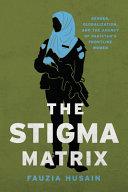
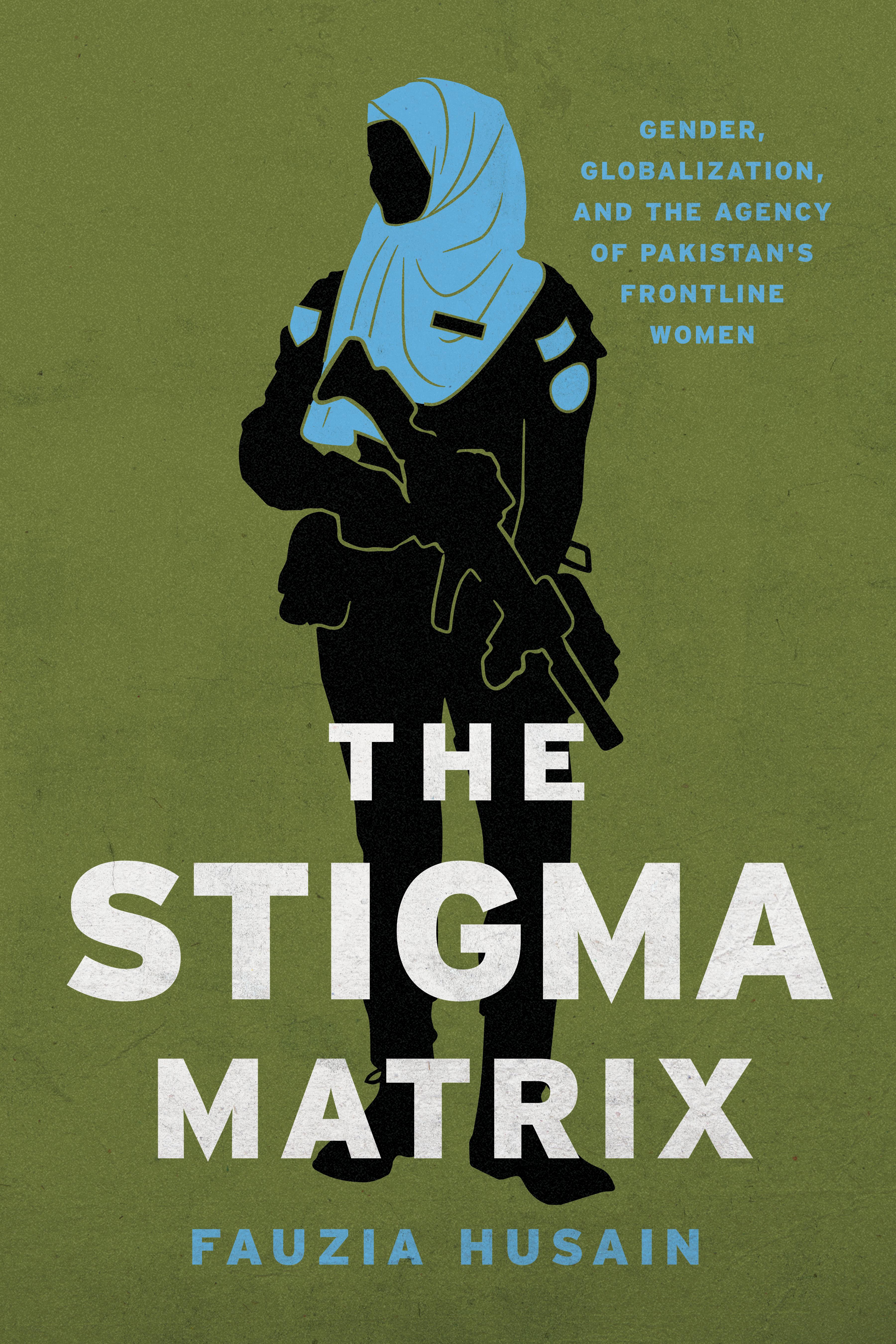
The Stigma Matrix
Gender, Globalization, and the Agency of Pakistan’s Frontline Women
FAUZIA HUSAIN
Stanford University Press
Stanford, California
Stanford University Press Stanford, California
© 2024 by Fauzia Husain. All rights reserved.
No part of this book may be reproduced or transmitted in any form or by any means, electronic or mechanical, including photocopying and recording, or in any information storage or retrieval system, without the prior written permission of Stanford University Press.
Printed in the United States of America on acid-free, archival-quality paper
Library of Congress Cataloging-in-Publication Data
Names: Husain, Fauzia (Professor), author.
Title: The stigma matrix : gender, globalization, and the agency of Pakistan’s frontline women / Fauzia Husain.
Other titles: Globalization in everyday life.
Description: Stanford, California : Stanford University Press, 2024. | Series: Globalization in everyday life | Includes bibliographical references and index.
Identifiers: lccn 2023017900 (print) | lccn 2023017901 (ebook) | isbn 9781503632370 (hardcover) | isbn 9781503636057 (paperback) | isbn 9781503636064 (epub)
Subjects: lcsh: Women employees—Pakistan—Social conditions. | Women—Employment—Pakistan. | Stigma (Social psychology)—Pakistan. | Purdah—Pakistan. | Globalization—Social aspects—Pakistan.
Classification: lcc hd6190.5 .h873 2024 (print) | lcc hd6190.5 (ebook) | ddc 331.4095491—dc23/eng/20230901
LC record available at https://lccn.loc.gov/2023017900
LC ebook record available at https://lccn.loc.gov/2023017901
Cover design and illustration: Lindy Kasler
Typeset by Newgen in Minion Pro 10/14.4
To Faryal Husain, Bibi Jan Tajik, and Nadia Naqi. Mother, grandmother, best friend. Thank you for everything.
This page intentionally left blank
1 THE GLOBAL CONSTITUENTS OF SEXUALIZED 26 STIGMAS IN PAKISTAN
2 THE MESO LEVEL OF THE STIGMA MATRIX: 61 THE CONTEXTS OF STIGMA IN FRONTLINE WORK
3 VEILED DELICACY: AGENTIC RESPONSES 83 TO STIGMA IN THE PAKISTANI POLICE FORCE
4 SACRED CONDUITS: STIGMA AND THE AGENCY 117 OF HEALTH WORKERS 5 MAVENS OF MOBILITY: HOW AIRLINE WOMEN 157 NAVIGATE STIGMA
Acknowledgments
This is one of my favorite sections to read in a book, but is a difficult one to write. So many people have helped in so many ways, that I worry about being able to list them all and about thanking them as deeply as they deserve. This book is the product of several years of effort, effort that was undertaken in at least three different countries and across several personal and professional relational contexts. Where to start with the giving of gratitude? I will start with the person who trained me, Allison Pugh, my advisor, from whom I learned not just the nuts and bolts of academic work but also what a caring, compassionate, and feminist academic looks like. As a writer, teacher, and advisor, you are my role model, and for providing that peerless template, I am truly grateful to you.
Thank you to my dissertation committee, Isaac Reed, Andrea Press, and Rachel Wahl, for providing such thoughtful guidance at the University of Virginia and beyond. In addition to my brilliant committee, I am also grateful to the sociology department and to the faculty at UVa. In particular I’d like to thank Sarah Corse, Elizabeth Gorman, and Josipa Roksa for their useful advice and generous support.
Thank you to my fellow graduate students, advisees, and friends Hexuan Zhang, Anna Cameron, Brooke Dinsmore, and Pilar Plater. And thank you
to Jaime Hartless, Sarah Mosseri, and Gabriella Smith, my primary academic family.
At the University of Toronto, thank you to my postdoc supervisor Sarah Kaplan for her generous support and wise advice. And thank you to Andras Tilcsik, Sonia Kang, and Dionne Pohler for timely and useful advice about numerous academic issues. Thank you also to the wonderful folks who contribute so much to GATE and to the GLab: Sarah Kaplan, Andras Tilcsik, Sonia Kang, Dionne Pohler, Daphne Baldassari, Joyce He, Kira Lussier, Sharmila Adhya, Hyeun Lee, Vanessa Conzon, and Alyson Colson.
At Queen’s University, I would like to thank Martin Hand for his generosity and valuable advice. And thank you to my amazing colleagues Thomas Abrams, Golshan Golraiz, Annette Burfoot, and Norma Mollers for the fruitful conversations and warm collegiality.
Outside the academy, I’m grateful to my grandmother, Bibijan Tajik, who dreamed very big dreams for me when I was a child. My mother, Faryal Husain, who raised and educated me, almost singlehanded. My brother Adnan, sister-in-law Mishal, niece and nephew Sonia and Ibrahim, who fed, sheltered, and comforted me when I first moved to Canada and started writing this book. My cousins, Samer Burney and Dennis Hall, and their children, Zara, Kazim, and Amir, for being my home away from home in Washington, D.C., during my MA and PhD. My father, Mujahid Husain, who passed away years before I started my academic career but who helped me develop resilience.
In Karachi, I’d like to thank Nadia Naqi, who was an invaluable source of support throughout my fieldwork. For introducing me to gatekeepers and informants, listening to my ideas and analysis, and helping me get past impossible hurdles managing access, transport, security, and other issues—this work is richer because of your tireless contribution. Thank you for being my friend!
Thank you to my uncle and aunt, Asif Tajik and Hina Tajik, and my friends, Adnan Madani, Bina Khan, and Aysha Adil, who make Karachi home for me, even when I’ve been away for years. Thank you also to friends who make the United States feel like home whenever I visit; Natalia Mahmud, Sahar Said, Hanna Siddiqui, Jaime Hartless, Sarah Mosseri, and Gabriella Smith.
For their valuable work on this book, I would like to thank Marcela Cristina Maxfield, senior editor, and the team at Stanford University Press— Gigi Mark, David Zielonka and Sarah Rodriguez. Thank you to copyeditor Martin Schneider for his capable and attentive work. Thank you also to Charlie Clark at Newgen.
Finally, I don’t have the words to thank the women and men who provided me with such an intimate glimpse into their professional and personal lives. I am unable to name these amazingly generous people here for privacy reasons. This work owes everything to the extraordinary generosity, hospitality, and kindness I received from my participants during my field work in Pakistan.
This page intentionally left blank
INTRODUCTION
ON A FRI d AY AFTERNOON IN April 2020, Inspector Sharafat Khan was attacked by a mob of worshippers. She had only recently become one of two women to command a mainstream (i.e., co-ed) station house in Karachi. She was trying to implement COVID-19 restrictions in the district under her command. The worshippers pelted her with stones. Videos of the attack soon went viral. In them, Khan, uniformed, can be seen cornered by a crowd of men, her nose bleeding as she screams to her police force to take action against the mob. In interviews with the media, members of the mob later justified their attack. They said it was warranted on account of her disrespectful behavior.
Khan was not the first woman agent of the state to suffer such an assault upon her dignity. Just eighteen months earlier, in October 2018, Assistant Superintendent of Police Sohai Ali Talpur successfully thwarted a terrorist attack on a Chinese embassy in Karachi. The case received considerable publicity in the media, as TV channels and newspapers carried stunning images of the operation. In them, Talpur, in uniform, can be seen leading a force of armed men. The men are all wearing bulletproof vests. Talpur, fortified with only a revolver, is pictured leading the charge. These striking images of Talpur and her team gained traction on international media
outlets as varied as CNN, Reuters, and the Hindustan Times. Certain Chinese nationals were so taken by Talpur’s bravery that they sent her proposals of marriage. But the international praise for Talpur’s bravery was tempered, at the local level, by doubts and censure. In cynical tweets, cartoons, and news reports, local critics asserted that Talpur’s involvement was nothing more than a publicity stunt, that she had used her rank to push herself into the limelight and that in truth, the credit belonged to her male subordinates (see Zahra 2018).
A few miles east of the embassy where Talpur thwarted a terrorist attack, another woman agent of the state also braved threats of violence in the line of duty. Shiza Hayat, a lady health worker, goes door to door administering the polio vaccine to children in her neighborhood. In the course of her duties, she said, she was intimidated by armed men. “For four days after the polio drive ended,” she said, “I noticed these men sitting outside my gate. They had guns and they looked very threatening. I was too scared to go out. If I needed to buy something, I would sneak out the back door.” This intimidation had come on the heels of a warning from her neighbors: “They told me very forcefully to give up polio work,” she said. “They think that lady health workers are lewd women because we provide the community with information and tools for contraception. . . . And they particularly dislike the vaccine work we do; they think the polio vaccine is part of an American conspiracy to sterilize Muslim children.”
The dignity assaults that Khan, Talpur, and Hayat endured are not unique. In fourteen months of field research in Karachi, Pakistan I witnessed, in site after site, frontline women workers, who, courageously face tremendous hardship and danger in the course of their work, reduced to tears by the insults, jokes, and threats lobbed at them by the public as well as by bosses, subordinates, clients, and even members of their own families. I watched public health workers who have braved terrorist threats to complete their polio vaccination work sob over the poor treatment they received at the hands of their bosses. I saw state-employed airline attendants, stoic in the face of plane safety problems, weep as they talked about family members who no longer spoke to them on account of their “disreputable jobs.” And I heard policewomen compare their workplaces to sewers that contaminate women’s dignity and their reputations.
While global gender mainstreaming initiatives have created opportunities for women like Khan, Talpur, Hayat, and other frontline women workers to take up new public roles on behalf of the Pakistani state, these measures have also brought these women into confrontation with cultural beliefs that call their competence, commitment, and their very social identity into question. The public nature of their jobs pit frontline women against local logics of gendered distancing, or what I call “purdah norms.” Purdah, literally “curtain,” describes a South Asian practice of women’s seclusion (see Papanek 1973). While it sometimes involves the physical segregation of women from men, for instance, through the erection of screens in public spaces that women can retire behind, at other times doing purdah means enacting norms of gendered distancing, such as veiling, lowering the gaze, and circumscribing interactions with non-kin men (see Husain 2020; Masood 2018). Purdah norms delineate certain spaces, temporalities, and roles as “dirty” for women (George 2000; Patel 2010; Grünenfelder 2013a, b; Rai et al. 2007; Mumtaz and Shaheed 1987). Those who violate the gendered boundaries of space and time by working in male-dominated occupations, like policing, for instance, or by taking on night shifts, are seen as immoral women, unworthy of respect or obedience (Grünenfelder 2013).
This book is concerned with the lives of these so-called dirty women. It follows the trials and tribulations of women like Khan, Talpur, Hayat and other frontline women workers employed by the Pakistani state to serve Pakistani citizens in the arenas of policing, health work, and aviation. Many of these women are the first in their family to venture out of their homes for work. Many have embraced their public-facing jobs in a desperate bid to support their families and serve their communities. But their jobs require them to weather persistent assaults on their dignity.
Although they can be fleeting—the women describe them as background noise—the dignity assaults endured by frontline women deserve our closer scrutiny. The bruising episodes frontline women encounter don’t just wound their bodies, their emotions, their reputations, and their dignity, they also mark frontline women as outsiders, who on account of their gender are ill suited for their public roles and offices. Whether brutal or subtle, the gestures of violence, disobedience, insolence, and mockery that frontline women ceaselessly face are like stigmata, leaving physical,
emotional, and reputational scars on their victims. The marks they make don’t just undermine specific security operations, like the physical distancing measures Khan was implementing in order to help the state stem the spread of COVID-19, but also disrupt the public standing of the women they target. And more broadly, such marks shape public beliefs about women’s ability to occupy positions of authority in the machinery of the state.
The pelted stones, the questioning memes, and the intimidation draw attention to the women’s presence and mark them as being out of place, as if they do not deserve to wield the authority or hold the offices they occupy, as if they do not belong in the spaces they patrol in service to the state. Such stigmata, therefore, operate as a mechanism of gendered exclusion, a device that limits women’s capacity to perform their duties for the state and, consequently, their ability to integrate fully into the state that they serve at considerable personal sacrifice.
As Khan’s encounter with the mob and Hayat’s intimidation by her neighbors shows, the dignity assaults frontline women confront are not spontaneous localized events but are rather the dynamic products of gender norms and security processes that are global in nature. Khan was attacked by a mob while implementing measures connected with a global pandemic. The mob’s anger must therefore be understood in the context of broader public sentiments around COVID-19 policies at the time. The imposition of restrictions around COVID-19 quickly prompted a slew of conspiracy theories in Pakistan. News reports about the virus were taken to be false, and the prescribed health measures were read as part of a foreign conspiracy aimed at causing harm to Muslims. Doctors, insisted members of the public, were trying to make money from hospitalizations, while the government was angling for aid money from the west. Some even argued that news of the virus was an excuse to insert a chip into the brains of Muslims, so that antagonistic foreign nations could access the thoughts of their victims. Similar conspiracy theories frame the violence against health workers like Hayat who administer the polio vaccine at the behest of not just the Pakistani state but also its global allies. Because of the vaccine’s transnational backing, these women are seen as agents of a western conspiracy to render Muslim boys infertile and speed up the sexual maturation of Muslim girls.
The stigmatizing affronts that frontline women face, therefore, are not simple. They are not local nor spontaneous nor unstructured but rather are deeply rooted in global processes, both recent and of longer standing. To tease apart this complex of global processes, this book introduces a new multiscalar framework—the stigma matrix—outlining a new theoretical approach that can help us understand how contemporary global policies build on colonial histories and local inequalities to shape women’s experiences of stigma as well as their responses to it. By encouraging us to step back and look beyond the micro-level interpersonal contexts where stigma is inflicted, the stigma matrix framework provides a more comprehensive, more global understanding of stigma. It allows us to apprehend how stigmas, such as the ones Khan, Talpur, and Hayat endured, feed upon a long history of racialized gender inequality and how they continue to draw sustenance from various levels of social life—from macro-level socioeconomic policies through meso-level organizational arrangements to micro-level interactions and experiences.
Adopting a multiscalar approach to stigma allows us also to understand what it is that stigma accomplishes, how it works as a tool for hegemonic domination. This framework draws inspiration from Patricia Hill Collins’s theorizing (Collins 2000) and builds on the work of sociologist Imogen Tyler (2020); these theoretical antecedents are discussed in more detail in chapter 1. Below I describe the particular shape that the stigma matrix takes in the context of Pakistan’s frontline women.
THE STI g MA MATRIX AN d PA k ISTAN’S FRONT l INE w OMEN
In the case of Pakistan’s frontline women, the stigma matrix is composed on the bedrock of colonial history. As I show in chapter 1, purdah norms and the panic around women’s appearance in public space are rooted in the colonial encounter, a traumatic history that continues to shape local perceptions of transnational engagement with Pakistan and frame contemporary processes of globalization. Contemporary cynicism about the intentions of global actors and agencies and ongoing fears about the risk that global processes might pose to women’s sexual modesty and to the social norms surrounding gender can be traced back to the colonial era. And it is
on this historic ground of cynicism and suspicion that contemporary global forces converge to create new tensions and pressures for Pakistani women.
Neoliberalism works to pull working-class women into public roles within the Pakistani state, for instance by making aid money conditional upon the state’s implementation of gender mainstreaming policies. The global process of securitization exerts another pull by necessitating women’s induction into security roles, like policing and polio eradication, where they help the state to expand its capacity by addressing and serving veiled women citizens. And the global process of Islamization, rooted in the Islamic revival of the 1970s (see Salvatore and LeVine 2005), pressures women who adopt these public roles to also serve as emblems of the nation’s religiosity by demonstrating compliance with the norms of purdah and adopting public gestures of pious propriety.
While the interplay of these global forces may sound abstract, their synthesis has had a very concrete impact on women’s lives. All three contemporary global forces—neoliberalism, securitization, and Islamization— directly impact the hierarchies that women must confront in their day-to-day lives. All three forces shape both the issues of class and the arrangements around gender for working-class families. Neoliberalism leaves such families scrambling to preserve their class positions in a brutal and increasingly privatized job market. Securitization creates new hurdles for working-class actors seeking mobility through the stable but shrinking government employment sector, for instance, by making such jobs conditional upon the completion of costly security checks. Islamization reinforces gender hierarchies by subjecting women to the authority of men in their families and at work.
In short, as it is composed of cross-cutting global forces, which interact with local norms and hierarchies, the stigma matrix operates like a megastructure that reshapes and reinvigorates local gender and class inequalities, which were already infused with stigma during the colonial period. Figure 1 provides a map for understanding how the stigma matrix is composed through the complex interaction of multiple global forces with local beliefs and hierarchies.
By focusing on the multiple levels of stigma’s composition, we are better able to grasp what stigma does, how it impugns women’s dignity in service
Global forces (e.g., neoliberalism, Islamization, securitization)
Historical forces (e.g., colonialism)
to hegemonic projects of domination. The stigmas associated with purdah violation, for instance, work to limit women’s occupation of public space. By formally or informally reinforcing the norms of purdah, Pakistani state elites are able to forge alliances with religio-political parties and also to cobble together a heterogeneous citizenry under the unifying banner of religious nationality. In the chapters that follow, I describe the functions that gender-based stigmas served in nineteenth century colonial India (an empire that included the land now occupied by Pakistan), and I show how such stigmas continue to help preserve women’s marginality in service to various political projects, and I document the pain that such stigmas produce for the women who must confront them.
The framework described in this book not only provides useful insights into the pressures Pakistani frontline women face, and the resources they use to navigate them, it can also help us understand the connection between stigma and inequality in other contexts. In the concluding chapter I discuss how the stigma matrix framework can be used to better understand gaslighting in intimate partnerships as well as diversity initiatives that aim to redress inequality in the workplace. When marginalized actors, like women, are formally recruited via diversity drives into contexts of work
Figure 1. The stigma matrix
that previously excluded them, such as the police force, The Stigma Matrix shows, they still have to contend with cultural forms of exclusion that continue to haunt their workplaces and the broader arenas that they occupy.
To be sure, frontline work is not entirely without its compensations. Their public facing jobs provide Pakistani women with money and purpose, with the capacity to provide for children, to care for aging parents, and to serve their communities. Shiza Hayat’s health job helped save her family from starvation after a spinal injury left her husband, a taxi driver, unable to work. Shahbano Taj, a policewoman I spoke with, told me she had taken on police work in order to support her divorced mother and younger siblings after her father abandoned them. Mehr Ali, a single mother of two, said her airline work had kept her stove burning at home and her children in school.
For each of these women, their work brought more than just personal benefit. Shiza Hayat said that she was motivated in her polio eradication work not only by the salary she received but also by her belief that she was “protecting the world’s children from a crippling disease.” Shahbano Taj told me proudly that her job enabled her to demonstrate to her village that “women too are somebody, they too can work and earn and take on positions of authority.” And Mehr Ali said that her work allowed her to provide comfort and aid to aged or unaccompanied women travelers, especially those who had never flown before, “by speaking in Urdu and through small gestures of caring, we are able to give them a feeling of connection,” she said. “We give them a feeling of belonging, a personal, Pakistani kind of intimacy that they wouldn’t find on any other airline.”
Despite their valiant and heartfelt service, women frontline workers say they are belittled and treated with scorn. Shahbano Taj said that women cops are seen by their male bosses as “nothing, less than nothing.” Shiza Hayat said that the stigma of her job had affected not only her own, but also her daughters’ relationships. “My younger daughter, Sarah, someone came and said to her in-laws’ that Sarah’s mother is nothing but a street walker,” she told me tearfully. And Mehr Ali said that her marriage broke up because of her job, “my husband couldn’t stop with his constant suspicion, that she is flying out of the city overnight, God knows what she gets up to.”
How do women navigate the conflicts created by their stigmatizing jobs? What kinds of resources do they bring to bear in negotiating the backlash they face for their occupation of stigmatized roles on the frontlines of service for the Pakistani state? And how do their efforts fare?
This book answers these questions in order to better understand how stigma, a mechanism of gendered exclusion constituted through the conjunction of global forces with local hierarchies, is configured and contested. Such contestations are described by scholars as destigmatization, “the process by which low-status groups gain recognition and worth in society” (Lamont 2018). Since destigmatization is a crucial route to equality and social inclusion, its study has been earmarked as deserving of special attention. In her 2017 presidential address at the annual meeting of the American Sociological Association, Michelle Lamont argued that in the context of multiple claims for recognition by destigmatization movements, like #MeToo and #BlackLivesMatter, it has become urgent for sociologists to gain a better understanding of how to extend cultural membership to those who have been denied it via cultural mechanisms like stigma (Lamont 2018). The incorporation of marginalized actors into arenas of power, such as the state, after all, depends not just on their admission to these spaces but also on their access to dignity within them.
By focusing on Pakistani frontline women’s efforts at navigating stigma, this book offers a fresh perspective on both, the obstacles and the opportunities that equity-seeking groups encounter as they undertake the long trek toward recognition and belonging. It does so by focusing on the experiences and routine practices of women like Khan, Hayat, and Ali, frontline workers who serve the Pakistani state and its transnational allies and who are subjected to various kinds of humiliation for their service. It asks, how do women frontline workers, like Khan, navigate the stigma produced at the intersection of local and global imperatives of gender and security? How do they contest this mechanism of exclusion and what can we learn from their efforts?
A QUESTION OF w OMEN’S A g ENCY
These questions are essentially questions about women’s agency, a concept sociologists use to describe an individual’s capacity for taking action in a
given situation. What kinds of agency are impeded by the stigma matrix, and what kinds of agency can overcome it? To answer this question, I use empirical data collected over fourteen months of fieldwork to develop a new multidimensional account of women’s agency. My conception of agency borrows from feminist theory as well as pragmatic sociological theory and is the primary contribution of this book. Agency, I show in the pages that follow, is multifaceted, involving at least two distinct forms of capacity: (1) a capacity for making or disrupting meaning that I call symbolic capacity and (2) a capacity for recruiting others to the meanings or projects we wish to advance, what I call relational capacity. Drawing on my observations of women’s efforts to navigate stigma, I argue that agency involves not just mobilizing signs to make new meanings and tell new stories about ourselves, our work, and our identities but also the capacity to attract allies who will believe and support the meanings we make or unmake. While the symbolic wing of agency works to unsettle or reinforce the structures of meaning that make up stigma, agency’s relational wing works to foster connection and forge relationships that can support an actor’s effort to destabilize the meanings and hierarchies that anchor stigma.
In short, agency, this book argues, involves not just doing but also connecting, not just aesthetic display-work but also relational effort. I describe this multidimensional conception of agency as well as its academic antecedents in more detail in chapter 3.
Parsing out the different dimensions of agency not only helps us see the multiple ways that marginalized actors navigate stigma; it also allows us to apprehend agency’s global character. Like stigma, agency also draws on multiple contexts of meaning, from the micro and immediate contexts women occupy to the macro and global contexts they serve. This global dimension of symbolic agency is demonstrated in chapter 5. And finally, as I show in chapter 6, agents work to recruit not only those within their immediate orbit but also distant allies, local as well as global. Thus, like stigma, agency too includes a global dimension, and this global character of agency becomes clear when we tease apart agency’s multiple facets. By outlining agency’s connection with broader contexts of meaning and relating, this book expands feminist thinking about Muslim women and the contexts that inform their agency.
THE CONTEXTS OF w OMEN’S w OR k
Feminist scholars have suggested that agency is embedded (see Korteweg 2008). By this they mean that agency is dependent on the specific settings in which it takes form. Inspector Khan, for instance, has access to a very different set of resources for tackling stigma than does Ali, an airline attendant. Khan, as the head of a co-ed police station, has access to weapons, potent symbols of force. But Ali is provided with no such tool, her arsenal is made up of makeup and designer purses, and she considers these as efficacious tools for navigating stigma. “When you present yourself well,” she argues, “when you put your best foot forward, then some people are deterred from harassing you, they feel intimidated by your dressing, and they get the impression that I am not someone who will put up with rude behavior.” But unlike Ali, Hayat, a health worker, attributes more efficacy to the tool she deploys in her effort to navigate stigma—her veil. Guns, she says, can fan the flames of resentment. “We do not like it when they send armed police with us on our polio work,” she claims, “the police slow us down, and they also create more tensions. . . . When I am working in a red zone [a high-risk area], these are zones where the people are from a different ethnic group, they don’t speak much Urdu, and they are very suspicious of the government. Then I prefer to go into that community alone, with just my veil for protection. I put on my veil, and I say, ‘I am your Muslim sister.’ I use the veil to underscore our common, religious identity, and then they are very brotherly and protective toward me. They respond very warmly to that ‘brother-brother’ language, and it is all because of my veil.” As these women’s accounts show, each context of frontline work provides women with a distinct set of local and global symbols they find useful for contesting stigma.
Each site of work also provides women with different relational resources. The police force is a male-dominated organization where women (less than 2 percent of the force) are also concentrated at the lowest ranks. Lady health workers, on the other hand, work in an exclusively female force, and their clients are primarily women and children. Unlike the police, health workers do not have station houses from which to operate. Their work, which was initially focused exclusively on lowering maternal mortality rates, occurs either on the doorstep of citizens’ homes, where they supply