Oxford University Press is a department of the University of Oxford. It furthers the University’s objective of excellence in research, scholarship, and education by publishing worldwide. Oxford is a registered trade mark of Oxford University Press in the UK and certain other countries.
Published in the United States of America by Oxford University Press 198 Madison Avenue, New York, NY 10016, United States of America.
All rights reserved. No part of this publication may be reproduced, stored in a retrieval system, or transmitted, in any form or by any means, without the prior permission in writing of Oxford University Press, or as expressly permitted by law, by license, or under terms agreed with the appropriate reproduction rights organization. Inquiries concerning reproduction outside the scope of the above should be sent to the Rights Department, Oxford University Press, at the address above.
You must not circulate this work in any other form and you must impose this same condition on any acquirer.
Library of Congress Cataloging-in-Publication Data
Names: Higgins, Michael Denis, 1952- author.
Title: The Seven Wonders of the Ancient World : science, engineering and technology / Michael Denis Higgins. Description: New York, NY : Oxford University Press, [2023] | Includes bibliographical references and index.
Identifiers: LCCN 2022058197 (print) | LCCN 2022058198 (ebook) | ISBN 9780197648148 (hardback) | ISBN 9780197648162 (epub)
Subjects: LCSH: Seven Wonders of the World. | Art and science. Classification: LCC N5333 .H54 2023 (print) | LCC N5333 (ebook) | DDC 709 .01—dc23/eng/20230103
LC record available at https://lccn.loc.gov/2022058197
LC ebook record available at https://lccn.loc.gov/2022058198
DOI: 10.1093/oso/9780197648148.001.0001
Thebookisdedicatedtomyfather,ReynoldHiggins.
Contents
Acknowledgements
1. Introduction
2. The Pyramids of Giza
3. The Gardens of Mesopotamia
4. The Statue of Zeus at Olympia
5. The Mausoleum at Halicarnassus
6. The Temple of Artemis at Ephesus
7. The Colossus of Rhodes
8. The Pharos at Alexandria
9. Rebuilding the Wonders
References
Index
Acknowledgements
The inspiration for this book came from my father’s chapter on the Colossus in Clayton and Price’s The Seven Wonders of the Ancient World. My first idea was to concentrate on the geology of the Wonders, following up on my first book, but this was widened to science in general at the suggestion of Stefan Vranka, Oxford University Press. My heartfelt thanks go to Betty Turner who read all chapters of this book many times. Stefan Vranka has given much advice and helped focus the material. Many documents came from numerous requests to interlibrary loans, UQAC, and well as the countless people who responded to my requests for pdfs. Finally, I would like to thank my wife, Judit Ozoray, for putting up with this too-long project, both in the field and at home.
The illustrations for this project have come from numerous sources, but I would to thank particularly Josep Casals for his stunning images of Babylon and Nineveh, Peter Manuelian and the Giza project for the reconstructions of the pyramid plateau, and Andrew Stewart and Candace Smith for their image of the Mausoleum. Wikimedia Commons has proved to be an invaluable open source of photos and vector artwork. Numerous libraries have provided open access to high-quality digital copies of older books and papers, particularly the New York Public Library and that of the University of Heidelberg. I have also appreciated those institutions that have opened their collections of art, particularly the Wellcome Collection and the Victoria and Albert Museum.
The following have helped me immensely with individual chapters. “The Pyramids”: Tim Parkin, University of Manchester; Per Storemyr, Archaeology & Conservation Services, Judith Bunbury,
University of Cambridge; Jenefer Metcalfe, University of Manchester. “The Gardens”: John Russell, Massart; Varoujan Sissakian, University of Kurdistan; Danny Clark-Lowes, Nubian Consulting; Jordi Vidal Palomino, UAB Barcelona. “Olympia”: Amelia Dowler, British Museum; Gerassimos Papadopoulos, National University of Athens; Ian Freestone, University College London; Kenneth Lapatin, Getty Museum; Éric Fouache, Université de Paris Sorbonne; Betsey Robinson, Vanderbilt University; Elizabeth Bloxam, University of London; Martin Vines. “Artemis”: Bahadır Yavuz, Dokuz Eylül Üniversitesi; Andreas Vött, Universität Mainz’; Lilli Zabrana, University of Vienna; Helmut Bruckner, University of Cologne; Walter Prochaska, University of Leoben; Bettina Schwarz, Österreichisches Archäologisches Institut. “The Mausoleum”: Poul Pedersen, University of Southern Denmark; Inan Ulusoy, Hacettepe University; Alessandro Pierattini, University of Notre Dame. “The Colossus”: Katarina Manoussou-Dellas, Ephorate of Rhodes; Paul Craddock, British Museum. “The Pharos”: Isabelle Hairy, Centre National de la Recherche Scientifique; Nabil Sayed Embabi, Ain Shams University; Clement Flaux, Mosaïques archéologie; Pierre Cousineau, Université du Québec à Chicoutimi; Ellie Ga.
1 Introduction
Culture and Science
I had a museum as a boy my father was a curator at the British Museum, so I had to have my own collection. It was a bit more modest than his but included a wide range of curiosities: fossils, rocks, minerals, wool, bones, horseshoes, mosaic fragments, pottery shards, Roman lamps. As I grew older, the natural materials began to overwhelm the cultural objects, pushing me towards science and finally a career in earth science. But recently, I have reflected on what I got from that collection—an idea of the essential continuity between the natural and cultural worlds. It is that theme that I want to expand on here, anchoring the cultural end in the Seven Wonders of the Ancient World and travelling along scientific byways to try to understand more about how ancient societies used the natural environment and how they were constrained by it.
I have chosen to use the canonical list of Wonders because they are a sampling of cultural icons that appealed to ancient writers and are still hugely influential today. The early selections were variable and I could have easily added or removed items from the established group without harming my overall approach. The Parthenon at Athens or the Colosseum at Rome would have been suitable additions, and I could have removed the Gardens in Mesopotamia as they are so remote from the Mediterranean but I think there would be objections if I omitted the Pyramids, even if they are so much older than the other Wonders.
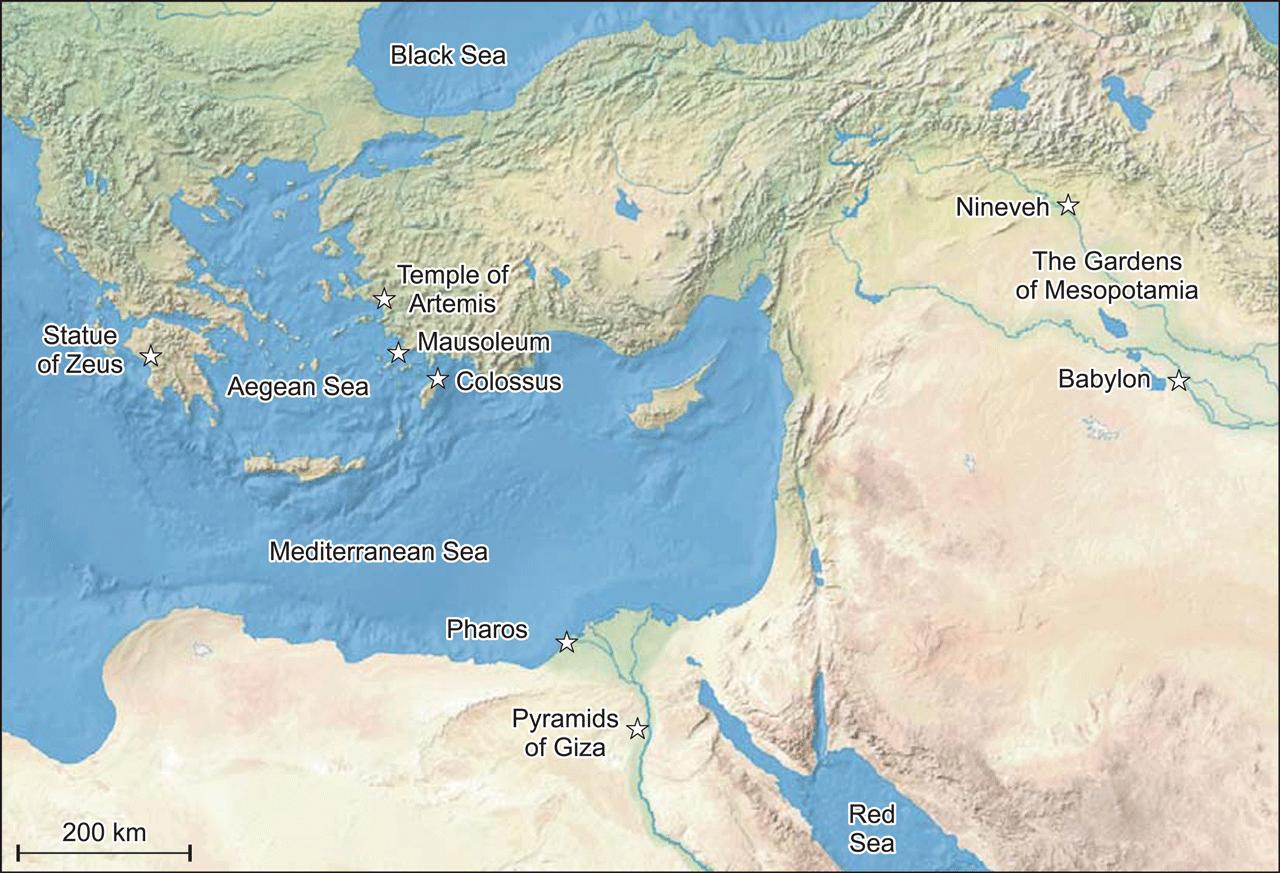
“Everyone knows of the renowned Seven Wonders of the World, but few have set eyes on them, for to do so you have to arrange a long journey to the land of the Persians on the far side of the Euphrates [the Gardens and Walls of Babylon]; you have to visit Egypt [the Pyramids of Giza]; you must then change direction and go to Elis in Greece [the Statue of Zeus at Olympia]. Then, you must see Halicarnassus, a city-state in Caria [the Mausoleum], and Ephesus in Ionia [the Temple of Artemis], and you have to sail to Rhodes [the Colossus], so that being exhausted by lengthy wanderings over the Earth’s surface, and growing tired from the effort of these journeys,
you finally fulfil your heart’s desire only when life is ebbing away, leaving you weak through the weight of years.”
This is how Philo of Byzantium thought of the Wonders: as sights or perhaps a “bucket” list of places to see before you die (Figure 11). Indeed, early compilations used the Greek word theamata, meaning “things to be seen,” but this was later changed to thaumata, “wonders.”1 A list of must-see sights for tourists may seem like a modern idea that is echoed in countless travel guides but non-essential travel has a long history.2 It may have started as pilgrimages to religious festivals along the Nile as early as 1500 bce. In the Aegean world, voyages were mostly by sea and developed later as they were at the mercy of pirates. However, by Roman times tourism was well established throughout the Mediterranean world and our earliest surviving travel guide dates from the 2nd century ce. Pausanias’s main interest was in the religious monuments of Greece, but he included many other details about legends and myths.3
Philo’s list may not seem quite right: he included the gigantic Walls of Babylon, but omitted the Pharos, maybe because he saw it only as a local attraction, having left Byzantium as a young man to live in its shadow at Alexandria, or perhaps because it stood out from the other Wonders by its practical purpose. In this book, I’ll use the familiar list, which probably dates from the European Renaissance.
Many people have tried to discover a theme that links the Seven Wonders.1,4 Some have suggested that they were initially part of a longer list of wonders from Alexander the Great’s empire and its successor kingdoms (see box 1-1: Alexander the Great and the Wonders). But it seems more likely that the Ancient Wonders were chosen for their exceptional beauty and size, as well as the engineering challenges that they represented: the Temple of Artemis at Ephesus was the largest in the Greek world; the Mausoleum, the largest tomb in the Aegean; the Colossus, the largest bronze statue; the Zeus at Olympia, the largest statue of gold and ivory; and the Pharos, the tallest building. We know little of the Hanging Gardens,
but they clearly impressed people. The Pyramids of Giza speak for themselves as they alone survive and continue to amaze travellers.
Box 1-1 Alexander the Great and the Wonders
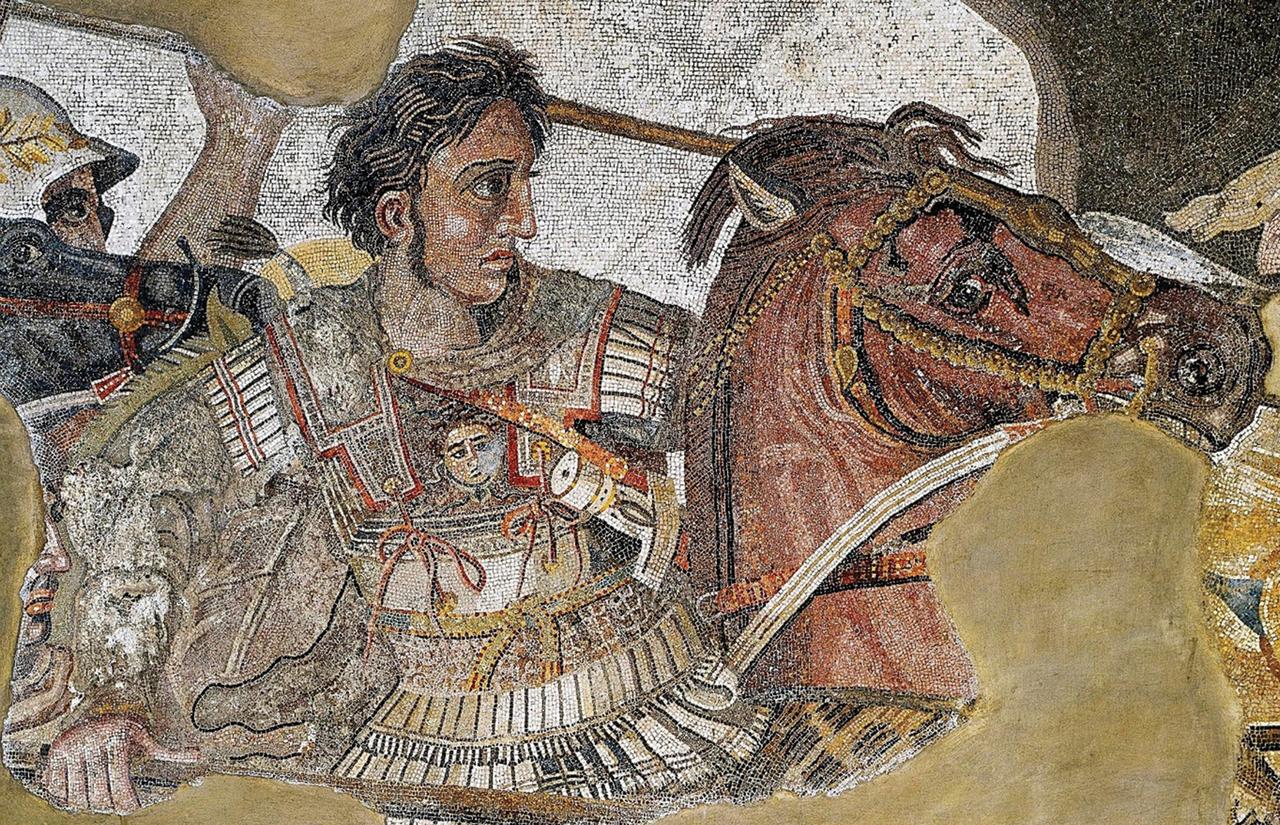
Alexander III of Macedon, later known as “the Great” by those that he had not subjugated,20 was connected to the Ancient Wonders of the canonical list (Plate 2a). In 334 bce, he set off eastwards from Macedonia to defeat the Persian Empire, a project started by his father Phillip II. His first victory was at Granicus in northwest Turkey, and from there he went south to Ephesus, where he granted autonomy to the city. The Ephesians politely refused his offer to finish the Temple of Artemis with the comment “A god cannot build a temple for another god.” His next stop was the city of Halicarnassus, where he besieged the strong walls over which the Mausoleumloomed. After that, all the cities of the region soon capitulated, including Rhodes. Forty years later the Colossus was erected, perhaps to commemorate his brief, but remote, rule: its sculptor, Chares, trained with Lysippus, Alexander’s official sculptor. In 332 bce, Alexander was in Egypt at Memphis, close to the Pyramids of Giza. From there he went to the coast to found Alexandria, where the Pharos would be constructed forty years later during the reign of his successor Ptolemy I. Alexander continued to Mesopotamia, where he won a battle near Nineveh and then proceeded to Babylon: both of these cities were associated with royal gardens, although the wondrous Hanging Gardens were long gone. He continued further eastward to the Indus valley, returning to Babylon in 324 bce, where he died in the Palace of Nebuchadnezzar II, aged thirty-two. Ptolemy I took his body to Memphis and then Alexandria, where he was buried in a magnificent tomb across the harbour from the Pharos. There was also a connection to the SanctuaryofOlympia, even though Alexander never visited the place. An unfinished monument to his father Phillip was completed there on Alexander’s orders and filled with statues of himself and his family.
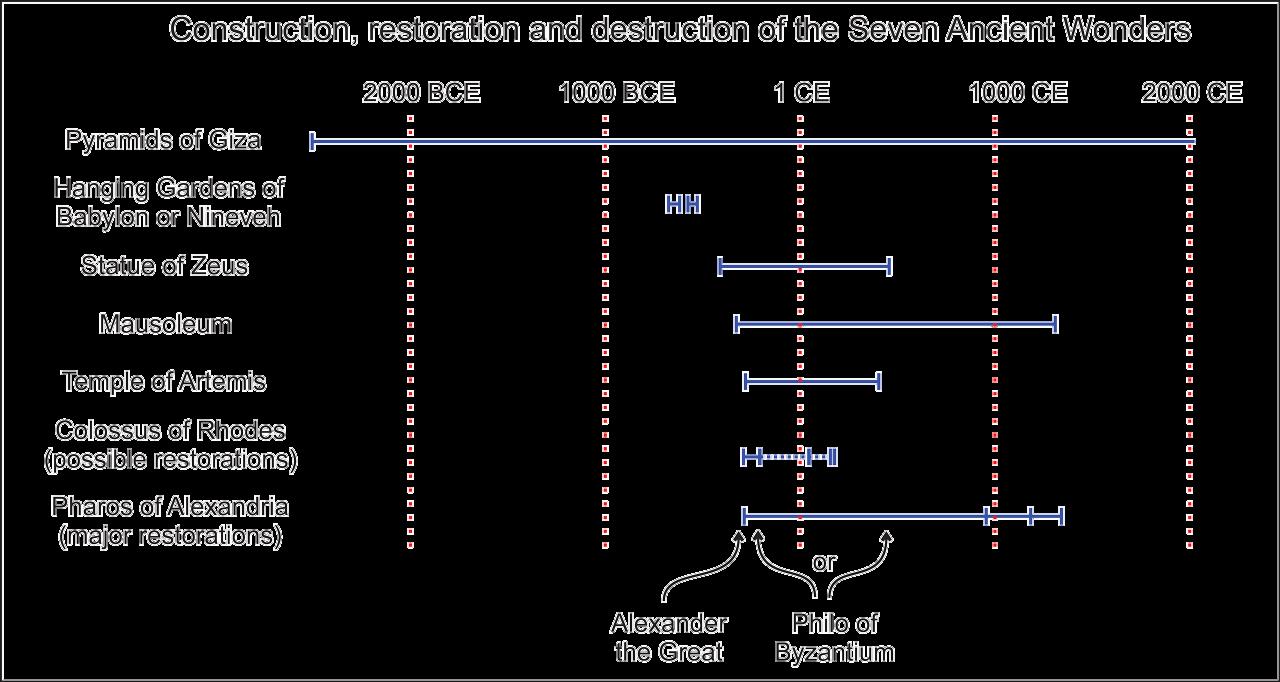
Figure 1-2: Timelines of the Ancient Wonders. Dates bce (Before Common Era) are numerically equal to bc and dates ce (Common Era) are equivalent to ad. Image by the author.
Philo speaks as if all the Wonders were extant during his lifetime, but that was not so (Figure 1-2). Although traces of the Walls of Babylon still existed, the Hanging Gardens did not, as they had a short life, perhaps that of a single ruler, long before Philo. However, subsequent rulers in Mesopotamia may have had similar gardens that were conflated into a single Wonder. The Colossus is generally thought to have fallen shortly after construction but may have been reconstructed several times, as I’ll show later. So, Philo’s journey would have been to five intact Wonders, all reasonably accessible from the Mediterranean Sea, and a difficult overland journey to see the traces, or rumours, of the remaining two. Despite the passage of time, a modern traveller could follow the same overall route but with different challenges.
Although one of the Wonders has survived more or less complete, the sorry state of the others means that they are now more symbols than artefacts, but powerful nevertheless. Their images are part of our culture and their names have been incorporated into our language, particularly the Mausoleum, Colossus, and Pharos. The
notion of the Ancient Wonders has inspired endless sevenfold lists, whose lifespan is likely to be much less than that enjoyed by those of the Ancient World.4
To understand how the Wonders were constructed, we must start with the works of ancient writers and complement this with information from archaeological excavations. Many people wrote about the Seven Ancient Wonders, but most of their texts survive only as fragments recycled in later works or even just titles in catalogues. In some ways, these works resemble traces of ancient life preserved so fragmentarily in fossils or older genetic material found in descendant organisms.
One of the most comprehensive works is that ascribed to Philo of Byzantium, quoted earlier. We don’t really know when his “De SeptemMundiMiraculis” was written or even really by whom.5 Philo of Byzantium was an engineer writing in the 3rd century bce, but the style of this manuscript is rather different from his other works, and it may have been written much later, perhaps from notes by Philo5 or by someone else as late as the 6th century ce. 6 Whoever the author, whenever it was written, all that exists today is a single copy made in the 9th century ce, unfortunately not intact: parts on the Temple of Artemis are missing as well as the entire section on the Mausoleum.
Now that I’ve chosen my cultural icons, I want to examine aspects of ancient and modern science that are pertinent to the Wonders. In this book, I use the word science in its widest sense to include science as pure knowledge, engineering as the practical application of knowledge, and technology as the realization of engineering practice. The fragments of ancient science that have been passed down to us can reveal how the Wonders were put together, and modern science can help fill the gaps in our knowledge and show how environmental changes affected the course of history.
Ancient Science in the Mediterranean Region
Much early science was founded on some aspects of practical knowledge.7 For example, Hesiod (~700 bce) wrote about chronology —specifically the seasonal appearance of the stars and phases of the moon as a guide to agricultural activities. Medicine gives us another example of the application of practical knowledge to human activities. However, wide fields of practical work, what we would call technology, were little discussed, probably because they were dirty and dangerous and hence the domain of slaves or lower-class freemen. Unfortunately, this includes many subjects of particular importance to the Wonders, such as stone and metalwork: there are many more images of artisans making metal objects as compared to such low-prestige activities as mining or smelting and few descriptions of any of these activities.
Plate 2a. Alexander the Great from a mosaic found at Pompeii dated at about 100 bce. Public Domain.
Early science and engineering changed slowly compared to today, and one factor may have been related to the availability of energy and resources.8 We now rely largely on chemical and electrical energy to power our technology, but in antiquity there was another source: slaves. Slavery was so well integrated into society that most people at the time could not imagine civilization without it. Slavery may not have been an ethical or efficient power resource, but its availability may have stifled innovation in that the easiest solution to most problems was just to use more slaves. This may be why steam power and possibly chemical batteries were known in antiquity but were regarded as toys or religious items.
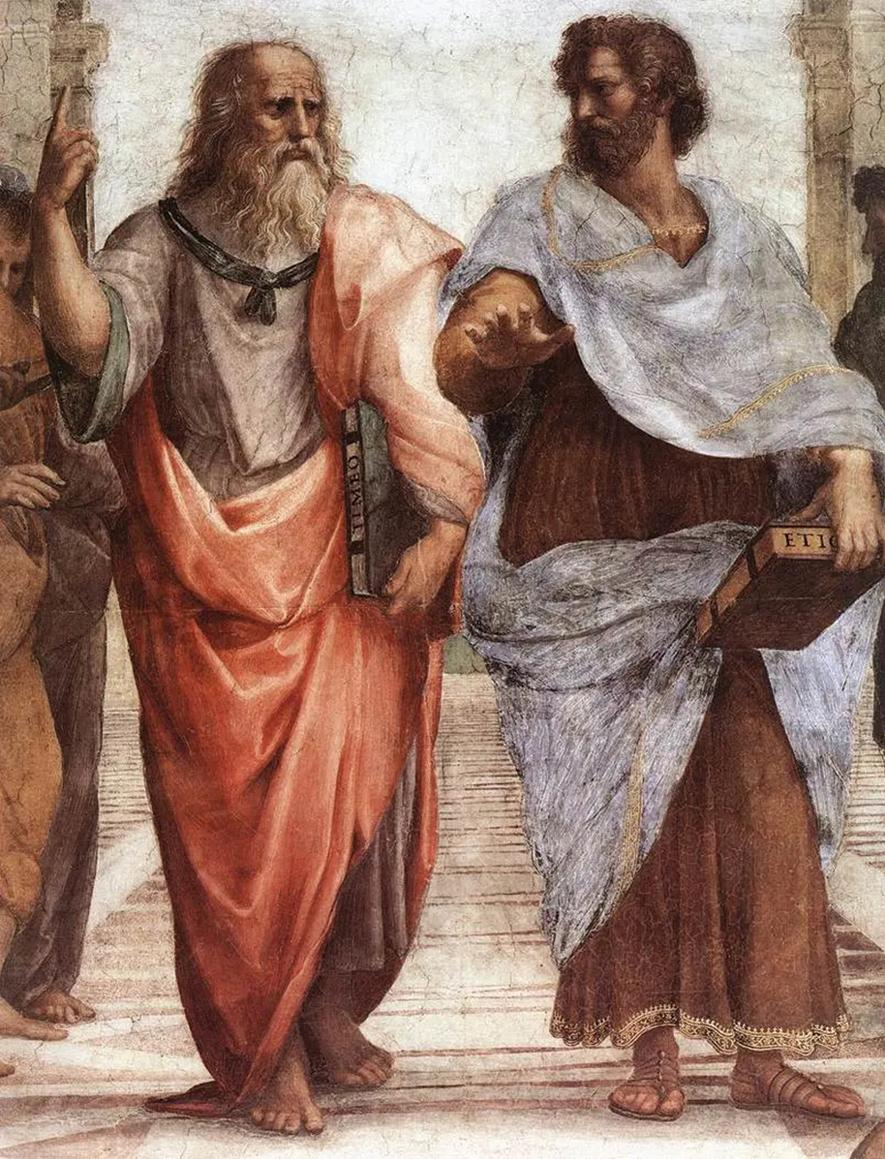
The 7th century bce saw the development of natural philosophy, the precursor of modern science. At first, this was not an exploration of practical knowledge but more an intellectual exercise into the question of how our ordered world came into being, a subject now covered by the term “cosmology.” Early ideas were based on the fundamental roles of water, air, fire, and earth, alone or in some combination. Pythagoras and Plato proposed that mathematics underlies the order of the cosmos, a theme that has come to dominate modern science (Plate 1a). However, it was Aristotle who launched the idea of evidence-based enquiry, which we know as the scientific method.
Plate 1a. The ancient Greek philosopher Plato points to the cosmos, suggesting the primordial role of mathematics, while his pupil Aristotle gestures towards the
observable world, the approach favoured in this book. From “The School of Athens,” 1509 ce, Raffaello Sanzio da Urbino. Public Domain.
In the early 3rd century bce, the centre of learning of the Mediterranean world passed from Athens to Alexandria when Ptolemy I built the great library and funded its residential college. Many scientists, mathematicians, and writers worked here, including Philo of Byzantium whom I mentioned above. They were from all over the region but their common language was Greek. The institute had its ups and downs but existed until the late 4th century ce when an edict from the emperor ordered the destruction of pagan temples, including the Temple of Serapis, which may have contained the last remaining scrolls. Although women may have studied in Alexandria, we know little about them except for Hypatia, who was active just after the destruction of the library. Her “scientific salon” may have been a meeting point for the surviving science refugees from the library. Although the library produced much knowledge, the scholars appear to have valued literature and pure science, with less interest in engineering and technology.
Although science and particularly engineering continued to advance in the Hellenistic Period and Roman Empire, the Seven Wonders were already built so these innovations are of lesser interest to us.9 However, explanations of natural phenomena and technology at this time can certainly inform us about science in earlier periods. Of particular importance is Pliny the Elder, who wrote an encyclopedia of natural history that has survived intact. I would now like to jump to modern scientific methods, which we can use to understand ancient science and environments, especially as they pertain to the Wonders.
Modern Science
Modern science started to develop about four hundred years ago following the confluence of several factors. The most important was probably the development of printing, which enabled the rapid and
widespread dissemination of knowledge, as well as its preservation from decay, fire, or religious fervour. Since that time the pace of science has increased exponentially, partly due to the increasing number of participants as well as the ease of access to information.
Much of modern science can be broadly divided into the experimental sciences of physics, chemistry, and parts of biology; and the historical sciences of astronomy, earth science, palaeontology, and archaeology. In the former, natural systems are commonly simplified so that they can be replicated in the laboratory; in the latter, the experiment or event has been completed and we have to interpret the process from the results. The historical sciences rely on a knowledge of the timing of events, hence the emphasis on chronology (see box 1-2: Scientific Chronology). Of course, this experimental/historical division is not rigid but just a description of the dominant approach used in different subjects.
Box 1-2 Scientific Chronology
Many events, such as the creation of an object or the formation of a rock, can be dated using scientific methods.21 Most methods depend on a “geological clock” that is set to zero by the event and the subsequent accumulation or loss of something that can be measured. Geologists usually make a distinction between methods for younger events, less than 50,000 years, and those for “deep time,” that is up to the age of the earth, which formed some 4,500 million years ago.
Special dating methods are applied to archaeological materials like pottery.21 For instance, nuclear particles produced by the radioactive decay of natural elements like uranium can boost the energy of electrons that may become trapped in the crystal lattice. There are several ways of releasing this energy and hence determining the age of the material. One of the best known is thermoluminescence, which is based on the emission of light when a sample is heated. Other methods can release the trapped energy
using light or can measure directly the energy of the electrons in place.
Carbon-14 is a method for dating “young” plant material, animal remains, and some cave deposits. It is based on the decay of a radioactive isotope of carbon that is formed continually in the upper atmosphere and incorporated into plants by photosynthesis. Recently, accuracy has been improved by calibration against wood samples dated independently by counting tree rings.
Igneous and metamorphic rocks, like marble, lava, and granite, are dated using radioactive isotopes that were created just before the formation of the solar system, such as uranium and potassium. Most sedimentary rocks like limestone cannot be dated exactly using these methods, and the presence of specific fossils are used instead to correlate these rocks to ones of the same age that have been dated from volcanic rocks fortuitously included in the sequence.
In this book, I want to use science to increase our understanding of the Wonders, such as their context, the materials used in their construction, and the forces that led to their damage or destruction. Another theme is the application of science to the understanding of ancient technology, very little of which was recorded. Few of the ancient workers could read or write, and it was not necessary to record their actions because it was passed on orally to other workers, commonly their children. Indeed, such information may have been tradesecretsthat were conserved within the profession.
Much of the modern science that can be applied to the understanding of the Seven Wonders is fundamentally interdisciplinary. Pure physics is not easily applicable, but geophysics can be used to examine the interior of the Pyramids. Similarly, chemistry is represented by the composition of natural materials, geochemistry, as well as anthropogenic materials like metal ingots or ceramics. One of the recurring themes is the influence of earth science, viewed in its widest possible sense, on our understanding of the Wonders.
Earth science examines our planet at all scales: from the whole globe to the atomic structure of minerals. There are many subdivisions, such as those that deal with the solid part, geophysics, geochemistry, and geoarchaeology;10 and those concerned with the fluid part, for example, hydrogeology and palaeoclimatology11 (see box 1-3: Getting Information on Ancient Climates).
Box 1-3 Getting Information on Ancient Climates
Climatic changes may have had a strong impact on many ancient cultures, including those that produced at least three of the Ancient Wonders, so how do we find out about past climates?11 First, the difference between weather and climate: climate is weather averaged over many years and for a large region. For example, a storm that causes a flood is weather, but the frequency of such events is climate. Ideally, we would like to know as much about ancient climates as we know about the weather today, but that is not possible—the best we can usually get is a record of mean temperatures and rainfall. We can get both global and local information on past climates from continuous natural records. There are many ways that we can use to investigate ancient climates and I’ll only mention the most important.
One of these records, for the last few million years, come from microscopic fossils preserved at the bottom of the oceans and sampled in deep-sea cores. These organisms lived at the surface and preserve a record of the isotopic composition of seawater at that time, which can tell us about the amount of glacial ice on land and hence the global sea level and temperature (see box 6-6: Sea Level and Cultural Developments).
Ice cores from glaciers give records of the atmospheric conditions during the last few hundred thousand years. It may seem contra-intuitive, but there is a connection between the extreme climate of these places and that elsewhere on the planet. The deposition temperature of the ice is recorded by the isotopic composition of hydrogen and oxygen in the ice, and air bubbles
caught in the ice give us samples of the atmosphere, including its carbon dioxide content. Atmospheric pollution, such as lead from smelting during Roman times, is also preserved in the ice. Finally, layers of volcanic ash can bear witness to major eruptions, such as that of Thera, Greece, in ~1600 bce.
Limestone deposits in caves, such as stalagmites, stalactites, and flowstones, can tell us about local climates (see Chapter 3: Water Supply). Rain or snow falls on the surface and percolates downwards dissolving carbonate minerals from limestone or marble. When the water reaches a cave, carbon dioxide is lost to the atmosphere provoking crystallization of carbonate minerals. If there is an important seasonality of rainfall, then a distinct layer will form each year. The age of these layers can be determined by counting for young deposits still in place and by using isotopic methods like carbon-14 or uranium-series for older or collapsed material. The width of layers can tell us about the amount of rainfall in that year, and their isotopic composition can provide the average atmospheric temperature.
Recent climate information can be derived from wood. Many species of trees lay down annual rings and their width can tell us about the rainfall in that year. The isotopic composition of the wood can tell us about the temperature. We can extend the record further by matching tree-ring width sequences from living trees to dead trees or cut lumber.
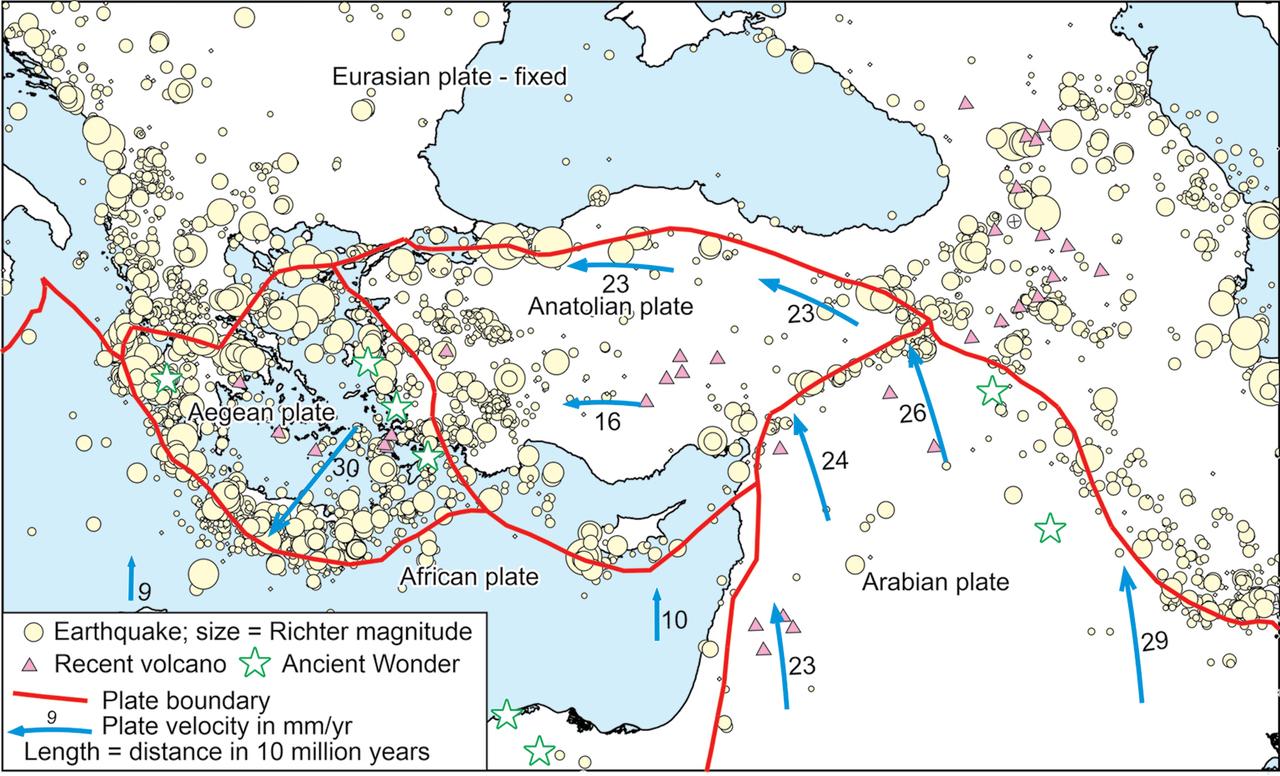
The vast range of landforms and rocks on earth initially meant that we did not have a clear vision of the large-scale functioning of our planet, but this changed with the development of the theory of Plate Tectonics in the 1970s, enabling us to link deep earth processes with surface observations. This theory proposes that the earth is covered with a generally rigid shell about 150 kilometres thick, which “floats” on a hotter and weaker interior. This shell is composed of about fourteen large plates, and many smaller ones, each of which moves independently from its neighbours (Plate 1b).12 Geological activity, such as earthquakes, volcanoes, and mountain
building occur more frequently along plate boundaries. Four or five of the Wonders were built close to these places.
Plate 1b. Tectonic plate boundaries, earthquakes, and volcanoes of our region. Image by author after Bird, P., 2003, “An Updated Digital Model of Plate Boundaries.” Geochemistry, Geophysics, Geosystems 4(3): 1027.
Earth science is linked inextricably and inevitably with culture and civilization: even the other name of the discipline, geology, links gē, the earth, with logos, knowledge and culture. Earth processes shaped the conditions that gave rise to the advanced social organization and wealth required for the construction of the Seven Wonders.13 Climate, water, and soils—all partly controlled by these same earth processes—determined agricultural productivity, which in turn, sustained populations large enough to provide the labour and wealth over and above immediate survival needs. Earth processes provided the resources needed for construction: stone, metals, water, and other materials. The adage “If you can’t grow it, you have to mine it” comes to mind. Finally, construction was financed in
some cases by trade, which was facilitated or hindered by regional geography.
The American historian Will Durant said that “Civilization exists by geological consent, subject to change without notice,”14 to which recent experiences suggest that we should add “biological consent”: the Wonders were not immune to either force. Earthquakes, aided and abetted by other processes, both natural and human, often took a lead role in their demise. Ironically, geological processes also helped protect the remains of some Wonders, by burying them and thus reducing the opportunity for plunder by later peoples. All these things happened long before our lives and I’d like to return to the theme of time.
Earth science gives us a view into the unimaginably distant past, where the unit is commonly a million years. This necessitates a world view that has been called Timefulnessby Marcia Bjornerund.15 She comments that “A recurrent theme [in earth history] is that long periods of planetary stability have ended abruptly . . . when rates of environmental change outpaced the biosphere’s capacity to adapt.” I think that this idea can be extended to our human timescale— societies can be stable for long periods, but this ends when they are unable to adjust sufficiently fast to environmental changes. The downfall of such civilizations was not necessarily brought on directly by events like rapid climate changes, pandemics, or earthquakes but may have been mediated by invasions of people from outside the affected region. Many aspects of the Wonders’ story express such events.
Geomyths
Finally, I would like to mention that some legends, myths, and stories in ancient literature may reflect observations of events that can be interpreted as actual geological phenomena, although they may have been conflated, transposed in time, and moved in space to satisfy the requirements of a narrative.16,17 Geomyths enter into the story of five of the Ancient Wonders.
Many such geomyths concern catastrophic events such as volcanic eruptions, earthquakes, tsunamis, fires, and floods. A popular example is the biblical story of the Exodus (13:21): “Now the Lord was going before them by day in a pillar of cloud to lead them in the way, and by night in a pillar of fire to give them light, so that they could travel day or night.” This has been interpreted as a description of the 35-kilometre-high column of volcanic ash from Thera (Santorini) Volcano during a catastrophic eruption in ~1600 bce. Similarly, the subsequent inundation of the Pharaoh’s army could be interpreted as a tsunami produced by the eruption.
Less disruptive geological phenomena may have been behind other geomyths: for instance, fossil bones of mastodons and other huge animals of the Pleistocene period (2.6 million to 12 thousand years ago) are frequently found in Greece and may have inspired legends of an ancestral race of humanoid giants.18
However, we should be careful as to what constitutes a geomyth and exclude pre-human events that cannot be based on ancient observations, such as the story related by Pliny the Elder concerning the two hills flanking the Gibraltar Strait—the Rock of Gibraltar and Jebel Musa. “. . . the inhabitants have called them the Pillars [Columns] of Hercules; they believe that they were dug through by him; upon which the sea, which was before excluded, gained admission, and so changed the face of nature.” This legend is not a geomyth as there could not have been any human observers—the strait was breached more than five million years ago.19 It should perhaps be considered an observation and possible poetic explanation, with nature personified as a supernatural being.
I have now set the stage for my book: the cultural icons are those chosen by the ancients for their beauty and size. Obviously, I have had to select what aspects of science, engineering, and technology I treat and have been guided by what seemed to be most important, but inevitably my personal interests have intervened. In the following chapters, I will treat the Wonders in chronological order of their construction.