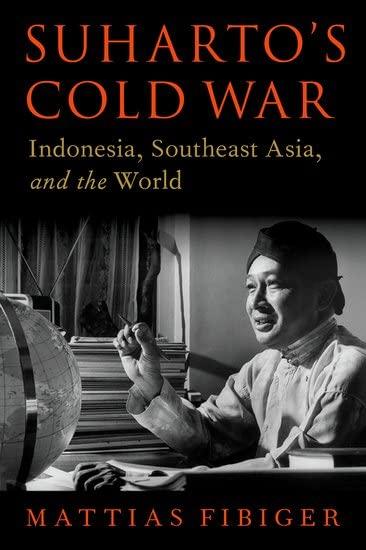
Suharto’s Cold War
Indonesia, Southeast Asia, and the World
MATTIAS FIBIGER
Oxford University Press is a department of the University of Oxford. It furthers the University’s objective of excellence in research, scholarship, and education by publishing worldwide. Oxford is a registered trade mark of Oxford University Press in the UK and certain other countries.
Published in the United States of America by Oxford University Press 198 Madison Avenue, New York, NY 10016, United States of America.
© Oxford University Press 2023
All rights reserved. No part of this publication may be reproduced, stored in a retrieval system, or transmitted, in any form or by any means, without the prior permission in writing of Oxford University Press, or as expressly permitted by law, by license, or under terms agreed with the appropriate reproduction rights organization. Inquiries concerning reproduction outside the scope of the above should be sent to the Rights Department, Oxford University Press, at the address above.
You must not circulate this work in any other form and you must impose this same condition on any acquirer.
CIP data is on file at the Library of Congress
ISBN 978–0–19–766722–4
DOI: 10.1093/oso/9780197667224.001.0001
Printed by Integrated Books International, United States of America
Portions of the manuscript are adapted from: Mattias Fibiger, “A Diplomatic Counterrevolution: Indonesian Diplomacy and the Invasion of East Timor,” Modern Asian Studies 55, no. 2 (March 2021): 587–628.
Copyright © The Author(s) 2020. Published by Cambridge University Press. Reprinted with permission.
Mattias Fibiger, “The Nixon Doctrine and the Making of Authoritarianism in Island Southeast Asia,” Diplomatic History 45, no. 5 (November 2021): 954–982. © The Author(s) 2021.
Published by Oxford University Press on behalf of the Society for Historians of American Foreign Relations. All rights reserved.
For Maggie
CONTENTS
Acknowledgments ix
Note on Spelling, Names, and Translation xiii
Abbreviations xv
Introduction 1
1. The Path to Power 17
2. In the Shadow of Vietnam 46
3. A New Order 66
4. An Anti-Chinese Axis 104
5. Internationalizing Counterrevolution 129
6. Capital and Consolidation 160
7. The Travails of Development 187
8. The Age of Oil 216
9. Realignments 251
Conclusion: Indonesia, Southeast Asia, and the World 277
Notes 287 Index 349
ACKNOWLEDGMENTS
I owe an enormous debt of gratitude to the people and institutions who made the publication of this book possible.
Thanks must be given first to an extraordinary group of mentors. I began this book as a dissertation at Cornell University. Fredrik Logevall was a sterling doctoral advisor who set a model for incisive thinking and elegant writing. His guidance, support, and good humor was nothing short of invaluable. Chen Jian introduced me to the craft of international history and pushed me to situate my arguments in a global context. Eric Tagliacozzo encouraged me to think across the borders of postcolonial Southeast Asia and about the longue durée. And Tom Pepinsky embodied an unusual combination of rigor and generosity in introducing me to the field of comparative politics. I hope to live up to the stellar scholarly examples they set.
I was inspired to pursue an academic career by my professors at the University of California, Santa Barbara. Tsuyoshi Hasegawa first ignited my intellectual interests and helped me find purpose in academic work. Salim Yaqub taught me how to think like a historian, how to conduct research in an archive, and how to navigate university life. Laura Kalman showed me the power of history to captivate. I owe them more than they can ever know.
An exemplary array of language teachers helped me acquire the faculties necessary to write this book. At Cornell, Jolanda Pandin and Maria Theresa Savella guided me through the early stages of learning Indonesian and Tagalog with unfailing grace. Maraming salamat po and terima kasih banyak. At Universitas Negeri Malang, Peni Anggari (mendiang), Az’ Arie Bachtiar, Basori, Elva Maharani, and Agnes Aisyah Suprihatin taught me how to operate in bahasa jalanan rather than bahasa diplomasi. I am grateful to them all.
I transformed a rather unwieldy dissertation into a more cohesive book after joining the Business, Government, and International Economy Unit at Harvard Business School. HBS provided the time and resources necessary to
reconceptualize and rewrite the entire manuscript. The trial by fire in global political economy that all new faculty members in the BGIE Unit endure also led me to rethink many of my key arguments and made the book immeasurably stronger. I thank all my colleagues for creating such a rich intellectual atmosphere. In addition, Jeremy Friedman, David Moss, Sophus Reinert, Meg Rithmire, and Dick Vietor read parts or all of the manuscript and offered insightful critiques and suggestions. The support staff in the BGIE Unit, especially Sarah Antommaria, provided invaluable logistical assistance.
A wider network of scholars helped shape the ideas in the book. I thank the members of my graduate cohort at Cornell, Kaitlin Pontzer, Ai Baba, Nicholas Bujalski, Shiau-Yun Chen, Kyle Harvey, Jason Kelly, Matthew Minarchek, Margaret Moline, Joshua Savala, and Osama Siddiqui. Also at Cornell, Fritz Bartel, Sean Fear, Christopher Tang, Brian Cuddy, Hoang Vu, Nathaniel Rojas, and Taomo Zhou shared ideas on international history. In Cambridge, I have benefited from conversations with and advice from William Kirby, Erez Manela, Jay Rosengard, Lou Wells, Arne Westad, and many attendees at various talks and seminars. I also thank Mark Atwood Lawrence, Jana Lipman, Wen-Qing Ngoei, Lien-Hang Nguyen, Bradley Simpson, and audience members at myriad conferences and workshops for offering commentary on various chapter drafts that improved the book.
For financial support that enabled me to conduct archival research, I thank the Social Science Research Council, the Judith Reppy Institute for Peace and Conflict Studies, and the Division of Research and Faculty Development at Harvard Business School. A Critical Language Scholarship from the United States Department of State facilitated language study. Universitas Indonesia and Universiti Malaya offered affiliations that allowed me to obtain research visas.
Thanks are due to myriad archivists at the national archives of Australia, Indonesia, Malaysia, the United Kingdom, and the United States; the presidential libraries of Gerald Ford, Richard Nixon, and Ronald Reagan; the Carlos Romulo Library; the World Bank and the International Monetary Fund; the Rockefeller Archive Center, the Minnesota State Historical Society, and the Hoover Institution; and the special collections reading rooms at Columbia University, Cornell University, Harvard University, the University of the Philippines at Diliman, and the University of California, Berkeley. Nadia Esham, Margaret Kenna, and Fitria Sis Nariswari provided outstanding research assistance tracking down documents after my departure from various archives. Isabelle Lewis made beautiful maps.
It was a distinct pleasure to work with Susan Ferber and Oxford University Press. Susan’s keen eye for everything from indelicate phrasing to incomplete thinking rescued me from mistakes both large and small. For her editorial judgment and consummate professionalism, she has my enduring gratitude.
I also thank the reviewers for OUP whose trenchant commentary bettered the manuscript.
My foremost debts are to my loved ones. My parents always taught me to pursue what I love, and that lesson led me to the position of thanking them here. I owe them everything. My siblings Kate, Dan, Piers, and Tor are an endless source of inspiration and laughter. I have treasured every moment with them and with my wider family: Greg Stephan, Gail Plecash, Kyle Melvin, Anna Melvin, Sophie Melvin, Emmett Melvin, Lauren Hurst, Neve Fibiger, Kai Fibiger, Lauren Capozzi, Jordan Tetreau, Easton Tetreau, Krista Capozzi, Scott Moline, Jayne Moline, Dan Moline, and Anna Staudacher.
And then there is Maggie. She came into my life when this book was no more than an idea. Over the course of its path from inception to publication, she read every word and discussed every idea. But the book’s journey paled in comparison to our own. We built a home, a life, and as this book came into being we learned we would be building a family as well. Words cannot capture the love and energy she devoted to our journey together. Through it all she tolerated my absence when I was traveling to far-flung archives and my presence when I was sulking about writer’s block. She has my gratitude, my admiration, and my love—always. This book is dedicated to her.
NOTE ON SPELLING, NAMES, AND TRANSLATION
The orthographic system governing the Indonesian language underwent significant changes during the years covered in the narrative ahead. In 1947, the Dutch-influenced oe was simplified into the Indonesian u (goeroe into guru) and the glottal stop indicated by ’ was denoted with k (ra’jat into rakjat). In 1972, the Suharto regime implemented a “perfection” of Indonesian spelling that shifted tj into c (tjatatan into catatan), dj into j (Djakarta into Jakarta), j into y (rakjat into rakyat), nj into ny (banjak into banyak), sj into sy (masjarakat into masyarakat), and ch into kh (achir into akhir). In quotations and citations, I have preserved the spelling of words as they were written in the documents in question.
Indonesians were free to maintain or alter the spelling of their names as they saw fit. Thus the man born Soemitro Djojohadikoesoemo became Sumitro Djojohadikusumo in 1947 but not Sumitro Joyohadikusumo in 1972. In the text, I have adopted the newest orthography for most names for the sake of simplicity. Most notably, I use Suharto even though the man preferred Soeharto. I have made exceptions for names that are almost exclusively rendered in the old orthography, such as William Soeryadjaya and the aforementioned Sumitro Djojohadikusumo. Most Indonesians do not have a family name, and many have only one name. I therefore use the name by which they were most commonly known rather than the final part of their name. For example, while I refer to Ali Murtopo as Murtopo, I refer to Alamsjah Ratu Perwiranegara as Alamsjah. In quotations and citations, I have preserved the spelling of names as they were rendered in the documents in question. Occasionally this includes a practice whereby the initial Su- prefix common in Javanese names is dropped and an honorific Bapak/Pak, Bang/Bung, or Ibu/Bu is added. For instance, Suharto was often referred to as Pak Harto.
Indonesian newspapers changed their names in accordance with new regulations surrounding spelling, meaning the military newspaper Angkatan
Bersendjata became Angkatan Bersenjata. In quotations, citations, and the text, I have preserved the spelling of newspapers as they were rendered at the time. Many Indonesian place names have changed as well. For example, the city of Ujung Pandang was renamed Makassar. I have adopted the most recent name for all place names. I refer to the western half of the island of New Guinea (variously known in Indonesia as West Irian, Irian Jaya, and Papua) as West Papua to differentiate it from Papua New Guinea on the eastern half of the island. In quotations and citations, I have preserved the names of places as they were rendered in the documents in question.
Unless otherwise noted, all translations are my own.
ABBREVIATIONS
ABRI Armed Forces of the Republic of Indonesia
Apodeti Timorese Popular Democratic Association
ASA Association of Southeast Asia
ASDT Timorese Social Democratic Association
ASEAN Association of Southeast Asian Nations
Askrindo PT Asuransi Kredit Indonesia
Aspri Personal Assistants
Bakin State Intelligence Coordinating Body
Bappenas National Development Planning Agency
BE Export Bonus
Berdikari Standing on One’s Own Feet (Self- Sufficiency/Autarky)
BKK Campus Coordinating Body
BKPM Investment Coordinating Board
BPI Central Intelligence Board
BSDU Barrio Self-Defense Unit
Bulog National Logistics Board
Caduad Army General Reserve
CPP Communist Party of the Philippines
CSIS Center for Strategic and International Studies (Jakarta)
DAP Democratic Action Party
Dekon Economic Declaration
DNU Department of National Unity
DPR People’s Representative Council (“Parliament”)
DPR-GR People’s Representative Council–Mutual Cooperation
FBSI All-Indonesia Labor Federation
Fosko Forum for Study and Communication
Fretilin Revolutionary Front for an Independent East Timor
G-30- S/PKI September Thirtieth Movement/Communist Party of Indonesia
GAM Free Aceh Movement
GBHN Broad Outlines of State Policy
Gerakan Malaysian People’s Movement Party
Golkar/
Sekber Golkar Functional Groups/Joint Secretariat of Functional Groups
Golput White Group
GPII Indonesian Islamic Youth Movement
Hankam Ministry of Defense and Security
Hankamrata Total People’s Defense and Security
ICCS International Commission of Control and Supervision
ICHDF Integrated Civilian Home Defense Forces
IGGI Inter-Governmental Group on Indonesia
IMF International Monetary Fund
IPC Investment Promotion Council
IPKI League of Upholders of Indonesian Freedom
ITB Bandung Institute of Technology
Kadin Chamber of Commerce and Industry
KAGI Indonesian Teacher Action Front
KAK Anti-Corruption Committee
KAMI Indonesian Student Action Front
KAP-Gestapu Action Command to Crush the September Thirtieth Movement
KAPPI Indonesian High School Student Action Front
KASI Indonesian Scholar Action Front
KAWI Indonesian Women Action Front
KBL New Society Movement
Kesban Security and Development
KIK Small Investment Credit
KIN State Intelligence Command
Kista Special Course
KMKP Permanent Working Capital Credit
KNIL Royal Netherlands Indies Army
KNPI National Indonesian Youth Committee
Kogam Crush Malaysia Command
Kopassandha Secret Warfare Command
Kopkamtib Operational Command for the Restoration of Security and Order
Kostrad Army Strategic Reserve Command
Koti Supreme Operations Command
Lemhannas National Resilience Institute
LNG Liquefied Natural Gas
MAF Malaysian Armed Forces
Mahmillub Extraordinary Military Tribunal
Malari January Fifteenth Catastrophe
Manipol Political Manifesto
MAP Military Assistance Program
MCA Malaysian Chinese Association
MFA Armed Forces Movement
MIC Malaysian Indian Congress
MM Students Accuse
MNLF Moro National Liberation Front
MPR People’s Consultative Assembly (“Assembly”)
MPRS Provisional People’s Consultative Assembly
MUI Indonesian Ulama Council
Nasakom Nationalism-Religion-Communism
NCC National Consultative Council
NEDA National Economic and Development Authority
Nekolim Neocolonialism, Colonialism, and Imperialism
NIEO New International Economic Order
NKK Normalization of Campus Life
NOC National Operations Council
NPA New People’s Army
NSC National Security Council
NU Nahdlatul Ulama
OIC Organization of the Islamic Conference
OPEC Organization of Petroleum-Exporting Countries
Opsus Special Operations
P4 Directive for the Realization and Implementation of Pancasila
PAP People’s Action Party
Parmusi Muslim Party of Indonesia
PAS Pan-Malaysian Islamic Party
PDI Indonesian Democratic Party
Permesta Charter of Universal Struggle
Peta Homeland Defense Force
PIBA Pacific Indonesia Business Association
PKI Communist Party of Indonesia
PKP Partido Komunista ng Pilipinas
PNI Indonesian Nationalist Party
Polkam Council on Political Stabilization and National Security
PPP
United Development Party
PRRI Revolutionary Government of the Republic of Indonesia
PSI Socialist Party of Indonesia
Repelita Five-Year Development Plan
RPKAD Army Paracommando Regiment
SEAARC Southeast Asian Association for Regional Cooperation
SEATO Southeast Asia Treaty Organization
Spri Personal Staff
SRI Stanford Research Institute
SSKAD/Seskoad Army Staff and Command School
Supersemar Order of March Eleventh
Trikora Three Commands of the People
Tritura Three Demands of the People
UDT Timorese Democratic Union
UMNO United Malays National Organization
Wanhankamnas
National Defense and Security Council
Suharto’s Cold War
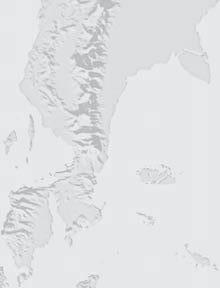
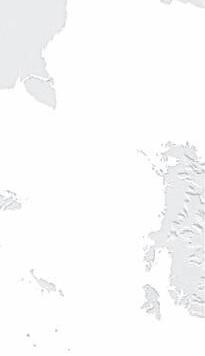
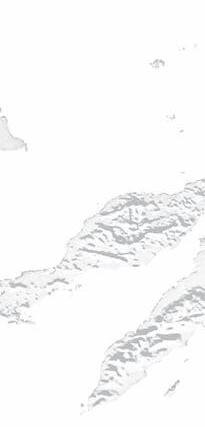
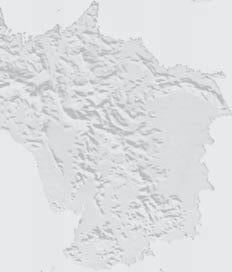
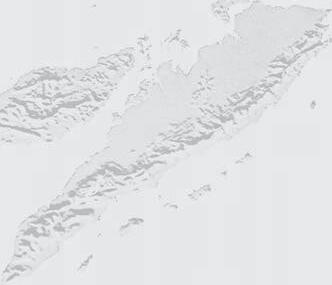
Indonesia in 1970
Introduction
An atmosphere of crisis enveloped Jakarta over the course of 1965. Indonesian society seemed to be coming apart at the seams, and denizens of the capital sensed an impending climax. But General Suharto was preoccupied by other matters on the morning of October 1. He had spent the evening at the hospital caring for his three-year-old son, who had suffered serious burns in a kitchen accident a few days earlier.1 It was after midnight by the time Suharto went home to care for his infant daughter. At half past four, he was awoken by a knock on the door by a cameraman for the national television station. The man was returning from an overnight film shoot and said he had heard gunfire at several locations across the capital. Distracted and exhausted, Suharto “didn’t give much thought” to the news. Half an hour later, a neighbor knocked at the door and announced that he too had heard gunshots. Suharto felt a pang of anxiety. Two more visitors arrived in rapid succession. One reported that a handful of senior army officers had been kidnapped. Another revealed that troops had taken up positions near the presidential palace, situated on the north side of Merdeka Square in central Jakarta. Suharto donned his uniform and climbed into a vehicle. Alone, he drove toward his office at the headquarters of the Army Strategic Reserve Command (Kostrad), located on the east side of Merdeka Square about half a mile from the palace. As he approached the Kostrad building, he looked across the square and saw the mysterious troops for himself. The long-awaited climax had arrived.2
But the nature of the events unfolding around Suharto remained unclear. Who were the troops occupying the square? What had happened to the leaders of the army? And where was President Sukarno? Shortly after Suharto arrived at Kostrad, the national radio station broadcast a ten-minute statement by Lieutenant Colonel Untung, a commander in the president’s palace guard. Untung explained that he led a group called the September Thirtieth Movement that had arrested several army leaders. He accused the movement’s captives of belonging to a “Council of Generals” that was allegedly working with the
Suharto’s Cold War. Mattias Fibiger, Oxford University Press. © Oxford University Press 2023. DOI: 10.1093/oso/9780197667224.003.0001
Central Intelligence Agency (CIA) to overthrow Sukarno. Untung reassured his listeners that the president and other key political figures were under the September Thirtieth Movement’s “protection.” He announced that the movement would take immediate action against “agents and sympathizers of the Council of Generals” across Indonesia. An “Indonesian Revolution Council” would be established and wield broad executive authority. Untung’s statement stressed that the September Thirtieth Movement was “solely a movement within the Army directed against the Council of Generals.”3 But Suharto remembered Untung as a “disciple” of Alimin, a former chief the Communist Party of Indonesia (PKI). The party had twice before staged revolutionary uprisings, first in 1926 and again in 1948, and the kidnappings and formation of a revolutionary council pointed unmistakably in the direction of a coup. Suharto concluded that the September Thirtieth Movement represented nothing less than an attempt by the PKI to “seize the power of the state by force.”4
Whether the events of October 1, 1965, did amount to a coup attempt remains unknown. Precisely what transpired that morning, who exactly was behind the plot, and what the plotters intended cannot be definitively answered over a half-century later.
This much is clear: in the early morning hours, teams of soldiers climbed into jeeps at Halim Perdanakusuma Air Force Base on the southern outskirts of Jakarta and rumbled toward the homes of seven of Indonesia’s most senior generals in the city center. They attempted to kidnap the generals, but their plan quickly went awry. Three of the movement’s seven targets were killed and another escaped. The conspirators then brought captives and corpses alike to an uninhabited rubber grove called Lubang Buaya near Halim. They shot the living and interred all the bodies in a derelict well, which they covered with branches and leaves.
As these murders were carried out, troops loyal to the September Thirtieth Movement occupied Merdeka Square, the symbolic seat of political power in central Jakarta. In the center of the square sat the half-finished National Monument, a tall obelisk symbolizing the country’s independence struggle, its construction halted amid an ongoing economic crisis. Along the square’s borders lay the key installations of the Indonesian state: not only the presidential palace and the Kostrad building but also the headquarters of the army, the ministry of defense, the telecommunications building, and the national radio station. Curiously, the troops occupying the square numbered only about 1,000—a tiny fraction of the total number of Indonesian soldiers in Jakarta that morning. The radio station soon began issuing bizarre broadcasts stating that Sukarno’s existing cabinet would be “decommissioned” and all ranks above lieutenant colonel would be abolished.5
Back at Halim, Untung and his military co-conspirators remained in hiding in a small house. Also on the grounds of the base, in another house less than a mile
away, were the PKI leader Dipa Nusantara Aidit and several close aides from the party’s shadowy Special Bureau. They were soon joined by none other than Sukarno, who had spent the night at the home of one of his wives and was not in fact under the September Thirtieth Movement’s protection. After he heard Untung’s initial radio broadcast, the president traveled to Halim, where his plane was on permanent standby in case he needed to make a quick escape from the city. Upon arriving at the base, Sukarno met with one of Untung’s subordinates. The president ordered a halt to all violent actions, appointed a loyalist as “caretaker” of the army, and summoned a crowd of deputies to Halim, including the commanders of the navy, police, and palace guard. The nationalist hero seemed unfazed by the cascade of events. “This kind of thing will happen in a revolution,” he mused.6
The drama of October 1 seeded a litany of historical mysteries. Why would the architects of the September Thirtieth Movement neglect to target Suharto, who was in Jakarta and in command of a considerable number of Kostrad troops? Why would the plotters’ radio broadcasts describe the movement as an effort to protect Sukarno and then announce the dissolution of the president’s cabinet and the formation of an alternative government in which Sukarno was apparently uninvolved? Why would the movement’s ostensible leaders remain hidden in two separate houses at Halim—isolated from each other, from their troops, and from the public? Why would the leaders of the PKI move to upend a political system that had proved so hospitable to the expansion of communist influence? Whoever masterminded the plot and whatever their ultimate purpose, the September Thirtieth Movement was either so poorly conceived or so shoddily implemented as to be almost incomprehensible in hindsight.7
Suharto responded decisively to the chaos. As he later recounted to an American journalist, “I realized the Army was in danger and I decided to assume leadership.”8 He called the officers in command of the troops occupying Merdeka Square to Kostrad headquarters. He told the mutineers that their actions amounted to a revolt and ordered them to surrender. One of the battalions occupying the area laid down their arms in the early afternoon. The other battalion fled to Halim. Troops loyal to Suharto recaptured the critical infrastructure surrounding the square by early evening. Once the radio station was secured, Suharto took to the airwaves to denounce the September Thirtieth Movement and inform the Indonesian public that “the general situation is again under control and security measures are being actively carried out.”9 Suharto then turned his attention to the air force base. He refused to allow any army officials, including the man Sukarno appointed caretaker of the army, to answer the president’s summons. Instead, Suharto sent a courier to Halim to order the president to leave the area—a remarkable feat of insubordination that portended a political struggle.10 Late that evening, crack Army Paracommando